Present and future of the study on Korean land planarians (Platyhelminthes: Tricladida: Geoplanidae)
ABSTRACT
To date, two species of land planarians, Diversibipalium koreense (Frieb, 1923) and Microplana unilineata (Frieb, 1923), have been recorded for the Republic of Korea. Meanwhile, various morphotypes of land planarians were discovered during the terrestrial invertebrate sampling campaign conducted in 2020, predicting that many species may inhabit the country. Accordingly, we initiated an international collaborative research in 2021 to elucidate the biodiversity of land planarians in the country and to document each species. We grouped more than 70 specimens collected from 2020 to 2022 into 22 morphospecies based on their external appearance. Subsequently, we tested the morphospecies independently in a molecular phylogeny inferred from the mitochondrial COI gene. Maximum likelihood (ML) analysis suggests that the 22 morphospecies are assigned to each clade as follows: (1) Bipaliinae (15 spp.), (2) Microplaninae (6 spp.), and (3) Rhynchodeminae (1 sp.). The Assemble Species by Automatic Partitioning (ASAP) analysis predicted that there would be 14 species of Bipaliinae instead of 15, reducing the number of putative species to 21. As previous sampling campaigns have only covered a small portion of the Republic of Korea, the expected number of species should be much higher. We hope that this international collaboration will continue to help reveal the true richness of Korean land planarians.
KEYWORDS:
ASAP; COI; molecular phylogeny; Republic of Korea; richness
INTRODUCTION
Geoplanidae Stimpson, 1858, land planarians, are a family of free-living Platyhelminthes with the necessary adaptations for a terrestrial lifestyle, currently divided into four subfamilies: Bipaliinae von Graff, 1896, Geoplaninae Stimpson, 1857, Microplaninae Pantin, 1953 and Rhynchodeminae von Graff, 1896. They are mainly found in natural habitats under rotten trees, leaves and stones. And sometimes they are found under bricks, plastic, trash, especially damp wood around human habitation (Tyler et al. 2006-2024, Winsor 1998). They are the top predators in terrestrial ecosystems and were suggested as an indicator taxon in biodiversity and conservation studies because of their biological traits and habitat needs (Ogren 1995, Jones and Cumming 1998, Sluys 1999, Prasniski and Leal-Zanchet 2009). Certain species have been introduced in different regions around the world, adversely affecting some areas (Jones et al. 2001, Ducey et al. 2007, Sugiura 2009, Iwai et al. 2010, Justine et al. 2014, 2020, 2022, Sluys 2016, Brown et al. 2022, De Luna and Boll 2023). Therefore, research on their diversity and accurate taxonomic identification is fundamentally necessary to identify which species have a positive or negative impact on terrestrial ecosystems. Currently, most of the research on land planarians has been carried out by European and South American researchers (e.g., Carbayo et al. 2016, Negrete et al. 2019, Rossi et al. 2019, Araujo et al. 2020, Lago-Barcia et al. 2021, 2023, Negrete et al. 2021, Almeida et al. 2022, 2023 Grau et al. 2022, Solà et al. 2023). On the other hand, there has been no domestic researchers on land planarians in the Republic of Korea until now. To date, there are two land planarian species known in the Republic of Korea as follow: Diversibipalium koreense (Frieb, 1923) and Microplana unilineata (Frieb, 1923). Meanwhile, various morphotypes of land planarians were discovered during the terrestrial invertebrate sampling campaign conducted by J-HS in 2020, predicting that many species may inhabit the Republic of Korea. Consequently, we began an international collaborative research in 2021 to elucidate the biodiversity of land planarians in the Republic of Korea and to document each species. Herein we provide the results of a molecular analysis of the material sampled to infer the richness of land planarians collected from the Republic of Korea in the period 2020-2022.
MATERIAL AND METHODS
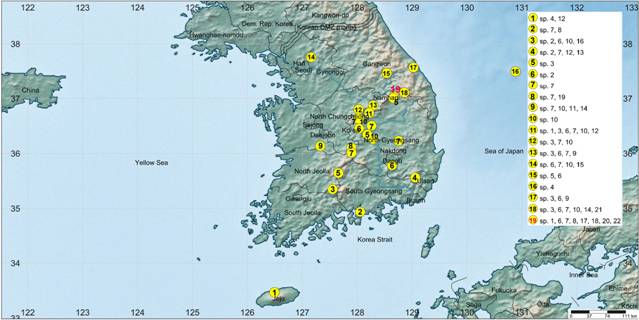
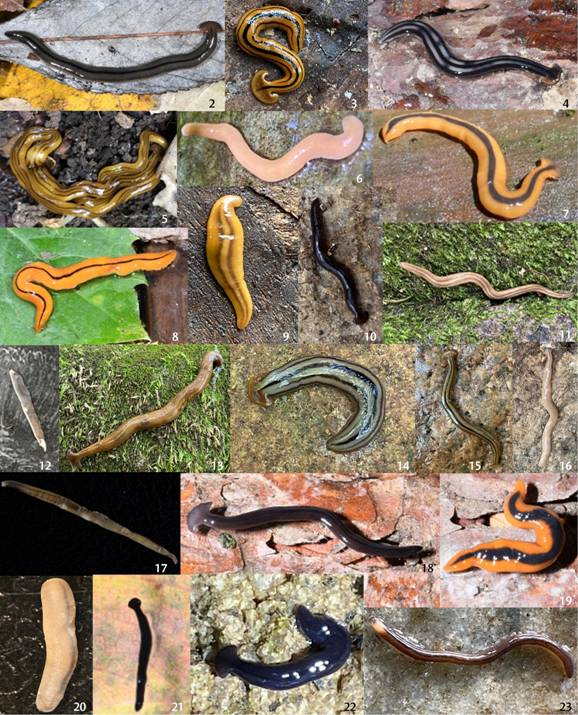
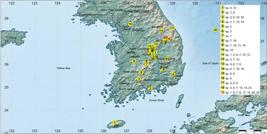
The specimens were collected by hand or soft tweezers from 2020 to 2022 in humid areas near mountain streams in administrative divisions Chungcheongbuk-do, Chungcheongnam-do, Daegu, Gangwon-do, Gyeonggi-do, Gyeongsangbuk-do, Gyeongsangnam-do, Jeju-do, Jeollabuk-do, and Ulsan of the Republic of Korea (Fig. 1). The map showing the collection sites was created using SimpleMappr (Shorthouse 2010). More than 70 land planarians were collected and grouped into 22 morphospecies according to their external appearance (Figs 2-23). Genomic DNA was extracted from tissues (approximately 2 mm in length) of the posteriormost region of the body, using the QIAGEN DNeasy Blood and Tissue Kit (Qiagen, Hilden, Germany) according to the manufacturer’s instructions. The remainder of the body is preserved in 80% ethanol for further morphological analysis. PCR amplification of the mitochondrial cytochrome c oxidase I (COI) gene from each specimen was performed using a pair of primers, namely, FlatwormCOI-F (5’-GCAGTTTTTGGTTTTTTGGACATCC-3’) and FlatwormCOI-R (5’-GAGCAACAACATAATAAGTATCATG-3’) (Sunnucks et al. 2006). The PCR amplification condition was as follows: an initial denaturation step at 95 °C for 5 min; 40 cycles each of 95 °C for 20 s, 48 °C for 20 s, and 72 °C for 1 min; and a final extension step at 72 °C for 5 min. Purification and sequencing of PCR products were carried out by Macrogen Corporation (Daejeon, Republic of Korea). Sequences were aligned using the MAFFT align option with default parameters in Geneious Prime v.2019.0.4 (Kearse et al. 2012). Five different datasets were generated, including GenBank sequences and new sequences from Korean specimens (Appendix 1). Dataset 1 corresponds to COI sequences from all subfamilies of Geoplanidae (Bipaliinae, Geoplaninae, Microplaninae, and Rhynchodeminae) using Geoplaninae and Rhynchodeminae as outgroups; dataset 2 corresponds to COI sequences excluding the two longest branches of dataset 1 (Rhynchodemus sylvaticus (Leidy, 1852) KJ659689, Geoplanidae sp. 16 OR671532); dataset 3 corresponds to COI sequences from representatives of the subfa milies Bipaliinae and Microplaninae using only Geoplaninae as outgroup (Rhynchodeminae excluded from outgroups); dataset 4 corresponds to COI sequences from representatives of the subfamily Bipaliinae using Microplaninae as the outgroup; and dataset 5 corresponds to COI sequences from representatives of the subfamily Microplaninae using Bipaliinae as the outgroup. Maximum likelihood (ML) analysis and dataset-specific model selection of 114 COI sequences of land planarians (including 58 GenBank data) were performed on the W-IQTREE web server (http://iqtree.cibiv.univie.ac.at/) (Trifinopoulos et al. 2016). The models selected for each dataset were: TIM+F+I+G4 (datasets 1, 2, and 4); GTR+F+I+G4 (datasets 3 and 5). Branch support in the ML analysis was performed with 1,000 ultrafast bootstrap (UFBoot) replicates, and UFBoot of 95% or greater for a branch is considered to provide high support to the branch (Minh et al. 2013). The figure of the ML tree was obtained using FigTree v1.3.1 (Rambaut 2009). Molecular species delimitation was tested with Assemble Species by Automatic Partitioning (ASAP), a tool designed to propose partitioning of species hypotheses using computed pairwise genetic distances between DNA sequences without phylogenetic reconstruction (Puillandre et al. 2021).
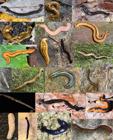
Photos of morphospecies from the Republic of Korea: (2) Geoplanidae sp. 1; (3) Geoplanidae sp. 2; (4) Geoplanidae sp. 3; (5) Geoplanidae sp. 4; (6) Geoplanidae sp. 5; (7) Geoplanidae sp. 6; (8) Geoplanidae sp. 7; (9) Geoplanidae sp. 8; (10) Geoplanidae sp. 9; (11) Geoplanidae sp. 10; (12) Geoplanidae sp. 11; (13) Geoplanidae sp. 12; (14) Geoplanidae sp. 13; (15) Geoplanidae sp. 14; (16) Geoplanidae sp. 15; (17) Geoplanidae sp. 16; (18) Geoplanidae sp. 17; (19) Geoplanidae sp. 18; (20) Geoplanidae sp. 19; (21) Geoplanidae sp. 20; (22) Geoplanidae sp. 21; (23) Geoplanidae sp. 22.
RESULTS
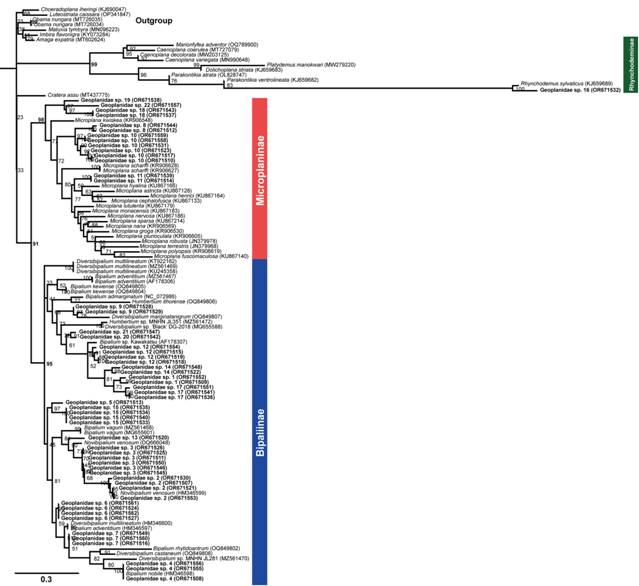
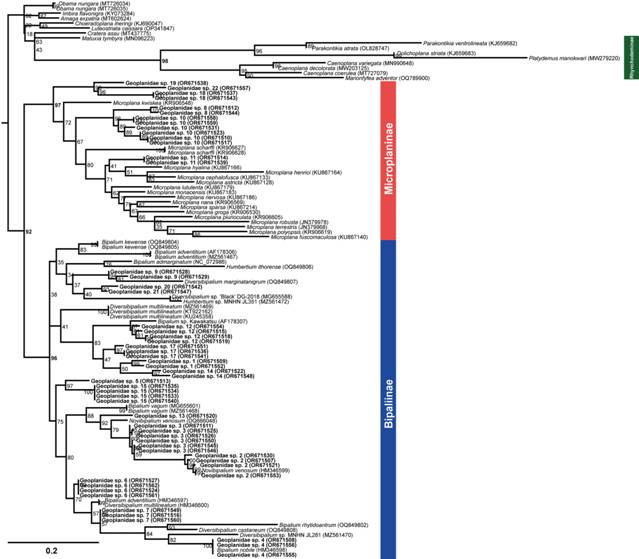
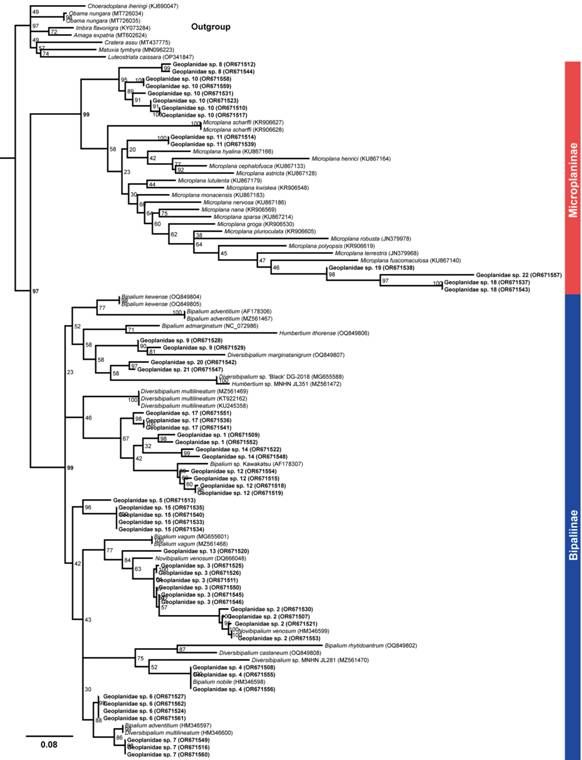
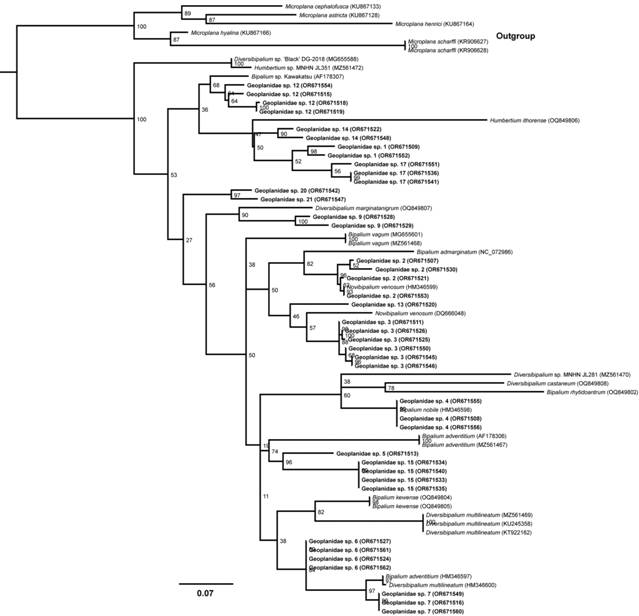
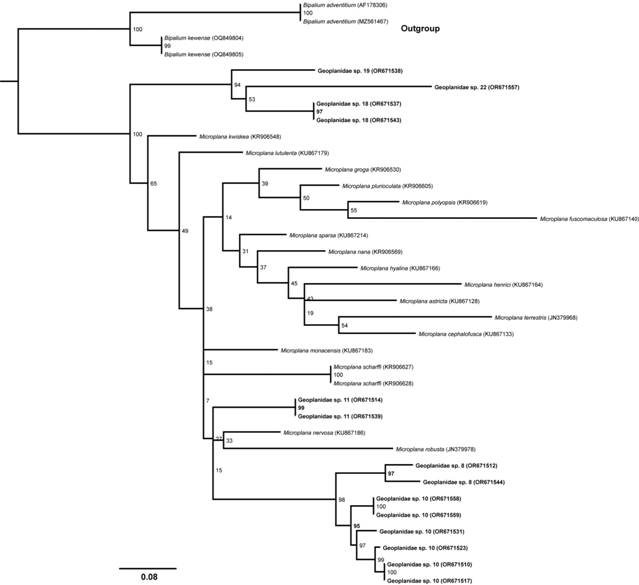
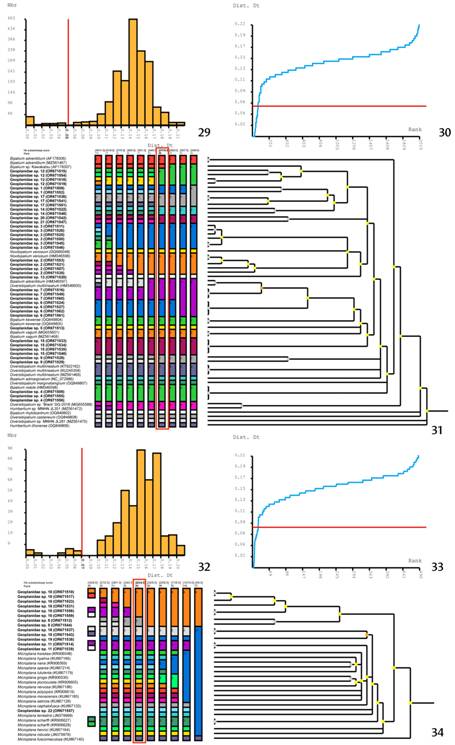
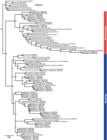
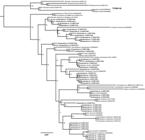
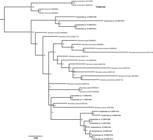
Dataset 1 corresponds to 114 COI sequences with a length of 194 bp; dataset 2 is composed of 112 COI sequences with a length of 194 bp; dataset 3 corresponds to 104 COI sequences with a length of 194 bp; dataset 4 is composed of 70 COI sequences with a length of 227 bp; and dataset 5 is composed of 36 COI sequences with a length of 255 bp. In the ML analysis of dataset 1, the phylogenetic tree shows the following results: (1) Korean land planarians belong to three subfamilies (Bipaliinae, Microplaninae, and Rhynchodeminae); (2) Rhynchodeminae clade forms long branches (especially R. sylvaticus KJ659689 and Geoplanidae sp. 16 OR671532); (3) Geoplaninae species does not form a monophyletic group (Cratera assu Araujo, Carbayo, Riutort & Álvarez-Presas, 2020 MT437775 and other sequences); and (4) the node connecting Bipaliinae and Microplaninae clades is not supported (91%), and Bipaliinae and Microplaninae clades are supported at 95% and 98%, respectively (Fig. 24). For dataset 2, the following results are shown: (1) Geoplaninae forms a clade with Rhynchodeminae; and (2) the node connecting Bipaliinae and Microplaninae clades is not supported (92%), and Bipaliinae and Microplaninae clades are supported at 96% and 97%, respectively (Fig. 25). In dataset 3, the node connecting Bipaliinae and Microplaninae is supported (97%), and both Bipaliinae and Microplaninae clades are highly supported at 99% (Fig. 26). In the phylogenetic tree of dataset 4, Geoplanidae sp. 2, 4, and 7 form clades with Novibipalium venosum (Kaburaki, 1922) (HM346599), Bipalium nobile Kawakatsu & Makino, 1982 (HM346598), and Bipalium adventitium Hyman, 1943 (HM346597) from GenBank data, respectively, and are highly supported (96%, 99%, and 97%) (Fig. 27). In dataset 5, all Korean Microplaninae species form a separate clade from the GenBank data, and all but two branches (Geoplanidae sp. 19 OR671538 and Geoplanidae sp. 22 OR671557) are highly supported (≥ 95%) (Fig. 28). The phylogenetic trees for all datasets show that 15, 6, and 1 of the 22 represented morphospecies of Korean land planarians are assigned to the Bipaliinae, Microplaninae, and Rhynchodeminae clades, respectively. The ASAP partition for Korean Bipaliinae that most closely approximated the 15 proposed morphospecies had a score of 10.50 at a threshold distance of 0.057. This partition showed 14 different putative species, as the genetic distance between Geoplanidae sp. 20 and 21 is lower (0.053) than the threshold distance (0.057). The ASAP partition for Korean Microplaninae with a score of 4.50 at a threshold distance of 0.075 produced six distinct putative species, corresponding to the number of six proposed morphospecies (Figs 29-34).
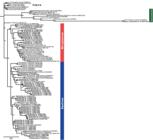
ML phylogenetic tree inferred from COI gene fragment of some land planarians sequenced for this work and GenBank (dataset 1). Numbers at nodes are ultrafast bootstrap (UFB) values. Scale bar means number of substitutions per site.
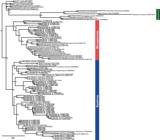
ML phylogenetic tree inferred from COI gene fragment of some land planarians sequenced for this work and GenBank (dataset 2). Numbers at nodes are ultrafast bootstrap (UFB) values. Scale bar means number of substitutions per site.
ML phylogenetic tree inferred from COI gene fragment of some land planarians sequenced for this work and GenBank (dataset 3). Numbers at nodes are ultrafast bootstrap (UFB) values. Scale bar means number of substitutions per site.
ML phylogenetic tree inferred from COI gene fragment of some land planarians sequenced for this work and GenBank (dataset 4). Numbers at nodes are ultrafast bootstrap (UFB) values. Scale bar means number of substitutions per site.
ML phylogenetic tree inferred from COI gene fragment of some land planarians sequenced for this work and GenBank (dataset 5). Numbers at nodes are ultrafast bootstrap (UFB) values. Scale bar means number of substitutions per site.
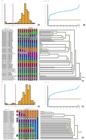
Output results made with the ASAP method: (29) Histogram in Bipaliinae species; (30) Ranked distances in Bipaliinae species; (31) Graphical output of groups in Bipaliinae species; (32) Histogram in Microplaninae species; (33) Ranked distances in Microplaninae species; (34) Graphical output of groups in Microplaninae species.
DISCUSSION
This preliminary study shows for the first time the large and still unexplored richness of Korean terrestrial planarians, which exceeds at least 21 undescribed species. The ML results of datasets 1 and 2 show that Geoplaninae does not form a monophyletic clade and does not support a node connecting the Bipaliinae and Microplaninae clades. These results are thought to be due to the long-branch attraction (LBA) artefact of Rhynchodeminae species (Figs 24, 25). LBA often leads to incongruence in phylogenetic analyses (Bergsten 2005, Philippe et al. 2017). In dataset 3, with Rhynchodeminae removed, Geoplaninae forms a monophyletic group, and a node connecting the Bipaliinae and Microplaninae clades is supported (Fig. 26). The ASAP result suggests that Geoplanidae sp. 20 and 21 are probably conspecific among the 15 proposed morphospecies of Korean Bipaliinae. In addition, it suggests that Geoplanidae sp. 2, 4, and 7 are probably conspecific with N. venosum, B. nobile, and B. adventitium, respectively. However, these possibilities need to be confirmed by histological examination (Figs 29-34).
Most of the Korean land planarian species were found under stones, rotting trees and leaf litter around mountain streams in well-preserved forests, while sampling efforts in rotten forests and meadows yielded poorer results (pers. obs.). This supports previous research suggesting that this organism can be used as a bioindicator of well-preserved habitats (Carbayo et al. 2002, Fonseca et al. 2006). Meanwhile, some species (Geoplanidae sp. 2, 4, and 7) were also found in disturbed habitats but are simultaneously found in well-preserved forests, which suggest that these species can tolerate disturbed habitats (Table 1). Our results showed that all subfamilies except Geoplaninae, the South American group, are distributed in the Republic of Korea. The native distribution of Bipaliinae is known to be Madagascar, South, East and Southeast Asia, while Microplaninae and Rhynchodeminae are known to have a cosmopolitan distribution (Sluys and Riutort 2018, Solà et al. 2023). Therefore, it is not surprising that many species (14 spp.) included in Bipaliinae were discovered in the Republic of Korea through this study. Interestingly, among the species of Bipaliinae, Bipalium kewense Moseley, 1878, from the Vietnamese highlands (Winsor et al. 2004), which is known to have been introduced worldwide, was not found during the sampling campaigns conducted in the Republic of Korea so far (Winsor 1983, Winsor et al. 2004). This may be explained by the fact that most of the sampling was done in natural habitats, which are not preferred by the species outside its natural distributional range. To date, only one Microplaninae species has been recorded for the Republic of Korea, namely M. unilineata, or a nearby region, namely Statomicroplana ruteocephala (Kaburaki, 1922), from Japan. However, according to our results, it is estimated that at least six species are present in the Republic of Korea alone. In particular, the Rhynchodeminae representative was discovered for the first time in the country through this study. Although the sampling campaigns conducted so far covered very few areas in the Republic of Korea, we found 21 putative species of land planarians. Considering that the Republic of Korea has many mountains, sampling effort at each site was relatively low, and that our sampling was conducted over only three years, the actual richness of Korean land planarians is expected to be much higher than 21 species. In fact, the regions with the highest species diversity were Gangwon-do and Gyeongsangbuk-do, which border two major mountain ranges (Taebaek Mountains and Sobaek Mountains) in the Korean peninsula (Table 1). In particular, at one sampling site in Gangwon State, as many as eight putative species were collected together (Fig. 1).
Number of putative species by administrative division from the Republic of Korea through sampling campaigns. Abbreviations by administrative division: (GY) Gyeonggi, (GW) Gangwon, (NG) North Gyeongsang, (SG) South Gyeongsang, (NC) North Chungcheong, (SC) South Chungcheong, (NJ) North Jeolla, (UL) Ulsan, (DA) Daegu, (JE) Jeju.
Currently, this collaborative study is the starting point for research on Korean land planarians, and future research is required to answer the following main questions: (1) What is the actual diversity of these organisms in the Republic of Korea?; (2) can they be used as bioindicators?; (3) is each species native or invasive? If it is an invasive species, where was it introduced?; and (4) what are their effects on the soil ecosystems?
ACKNOWLEDGMENTS
This work was supported by a grant from the Nakdonggang National Institute of Biological Resources (NNIBR), funded by the Ministry of Environment (MOE) of the Republic of Korea (NNIBR20241101) and São Paulo Research Foundation (FAPESP 2022/11972-2). FC fully thanks the NNIBR President Ho Yu for the invitation to visit the Korean Institute. We thank Jin-Young Kim, Eun Jung Ahn, Gwiae Kim, Yeoung Hee Lee, Jin Yeup Hyoung, Joong Duk Jo, Yeha Song, Jeha Song and Jiwon Lim for helping with collecting specimens in this study. Postscript: Recent sampling campaigns throughout the Republic of Korea have yielded an additional 20 putative species of land planarians, identified using the same methodology as in this paper.
LITERATURE CITED
-
Almeida AL, Álvarez-Presas M, Bolonhezi L, Carbayo F (2022) Integrative taxonomy increases biodiversity knowledge of Gusana (Platyhelminthes, Tricladida, Geoplanidae) with the description of four new Chilean species. Invertebrate Systematics 36: 533-556. https://doi.org/10.1071/is21066
» https://doi.org/10.1071/is21066 -
Almeida AL, Álvarez-Presas M, Carbayo F (2023) The discovery of new Chilean taxa revolutionizes the systematics of Geoplaninae Neotropical land planarians (Platyhelminthes: Tricladida). Zoological Journal of the Linnean Society 197: 837-898. https://doi.org/10.1093/zoolinnean/zlac072
» https://doi.org/10.1093/zoolinnean/zlac072 -
Araujo APG, Carbayo F, Riutort M, Álvarez-Presas M (2020) Five new pseudocryptic land planarian species of Cratera (Platyhelminthes: Tricladida) unveiled through integrative taxonomy. PeerJ 8: e9726. https://doi.org/10.7717/peerj.9726
» https://doi.org/10.7717/peerj.9726 -
Bergsten J (2005) A review of long-branch attraction. Cladistics 21: 163-193. https://doi.org/10.1111/j.1096-0031.2005.00059.x
» https://doi.org/10.1111/j.1096-0031.2005.00059.x -
Brown M-D, Lindo J, Robinson R (2022) First record of exotic terrestrial flatworms (Tricladida: Geoplanidae) Bipalium vagum Jones & Sterrer, 2005 and Dolichoplana striata Moseley, 1877 with confirmation of Platydemus manokwari de Beauchamp, 1963 in Jamaica. BioInvasions Record 11: 373-382. https://doi.org/10.3391/bir.2022.11.2.10
» https://doi.org/10.3391/bir.2022.11.2.10 -
Carbayo F, Álvarez-Presas M, Jones HD, Riutort M (2016) The true identity of Obama (Platyhelminthes: Geoplanidae) flatworm spreading across Europe. Zoological Journal of the Linnean Society 177: 5-28. https://doi.org/10.1111/zoj.12358
» https://doi.org/10.1111/zoj.12358 -
Carbayo F, Leal-Zanchet AM, Vieira EM (2002) Terrestrial flatworm (Platyhelminthes: Tricladida: Terricola) diversity versus man-induced disturbance in an ombrophilous forest in southern Brazil. Biodiversity & Conservation 11: 1091-1104. https://doi.org/10.1023/A:1015865005604
» https://doi.org/10.1023/A:1015865005604 -
De Luna M, Boll PK (2023) An annotated checklist of terrestrial flatworms (Platyhelminthes: Tricladida: Geoplanidae) from Mexico, with new records of invasive species from a citizen science platform and a new nomen dubium. Zootaxa 5297: 518-532. https://doi.org/10.11646/zootaxa.5297.4.3
» https://doi.org/10.11646/zootaxa.5297.4.3 - Ducey PK, McCormick M, Davidson E (2007) Natural history observations on Bipalium cf. vagum Jones and Sterrer (Platyhelminthes: Tricladida), a terrestrial broadhead planarian new to North America. Southeastern Naturalist 6: 449-460. https://doi.org/10.1656/1528-7092(2007)6[449:nhoobc]2.0.co;2
- Fonseca CR, Ganade G, Baldissera R, Becker CG, Brescovit AD, Campos LM, et al. (2006) Araucaria forest indicators: contrasting indicator value distributions across nine taxonomic groups. In: Lafortezza R, Sanesi G (Eds) Pattern and processes in forest landscapes: Consequences of human management. Accademia Italiana di Scienze Forestali, Florence, 125-130.
-
Grau JH, Almeida AL, Sluys R, Carbayo F (2022) A new genus and two new species of land planarians (Platyhelminthes: Tricladida: Geoplanidae) from Southern Chile. Journal of Natural History 56: 947-967. https://doi.org/10.1080/00222933.2022.2097137
» https://doi.org/10.1080/00222933.2022.2097137 -
Iwai N, Sugiura S, Chiba S (2010) Prey-tracking behavior in the invasive terrestrial planarian Platydemus manokwari (Platyhelminthes, Tricladida). Naturwissenschaften 97: 997-1002. https://doi.org/10.1007/s00114-010-0717-4
» https://doi.org/10.1007/s00114-010-0717-4 -
Jones HD, Cumming MS (1998) Feeding behaviour of the termite-eating planarian Microplana termitophaga (Platyhelminthes: Turbellaria: Tricladida: Terricola) in Zimbabwe. Journal of Zoology 245: 53-64. https://doi.org/10.1111/j.1469-7998.1998.tb00071.x
» https://doi.org/10.1111/j.1469-7998.1998.tb00071.x -
Jones HD, Santoro G, Boag B, Neilson ROY (2001) The diversity of earthworms in 200 Scottish fields and the possible effect of New Zealand land flatworms (Arthurdendyus triangulatus) on earthworm populations. Annals of Applied Biology 139: 75-92. https://doi.org/10.1111/j.1744-7348.2001.tb00132.x
» https://doi.org/10.1111/j.1744-7348.2001.tb00132.x -
Justine J-L, Marie AD, Gastineau R, Fourcade Y, Winsor L (2022) The invasive land flatworm Obama nungara in La Réunion, a French island in the Indian Ocean, the first report of the species for Africa. Zootaxa 5154: 469-476. https://doi.org/10.11646/zootaxa.5154.4.4
» https://doi.org/10.11646/zootaxa.5154.4.4 -
Justine J-L, Winsor L, Gey D, Gros P, Thévenot J (2014) The invasive New Guinea flatworm Platydemus manokwari in France, the first record for Europe: time for action is now. PeerJ 2: e297. https://doi.org/10.7717/peerj.297
» https://doi.org/10.7717/peerj.297 -
Justine J-L, Winsor L, Gey D, Gros P, Thévenot J (2020) Obama chez moi! The invasion of metropolitan France by the land planarian Obama nungara (Platyhelminthes, Geoplanidae). PeerJ 8: e8385. https://doi.org/10.7717/peerj.8385
» https://doi.org/10.7717/peerj.8385 -
Kearse M, Moir R, Wilson A, Stones-Havas S, Cheung M, Sturrock S, et al. (2012) Geneious Basic: an integrated and extendable desktop software platform for the organization and analysis of sequence data. Bioinformatics 28: 1647-1649. https://doi.org/10.1093/bioinformatics/bts199
» https://doi.org/10.1093/bioinformatics/bts199 -
Lago-Barcia D, Álvarez-Presas M, Riutort M, Oceguera-Figueroa A, Carbayo F (2023) Phylogenetic relationships of the Geoplaninae land planarians (Platyhelminthes, Tricladida) assessed with a total evidence approach, with the description of a new species of Gigantea Molecular Phylogenetics and Evolution 184: 107750. https://doi.org/10.1016/j.ympev.2023.107750
» https://doi.org/10.1016/j.ympev.2023.107750 -
Lago-Barcia D, Silva M, Carbayo F (2021) Revision and description of six species of Choeradoplana (Platyhelminthes, Tricladida), with an emendation to the genus. ZooKeys 1016: 1-48. https://doi.org/10.3897/zookeys.1016.59617
» https://doi.org/10.3897/zookeys.1016.59617 -
Minh BQ, Nguyen MAT, von Haeseler A (2013) Ultrafast approximation for phylogenetic bootstrap. Molecular Biology and Evolution 30: 1188-1195. https://doi.org/10.1093/molbev/mst024
» https://doi.org/10.1093/molbev/mst024 -
Negrete L, Álvarez-Presas M, Riutort M, Brusa F (2021) Integrative taxonomy of land planarians (Platyhelminthes: Geoplanidae) from the Andean-Patagonian Forests from Argentina and Chile, with the erection of two new genera. Journal of Zoological Systematics and Evolutionary Research 59: 588-612. https://doi.org/10.1111/jzs.12444
» https://doi.org/10.1111/jzs.12444 -
Negrete L, do Amaral SV, Ribeiro GG, Wolmann Gonçalves J, Valiati VH, Damborenea C, Brusa F, Leal-Zanchet AM (2019) Far away, so close! Integrative taxonomy reveals a new genus and species of land flatworm (Platyhelminthes: Geoplanidae) from southern South America. Zoological Journal of the Linnean Society 189: 722-744. https://doi.org/10.1093/zoolinnean/zlz131
» https://doi.org/10.1093/zoolinnean/zlz131 -
Ogren RE (1995) Predation behaviour of land planarians. Hydrobiologia 305: 105-111. https://doi.org/10.1007/bf00036370
» https://doi.org/10.1007/bf00036370 -
Philippe H, Vienne DM, Ranwez V, Roure B, Baurain D, Delsuc F (2017) Pitfalls in supermatrix phylogenomics. European Journal of Taxonomy 283: 1-25. https://doi.org/10.5852/ejt.2017.283
» https://doi.org/10.5852/ejt.2017.283 -
Prasniski MET, Leal-Zanchet AM (2009) Predatory behavior of the land flatworm Notogynaphallia abundans (Platyhelminthes: Tricladida). Zoologia 26: 606-612. https://doi.org/10.1590/s1984-46702009005000011
» https://doi.org/10.1590/s1984-46702009005000011 -
Puillandre N, Brouillet S, Achaz GJMER (2021) ASAP: assemble species by automatic partitioning. Molecular Ecology Resources 21: 609-620. https://doi.org/10.1111/1755-0998.13281
» https://doi.org/10.1111/1755-0998.13281 -
Rambaut A, Drummond AJ (2009) FigTree, version 1.3.1. Institute of Evolutionary Biology, University of Edinburgh, Edinburgh. http://tree.bio.ed.ac.uk/softw are/figtree/
» http://tree.bio.ed.ac.uk/softw are/figtree/ -
Rossi I, do Amaral SV, Ribeiro GG, Müller MJ, Valiati VH, Leal-Zanchet AM (2019) Phylogenetic relationships within the flatworm genus atuxia (Platyhelminthes, Tricladida, Continenticola) inferred from molecular data with the description of a southern lineage of the genus. Organisms Diversity & Evolution 19: 377-390. https://doi.org/10.1007/s13127-019-00410-6
» https://doi.org/10.1007/s13127-019-00410-6 -
Shorthouse DP (2010) SimpleMappr, an online tool to produce publication-quality point maps. Available online at: Available online at: http://www.simplemappr.net [Accessed: 19/10/2023]
» http://www.simplemappr.net - Sluys R (1999) Global diversity of land planarians (Platyhelminthes, Tricladida, Terricola): a new indicator-taxon in biodiversity and conservation studies. Biodiversity & Conservation 8: 1663-1681.
-
Sluys R (2016) Invasion of the flatworms. American Scientist 104: 288-295. https://doi.org/10.1511/2016.122.288
» https://doi.org/10.1511/2016.122.288 -
Sluys R, Riutort M (2018) Planarian Diversity and Phylogeny. In: Rink JC (Ed) Planarian regeneration: methods and protocols. Springer, New York, 1-56. https://doi.org/10.1007/978-1-4939-7802-1_1
» https://doi.org/10.1007/978-1-4939-7802-1_1 -
Solà E, Sluys R, Riutort M, Kawakatsu M (2023) Molecular phylogenetics facilitates the first historical biogeographic analysis of the hammerhead worms (Platyhelminthes: Tricladida: Bipaliinae), with the description of twelve new species and two new genera. Zootaxa 5335: 1-77. https://doi.org/10.11646/zootaxa.5335.1.1
» https://doi.org/10.11646/zootaxa.5335.1.1 -
Sugiura S (2009) Seasonal fluctuation of invasive flatworm predation pressure on land snails: Implications for the range expansion and impacts of invasive species. Biological Conservation 142: 3013-3019. https://doi.org/10.1016/j.biocon.2009.07.032
» https://doi.org/10.1016/j.biocon.2009.07.032 -
Sunnucks P, Blacket MJ, Taylor JM, Sands CJ, Ciavaglia SA, Garrick RC, et al. (2006) A tale of two flatties: different responses of two terrestrial flatworms to past environmental climatic fluctuations at Tallaganda in montane southeastern Australia. Molecular Ecology 15: 4513-4531. https://doi.org/10.1111/j.1365-294x.2006.03107.x
» https://doi.org/10.1111/j.1365-294x.2006.03107.x -
Trifinopoulos J, Nguyen L-T, von Haeseler A, Minh BQ (2016) W-IQ-TREE: a fast online phylogenetic tool for maximum likelihood analysis. Nucleic Acids Research 44: W232-W235. https://doi.org/10.1093/nar/gkw256
» https://doi.org/10.1093/nar/gkw256 -
Tyler S, Artois T, Schilling S, Hooge M, Bush LF (2006-2024). World List of turbellarian worms: Acoelomorpha, Catenulida, Rhabditophora. https://www.marinespecies.org/turbellarians [Accessed: 06/02/2024]
» https://www.marinespecies.org/turbellarians -
Winsor L (1983) A revision of the cosmopolitan land planarian Bipalium kewense Moseley, 1878 (Turbellaria: Tricladida: Terricola). Zoological Journal of the Linnean Society 79: 61-100. https://doi.org/10.1111/j.1096-3642.1983.tb01161.x
» https://doi.org/10.1111/j.1096-3642.1983.tb01161.x -
Winsor L (1998) Collection, handling, fixation, histological and storage procedures for taxonomic studies of terrestrial flatworms (Tricladida: Terricola). Pedobiologia 42: 405-411. https://doi.org/10.1016/s0031-4056(24)00462-1
» https://doi.org/10.1016/s0031-4056(24)00462-1 - Winsor L, Johns PM, Barker GM (2004) Terrestrial planarians (Platyhelminthes: Tricladida: Terricola) predaceous on terrestrial gastropods. In: Natural enemies of terrestrial molluscs. CABI Publishing, Wallingford, 227-278.
ADDITIONAL NOTES
- ZooBank register
-
How to cite this article
Song J-H, Carbayo F (2024) Present and future of the study on Korean land planarians (Platyhelminthes: Tricladida: Geoplanidae). Zoologia 41: e23083. https://doi.org/10.1590/S1984-4689.v41.e23083
-
Published by
Sociedade Brasileira de Zoologia at Scientific Electronic Library Online - https://www.scielo.br/zool
-
Nakdonggang National Institute of Biological Resources (NNIBR), funded by the Ministry of Environment (MOE) of the Republic of Korea (NNIBR20241101) and São Paulo Research Foundation (FAPESP 2022/11972-2). This work was supported by a grant from the Nakdonggang National Institute of Biological Resources (NNIBR), funded by the Ministry of Environment (MOE) of the Republic of Korea (NNIBR20241101) and São Paulo Research Foundation (FAPESP 2022/11972-2).