Taxonomy of the South American species of Artonia (Lepidoptera: Hesperiidae), with descriptions of the final larval instars and pupa of Artonia artona
ABSTRACT
The two South American species of Artonia Grishin, 2019 are herein revised. A lectotype for Artonia artona (Hewitson, 1868) is designated. Larvae of Artonia artona were found feeding on an unidentified species of Poaceae Barnhart, and the final larval instars and pupa are described and illustrated for the first time. Detailed descriptions and a review of variation of the species are provided based on examination of a large number of specimens. Illustrations of the male and female genitalia and a distribution map for both species are provided.
KEYWORDS:
Butterfly; Hesperiinae; immature stages; new taxa; skippers
INTRODUCTION
Hesperia artonaHewitson, 1868 (Hesperiinae: Moncina) was described from Rio de Janeiro, state of Rio de Janeiro, Brazil (Hewitson 1868). The species was subsequently transferred to Carystus Hübner, [1819] by Butler (1870), based on its longer antennae relative to other species of Hesperia Fabricius, 1793. Later, without explicit justification, Hayward (1948) transferred the species to VettiusGodman, 1901. In his comprehensive monograph on Neotropical Hesperiidae, Evans (1955) recognized 21 species in Vettius, including Vettius artona, and provided a diagnosis for the genus based on general characters of the antenna, labial palpus, wing venation, and color patterns.
Although V. artona was included in phylogenetic studies exploring relationships within Hesperiidae (Warren et al. 2008, 2009), the most comprehensive analysis for the genus Vettius was conducted by Cong et al. (2019) using nuclear genome and Z-chromosome data. Their results revealed that Vettius is polyphyletic, with V. artona recovered as sister to Cobalopsis autumna (Plötz, 1882), albeit with considerable genetic divergence from other species of Cobalopsis Godman, 1900. Based on these results, V. artona was placed in the monotypic new genus Artonia Grishin, 2019 (in Cong et al. 2019), a classification later corroborated by Zhang et al. (2022) through phylogenomic data.
More recently, Grishin (in Zhang et al. 2025), based on evidence from nuclear and mitochondrial genomes, described two additional species of Artonia: Artonia darienia Grishin, 2025 from Cana, Darién Province, Panama, and Artonia guiania Grishin, 2025 from the Eastern Kanuku Mountains, Guyana. Thus, Artonia is a widely distributed genus throughout the Neotropical Region, with species occurring from Guatemala to Brazil and northern Argentina. Artonia spp. are frequently recorded in faunal surveys (Mielke 2025) and are relatively well represented in collections. Despite their broad distribution and variation in wing-spot patterns (Godman 1901), the species of Artonia have never been studied in detail, even in the most recent works, which were based on few or single specimens (Zhang et al. 2025). Furthermore, illustrations of the female genitalia are not available, and the only known information regarding their immature stages is that the larva of A. artona feeds on Bromeliaceae or on grasses (Silva et al. 1968, Glassberg 2017).
This study aims to provide a taxonomic review of the two South American species of Artonia. It also presents, for the first time, descriptions and illustrations of the female genitalia of both species, as well as the final larval instars and pupa of A. artona.
MATERIAL AND METHODS
A total of 355 specimens (223 males and 132 females) were analyzed from the following collections: DZUP, Coleção Entomológica Padre Jesus Santiago Moure, Universidade Federal do Paraná, Curitiba, Paraná, Brazil; DZUP-OM, Olaf Mielke Collection (deposited at DZUP); NHMUK, The Natural History Museum, London, United Kingdom; and USNM, National Museum of Natural History, Smithsonian Institution, Washington, D.C., USA. Morphological examination was conducted using standard techniques for Lepidoptera research (Medeiros et al. 2019). In the “Material examined” section, dissected specimens are marked with an asterisk (*) next to their voucher numbers. Specimens exhibiting variation in the number of forewing discal cell spots are indicated by ‘0’, ‘1’, or ‘2’, corresponding to the respective number of spots present.
The description of the final two larval instars and pupa of A. artona was based on two specimens collected during a field expedition on February 28, 2025, in Serrinha, Joinville, Santa Catarina, Brazil (26°18’39”S, 48°58’9”W; 200 m a.s.l.). The larvae were reared in plastic containers under ambient humidity and temperature. For larval feeding, a seedling of the host plant was transported and maintained near the laboratory. The immature stages were inspected daily for monitoring, cleaning, and food replenishment. The single emerged adult, a female, was deposited at DZUP (voucher number DZ 73.321). An herbarium voucher of the host plant was prepared and deposited in the Herbário William Antônio Rodrigues (UPCB), Departamento de Botânica, Universidade Federal do Paraná, Curitiba, Paraná, Brazil (voucher number UPCB0098954).
Photographs of immature stages and genitalia were taken with a Leica DFC 500 digital camera, using the focus stacking system of LEICA LAS 3D VIEW and LAS MONTAGE version 4.12.0 software. The remaining photographs were taken with a Canon EOS T5 digital camera. The bursa copulatrix of the female genitalia was stained with Chlorazol Black. Morphological terminology follows Carneiro et al. (2013) for adults and Stehr (1987) for immature stages. The following abbreviations are used in the text: FW, forewing; HW, hind wing; DFW, dorsal forewing; DHW, dorsal hind wing; VFW, ventral forewing; and VHW, ventral hind wing.
The distribution map was generated in QGIS Desktop version 3.42.3, using combined data from the examined material and literature. Literature records from imprecise localities (e.g., “South America”, “from Nicaragua to Brazil”), unconfirmed records (i.e., when identification could not be confidently verified through specimens or illustrations), and localities from which no specimens were examined were excluded. The synonymic bibliography under each species follows the format established by Mielke (2025).
TAXONOMY
Artonia Grishin, 2019
Artonia Grishin, 2019, in Cong et al., Insecta Mundi 731: 32.
Type species. Hesperia artonaHewitson, 1868, by original designation.
Diagnosis. According to Cong et al. (2019), species in Artonia are morphologically similar to those of Vettius, but differ in lacking brands in males, lacking a white streak in cell CuA2-2A on DHW, and possessing white spot in CuA2-2A on DFW and white veins on VHW. Male genitalia with short and broad uncus, arms short and far apart; gnathos not expanded in lateral view; aedeagus narrow, curved; valva with harpe close to ampulla, upturned, ending in a finger-like process protruding dorsad from valva. In addition to the diagnosis proposed by Cong et al. (2019), the following diagnostic characters are included for Artonia: male genitalia with costa anteroventrally projected, ending in a spined plate connected to fultura inferior and sacculus; female genitalia with lamella postvaginalis abruptly converging to a median triangular distal projection, ostium at the anterior margin of sterigma, ductus bursae with the initial third sclerotized, narrow, dorsoventrally flattened, ductus seminalis arising dorsally at the beginning of the ductus’s sinuosity, and cervix of the bursa copulatrix globose.
Artonia artona (Hewitson, 1868)
Hesperia artonaHewitson, 1868. Descr. Hesp. 2, p. 27; Rio de Janeiro, [Brazil]; collection Hewitson.- Hewitson, 1876. Illustr. Exot. Butt. 5, p. [107], pl. [56] (Hesperia 7), figs 67, 68 (d, v).- Kirby,1879. Cat. Coll. Diurn. Lep. Hewitson, p. 221.- Plötz, 1882. Stett. ent. Ztg. 43: 449.
Carystus artona; Butler, 1870. Ent. monthly Mag. 7: 92.- Kirby, 1871. Syn. Cat. Diurn. Lep., p. 590.- Kirby, 1877. Syn. Cat. Diurn. Lep., Suppl., p. 822.- Mabille, 1904, in Wytsman. Gen. Ins. 17, p. 160.- Kaye, 1904. Trans. ent. Soc. London, p. 220.- Kaye, 1921. Mem. Dept. Agric. Trinidad and Tob. 2: 147.- Draudt, 1923, in Seitz. Gross-Schmett. Erde 5, p. 980, pl. 188i (d, v).- Lindsey, 1925. Denis. Univ. Bull., Jour. Sc. Lab. 21: 110.- Williams & Bell, 1931. Trans. Amer. Ent. Soc. 57: 284.- Spitz, 1932. Rev. Mus. Paulista 17: 877.- F. Hoffmann, 1934. Ent. Rdsch. 51: 73.- Hayward, 1934. Rev. Soc. ent. arg. 6: 104, 169, 200, pls 11, figs 15, 16 (d, v), 18, fig. 17 (male gen.).- Hall, 1939. Agric. Jour. Brit. Guiana 10: 232.- Hall, 1940. Ent. Bull. Brit. Guiana Dept. Agric. 3: 68.- Hayward, 1941. Rev. Mus. La Plata, n. s., Zool. 2: 317.- Bell, 1946. Bol. Ent. venezol. 5: 170.- Hayward, 1947. Acta zool. Lill. 4: 357.- Pallister, 1956. Amer. Mus. Novit. 1763: 13, 63.- Silva et al., 1968. Quarto Cat. Ins. viv. Plantas Brasil 2(1), p. 304; hostplant.- J. Zikán & W. Zikán, 1968. Pesq. agropec. bras. 3: 58; hostplant.- Barcant, 1970. Butt. Trinidad and Tob., p. 301.- Andrade, 1994. Shilap Revta. lepid. 22: 154.
Vettius artona; Hayward, 1948. Acta zool. Lill. 5: 109.- Pallister, 1956. Amer. Mus. Novit. 1763: 69.- K. Brown & O. Mielke, 1967. Jour. Lep. Soc. 21: 166.- Ebert, 1968, inSilva et al. Quarto Cat. Ins. viv. Plantas Brasil 2(2), p. 233.- K. Brown & O. Mielke, 1968. Jour. Lep. Soc. 22: 156.- Ebert, 1969. Jour. Lep. Soc. 23, Suppl. 3: 37.- Hayward, 1973. Op. Lill. 23: 80.- Biezanko & O. Mielke, 1973. Acta biol. paranaense 2: 86.- Lewis, 1973. Butt. World, p. 88, fig. 17 (v), p. 249.- Steinhauser, 1975. Bull. Allyn Mus. 29: 34.- Lewis, 1975. Marip. Mundo, p. 88, fig. 17 (v), p. 249.- Lamas, 1981. Rev. Soc. Mex. Lep. 6: 37.- Kesselring & Ebert, [1982]. Rev. Nordestina Biol. 2: 109.- Cock, 1982. Occ. Pap. Dept. Zool. UWI 5: 17, 36.- Bridges, 1983. Lep. Hesp. 1, p. 10; 2, p. 39.- de Jong, 1983. Tijd. Ent. 126: 245.- K. Brown, 1987. An. Prim. Simp. Pantanal, Brasília, p. 168.- Bridges, 1988. Cat. Hesp. 1, p. 16; 2, p. 65.- K. Brown, 1992, in Morellato. Hist. nat. Japi, p. 179, fig. 17 (v).- Lamas, 1994, in Foster et al. RAP Working Papers 6: 176.- Bridges, 1994. Cat. Fam.-Group, Gen.-Group, Sp.-Group Nam. Hesp. (Lep.) World 8, p. 19; 9, p. 73.- C. Mielke, 1995. Revta bras. Zool. 11(4): 765.- Robbins et al., 1996, in Wilson & Sandoval. Manu, p. 249.- Lamas, Robbins & Harvey, [1997]. Rev. peruana Ent. 39: 69.- O. Mielke & Casagrande, 1998, in Milliken & Ratter. Maracá, p. 478.- Maes et al., 1999, in Maes. Cat. Ins. Art. Nicaragua 3, p. 1278.- K. Brown & Freitas, 2000. Bol. Mus. Biol. Mello Leitão, n. s., Sta. Teresa, 11/12: 113.- Murray, 2000. Jour. Res. Lep. 35: 54.- Salazar & López, 2002. Bol. Cient. Mus. Hist. Nat. U. de Caldas 6: 144.- Orellana, Warren & O. Mielke, 2002. Entomotropica 17: 108.- Andrade, 2002, in Costa et al. Monogr. Terc. Milenio, Saragoza, 2: 158.- Canals, 2003. Marip. Misiones, p. 114, 461, figs (d, v).- O. Mielke, 2004. Hesperioidea, p. 83, in Lamas (ed.). Checklist: Part 4A, Hesperioidea-Papilionoidea, in Heppner (ed.). Atlas Neotrop. Lep. 5A.- O. Mielke, 2005. Cat. Amer. Hesperioidea 5, p. 1343.- Pinheiro & Emery, 2006. Biota Neotrop. 6(3): 6.- Garwood et al., 2007. Butt. South. Amaz., p. 239, fig. (v).- Fleck et al., 2007. Borboletas da SIX. Embrapa, Pelotas, p. 58, fig. ([female] d. v).- Silva, Landa & Vitalino, 2008. Lundiana 8(2): 139.- Pinheiro & Emery, 2007. Heringeriana 1(1): 66.- O. Mielke, Emery & Pinheiro, 2008. Revta bras. Ent. 52(2): 287.- Carneiro, O. Mielke & Casagrande, 2008. Shilap Revta. lepid. 36(142): 266.- Warren, Ogawa & A. Brower, 2008. Cladistics 24: 674.- González M. & Andrade-C., 2008. Rev. Acad. Colomb. Cienc. Ex. Fis. Nat. 32(124): 431.- Beccaloni et al., 2008. Monografías Tercer Milenio 8: 54; hostplant.- Greeney & Warren, 2009. Jour. Ins. Sc. 9(32): 7; hostplant.- Warren, Ogawa & A. Brower, 2009. Syst. Ent. 34: 523.- Cock, 2009. Living Word 2009: 16, fig. 12 (male d, v); hostplant.- Garwood et al., 2009. Butt. South. Amaz., 2nd ed., p. 329, fig. (v).- Núñez B., 2009. Trop. Lep. Res. 19(2): 77.- Salazar et al., 2010. Bol. Cient. Mus. Hist. Nat. U. de Caldas 14(1): 158.- Francini et al., 2011. Revta bras. Ent. 55(1): 67.- Dolibaina, O. Mielke & Casagrande, 2011. Biota Neotrop. 11(1): 346.- Paluch et al., 2011. Biota Neotrop. 11(4): 238.- Zacca, Bravo & Araújo, 2011. EntomoBrasilis 4(3): 141.- Silva, [2011]. Ecol. Mariposas Ecuador, p. 202.- O. Mielke, Carneiro & Casagrande, 2012. Revta bras. Ent. 56(1): 65.- Garwood & Lehman, 2013. Butt. C. Amer. 3, Hesp., p. 226, figs (v).- Uehara, 2013. Butterflies 63: 37, fig. 40 (male d, v).- Giovenardi et al., [2014]. Rev. colomb. Ent. 39(2), Supl., p. 16.- Carneiro et al., 2014. Neotrop. Ent. 43(1), Elect. Suppl. Mat., p. 7.- Kerpel et al., 2014, in Bravo & Calor (eds). Arthrop. Semiárido: Biodiv. Conserv., p. 270.- Beltrami et al., 2014. Trop. Lep. Res. 24(1): 34.- Marchiori, Romanowski & Mendonza, 2014. Shilap Revta. lepid. 42(166): 233.- Carneiro et al., 2014. PLoS ONE 9(10) (e108207), fig. S2.- Cock, 2014. Insecta Mundi 393: 27.- Vargas-Ch. & Salazar, 2014. Bol. Cient. Mus. Hist. Nat. U. de Caldas 18(1): 279.- Piovesan et al., 2014. Scientia Plena 10(9): 15.- Gaviria-O. & Henao-B., 2014. Rev. Fac. Ci. Univ. Nac. Colomb., Medellín, 3(2): 71.- Pereira, Leite & Brugiolo, 2015. Revta bras. Zoociências 16: 114, fig. 79 (d, v).- Andrade-C., Henao-B. & Salazar, 2015. Rev. Colomb. Amaz. 8: 104.- Piovesan & Orlandin, 2016, in Orlandin et al. Borb. Marip. S. Catarina, p. 80.- Freitas et al., 2016, in Rolim, Menezes & Srbek-Araújo. Floresta Atl. de Tabuleiro, p. 324.- Paluch et al., 2016. Biota Neotrop. 16(1): 6.-Sahoo et al., 2016. PeerJ 4(e2653), p. 10, figs 3a, b (multigene trees).- Sahoo et al., 2017. BMC evol. Biol. 17: 174, Addition. File 2, p. 2.- Pérez et al., 2017. Shilap Revta. lepid. 45(179): 442.- Palo Jr., 2017. Borb. Brasil 3, p. 2191, figs (v); p. 2334.- Glassberg, 2017. Swift Guide Butt. Mexico and C. America, 2nd ed., p. 247, fig. (v); hostplant.- Klimaitis et al., 2018. Marip. Argentinas, p. 268, figs (male, female d, v).- Sambhu & Nankishore, 2018. Zootaxa 4371(1), p. 38.- Soldati, Silveira & Silva, 2019. Pap. Avuls. Zool. 59(e20195902), p. 4.- Melo et al., 2019. Biota Neotrop. 19(1) (e20180614), p. 7.- Henriques et al., 2019. Biota Neotrop. 19(3) (e20180655), p. 4.- Orlandin et al., 2020. Pap. Avuls. Zool. 59 (e20195949), p. 14; ecol.- Bizarro & Martin, 2020. Guide Butt. Serra dos Orgãos. South-eastern Brazil, p. 271.- Núñez, Alegre-Barroso & Hausmann, 2021. Systematics and Biodiv. 19(1), p. 9, fig. 17 (dated chronogram).- Orlandin & Carneiro, 2021. Urban Ecosystems 24, Append. J.- Zamoner (org.), 2021. Borb. de Curitiba e do Paraná, p. 54, 81.- Montero-Abril, Ortiz-Pérez & Le Crom, 2022. Conserv.Colombiana 27, p. 59.- Gallardo & Diaz, 2022. Guide Butt. Honduras, p. 335.- Rosário, Barbosa & Paz, 2024. Diversitas Jour. 9(2): 1052-1069, Tab. S1: 11.
(no genus) artona; Beattie, 1976. Rhop. Direct., p. 85.
(no name) Raymond, 1982. Marip. Venezuela, pl. 15, fig. 17 (d, v).
Artonia artona; Cong et al., 2019. Insecta Mundi, 32, 44, figs 11, 12 (genomic trees).- Orlandin, Piovesan & Carneiro, 2020. Borboletas Meio-Oeste Santa Catarina, p. 47, fig. 48h, i (d, v); hostplant.- Zhang et al., 2022. Insecta Mundi 921: 66, 115, fig. 14 (genomic tree).- Orlandin et al., 2022, in Greca de Macedo & Dias. Portaria Nº 1082, Pref. Curitiba, p. 60.- Orlandin et al., 2023, in Straube. Invent. Fauna Curitiba, p. 170.- Vieira-Silva et al., 2023. Pap. Avuls. Zool. 63: e202363032, p. 6.- Greve et al., 2023. Biota Neotrop. 23(3): e20231487, p. 12.- Gualberto, Medeiros & Kerpel, 2024. EntomoBrasilis 17:e1068, p. 8.- Governo Estado Paraná, 2024. Decreto n° 6040, Anexo IX, p. 59.
Note. Many references may refer to A. guiania or A. darienia, but confirmation was not possible.
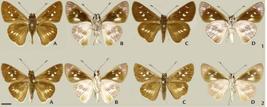
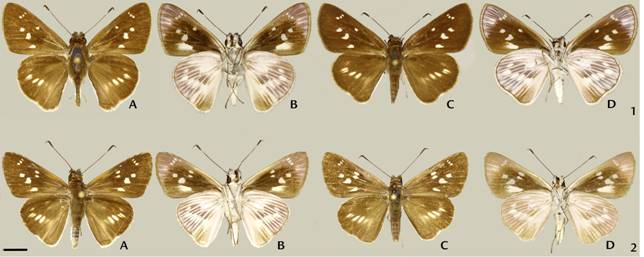
Artonia species in dorsal and ventral views. (1) Artonia artona: (A-B) male, Vossoroca, Tijucas do Sul, Paraná, Brasil, DZ 73.192; (C-D) female, Jardim Zoológico, Curitiba, Paraná, Brazil, OM 34.511; (2) Artonia guiania: (A-B) male, Reserva Catuaba, Senador Guiomard, Acre, Brazil, OM 65.116; (C-D) female, Reserva Humaitá, Porto Acre, Acre, DZ 73.160. Scale bar: 5 mm.
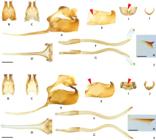
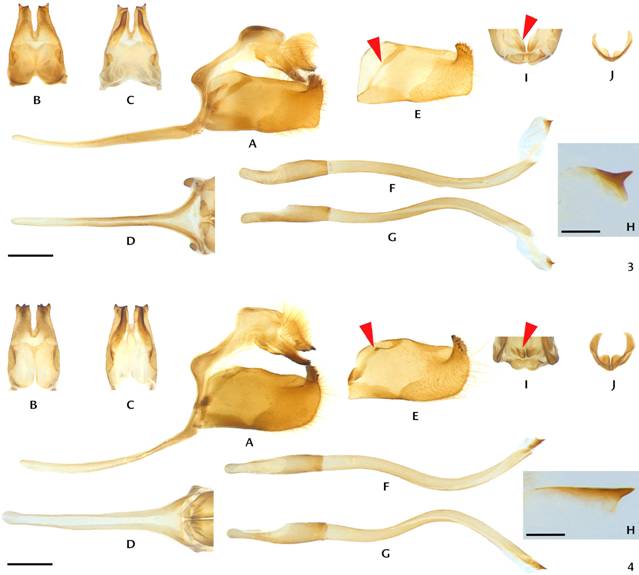
Male genitalia of Artonia species. (3) Artonia artona, Boca do Mato, Cachoeiras de Macacu, Rio de Janeiro, Brazil, DZ 73.093; (4) Artonia guiania, Fazenda Urupá, Candeias do Jamari, Rondônia, Brazil, OM 42.098: (A) lateral view of tegumen, saccus, uncus, gnathos, and valva; (B) dorsal view of tegumen, uncus and gnathos; (C) ventral view of tegumen, uncus and gnathos; (D) ventral view of saccus; (E) interior view of right valva - the red arrow point to the anteroventrally projected costa; (F) dorsal view of aedeagus; (G) left lateral view of aedeagus; (H) cornutus; (I) dorsal view of fultura inferior - the red arrow point to the terminal spined plate of costa; (J) anterior view of fultura inferior. Scale bars: A-G, I, J = 500 µm, H = 100 µm.
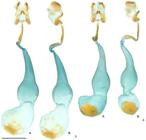
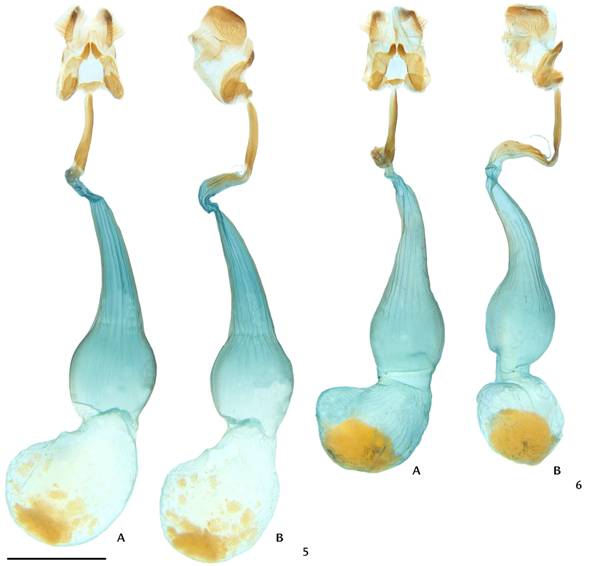
Female genitalia of Artonia species in ventral (A) and lateral (B) views. (5) Artonia artona, Vossoroca, Tijucas do Sul, Paraná, Brasil, DZ 73.108; (6) Artonia guiania, Goiás Velho, Goiás, Brazil, DZ 73.106. Scale bar: 2 mm.
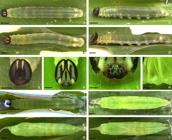
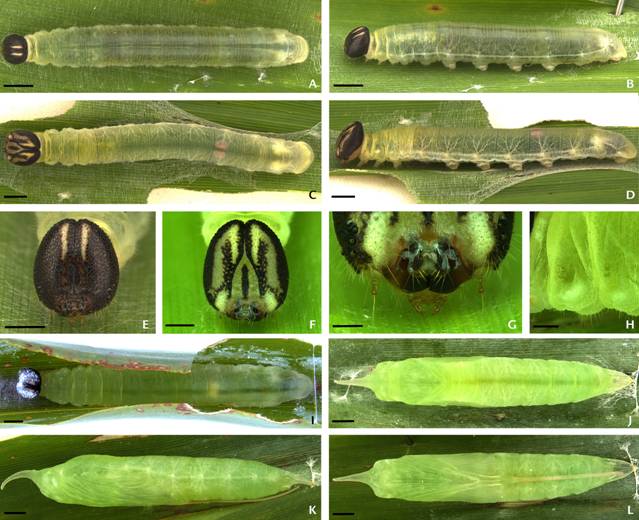
Immature stages of Artonia artona: (A-B) penultimate instar; (C-D) last instar; (E) head of the penultimate instar; (F) head of the last instar; (G) anterior view of mouthparts of the last instar, showing the bilobed labrum; (H) subdorsal ocellus-like structure in the thoracic segments of the last instar; (I) prepupa; (J-L) pupa. Scale bars: A-D, I-L = 2.0 mm, E-F = 1.0 mm, G-H = 0.5 mm.
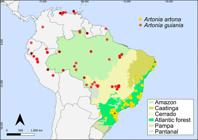
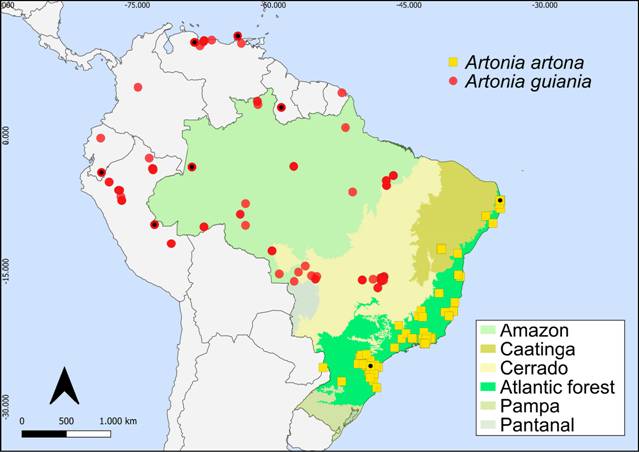
Geographic distribution of Artonia species. Geographic distribution of Artonia species. Symbols with a black center represent confirmed records from the literature.
Diagnosis. Artonia artona differs from the other species of the genus by the following characters: FW discal cell usually with a single semi-hyaline spot (Fig. 1A-D) (see variation section); male genitalia with the ventral margin of the harpe forming an angle of approximately 90° (Fig. 3A, E) and the cornutus shaped as a rounded plate with a concave dorsal margin, ending in a dorsally directed spine (Fig. 3H). Female genitalia are quite similar to those of A. guiania, but the distal triangular projection of the lamella postvaginalis is generally more developed and pointed, and the anterior portion of the sclerotized area of the bursa copulatrix is slightly broader in ventral view (Fig. 5A).
Description. FW length 15-19 mm in males, 15-19 mm in females. Nudum with 12-13 segments in both sexes. Wing pattern as originally described by Hewitson (1868). Male and female genitalia similar to A. guiania, differing in diagnostic characters noted above.
Variation. According to the material examined, the number of spots in the FW discal cell of A. artona ranges from zero to two in males and from one to two in females; however, this variation is more pronounced in females. Among the 149 examined males, only three lack discal spots, and three others exhibit two discal spots. In contrast, of the 88 females, 17 possess two discal spots. Most female specimens with two discal spots are from Paraná and Santa Catarina (Southern Brazil), which may reflect the fact that these states have been more thoroughly surveyed. There are also records of females with two spots from Paraíba, Minas Gerais, and Rio de Janeiro. Other observed variations include a less whitened VHW in specimens from northeastern Brazil compared to those from the southeastern and southern regions, and the presence in some specimens of an additional subapical white spot in R2-R3 on the VFW.
Immature stages (Fig. 7).
Penultimate instar (Fig. 7A-B, E): Head blackish brown, rugose, oval; epicranium with two cream stripes, positioned left and right to epicranial suture. Thorax with narrow, brown prothoracic shield; legs with light brown tips. Body slender, translucent green, cream at extremities; spiracles cream to light brown. Development time since collection: five days.
Last instar (Fig. 7C-D, F-H): Head black, slightly more elongated than in penultimate instar, with following additional cream markings: elongated stripe on each side of head extending from epicranial stripe to stemmatal area, and pair of lighter oval spots between stemmata and mouthparts; adfrontal area and lateral margins of frontoclypeus cream, leaving narrow, black central stripe; labrum bilobed, base narrower than apex. Thorax with cream prothoracic plate; each segment with different number of subdorsal ocellus-like structures (Fig. 7H). Body similar to penultimate instar, slightly paler. Male differing from female by visible gonads, appearing as pair of dorsal, pink, oval spots in sixth abdominal segment (Fig. 7H). Prior to pupation, larva building shelter by joining two lateral edges of leaf with silk, remaining inside for two days (Fig. 7I). During this stage, white waxy substance produced, accumulated mainly on head. Development time: eight days.
Pupa (Fig. 7J-L): Translucent green, somewhat cream dorsally on abdominal segments I and II; head with prominent, pointed, ventrally curved anterior projection; proboscis long, reaching median portion of cremaster, not fused to abdomen; distal half cream to light brown. Body elongated, fusiform; cremaster triangular, dorsoventrally flattened, slightly curved ventrally. Development time: not recorded.
Type Material. Considering that Hesperia artonaHewitson, 1868 was described based on an unspecified number of specimens, the male syntype deposited in the NHMUK is herein designated as the lectotype to ensure the identity of the species. This specimen, illustrated by Warren et al. (2024) has the following labels (each separated by a slash): / TYPE / Rio. [de Janeiro, Brasil] Hewitson Coll. 79-69 Hesperia artona / [illegible red label] /. The following two labels will be added: / LECTOTYPUS / Lectotypus Hesperia artona Hewitson, 1868 Medeiros & O. Mielke det. 2025 /.
Additional examined material (149 ♂♂ and 88 ♀♀). Illustration of the lectotype above designated and available in Warren et al. (2024) and the following specimens: BRAZIL - Paraíba: João Pessoa, 17.III.1979, 1 ♀, Kesselring leg., DZ 73.2632 (DZUP), 6.VIII.1994, 1 ♂, N. Tangerini leg., DZ 73.161 (DZUP). Pernambuco: Garanhuns, 800 m, 18.III.1967, 1 ♂, H. Ebert leg., DZ 73.165 (DZUP), 800-900 m, 20.XII.1960, 1 ♀, XI.1961, 1 ♀, 20.VIII.1967, 1 ♀, 8.IX.1967, 1 female, H. Ebert leg., DZ 73.264, DZ 73.265, DZ 73.094*, DZ 73.164 (DZUP); Goiana, 25.VI.1967, 1 ♂, Kesselring leg., DZ 73.163 (DZUP); Paulista (Granja do Delegado), II.2022, 1 ♂, P. Grossi leg., OM 93.633 (DZUP-OM); Recife, 8.VII.1957, 1 ♂, H. Ebert leg., DZ 73.162 (DZUP). Alagoas: Maceió, no data, 1 ♀, 28.IV.1968, 1 ♀, 8.VII.1973, 1 ♀, 15.VI.1975, 1 ♂, A. Cardoso leg., DZ 73.267, DZ 73.266, DZ 73.268, DZ 73.166 (DZUP). Bahia: Amargosa, 6-8.IV.2002, 1 ♂, O.-C. Mielke leg., OM 55.984 (DZUP-OM); Camacã (Reserva Serra Bonita), 15°23’00”S, 39°33’00”W, 800 m, 16-24.IV.2012, 1 ♂, A. Moser leg., DZ 73.168 (DZUP), 800-900 m, 3-10.XII.2016, 1 ♂, O. Mielke, Carneiro, Dias, Dolibaina & Santos leg., DZ 73.170 (DZUP), (Reserva Serra Bonita, Trilha das Bromélias), 15°23’00’S, 39°34’00”W, 920 m, 3-10.XII.2016, 1 ♂, O. Mielke, Carneiro, Dias, Dolibaina & Santos leg., DZ 73.169 (DZUP); Lençóis, 600 m, 3-7.XII.1997, 2 males, 2 ♀♀, O. Mielke & Casagrande leg., OM 47.632, OM 48.338, OM 47.616, OM 47.640 (DZUP-OM), (14 km N), 650 m, 14.III.1999, 2 males, 1 ♀, O. Mielke leg., OM 50.216, OM 50.188, OM 50.251 (DZUP-OM), (8 km N), 650 m, 15-III.1999, 2 males, O. Mielke leg., OM 50.348, OM 50.432 (DZUP-OM); Mascote (São João do Paraíso, 30 km N de Camacã), 22.VII.1977, 1 ♂, O. Mielke, Moure & C. Elias leg., DZ 73.167 (DZUP); Palmeiras (Pai Inácio), 850 m, 11.III.1999, 2 males, O. Mielke leg., OM 50.241, OM 50.248 (DZUP-OM). Minas Gerais: Belo Horizonte, 4.IV.1966, 1 ♂, Brown leg., OM 10.603 (DZUP-OM); Cambuquira, 100 m, 4.VIII.1968, 1 ♀, H. Ebert leg., DZ 73.269 (DZUP); Carmo do Rio Claro, 5.II.1959, 1 ♀, O. Mielke leg., OM 2.4092 (DZUP-OM); Catas Altas (Serra do Caraça), 1,300 m, 1-5.II.1985, 1 ♂, O. Mielke & Casagrande leg., DZ 73.105*2 (DZUP); Conceição dos Ouros, 30.V.2003, 1 ♂, 30.VIII.2021, 1 ♀, Pereira leg., OM 63.087, OM 87.192 (DZUP-OM), (Serra Grande), 1.365 m, X.2017, 1 ♀, Almeida leg., OM 66.960 (DZUP-OM); Itaipé, 650 m, 29.III.1969, 1 ♂, H. Ebert leg., DZ 73.172 (DZUP); Juiz de Fora (Recanto dos Lagos) 25.II.2010, 1 ♂, N. Tangerini leg., DZ 62.123* (DZUP); Santana do Riacho (Serra do Cipó), 1,300 m, 25-26.X.2003, 1 ♂, O. Mielke leg., DZ 73.171 (DZUP). Espírito Santo: Baixo Guandu, 23.I.1971, 1 ♂, C. & C. T. Elias leg., DZ 73.176 (DZUP); Conceição da Barra, 10.IV.1968, 1 ♂, 26.IV.1968, 1 ♂, 18.VII.1968, 1 ♀, C. & C. T. Elias leg., DZ 73.175, DZ 73.084*, DZ 73.277 (DZUP); Linhares, 20.VII.1972, 1 ♀, 6.III.1973, 1 ♀, 17-22.IX.1973, 1 ♂, X.1980, 1 ♀, C. Elias leg., DZ 73.270, DZ 73.272, DZ 73.173, DZ 73.271 (DZUP), 40 m, 20-29.II.1992, 1 ♂, V. O. Becker leg., OM 50.794 (DZUP-OM); Santa Teresa, 6-13.IX.1966, 1 ♀, 26.VI.1967, 1 ♂, 13.IX.1967, 1 ♀, 27.IX.1967, 1 ♀, 22.XI.1967, 1 ♀, C. & C. T. Elias leg., DZ 73.273, DZ 73.174, DZ 73.274, DZ 73.276, DZ 73.275 (DZUP). Rio de Janeiro: Itatiaia (Parque Nacional do Itatiaia), 19.VII.1961, 1 ♂, O. Mielke leg., OM 3.748 (DZUP-OM), 800 m, 21.IV.1965, 1 ♀, 3.V.1967, 1 ♀, 6.V.1967, 1 ♂, 1,000-1,200 m, 10.VII.1963, 1 ♀, H. Ebert leg., DZ 73.284, DZ 73.280, DZ 73.188, DZ 73.283 (DZUP), 750 m, 22.IV.1969, 1 ♂, 1,000-1,200 m, II.1959, 1 ♂, H. Ebert leg., DZ 73.179, DZ 73.067* (DZUP); Cachoeiras de Macacu (Boca do Mato), 30.V.2000, 1 ♂, 15.VI.2000, 1 ♂, 10.VIII.2000, 1 ♂, 20.VIII.2001, 1 ♂, 13.VI.2003, 1 ♂, N. Tangerini leg., DZ 73.184, DZ 73.185, DZ 73.183, DZ 73.093*, DZ 73.181 (DZUP); Magé, 3.VII.1968, 1 ♂, Brown leg., DZ 73.177 (DZUP); Miguel Pereira, 800 m, 18.II.1966, 1 ♂, H. Ebert leg., DZ 73.180 (DZUP); Nova Friburgo (Sans Souci), 20.III-24.IV.2005, 2 males, P. Grossi leg., OM 65.787, OM 93.652 (DZUP-OM); Petrópolis (Alto da Serra), 15.VIII.1960, 1 ♂, 15.IV.1962, 1 ♂, 15.IX.1963, 1 ♀, O. Mielke leg., OM 3.416, OM 4.318, OM 5.409 (DZUP-OM); Resende (Penedo), 450 m, 20.II.1957, 1 ♀, no collector, DZ 73.2782 (DZUP); Rio de Janeiro (Alto da Boa Vista), 28.X.1963, 1 ♀, O. Mielke leg., OM 5.451 (DZUP-OM), (Covanca, Jacarepaguá), 18.V.1958, 1 ♀, no collector, OM 2.036 (DZUP-OM), 9.IV.1945, 1 ♂, no collector, DZ 73.187 (DZUP), 24.III.1940, 1 ♂, D’Almeida leg., DZ 73.178 (DZUP), 18.VIII.1957, 1 ♀, N. Tangerini leg., DZ 73.2852 (DZUP), 19.VIII.1962, 1 ♀, 18-IV.1964, 1 ♂, O. Mielke leg., OM 4.635, OM 5.741 (DZUP-OM), (Gavea), 19.VII.1936, 1 ♂, Travassos & Oiticica leg., DZ 73.186 (DZUP), (Morro Dona Marta), XII.1935, 1 ♂, N. Tangerini leg., DZ 73.182 (DZUP), (Paineiras), 2.XII.1956, 1 ♀, Gagarin & D’Almeida leg., DZ 73.2792 (DZUP), 500 m, 13.VII.1952, 1 ♀, 15.III.1953, 1 ♀, H. Ebert leg., DZ 73.2812, DZ 73.286 (DZUP), (Sumaré), 5.IV.1959, 1 ♀, 7.V.1965, 1 ♂, O. Mielke leg., OM 532, OM 6.823 (DZUP-OM), 9.XII.1966, 1 ♀, N. Tangerini leg., DZ 73.066* (DZUP); São José do Vale do Rio Preto, 16.IV.1965, 1 ♂, N. Tangerini leg., DZ 73.189 (DZUP); Teresópolis (Parque Nacional da Serra dos Órgãos), 900 m, 8.V.1968, 1 ♀, H. Ebert leg., DZ 73.282 (DZUP). São Paulo: São Paulo (Serra da Cantareira), 30.IV.1941, 1 ♂, no collector, DZ 73.190 (DZUP); Paraná: Antonina (Cacatu), 9.IV.1982, 1 ♂, O. Mielke leg., DZ 76.065 (DZUP); Balsa Nova (São Luiz do Purunã), 3.III.1972, 1 ♂, no collector, DZ 73.207 (DZUP), 4.IV.1981, 1 ♂, O. Mielke & Casagrande leg., DZ 73.196 (DZUP), 8.III.1980, 1 ♂, O. Mielke leg., DZ 73.208 (DZUP); Campo Largo (Rio Verde), 25°26’23”S, 49°27’51”W, 895 m, 29.IV.2001, 1 ♀, Bizarro leg., DZ 73.2962 (DZUP); Cerro Azul, 600 m, 28.IX.1985, 1 ♂, O.-C. Mielke leg., DZ 73.201 (DZUP); Curitiba (Uberaba - Tirol das Torres), 11.IV.2021, 1 ♂, 11.IV.2024, 1 ♂, O. Mielke leg., OM 92.062, OM 94.004 (DZUP-OM), (Zoológico Municipal de Curitiba), 25.II.1993, 2 ♀♀, C. Mielke leg., OM 34.511, OM 34.594 (DZUP-OM); Foz do Iguaçu (Parque Nacional do Iguaçu), 21-24.IV.1995, 1 ♂, O. Mielke & Casagrande leg., DZ 73.209 (DZUP); Imbituva, 3.IV.1971, 1 ♂, 1 ♀, Moure & O. Mielke leg., DZ 73.295, DZ 73.2122 (DZUP); Jaguariaiva (Parque Estadual do Cerrado) 1-3.III.2015, 1 ♀, O. Mielke, Dolibaina & Siewert leg., DZ 73.099* (DZUP); Morretes (Alto da Serra), 800 m, 2.IV.2003, 1 ♀, O. Mielke leg., OM 60.3872 (DZUP-OM); Paranaguá (Alexandra) 3.X.1968, 1 ♀, O. Mielke leg., DZ 73.297 (DZUP); Piên (Trigolândia), 850 m, 5.XII.2022, 1 ♂, 10.V.2023, 1 ♀, 15.V.2023, 1 ♀, 10.V.2024, 1 ♂, Rank leg., DZ 73.214 DZ 73.294, DZ 73.293, DZ 73.210 (DZUP); Ponta Grossa (Parque Estadual de Vila Velha), 25.IV.2002, 1 ♂, 1 ♀, O. Mielke leg., DZ 73.298, OM 92.896 (DZUP, DZUP-OM); Pontal do Paraná (Atami), 10 m, 26-31.XII.2007, 2 ♀♀, O. Mielke leg., DZ 73.290, DZ 73.291 (DZUP), 20.IV.1992, 1 ♂, O. Mielke leg., OM 32.931 (DZUP-OM); Tibagi, 10.II.1994, 1 ♀, O. Mielke & Casagrande leg., OM 40.9962 (DZUP-OM); Tijucas do Sul (Vossoroca), 18.IV.1970, 1 ♂, IV.1971, 1 ♂, 2 ♀♀, 7.IV.1971, 6 ♂♂, 1 ♀, Moure & O. Mielke leg., DZ 73.213, DZ 73.108*, DZ 73.289, DZ 73.204, DZ 73.287, DZ 73.191, DZ 73.194, DZ 73.198, DZ 73.199, DZ 73.205, DZ 73.206 (DZUP), 20.III.1971, 2 ♂♂, 18.I.1981, 1 ♀, 850 m, 20.III.1971, 1 ♂, 8.III.1972, 1 ♂, 2.XI.1978, 3 males, 28.II.1979, 1 ♂, 8.II.1981, 1 ♂, O. Mielke leg., DZ 73.086*2, DZ 73.193, DZ 73.288, DZ 73.192, DZ 73.203, DZ 73.085*, DZ 73.195, DZ 73.197, DZ 73.200, DZ 73.211 (DZUP); Ventania (12 km NW), 1,000 m, 30.XI.2008, 1 ♂, O. Mielke leg., DZ 73.202 (DZUP), (12,5 km N), 1,000 m, 21-22.I.2006, 1 ♂, O.-C. Mielke leg., DZ 73.209 (DZUP). Santa Catarina: Brusque, 15.XII.1967, 1 ♂, V. O. Becker leg., DZ 73.247 (DZUP); Florianópolis (Naufragados), 18.IV.2005, 1 ♀, E. C. Santos leg., DZ 73.3202 (DZUP); Joinville, 27.X.1968, 2 ♂♂, 19.II.1970, 1 ♂, 27.III.1970, 5 males, 2 males, O. Mielke leg., DZ 73.239, DZ 73.242 DZ 73.217 DZ 73.102, DZ 73.235, DZ 73.236, DZ 73.237, DZ 73.240, OM 17.340, OM 17.341 (DZUP), 12.III.1966, 1 ♂, V.1966, 1 ♂, 27.III.1967, 2 ♂♂, VIII.1967, 1 ♂, 1 ♀, 4.I.1970, 1 ♀, 9.IV.1978, 1 ♀, Miers leg., OM 10.656 (DZUP-OM), DZ 73.238, DZ 73.233, DZ 73.243, DZ 73.314, DZ 73.241, DZ 73.313, DZ 73.3162 (DZUP), 31.XII.1986, 2 ♂♂, 18.IV.1987, 1 ♂, 31.X.1987, 1 ♂, 29.XII.1987, 1 ♂, 4.I.1988, 1 ♂, 8.X.1988, 1 ♂, 31.X.1989, 1 ♂, 30.XI.1999, 1 ♀, Miers & O. Mielke leg., OM 51.983, OM 52.270, OM 51.9690, OM 52.4100, OM 16.833, OM 51.160, OM 18.843, OM 52.151, OM 50.343 (DZUP-OM), 10-200 m, 20.IV.1969, 1 ♂, 12.IV.1971, 1 ♀, 1.V.1971, 1 ♀, 1.X.1971, 1 ♀, Miers leg., DZ 73.219, DZ 73.310, DZ 73.307, DZ 73.308 (DZUP), 28.X.1967, 2 ♂♂, 20.IV.1969, 1 ♂, 2 ♀, 5.VII.1969, 3 ♂♂, 11.X.1969, 1 ♂, 5.IX.1970, 2 ♂♂, 24.IV.1971, 1 ♀, 9.X.1971, 1 ♂, 9.X.1972, 1 ♂, 6.III.1973, 1 ♂, 15.I.1977, 1 ♂, 22.II.1977, 1 ♂, 1 ♀, 5.IV.1980, 1 ♀, Miers & O. Mielke leg., DZ 73.231, DZ 73.232, DZ 73.3172, DZ 73.218, DZ 73.312, DZ 73.215, DZ 73.222, DZ 73.248, DZ 73.087*, DZ 73.224, DZ 73.2250, DZ 73.311, DZ 73.234, DZ 73.230, DZ 73.223, DZ 73.244, DZ 73.315, DZ 73.245, DZ 73.3092 (DZUP); (Itororó), 20.XI.1970, 4 ♂♂, O. Mielke leg., DZ 73.226, DZ 73.227, DZ 73.228, DZ 73.229 (DZUP), 200 m, 1.XII.2007, 1 ♂, O. Mielke leg., DZ 73.220 (DZUP), (Serrinha), 250 m, 1.XI.2010, 1 ♂, Rank leg., DZ 73.249 (DZUP), 6.XI.2010, 2 ♂♂, O. Mielke & Dias leg., DZ 73.250, DZ 73.251 (DZUP); Pinhal, IV.1967, 2 ♀♀, Walter leg., DZ 73.096*, DZ 73.318 (DZUP); Rio dos Cedros (Alto Rio dos Cedros), 650 m, 16.II.1972, 1 ♀, Lauterjung leg., DZ 73.319 (DZUP); São Bento do Sul, 100 m, 15.III.1980, 1 ♂, H. Ebert leg., DZ 73.246 (DZUP), (Rio Natal), 500 m, 26.IV.1994, 1 ♀, 15.II.2012, 1 ♀, 11.IV.2018, 1 ♀, Rank leg., OM 40.477 (DZUP-OM), DZ 73.2992 (DZUP), OM 89.238 (DZUP-OM), 16.IV.2007, 1 ♂, Rank leg., DZ 73.252 (DZUP), (Rio Vermelho), 850, 18.IV.2016, 1 ♀, 10.V.2023, 1 ♀, 15.V.2023, 2 ♀♀, 27.V.2023, 1 ♀, 20.V.2024, 1 ♀, 5.VI.2024, 1 ♀, Rank leg., DZ 73.300, DZ 73.306, DZ 73.301, DZ 73.302, DZ 73.305, DZ 73.304, DZ 73.3032 (DZUP), 800 m, 6.III.1987, 1 ♀, Rank leg., OM 13.9062 (DZUP-OM), 850 m, 31.III.1974, 1 ♂, 6.V.2019, 3 ♀♀, 21.XII.2019, 1 ♀, 10.V.2020, 1 ♂, 24.V.2020, 1 ♀, 14.VI.2021, 1 ♀, 21.IV.2023, 1 ♂, 5.V.2023, 1 ♂, 20.V.2023, 1 ♂, 26.V.2023, 1 ♂, 27.V.2023, 2 ♂♂, 26.VII.2023, 1 ♂, 27.III.2024, 1 ♀, 21.IV.2024, 1 ♂, 20.V.2024, 1 ♂, 5.VI.2024, 1 ♂, 12.VI.2024, 1 ♂, Rank leg., DZ 73.221 (DZUP), OM 89.187, OM 89.4582, OM 89.528, OM 92.197, OM 92.196, OM 92.200, OM 92.198 (DZUP-OM), DZ 73.260, DZ 73.216, DZ 73.262, DZ 73.257, DZ 73.255, DZ 73.256, DZ 73.253, DZ 73.089*, DZ 73.258, DZ 73.259, DZ 73.254, DZ 73.261 (DZUP).
Etymology. Not provided by the author.
Hostplants. Bromeliaceae A. Juss. (Silva et al. 1968) and grasses (Glassberg 2017). In our study, the immature stages were recorded feeding on an unidentified species of Poaceae Barnhart.
Distribution and phenology. All confirmed records for A. artona are restricted to the Brazilian Atlantic Forest biome, where the species inhabits forested environments, montane forests (including enclaves within the Caatinga biome), and hilltops, ranging from 10 to 1,700 m a.s.l. (Fig. 8). Collection data indicate that this species has been recorded in every month, suggesting multiple synchronized generations throughout the year. Confirmed additional records from the literature are: BRAZIL - Paraíba: Bayeux (Parque Estadual Mata do Xem-Xem) (Gualberto et al. 2024). Paraná: Curitiba (Centro Politécnico, UFPR) (Pereira et al. 2015).
Remarks. The male genitalia of A. artona were not illustrated in the original description (Hewitson 1868). Genital illustrations attributed to A. artona by Godman (1901), Hayward (1934, 1950), and Evans (1955) likely correspond to A. guiania or A. darienia, as indicated by the rounded ventral margin of the harpe. Despite this uncertainty, these references are here provisionally reassigned to the catalogue of A. guiania until the illustrated material can be directly examined. Considering the allopatric distribution of the two South American Artonia species, the following additional literature records from the Atlantic Forest biome most likely correspond to A. artona: BRAZIL - Paraíba: João Pessoa (Mata do Buraquinho) (Kesselring and Ebert 1982). Pernambuco: Caruaru (Parque Ecológico João Vasconcelos Sobrinho) (Paluch et al. 2011); Recife (Parque Estadual Dois Irmãos) (Melo et al. 2019). Bahia: Serra da Jibóia (Zacca et al. 2011); Itanagra (Private Reserve of Natural Heritage “Fazenda Lontra/Saudade”) (Paluch et al. 2016). Espírito Santo: Linhares (Reserva Natural Vale) (Freitas et al. 2016). Minas Gerais: Poços de Caldas (Ebert 1969). Rio de Janeiro: Itatiaia (Silva et al. 1968, Zikán and Zikán 1968); Teresópolis (Serra dos Órgãos) (Bizarro and Martin 2020). São Paulo: Jundiaí (Serra do Japi) (Brown Jr. 1992). Paraná: Quatro Barras (Serra da Baitaca State Park - Anhangava Mountain); Tijucas do Sul (Araçatuba Mountain); Campina Grande do Sul (Pico Paraná State Park - Caratuva Mountain) (Carneiro et al. 2014); Guarapuava (Dolibaina et al. 2011). Santa Catarina: Florianópolis (Ilha de Santa Catarina) (Carneiro et al. 2008); Joaçaba (Orlandin et al. 2019, 2020); Massaranduba (Hoffmann 1934). Rio Grande do Sul: São Francisco de Paula (Bosque de Araucária, FLONA-SFP) (Marchiori et al. 2014); São Leopoldo (Biezanko and Mielke 1973).
Artonia guiania Grishin, 2025
Carystus artona [misid.]: Godman, 1900, in Godman & Salvin. Biol. Centr. Amer., Lep.-Rhop. 2, p. 586; 3, pl. 102, figs 16, 17 (male d, v), 18 (male gen.). - Hayward, 1934. Rev. Soc. ent. arg. 6: 104, 169, 200, pls 11, figs 15, 16 (d, v), 18, fig. 17 (male gen.).
Vettius artona [misid.]: Hayward, 1950, in Descole (ed.). Gen. Sp. Anim. Arg. 2, p. 282, 287, pls 12, fig. 11 (male gen.), 24, fig. 19 (v).- Evans, 1955. Cat. Amer. Hesp. 4, p. 185, pl. 66 (male gen.) - O. Mielke & Casagrande, 1992. Acta Amaz. 21: 201.
Artonia guiania Grishin, 2025 in Zhang et al. Insecta Mundi 1148: 234, figs 16 (Z chromosome and mitochondrial genome tree), 564, 565 (male d, v), 1329, 1330, 1331 (male gen.); holotype male, Guyana: Two Hat Mt, E. Kanukus, S. Rupununi, S. Slope, 850-1200’, 21-28.IX.2000 3°6.8’N 59° 5.9’W S. Fratello et al. leg.; USNM.
Diagnosis. Artonia guiania differs from the other species of the genus by the following characters: FW discal cell usually with two semi-hyaline white spots (Fig. 2A-D; see variation section); male genitalia with the ventral margin of the harpe rounded (Fig. 4A, E), and the cornutus shaped as an elongated plate with a straight dorsal margin, ending in a distally directed spine (Fig. 4H). Female genitalia are quite similar to those of A. artona, but the distal triangular projection of the lamella postvaginalis is generally less developed, and the distal portion of the sclerotized area of the ductus bursae is slightly narrower in ventral view (Fig. 6).
Redescription. Male (Figs 2A-B, 4A-H). Ground color dark brown. FW length 14-17 mm.
Head: Vertex with white spot; transfrontal, frontoclypeal, and laterofacial sutures covered with elongate white scales; patches of yellow to red ferruginous scales anterior and posterior to antenna, behind eye, and along collar. Antenna longer than half length of costa, white ventrally beneath club and at base of shaft segments; apiculus ventrally yellow; nudum with 12-13 segments. Labial palpus mixed with white, brown, and black scales; second segment laterally with diffuse cream spot near apex; third segment short, conical.
Thorax: Ventrally white. Legs ventrally white; midtibia with spines and pair of apical spurs; hind tibia with pair of median and apical spurs.
Wings: DFW (Fig. 2A): Costal area and Sc-R1 faintly yellow. Three small, semihyaline subapical white spots between R3 and M1. Four semihyaline discal white spots: two elliptical in discal cell; one rectangular in M3-CuA1; one irregular and larger in CuA1-CuA2. Opaque, triangular to rectangular white spot in lower half of CuA2-2A. Marginal line slightly darker than ground color. Fringe grayish brown. DHW (Fig. 2A): band of seven elongate, opaque white spots between Sc+R1 and 2A; anterior and two posterior spots very faint; spots between M1 and M3 narrower. Marginal line and fringe as on DFW. VFW (Fig. 2B): Costal area gray to pale yellow. Spots mirroring DFW, but spot in CuA2-2A much larger and irregularly diffuse. Apex purple-grayish with white streaks between veins, slightly broader between M1 and CuA1. Marginal line brown. Fringe gray. VHW (Fig. 2B): Slightly purple, except for light brown anal fold. Veins white; entire wing scaled with white, particularly at base. Spots similar to DHW, but extending distally as white streaks between veins. Marginal line brown. Fringe gray to white.
Abdomen: Ventrally white, sometimes with vestigial, discontinuous brown median line.
Genitalia (Fig. 4A-J): Tegumen nearly square; anterior margin deeply indented medially. Saccus long, narrow. Uncus bifid; apex of each arm truncated, with short, slightly curved distolateral projection. Gnathos longer than uncus; arms with parallel, pointed apex. Valva rectangular, twice as long as wide; costa anteroventrally projected, ending in spined plate connected to fultura inferior and sacculus by narrow membranous joint; ampulla elongated; harpe broad, ventrally rounded, dorsally ending in spined, finger-like projection. Aedeagus longer than valva+saccus; distal half strongly curved and twisted to left; coecum rounded. Fultura inferior semicircular.
Female (Figs 2C-D, 6A-B). Ground color dark brown. FW length 14-18 mm. Similar to male, differing by more rounded HW and somewhat larger FW discal spots.
Genitalia (Fig. 6A-B): Tergum VIII Z-shaped, weakly sclerotized. Sterigma triangular; lateral projection rounded. Lamella antevaginalis wider than long. Lamella postvaginalis composed of central triangular membranous area, laterally bordered by two elongated sclerotized plates abruptly converging to median triangular distal projection. Ostium at anterior margin of sterigma. Bursa copulatrix nearly 7.5 times longer than sterigma; ductus bursae with initial third sclerotized, dorsoventrally flattened, connected to remaining membranous portion by pronounced sinuosity; ductus seminalis arising dorsally at beginning of ductus bursae sinuosity. Papilla anal rectangular.
Variation. Artonia guiania exhibits a reduction in the size and number of white spots in specimens from the northernmost parts of its distribution. For example, individuals from Ecuador display only a single spot in the discal cell, and all spots on both wings are somewhat reduced in size. In contrast, some specimens from Venezuela, Colombia, and Peru bear two spots in the discal cell, but only on the ventral surface, while on the dorsal surface the lower spot is absent. In contrast to A. artona, where discal cell spot variation is more frequent in females, in A. guiania it predominantly occurs in males.
Type Material. Holotype ♂ deposited in the USNM with the following labels (each separated by a slash) / GUYANA: Two Hat Mt, E.Kanukus, S.Rupununi, S. Slope 850-1200’ 21-28.IX.2000 3° 6.8’N 59° 5.9’W Leg. S. Fratello et al / DNA sample ID: NVG-19022F05 c/o Nick V. Grishin / DNA sample ID: NVG-23121B05 c/o Nick V. Grishin / genitalia NVG241121-42 c/o Nick V. Grishin / {QR Code} USNM ENT 00178962 / HOLOTYPE ♂ /.
Additional examined material (74 ♂♂ and 45 ♀♀). COLOMBIA - Caldas: Victoria (Bellavista Reserve), 23.IV.2012, 1 ♂, Gaviria leg., DZ 73.076*1 (DZUP). VENEZUELA - (Massif de Naiguatá), 720 m, 27.IX.1959, 1 ♂, Lichy leg., OM 40.434 (DZUP-OM). Arágua: Girardot (Choroni), 250 m, V.1972, 1 ♂, V.1974, 2 ♂♂, III.1975, 1 ♀, Romero leg., DZ 73.110 DZ 73.109, DZ 73.111 (DZUP), OM 91.0941 (DZUP-OM). Maracay (Rancho Grande), 1100 m, 6.I.1965, 1 ♀, Lichy leg., OM 40.170* (DZUP-OM). Carabobo: Libertador (La Araguata), 19.X.1957, 1 ♂, Yépez & Rosales leg., DZ 73.079* (DZUP). Monagas: Caripe, 10°10’27”N, 63°30’19”W, 860 m, VII.2017, 1 ♂, no collector, OM 88.490*1 (DZUP-OM). ECUADOR - Santo Domingo de los Tsáchilas: San José de Alluriquín (Tinalândia), 800 m, 8.II.2001, 1 ♂, O. Mielke & Casagrande leg., OM 52.534*1 (DZUP-OM). FRENCH GUIANA - Cayenne: Roura (Montagne des Chevaux), 3.I.2010, 1 ♂, no collector, DZ 73.077* (DZUP). PERU - Amazonas: (Jorge Chávez), 1700 m, 10.XII.2003, 1 ♂, 1 ♀, no collector, OM 63.753, OM 63.788 (DZUP-OM). Loreto: Iquitos, no data, 1 ♂, no collector, DZ 73.114 (DZUP), (Clotilde), XII.2014, 1 ♂, Ramírez leg., OM 79.294 (DZUP-OM), (Picuroyacu), IV.2016, 1 ♂, J. J. Ramírez H. leg., OM 80.266 (DZUP-OM), (Rio Itaya, Meliton Carbajal), XI.2017, 1 ♀, Ramírez leg., DZ 73.088* (DZUP), (Rio Momón, Centro Fuerte), XI.2017, 1 ♂, Ramírez leg., DZ 73.116 (DZUP). Madre de Dios: (Parque Nacional del Manu, Pakitza), 340 m, 5.X.1991, 1 ♂, 17.X.1991, 1 ♂, O. Mielke leg., DZ 73.113, DZ 73.112 (DZUP), 11°55’48”S, 71°15’18”W, 5.X.1991, 1 ♀, R. Robbins leg., DZ 73.141 (DZUP). San Martín: Juanjuí, IX.1925, 1 ♀, VII.1955, 1 ♂, VII.1975, 1 ♀, Klug leg., OM 91.084 (DZUP-OM), DZ 73.115, DZ 73.142 (DZUP), 200 m, 15.IX.2002, 2 ♀♀, 11.X.2002, 1 ♀, no collector, OM 60.282, OM 60.471, OM 60.168 (DZUP-OM), Moyobamba, 06°02’13”S, 76°58’22”W, 800 m, X.2016, 3 ♂♂, 1 ♀, J. Pintado leg., OM 80.778, OM 80.818, OM 80.858, OM 81.1591 (DZUP-OM), (Calzada), X.2015, 3 ♂♂, J. Pintado leg., OM 79.234, OM 79.244, OM 79.2741 (DZUP-OM); 06°01’51”S, 77°03’54”W, 850 m, X.2016, 5 ♂♂, J. Pintado leg., OM 83.096, OM 83.167, OM 83.585, OM 83.605*1, OM 83.627 (DZUP-OM), Saposoa (Pasarraya), 25.VIII.2012, 1 ♀, C. Calderon leg., OM 74.051 (DZUP-OM). BRAZIL - Roraima: Alto Alegre (Ilha de Maracá), 23-28.II.1988, 1 ♂, O. Mielke & Casagrande leg., DZ 62.113* (DZUP); Amajari (Tepequém), 620 m, 14-16.VII.2009, 1 ♂, 1 ♀, O. Mielke & Casagrande leg., DZ 73.107*, DZ 73.101 (DZUP); Amapá: Serra do Navio, 29.VII.2007, 1 ♀, O. Mielke & Casagrande leg., DZ 73.143 (DZUP). Amazonas: Humaitá (Rio Ipixuna, 40 km W de Humaitá), 5.VII.2001, 1 ♂, O. Mielke leg., OM 53.028 (DZUP-OM); Maués (Rio Preto), 15-30.XI.2007, 1 ♂, 1 ♀, 1-15.III.2008, 1 ♂, 1 ♀, 15-30.III.2008, 2 ♀♀, 16-31.III.2008, 1 ♂, 1 ♀, 15-30.IV.2008, 3 ♂♂, 2 ♀♀, 15-30.V.2009, 1 ♂, no collector, OM 69.503, OM 69.454 OM 69.998*, OM 70.194, OM 70.961, OM 71.011*, OM 70.176, OM 70.029, OM 70.527, OM 70.537, OM 70.517, OM 70.627, OM 70.737, OM 71.472 (DZUP-OM). Pará: Ourilãndia do Norte (Serra da Onça), 21.VII.1976, 1 ♀, Gifford leg., DZ 73.144 (DZUP). Acre: Senador Guiomard (Reserva Catuaba), 200 m, 2-5.IX.2004, 3 ♂♂, 8-10-IX-2004 1♀, O. Mielke & Casagrande leg., DZ 73.075*, DZ 73.117, DZ 73.118, DZ 73.160 (DZUP). Rondônia: Cacaulândia (Linha 105, km [ilegível], 50 km N Ariquemes), 10-22.VII.1991, 1 ♂, C. Mielke & Miers leg., OM 27.411 (DZUP-OM); Candeias do Jamari (Fazenda Urupá), 8-10.XII.1996, 2 ♂♂, O.-C. Mielke & Miers leg., OM 42.034, OM 42.098* (DZUP-OM); Vilhena 29.X.1986, 1 ♀, 23.IX.1986, 2 ♂♂, 12.XI.1986, 1 ♀, 27.XI.1986, 2 ♂♂, 27.XII.1986, 1 ♀, C. Elias leg., DZ 73.147, DZ 73.135, DZ 73.136, DZ 73.146, DZ 73.081*, DZ 73.133, DZ 73.145 (DZUP), 20.VI.1978, 1 ♂, Gifford leg., DZ 73.134 (DZUP), (57-81 km NW), 320 m, 6.VII.1972, 1 ♂, O. Mielke & Brown leg., DZ 73.132 (DZUP). Maranhão: Açailândia, 22.VIII.1974, 1 ♂, 1 ♀, 23.VIII.1974, 3 ♂♂, O. Mielke leg., DZ 73.098*, DZ 73.127, DZ 73.121, DZ 73.122, DZ 73.126 (DZUP), Imperatriz, 3.VII.1974, 1 ♂, 8.VIII.1974, 2 ♂♂, 14.VIII.1974, 1 ♂, Exc. Depto. Zool. leg., DZ 73.125, DZ 73.080*, DZ 73.124, DZ 73.123 (DZUP), Santa Luzia (Fazenda Terrasse, km 108 estrada Açailândia-Santa Luzia), 3.VIII.1974, 1 ♂, 4.VIII.1974, 5 ♂♂, O. Mielke leg., DZ 73.129, DZ 73.119, DZ 73.120, DZ 73.128, DZ 73.130, DZ 73.131 (DZUP). Mato Grosso: Barra do Bugres (Alto Rio Paraguai), 150 m, 26-29.VII.1974, 1 ♀, H. & H. D. Ebert leg., DZ 73.097* (DZUP); Campo Verde (São José da Serra, Alto Rio das Mortes), 700 m, 24.VI.1972, 2 ♀♀, 15.VII.1972, 1 ♀, O. Mielke & Brown leg., DZ 73.151, DZ 73.083*, DZ 73.149 (DZUP); Cárceres, 16.XI.1984, 1 ♀, Buzzi, O. Mielke, C. Elias & Casagrande leg., DZ 73.148 (DZUP); Chapada dos Guimarães, 700 m, 16.V.1978, 1 ♂, no collector, DZ 73.092* (DZUP); Diamantino (Alto Rio Arinos, Fazenda São João), 3.IX.1978, 1 ♀, O. Mielke & Furtado leg., DZ 73.150 (DZUP); Pontes e Lacerda (Serra do Patrimônio), 15°16’22”S, 59°19’33”W, 300-500 m, 11.VII.2015, 1 ♀, L. Queiroz-Santos & J. P. Santos leg., DZ 73.095* (DZUP). Goiás: Goiás Velho, 25.II.1974, 1 ♀, 10.VI.1977, 1 ♀, Gifford leg., DZ 73.106*, DZ 73.152 (DZUP), 25-26.II.1979, 1 ♂, Raw leg., OM 91.074 (DZUP-OM), 9.II.1980, 1 ♀, no collector, OM 91.104* (DZUP-OM); Pirenópolis, 820 m, 25.IX.2010, 1 ♂, E. Emery leg., DZ 73.137 (DZUP); Vianópolis (Ponte Funda), 26.I.1986, 1 ♂, 12.II.1986, 1 ♂, N. Tangerini leg., DZ 73.104*, DZ 73.082* (DZUP). Distrito Federal: Brasília, 9.VII.1977, 1 ♂, Gifford leg., DZ 73.091* (DZUP), 1000 m, 21.II.1968, 1 ♀, K. Ebert leg., DZ 73.156 (DZUP), (APA Gama e Cabeça de Veado), 20.VIII.1978, 1 ♀, IV.1979, 1 ♀, Gifford leg., DZ 73.159, DZ 73.157 (DZUP), (Escola Fazendária), 5.VI.1977, 1 ♀, 21.VI.1977, 1 ♀, Gifford leg., DZ 73.153, DZ 73.155 (DZUP), (km 11 Buritis), 30.VI.1976, 1 ♀, Gifford leg., DZ 73.158 (DZUP), (Parque Recreativo do Gama), 1000 m, 17.VI.1972, 1 ♀, 20.VI.1972, 1 ♂, 28.VI.1972, 1 ♂, O. Mielke & Brown leg., DZ 73.090*, DZ 73.138, DZ 73.139 (DZUP), Planaltina (Cérrego Grotão), 908 m, 13-15.IV.2011, 1 ♂, E. Emery leg., DZ 73.140 (DZUP), 912 m, 25.I.2012, 1 ♂, E. Emery leg., DZ 73.103 (DZUP); Sobradinho, 20.VI.1980, 1 ♀, no collector, DZ 73.154 (DZUP).
Distribution and phenology. Based on the material examined, A. guiania occurs in humid forest areas from Venezuela to central Brazil, at elevations ranging from 150 to 1,700 m a.s.l. (Fig. 8). Collection data indicate that this species has been recorded in every month of the year, suggesting the occurrence of several generations throughout the year. Confirmed additional records from the literature are: ECUADOR - Zamora-Chinchipe: Zamora (Evans 1955). PERU - Ucayali (Evans 1955). TRINIDAD AND TOBAGO - El Tucuche and Lalaja Ridge (Cock 2009; identification confirmed by Dr. Matthew Cock). BRAZIL - Amazonas: São Paulo de Olivença (Evans 1955).
Remarks. As mentioned in the remarks section for A. artona, the illustrations of male genitalia attributed to this species in the literature may correspond to A. guiania or A. darienia. However, the identification of the specimens used by these authors to depict the wing pattern is uncertain. For instance, the specimen illustrated by Godman (1901) displays two relatively large spots in the discal cell of the FW and may correspond to A. guiania or A. darienia. Nevertheless, the author stated that he possessed material from Nicaragua, Guyana, and southern Brazil, but failed to indicate the origin of the illustrated specimen. The specimen illustrated by Hayward (1934), however, shows only one spot in the discal cell, and the genitalia figure provided is an exact reproduction of that published by Godman (1901). Years later, Hayward (1950) presented another illustration, this time of a specimen with two spots in the discal cell. In both works, the author states that the species occurs from Nicaragua to Brazil and also in Misiones, Argentina, but fails to indicate the provenance of the illustrated material. Therefore, as with the genitalia illustrations, the other figures provided by these authors cannot be confidently associated with either Artonia species.
There is a reduction of wing spots in specimens from the northern range of A. guiania. A similar reduction is seen in specimens illustrated from Trinidad and Tobago (Lewis 1973) and Venezuela (Uehara 2013), although their identification remains unconfirmed. Nonetheless, we interpret this spot reduction as an intraspecific variation within A. guiania, based on two factors: the lack of diagnostic characters in the male and female genitalia, and the apparent clinal pattern with southern populations exhibiting more prominent spots, which gradually reduce through Peru, Venezuela, and Colombia. Considering the allopatric distribution of the two South American Artonia species, the following additional literature records likely correspond to A. guiania: COLOMBIA - Chocó: San José del Palmar (Zona del Bajo Palmar) (Vargas-Ch. and Salazar 2014). Putumayo: (Centro Experimental Amazónico) (Salazar et al. 2010); Mocoa - Villagarzón (Río Mocoa) (Montero-Abril et al. 2022). Valle del Cauca: (Upper Garrapatas Valley) (Salazar and López 2002); Tuluá (Reserva Natural de la Sociedad Civil Los Chagualos) (Gaviria-O. and Henao-B. 2014). TRINIDAD AND TOBAGO - Port of Spain (Williams and Bell 1931). Tunapuna-Piarco: Tunapuna (Kaye 1904, 1921). GUYANA - (Two Hat Mt., eastern Kanukus, south Rupununi, southern slope) (Sambhu and Nankishore 2018). SURINAME - Zanderij-Phedra (De Jong 1983). Marowijne: Moengo Boven (Cottica River) (Williams and Bell 1931). ECUADOR - Napo: (Jatun Sacha Biological Station) (Murray 2000). Pichincha (Palo Jr. 2017). PERU - Huánuco: Tingo Maria (Pallister 1956). Loreto: (Puesto de Vigilancia Arcadia, Río Napo), (Upper Río Napo, Puesto de Vigilancia Castaña, Río Aguarico) (Lamas et al. 1997). Madre de Dios: (Explorer’s Inn Reserve) (Lamas 1994), (Reserva Tambopata) (Lamas 1981, Robbins et al. 1996). BRAZIL - Distrito Federal: Brasília (Estação Ecológica do Jardim Botânico), (Fazenda Água Limpa), (Reserva Ecológica do IBGE) (Pinheiro and Emery 2007). Minas Gerais: (Área de Proteção Ambiental Serra de São José) (Henriques et al. 2019), (Serra do Rola-Moça State Park) (Soldati et al. 2019); Belo Horizonte (Coração Eucarístico, Pontifícia Universidade Católica de Minas Gerais) (Silva et al. 2008). São Paulo: São Paulo (Instituto Butantan) (Vieira-Silva et al. 2023). ARGENTINA - Misiones: (Parque Nacional Iguazú) (Hayward 1934, Klimaitis et al. 2018).
Immature stages. Unknown.
DISCUSSION
According to the present revision, Artonia is represented in South America by two potentially allopatric species that can be reliably distinguished primarily through genitalia examination. The differences in the shape of the valva and cornutus between these species are so pronounced and consistent that it is remarkable the second species was only recently described. The lack of accurate illustrations of A. artona genitalia in the literature likely contributed to this long-standing oversight. Furthermore, the cornutus was never adequately described or illustrated in earlier works (Godman 1901, Hayward 1934, 1950, Evans 1955). Although traditionally overlooked in classical taxonomic studies, the morphology of the cornuti has proven highly useful for diagnosing species within Hesperiidae (e.g., Medeiros et al. 2019).
Recent phylogenetic analyses based on phylogenomic data recovered Artonia as sister to Cobalopsis Godman, 1900 (Cong et al. 2019, Zhang et al. 2022). Despite several morphological similarities shared between the species of these two genera-such as the absence of a male stigma and the general shape and position of the semihyaline spots in the FW discal cell-the white hind wing bases and veins readily distinguish species of Artonia from those of Cobalopsis and other related genera, such as Rectava Grishin, 2022 and Lurida Grishin, 2019 (Zhang et al. 2022). However, a similar wing pattern has evolved convergently in Phlebodes fuldai (E. Bell, 1930) and Phlebodes yalta (Evans, 1955). Species of Artonia can be distinguished from the latter two by the absence of the male stigma and by male genitalia in which the costa is anteroventrally projected, ending in a spined plate connected to the fultura inferior and sacculus. This latter genital feature appears to be uncommon within Hesperiinae and may represent a putative synapomorphy for Artonia.
The immature stages of Hesperiidae species remain poorly known, which limits extensive comparisons with the results presented herein. However, the pupa of A. artona closely resembles those of several related genera in exhibiting a green body and a well-developed cephalic projection (Cock 2012, Orlandin et al. 2020). The color pattern on the head of the final instar larva is similar to that of Cobalopsis valerius (Möschler, 1878) (see Cock 2012), which is consistent with its sister-group relationship. It also resembles the larvae of Cymaenes tripunctus theogenis (Capronnier, 1874), Lerema (Lerema) ancillaris (Butler, 1877), Artines angelicaMedeiros, 2019, and Vehilius jabre Medeiros, Souza & Kerpel, 2023 (Cock 2012, Medeiros et al. 2025, Vega et al. 2025).
Considering that available host-plant records for other species phylogenetically related to A. artona are restricted to Poaceae, and that A. artona was recorded here, feeding on this same plant family, the historical observation by Silva et al. (1968) citing Bromeliaceae appears highly doubtful and requires empirical confirmation.
ACKNOWLEDGMENTS
We thank Renato Goldenberg for identifying the host plant at the family level. We also thank Ricardo Siewert for his comments and suggestions, and Matthew Cock for his comments, suggestions, and verification of the A. guiania record from Trinidad and Tobago, all of which significantly improved the quality of the manuscript.
LITERATURE CITED
-
Biezanko CM, Mielke OHH (1973) Contribuição ao estudo faunístico dos Hesperiidae Americanos. IV. Espécies do Rio Grande do Sul, Brasil, com notas taxonômicas e descrições de espécies novas. (Lepidoptera). Acta Biologica Paranaense 2(1/4): 51-102. https://doi.org/10.5380/abpr.v2i0.817
» https://doi.org/10.5380/abpr.v2i0.817 - Bizarro J, Martin A (2020) A Guide to the butterflies of the Serra dos Orgãos, South-eastern Brazil. REGUA Publications, Rio de Janeiro, 389 pp.
- Brown Jr KS (1992) Borboletas da Serra do Japi: Diversidade, hábitats, recursos alimentares e variação temporal. In: Morellato LPC (Ed.) História natural da Serra do Japi. Ecologia e preservação de uma área florestal no Sudeste do Brasil . Editora da Unicamp/Fapesp, Campinas, 142-187.
- Butler AG (1870) The genera of Hesperidae in the collection of the British Museum. Entomologist’s Monthly Magazine 7(76): 92-99.
- Carneiro E, Mielke OHH, Casagrande MM (2008) Borboletas do sul da ilha de Santa Catarina, Florianópolis, Santa Catarina, Brasil (Lepidoptera: Hesperioidea e Papilionoidea). Shilap Revista de Lepidopterogía 36(142): 261-271.
- Carneiro E, Mielke OHH, Casagrande MM (2013) Thorax and abdomen morphology of some Neotropical Hesperiidae (Lepidoptera). Insecta Mundi 0327: 1-47.
-
Carneiro E, Mielke OHH, Casagrande MM, Fiedler K (2014) Skipper richness (Hesperiidae) along elevational gradients in Brazilian Atlantic Forest. Neotropical Entomology 43(1): 27-38. https://doi.org/10.1007/s13744-013-0175-8
» https://doi.org/10.1007/s13744-013-0175-8 - Cock MJW (2009) The skipper butterflies (Hesperiidae) of Trinidad. Part 16, Hesperiinae, Genera Group J, Vettius - Naevolus Living World 2009: 11-31.
- Cock MJW (2012) The Skipper Butterflies (Hesperiidae) of Trinidad. Part 19. Hesperiinae, Moncini: the remaining genera with pale spots: Cymaenes, Cobalopsis, Arita, Lerema, Morys and Tigasis. Living World 2012: 20-40.
- Cong Q, Zhang J, Shen J, Grishin NK (2019) Fifty new genera of Hesperiidae (Lepidoptera). Insecta Mundi 0731: 1-56.
- De Jong R (1983) Annotated list of the Hesperiidae (Lepidoptera) of Surinam, with descriptions of new taxa. Tijdschrift voor Entomologie 126(11): 233-268.
- Dolibaina DR, Mielke OHH, Casagrande MM (2011) Borboletas (Papilionoidea e Hesperioidea) de Guarapuava e arredores, Paraná, Brasil: um inventário com base em 63 anos de registros. Biota Neotropica 11(1): 341-354.
- Ebert H (1969) On the frequency of butterflies in Eastern Brazil, with a list of the butterfly fauna of Poços de Caldas, Minas Gerais. Journal of the Lepidopterists’ Society 23(Suppl. 3): 1-48.
- Evans WH (1955) A Catalogue of the American Hesperiidae indicating the Classification and Nomenclature adopted in the British Museum (Natural History). Part IV. Hesperiinae and Megathyminae. British Museum, London, 499 pp.
- Freitas AVL, Brown Jr KS, Mielke OHH, Santos JP, Vasconcellos-Neto J (2016) Borboletas da Reserva Natural Vale, Linhares/ES. In: Rolim SG, de Menezes LFT, Srbek-Araujo AC (Eds) Floresta atlântica de tabuleiro: Diversidade e endemismos na Reserva Natural Vale. Editora Rupestre, Belo Horizonte, 317-328.
- Gaviria-O FG, Henao-B ER (2014) Diversidad de mariposas diurnas (Hesperioidea - Papilionoidea) en tres estados sucesionales de un bosque húmedo premontano bajo, Tuluá, Valle del Cauca. Revista de la Facultad de Ciencias, Universidad Nacional de Colombia 3(2): 49-80.
- Glassberg J (2017) A swift guide to the butterflies of Mexico and Central America. Sunstreak Books, Morristown, 2nd ed., 266 pp.
- Godman FD (1901) Hesperiidae [parte]. In: Godman FD, Salvin O (Eds) Biologia Centrali-Americana, Insecta, Lepidoptera Rhopalocera. vol. 2, 142-457.
-
Gualberto EP, Medeiros AD, Kerpel SM (2024) Butterflies of two Atlantic Forest conservation units from Paraíba state, northeast of Brazil. EntomoBrasilis 17: e1068. https://doi.org/10.12741/ebrasilis.v17.e1068
» https://doi.org/10.12741/ebrasilis.v17.e1068 - Hayward KJ (1934) Lepidópteros argentinos. Familia Hesperidae. Revista de la Sociedad Entomológica Argentina 6(2/4): 97-181.
- Hayward KJ (1948) Hesperioidea argentina XIX. Acta Zoologica Lilloana 5: 103-112.
- Hayward KJ (1950) Insecta, Lepidoptera (Rhopalocera), familia Hesperiidarum, Subfamilia Hesperiinarum. In: Descole HR (Ed.) Genera et species animalium argentinorum. Guillermo Kraft, Buenos Aires, vol. 2, 1-388.
-
Henriques NR, Beirão MV, Silva EBR, Cornelissen TG (2019) Butterflies (Lepidoptera: Papilionoidea) from the campos rupestres of Serra de São José, Minas Gerais, Brazil. Biota Neotropica 19(3): e20180655. https://doi.org/10.1590/1676-0611-bn-2018-0655
» https://doi.org/10.1590/1676-0611-bn-2018-0655 - Hewitson WC (1868) Descriptions of one hundred new species of Hesperidae 2. John Van Voorst, London, vol. 2, 25-56.
- Hoffmann F (1934) Beiträge zur Lepidopterenfauna von St. Catharina (Südbrasilien). Entomologische Rundschau 51(7): 71-74.
-
Kaye WJ (1904) A catalogue of the Lepidoptera Rhopalocera of Trinidad. Transactions of the Entomological Society of London (2): 159-224. https://doi.org/10.1111/j.1365-2311.1904.tb02744.x
» https://doi.org/10.1111/j.1365-2311.1904.tb02744.x - Kaye WJ (1921) A catalogue of the Trinidad Lepidoptera Rhopalocera (butterflies). Memoirs of the Department of Agriculture of Trinidad and Tobago 2: 13-163.
- Kesselring J, Ebert H (1979) [1982] Relação das borboletas encontradas na “Mata do Buraquinho”, João Pessoa, Estado da Paraíba, Brasil. Revista Nordestina de Biologia 2(1/2): 105-118.
- Klimaitis JF, Núñez-Bustos EO, Klimaitis CL, Güller RM (2018) Mariposas de Argentina. Guía de identificación. Butterflies of Argentina. Identification guide. Vázquez Mazzini Editores, Buenos Aires, 328 pp.
- Lamas G (1981) La fauna de mariposas de la Reserva de Tambopata, Madre de Dios, Perú (Lepidoptera, Papilionoidea y Hesperioidea). Revista de la Sociedad Mexicana de Lepidopterología 6(2): 23-40.
- Lamas G (1994) Butterflies of the Explorer’s Inn Reserve. In: Foster RB, Carr JL, Forsyth AB (Eds) The Tambopata - Candamo Reserved Zone of Southeastern Perú: A Biological Assessment. RAP Working Papers 6: 62-63, 162-177.
- Lamas G, Robbins RK, Harvey DJ (1996) [1997] Mariposas del alto Río Napo, Loreto, Perú (Lepidoptera: Papilionoidea y Hesperioidea). Revista Peruana de Entomología 39: 63-74.
- Lewis HL (1973) Butterflies of the World. Follett, Chicago, 312 pp.
- Marchiori MOO, Romanowski HP, Mendonça-Júnior MS (2014) Mariposas en dos ambientes forestales contrastantes en el sur de Brasil (Lepidoptera: Hesperioides & Papilionoidea). Shilap Revista de Lepidopterología 42(166): 221-236.
-
Medeiros AD, Dolibaina DR, Carneiro E, Mielke OHH, Casagrande MM (2019) Taxonomic revision of Artines Godman, 1901 (Hesperiidae: Hesperiinae: Moncini) with the description of nine new species. Zootaxa 4614(1): 1-49. https://doi.org/10.11646/zootaxa.4614.1.1
» https://doi.org/10.11646/zootaxa.4614.1.1 -
Medeiros AM, Medeiros AD, Kerpel SM (2025) Immature stages of Callimormus saturnus (Herrich-Schäffer, 1869) (Lepidoptera: Hesperiidae, Hesperiinae, Hesperiini, Moncina): biology, morphology and behavior. Historia Naturalis Bulgarica 47(6): 145-156. https://doi.org/10.48027/hnb.47.063
» https://doi.org/10.48027/hnb.47.063 -
Melo DHA, Duarte M, Mielke OHH, Robbins RK, Freitas AVL (2019) Butterflies (Lepidoptera: Papilionoidea) of an urban park in northeastern Brazil. Biota Neotropica 19: e20180614. https://doi.org/10.1590/1676-0611-BN-2018-0614
» https://doi.org/10.1590/1676-0611-BN-2018-0614 -
Mielke OHH (2025) Catalogue and Checklist of the American Hesperiidae. https://sites.google.com/site/lablepneo/publica%C3%A7%C3%B5es/livros [Accessed: 12/05/2025]
» https://sites.google.com/site/lablepneo/publica%C3%A7%C3%B5es/livros -
Montero-Abril FE, Ortiz-Pérez MC, Le Crom J (2022) Diversidad de mariposas diurnas (Lepidoptera: Papilionoidea) en la parte media y baja del Río Mocoa, Putumayo, Colombia. Conservación Colombiana 27: 28-59. https://doi.org/10.54588/cc2021v27n01a03
» https://doi.org/10.54588/cc2021v27n01a03 -
Murray DL (2000) A survey of the butterfly fauna of Jatun Sacha, Ecuador (Lepidoptera: Hesperioidea and Papilionoidea). Journal of Research on the Lepidoptera 35: 42-60. https://doi.org/10.5962/p.266571
» https://doi.org/10.5962/p.266571 - Orlandin E, Piovesan M, Carneiro E (2020) Borboletas do Meio-Oeste de Santa Catarina: História Natural e Guia de Identificação. The Authors, Joaçaba, 398 pp.
-
Orlandin E, Piovesan M, D’Agostini FM, Carneiro E (2019) Use of microhabitats affects butterfly assemblages in a rural landscape. Papéis avulsos de Zoologia 59: e20195949. https://doi.org/10.11606/1807-0205/2019.59.49
» https://doi.org/10.11606/1807-0205/2019.59.49 - Pallister JC (1956) Skippers taken on the Frank C. Johnson entomological expedition to Peru, with distributional and ecological notes (Lepidoptera, Hesperiidae). American Museum Novitates 1763: 1-69.
- Palo Jr H (2017) Borboletas do Brasil. Vento Verde Editora, São Carlos, vol. 3, 672 pp.
-
Paluch M, Mielke OHH, Linhares LM, Silva DC (2016) Butterflies (Lepidoptera: Papilionoidea and Hesperioidea) of the Private Reserve of Natural Heritage Fazenda Lontra/Saudade, Itanagra, Northern Coast of Bahia, Brazil. Biota Neotropica 16(1): 1-7. https://doi.org/10.1590/1676-0611-BN-2014-0085
» https://doi.org/10.1590/1676-0611-BN-2014-0085 -
Paluch M, Mielke OHH, Nobre CEB, Casagrande MM, Melo DHA, Freitas AVL (2011) Butterflies (Lepidoptera: Papilionoidea and Hesperioidea) of the Parque Ecológico João Vasconcelos Sobrinho, Caruaru, Pernambuco, Brazil. Biota Neotropica 11(4): 229-238. https://doi.org/10.1590/S1676-06032011000400020
» https://doi.org/10.1590/S1676-06032011000400020 - Pereira LL, Leite LAR, Brugiolo SSS (2015) Riqueza de Lepidoptera (Papilionoidea e Hesperioidea) em dois fragmentos urbanos de floresta ombrófila mista no campus da Universidade Federal do Paraná (Curitiba, Paraná, Brasil). Revista Brasileira de Zoociências 16: 105-121.
-
Pinheiro CEG, Emery EO (2007) As borboletas (Lepidoptera: Papilionoidea e Hesperioidea) da Estação Ecológica do Jardim Botânico, Reserva Ecológica do IBGE e Fazenda Água Limpa (Distrito Federal). Heringeriana 1(1): 61-74. https://doi.org/10.17648/heringeriana.v1i1.119
» https://doi.org/10.17648/heringeriana.v1i1.119 - Robbins RK, Lamas G, Mielke OHH, Harvey DJ, Casagrande MM (1996) Taxonomic composition and ecological structure of the species-rich butterfly community at Pakitza, Parque Nacional del Manu, Perú. In: Wilson DE, Sandoval A (Eds) Manu. The biodiversity of southeastern Peru. Smithsonian Institution, Washington, D.C., 217-252.
- Salazar JA, López C (2002) Predicting the overall butterfly species richness in a tropical montane rainforest in the Colombian Chocó. Boletín Científico del Museo de Historia Natural de la Universidad de Caldas 6: 111-145.
- Salazar JA, Vargas-Ch JI, Mora-Villaquirán AM, Benavides-Pérez J (2010) Identificación preliminar de los Rhopalocera que habitan el Centro Experimental Amazónico (C.E.A.) Mocoa-Putumayo - y algunas especies aptas para criar en cautiverio (Insecta: Lepidóptera). Boletín Científico del Museo de Historia Natural de la Universidad de Caldas 14(1): 150-188.
-
Sambhu H, Nankishore A (2018) Butterflies (Lepidoptera) of Guyana: A compilation of records. Zootaxa 4371(1): 1-187. https://doi.org/10.11646/zootaxa.4371.1.1
» https://doi.org/10.11646/zootaxa.4371.1.1 - Silva AG, Gonçalves CR, Galvão DM, Gonçalves AJL, Gomes J, et al. (1968) Quarto catálogo dos insetos que vivem nas plantas do Brasil seus parasitos e predadores. Ministério da Agricultura, Rio de Janeiro, vol. 1, 622 pp, vol. 2, 265 pp.
-
Silva ARM, Landa GG, Vitalino RF (2008) Borboletas (Lepidoptera) de um fragmento de mata urbano em Minas Gerais, Brasil. Lundiana 8(2): 137-142. https://doi.org/10.35699/2675-5327.2007.23195
» https://doi.org/10.35699/2675-5327.2007.23195 -
Soldati D, Silveira FA, Silva ARM (2019) Butterfly fauna (Lepidoptera, Papilionoidea) in a heterogeneous area between two biodiversity hotspots in Minas Gerais, Brazil. Papéis avulsos de Zoologia 59: e20195902. https://doi.org/10.11606/1807-0205/2019.59.02
» https://doi.org/10.11606/1807-0205/2019.59.02 - Stehr FW (1987) Immature insects. Kendall/Hunt Publishing, Dubuque, 770 pp.
- Uehara J (2013) Collecting butterflies in Venezuela. Butterflies 63: 29-49.
- Vargas-Ch JI, Salazar JA (2014) Biodiversidad y mariposas en una región del Alto Chocó, San José del Palmar, Colombia. Boletín Científico del Museo de Historia Natural de la Universidad de Caldas 18(1): 259-284.
-
Vega Y, Bancayan CF, Velazco AC, Arteaga ZE, Gallice G, Nakahara S (2025) Immature stages and biology of the Neotropical skipper Artines angelica Medeiros, 2019 (Hesperiidae: Hesperiinae: Hesperiini: Moncina). Acta Amazonica 55: e55bc24162. https://doi.org/10.1590/1809-4392202401621
» https://doi.org/10.1590/1809-4392202401621 -
Vieira-Silva A, Duarte e Silva AP, Accacio GM, Candia-Gallardo CE, Hingst-Zaher E (2023) Butterflies (Lepidoptera: Papilionoidea) of the urban park of Instituto Butantan, São Paulo, Southeastern Brazil. Papéis avulsos de Zoologia 63: e202363032. https://doi.org/10.11606/1807-0205/2023.63.032
» https://doi.org/10.11606/1807-0205/2023.63.032 -
Warren AD, Davis KJ, Stangeland EM, Pelham JP, Grishin NV (2024) Illustrated Lists of American Butterflies. http://www.butterfliesofamerica.com/ [Accessed: 22/06/2025]
» http://www.butterfliesofamerica.com/ -
Warren AD, Ogawa JR, Brower AVZ (2008) Phylogenetic relationships of subfamilies and circumscription of tribes in the family Hesperiidae (Lepidoptera: Hesperioidea). Cladistics 24: 1-35. https://doi.org/10.1111/j.1096-0031.2008.00218.x
» https://doi.org/10.1111/j.1096-0031.2008.00218.x -
Warren AD, Ogawa JR, Brower AVZ (2009) Revised classification of the family Hesperiidae (Lepidoptera: Hesperioidea) based on combined molecular and morphological data. Systematic Entomology 34: 467-523. https://doi.org/10.1111/j.1365-3113.2008.00463.x
» https://doi.org/10.1111/j.1365-3113.2008.00463.x - Williams RC, Bell EL (1931) Hesperiidae of the Forbes Expedition to Dutch and British Guiana (Lepidoptera). Transactions of the American Entomological Society 57: 249-287.
-
Zacca T, Bravo FR, Araújo MX (2011) Butterflies (Lepidoptera: Papilionoidea and Hesperioidea) from Serra da Jibóia, Bahia State, Brazil. EntomoBrasilis 4(3): 139-143. https://doi.org/10.12741/ebrasilis.v4i3.134
» https://doi.org/10.12741/ebrasilis.v4i3.134 - Zhang J, Cong Q, Shen J, Grishin NV (2022) Taxonomic changes suggested by the genomic analysis of Hesperiidae (Lepidoptera). Insecta Mundi 0921: 1-135.
- Zhang J, Cong Q, Shen J, Song L, Grishin NV (2025) Descriptions of three hundred new species of Hesperiidae (Lepidoptera: Papilionoidea). Insecta Mundi 1148: 1-369.
- Zikán JF, Zikán W (1968) Inseto-fauna do Itatiaia e da Mantiqueira. III. Lepidoptera. Pesquisa Agropecuária Brasileira 3: 45-109.
ADDITIONAL NOTES
- ZooBank register
-
Data Availability Statement
No datasets were generated or analyzed in this study. Data sharing is not applicable to this article.
-
Funding
This research was funded by Coordenação de Aperfeiçoamento de Pessoal de Nível Superior: ADM (88887.941144/2024-00), ASB (88887.949958/2024-00), SC (88887.931876/2024-00), and Conselho Nacional de Desenvolvimento Científico e Tecnológico: EPG (132047/2024-1), MMC (310227/2021-3).
-
Ethical Statement
This study did not involve live vertebrate animals and therefore did not require approval by an ethics committee. Field activities were conducted under collection permits issued by ICMBio (permit no. 75198).
-
AI Statement
Artificial intelligence tools were used solely to assist with language editing and grammar.
-
How to cite this article
Medeiros AD, Suênia-Bastos A, Gualberto EP, Cajé S, Casagrande MM, Mielke OHH (2026) Taxonomy of the South American species of Artonia (Lepidoptera: Hesperiidae), with descriptions of the final larval instars and pupa of Artonia artona. Zoologia 43: e25053. https://doi.org/10.1590/S1984-4689.v43.e25053
-
Published by
Sociedade Brasileira de Zoologia at Scientific Electronic Library Online - https://www.scielo.br/zool
No datasets were generated or analyzed in this study. Data sharing is not applicable to this article.