Biodiversity of Porifera in Brazil
ABSTRACT
The sponge fauna of Brazil is highly diverse and still underestimated. Until 2011, 443 species were recorded, representing 5.3% of the Porifera diversity worldwide. Nowadays, the complete list of sponge species in Brazil is available online at the Taxonomic Catalog of the Brazilian Fauna (CTFB). This study aimed to present the current state of knowledge about the Porifera biodiversity in Brazil based on the list of valid extant sponge species up to December 2022 in the CTFB and World Porifera Database (WPD). By then, a total of 612 species of sponges were listed from Brazil, including 551 marine and 61 freshwater sponges. Demospongiae is the most diverse class, with 508 species, followed by Calcarea (68), Hexactinellida (19) and Homoscleromorpha (17). Among the Brazilian sponge fauna, 310 species are endemic (50%), with the majority belonging to the Class Demospongiae (256). Marine sponges are distributed across all the Brazilian coast and the regions with the highest number of marine species were the Northeast and Southeast regions, with 343 and 229 species, respectively. Among the hydrographic basins, freshwater sponges are more diverse in the Paraná basin, with 33 species recorded. The sponge diversity in Brazil is probably higher, since these numbers are limited by the collection effort in each region.
KEY WORDS:
Distribution; diversity; freshwater sponges; history; marine sponges; sponges; taxonomy
INTRODUCTION
Sponges (phylum Porifera) are among the most abundant and diverse groups of benthic invertebrates. They are mainly sessile filter feeders, with the exception of a small group of carnivorous sponges almost restricted to the deep sea (Van Soest et al. 2012). Sponges are important ecological components of benthic communities and participate in a diverse array of interactions with other organisms, including commensalism, competition, cooperation, predation, decomposition of organic matter, symbiosis with microorganisms, etc. (Wullf 2006, Bell 2008, Pawlik and McMurray 2020). They are also important sources of natural products with a diverse array of pharmacological properties besides other biotechnological applications (Thakur and Müller 2004, Laport et al. 2009).
Despite their importance, sponge taxonomy is still incipient. The reduced number of both taxonomists and useful taxonomic characters led to a general underestimation of sponge biodiversity worldwide. The widespread use of molecular taxonomy in the 21st century helped to distinguish many sibling species, increasing the biodiversity estimates and leading to major changes in higher taxa classification (Morrow and Cárdenas 2015). There are 9,639 valid extant species of sponges known worldwide, but an average of 120 new species were described per year in the last decade (de Voogd et al. 2024).
In Brazil, the number of sponge species is also underestimated and rapidly increasing. Previous attempts to list the sponge species of Brazil were made in the 1960’s (Mello-Leitão et al. 1961: 82 species), 1970’s (Hechtel 1976: 156 species, only marine demosponges) and in the 21st century (Muricy et al. 2011: 443 species). Other reviews focused exclusively on deep-sea sponges (Hajdu and Lopes 2007, Fernandez et al. 2018). The complete list of sponge species in Brazil is now available online at the Taxonomic Catalog of the Brazilian Fauna (CTFB - http://fauna.jbrj.gov.br), which is constantly updated (Pinheiro et al. 2024). By December 2022 it listed 612 valid extant sponge species for Brazil, but further 18 species have been registered since (Pinheiro et al. 2024) and there are many other species still to be described. Other online initiatives with information on the taxonomy and distribution of the Brazilian sponges are the World Porifera Database (WPD; de Voogd et al. 2024) and the database of the Brazilian environmental agency ICMBio for extinction risk and endangered species, called SALVE (ICMBio 2024).
The goals of this study were: 1) to revise the history of sponge taxonomy in Brazil; 2) to list and count the currently valid extant sponge species in Brazil, comparing the different taxonomic groups and regions; 3) to determine the percentage of endemic species per taxonomic group and geographical region; 4) to evaluate the current state of knowledge about Brazilian sponges; and 5) to point out trends, areas and taxonomic groups that should be studied in more detail.
MATERIAL AND METHODS
Because this report was written during the year 2023, all analyses were based on the list of valid extant sponge species in Brazil up to 31 December 2022 available in the Taxonomic Catalog of Brazilian Fauna (CTFB) (Pinheiro et al. 2024), the World Porifera Database (WPD) (de Voogd et al. 2024) and all the published literature on Brazilian sponges. Records from PhD Thesis were not considered, except in one case as a basis to estimate the richness and endemism per state (Annunziata 2019).
RESULTS AND DISCUSSION
History of the discovery of sponge species in Brazil
The first taxonomic studies about sponges from Brazil were those of Bowerbank (1863) describing six Amazonian freshwater sponges (Acalle recurvata, Drulia brownii, Metania reticulata, Tubella gregaria, Tubella paulula and Uruguaya corallioides) and of Müller (1865) and Schultze (1865) describing and renaming the marine sponge Darwinella muelleri Schultze, 1865.
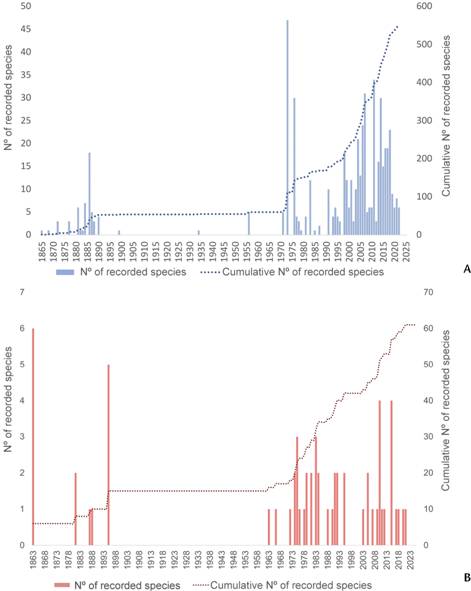
The number of marine species recorded per year from Brazil was initially related to the results of major oceanographic expeditions such as the H.M.S. Challenger in the 1880’s (Poléjaeff 1884, Ridley and Dendy 1886, 1887, Schulze 1887, Sollas 1888) and the R/Vs Calypso and Oregon II in the 1970’s (Boury-Esnault 1973, Collette and Rützler 1977), and of collections by foreign researchers such as Jacques Laborel (Hechtel 1983) (Figs 1A, 2A).
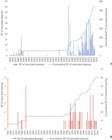
Rate of new records of sponge species from Brazil: (A) Absolute number and cumulative number of marine species recorded per year (1865-2022); (B) Absolute number and cumulative number of freshwater species recorded per year (1863-2022). Data from the World Porifera Database (de Voogd et al. 2024).
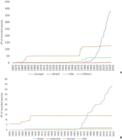
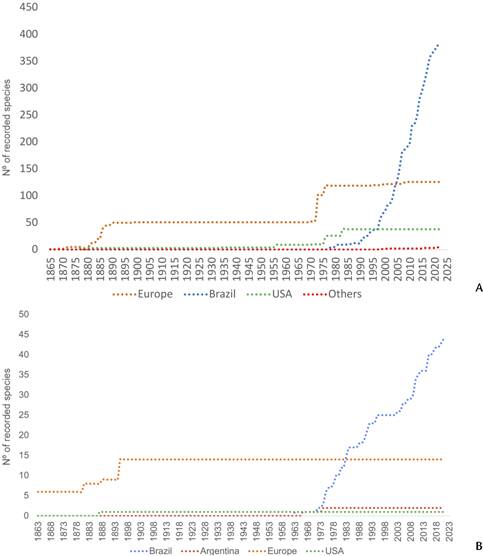
Cumulative number of sponge species from Brazil per year according to the nationality of the first author: (A) Records of marine species (1865-2022); (B) Records of freshwater species (1863-2022). Data from the World Porifera Database (de Voogd et al. 2024).
In the inland habitats, the records of sponges were the result of collections made by foreign naturalists in Brazil who sent material to researchers in Europe (Bowerbank 1863, Carter 1881, Weltner 1895, Traxler 1895) and the USA (Potts 1887, Hinde 1888) at the end of the 19th century (Figs 1B, 2B).
There were two major shifts from European and American taxonomists to Brazilian specialists, in the 1960’s for freshwater sponges (Fig. 2B) and in the 1990’s for marine sponges (Fig. 2A). In the 21st century, several sponge taxonomists were established in Brazil (Fig. 2) and the number of species described per year became higher and more constant, although it still varies widely from year to year (Fig. 1).
Diversity of Porifera in Brazil
Until December 2022, 612 valid sponge species were recorded from Brazil, including 551 marine sponges and 61 freshwater sponges (see Supplementary Tables 1 and 2). Of these, 339 marine and 45 freshwater sponges were originally described from Brazil.
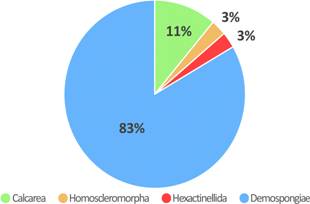
Sponge species of all four classes of Porifera are recorded in Brazil. Demospongiae is by far the richest class (508 species), followed by Calcarea with 68 species, Hexactinellida with 19 species and Homoscleromorpha with 17 species (Fig. 3). All 61 species of freshwater sponges belong to the Class Demospongiae (Order Spongillida), since the other three classes are exclusively marine.
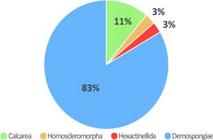
Diversity (in percentage) of the four classes of sponges recorded from Brazil until December 2022.
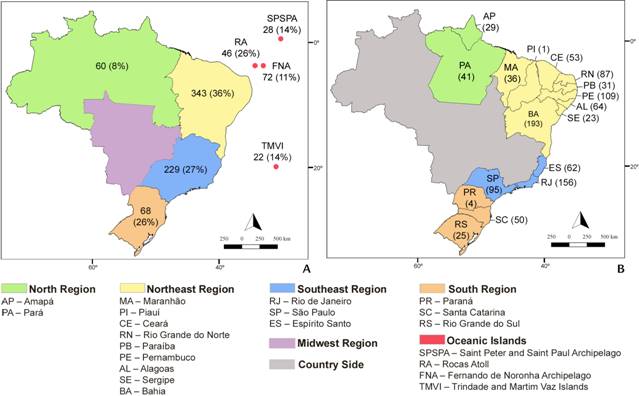
The Northeast (NE) and Southeast (SE) regions showed the highest numbers of records of marine sponges, with 343 and 229 species, respectively, whereas the North (N) and South (S) regions have the lowest numbers, with 60 and 68 species, respectively (Fig. 4A).
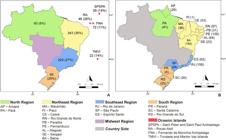
Diversity of marine species from Brazil until December 2022: (A) Number of records and endemism rates (%) in the North, Northeast, Southeast and South regions and oceanic islands; (B) Number of records in the coastal states. Modified from Muricy et al. (2011).
Regarding the oceanic islands of Brazil, the most diverse sponge fauna is found in Fernando de Noronha Archipelago, with 72 species, followed by Rocas Atoll (46 spp.), São Pedro e São Paulo Archipelago (28 spp.), and Trindade and Martim Vaz Islands (22 spp.) (Fig. 4A).
Among the coastal states from Brazil, Bahia (NE) has the highest diversity, with 193 species, followed by Rio de Janeiro (SE), Pernambuco (NE) and São Paulo States (SE), with 156, 109 and 95 species, respectively. Piauí (NE) and Paraná (S) states remain poorly known, with only one and four records, respectively (Fig. 4B).
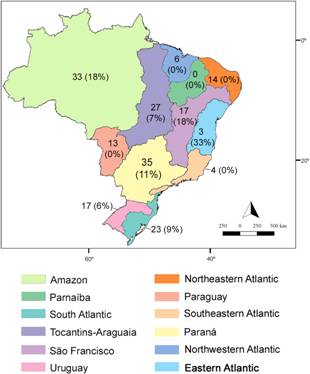
The freshwater species are more diverse in the Paraná (35 spp.), Amazon (33 spp.), Tocantins-Araguaia (27 spp.) and South Atlantic (23 spp.) basins. On the other hand, the fauna in the Parnaíba (0 spp.), Eastern Atlantic (3 spp.), Southeastern Atlantic (4 spp.) and Northwestern Atlantic (6 spp.) basins are poorly known (Fig. 5).
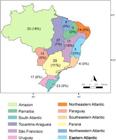
Records and endemism rate (%) of freshwater sponges in the twelve hydrographic basins of Brazil until December 2022. Modified from Muricy et al. (2011).
Regarding the marine sponges, it would be strategic to focus new collection efforts on the areas with the lowest number of known species, such as Paraná, Piauí, Sergipe and the Northern Region. However, these areas are largely influenced by sediment plumes from river mouths, decreasing the opportunities for diving to study the shallow coastal benthos and increasing the investments needed to study deeper reefs.
On the other hand, there are specimens already deposited in Porifera collections, such as the material from the mesophotic reefs of the Amazon River plume and from the state of Paraná in the Porifera Collection of the Museu Nacional/Universidade Federal do Rio de Janeiro (MN/UFRJ) and from the state of Piauí in the Porifera Collection of the Museu de Zoologia of the Universidade Federal de Pernambuco (UFPE), but the current human resources are not enough to meet this demand.
Even in the states where the spongiofauna is best known, the diversity in some regions is still underestimated. Bettcher et al. (2023), who studied sponges collected only in the intertidal environment of four reefs in southern Bahia, found at least 64 species, leaving others 40 morphotypes that were not identified at a specific level. It is important to emphasize here that the Bahian coastline extends for about 1,200 km and this state has almost 565,000 km2. Therefore, although 193 species had already been recorded to Bahia - leading it to the first place in the Brazilian sponge diversity rank - this number indicates the presence of 0.16 marine species/km of coast, which is a remarkably low number considering the variety of ecosystems in Bahia. On the other hand, this number is still higher when compared to the 0.065 species/km of the entire Brazilian coast. In this sense, it is no exaggeration to say that our knowledge of the Brazilian spongiofauna is just the tip of the iceberg.
For freshwater sponges, the situation is even more dramatic: most of the known diversity has been reported by a single Brazilian researcher, Cecília Volkmer-Ribeiro, who has mainly studied sponges from the South Atlantic, Paraná, Tocantins-Araguaia and Amazon basins. Since 2004, Pinheiro’s work has focused on the São Francisco and Northeast Atlantic basins, complementing Volkmer-Ribeiro’s efforts. The difficulty of sampling in these environments, coupled with the scarcity of human resources trained in freshwater sponge taxonomy are the major challenges to overcome.
Endemism of Porifera in Brazil
Of the 612 sponge species from Brazil, a total of 310 are endemic, of which 282 are marine species. Considering only those 339 species originally described from this country, 280 species are Brazilian endemics, with 195 species known only from a single locality, whereas 85 are also found along the Brazilian coast. In regard to the freshwater sponges, of the 61 species, 28 are Brazilian endemics.
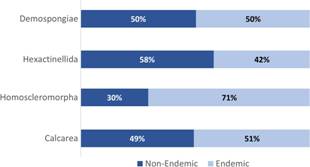
The class Homoscleromorpha has the highest endemism rate, with 12 endemic species of the 17 species. Calcarea and Demospongiae have similar endemism rates, with 35 endemic species and 256 endemic species, considering both marine and freshwater sponges, of the 68 and 512 species, respectively. Hexactinellida has the least endemism with eight endemic species, of the 19 species (Fig. 6).
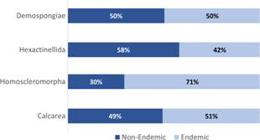
Percentage of Brazilian non-endemic and endemic species in the four classes of sponges until December 2022.
The Northeast Region has 123 endemic species (in a total of 343 species) followed by the Southeast Region with 63 endemic species (out of 229) and the South Region with 18 endemic out of 68 species. The North Region has five endemics out of 60 species. Rocas Atoll is the Brazilian oceanic island with the highest endemism rate, with 12 endemics out of 46 species (Fig. 4A).
Another factor that should not be overlooked when analyzing endemism rates is under-sampling: 195 marine species are known only from their type localities, but some of them will probably be found when collections in new localities of the Brazilian coast occur. Additionally, many species considered to be co-specific with Caribbean populations are probably distinct species waiting for further investigation, e.g. Aplysina fulva (Pallas, 1766) and Amphimedon compressa Duchassaing & Michelotti, 1864. In this sense, we believe that differences in the rates of endemism between the Brazilian coast regions tend to decrease as studies progress, whereas the endemism of Brazil tends to increase, especially when compared to the Caribbean spongiofauna.
Seven of the twelve hydrographic basins have endemic freshwater sponge species: Amazon (6 spp.), Paraná (4 spp.), São Francisco (3 spp.), Tocantins-Araguaia (2 spp.), South Atlantic (2 spp.), Eastern Atlantic (1 spp.), and Uruguay basin (1 sp.) (Fig. 5).
Considering South America as a whole, the endemism rate for freshwater sponges is even higher. Of a total of 67 species, only six occur outside the borders of South America. There is a possibility that some of these six species belong to species complexes, which could make the endemism rate even higher (Pinheiro and Calheira 2020).
Porifera taxonomy in Brazil
Currently, there are 29 researchers with PhD working on the taxonomy and systematics of Porifera, 15 of which are employed by Higher Education Institutions (HEI). The other 14 are either on fixed-term contracts, post-doctoral fellows or collaborators with other researchers. Almost 15 years ago, Zilberberg et al. (2010) counted 13 researchers, nine of which were employed by HEIs. This doubling of the number of researchers helps to explain the increase in scientific production over the last decade. This increase also changed the distribution of professionals linked to HEIs by region, currently with the Northeast with the highest number of professionals (7), followed by the Southeast (5), South (2) and Central-West region (1).
Some projects have also been instrumental in the advancement of knowledge of Brazilian spongiofauna, such as the REVIZEE project in the 1990’s, funded by the Federal Government of Brazil, and the Porifera Network in the 2000’s, funded by Petrobras. The REVIZEE project provided access to the spongiofauna of different bathymetries along most of the Brazilian coast. This project yielded a huge amount of material for the Porifera Collections, which is still being studied. The Porifera Network, on the other hand, although focused only on the Potiguar Basin, where sponges from different bathymetries were also collected, provided an increase in the infrastructure of the Porifera Laboratories in the states of Rio de Janeiro, Bahia and Pernambuco, and covered the costs of the publication of the field guides of Bahia (Hajdu et al. 2011) and Brazilian oceanic islands (Moraes 2011). In addition, it also provided the digitalization of the collection’s databases so that all Porifera researchers could have broad access to them.
Another important milestone for Porifera taxonomy was the Catalogue of Brazilian Porifera (Muricy et al. 2011), the result of a joint effort by all Brazilian spongiologists. This book cataloged all species described or recorded from Brazil up to December 2010, providing synonyms, type locality, location of type material, distribution records, as well as comments on taxonomic issues of each species. This work provided easy access to all the taxonomic problems of each species and served as the basis for most subsequent studies.
Muricy et al. (2011) listed 443 species of sponges known from Brazil. After 12 years, 178 other species have been recorded, representing an increase of more than 40% of the Brazilian spongiofauna, which has gone from 5.3 to 6.5% of the world’s spongiofauna. Due to the increase in the number of researchers in the country, as well as the large number of graduate students without permanent positions who have been trained in Porifera taxonomy and systematics, there is a great potential to discover more new species and to better understand their distribution in Brazil. But for this to happen, maintaining PhD researchers in the HEIs is extremely important, together with the need of more government incentives through grants and postdoctoral fellowships to keep these researchers working in the Academia.
ACKNOWLEDGEMENTS
The Fundação Carlos Chagas Filho de Apoio à Pesquisa do Rio de Janeiro (FAPERJ) provided J. Sandes with a Post-doctoral fellowship (FAPERJ NOTA 10 204.366/2021). G. Muricy was supported by grants from the FAPERJ (‘Cientistas do Nosso Estado’, E-26/202.898/2018), and Conselho Nacional de Desenvolvimento Científico e Tecnológico (CNPq Programa Arquipélago 43302/2019-7; CNPq PROTAX 441747/2020-5). F.F. Cavalcanti is thankful to Fundação de Amparo à Pesquisa do Estado da Bahia (FAPESB JCB0069/2014) and to the CNPq (grants 449070/2014-0 and 406993/2023-8). U. Pinheiro was supported by grants from CNPq (PQ-PROC.310914/2021-3) and Fundação de Amparo à Ciência e Tecnologia do Estado de Pernambuco (FACEPE APQ-0977-2.04/22). B. Annunziata thanks the financial support of Universidade Estadual do Piauí (UESPI). We are especially gratefull to the anonymous referees for the review of the manuscript.
LITERATURE CITED
-
Annunziata BB (2019) Espongiofauna marinha dos estados do Piauí e Maranhão (Nordeste do Brasil) e considerações biogeográficas no Atlântico Sul Ocidental. PhD Thesis, Universidade Federal de Pernambuco, Recife. https://repositorio.ufpe.br/handle/123456789/35425
» https://repositorio.ufpe.br/handle/123456789/35425 - Bell JJ (2008) The functional roles of marine sponges. Estuarine, Coastal and Shelf Science 79: 341-353.
- Bettcher L, Fernandez JC, Gastaldi M, Bispo A, Leal CV, Leite D, et al. (2023) Checklist, diversity descriptors and selected descriptions of a highly diverse intertidal sponge (Porifera) assemblage at Costa do Descobrimento (Bahia, Brazil). Zootaxa 5277(3): 443-489.
- Boury-Esnault N (1973) Résultats scientifiques des campagnes de la ‘Calypso’. Campagne de la ‘Calypso’ au large des côtes atlantiques de l’Amérique du Sud (1961-1962). I. 29. Spongiaires. Annales de l’Institut Océanographique 49(Suppl. 10): 263-295.
- Bowerbank JS (1863) A Monograph of the Spongillidae. Proceedings of the Zoological Society of London 1863: 440-472.
- Carter HJ (1881) History and Classification of the known species of Spongilla Annals and Magazine of Natural History 7(5): 77-107.
-
Collette BB, Rützler K (1977) Reef fishes over sponge bottoms off the mouth of the Amazon River. In: Proceedings of the 3rd International Coral Reef Symposium. University of Miami, Miami, 305-310. https://repository.si.edu/handle/10088/7901
» https://repository.si.edu/handle/10088/7901 -
de Voogd NJ, Alvarez B, Boury-Esnault N, Cárdenas P, Díaz MC, Dohrmann M, et al. (2024) World Porifera Database. https://www.marinespecies.org/porifera [Accessed: 16/02/2024]
» https://www.marinespecies.org/porifera -
Fernandez JCC, Rodriguez PRD, Santos GG, Pinheiro U, Muricy G (2018) Taxonomy of deep-water tetillid sponges (Porifera, Demospongiae, Spirophorina) from Brazil, with description of three new species and new characters. Zootaxa 4429: 53-88. https://doi.org/10.11646/zootaxa.4429.1.2
» https://doi.org/10.11646/zootaxa.4429.1.2 - Hajdu E, Lopes DA (2007) Checklist of Brazilian deep-sea sponges. In: Custódio MR, Lôbo-Hajdu G, Hajdu E, Muricy G (Eds) Porifera Research: Biodiversity, Innovation and Sustainability. Museu Nacional, Rio de Janeiro, Série Livros 28, 353-359.
- Hajdu E, Peixinho S, Fernandez JCC (2011) Esponjas marinhas da Bahia: guia de campo e laboratório. Museu Nacional, Rio de Janeiro, 276 pp.
- Hechtel GJ (1976) Zoogeography of Brazilian marine Demospongiae. In: Harrison FW, Cowden R (Eds) Aspects of sponge biology. Academic Press, New York, 237-259.
- Hechtel GJ (1983) New species of marine Demospongiae from Brazil. Iheringia Série Zoologia 63: 58-89.
- Hinde GJ (1888) On some new species of Uruguaya Carter, with remarks on the genus. Annals and Magazine of Natural History 2: 1-12.
-
ICMBio (2024) Sistema de Avaliação do Risco de Extinção da Biodiversidade - SALVE. Instituto Chico Mendes de Conservação da Biodiversidade, Instituto Chico Mendes de Conservação da Biodiversidade, https://salve.icmbio.gov.br/ [Accessed: 16/02/2024]
» https://salve.icmbio.gov.br/ - Laport MS, Santos OCS, Muricy G (2009) Marine sponges: potential sources of new antimicrobial drugs. Current Pharmaceutical Biotechnology 10(1): 86-105.
- Mello-Leitão A, Pêgo AF, Lopes WM (1961) Poríferos assinalados no Brasil. Avulsos do Centro de Estudos Zoológicos 10: 1-29.
- Moraes FC (2011) Esponjas das ilhas oceânicas brasileiras. Museu Nacional, Rio de Janeiro , 252 pp.
-
Morrow C, Cárdenas P (2015) Proposal for a revised classification of the Demospongiae (Porifera). Frontiers in Zoology 12: 7. https://doi.org/10.1186/s12983-015-0099-8
» https://doi.org/10.1186/s12983-015-0099-8 - Müller F (1865) Ueber Darwinella aurea, einen Schwamm mit sternförmigen hornnadeln. Archiv für Mikroskopische Anatomie Band 1: 344-353.
- Muricy G, Lopez DA, Hajdu E, Carvalho M, Moraes FC, Klautau M, Menegola C, Pinheiro U (2011) Catalogue of Brazilian Porifera. Museu Nacional, Rio de Janeiro , 299 pp.
-
Pawlik JR, McMurray SE (2020) The Emerging Ecological and Biogeochemical Importance of Sponges on Coral Reefs. Annual Review of Marine Science 12: 315-337. https://doi.org/10.1146/annurev-marine-010419-010807
» https://doi.org/10.1146/annurev-marine-010419-010807 - Pinheiro U, Calheira L (2020) Thorp and Covich’s Freshwater Invertebrates. Phylum Porifera. In: Damboroenea C, Rogers DC, Thorp JH (Eds) Keys to Neotropical and Antarctic fauna. Elsevier, San Diego, vol. 5, 4th ed., 79-92.
-
Pinheiro US, Cavalcanti FF, Sandes J, Annunziata BB, Muricy G (2024) Porifera. In: Catálogo Taxonômico da Fauna do Brasil. PNUD. http://fauna.jbrj.gov.br/fauna/faunadobrasil/6 [Accessed: 16/02/2024]
» http://fauna.jbrj.gov.br/fauna/faunadobrasil/6 - Poléjaeff N (1884) Report on the Keratosa collected by H.M.S. ‘Challenger’ during the years 1873-1876. Reports on the Scientific Results of the Voyage of H.M.S. Challenger 1873-1876. Zoology 11: 1-88.
- Potts E (1887) Contribution towards a synopsis of the American forms of freshwater sponges. Proceedings of the Academy of Natural Sciences of Philadelphia 39: 159-279.
- Ridley SO, Dendy A (1886) Preliminary report on the Monaxonida collected by H.M.S. Challenger. Annals and Magazine of Natural History 18(5): 325-351, 470-493.
- Ridley SO, Dendy A (1887) Report on the Monaxonida collected by H.M.S. ‘Challenger’ during the years 1873-1876. Reports on the Scientific Results of the Voyage of H.M.S. Challenger 1873-1876. Zoology 20(59): 1-275.
- Schultze MJS (1865) Über ein Exemplar von Hyalonema sieboldi aus Japan und einem Schwamm mit Nadeln aus Hornsubstanz. Verhandlungen des naturhistorischen Vereins der preussischen Rheinlande und Westfalens 22(3): 6-7.
- Schulze FE (1887) Report on the Hexactinellida collected by H.M.S. ‘Challenger’ during the years 1873-1876. Report on the Scientific Results of the Voyage of H.M.S. Challenger 1873-1876. Zoology 21: 1-514.
- Sollas WJ (1888) Report on the Tetractinellida collected by H.M.S. Challenger, during the years 1873-1876. Report on the Scientific Results of the Voyage of H.M.S. Challenger 1873-1876. Zoology 25(63): 1-458.
- Thakur M, Müller W (2004) Biotechnological potential of marine sponges. Current Science 86(11): 1506-1512.
- Traxler L (1895) Spikules von Süsswasserschwämmen aus Brasilien. Foldtani Kozlony 25: 238-240.
-
Van Soest RWM, Boury-Esnault N, Vacelet J, Dohrmann M, Erpenbeck D, de Voogd NJ, et al. (2012) Global diversity of sponges (Porifera). Plos One 7(4): e35105. https://doi.org/10.1371/journal.pone.0035105
» https://doi.org/10.1371/journal.pone.0035105 - Weltner W (1895) Spongillidenstudien III. Katalog und Verbreitung der bekannten Süsswasserschw.mme. Archiv für Naturgeschichte 61(1): 114-144.
- Wulff JL (2006) Ecological interactions of marine sponges. Canadian Journal of Zoology 84: 146-166.
- Zilberberg C, Klautau M, Menegola C, Berlinck R, Hajdu E (2010) Porifera. In: Rocha RMR, Boeger WAP (Orgs). Estado da arte e perspectivas para a Zoologia no Brasil. UFPR, Curitiba, 17-28.
ADDITIONAL NOTES
- ZooBank register
-
How to cite this article
Sandes J, Muricy G, Cavalcanti FF, Pinheiro U, Annunziata BB (2024) Biodiversity of Porifera in Brazil. Zoologia 41: e24017. https://doi.org/10.1590/S1984-4689.v41.e24017
-
Published by
Sociedade Brasileira de Zoologia at Scientific Electronic Library Online - https://www.scielo.br/zool
-
Fundação Carlos Chagas Filho de Apoio à Pesquisa do Rio de Janeiro 204.366/2021. E-26/202.898/2018). Conselho Nacional de Desenvolvimento Científico e Tecnológico 43302/2019-7; 441747/2020-5,449070/2014-0, 406993/2023-8, PQ-PROC.310914/2021-3. Fundação de Amparo à Pesquisa do Estado da Bahia JCB0069/2014). Fundação de Amparo à Ciência e Tecnologia do Estado de Pernambuco APQ-0977-2.04/22. The Fundação Carlos Chagas Filho de Apoio à Pesquisa do Rio de Janeiro (FAPERJ) provided J. Sandes with a Post-doctoral fellowship (FAPERJ NOTA 10 204.366/2021). G. Muricy was supported by grants from the FAPERJ (‘Cientistas do Nosso Estado’, E-26/202.898/2018), and Conselho Nacional de Desenvolvimento Científico e Tecnológico (CNPq Programa Arquipélago 43302/2019-7; CNPq PROTAX 441747/2020-5). F.F. Cavalcanti is thankful to Fundação de Amparo à Pesquisa do Estado da Bahia (FAPESB JCB0069/2014) and to the CNPq (grants 449070/2014-0 and 406993/2023-8). U. Pinheiro was supported by grants from CNPq (PQ-PROC.310914/2021-3) and Fundação de Amparo à Ciência e Tecnologia do Estado de Pernambuco (FACEPE APQ-0977-2.04/22).
Supplementary material 1
Authors: J. Sandes, G. Muricy, F.F. Cavalcanti, U. Pinheiro, B.B. Annunziata
Data type: Species data.
Copyright notice: This dataset is made available under the Open Database License (http://opendatacommons.org/licenses/odbl/1.0/). The Open Database License (ODbL) is a license agreement intended to allow users to freely share, modify, and use this Dataset while maintaining this same freedom for others, provided that the original source and author(s) are credited.
Link: https://doi.org/10.1590/S1984-4689.v41.e24017
Supplementary material 2
Authors: J. Sandes, G. Muricy, F.F. Cavalcanti, U. Pinheiro, B.B. Annunziata
Data type: Species data.
Copyright notice: This dataset is made available under the Open Database License (http://opendatacommons.org/licenses/odbl/1.0/). The Open Database License (ODbL) is a license agreement intended to allow users to freely share, modify, and use this Dataset while maintaining this same freedom for others, provided that the original source and author(s) are credited.
Link: https://doi.org/10.1590/S1984-4689.v41.e24017
Data citations
de Voogd NJ, Alvarez B, Boury-Esnault N, Cárdenas P, Díaz MC, Dohrmann M, et al. (2024) World Porifera Database. https://www.marinespecies.org/porifera [Accessed: 16/02/2024]
Pinheiro US, Cavalcanti FF, Sandes J, Annunziata BB, Muricy G (2024) Porifera. In: Catálogo Taxonômico da Fauna do Brasil. PNUD. http://fauna.jbrj.gov.br/fauna/faunadobrasil/6 [Accessed: 16/02/2024]