 Enhancing genetic gains in conilon coffee through intra-population recurrent selection in Espírito Santo, Brazil
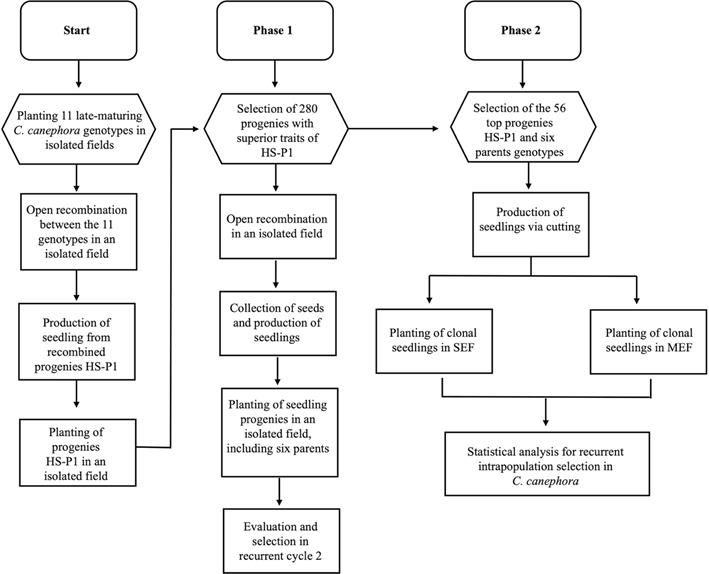
Recurrent intrapopulation selection is a key approach for the plant breeding of Coffea canephora, enabling the development of progenies superior to their parents while preserving genetic variability. This study was conducted in Espírito Santo, a major Conilon coffee production hub in Brazil, across two environments with contrasting soil and climatic conditions. This study to evaluated the agronomic performance, selection gains, and genetic divergence of 56 hybrid progenies from a late-maturing population, along with six parental plants. Genetic parameter estimates confirmed the presence of genetic variability and selection potential among the genotypes. Using Mulamba and Mock and Additive selection indices, 16 promising progenies were identified for the development of new cultivars. The strategy proved effective in recommending high-yielding genotypes adapted to each environment, highlighting its importance for sustainable cultivation under diverse edaphoclimatic conditions.
Key words:
Coffea canephora; plant breeding; hybrid progenies; cultivar; selection gains
 Thumbnail