
 Chrononutrition: exploring determinants and feature importance of eating timing among Brazilian adults
Our study aimed to explore factors influencing the timing of food intake, including physiological, behavioral, personal preferences, cultural, and environmental dynamics. Using data from 5,260 Brazilian adults collected through a virtual, exploratory, population-based survey (Sonar-Brazil/2023-24), Lasso regression identified the determinants of the timing of the first and last food intake, lunch, eating midpoint, and weekly breakfast skipping. Random Forest analysis was used to assess the feature importance for the eating midpoint. Chronotype emerged as the primary predictor across all outcomes: as chronotype shifted towards eveningness, the frequency of breakfast skipping increased and food intake timings delayed. While depression, obesity, evening screen time, smoking, caffeine consumption, having dinner as the largest meal, short sleep duration, and working remotely were associated with a later eating midpoint, age, female sex, exercising, evening alcohol consumption, diet quality, working in-office, and higher education were associated with an earlier eating midpoint. Insights into modifiable factors influencing eating timing can inform public health interventions aimed at promoting healthier eating habits aligned with the circadian system, tailored to diverse regional and individual contexts.
Key words:
Meal timing; Circadian rhythm; Chrononutrition; Food intake
 Thumbnail
 Thumbnail
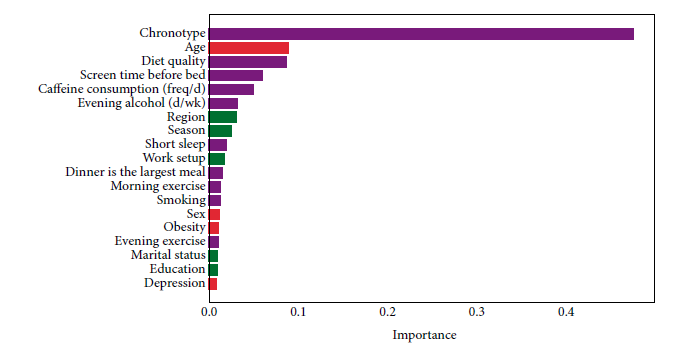 The colors in the figure represent each group of variables. In purple: Behavioral and Personal Preference, in red: Physiological variables, in green: Cultural and Environmental variables. Source: Authors.
 Notes: MSFsc = Midpoint of Sleep on Free Days corrected for Sleep Extension on Free Days. *All the associations are significant (P-values≤0.01). Source: Authors.