
 Reading Processing and Retention of Textual Information: Effects of Topic Familiarity and Reading Purpose Across Lower and Higher Working-Memory Capacity Groups
ABSTRACT
In the light of contemporary approaches to the interface between language and cognition, this study investigates not only isolated but also cumulative effects of prior knowledge (topic familiarity) and reading purpose on immediate retention of textual information among readers with lower and higher working memory capacity. Although the literature reports significant advances in the isolated investigation of these constructs, studies examining their combined effects on retention of reading information are still scarce, especially when readers’ individual differences in working memory capacity are taken into consideration. The results show compensatory effects of prior knowledge and reading purpose, as well as positive effects when both constructs are present, especially in the retention performance of readers with lower working memory capacity. Discussions are based on Baddeley’s version of the working memory model (2000), since the results reflect a more efficient allocation of limited working memory resources due to these cognitive facilitators. The results are also discussed from the perspective of the reading model proposed by Van Dijk and Kintsch (1983), since both constructs are suggested as facilitators of more coherent mental representations promoting more retention. These contribute to the understanding of cognitive mechanisms involved in reading processing and offer theoretical and empirical support for ongoing discussions in Psycholinguistics and language processing research.
KEYWORDS:
working memory; prior knowledge; reading purpose; immediate retention of textual information
RESUMO:
À luz das abordagens contemporâneas da interface entre linguagem e cognição, este estudo investiga não apenas os efeitos isolados, mas também os efeitos cumulativos do conhecimento prévio (familiaridade com o tópico) e do propósito da leitura na retenção imediata de informações textuais entre leitores de menor e maior capacidade de memória de trabalho. Embora a literatura registre avanços significativos na investigação isolada desses construtos, estudos que examinam seus efeitos combinados na retenção de informações lidas ainda são escassos, especialmente considerando leitores com diferenças individuais na capacidade de memória de trabalho. Os resultados mostram efeitos compensatórios do conhecimento prévio e do propósito da leitura, bem como efeitos positivos quando ambos os construtos estão presentes, especialmente na retenção de leitores com menor capacidade de memória de trabalho. As discussões são baseadas na versão do modelo de memória de trabalho de Baddeley (2000), uma vez que os resultados refletem uma alocação mais eficiente dos recursos limitados da memória de trabalho devido a esses facilitadores cognitivos. Resultados são também discutidos sob a perspectiva do modelo de leitura proposto por Van Dijk e Kintsch (1983), visto que ambos os construtos são sugeridos como facilitadores de representações mentais mais coerentes que promovem maior retenção. Essas descobertas contribuem para a compreensão dos mecanismos cognitivos envolvidos no processamento da leitura e oferecem suporte teórico e empírico para discussões em andamento na área de Psicolinguística e pesquisa em processamento da linguagem.
PALAVRAS-CHAVE:
memória de trabalho; conhecimento prévio; propósito de leitura; retenção imediata de informações textuais
Introduction
Current theories of reading comprehension converge on the view that the process is complex and multifactorial, shaped by the interaction of cognitive, linguistic, and contextual variables, which in turn directly influence the retention of information (Van Dijk; Kintsch, 1983; Kintsch, 1998; Baddeley, 2000; Daneman; Carpenter, 1980; Rumelhart, 1980; Pressley; Afflerbach, 1995). Some important factors include working memory capacity, prior knowledge (based on topic familiarity, in this study), and reading purpose.
From a neurocognitive perspective, these factors are grounded in the brain mechanisms that support reading and comprehension. Thus, complex neurocognitive architecture involving the coordinated activity of multiple brain regions are responsible for decoding, linguistic processing, and meaning construction. Neuroimaging research has consistently identified a left-lateralized reading network that includes the occipitotemporal region (associated with visual word recognition), the temporoparietal area, involved in phonological processing, and the inferior frontal gyrus, linked to syntactic and semantic integration (Pugh et al., 2001; Price, 2012). These systems interact dynamically during reading, enabling the transformation of visual input into meaningful linguistic representations. Importantly, efficient reading depends not only on the automatization of lower-level processes but also on higher-order cognitive functions, such as working memory and attentional control, which support the integration and the retention of textual information.
In addition, neurophysiological accounts of reading emphasize the role of prior knowledge and purpose-directed processing in modulating comprehension at the neural level. Studies suggest that top-down processes, supported by frontal and parietal networks, facilitate the activation of relevant semantic schemas and guide the allocation of cognitive resources during reading (Kendeou; McMaster; Christ, 2016). These mechanisms are particularly relevant for the construction of coherent situation models, as proposed by Van Dijk and Kintsch (1983), and align with findings that readers with greater background knowledge or clearer reading purposes exhibit more efficient neural processing and better retention outcomes. Within this framework, the interaction between bottom-up decoding processes and top-down cognitive control mechanisms provides a neurophysiological basis for understanding how reading context variables, such as prior knowledge and reading purpose, enhance comprehension and memory, especially among readers with limited working memory capacity.
Research on the role of working memory reinforces the construct as an effective predictor for comprehension, emphasizing that higher memory spans are positively correlated with high scores in comprehension tests (Linares; Pelegrina, 2023; Morris; Lonigan, 2022; Azevedo et al., 2025).
Providing a more detailed account of these studies, Linares and Pelegrina, (2023) investigated how different components of working memory, particularly updating and attentional control, relate to reading comprehension performance. The study employed standardized cognitive tasks alongside comprehension measures to examine these relationships in a sample of students. Their findings indicated that the updating component of working memory was a significant predictor of comprehension outcomes, even when controlling for other cognitive variables. The authors conclude that efficient updating processes play a crucial role in shaping reading comprehension and, consequently, the retention of textual information.
Adding similar evidence, Morris and Lonigan (2022) examined how different components of working memory relate to children’s reading skills using standardized cognitive and reading assessments. Through a correlational design and regression analyses, they found that both storage and processing components significantly predict reading performance, with complex working memory more strongly associated with comprehension.
Consistent with these findings, Azevedo et al. (2025) investigated the role of working memory capacity in the recall of textual information during multitasking digital reading. The study adopted a quantitative, experimental design in which participants completed reading tasks under different conditions (e.g., with and without concurrent tasks) on digital platforms. Data were analyzed using inferential statistics to examine the predictive effect of working memory and the impact of multitasking on retention. The findings showed that higher working memory capacity significantly predicted better recall, particularly under cognitively demanding, multitasking conditions.
As for the role of prior knowledge in reading comprehension, it began to be studied in the 1970s with the introduction of schema theory (Rumelhart, 1980). This theory explains that reading happens through the interaction between the text itself and what the reader already knows. One important model proposed by Van Dijk and Kintsch (1983) sugests that while we build a mental understanding of the meaning of a text, we also activate a mental “situation model”, that is, a mental representation of the events, people, and actions described. Readers connect what they already know with the new information from the text to create a clear and complete understanding. In line with this theoretical framework, studies have shown how readers benefit from combining new ideas with their existing knowledge, which is key for real comprehension (McNamara et al., 1996; Oliveira, 2015; Smith et al., 2021).
Particularly, McNamara et al. (1996) reported having found that readers benefited from topic familiarity by recalling text elements regardless of their reading capacity. The authors hypothesized that the ability to recall information was directly related to the formation of an adequate text base, which can be enhanced by prior knowledge.
Likewise, Oliveira (2015) investigated the influence of prior knowledge on reading comprehension using a quantitative design with comprehension tasks based on texts that varied in familiarity. Participants’ prior knowledge was assessed beforehand, and their comprehension was measured through recall and comprehension questions. Data were analyzed to compare performance across different levels of topic familiarity. The results showed that prior knowledge facilitated comprehension, as previously stored information was activated and supported the construction of meaning during reading.
In a more recent study extending these findings, Smith et al. (2021) conducted a critical review to examine the influence of background knowledge on the reading comprehension of primary school, aged children. The study synthesized findings from empirical research focusing on how prior knowledge interacts with reading ability. Through a qualitative analysis of the literature, the authors compared outcomes across learners with varying levels of reading proficiency. The results indicated that prior knowledge affects readers differently, with a more pronounced impact on children with lower reading capacity, for whom it serves as a compensatory mechanism in comprehension.
When it comes to reading purpose, knowing what you want to get from a text before you start reading helps you understand it more easily and with less mental effort. By having a clear purpose, readers can focus better, choose the right strategies, and pay attention to the parts of the text that matter most. This saves mental energy, which can then be used to understand the content more deeply (Linderholm; Broek, 2002).
Research has also demonstrated that the nature of task instructions influences the goals readers establish and the strategies they employ during reading. Reading purpose enables readers to allocate cognitive resources more efficiently and to construct more elaborated and coherent representations of the text (Linderholm; Broek, 2002; Aljabri, 2025; Balantekin, 2026).
More specifically, Linderholm and Broek (2002) investigated the extent to which readers with higher and lower working memory spans adjust cognitive processes to suit their reading purpose. Participants performed a verbal protocol task while reading an expository text in one of two reading purpose conditions, entertainment or study, and then completed a free recall task. All readers adjusted their processing to suit their reading purpose. For example, when engaged in reading for study purposes, readers with lower working memory capacity tended to prioritize processing strategies that impose fewer demands on their limited cognitive resources, thereby facilitating more efficient management of information during comprehension.
In a similar way, Aljabri (2025) examined how strategy use varies according to learning purposes through a quantitative, survey-based design. Participants completed structured questionnaires measuring their use of reading strategies across different task conditions, as well as comprehension assessments. The data were analyzed using correlational and inferential statistics. The results showed that readers adjusted their strategies based on task demands, with goal-oriented instruction leading to more effective comprehension processes.
Additionally, Balantekin (2026) explored the relationship between task design, reader engagement, and comprehension using a mixed-methods approach. The study combined comprehension tests with self-report measures of engagement and task perception. Quantitative data were analyzed statistically, while qualitative responses provided additional insights into reader behavior. The findings suggested that clearly defined reading purposes and engaging tasks positively influenced comprehension by promoting deeper cognitive processing.
In short, many studies have looked at how working memory, prior knowledge (topic familiarity), and reading purpose affect text comprehension, whether in a first or second language, and whether reading digitally or on paper (Linares; Pelegrina, 2023; Morris; Lonigan, 2022; Azevedo et al., 2025; McNamara et al., 1996; Oliveira, 2015; Smith et al., 2021; Linderholm; Broek, 2002; Aljabri, 2025; Balantekin, 2026). However, none of these studies has concurrently explored how working memory and topic familiarity together influence reading comprehension, or how working memory and reading purpose work together. In other words, there are still few clear answers to how readers with different working memory capacities retain textual information in different reading contexts that involve knowing the topic, have a clear purpose, or both. Therefore, this study also intends to focus specifically on immediate retention, which has been less explored.
With this in mind, the primary aim of the present study, which is derived from the author’s doctoral dissertation (see Paula, 2025), is to investigate how readers with lower and higher working memory capacities retain immediate information when reading in different contexts. These contexts include whether or not they are familiar with the topic, whether they have a clear reading purpose, and both.
Method
This study was motivated by one general research question: How does immediate retention of textual information, among readers with lower and higher working-memory capacity, vary according to four different reading contexts? The four contexts being defined as described below:
-
Context 1, in which readers have no topic familiarity and no established reading purpose;
-
Context 2, in which readers have familiarity with the topic, only;
-
Context 3, in which a reading purpose is established, only;
-
Context 4, in which readers have both topic familiarity and established reading purpose.
More specifically, the study intends to answer one specific question:
Do readers with higher working memory capacity achieve significantly higher retention levels than readers with lower working memory capacity within the four reading contexts outlined by this study?
In order to answer this question, an experimental quantitative study was designed.
Context and participants
This research was carried out with 40 students from the Portuguese and English Language and Literature program at two federal universities in the northeast of Brazil: The Federal University of Ceará and The Federal Institute of Ceará. The cohort consisted of 20 female and 20 male participants, with a mean age of 27 years old, who reported reading extensively on computer screens.
Instrument: Reading Span Test and Symmetry Span Task
In order to categorize participants into groups with lower and higher working memory capacity, this study used two working memory tests. The first test was a computerized version of the Reading Span Test from Daneman and Carpenter (1980) : The Reading Span Test implemented in JavaScript with the Psych library (Oliveira et al., 2021), which is self- administered and group-applicable, requiring participants to complete and memorize the final word of sentences in Portuguese while later recalling them. The validity of this computerized test was confirmed by a significant positive correlation with the original one. The second test used is the Symmetry Span Task (Kane et al., 2004; Unsworth et al., 2009), a non-verbal measure in which participants memorize the position of colored squares on a grid while simultaneously judging the symmetry of figures, complementing the verbal nature of the Reading Span Test. Both tests are hosted on the Lapsi platform, a digital laboratory for experiments in the field of Psycholinguistics (Oliveira, 2024) - see Paula (2025) for more information about the tests.
Following Conway et al. (2008), participants’ scores from both tests were averaged, and an extreme-groups approach was adopted. Scores were divided into quartiles, and only the participants in the lowest quartile (≤22 scores) and highest quartile (>35 scores) were analyzed. This ensured a clear contrast between lower and higher working memory groups of readers.
Instruments: four different texts and a questionnaire
Participants read four different texts organized in four different contexts. In Context 1, participants read a text about an unfamiliar topic with no established reading purpose; in Context 2, participants read a text about a familiar topic with no reading purpose; in Context 3, clear instructions were given before they start reading (so they had a clear purpose in mind), but the text was about an unfamiliar topic; and in Context 4, they read a text about a familiar topic with an established reading purpose in mind. After reading each text, participants were instructed to rewrite the text, with all the information they could remember.
In order to assign the texts for each context, participants completed a questionnaire that assessed their profile, as well as verified their familiarity with some topics. In order to verify familiarity, ten different topics were given, and participants were asked to rank their familiarity with the topics on a scale from 0 (not familiar at all) to 4 (very familiar). The two texts with their topics marked as the most familiar were chosen to be read in Contexts 2 or 4, in which familiarity with the topic was required. The two topics reported by participants as having the lowest familiarity with were chosen to be read in Contexts 1 or 3, in which familiarity should be absent.
It is also important to mention that not all participants read the same texts in each context. As previously explained, there were two texts with a familiar topic (that could be used in both contexts 2 and 4) and two texts with an unfamiliar topic (that could be used in both contexts 1 and 3). This way, twenty participants (Group A) read texts 1, 2, 3 and 4 in Contexts 1, 2, 3 and 4, respectively, while the other twenty participants (Group B) read texts 3,4,1 and 2 in Contexts 1, 2, 3 and 4, respectively. Thus, context effect instead of text effect was ensured, although all the texts were informational texts taken from Superinteressante magazine, with similar number of words.
Data collection procedures
Data Collection was divided into five moments (with the researcher in a computer lab on five different days); each moment being organized according to the following description:
Moment 1: Participants completed the Reading Span Test (Oliveira et al., 2021) and the Symmetry Span Task (Kane et al., 2004; Unsworth et al., 2009), followed by the questionnaire used to determine participant's profile and their levels of familiarity with some topics.
Moment 2: Participants read a text with an unfamiliar topic without receiving any instructions about what to do during and after reading (Context 1). Soon after, they were asked to recall the text by writing what they could remember.
Moment 3: Participants read a text with a familiar topic (Context 2). When they were finished, they were asked to recall the text by writing what they could remember. It is important to highlight that a conversation about the topic of the text was held before asking each participant to start reading, to reinforce familiarity.
Moment 4: Participants received clear instructions of what to do during and after reading the text (Context 3). Then, they were asked to recall the text by writing what they could remember.
Moment 5: Participants read a text with a familiar topic and also received clear instructions of what to do during and after reading the text (Context 4). As they finished, they were asked to recall the text by writing what they could remember.
Data analysis
First, in order to analyze immediate retention, participants written recalls were compared with the original texts. Propositional analysis of the original texts (better explained in the next session) was used to identify the number of semantic units in each text, and retention percentages were calculated based on the number of units correctly recalled. So, for example, if, in his/her written text, a participant recalled 13 units from a text which contained 26 propositional units in Context 1, this represented that this participant obtained 50% of immediate retention in Context 1. After calculating the percentage of retention of each participant in each context, the means of retention between lower and higher working memory span groups were compared in each context.
Besides the descriptive analysis, hypothesis tests were used to verify if the results were statistically significant. This way, a more detailed description of these tests is made as the result is presented.
Propositional Analysis
According to van Dijk and Kintsch (1983), when we read a text, each sentence can be decomposed into small units of meaning called propositions. A proposition tells us what is happening (the action/predicate) and who or what is involved (the agent and related elements: arguments). By connecting these propositions, readers build what is called “textbase”, a kind of a “meaning map”. In summary, by connecting these propositions, readers make sense of texts and can remember comprehended information.
In the present study, propositional analysis was used to identify how much information participants could retain. First, for each text, the periods (complete sentences) were identified and divided into semantic propositions, by separating what is action from what is argument. Then, the number of arguments present in each text was counted. This way, if a text quantified 26 arguments and a participant used 13 from those arguments while recalling the text in Context 1, this participant achieved 50% of retention in Context 1. See the following example:
Period 1: “Pesquisadores renomados investigaram Albatrozes-de-sobrancelha nas Maldivas por 15 anos”.
Proposition 1 = investigar (Predicate 1): - Pesquisadores (A1)
-Albatrozes-de-sobrancelha (A2)
*Circumstances of place (Maldivas) and time (for 15 years) are not included in the arguments.
For the complete division of the texts used in this study into propositions (predicates + arguments), refer to Paula (2025) .
Results and Discussion
In this section, the results of the descriptive and inferential analyses carried out are presented in order to answer the specific question of this study. Results are also discussed for clarification.
Do readers with higher working memory capacity achieve significantly higher retention levels than readers with lower working memory capacity within the four reading contexts outlined by this study?
A descriptive analysis using a summary table and a bar chart was used. Table 1 shows the descriptive measures of immediate retention for each memory group across the proposed reading contexts. In summary, Table 1 shows that variability is higher in the first contexts, especially for the lower working memory group of readers. As the contexts progress, both the mean and consistency tended to increase, with a reduction in the coefficient of variation, indicating greater uniformity in the results. The lower dispersion observed in the higher working memory group also suggests a more steadily performance in this group of readers.
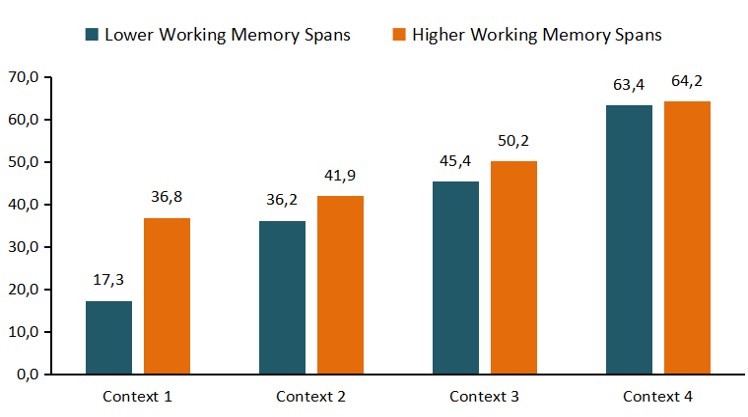
In Figure 1 below immediate retention between lower and higher working memory groups are compared for each context. As it can be observed, there is a reduction in the difference in retention levels between the two memory groups as the contexts progress.

Moving on to an inferential analysis in order to find statistical evidence for the results described so far, hypothesis tests for independent samples were conducted, comparing the immediate retention mean between readers of higher and lower working memory capacity in each reading context proposed by this study, as shown in Table 2.
It is important to mention that, before running the comparison tests, the assumptions required for applying the parametric Student’s t-test were checked. Normality was tested by Shapiro-Wilk and homogeneity of variances with Levene’s test. When assumptions were met, Student’s t-test was applied. As shown in Table 2, the non-parametric Mann Whitney U test was required only for Context 3.
According to Table 2, it is possible to state that there was a significant difference in retention between the two memory groups of readers only in Context 1 (no topic familiarity and no established reading purpose), with p-value < 0,01. In other words, readers with higher working memory capacity retained significantly more information than those with lower spans, but only in this first context. In the other contexts, no significant differences in immediate retention were found between the two groups (p-value = 0,06 in Context 2; p-value = 0,19 in Context 3; and p-value = 0,43, in Context 4).
The Construction-Integration Reading Model (Kintsch, 1998; Kintsch and Van Dijk,1978) can be used to reflect on this result. According to this model, working memory plays a central role in reading, given that it is responsible for temporarily storing the information read in a text while simultaneously processing such information to fill in gaps in coherence that give meaning to the information read, thus creating what the model calls a “textbase”. It is this “textbase” that is integrated with prior knowledge stored in long-term memory (stored in the form of propositions) and the result of this integration is what is called “situation model”. This integration occurs in working memory. Consequently, the amount of information read, comprehended and retained in long-term memory depends greatly on the amount of information that the working memory is able to store and process during reading. It is this “textbase” that is integrated into the reader's prior knowledge and that will enable effective comprehension (and retention), that is, the “situation model”, which is the product of what was read and stored in the long-term memory.
Consequently, it is quite understandable that, in Context 1, individuals with higher working memory spans obtained greater retention levels in the recall task, since such readers have the capacity to store a greater amount of new information that is read and processed and that will be integrated into prior knowledge. This result reinforces the idea that higher working-memory capacity readers have greater storage and processing capacity and, therefore, are more likely to obtain much higher retention levels.
However, it is important to remember that the working memory has a limited capacity to store and process new information, as for example of a text on an unfamiliar topic (Baddeley; Hitch, 1974). Therefore, this storage capacity can be positively or negatively impacted by the cognitive load imposed by the degree of familiarity or unfamiliarity with the text topic: higher familiarity with the topic imposes a lower cognitive load on the working memory, leaving more resources for the storage and processing tasks (Kintsch, 2009), that is, allowing individuals with lower working memory spans to use more available resources to store more information and process it more effectively, generating a better quality of “textbase”. Thus, it is plausible to hypothesize that this was the reason why there were no differences in retention levels between the two groups of memory in Context 2 (with topic familiarity only). Differences between the two groups of working memory became more balanced in the context that required less cognitive load for readers with lower working memory spans, which led this group to retain more information than in Context 1.
Moreover, this result is in line with other studies showing that topic familiarity can have a compensatory effect on readers with lower working memory capacity. In other words, readers who have higher prior knowledge (topic familiarity) about the topic are often able to compensate for limitations in working memory (Adams et al., 1995; MacNamara et al., 2011; Recht; Leslie, 1988; Cervetti; Wright, 2020).
Similarly, clear instructions about what to do during and after reading (Context 3) appear to have reduced the cognitive load on readers with lower working memory capacity. As a result, this group was able to recall enough information to eliminate significant differences in immediate retention between the memory groups.
Readers with lower working memory capacity often struggle with the inference-making process, which places high demand on cognitive resources (Cain; Oakhill, 1998; Long et al., 1994; Masson and Miller, 1983; Oakhill, 1994; Whitney et al., 1991). Consequently, they are more likely to rely on memorization strategies and the repetition of key text parts (techniques commonly used by less skilled readers).
Thus, this study adds a new perspective to previous research by demonstrating that such strategies did not place a high demand on lower working-memory readers’ cognitive resources. Actually, these strategies were enough to make them perform well in the recall task at the point of making them achieve similar retention levels to those readers with higher working memory capacity. While it is possible that these strategies might not be enough for more demanding tasks, such as writing a critical summary in one’s own words, or answering comprehension questions that require deeper analysis, results presented in this research show evidence that memorization and repetition of key parts of the text are effective strategies for making readers with lower working memory capacity recall more information read.
This interpretation is supported by Linderholm and Van den Broek (2002) findings, which indicated that, when reading for study purposes (a similar situation to reading for recalling the text), readers with lower working memory capacity tended to repeat more of the original text. In contrast, those with higher spans were more likely to add new ideas and produce more critically elaborated responses.
In short, some working memory theories suggest that differences between readers with higher and lower working memory spans become more noticeable when the reading task places greater demands on cognitive resources (Carpenter et al., 1994; Just; Carpenter, 1992). However, knowing in advance that they would need to recall the text after reading led readers of lower working memory capacity to adopt memorization and repetition strategies that supported their retention of information (in fact, they were even encouraged to use such strategies).
Paraphrasing and repeating key parts of the text while reading appeared not to consume too much of their cognitive resources. This likely left enough mental capacity available to maintain the “textbase” in working memory (processing) and to integrate it with prior knowledge stored in long-term memory (manipulation). As a result, the reading task became less demanding, helping to create more balanced retention outcomes between the two memory groups.
At the same time, readers with higher working memory capacity may have used different strategies during their recall tasks, such as making inferences, drawing connections, or adding critical commentary, as suggested by previous studies (Broek et al., 2001; Linderholm and Van den Broek, 2002). This may have led them to introduce new, relevant information into their recall tasks, adding information that, although meaningful, was not actually part of the original text and therefore was not counted in the recall task. This behavior might also help to explain why retention levels appeared similar between the two groups: readers with higher working memory capacity may not have recalled everything they could have, but instead recalled what they chose to focus on: supplementing the original content with relevant but non-textual contribution. Thus, this hypothesis adds another valuable insight to existing research on the relationship between working memory capacity and retention of information read.
Furthermore, it is quite plausible that the lack of significant differences in retention between the memory groups in Context 4 (where both topic familiarity and a clearly defined reading purpose were present) can be explained by the same reasons discussed so far. It is important to highlight that this context combines two elements that, even when considered separately, had already proved to be helpful in supporting better retention for readers with lower working memory capacity. When used together, these two supports likely reinforced each other, making it even easier for these readers to retain what they read.
Conclusion
This study was motivated by one specific research question: Do readers with higher working memory capacity achieve significantly higher retention levels than readers with lower working memory capacity within the four reading contexts outlined by the study?
In summary, the conclusions of this study emphasize, innovate, and/or add to the findings of previous research by showing that readers with higher working memory capacity generally achieve significantly higher levels of retention. This occurs because they can store a greater amount of new information that is read, processed, and then integrated with pre-existing knowledge in long-term memory. However, readers with lower working memory capacity can improve their immediate retention when they read in a context that provides familiarity with the topic and/or a clear reading purpose (that is, specific instructions about what to do during and after reading). The presence of these cognitive facilitators reduces cognitive load placed on working memory, freeing up more resources for storing and processing information (Kintsch, 1998). Consequently, readers with lower working memory spans can use the extra cognitive resources that become available to store more information and perform deeper processing. As a result, they build a higher-quality mental representation of the text, which allows them to remember the content better to the point of reaching similar levels of immediate retention as readers with higher working memory capacity, when such cognitive supports are present.
It is also important to note that the impact of topic familiarity and/or reading purpose was greater among readers with lower working memory capacity. This shows that activities such as pre-reading discussions, topic exploration, brainstorming, and the use of images or short introductory videos can activate mental frameworks that reduce cognitive load, helping these readers remember information more effectively (Cowan, 2008; McNamara et al., 1996). Similarly, clear reading guidance, such as reading plans, guiding questions, and post-reading tasks aligned with pre-reading goals, also improves retention for this group.
In summary, the findings corroborate the view that reading contexts strategically structured with cognitive supports can reduce individual differences of working memory capacity during text processing. From a language-cognition perspective, the results highlight how contextual and task-related factors interact with cognitive resources to shape reading performance. Rather than conceptualizing retention of information as a fixed result of cognitive limitations, the study demonstrates that appropriately designed reading conditions can promote compensatory mechanisms that enable readers with lower working memory capacity to achieve levels of performance comparable to those of their peers. These findings contribute to contemporary discussions on the cognitive bases of reading and emphasize the dynamic interplay between cognitive demands and reading conditions in language processing.
Finally, it is important to point out that this study has limitations regarding the measurement of reading time, which could have helped demonstrate the degree of ease associated with each reading context: shorter reading times would indicate greater facility of comprehension. In addition to suggesting a future study that addresses the gap described above, another important point to highlight is that this study was conducted in a controlled experimental setting, which differs from real reading contexts in everyday school environments. Therefore, a study conducted in actual classrooms during regular Portuguese lessons could provide a reading environment that more closely reflect real-life conditions.
References
- ADAMS, B. C.; BELL, L. C.; PERFETTI, C. A. A trading relationship between reading skill and domain knowledge in children’s text comprehension. Discourse Processes, v. 20, n. 3, p. 307-323, 1995.
- ALJABRI, S. Corrigendum: exploring EFL students' preferences and practices of study strategies: repeated reading versus testing. Frontiers in Education, v. 9, n. 1, e1457504, 2025.
- AZEVEDO, B. et al Working memory capacity as a predictor of text idea recall in multitasking L2 digital reading. Psicologia: Reflexão e Crítica, v. 38. n. 14, n.p., 2025.
- BADDELEY, A. D. The episodic buffer: a new component of working memory? Trends in Cognitive Sciences, v. 4, n. 11, p. 417-423, 2000.
- BADDELEY, A. D.; HITCH, G. Working memory: In BOWE, G. A. (ed.), The psychology of learning and motivation New York: Academic Press, 1974. v. 8, p. 47-89.
- BALANTEKIN, Y. Improving students’ reading, comprehension, and reading motivation through texts generated from their prompts using ChatGPT-4: a mixed-method study. Humanities and Social Sciences Communications, v. 13, n. 1, p. 1-15, 2026.
- BROEK, P.V.D.; LORCH , R. F.JR.; LINDERHOLM, T.; GUSTAFSON, M. The effects of reader’s goals on inference generation and memory for texts. Memory & Cognition, v. 29, n. 8, p. 1081-1087, 2001.
- CAIN, K.; OAKHILL, J. Comprehension skill and inference-making ability: Issues of causality. In: HULME, C.; JOSHI, R.M. (ed.), Reading and spelling: Development and disorders. Mahwah: Erlbaum, 1998. p. 329-367
- CARPENTER, P. A.; MIYAKE, A.; JUST, M. A. Working memory constraints in comprehension: Evidence from individual differences, aphasia, and aging. In: GERNSBACHER, M. A. (ed.), Handbook of psycholinguistics New York: Academic Press , 1994. p. 1075-1122.
- CERVETTI, G. N.; WRIGHT, T. S. The role of knowledge in understanding and learning from text. Handbook of Reading Research, v. 5, n. 1, p. 237-260, 2020.
- COWAN, N. What is the difference between long-term, short-term, and working memory? Progress in Brain Research, v. 169, p. 323-338, 2008.
- DANEMAN, M.; CARPENTER, P. A. Individual Differences in Working Memory and Reading. Journal of Verbal Learning and Verbal Behavior, v. 19, p. 450-466, 1980.
- JUST, M. A.; CARPENTER, P. A. A capacity theory of comprehension: Individual differences in working memory. Psychological Review, v. 99, p.122-149, 1992.
- KANE, M. J.; HAMBRICK, D. Z.; TUHOLSKI, S. W.; WILHELM, O.; PAYNE, T. W.; ENGLE, R. W. The generality of working memory capacity: A latent-variable approach to verbal and visuospatial memory span and reasoning. Journal of Experimental Psychology General, v. 133, p. 189-217, 2004.
- KENDEOU, P.; McMASTER, K. L.; CHRIST, T. J. Reading comprehension: core components and processes. Policy Insights from the Behavioral and Brain Sciences, v. 3, n. 1, p. 62-69, 2016.
- KINTSCH W. Comprehension: A paradigm for cognition. Cambridge: Cambridge University Press, 1998.
- LINARES, R.; PELEGRINA, S. The relationship between working memory updating components and reading comprehension. Cognitive Processing, v. 24, n. 2, p. 253-265, 2023.
- LINDERHOLM, T.; BROEK, P. V. D. The effects of Reading purpose and working memory capacity on the processing of expository texts. Journal of Educational Psychology, v. 94, n. 4, p. 778-784, 2002.
- LONG, D. L.; OPPY, B. J.; SEELY, M. R. Individual differences in the time course of inferential processing. Journal of Experimental Psychology: Learning, Memory, and Cognition, v. 20, n. 1, p. 1456-1470, 1994.
- MASSON, M. E. J.; MILLER, J. A. Working memory and individual differences in comprehension and memory of text. Journal of Educational Psychology , v. 75, n. 1, p. 314-318, 1983.
- McNAMARA, D. S.; KINTSCH, E.; SONGER N. B.; KINTSCH, W. Are good texts always better? Interactions of text coherence, background knowledge, and levels of understanding in learning from text. Cognition and Instruction, v. 14, n. 1, p. 1-43,1996.
- McNAMARA, D. S.; OZURU, Y.; FLOYD R. G. Comprehension challenges in the fourth grade: The roles of text cohesion, text genre, and readers’ prior knowledge. International Electronic Journal of Elementary Education, v. 4, n. 1, p. 229-257, 2011.
- MORRIS, B. M.; LONIGAN, C. J. What components of working memory are associated with children's reading skills? Learning and Individual Differences, v. 95, n.1, p. 102-114, 2022.
- OAKHILL, J. Individual differences in children’s text comprehension. In: Gernsbacher, M. A. (ed.), Handbook of psycholinguistics . San Diego: Academic Press, 1994. p. 821-848.
-
OLIVEIRA, D. A. de. Lapsi: Laboratório de Psicolinguística na Web. Versão 0.10.2024. Jacobina: Davi Solutions, 2024. Software. Disponível em: https://lapsi2.davi.solutions Acesso em: 15 jan. 2025.
» https://lapsi2.davi.solutions -
OLIVEIRA, D. A.; WOELFER, S. W.; TOMITCH, L. M. B. Construindo um Teste de Capacidade de Leitura Autoaplicável com Apresentação Aleatória de Estímulos. Neuropsicología Latinoamericana, [S. l.], v. 13, n. 1, 2021. Disponível em: https://neuropsicolatina.org/index.php/Neuropsicologia_Latinoamericana/article/view/560 Acesso em: 15 jan. 2025.
» https://neuropsicolatina.org/index.php/Neuropsicologia_Latinoamericana/article/view/560 - OLIVEIRA, N. B. A relação do conhecimento prévio com a compreensão leitora mediante um olhar psicopedagógico Trabalho de Conclusão de Curso (Graduação em Psicopedagogia) - Universidade Federal da Paraíba, João Pessoa, 2015.
- PAULA, S. G. C. Memória de trabalho e retenção de informações lidas em diferentes contextos de leitura Tese (Doutorado em Linguística) - Universidade Federal do Ceará, Fortaleza, 2025.
- PRESSLEY, M.; AFFLERBACH, P. Verbal protocols of reading: The nature of constructively responsive reading. New Jersey: Lawrence Erlbaum Associates, Inc. , 1995.
- PRICE, C. J. A review and synthesis of the first 20 years of PET and fMRI studies of heard speech, spoken language and reading. NeuroImage, v. 62, n. 2, p. 816-847, 2012.
- PUGH, K. R. et al Neurobiological studies of reading and reading disability. J Commun Disord v. 34, n. 6, p. 479-492, 2001.
- RECHT, D. R.; LESLIE, L. Effect of prior knowledge on good and poor readers’memory of text. Journal of Educational Psychology , v. 80, n. 1, p. 16-20, 1988.
- RUMELHART, D. E. Schemata: The building blocks of cognition. In: SPIRO, R. J.; BRUCE, B. C.; BREWER, W. F. (ed.), Theoretical issues in reading comprehension, 1980. p. 35-58.
- SMITH, R.; SNOW, P.; SERRY, T.; HAMMOND, L. The role of background knowledge in reading comprehension: A critical review. Reading Psychology, v. 42, n. 3, p. 214-240, 2021.
- UNSWORTH, N.; BREWER, G. A.; SPILLERS, G. J. There’s more to the working memory capacity-fluid intelligence relationship than just secondary memory. Psychonomic Bulletin & Review, v. 16, p. 931-937, 2009a.
- VAN DIJK, T. A.; KINTSCH, W. Strategies of discourse comprehension New York: Academic Press , 1983.
- WHITNEY, P.; RITCHIE, B. G.; CLARK, M. B. Working-memory capacity and the use of elaborative inferences in text comprehension. Discourse Processes , v. 14, n. 1, p. 133-145, 1991.
-
*
The author acknowledges Professor Susanne M. Jaeggi (Northeastern University) for her guidance during a doctoral sandwich period in Boston, particularly regarding the methodological design and data analysis of this study. This research was supported by the Coordination for the Improvement of Higher Education Personnel (CAPES), Brazil, through the Doctoral Sandwich Program (PDSE) - Finance Code 001.
-
Data and Material Availability:
All the data supporting the results of this study were published in the article itself.
All the data supporting the results of this study were published in the article itself.

 Source: Elaboratedby the authors.