
 Economic viability of tomato production in open field and protected cultivation in the Agreste and Semi-arid regions of Alagoas
ABSTRACT
Tomato (Solanum lycopersicum L.) production plays an important role in the livelihoods of smallholder farmers in Brazil, particularly in the Northeastern region. In the state of Alagoas, cultivation has expanded steadily in the Canal do Sertão, although growers continue to face major challenges associated with adverse edaphoclimatic conditions and a volatile market. This study evaluated the economic viability of the cultivars BRS Sena and BRS Equatorial under open-field and protected cultivation using data from technological reference units. Yields ranged from 52.5 to 99.0 t/ha, while profitability was strongly influenced by pricing, which varied from R$ 1.67 to R$ 2.66/kg. The absence of a market price premium for tomatoes produced under protected cultivation, combined with the additional capital required for the infrastructure amortization, substantially reduced their economic viability. Conversely, open-field production remained profitable, particularly when harvests coincided with periods of higher market prices. Protected cultivation is promising but requires market price differentiation and improvements in its adoption and management. Its viability also depends on credit policies, operational cost reduction, and supportive institutional arrangements.
Keywords:
Solanum lycopersicum
; production costs; profitability; protected cultivation; open field
RESUMO
A produção de tomate (Solanum lycopersicum L.) no Brasil é importante para a economia de pequenas propriedades rurais, especialmente nos estados do Nordeste. Em Alagoas (AL), a produção de tomate vem crescendo de forma constante na região do Canal do Sertão. Apesar de sua relevância, os produtores locais enfrentam desafios significativos, incluindo restrições edafoclimáticas e condições de mercado voláteis, que impactam diretamente o desempenho agronômico e a rentabilidade. Este estudo teve como objetivo avaliar a viabilidade econômica de diferentes cultivares de tomate em sistemas de cultivo a céu aberto e sob cobertura em tais localidades. Foram realizados estudos de caso das cultivares BRS Sena e BRS Equatorial, com dados coletados de unidades de referência tecnológica instaladas localmente. Os rendimentos de produção variaram consideravelmente, de 52,5 a 99 toneladas por hectare. A lucratividade mostrou-se altamente sensível às oscilações dos preços médios de mercado (entre R$ 1,67 e R$ 2,66 por quilograma), uma vez que o mercado não diferencia o preço pago pelos tomates com base no sistema de cultivo. Notadamente, os resultados indicam que o cultivo protegido enfrenta, atualmente, limitações econômicas associadas aos custos de capital. Em contraste, a produção em campo aberto mostrou-se mais viável, especialmente quando os períodos de colheita coincidiram com picos de preços de mercado. O cultivo protegido é promissor, mas requer diferenciação de preços de mercado e melhorias na adoção e no manejo. Sua viabilidade também depende de políticas de crédito, redução de custos operacionais e apoio por meio de arranjos institucionais.
Palavras-chave:
Solanum lycopersicum
; custos de produção; rentabilidade; cultivo protegido; campo aberto
Tomato (Solanum lycopersicum L.) is the most important vegetable crop worldwide, being cultivated for both fresh consumption and industrial processing markets (Du et al., 2025). In 2023, Brazil cultivated tomatoes on 59,010 hectares, achieving an average yield of 70,598 kg per hectare and a total production of 4,166,017 tons (IBGE-PAM, 2025a). Specifically, for the fresh market segment, the state of Alagoas (AL) cultivated 193 hectares, with yields of 44.858 kg/ha and a production value of approximately BRL 34.6 million, making it one of the largest producers in the Northeast region (NE), with Mata Grande city as the main production area (IBGE-PAM, 2025b).
In this context, vegetable cultivation in the Agreste region of AL is growing rapidly and demonstrating its potential. The central location, adequate topography, and abundant groundwater for irrigation support this trend in the region. Additionally, the expanding consumer market and logistics/transportation infrastructure make it a suitable area for production and distribution (Ferreira, 2011; SEBRAE-AL, 2023). However, in this area, and prominently in the semi-arid region of the state, technical information regarding tomato cultivars and their production management is limited to the following: these locations have low levels of evapotranspiration and precipitation, with soluble salts accumulated in the soil root zone, which hinders plant growth and agricultural yields (Nascimento et al., 2024), thereby requiring mitigation measures to be implemented.
Beyond edaphoclimatic constraints, the success of technology adoption is limited by local socioeconomic dynamics that condition growers' capacity to absorb complex systems. When interventions occur, groups that depend on government funding, even those that implement innovative processes, are influenced by factors such as occupational diversity (e.g., informal work) and the variety of economic agents involved. To establish new local agricultural chains, research and development results focusing on novel crops and resilient systems are essential (Baiardi, 2024). Given these circumstances, new technologies can revolutionize this species breeding, making possible the development of cultivars more tolerant to stresses of different origins (Jone and Panthee, 2026; Goes et al., 2026), and likewise, protected cultivation offers an alternative that incorporates climate strategies to overcome the impacts of adverse weather events on crop production. This approach aims to secure the regional food supply by maintaining consistent production levels and incorporating new cultivars and technologies (Goddek et al., 2023; SEBRAE-AL, 2023).
Reliable economic information is also essential to tomato producers, since the costs of establishing and operating a protected production structure are rising. Indicators related to investment recovery and profitability are not always available through extension programs or by commercial services. Therefore, market quotations and productivity levels remain as the critical determinants of production costs and viability (Machado Neto, 2014).
Prices received by tomato producers in the AL state are volatile due to overlapping harvest calendars, insufficient planning, and imbalances. Concentrated surpluses from local short-term production still occur, temporarily exceeding the capacity of certain channels to absorb them, resulting in price pressure during those periods and areas. This situation discourages the continued cultivation of this species (Santos, 2022). Additionally, the region's dependence on tomatoes from other states, such as Bahia and Pernambuco, to fulfill domestic demand further complicates the issue, as local production is not self-sufficient (Santos, 2022).
Considering the challenges faced in the Agreste and Semi-arid regions of Alagoas state, open-field and protected tomato production systems were evaluated to study the economic viability of two tomato cultivars under these conditions.
MATERIAL AND METHODS
The evaluations were conducted in 2024 in production units located in Arapiraca and Delmiro Gouveia. Edaphoclimatic conditions, cultivation systems, and the adopted cultivars were characterized, following a predefined data collection protocol based on the production costs, which were recorded throughout the aforementioned production cycles. This approach enabled an integrated analysis of technical and economic parameters under field conditions, ensuring an understanding of each production unit (Chart 1).
Case studies
A case study design was chosen since the region possesses unique characteristics, providing a detailed description of the context in which an intervention took place (Yin, 2014). The five reference units correspond to the existing tomato production areas at the time, given the region's incipient status in vegetable production.
Tomato cultivars
The tomato cultivars were adopted within a technology transfer project as the only materials that showed satisfactory adaptation/performance under the typical conditions of each region, such as high temperatures and saline soils. Both BRS Sena and BRS Equatorial are processing tomato cultivars of a determinate growth habit. In the Northeast of Brazil, most of the producing regions grow tomatoes without staking/training for the fresh market. Thus, hybrids suited to this specificity most possess a dual-purpose aptitude, with fruit shape and characteristics closely resembling the Italian type.
BRS Sena is a hybrid cultivar that combines tolerance to begomovirus and bacterial spot, good productivity, and soluble solids content (Brix) (Quezado-Duval et al., 2014). Originally developed for the industrial segment, it has adapted to the region, producing fruits for the fresh market (EMBRAPA, 2023). BRS Equatorial is a hybrid cultivar that combines tolerance to high temperatures and salinity, with good productivity and soluble solids content (Brix) of fruits.
BRS Sena was cultivated during the rainy season due to its resistance to bacterial spot, a period when this disease is more prevalent in open-field production. By contrast, BRS Equatorial is highly susceptible and was grown in the dry season.

Cultivation systems units
The production areas adopted a uniform spacing of 0.4 meters between plants and 2 meters between rows for both cultivars. In Delmiro Gouveia and Arapiraca, one thousand tomato plants were cultivated in commercial production fields, where technological reference units were established, using two methods: open-field and protected cultivation (high tunnel covered with a photoselective colored (red) shade netting).
In Delmiro Gouveia, the hybrid used was BRS Sena. In Arapiraca, the hybrid used was BRS Equatorial. Sowing in Delmiro Gouveia took place in June 2024 for the protected cultivation unit and in August 2024 for the open-field unit. In Arapiraca, sowing occurred in June and August for protected cultivation and in November for open-field cultivation, all during the same year. In both locations, fruit production began, on average, 80 days after planting and lasted until 120 days. Production practices were employed according to the growers' execution based on recommendations from local extension.
Production costs
The value of all inputs, services, and operational expenses incurred during the production cycle and defines the total cost of production (Matsunaga et al., 1976; CONAB, 2020). These were estimated using detailed data collected in each reference unit to assess economic viability, with the results analyzed against the average market prices observed at CEASA-AL (the state capital's wholesale food market).
Understanding the surrounding factors is essential because various constraints impact how certain technologies are adopted. For example, small properties in AL often face management difficulties, particularly cost control and planning (Lima and Brandão, 2021). According to the most recent Brazilian Census, 17.7% of the residents of Alagoas State aged 15 or older are illiterate (IBGE, 2022). Despite illiteracy and low levels of educational attainment persisting among rural populations, it has gradually increased in the state. Still, this progress has not kept pace with the demands of novel agricultural systems, which challenge growers' capacity to adapt to ongoing changes (SEPLAG, 2016).
Thus, a simplified publicly available online guide for data collection and entry was proposed to estimate investment and positive economic returns. This guide included a spreadsheet designed to facilitate its use (Hanashiro et al., 2021). The development of this guide and spreadsheet has led to the release of a webpage (https://custo-producao.a.agro.rocks/). Once all coefficients are in the webpage system, it automatically calculates the financial result by determining the difference between costs and revenue. Several coefficients were kept unchanged so that the producer could input the general data without worrying about complex calculations.
However, two adjustments were made to the financial calculation by CEPEA (Center for Advanced Studies on Applied Economics): PGTO (payment) and CARP (Annual Capital Recovery Cost) (Silva et al., 2014a), and used in the guide by Hanashiro et al. (2021). These adjustments were as follows: the residual value of the asset (scrap value) was considered zero; the interest rate was set at an average of 3.6% per year (real interest rate); and the initial value of the asset and its useful life in years remained unchanged. This ensured that capital costs were equalized throughout the structure's lifespan, allowing for a comparison of viability without bias from differing initial investments.
Although a greenhouse can have a lifespan of a decade or more, in our case studies, it's assumed that no one has that amount of time to carry out such field tests, so the focus is on the short to medium term (up to 3 years). Naturally, if it were used for a longer period, the depreciation would be spread over the following years. But that's not the situation here.
To standardize calculations, an annual periodicity was assigned to activities from planting to harvest. This approach demonstrated the minimum productivity required to cover costs and indicated when the producer would start to profit. It also enables simulations on average prices to identify new productivity levels that ensure financial viability. Reliable standards aid price negotiations between tomato producers and buyers, ensuring profitable returns (Menezes et al., 2007). For protected cultivation growers, it is essential to adjust management practices and financial calculations needed to amortize investments, guided by economic viability analysis indicators (Silva et al., 2014a). So, the economic outcomes reported here provide a de facto measure of production performance under commercial conditions.
This assessment was conducted from a broader sustainability perspective, recognizing that the viability of smallholder tomato production depends not only on financial performance but also on social and environmental considerations. Therefore, adoption of production systems with lower capital requirements may result in improved allocation of financial resources to labor conditions, plant health practices, and other related aspects. Although the study was conducted in two locations with specific edaphoclimatic conditions, both were selected because they are potential regions; the units represent the technological level of local growers and provided the technical and administrative conditions required for its implementation.
RESULTS AND DISCUSSION
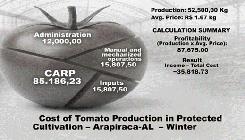
In the protected cultivation unit in Arapiraca (Figure 1), a productivity of 52.5 tons per hectare (t/ha) was observed, with an average price of R$1.67 per kilogram (R$/kg). The gross revenue was R$87,675.00, resulting from a total cost of R$123,493.73, mainly due to a high CARP of R$85,186.23; a loss of R$35,818.73 was recorded. This means that, at this time, production was not economically viable.
To avoid a loss, the price should be at least R$2.36/kg. Alternatively, if the practiced price of R$1.67/kg were to be maintained, the minimum productivity would have been 73.94 t/ha. Araújo Neto (2017), when evaluating the profitability of different tomato cultivation systems, affirmed that, in this case, similar to the results obtained in his study in Acre State, an increase in productivity is necessary for protected cultivation, or the medium-to long-term trend will be a retraction and an exit from the activity. Other studies conducted in the states of Paraíba and Ceará reported yields ranging from 50 t/ha to 70 t/ha under low-technology protected cultivation structures and pointed to the main environmental factors of this system (Silva et al., 2013, 2014b; Goes et al., 2026). Although these did not discuss economic viability, they mentioned thermal and water-related limitations, which are characteristic of the region and often associated with higher operating costs. This pattern is consistent with findings from tropical and arid regions worldwide, where energy requirements for cooling and greater irrigation demand reduce the competitiveness of this system under these conditions (Tsafaras et al., 2022; Abbas et al., 2024; Farhat et al., 2024).
A production scenario with higher average prices of R$2.66/kg and a slightly increased productivity of 53.5 t/ha at the same location, achieved under protected cultivation (with planting scheduled for 10/10/2024), demonstrated improved economic viability (Figure 2). Given an identical cost structure of R$123,493.73, the revenue increased slightly to R$142,310.00, resulting in a positive profit of R$18,816.27.
Capital recovery accounted for a substantial share of total production costs in protected cultivation systems, underscoring the importance of infrastructure investments for economic performance. Under the CARP methodology, investment costs are annualized over the structure's useful life, making profitability highly dependent on utilization. Consequently, successive production cycles can reduce capital costs on a per-unit basis by spreading fixed investments over a larger output volume/period, thereby improving long-term economic viability, provided productivity and market access are maintained.
Even though protected cultivation allows greater environmental control and yield potential, the additional revenue generated was insufficient to offset markedly higher fixed costs. This scenario may be further aggravated by human capital qualification and technical capacity, which may hinder the effective adoption of advanced management practices required to operate complex production systems efficiently.

Continuing the discussion on production under protected cultivation, in Delmiro Gouveia, despite achieving a productivity of 67 t/ha, the average price received was R$1.67/kg. Unfortunately, this price was insufficient to cover the production costs, which amounted to R$123,473.73. Consequently, the total revenue generated was R$111,890.00, resulting in a loss of R$11,583.73 (Figure 3). To solve this, the price would need to increase to at least R$1.84/kg, or productivity would need to rise to 73.93 t/ha.

In the short term, specifically within one productive cycle, recovering the investment is not achievable. For example, in the Distrito Federal (DF) region, tomato production in protected cultivation structures during the rainy season shows that investments are recovered after one cycle under high tunnels, whereas the production using greenhouses requires two production cycles (EMATER-DF, 2020).
In AL, the results of protected cultivation indicate that it is important to compare costs and profitability with a more streamlined expenditure structure, similar to that of open-field production. In Arapiraca, it achieved a productivity level of 57 t/ha, with an average price of R$2.66/kg (Figure 4). This resulted in the best economic outcome in terms of profitability, totaling R$108,452.50. The gross revenue was R$151,620.00, while the total costs amounted to R$43,167.50, and CARP of R$5,180.00. In an analysis of historical price trends and commercialization at CEASA-AL, Santos (2022) noted that data for February, March, and April 2019 were unavailable due to extremely high prices during that period, likely resulting from a tomato deficit in the state. This scenario contributed to elevated price quotations in line with national and Pernambuco State trends. For open-field production in Arapiraca, established in November, the harvest typically begins in February and can continue through March and April. This timing coincides with the aforementioned period of higher quotations.

The open-field production in Delmiro Gouveia (Figure 5) yielded an economic result that was nearly the same as the previous period: R$107,498.90. This outcome occurred despite the low price of R$1.67/kg, primarily due to the high productivity recorded at 99 t/ha. Additionally, while there was a slight increase in costs associated with manual and mechanized operations compared to other areas, the CARP remained low at R$7,873.60. The total costs amounted to R$57,831.10. The significant revenue generated, R$165,330.00, contributed to the positive economic result mentioned above.

The yield performance of the evaluated cultivars was consistent with their respective positioning. BRS Equatorial showed high adaptability to the conditions in Arapiraca, particularly coping with soil salinity. Although it may not have been economically viable for protected cultivation, where prices and other costs influenced its rentability, the cultivar's agronomic potential is evident, mainly in open-field cultivation, which may be a solution for other regions where salinity restricts production. Regarding BRS Sena, its adaptation to high temperatures and yield values were satisfactory, comparable to those reported by Quezado-Duval et al. (2014), which ranged from 63,9 t/ha to 119 t/ha.
The regional market integration contributes to the convergence of tomato prices, as local transactions are largely benchmarked against CEASA-AL prices. Arapiraca is located 129 km from the state capital, Maceió, whereas Delmiro Gouveia is 291 km away; the two municipalities are 166 km apart. Oliveira et al. (2023) described a similar situation, noting a bilateral causality between two regions in the state of Ceará, also in the NE. They found that Italian tomato prices in Fortaleza (state capital) influence prices in Ibiapaba (countryside), but not the other way around. Hence, localized production advantages are rarely translated into higher farm-gate prices. In the absence of differentiated value chains, neither for protected cultivation nor open-field production, quality-related premiums are not transmitted to growers, limiting the economic return on additional infrastructure investments.
These results prompt reflections on protected cultivation in the two locations in Alagoas, particularly concerning the significant investment required for structures and implementation services. Asci et al. (2014) suggest that the risks associated with introducing this system for tomato production can be mitigated through various policies or market conditions that affect credit availability, interest rates, insurance, energy prices, and product prices. Furthermore, incremental implementation and affordable structural models could make this cultivation method a more favorable option, allowing producers to scale investments gradually according to financial capacity.
Carvalho (1989) affirmed that small-scale growers in the NE (North Eastern) semi-arid region required programs tailored to their economic and technical needs to access novelties, a scenario that remains valid today for AL state, since the provision of subsidized or free technologies alone does not ensure progress. To overcome these hindrances in the NE, it is essential to seek qualifications and current public policies (Soares and Aguiar, 2025).In this sense, agricultural extension plays a central role in identifying, adapting, and transferring technologies relevant to production and agro-industrial initiatives. Even so, extension and technical assistance services in this region still require substantial restructuring and strengthening to support growers (Unger, 2009; Vargas et al., 2022), as well as greater incentives for local procurement through acquisition programs for public school meals and overall food supply (Ferro, 2024).
Following this stage, collaboration between the public and private sectors should support the commercialization, promotion, and dissemination of new technologies to establish a sustainable economic foundation (Lima and Fernandes, 2009). As a case in point, for tomato production in Florida, USA, direct marketing efforts aimed at consumers through farmers' markets or other channels, as well as the promotion of quality attributes, such as local origin, were vital. These actions can lead to higher prices, often referred to as "premium" prices, and are essential for the success of small-scale protected cultivation systems (Athearn et al., 2018).
The viability analysis, using a user-friendly web tool, indicated that recovering the investment in protected cultivation structures requires higher productivity in the first cycle, based on average prices. Continuous monitoring of costs and values in subsequent cycles is essential. In open-field cultivation, aligning harvest schedules with peak prices while ensuring productivity is achievable due to lower investment levels results in positive outcomes.
Identifying new markets and seeking government policies to provide credit and support production, alongside improvements in extension services, are pressing for the continuity of this new productive chain. The capital costs in protected tomato cultivation can be reduced through low-cost structures and incremental implementation of techniques/inputs, allowing producers to scale investments gradually according to their financial capacity. Other costs can also be reduced through methods such as collective investments, cooperatives, and access to federal food acquisition programs.
Final considerations
● In the state of Alagoas, open-field production offers better profitability because the entire infrastructure associated with protected cultivation (greenhouses, pumps, irrigation/fertigation systems) is very expensive, and its depreciation results in high annual costs. In both Arapiraca and Delmiro Gouveia, open-field profitability was highly significant and comparable in value (R$106,452/hectare and R$107,498/hectare, respectively). Then, open-field production, combined with harvest timing, showed greater economic viability under the studied conditions.
● The results show that protected cultivation could be a viable alternative, provided that average prices are remunerative, the market pays a premium for tomatoes grown under protected cultivation compared to open-field production, the vegetable in question requires this production system (due to soil and climatic constraints), or average productivity is significantly increased (which was not observed in the cases studied in Alagoas, where the vegetable market is still in its beginning stage. Of the three cases evaluated, only one remained minimally profitable: the summer crop in Arapiraca, which yielded R$18,816, benefiting from higher average prices received (R$2.66 versus R$1.67). In the cases of protected cultivation in Arapiraca (winter) and Delmiro Gouveia, losses of R$35,818 and R$11,593 were recorded, respectively. Thus, to break even in the Arapiraca winter crop, productivity would have needed to rise from 52.500 t/hectare to 73.940 t/hectare, or the average price would have needed to increase from R$1.67/kg to BRL2.36/kg (considering only one variable at a time). For Delmiro Gouveia, productivity would have needed to increase from 67.000 t/hectare to 73.930 t/hectare, or the average price received by the producer would have needed to rise from R$1.67/kg to R$1,84/kg.
● To make protected cultivation viable, management strategies, access to credit, and yield increases are necessary. In the state of Alagoas, where vegetable farming is still in its infancy, various public policies should be implemented to boost production. One such policy - applicable to all productive activities, not just agriculture - is to focus on reducing illiteracy and low educational attainment, factors that hinder the adoption of technical information. Promoting higher education levels through municipal and state initiatives is crucial. Furthermore, rural extension agencies like Emater-AL (Innovation for Sustainable Rural Development in Alagoas) need to be strengthened so they can better serve the large number of family farmers; this involves assisting them in selecting suitable locations for various species (and cultivars) and choosing the best vegetable cultivation systems, as well as enhancing collaboration with Sebrae-AL (Brazilian Micro and Small Business Support Service in Alagoas) and Senar-AL (National Rural Learning Service in Alagoas) to support the economic viability of their enterprises. Additionally, state-owned credit institutions could assist by evaluating the provision of credit for crops of economic value and interest to the state - a category that certainly includes vegetables. This effort should also rely on validation from research bodies like Embrapa (Brazilian Agricultural Research Corporation) to ensure that the best technologies, cultivars, and production systems for vegetables are made available.
ACKNOWLEDGEMENTS
The authors thank Embrapa Hortaliças for providing seeds of the cultivars used and SEBRAE-AL for logistical support. They also thank the producers from Arapiraca and Delmiro Gouveia for making their study areas available.
REFERENCES
- ABBAS, F; AL-OTOOM, A; AL-NAEMI, S; ASHRAF, A; MAHASNEH, H. 2024. Experimental and life cycle assessments of tomato (Solanum lycopersicum) cultivation under controlled environment agriculture. Journal of Agriculture and Food Research 18: 101266.
- ARAÚJO NETO, SE. 2017. Rentabilidade de sistemas de cultivo de tomate no Acre. Horticultura Brasileira 35: 456-462.
- ASCI, S; VANSICKLE, JJ; CANTLIFFE, DJ. 2014. Risk in investment decision-making and greenhouse tomato production expansion in Florida. International Food and Agribusiness Management Review 17: 1-19.
- ATHEARN, KR; HOCHMUTH, RC; LAUGHLIN, WL; CLARK, JL. 2018. Economic analysis of small-scale greenhouse tomato production in Florida. Proceedings of Florida State Horticulture Society 131: 99-102.
- BAIARDI, A. 2024. Avaliando intervenções desenvolvimentistas no Nordeste e no Semiárido rural brasileiro: mudar ou permanecer? In: PEDROSO, MTM; BRISOLA, MV; NAVARRO, Z (Org.). O Brasil Rural: novas interpretações São Paulo: Editora Baraúna. p.56-100.
- CARVALHO, JO. 1989. Tecnologia para o Semi-Árido: o caso da irrigação. Revista Econômica do Nordeste 20:31-42.
-
CONAB. 2020. Custos de produção agrícola: metodologia de cálculo. Available at: Available at: https://www.gov.br/conab/pt-br/atuacao/informacoes-agropecuarias/custos-de-producao Accessed August 10, 2024.
» https://www.gov.br/conab/pt-br/atuacao/informacoes-agropecuarias/custos-de-producao - DU, M; SUN, C; DENG, L; ZHOU, M; LI, J; DU, Y; YE, Z; HUANG, S; LI, T; YU, J; et al . 2025. Molecular breeding of tomato: Advances and challenges. Journal of Integrative Plant Biology 67: 669-721.
-
EMATER-DF. Caderno de inovações tecnológicas 2020. Available at: Available at: https://www.emater.df.gov.br/documents/25679385/26392195/Caderno-tecnologico-V.-II.pdf Acessed August 10, 2024.
» https://www.emater.df.gov.br/documents/25679385/26392195/Caderno-tecnologico-V.-II.pdf - EMBRAPA - Empresa Brasileira de Pesquisa Agropecuária. Sistema brasileiro de classificação de solos 4a ed. Brasília: EMBRAPA, 2014. 374p.
- EMBRAPA. 2023.Cultivares da Embrapa Hortaliças: (1981-2023) Brasília, DF: Embrapa, 2023. 236p.
- FARHAT, M; GHIAT, I; HAZRAT, B; LUQMAN, M; AL-ANSARI, T. 2024. A framework based on an input-yield model for greenhouse optimization for varying environmental conditions. Energy Conversion and Management 22: 100555
- FERREIRA, LM. 2011. A logística como diferencial competitivo e inovador do agronegócio: perspectivas para o APL horticultura no Agreste em Alagoas. Recife: Universidade Federal de Pernambuco, 138p. (M.Sc. Dissertation).
- FERRO, JAC. 2024. A agricultura familiar e o Programa Nacional de Alimentação Escolar (PNAE): das mãos que cultivam para a refeição que alimenta São Cristóvão: Universidade Federal de Sergipe. 234p. (Ph.D. thesis).
- GODDEK, S; KÖRNER, O; KEESMAN, KJ; TESTER, MA; LEFERS, R; FLESKENS, L; JOYCE, A; VAN, OSE; GROSS, A; LEEMANS, R. 2023. How greenhouse horticulture in arid regions can contribute to climate-resilient and sustainable food security. Global Food Security 38: 100701.
- GOES, GF; LACERDA, CF; SOUSA, GG; SOUSA, HC; BEZERRA, MA; SANTOS, S; BALDÉ, B; SILVA, FDB. 2026. Morphophysiology of tomato crop under saline stress in different environments. Revista Ambiente & Água 21, e3116.
- HANASHIRO, MM; TEIXEIRA, FMV; MANGABEIRA, JAC; BUENO, MF; CARVALHO, HMG; SILVA, PP; NASCIMENTO, WM. 2021. Roteiro para verificação de custos e viabilidade econômica na produção de hortaliças e outras culturas. Documentos, Embrapa Hortaliças 188: 1-18.
-
IBGE. 2022. Censo demográfico 2022. Available at: Available at: https://www.ibge.gov.br/estatisticas/sociais/saude/22827-censo-demografico-2022.html Accessed March 20, 2024.
» https://www.ibge.gov.br/estatisticas/sociais/saude/22827-censo-demografico-2022.html -
IBGE-PAM, 2025a. produção de tomate (Brasil). Available at: Available at: https://www.ibge.gov.br/explica/producao-agropecuaria/tomate/br Accessed August 20, 2025.
» https://www.ibge.gov.br/explica/producao-agropecuaria/tomate/br -
IBGE-PAM, 2025b. Produção de tomate (Alagoas). Available at: Available at: https://www.ibge.gov.br/explica/producao-agropecuaria/tomate/al . Accessed August 20, 2025.
» https://www.ibge.gov.br/explica/producao-agropecuaria/tomate/al - JONE, MJH; PANTHEE, DR. 2026. Status of tomato breeding for abiotic stress tolerance. In: PANTHEE, DR.; KOLE, C (eds). Tailoring the Tomato Genome for NextGen Agriculture (1st Ed.). CRC Press. p.176-221.
- LIMA, IF. Fundamentos geográficos do meio físico do Estado de Alagoas Maceió: Série Estudo de Regionalização, v.3, Maceió, 1977. 93p.
- LIMA, ALL; BRANDÃO, TFB. 2021. Formação do preço de venda: um estudo com avicultores familiares inseridos no PAF. Diversitas Journal 6: 1142-1160.
- LIMA, JPR; FERNANDES, AC. 2009. Demandas e ofertas tecnológicas em economias retardatárias: anotações a partir de dois segmentos econômicos no Nordeste brasileiro. Revista Brasileira de Inovação 8: 303-340.
- MACHADO NETO, AS. 2014. Viabilidade agroeconômica da produção de tomate de mesa sob diferentes sistemas de cultivo e manejo de adubação Campos dos Goytacazes: UENF,. 107p. (Ph.D. thesis).
- MATSUNAGA, M. et al. 1976. Metodologia de cálculo do custo de produção. Agricultura em São Paulo 23: 123-139.
- MENEZES, AH; PINHEIRO, JCV; LIMA, HJM. 2007. Rentabilidade mínima do tomate de mesa orgânico e sua competitividade em relação ao tomate convencional - Serra da Ibiapaba, CE In: XLV Congresso da SOBER - Conhecimentos para Agricultura do Futuro. Londrina: SOBER. p.1-15.
- NASCIMENTO, DL; SILVA, MO; OLIVEIRA, J; LIMA, FF; COSTA, ES; VELOSO, CL; PRATES, FBS; CUNHA, JLX; SOUZA, LFS; VARJÃO, LFB; COSTA, KD. 2024. O controle genético da tolerância à salinidade em tomateiro envolve um gene de efeito maior e poligenes associados. Revista Caderno Pedagógico 21: 1-21.
- OLIVEIRA, K; TABOSA, FJS; SILVA, VHMC; FERREIRA, FI; MENEZES, E; LESSA, L; SOUSA, EC. 2023. Causalidade no preço do tomate no estado do Ceará. Contribuciones a las Ciencias Sociales 16: 20877-20896.
- PARAHYBA, RBV; LEITE, AP; OLIVEIRA NETO, MB. 2006. Solos do município de Delmiro Gouveia - Estado de Alagoas. Comunicado Técnico.Embrapa Solos 36: 1-12.
- QUEZADO-DUVAL, AM; FURUMOTO, O; VILLAS BÔAS, HDC. 2014. BRS Sena: do desenvolvimento à inserção na cadeia produtiva. Documentos, Embrapa Hortaliças 143: 1-36.
- SANTANA, JR; GOMES, HF; OLIVEIRA, MF. 2022. Temporal analysis of heat island in Arapiraca-Alagoas, Brazil based on geoprocessing. Diversitas Journal 7: 2371-2390.
- SANTOS, MV. 2022. Sazonalidade dos preços do tomate nos estados de Alagoas e PernambucoUFAL, Campus Arapiraca. 32p. (BachelorThesis).
- SANTOS, GR; SANTOS, EMC; LIRA, ES; GOMES, DL; SOUZA, MA; ARAÚJO, KD. 2017. Análise da precipitação pluvial e da temperatura do ar de Olho D’água do Casado, Delmiro Gouveia e Piranhas, Alagoas. Revista de Geociências do Nordeste 3: 16-27.
-
SEBRAE-AL. Estudo cadeia da horticultura em Alagoas. Available at: Available at: https://web.archive.org/web/20240715185439/https://sebrae.com.br/Sebrae/Portal%20Sebrae/UFs/AL/Anexos/2023_Cadeia%20da%20Horticultura.pdf Accessed December 17, 2025.
» https://web.archive.org/web/20240715185439/https://sebrae.com.br/Sebrae/Portal%20Sebrae/UFs/AL/Anexos/2023_Cadeia%20da%20Horticultura.pdf - SEPLAG: Alagoas. Secretaria de Estado do Planejamento, Gestão e Patrimônio. Estudo sobre a Agricultura Familiar em Alagoas/Alagoas Secretaria de Estado do Planejamento, Gestão e Patrimônio. - Maceió: SEPLAG, 2016. 56p.
- SILVA, JM; FERREIRA, RS; MELO, AS; SUASSUNA, JF; DUTRA, AF; GOMES, J.P. 2013. Cultivo do tomateiro em ambiente protegido sob diferentes taxas de reposição da evapotranspiração. Revista Brasileira de Engenharia Agrícola e Ambiental 17: 40-46.
-
SILVA, BA; SILVA, AR; PAGIUCA, LG. 2014a. CULTIVO PROTEGIDO - Em busca de mais eficiência produtiva! Hortifruti Brasil. Available at: Available at: https://www.cepea.org.br/hfbrasil/edicoes/132/mat_capa.pdf Accessed September 15, 2025.
» https://www.cepea.org.br/hfbrasil/edicoes/132/mat_capa.pdf - SILVA, JA; DUTRA, AF; CAVALCANTE, NMS; MELO, AS; SILVA, FG; SILVA, JM. 2014b. Aspectos agronômicos do tomateiro “Caline Ipa 6” cultivado sob regimes hídricos em área do semiárido. Revista Agro@mbiente On-line 8: 336-442.
-
SILVA, VRS; CABRAL JÚNIOR, JB. 2023. Climatologia e período de retorno de eventos extremos de precipitação diária em Arapiraca, Alagoas. Available at: Available at: https://editorarealize.com.br/editora/anais/sbgfa/2024/TRABALHO__EV206_MD1_ID1465_TB1197_29102024133516.pdf Accessed September 15, 2025.
» https://editorarealize.com.br/editora/anais/sbgfa/2024/TRABALHO__EV206_MD1_ID1465_TB1197_29102024133516.pdf - SOARES, JAS; AGUIAR, JO. 2025. Desafios na adoção de tecnologias sociais na agricultura familiar: percepção dos sujeitos no semiárido paraibano. Observatorio de la Economía Latinoamericana 23: e10476.
- TSAFARAS, I; CAMPEN, JB; ZWART, HF; VOOGT, W; AL HARBI, A; AL ASSAF, K; ABDELAZIZ, ME; QARYOUTI, M; STANGHELLINI, C. 2022. Quantifying the trade-off between water and electricity for tomato production in arid environments. Agricultural Water Management 271:107819.
- UNGER, RM. 2009. O desenvolvimento do Nordeste como projeto nacional: um esboço Brasília: Secretaria de Assuntos Estratégicos da Presidência da República. 82p.
- VARGAS, DL; AQUINO, JR; CARVALHO, CX. 2022. Assistência técnica, extensão rural e agricultura familiar no Nordeste: panorama, desempenho recente e desafios. Revista Emancipação 22:1-19.
-
XAVIER RA; DORNELLAS PC. 2012. Caracterização ambiental do município de Arapiraca, Região Agreste de Alagoas. Revista Ambientale 3: 108-121. https://periodicosuneal.emnuvens.com.br/ambientale/article/view/89
» https://periodicosuneal.emnuvens.com.br/ambientale/article/view/89 - YIN, R. Case Study Research: design and methods . 5 ed. Thousand Oaks, CA: Sage, 2014.

 Sources: Arapiraca -


