 Colorectal Cancer and the Impact of the COVID-19 Pandemic on its Diagnosis in Brazil
Abstract
Introduction Colorectal cancer (CRC) is the third most commonly diagnosed cancer and the fourth leading cause of cancer-related deaths. Among women, it is the second most prevalent type of cancer. Guidelines recommend CRC screening starting at the age of 50 years, with colonoscopy being the gold-standard test due to its sensitivity in detecting cancer and precancerous lesions. During the coronavirus disease 2019 (COVID-19) pandemic, there was a reduction in screening due to the closure of services and/or public fear of contracting the virus. Screening for CRC in women involves anatomical and psychosocial challenges, which were further exacerbated during the pandemic.
Objective To quantitatively determine the number of colonoscopies performed on women and to assess the number of CRC cases diagnosed in women before and during the COVID-19 pandemic.
Materials and Methods We conduicted an analytical, retrospective study based on data from the Brazilian Unified Health System's (Sistema Único de Saúde, SUS, in Portuguese) Information and Computer Sciences Department (Departamento de Informação e Informática do SUS, DATASUS, in Portuguese) regarding the number of colonoscopies and CRC diagnoses in women from 2018 to 2023 in Brazil. Data were analyzed using the Microsoft Excel (Microsoft Corp.) software and expressed in terms of absolute and relative frequencies.
Results In 2020, there was a 32.3% reduction in the number of colonoscopies performed compared to 2019, followed by an increase in subsequent years. The number of CRC diagnoses in women rose between 2018 and 2023, with a 0.7% increase in 2020.
Conclusion During the pandemic, the number of colonoscopies performed in women and the general population decreased, accompanied by a slight increase in CRC diagnoses.
Keywords
colorectal cancer; colonoscopy; women; COVID-19
Introduction
Colorectal cancer (CRC) is the third most commonly diagnosed cancer worldwide, accounting for 11% of all cancers, and the fourth leading cause of cancer-related deaths.1 In Brazil, it ranks among the top five most frequent diseases in the population.2
Estimates from the Brazilian National Cancer Institute (Instituto Nacional do Câncer, INCA, in Portuguese) projected 704 thousand new cancer cases from 2023 to 2025, with CRC being the second most prevalent among women (8.6%) and the third among men (7.8%).2 Toledo et al.3 identified the South and Southeast regions of Brazil, areas known for their economic strength and concentration of high-complexity healthcare services, as presenting the highest incidence rates.
Global guidelines1 recommend CRC screening starting between the ages of 50 nad 75 years, or even earlier, at 45 years. Meta-analyses4 indicate that a reduction in CRC incidence and mortality requires at least 15 years of preventive screening.
Colorectal cancer includes tumors of the large intestine and rectum, with 50% occurring in the rectum and sigmoid colon, and 30%, in the cecum. It is a heterogeneous disease that may arise from adenomas (75%) and serrated polyps (12–15%). During growth, the polyps may erode and cause minor bleeding, which is detectable through laboratory tests, enabling early removal.5
The risk factors for CRC are modifiable and non-modifiable. Among the modifiable factors are a diets rich in processed foods, red meat, and low in fiber, smoking, alcoholism, and a sedentary lifestyle, leading to chronic inflammation. The non-modifiable factors include sex, age, race, personal medical history (of adenomatous polyps, pelvic irradiation, and inflammatory bowel diseases, such as ulcerative colitis and Crohn's disease), hereditary syndromes such as Lynch syndrome and familial adenomatous polyposis, and family history of CRC.6
The World Health Organization (WHO) recommends screening and early diagnosis for these cancers.7 The screening methods include fecal occult blood tests (FOBTs), fecal immunochemical tests (FITs), colonoscopy, and rectosigmoidoscopy.5
Currently, colonoscopy is the gold standard for CRC screening due to its high sensitivity for cancer and precancerous lesions, its ability to provide diagnosis and therapy in a single procedure, and its long recommended intervals of 10 years for normal results. One or two normal results within this interval may confer lifelong protection against CRC.1
However, colonoscopy remains inaccessible in many countries, including Brazil. The American Cancer Society (ACS) strategy recommends initiating screening with FOBT as a first-line test, reserving colonoscopy for confirmatory follow-up in positive cases.3
The Brazilian Society of Coloproctology (Sociedade Brasileira de Coloproctologia, SBCP, in Portuguese), Brazilian Society of Digestive Endoscopy (Sociedade Brasileira de Endoscopia Digestiva, SOBED, in Portuguese), and INCA recommend CRC screening via annual FOBTs starting at the age of 50 years, and colonoscopy every 10 years.3
The tests should be repeated at 10-year intervals until the age of 75 years. Frequent surveillance of positive cases and repeated testing in eligible populations have increased the demand for colonoscopies, which represents a challenge in places where the availability of the test is limited.8
One of the parameters analyzed in colonoscopy to consider the examination complete is the cecal intubation rate (CIR), considered satisfactory at ≥ 95% when performed for screening. In women, anatomical differences contribute to lower CIRs. The total length of the colon is greater in women than in men (155 cm versus 145 cm respectively), particularly in the transverse colon (48 cm versus 40 cm respectively), making complete colonoscopy more challenging. Additionally, women face a higher risk of right-sided colon cancer (55%), often with flat or depressed morphology, which can be challenging to detect.1
Bestari and Joewono1 observed that women appear to be more reluctant to undergo colonoscopy, attributing this behavior to embarrassment, particularly when the gastroenterologist is of the male sex.
In the context of the coronavirus disease 2019 (COVID-19) pandemic, patients who would undergo cancer screening, including colonoscopy, stopped doing so, among other reasons, for fear of contracting the virus. Screening delays lead to late-stage diagnoses, with the consequent formation of more advanced tumors and reduced survival rates, with women experiencing 1 year shorter survival compared to men.1 Furthermore, Blanco et al.9 noted that the redirection of healthcare professionals, such as gastroenterologists, to act on the front lines against COVID-19 and the suspension of most procedures significantly impacted CRC screening in asymptomatic individuals and surveillance of precancerous lesions.9
The slow progression from adenomatous polyps to invasive cancer underscores the importance of screening to substantially reduce CRC cases and preventable deaths. Colonoscopy is an effective screening tool that has been shown8 to provide long-term protection against CRC incidence and mortality.
The ACS screening recommendations and the US Preventive Services Task Force simulation studies8 suggest that starting screening for CRC at the age of 45 years, 5 years earlier than the current guidelines, leads to more years of life.
A global population-based screening program10 has shown higher participation rates among women. This is attributed to greater awareness of other screening initiatives, such as breast cancer programs.
Objectives
General Objective
The general objective of the current study is to quantitatively determine the number of colonoscopies performed on women and to assess the number of CRC cases diagnosed in women before and during the COVID-19 pandemic.
Specific Objective
The specific objective is to compare data regarding the number of colonoscopies performed in the 2 years prior to the pandemic and in the three subsequent years, correlating these findings with the CRC diagnoses identified during the same period.
Materials and Methods
We conducted an analytical, retrospective study, based on data from the database of the Brazilian Unified Health System's (Sistema Único de Saúde, SUS, in Portuguese) Information and Computer Sciences Department (Departamento de Informação e Informática do SUS, DATASUS, in Portuguese)11 regarding the number of colonoscopies and CRC among women in Brazil between 2018 and 2023. This period encompasses 2 years prior to the pandemic and the three years of the COVID-19 pandemic, as defined by the WHO, with the pandemic period established between January 30th, 2020, and May 5th, 2023.12 Statistical estimates made by INCA were also used as data sources. The DATASUS data do not provide detailed information on the disease, but indicate its epidemiology to healthcare professionals. The INCA data are tabulated according to the descriptor and period of the research.
The study population consisted of female SUS users across Brazil who underwent colonoscopies during the 5 years previously mentioned. Data collection took place in May 2024, with the data stored in tables and graphs using the Microsoft Excel (Micrisoft Corp.) software and expressed as absolute and relative frequencies. The study was approved by the institutional Ethics in Research Committee, under CAAE number: 81187822.9.0000.5546.
Results
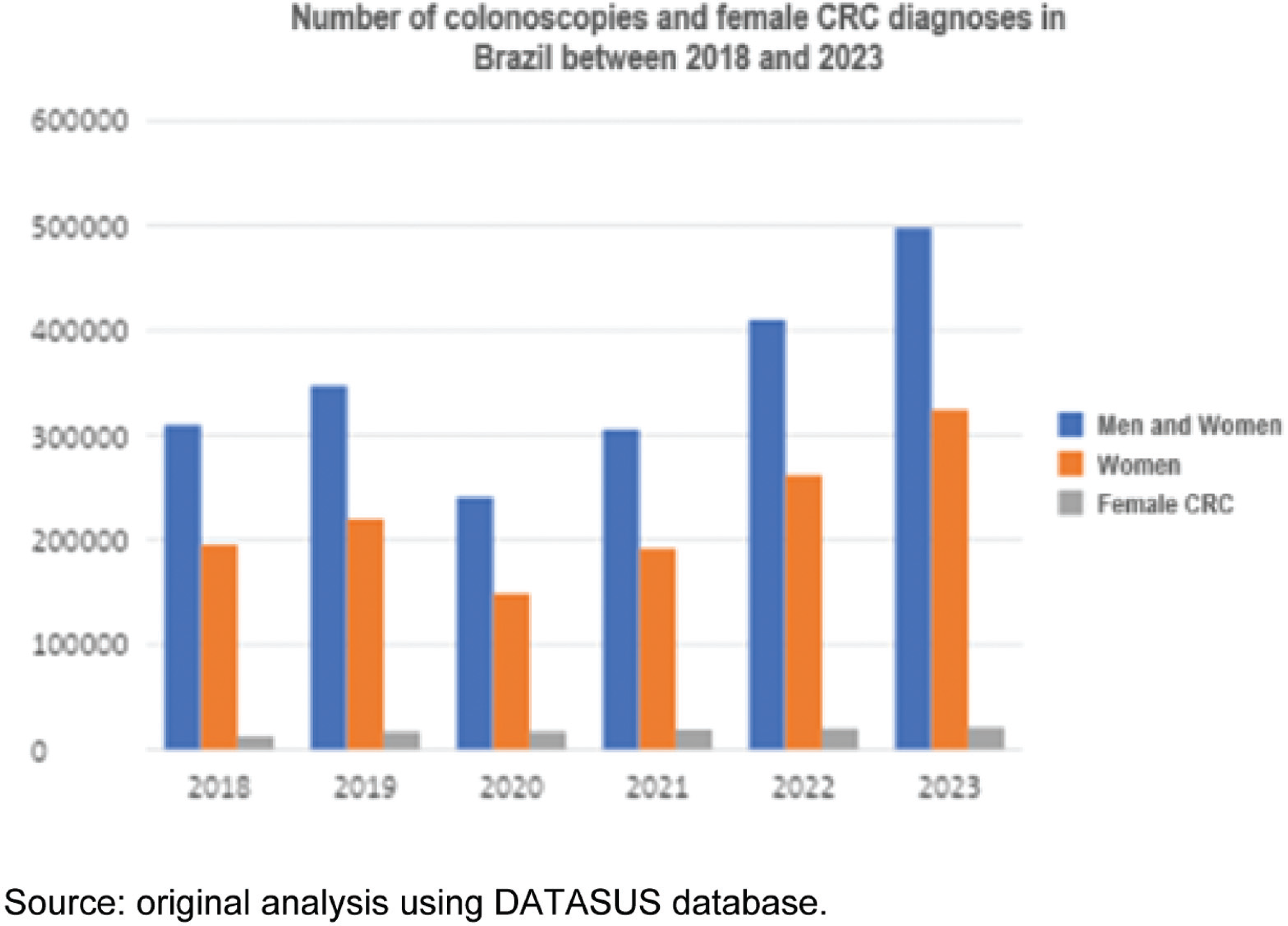
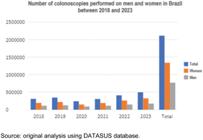
In 2018, a total of 309,291 colonoscopies were performed across Brazil, 195,175 of which were performed on women (Fig. 1). These colonoscopies yielded 24,876 diagnoses of CRC among men and women, with 12,503 diagnoses established in women (Fig. 2). In 2019, the number of colonoscopies performed on men and women increased to 347,159 nationwide, with 220,009 examinations performed on women. These procedures corresponded to 34,037 CRC diagnoses, 16,976 of which were in women. Before the pandemic, from 2018 to 2019, there was a 12.7% increase in the number of colonoscopies performed on women, accompanied by a 35.7% rise in CRC diagnoses among female patients.

Number of colonoscopies and female colorectal cancer (CRC) diagnoses in Brazil between 2018 and 2023.
In 2020, during the pandemic, as declared by the WHO on March 17, a disruption in the previously-observed trends was noted.12 The number of colonoscopies performed in Brazil among men and women was of 240,926, lower than that of the previous year, which was 347,159 (Fig. 2). More than 100 thousand individuals did not undergo colonoscopy in 2020 compared to 2019. Regarding women, there was a decline in the number of colonoscopies, from 220,009 to 148,845, during this period, corresponding to a 32.3% reduction. Among women, the CRC diagnoses 17,110, representing a slight increase of 0.7%, corresponding to 134 additional cases when compared to the preceding year. Despite the rise in female CRC diagnoses, the growth trend in year-to-year diagnoses declined: from 2018 to 2019, the diagnosis rate increased by 35.7%, whereas from 2019 to 2020, it rose by only 0.7%.
In 2021, the total number of colonoscopies performed among men and women was of 305,285, 191,550 of which were performed on women. An increase of 28.6% was observed in the number of colonoscopies performed in women compared to the first year of the pandemic. However, the absolute numbers of colonoscopies in women did not surpass the values recorded in 2018 (195,175) and 2019 (220,009). Regarding CRC diagnoses in women, there was a 10.4% increase from 2020 to 2021, with 19,868 new cases reported.
In 2022, a total of 409,992 colonoscopies were performed among men and women in Brazil, with 261,719 exams conducted in women. This represented a 36.6% increase in colonoscopies performed in women compared to 2021. In this year, the absolute number of colonoscopies among women surpassed the 2018 and 2019 values, separately, for the first time since the start of the COVID-19 pandemic. Regarding CRC diagnoses, 19,868 cases were observed in women, reflecting a 5.1% increase compared to 2021.
In 2023, with the official pandemic period lasting until May 5th,12 a total of 497,413 colonoscopies were performed in Brazil among men and women, with 323,963 of these procedures performed on women. This represented a 23.7% increase in colonoscopies among women compared to the previous year. There were 20,937 diagnoses of CRC in women during this period, corresponding to a 5.3% increase in the number of diagnoses made in 2022, a rate of increase similar to that observed in the comparison between 2021 and 2022, which was of 5.1%.
From 2018 to 2023, the number of CRC diagnoses in women was consistently higher than in men each year. A slight increase in diagnoses was observed in 2020 for both sexes, followed by sustained growth in subsequent years (Fig. 3).

Between 2018 and 2023, the number of colonoscopies performed on women showed fluctuations (Fig. 4). In the 2 years preceding the pandemic, there was a progressive trend in the number of these procedures, with a 12.7% increase from 2018 to 2019. In 2020, a decline in the number of colonoscopies performed was observed, with a reduction of approximately 32.3% compared to the previous year. In 2021, the number of colonoscopies performed exceeded the previous year by 28.6%, although, in absolute numbers, it remained lower than in 2019, with a difference of 41,874 procedures. In 2022, there was a 36.6% increase in the number of colonoscopies performed on women compared to the previous year, surpassing the 2019 values, with 261,719 procedures conducted. The growing trend continued into the following year, 2023, with an increase of 23.7% compared to 2022.

The impacts of the reduction in colonoscopy procedures can be visualized by the slight increase in CRC diagnoses in 2020, deviating from the growth rate observed in previous years (Fig. 5). From 2018 to 2019, CRC cases rose by 35.7%, whereas, from 2019 to 2020, the increase was only of 0.7%. According to INCA, the projected number of new CRC cases for 2020 was of 40,990, with 20,470 female cases, a quantity higher than the actual number of CRC diagnoses recorded that year. In 2020, a total of 34,363 CRC diagnoses were documented in men and women, 17,110 of which were in women.

Female CRC diagnoses and number of colonoscopies performed in women in Brazil between 2018 and 2023.
Discussion
Colonoscopy, which is recommended nationally and internationally as a screening method for CRC, is an effective tool for the early diagnosis of this type of cancer. The current study found a higher number of colonoscopies and CRC diagnoses among women in Brazil, with a slight increase in diagnoses during the pandemic, which may reflect a scenario of underdiagnosis.
Carethers et al.,13 in a study carried out in the United Sates about disparities in cancer prevention during the COVID-19 era, highlighted the disproportionate socioeconomic impacts of the pandemic on women's access to and use of preventive health services. Unemployment and loss of insurance affected women more, further limiting their ability to undergo CRC screening. Additional barriers included disruptions in local transportation, work schedule conflicts, and lack of childcare due to school closures, all of which hindered women's continuity in obtaining preventive care.13
Furthermore, Schifferdecker et al.,14 in a study on women's perspectives and experiences regarding breast cancer screening and surveillance, demonstrated the necessity of direct and personal contact from healthcare professionals to ensure adherence to proposed treatments and preventive care.14 The study found that health communication was insufficient, leaving women uncertain about undergoing cancer screening tests in the context of COVID-19 transmission. This scenario also impacted the performance of invasive exams, such as colonoscopy. According to the authors,14 communication barriers related to cancer screening were exacerbated during the pandemic.
The present study revealed an increase in the number of colonoscopies during the prepandemic period, followed by a 32.3% reduction in 2020 and a subsequent rise in the following years. There is a growing trend in the performance of colonoscopies, temporarily interrupted in the first year of the pandemic and resumed in 2022. Public policy efforts to promote CRC screening and raise public awareness about its importance may have contributed to this recovery. The increase in colonoscopies from 2020 to 2021 can be attributed to the partial reopening of non-COVID-19 outpatient services and procedures, as well as the emergence of symptoms in previously-asymptomatic patients who had not been screened the previous year and sought medical attention at that time. In a United States study by Miller et al.,15 colonoscopies during this period were largely reserved for patients with more urgent needs, likely those with symptoms or suspected CRC.15 A 43% overall decrease in referrals for screening exams was observed during the pandemic, including routine exams, while referrals for suspected cancer cases increased by 40%.
The reduction in colonoscopies likely contributed to the silent progression of CRC, delaying diagnosis until more advanced stages. Developing countries such as Brazil experienced a decline in diagnostic exams, particularly invasive ones such as colonoscopy, and in CRC treatment due to the prioritization of support for patients with moderate-to-severe COVID-19. In this context, a study by Bestetti et al.16 on the impacts of the COVID-19 pandemic on the diagnosis and treatment of CRC patients at a hospital in São Paulo, Brazil, found a higher incidence of liver metastases among patients operated on during the pandemic compared to the prepandemic period.
A retrospective multicenter cohort study17 in Italy involving 17,938 adult patients who underwent CRC surgery between 2018 and 2021 assessed the pandemic's effects on clinical presentation. A significant association was found between the pandemic period and an increase in advanced-stage CRC, aggressive histology, distant metastases, and stenotic lesions. The number of patients diagnosed with metastatic disease during the pandemic increased by 8.6% compared to the expected rate based on prepandemic data.17
The postpandemic period is expected to be marked by expanded cancer screening campaigns, with greater coverage of exams such as colonoscopy, aiming to compensate for gaps left during the COVID-19 pandemic.
The current study may guide future research in assessing the impacts of reduced CRC screening among women during the pandemic. Additionally, it may alert healthcare institutions to the possibility of delayed diagnoses and more advanced-stage cases of this cancer in Brazil.
Conclusion
During the COVID-19 pandemic, similar results were observed worldwide, with a decline in the number of invasive procedures performed, such as colonoscopies, in the general population and among women. The impacts of this can be seen in the number of female CRC diagnoses during this period. Although an increase in CRC diagnoses was observed during the pandemic, this rise was modest.
Therefore, observing the trend of increase in CRC diagnoses in the years preceding the pandemic, the slight increase in CRC in women seems to reflect underdiagnosis between 2020 and 2023, linked to the reduction in the number of screening imaging exams at the time.
Although the analyzed years showed higher numbers of colonoscopies performed and CRC diagnoses among women before and during the pandemic, several studies highlight anatomical, psychosocial, and economic factors that hindered the diagnosis of CRC during the pandemic. The consequences of delayed CRC diagnosis during the pandemic will likely become evident in the following years.
Funding
Data Availability
Data will be available upon request to the corresponding author.
References
- 1 Bestari MB, Joewono IR. Screening Colonoscopy for Colon Cancer in Women during COVID-19 Pandemic. Acta Med Indones 2021; 53(01):132–139
-
2 Silva AAD, Carlotto J, Rotta I. Standardization of the infusion sequence of antineoplastic drugs used in the treatment of breast and colorectal cancers. Einstein (Sao Paulo) 2018;16(02): eRW4074. Doi: 10.1590/S1679-45082018RW4074
» https://doi.org/10.1590/S1679-45082018RW4074 -
3 Toledo CM, Almeida LMPRd, Averbach M, Barbosa JdLES. Analysis of the tracking initiatives of colorectal cancer in Brazil. Arq Gastroenterol 2023;60(4):450–462 Doi: 10.1590/S0004-2803. 230402023-93
» https://doi.org/10.1590/S0004-2803.230402023-93 -
4 Jodal HC, Helsingen LM, Anderson JC, Lytvyn L, Vandvik PO, Emilsson L. Colorectal cancer screening with faecal testing, sigmoidoscopy or colonoscopy: a systematic review and network meta-analysis. BMJ Open 2019;9(10):e032773. Doi: 10.1136/ bmjopen-2019-032773
» https://doi.org/10.1136/bmjopen-2019-032773 -
5 Ministério da Saúde. Instituto Nacional de Câncer José Alencar Gomes da Silva (INCA) Detecção precoce do câncer. [Internet]. Rio de Janeiro: INCA; 2021 [cited 2024 mar 04]. 74 p. Avalaible from: https://www.inca.gov.br/sites/ufu.sti.inca.local/files/media/document/deteccao-precoce-do-cancer.pdf
» https://www.inca.gov.br/sites/ufu.sti.inca.local/files/media/document/deteccao-precoce-do-cancer.pdf -
6 Sykaras AG, Christofidis K, Politi E, Theocharis S. Exosomes on Endometrial Cancer: A Biomarkers Treasure Trove? Cancers (Basel) 2022;14(07):1733. Doi: 10.3390/cancers14071733
» https://doi.org/10.3390/cancers14071733 -
7 World Health Organization (WHO). International Agency for Research on Cancer (IARC) Colon Cancer Screening [Internet]. Lyon: IARC; 2019. IARC Handbooks of Cancer Prevention, v. 17. Available from: http://publications.iarc.fr/573
» http://publications.iarc.fr/573 -
8 Chen C, Stock C, Hoffmeister M, Brenner H. Optimal age for screening colonoscopy: a modeling study. Gastrointest Endosc 2019;89(05):1017–1025.e12. Doi: 10.1016/j.gie.2018.12.021
» https://doi.org/10.1016/j.gie.2018.12.021 -
9 Blanco GDV, Calabrese E, Biancone L, Monteleone G, Paoluzi OA. The impact of COVID-19 pandemic in the colorectal cancer prevention. Int J Colorectal Dis 2020;35(10):1951–1954. Doi: 10.1007/s00384-020-03635-6
» https://doi.org/10.1007/s00384-020-03635-6 -
10 Navarro M, Nicolas A, Ferrandez A, Lanas A. Colorectal cancer population screening programs worldwide in 2016: An update. World J Gastroenterol 2017;23(20):3632–3642. Doi: 10.3748/ wjg.v23.i20.3632
» https://doi.org/10.3748/wjg.v23.i20.3632 -
11 Ministério da Saúde. Deparatamento de Informação e Informática do Sistema Único de Saúde (DATASUS). Departamento de Informação e Informática do Sistema Único de Saúde [Homepage on the Internet]. Brasília: Ministério da Saúde [cited 2024 mar14.]. Available from: https://datasus.saude.gov.br/
» https://datasus.saude.gov.br/ -
12 World Health Organization (WHO) Statement on the fifteenth meeting of the IHR (2005) Emergency Committee on the COVID-19 pandemic [Internet]. Geneva: WHO; 2023 [cited 2024 Jun 4]. Available from: https://www.who.int/news/item/05-05-2023-statement-on-the-fifteenth-meeting-of-the-international-health-regulations-(2005)-emergency-committee-regarding-the-corona-virus-disease-(covid-19)-pandemic
» https://www.who.int/news/item/05-05-2023-statement-on-the-fifteenth-meeting-of-the-international-health-regulations-(2005)-emergency-committee-regarding-the-corona-virus-disease-(covid-19)-pandemic -
13 Carethers JM, Sengupta R, Blakey R, Ribas A, D’Souza G. Disparities in Cancer Prevention in the COVID-19 Era. Cancer Prev Res (Phila) 2020;13(11):893–896. Doi: 10.1158/1940-6207.CAPR20-0447
» https://doi.org/10.1158/1940-6207.CAPR-20-0447 -
14 Schifferdecker KE, Vaclavik D, Wernli KJ, et al. Women's considerations and experiences for breast cancer screening and surveillance during the COVID-19 pandemic in the United States: A focus group study. Prev Med 2021;151:106542. Doi: 10.1016/j. ypmed.2021.106542
» https://doi.org/10.1016/j.ypmed.2021.106542 -
15 Miller J, Maeda Y, Au S, et al. Short-term outcomes of a COVID-adapted triage pathway for colorectal cancer detection. Colorectal Dis 2021;23(07):1639–1648. Doi: 10.1111/codi.15618
» https://doi.org/10.1111/codi.15618 -
16 Bestetti JM, Mendonça RLdS, Cruz TdLPd, et al. Impacto da pandemia de COVID-19 no tratamento cirúrgico do câncer de cólon proximal em um hospital terciário. Int J Health Manag Rev 2021;7(3):1–13 Doi: 10.37497/ijhmreview.v7i3.290
» https://doi.org/10.37497/ijhmreview.v7i3.290 -
17 Rottoli M, Gori A, Pellino G, et al; COVID–Colorectal Cancer (CRC) Study Group. Colorectal Cancer Stage at Diagnosis Before vs During the COVID-19 Pandemic in Italy. JAMA Netw Open 2022;5(11): e2243119. Doi: 10.1001/jamanetworkopen.2022.43119
» https://doi.org/10.1001/jamanetworkopen.2022.43119