 Maize silage conservation with a mixed fermentation bioinoculant at different packing densities
Abstract
The objective of this work was to evaluate the effect of a mixed fermentation bioinoculant on the conservation of whole-plant maize silage at different packing densities. Experimental silos were opened after 45 days to determine fermentative losses, chemical composition, dry matter degradability in vitro, and aerobic stability. A dose-response assay compared bioinoculant application rates of 0, 2, 4, 6, and 8 L t-1 in silages packed at 400 and 550 kg m-3. Especially at intermediate doses, the bioinoculant increased aerobic stability and reduced losses of dry matter, gases, and ammonia nitrogen, while preserving non-fiber carbohydrates and hemicellulose. In the efficiency validation, the 4 L t-1 dose was compared with a commercial inoculant under the same two packing densities. The tested bioinoculant improved aerobic stability, whereas the commercial inoculant resulted in higher dry matter degradability in vitro. The results indicate that the mixed fermentation bioinoculant enhances the conservation of maize silage under variable packing conditions and improves the stability of the material after silo opening.
Index terms:
Zea mays; lactic acid bacteria; aerobic stability; multivariate analysis; additives.
Resumo
O objetivo deste trabalho foi avaliar o efeito de um bioinoculante de fermentação mista na conservação da silagem de milho em diferentes densidades de compactação. Silos experimentais foram abertos após 45 dias para determinar perdas fermentativas, composição química, degradabilidade da matéria seca in vitro e estabilidade aeróbica. Um ensaio de dose-resposta comparou as doses de 0, 2, 4, 6 e 8 L t-1 de bioinoculante aplicadas em silagens compactadas a 400 e 550 kg m-3. Especialmente nas doses intermediárias, o bioinoculante aumentou a estabilidade aeróbia e reduziu as perdas de matéria seca, gases e nitrogênio amoniacal, além de preservar os carboidratos não fibrosos e a hemicelulose. Na validação da eficiência, comparou-se a dose de 4 L t-1 a um inoculante comercial nas mesmas densidades de compactação. O bioinoculante testado melhorou a estabilidade aeróbia, enquanto o inoculante comercial aumentou a degradabilidade da matéria seca in vitro. Os resultados indicam que o bioinoculante de fermentação mista melhora a conservação da silagem de milho sob condições variáveis de compactação e aumenta a estabilidade do material após a abertura do silo.
Termos para indexação:
Zea mays; bactérias ácido-láticas; estabilidade aeróbica; análise multivariada; aditivos.
Introduction
Packing density is recognized as a central determinant of whole-plant maize (Zea mays L.) silage quality. Its effects on oxygen exclusion, porosity, and subsequent microbial activity during storage (Borreani & Tabacco, 2018) influence the rate at which anaerobic conditions are established during ensiling (Bernardes et al., 2018; Borreani et al., 2018). Convesely, inadequate packing increases porosity and prolongs oxygen exposure. This reduces the efficiency of the conservation process, contributing to higher dry matter and nutrient loss throughout storage (Bernardes et al., 2018; Krüger et al., 2020). Nevertheless, monitoring silage management remains a low priority, occurring in fewer than 25% of routine operations on commercial farms (Martins et al., 2019).
Inoculants based on lactic acid bacteria (LAB) are widely adopted to improve silage conservation, especially under suboptimal ensiling conditions (Gallo et al., 2018; Kung Jr. et al., 2021). However, the effectiveness of silage additives depends on the physicochemical conditions established during ensiling, especially oxygen availability (Borreani et al., 2018; Gallo et al., 2018). On one hand, lower packing density influences forage porosity and oxygen entrapment, which prolongs aerobic conditions and favors undesirable microbial activity, thereby increasing the importance of inoculants to accelerate fermentation (Gallo et al., 2018; Muck et al., 2018). On the other hand, higher packing densities promote faster oxygen depletion and more stable anaerobic conditions, potentially reducing the magnitude of inoculant responses (Oliveira et al., 2017). Although packing densities around 550 kg m-3 are considered adequate, lower values are common under practical conditions, reinforcing the need to evaluate additive performance across different packing scenarios (Borreani et al., 2018).
The homofermentative Lactiplantibacillus plantarum and heterofermentative Lentilactobacillus buchneri LABs are associated with improvements in silage preservation due to their broad effects on fermentation dynamics and the resulting conservation profile (Oliveira et al., 2017; Muck et al., 2018). Within this context, studies indicate that inoculant formulations combining these LAB species can contribute to more favorable preservation outcomes, including enhanced chemical composition, reduced losses, and increased aerobic stability (AS) (Silva et al., 2021).
Among available microbial additives, mixed fermentation bioinoculants, defined in this study as microbial products containing complex consortia obtained through the anaerobic fermentation of non-sterile substrates, have gained attention due to their efficiency (Barros Neto et al., 2026). Recent evidence has demonstrated their potential to improve silage conservation, even though evaluations have been predominantly conducted under specific crop and ensiling conditions. There remains limited exploration of key management factors such as packing density, despite its recognized importance under practical and variable ensiling conditions (Borreani et al., 2018; Gallo et al., 2018; Persson & Bakken, 2024; Barros Neto et al., 2026).
The objective of this work was to evaluate the effect of a mixed fermentation bioinoculant on the conservation of whole-plant maize silage at different packing densities.
Materials and Methods
The experiment was conducted at the Universidade Federal de Sergipe Experimental Farm, (10°55'26"S, 37°12'02"W, at 28 m of altitude). Whole-plant transgenic hybrid maize SHS SUPERR (Santa Helena Sementes, Rio Claro, SP, Brazil) was sown on July 12, 2022, following regional agronomic recommendations for the state of Sergipe, Brazil. Planting was performed at a target population of 62,500 plants per ha. The maize was harvested for ensiling 87 days after planting, on October 6, 2022. The whole-plant dry matter ranged from 31.6 to 34.9%.
The plants were processed using a MC1001N stationary forage harvester (Laboremus, Campina Grande, PB, Brazil) adjusted to 19 mm of theoretical length of cut. After chopping, the fresh forage was homogenized and divided into piles corresponding to each treatment combination. Each pile was subsequently used to fill experimental silos, which served as the experimental units.
A mixed fermentation bioinoculant composed of L. plantarum and L. buchneri (Korin Agriculture and Environment, Ipeúna, SP, Brazil) was evaluated in two experimental phases. The first phase consisted of a dose-response assessment in a completely randomized design following a 5×2 factorial arrangement. This included inoculant rates of 0, 2, 4, 6, and 8 L Mg-1 of fresh matter applied at packing densities of 400 and 550 kg m-3, with five replicates per treatment. Based on a product concentration of 4.0×10⁸ CFU mL-1, the application rates corresponded to 0 CFU g-1, 8.0×10⁵ CFU g-1, 1.6×10⁶ CFU g-1, 2.4×10⁶ CFU g-1, and 3.2×10⁶ CFU g-1 for the control (0 L Mg-1), 2 L Mg-1, 4 L Mg-1, 6 L Mg-1, and 8 L Mg-1 treatments, respectively.
The bioinoculant solution was prepared 3 days prior to application by diluting 1 L of the product into a mixture composed of 9 L of potable water and 150 g of Hibana (Korin Agriculture and Environment, Ipeúna, SP, Brazil). The mixture was homogenized and allowed to ferment in a loosely closed container. Immediately before ensiling, the treatments were applied uniformly to each forage pile using a handheld sprayer.
The forage from each pile was manually packed with wooden plungers into 150 mm×500 mm PVC experimental silos until the predetermined densities were achieved. An effluent collection system was located at the base of each silo, consisting of a chamber filled with sand, previously dried at 105°C for 24 hours, separated from the silage mass by cotton fabric and nylon mesh. The silos were closed with PVC lids equipped with Bunsen-type gas release valves, sealed with silicone, and stored indoors at ambient conditions for 45 days in order to evaluate the early effects of the bioinoculant.
The second experimental phase consisted of an efficiency validation, in which the bioinoculant was compared with a commercial inoculant under the same packing densities. This phase used a completely randomized 2×2 factorial arrangement with five replicates per treatment.
The commercial inoculant consisted of a microbial consortium including Latilactobacillus curvatus, L. plantarum, Lactobacillus acidophilus, Pediococcus acidilactici, Enterococcus faecium, L. buchneri, Lactococcus lactis, and Acidipropionibacterium acidipropionici combined with a 5% cellulolytic enzyme. The product contains a declared minimum concentration of 1.0×10¹⁰ CFU g-1 of product and was reconstituted by diluting 250 g in 100 L of water, according to the manufacturer’s instructions. The inoculant was applied at 2 L Mg-1 of fresh matter, corresponding to a theoretical application rate of approximately 5.0×10⁴ CFU g-1 of fresh forage. The solution was applied using the same procedure adopted for the bioinoculant.
The analytical procedures were divided into four main categories: fermentative losses, chemical composition, dry matter degradability in vitro, and AS after exposure. Fermentative losses, comprising dry matter losses, gas losses, and effluent losses, were measured gravimetrically by weighing the silos and their content before and after the storage period following the methods described by Jobim et al. (2007). Additionally, ammoniacal nitrogen was quantified according to Bolsen et al. (1992).
For the chemical composition analysis, samples of fresh forage and silage were oven-dried at 55°C for 72 hours and ground in a Wiley mill through a 1 mm sieve. Dry matter, ether extract (EE), and ash were analyzed following the procedures of Latimer Jr. (2023). Crude protein (CP) was determined via Kjeldahl digestion, whereas neutral detergent fiber (NDF), acid detergent fiber (ADF), neutral detergent insoluble protein, and acid detergent insoluble protein were determined according to Latimer Jr. (2023). Acid detergent lignin (ADL) was obtained using 72% sulfuric acid also according to Latimer Jr. (2023). Hemicellulose (HEM) and cellulose (CEL) were calculated as the difference between NDF and ADF, and between ADF and ADL, respectively. Finally, non-fiber carbohydrates (NFC) were calculated following the equation:
Analysis of dry matter disappearance (DMDIS) in vitro and true dry matter degradability (DMD) were determined using composite samples of 25 g per treatment (5 g per replicate), obtained from dried and ground silage. Rumen fluid was collected from freshly slaughtered cattle, transported in thermally insulated containers at 39°C, filtered through two layers of cheesecloth, and maintained under continuous CO2 infusion. The inoculum viability was confirmed by the methylene-blue reduction test (Dirksen et al., 1993). Approximately 0.5 g of each sample was placed in filter bags and incubated in a buffered medium, composed of 80% incubation solution and 20% rumen inoculum, under CO2 at 39°C for 48 hours (Theodorou et al., 1994; Mould et al., 2005). Following incubation, the bags were rinsed with warm distilled water and dried at 105°C for 24 hours.
DMDIS was calculated as the difference between the initial sample weight and the residue remaining after incubation and drying. Subsequently, the residues were ashed at 600°C for 3 hours to correct for mineral content. DMD was determined by subjecting the incubation residues to neutral detergent extraction, followed by an acetone wash and drying in order to remove microbial contamination and estimate the truly degraded fraction (Goering & Van Soest, 1970).
Aerobic stability after exposure was evaluated using 2 kg samples placed in 5 L polystyrene boxes, and maintained at 25±1.5°C for 108 hours. Silage temperature was recorded every 4 hours, and AS was defined as the time required for the sample to exceed ambient temperature by 2°C. Additionally, the pH was measured immediately upon silo opening and at 24 hour intervals throughout the exposure period using fresh subsamples homogenized in distilled water (Latimer Jr., 2023).
All statistical analyses were performed in R software version 4.0.2 (R Core Team, 2020), adopting a 5% significance level. Pearson correlations were visualized through correlograms using the corrplot package (Wei et al., 2024). Principal component analysis (PCA) was performed using the factoextra package (Kassambara & Mundt, 2020), focusing on variables that contributed the most to multivariate separation across the first two principal components.
In the dose-response experiment, data were analyzed using analysis of variance (ANOVA) and polynomial regression to evaluate linear and quadratic effects of inoculant rates. The model selection is based on lack-of-fit tests and adjusted R2. The following statistical model was employed:
where Yijk is the observed value, μ is the overall mean, αi is the fixed effect of dose, βj is the fixed effect of density, (αβ) ij is the interaction, and ɛijk is the residual error. In the efficiency-validation phase, PCA-selected variables were subjected to ANOVA to assess the effects of the inoculant, packing density, and their interaction. Tukey’s test was applied when effects were significant.
Results and Discussion
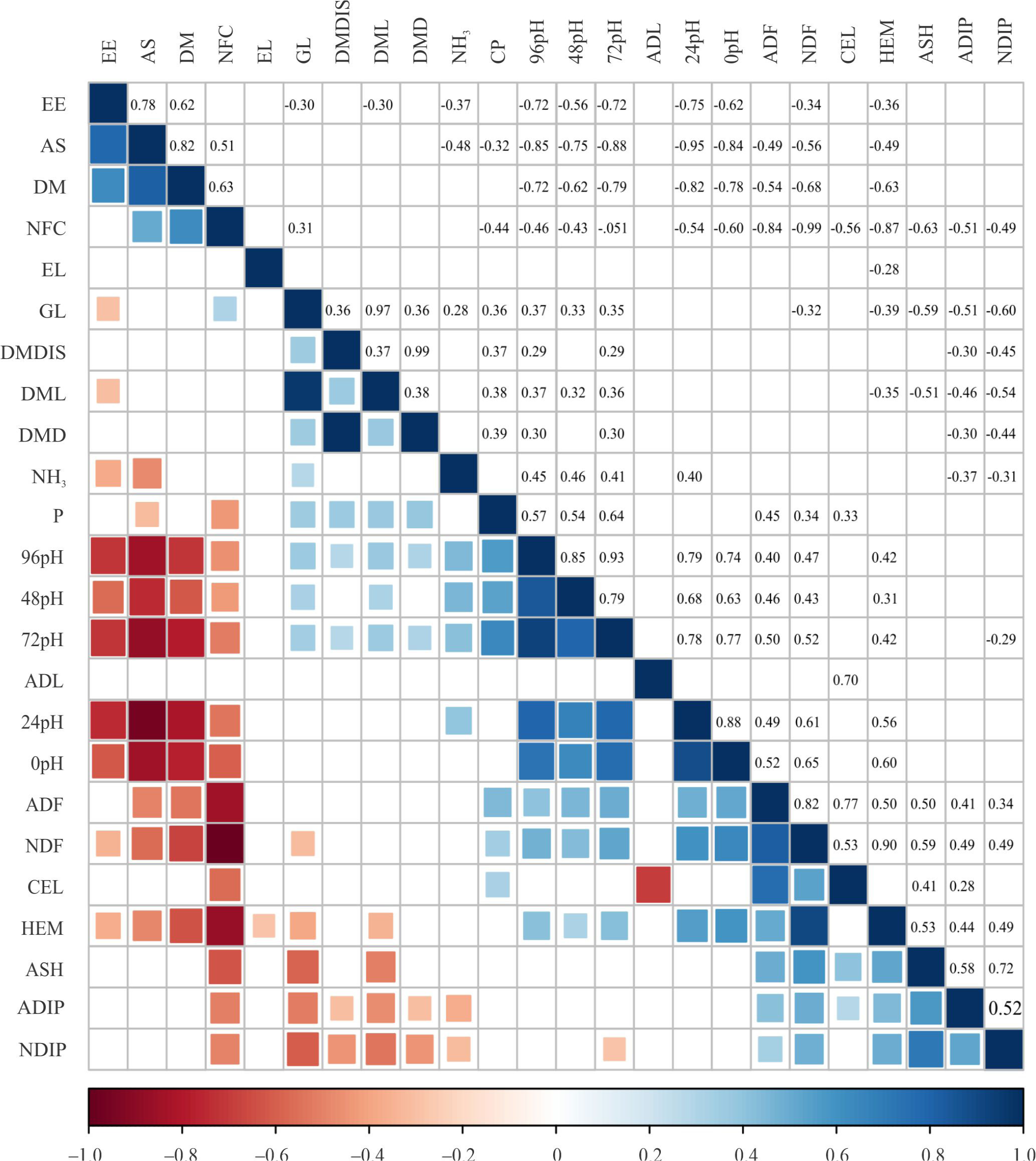
The correlation matrix revealed two main clusters of variables (Figure 1). Dry matter, EE, NFC, and AS were positively associated, yet negatively correlated with pH, NDF, ADF, and HEM. This pattern indicates that improved stability was linked to lower fiber concentrations and higher proportions of water-soluble or rapidly fermentable components. These findings corroborate the relationships described by Gallo et al. (2018), who reported that adequate compaction and the use of efficient inoculants help to reduce fiber degradation and enhance stability. Variables associated with fermentative losses, such as dry matter and gas losses, as well as ammoniacal nitrogen, were moderately or negatively related to AS. This indicates that higher losses were accompanied by reduced preservation efficiency.

Pearson correlogram of measured variables. The intensity of blue for positive and red for negative correlations represents the magnitude of the association. The numbers within the upper half indicate the specific Pearson correlation coefficients. Non-significant correlations (p > 0.05) are blank. DM, dry matter; EE, ether extract; NDF, neutral detergent fiber; ADF, acid detergent fiber; HEM, hemicellulose; CEL, cellulose; ADL, acid detergent lignin; NFC, non-fiber carbohydrates; CP, crude protein; NDIP, neutral detergent insoluble protein; ADIP, acid detergent insoluble protein; DMD, dry matter degradability; DMDIS, dry matter disappearance; DML, dry matter losses; EL, effluent losses; GL, gas losses; NH3, ammoniacal nitrogen; AS, aerobic stability; 0pH, 24pH, 48pH, 72pH, and 96pH, pH at 0, 24, 48, 72, and 96 hours after exposure, respectively.
Principal component analysis explained approximately 65% of the total variance, with the first component clearly separating treatments according to the inoculant dose (Figure 2). Silages without inoculation were grouped with higher pH, ammoniacal nitrogen, and fiber fractions; conversely, the 8 L Mg-1 bioinoculant rate was associated with higher dry matter, non-fiber carbohydrates, ether extract, and AS. The second component highlighted the performance of intermediate rates, which clustered with lower losses, particularly at 400 kg m-3. At this lower density, the risk of deterioration is greater due to higher oxygen entrapped during ensiling. These multivariate trends reinforce the biological coherence of the observed responses and align with the mechanisms described for L. plantarum and L. buchneri in mixed inoculation systems (Oliveira et al., 2017; Muck et al., 2018).
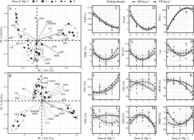
Principal component analysis of whole-plant maize (Zea mays) silages packed at 400 kg m-3 (A) and 550 kg m-3 (B), and dose-response curves for 0pH (C), 96pH (D), aerobic stability (AS; E), dry matter losses (DML; F), gas losses (GL; G), ammoniacal nitrogen (NH3; H), non-fiber carbohydrates (NFC; I), cellulose (CEL; J), hemicellulose (HEM; K), acid detergent lignin (ADL; L), ash (ASH; M), and dry matter degradability (DMD; N) according to bioinoculant application rate and packing density. DM, dry matter; EE, ether extract; NDF, neutral detergent fiber; ADF, acid detergent fiber; CP, crude protein; DMDIS, dry matter disappearance; EL, effluent losses; 24pH, 48pH, and 72pH, pH at 24, 48, and 72 hours after exposure, respectively.
Regression analysis further demonstrated that the bioinoculant had a quadratic effect on several variables (Table 1 and Figure 2). Aerobic stability increased markedly with the 4 and 6 L Mg-1 rates, exceeding 100 hours, whereas the control silage heated after approximately 37 hours of exposure. In silages without inoculant, the pH rose sharply, reaching values above 5.5, after 96 hours; this indicates intense aerobic deterioration. Conversely, the intermediate rates stabilized pH throughout the exposure period. This effect is attributed to the heterofermentative activity of L. buchneri, which promotes the production of antifungal metabolites, thereby enhancing AS during air exposure (Muck et al., 2018; Şahin & Tan, 2019; Yang et al., 2022).
Analysis of variance (ANOVA), equations and coefficients of determination for the packing density, bioinoculant application rate, and their interaction on response variables.
Fermentation losses were minimized near the 4 L Mg-1 rate, whereas the higher losses observed at 8 L Mg-1 indicate a non-linear response to inoculant application. This result is consistent with studies showing that microbial efficiency depends on the balance between substrate availability and microbial activity under ensiling conditions (Tan et al., 2018). This pattern suggests that increasing the rate beyond the optimal concentration does not necessarily improve fermentation efficiency under the evaluated conditions.
In the present study, the 8 L Mg-1 rate was associated with increased NFC and reduced CEL and HEM contents, indicating a greater transformation of structural carbohydrates, which may have contributed to higher fermentative losses. In contrast, intermediate rates seemingly preserve the fibrous fraction while maintaining lower dry matter losses. Additionally, considering that packing density influences oxygen availability and fermentation dynamics, the observed responses likely reflect the interaction between the applied rate of inoculant and the ensiling environment, rather than a purely rate-driven effect. Similar rate-dependent responses have been reported in silages treated with heterofermentative inoculants (Arriola et al., 2021).
Packing density influenced the overall response pattern, although the effects of the applied rate of bioinoculant were more consistent than the specific rate × density interactions. This is expected since compaction directly affects porosity, oxygen diffusion, and the rate of anaerobic stabilization (Tan et al., 2017; Bernardes et al., 2018). At 400 kg m-3, untreated silages tended to show higher fermentative losses and lower AS; however, the regression models did not consistently separate densities across all variables.
Inoculation reduced losses and improved stability regardless of density, showing a distinct rate-response pattern. At 550 kg m-3, the more anaerobic environment reduced the magnitude of these effects, although benefits to AS and pH were still observed. The apparent divergence between regression models and the PCA reflects their different approaches, as regression evaluates individual responses, while PCA captures multivariate correlations. These findings are in agreement with Gallo et al. (2018) and Kung Jr. et al. (2021).
Dry matter degradability in vitro exhibited different tendencies depending on the packing density. At the 400 kg m-3 density, degradability increased with the applied bioinoculant rate, reaching nearly 70% at 6 L Mg-1. At 550 kg m-3, degradability was reduced at intermediate rates, but partially recovered at the highest rate. This variation may be associated with faster establishment of anaerobic conditions and pH decline at a higher density, which potentially limits the early microbial and enzymatic breakdown of structural carbohydrates.
At intermediate rates, this effect may have restricted fibrolytic activity. However, at the 8 L Mg-1 rate, the greater microbial load may have enhanced secondary fermentation pathways, including the action of L. buchneri, contributing to partial fiber modification and recovery of degradability. Such contrasting responses may reflect differences in fibrolytic activity and the balance between homofermentation and heterofermentation across varying densities (Kung Jr. et al., 2021; Yang et al., 2022).
In the validation phase, comparing the 4 L Mg-1 rate with a commercial inoculant (Figure 3), the bioinoculant improved AS and maintained the pH below 4 throughout the exposure period. In contrast, the commercial product increased dry matter degradability but resulted in lower stability. These contrasting responses are consistent with the broader microbial profile of the commercial inoculant, which comprises multiple homofermentative and facultative heterofermentative strains combined with enzymes. These components are typically associated with faster substrate fermentation and greater nutrient solubilization (Muck et al., 2018; Silva et al., 2024).

Scatter plots of the principal components (A), and means of the bioinoculant and commercial inoculant in the Tukey test for the following variables at a 5% probability: pH over time after silo opening (B); aerobic stability (C); and dry matter losses (D). The principal component analysis was performed using individual observations, including the effect of packing density, whereas panels B to D present treatment means averaged across packing densities. DM, dry matter; EE, ether extract; NDF, neutral detergent fiber; ADF, acid detergent fiber; HEM, hemicellulose; CEL, cellulose; ADL, acid detergent lignin; NFC, non-fiber carbohydrates; CP, crude protein; NDIP, neutral detergent insoluble protein; ADIP, acid detergent insoluble protein; DMDIS, dry matter disappearance; DML, dry matter losses; EL, effluent losses; GL, gas losses; NH3, ammoniacal nitrogen; AS, aerobic stability; 0pH, 24pH, 48pH, 72pH, and 96pH, pH at 0, 24, 48, 72, and 96 hours after exposure, respectively.
Conversely, the superior AS observed with the mixed fermentation bioinoculant aligns with the metabolic pathways described for L. buchneri, which are linked to improved spoilage resistance during air exposure (Silva et al., 2021; Yang et al., 2022). The lower pH and extended stability measured in the present study support this interpretation, and similar patterns have been reported in previous comparisons between inoculant types (Pupo & Ferraretto, 2023).
Across both phases, the experimental bioinoculant consistently reduced fermentative losses and enhanced AS. These responses were primarily associated with the application rate rather than with a clear separation between packing densities. This distinction is relevant for practical silage systems, where achieving optimal compaction is often challenging (Krüger et al., 2020; Kung Jr. et al., 2021).
Overall, the results indicate that the mixed fermentation bioinoculant promotes more favorable preservation dynamics and mitigates the effects of residual oxygen on silage stability, thereby contributing to improved conservation and reduced nutrient losses. In contrast, the commercial inoculant was associated with higher NFC and DMD, suggesting faster pH decline and effective preservation of readily fermentable substrates, which under adequately packed conditions may result in comparable preservation outcomes.
Conclusions
-
1. The mixed fermentation bioinoculant improved maize (Zea mays) silage conservation, primarily by reducing fermentative losses and enhancing aerobic stability (AS).
-
2. An application rate of 4 L Mg-1 provided the most consistent balance among fermentation losses, chemical composition, AS, and dry matter degradability in vitro.
-
3. Although packing density influenced the ensiling environment, the overall responses were more consistently associated with bioinoculant application rate than with clear density-dependent effects.
-
4. Compared with the commercial inoculant, the bioinoculant promoted superior AS while maintaining similar fermentative losses and adequate degradability, indicating its potential as an alternative additive under different ensiling conditions.
Acknowledgments
To Korin Agriculture and Environment, for financing this study (PQA-PROJ-0008); to Universidade Federal de Sergipe, Mokichi Okada Research Center, and Fundação de Apoio à Pesquisa e à Inovação Tecnológica do Estado de Sergipe - FAPITEC/SE, for the support and assistance.
Disclaimer/Publisher’s note:
The statements, opinions, and data contained in all texts published in Pesquisa Agropecuária Brasileira (PAB) are solely those of the individual author(s) and not of the journal’s publisher, editor, and editorial team, who disclaim responsibility for any injury to people or property resulting from any referred ideas, methods, instructions, or products.
The mention of specific chemical products, machines, and commercial equipment in the texts published in this journal does not imply their recommendation by the publisher.
Declaration of use of AI technologies
During the preparation of this work, the authors used generative AI to assist with language editing and improvement of clarity and readability. After this use, the authors reviewed and edited the content as needed and take full responsibility for it.
Data availability statement
Data available upon request: research data are only available upon reasonable request to the corresponding author.
References
-
ARRIOLA, K.G.; OLIVEIRA, A.S.; JIANG, Y.; KIM, D.; SILVA, H.M.; KIM, S.C.; AMARO, F.X.; OGUNADE, I.M.; SULTANA, H.; PECH CERVANTES, A.A.; FERRARETTO, L.F.; VYAS, D.; ADESOGAN, A.T. Meta-analysis of effects of inoculation with Lactobacillus buchneri, with or without other bacteria, on silage fermentation, aerobic stability, and performance of dairy cows. Journal of Dairy Science, v.104, p.7653-7670, 2021. DOI: https://doi.org/10.3168/jds.2020-19647
» https://doi.org/10.3168/jds.2020-19647 -
BARROS NETO, A.P. de; ROCHA, F.I.; BACKES, A.A.; MORAIS, J.A. da S.; FAGUNDES, J.L.; NUSSIO, L.G.; LOBO, A.A.G.; KINJO, S.; PEREIRA, D.C. de O.; OLIVEIRA, J.P.A.F.; SOUSA, B.M. de L. Mixed fermentation bioinoculant improves conservation of BRS Capiaçu silage under fresh and wilted conditions. Revista Observatorio de la Economía Latinoamericana, v.24, p.1-21, 2026. DOI: https://doi.org/10.55905/oelv24n1-115
» https://doi.org/10.55905/oelv24n1-115 -
BERNARDES, T.F.; DANIEL, J.L.P.; ADESOGAN, A.T.; MCALLISTER, T.A.; DROUIN, P.; NUSSIO, L.G.; HUHTANEN, P.; TREMBLAY, G.F.; BÉLANGER, G.; CAI, Y. Silage review: unique challenges of silages made in hot and cold regions. Journal of Dairy Science, v.101, p.4001-4019, 2018. DOI: https://doi.org/10.3168/jds.2017-13703
» https://doi.org/10.3168/jds.2017-13703 -
BOLSEN, K.K.; LIN, C.; BRENT, B.E.; FEYERHERM, A.M.; URBAN, J.E.; AIMUTIS, W.R. Effect of silage additives on the microbial succession and fermentation process of alfalfa and corn silages. Journal of Dairy Science, v.75, p.3066-3083, 1992. DOI: https://doi.org/10.3168/jds.S0022-0302(92)78070-9
» https://doi.org/10.3168/jds.S0022-0302(92)78070-9 - BORREANI, G.; TABACCO, E. New concepts on baled silages. In: INTERNATIONAL CONFERENCE ON FORAGES, 2., 2018, Lavras. Proceedings Lavras: Universidade Federal de Lavras, 2018. p.49-73.
-
BORREANI, G.; TABACCO, E.; SCHMIDT, R.J.; HOLMES, B.J.; MUCK, R.E. Silage review: factors affecting dry matter and quality losses in silages. Journal of Dairy Science, v.101, p.3952-3979, 2018. DOI: https://doi.org/10.3168/jds.2017-13837
» https://doi.org/10.3168/jds.2017-13837 - DIRKSEN, G.; GRÜNDER, H.-D.; STÖBER, M. Exame clínico dos bovinos 3.ed. Rio de Janeiro: Guanabara Koogan, 1993.
-
GALLO, A.; BERNARDES, T.F.; COPANI, G.; FORTUNATI, P.; GIUBERTI, G.; BRUSCHI, S.; BRYAN, K.A.; NIELSEN, N.G.; WITT, K.L.; MASOERO, F. Effect of inoculation with Lactobacillus buchneri LB1819 and Lactococcus lactis O224 on fermentation and mycotoxin production in maize silage compacted at different densities. Animal Feed Science and Technology, v.246, p.36-45, 2018. DOI: https://doi.org/10.1016/j.anifeedsci.2018.09.009
» https://doi.org/10.1016/j.anifeedsci.2018.09.009 - GOERING, H.K.; VAN SOEST, P.J. Forage Fiber Analyses (apparatus, reagents, Procedures, and some applications). Washington: U.S. Agricultural Research Service, 1970. 20p. (Agriculture Handbook, n.379).
-
JOBIM, C.C.; NUSSIO, L.G.; REIS, R.A.; SCHMIDT, P. Avanços metodológicos na avaliação da qualidade da forragem conservada. Revista Brasileira de Zootecnia, v.36, p.101-119, 2007. Suppl. especial. DOI: https://doi.org/10.1590/S1516-35982007001000013
» https://doi.org/10.1590/S1516-35982007001000013 -
KASSAMBARA, A.; MUNDT, F. factoextra: extract and visualize the results of multivariate data analyses. 2020. Available at: <https://cran.r-project.org/web/packages/factoextra/index.html>. Accessed on: Dec. 17 2024.
» https://cran.r-project.org/web/packages/factoextra/index.html -
KRÜGER, A.M.; LIMA, P. de M.T.; ABDALLA FILHO, A.L.; MORO, J. de G.; CARVALHO, I.Q. de; ABDALLA, A.L.; JOBIM, C.C. Dry matter concentration and corn silage density: effects on forage quality. Tropical Grasslands-Forrajes Tropicales, v.8, p.20-27, 2020. DOI: https://doi.org/10.17138/tgft(8)20-27
» https://doi.org/10.17138/tgft(8)20-27 -
KUNG JR., L.; SAVAGE, R.M.; SILVA, E.B. da; POLUKIS, S.A.; SMITH, M.L.; JOHNSON, A.C.B.; MILLER, M.A. The effects of air stress during storage and low packing density on the fermentation and aerobic stability of corn silage inoculated with Lactobacillus buchneri 40788. Journal of Dairy Science, v.104, p.4206-4222, 2021. DOI: https://doi.org/10.3168/jds.2020-19746
» https://doi.org/10.3168/jds.2020-19746 -
LATIMER JR., G.W. (Ed.). Official Methods of Analysis of AOAC International 22nd ed. New York: AOAC International, 2023. DOI: https://doi.org/10.1093/9780197610145.001.0001 Ether Extract (EE): AOAC Official Method 920.39 (Fat / Crude Ether Extract in Animal Feed); Dry Matter (DM): AOAC Official Method 930.15 (Moisture in Animal Feed); Ash: AOAC Official Method 942.05 (Ash of Animal Feed); pH: AOAC Official Method 943.02 (pH of Flour); Acid Detergent Fiber (ADF) and Acid Detergent Lignin (ADL): AOAC Official Method 973.18 (Fiber / Acid Detergent Fiber and Lignin in Animal Feed); Crude Protein (CP): AOAC Official Method 2001.11 (Protein / Crude Protein in Animal Feed - Kjeldahl Method); Neutral Detergent Fiber (NDF): AOAC Official Method 2002.04 (Amylase-Treated Neutral Detergent Fiber in Feeds).
» https://doi.org/10.1093/9780197610145.001.0001 -
MARTINS, J.P.N.; KARLE, B.M.; HEGUY, J.M. Needs assessment for cooperative extension dairy programs in California. Journal of Dairy Science, v.102, p.7597-7607, 2019. DOI: https://doi.org/10.3168/jds.2018-15959
» https://doi.org/10.3168/jds.2018-15959 -
MOULD, F.L.; MORGAN, R.; KLIEM, K.E.; KRYSTALLIDOU, E. A review and simplification of the in vitro incubation medium. Animal Feed Science and Technology, v.123-124, p.155-172, 2005. DOI: https://doi.org/10.1016/j.anifeedsci.2005.05.002
» https://doi.org/10.1016/j.anifeedsci.2005.05.002 -
MUCK, R.E.; NADEAU, E.M.G.; MCALLISTER, T.A.; CONTRERAS-GOVEA, F.E.; SANTOS, M.C.; KUNG JR, L. Silage review: recent advances and future uses of silage additives. Journal of Dairy Science, v.101, p.3980-4000, 2018. DOI: https://doi.org/10.3168/jds.2017-13839
» https://doi.org/10.3168/jds.2017-13839 -
OLIVEIRA, A.S.; WEINBERG, Z.G.; OGUNADE, I.M.; CERVANTES, A.A.P.; ARRIOLA, K.G.; JIANG, Y.; KIM, D.; LI, X.; GONÇALVES, M.C.M.; VYAS, D.; ADESOGAN, A.T. Meta-analysis of effects of inoculation with homofermentative and facultative heterofermentative lactic acid bacteria on silage fermentation, aerobic stability, and the performance of dairy cows. Journal of Dairy Science, v.100, p.4587-4603, 2017. DOI: https://doi.org/10.3168/jds.2016-11815
» https://doi.org/10.3168/jds.2016-11815 - PERSSON, T.; BAKKEN, A.K. A review of the effects of density and silo type on silage fermentation, nutritive quality and losses during storage Svanhovd: Nibio, v.10, 2024.
-
PUPO, M.R.; FERRARETTO, L.F. Effects of laboratory ensiling method, microbial inoculation, and storage length on the fermentation profile and nutrient composition of whole-plant corn silage and high-moisture corn. Animal Feed Science and Technology, v.306, art.115818, 2023. DOI: https://doi.org/10.1016/j.anifeedsci.2023.115818
» https://doi.org/10.1016/j.anifeedsci.2023.115818 - R CORE TEAM. R: a language and environment for statistical computing. version 4.0.2. Vienna: R Foundation for Statistical Computing, 2020.
-
ŞAHIN, M.; TAN, F. Examination of the measurement methods used to determine the silage density in small farm. European Journal of Science and Technology, v.17, p.744-749, 2019. DOI: https://doi.org/10.31590/ejosat.625909
» https://doi.org/10.31590/ejosat.625909 -
SILVA, É.B. da; COSTA, D.M.; SANTOS, E.M.; MOYER, K.; HELLINGS, E.; KUNG JR., L. The effects of Lactobacillus hilgardii 4785 and Lactobacillus buchneri 40788 on the microbiome, fermentation, and aerobic stability of corn silage ensiled for various times. Journal of Dairy Science, v.104, p.10678-10698, 2021. DOI: https://doi.org/10.3168/jds.2020-20111
» https://doi.org/10.3168/jds.2020-20111 -
SILVA, É.B. da; POLUKIS, S.A.; SMITH, M.L.; VOSHELL, R.S.; LEGGETT, M.J.; JONES, P.B.; KUNG Jr., L. The use of Lentilactobacillus buchneri PJB1 and Lactiplantibacillus plantarum MTD1 on the ensiling of whole-plant corn silage, snaplage, and high-moisture corn. Journal of Dairy Science, v.107, p.883-901, 2024. DOI: https://doi.org/10.3168/jds.2023-23672
» https://doi.org/10.3168/jds.2023-23672 - TAN, F.; DALMIS, I.S.; KOC, F. Effects of compaction pressure on silage fermentation in bunker silo. Agronomy Research, v.15, p.298-306, 2017.
-
TAN, F.; KAYISOGLU, B.; OKUR, K. Effects of compaction pressure on the temperature distribution in bunker type silage silo. Indian Journal of Animal Sciences, v.88, p.116-120, 2018. DOI: https://doi.org/10.56093/ijans.v88i1.79521
» https://doi.org/10.56093/ijans.v88i1.79521 -
THEODOROU, M.K.; WILLIAMS, B.A.; DHANOA, M.S.; MCALLAN, A.B.; FRANCE, J. A simple gas production method using a pressure transducer to determine the fermentation kinetics of ruminant feeds. Animal Feed Science and Technology, v.48, p.185-197, 1994. DOI: https://doi.org/10.1016/0377-8401(94)90171-6
» https://doi.org/10.1016/0377-8401(94)90171-6 -
WEI, T.; SIMKO, V.; LEVY, M.; XIE, Y.; JIN, Y.; ZEMLA, J.; FREIDANK, M.; CAI, J.; PROTIVINSKY, T. corrplot: visualization of a correlation matrix. 2024. Available at: <https://cran.r-project.org/web/packages/corrplot/index.html>. Accessed on: Dec. 17 2024.
» https://cran.r-project.org/web/packages/corrplot/index.html -
YANG, F.; CAI, Y.; GUO, X.S.; ZHONG, J. (Ed.). New Microbial Inoculants for Enhancing Fermentation Quality of Silage Lausanne: Frontiers Media SA., 2022. DOI: https://doi.org/10.3389/978-2-88974-874-7
» https://doi.org/10.3389/978-2-88974-874-7
Edited by
-
Chief editor:
Edemar Corazza
-
Edited by:
Madalena Rinaldi