
 Störmer problem: a computational study on the formation of the Van Allen radiation belt
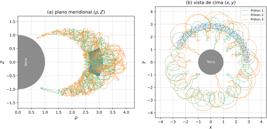
We present the Störmer problem in the framework of classical mechanics: the motion of non-relativistic charged particles under the Earth’s dipolar magnetic field. Starting from the Lagrangian formulation in cylindrical coordinates, we derive the equations of motion and identify the conserved quantities. The resulting system is non-integrable, and we employ the second-order symplectic Störmer-Verlet method to numerically integrate the equations of motion. Three cases are analyzed: the equatorial case, where the particle is restricted to the plane; the full three-dimensional case; and the case where the particle is constrained to a spherical surface. In the equatorial case, we show that the effective potential has a local minimum and maximum, and that particles with energy below the maximum are confined to oscillatory orbits. In the three-dimensional case, the dynamics exhibits sensitivity to initial conditions and trajectories that reproduce the toroidal structure of the Van Allen radiation belt. In the spherical case, the system becomes integrable and admits an analytical solution in Jacobi elliptic functions, which we use to validate the numerical integrator.
Keywords:
Störmer problem; Van Allen radiation belt; symplectic integration; classical mechanics
 Thumbnail
 Thumbnail
 Thumbnail
 Thumbnail
 Thumbnail
 Thumbnail


