
 Desecuritizing Cannabis: The Role of Local Political and Social Actors in California’s Policy Reform
Abstract
The United States has been the driving force behind the establishment of the international drug control regime and has historically served as its principal enforcer. What impact have domestic policy changes had on federal authorities in the case of the state of California? We argue that growing civil and political support for reform led to significant changes in the policy landscape, with legislation gradually turning California “green” for the recreational use of marijuana. From a methodological perspective, this study employs detailed historical process tracing to examine a single case study: the state of California. We explore how the drug issue has been perceived, how drug-related laws have been developed, and the role played by local political and social actors in shaping these changes. To understand this process, we draw on the theories of securitization and desecuritization. We ask: how is the leader of the global prohibition regime rearticulating the drug issue from a process of securitization to one of desecuritization? Our findings suggest that the securitization of drugs in California was driven primarily by governmental actors through a top-down process, whereas desecuritization has been led largely by civil society through a bottom-up dynamic.
Keywords
Drug Policy; United States; California; Cannabis Reform; Prohibitionism; Desecuritization Theory
Introduction
The year of 2021 marked the 50th anniversary of U.S. President Nixon’s declaration of the War on Drugs, which is still being fought. Although most states in the United States have enacted reforms to their cannabis laws, marijuana and marijuana-derived products remain illegal under federal law, subject only to very limited exceptions. After decades of strong U.S. engagement in promoting and enforcing global drug prohibition, a puzzle emerges: since 2012, states have increasingly regulated and legalized cannabis despite federal prohibition. The pace of change has been remarkable. By the end of 2025, cannabis had been legalized for medical use in 40 of the 50 states, and for recreational use in 24 states. Moreover, policy reform is not limited to cannabis. In 2020, voters in Oregon approved two landmark drug policy initiatives. The first decriminalized the possession of small amounts of illicit drugs, including heroin, cocaine, and methamphetamine. The second authorized the creation of a state-regulated program to license providers of psilocybin services. These developments suggest that changes in drug policy are extending beyond cannabis and challenging long-standing assumptions underlying the prohibitionist framework.
Considering this shift, one might ask: how can the United States regulate drugs domestically while maintaining federal prohibition? How is prohibition being rearticulated, transforming the drug issue from securitization to desecuritization within the federal system? This article aims to understand how a powerful war discourse that has been in place for decades is gradually being challenged. Additionally, it seeks to analyze how drugs are discursively constructed and the implications of these different constructions. To address these questions, we argue that understanding when and how non-state actors from civil society are able to influence security policies — and what enables them to exert such influence — is key to explaining marijuana policy in the United States.
Using California as a case study, this article argues that the desecuritization of marijuana in the United States has largely taken place through a bottom-up process. Rather than being driven by political elites, this shift has been led by NGOs, civil society actors, and local regulators1. In the specific case of California, we contend that the reframing of cannabis — from a security threat to a matter of public policy — emerged primarily in response to popular demand, challenging the traditional, top-down securitization narrative. However, both the process of securitization and its reversal through desecuritization were not ipso facto transformations. Instead, they developed over several decades, progressing through multiple phases from the late 20th century into the early decades of the 21st century.
The article is divided into three sections: methodology; theoretical framework on the concepts of securitization and desecuritization; the first moment of desecuritization of marijuana in California, and the second moment of desecuritization in that state.
Methodology
The way we methodologically approach this study is by adopting a qualitative case study design, employing process tracing as its primary analytical strategy. Here we assume the definition that process tracing is “detailed examination of an aspect of a historical episode to develop or test explanations that may be generalizable to other events” (George and Bennet 2005, 5). Moreover, process tracing enables a systematic examination of failed securitization efforts in California, helping to explain why certain attempts to frame marijuana as a security threat stalled, while others gained traction, making this approach particularly well suited to the case analyzed in this study.
The state of California was selected because its political and socio-cultural context places it at the center of U.S. drug policy debates. The state has a large Latino population and shares a border with Mexico, a country that U.S. drug discourse has long portrayed as a primary source of illicit drug production and trafficking. As a result, California occupies a unique position in which domestic marijuana policy is deeply entangled with racialized, border-focused, and foreign-policy-oriented understandings of drug production and control.
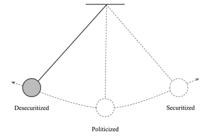
In this paper, we also focus specifically on the California case in order to capture the evolutionary dynamics of securitization and desecuritization over time. Using the image of a pendulum as an analytical device, we illustrate how public issues can move between the realms of security and normal politics as dominant discourses shift. In our visual analysis, the pendulum illustrates that an issue may occupy different positions at different moments (figure 3 and 4 below).

The empirical analysis is based on multiple qualitative data sources, as detailed below:
-
Documents from California legislative sessions, including historical archives spanning several decades and covering the early stages of marijuana regulation in the state and records of legislative participation.
-
Interview material from in-person semi-structured interviews with key actors in the cannabis sector, including activists, scholars and business owners, as shown in Table 1.
Securitization and Desecuritization: traditional theory and its challenges
The securitization approach is an alternative route to a wider concept of security that broadens the security agenda to include threats other than military ones. While the traditional studies’ central concern is “how we become more secure”, securitization theory asks instead “how does an issue become a security issue”. The core claim of securitization theory – that security must be understood as a “speech-act” – is not only a sociological and explanatory tenet. As a speech-act, securitization is located within the realm of political argument and discursive legitimation, and security practices are thus susceptible to criticism and transformation. The social construction of security issues (who or what is being secured, and from what) is analyzed by examining the “securitizing speech-acts” through which threats become represented and recognized (Buzan et al. 1998).
Applying the securitization theory to the USA, we argue that drugs became securitized by the speech (act) President Nixon gave in 19712, declaring The War on Drugs, with the goal of eradicating what he viewed as the growing problem of drug addiction. We identify Nixon’s discourse as a key speech act in the securitizing move that contributed to the construction of the War on Drugs. This is not to suggest that, in the USA’s case, this was the only speech act responsible for the securitization of drugs; rather, it is the one selected for the purposes of the present analysis.
The president states that “America’s public enemy number one in the United States is drug abuse. In order to fight and defeat this enemy, it is necessary to wage a new, all-out offensive”. In this sense, Buzan et al. (1998) argues that a successful speech-act is a combination of language and society, of both intrinsic features of speech and the public that authorizes and recognizes that speech. Nixon used the words “enemy”, “fight”, “defeat” and “offensive” articulating the internal conditions of a speech act. This kind of language was greatly influential in establishing the war on drugs as a global fight focused on eliminating substance abuse. In fact, global drug policy has been largely shaped by the United States’ advocacy for an “absolutist prohibition approach” (Collins 2014).
Moreover, Jutila (2006) believes that presenting an issue as an existential threat – if done successfully – means that “normal” day-to-day politics is intensified into emergency politics. This applies to Nixon’ speech and actions, particularly when he points that “in order to defeat this enemy which is causing such great concern, and correctly so, to so many American families, money will be provided to the extent that it is necessary and to the extent that it will be useful”.
On the other hand, while securitization theory might be considered over-explored, desecuritization theory would be under-explored. The concept of desecuritization focuses on moving issues “out of security” realm, it is the “shifting of issues out of emergency mode and into the normal bargaining process of the political sphere” (Buzan et al. 1998). That gives us ground for innovation and contribution, but at the same time brings hesitancy. The first discussions about desecuritization were about how it could be achieved (Huysmans 1998). Next, the literature on desecuritization has focused on three sets of questions: what counts as desecuritization (identification of the phenomenon), why should there be desecuritization (ethics and normativity), and how can desecuritization be achieved (transformative practice) (Balzacq 2005). Additionally, we would say that even fewer have attempted to explore the dynamics of desecuritization within and related to drugs, mainly cannabis, pursued by non-elite actors in the states of the U.S., making that relevant for individuals seeking a comprehensive understanding of the complex interplay between drug policy, societal perceptions, and the role of grassroots movements in reshaping the discourse surrounding drug decriminalization.
Åtland (2008) points out that whereas securitization can be characterized as a form of depoliticization, desecuritization usually implies some form of re-politicization. Instead of framing an issue in terms of security, the purpose of a “desecuritizing move” is to take the “securityness” out of the issue and reintroduce it to the sphere of everyday politics. That means, visually, moving the pendulum away from one extreme to the middle, not yet achieving desecuritization, but provoking discussions on the matter.
Hansen (2011) gives another option for desecuritization called “replacement”, which is “the combination of one issue moving out of security while another is simultaneously securitized”. Hansen also argues that another “form of desecuritization that one encounters in the literature applying securitization theory is that of silencing, that is when an issue disappears or fails to register in security discourse”. The option to silence an issue sounds unintentional and, as the discourse shows, prohibitionism has been sustained over time, not only through discourse, but also through policy practice. The drug issue is far from silent; it is iterative, dynamic and multi-layered. Finally, Hansen (2011) elaborates on the option of desecuritization through “rearticulation”. She continues to explain that “at level one, rearticulation refers to fundamental transformations of the public sphere including a move out of the friend-enemy distinction” (Hansen 2011). We argue that this is the strategy taken for the desecuritization of drugs, particularly cannabis in many states in the U.S.
Some critics of securitization theory
Securitization theory has been subject to tension almost since its inception, and an increasing number of scholars have criticized its emphasis on the discursive dimension of securitization. The work of Williams (2003; 1998) was one of these first notable dissents, as he argues that different types of speeches might constitute an act and made an important theoretical connection to Schmittian politics of sovereign exceptionality.
What most of these critiques share is a concern that that they view the emphasis on speech as problematic in cases where the ability to speak is constricted, or where securitization occurs without a speech act (Fako 2015). Among the main voices in this regard is Thierry Balzacq (2005), who introduces a broader, socially oriented understanding of “the context, the psycho-cultural disposition of the audience, and the power that both the speaker and the listener bring to the interaction”. This approach increases the explanatory power of the securitization theory by including a social context that is “independent from the use of language” (Balzacq 2005). His examples demonstrate that these choices are constrained by history, memory, and discursive personifications. Likewise, Ralf Emmers (2007) highlights similar contextual factors and argues that articulating issues in security terms allows audiences to grant securitizing actors the legitimacy to mobilize state power and move beyond established rules.
On the other hand, a number of critiques concerning the concept of securitization have merged, addressing, for example, issues of political responsibility (Eriksson 1999), the absence of gender considerations (Hansen 2011), and the role of non-discursive, institutionalized forms of securitization (Bigo 2002). Alongside other scholars, we also believe that securitization and desecuritization can occur at local as well as international levels. For instance, Lemanski (2012) suggests that security problems exist on a variety of scales — and security and securitization can be constructed from the bottom up as well as from the top down. Also, McInnes and Rushton (2012) have described securitization as a multidimensional process that can be carried out on a variety of levels (local, state and international) as well as along a continuum, with some issues being more securitized than others. In addition, they suggest that issues can become both securitized and desecuritized over time.
Furthermore, the theory is a constant subject of constructive theoretical discussions and critique (Hayes 2009; McDonald 2008; Mitzen 2006; Stritzel 2007; Taureck 2006; Williams 1998; 2003). Additionally, Floyd (2007; 2011) believes that securitization is complete only if the warning promise made in the speech act is followed by a change in relevant behavior by a relevant agent, a security practice. More recently, Rita Floyd (2019), drawing on the tradition of “just war”, has offered a significant revision of securitization theory by assessing when, and how, it is morally acceptable to transform an issue into a security matter. According to Floyd (2019) critical theorists have often emphasized only the negative effects of securitization, such as the suspension of rights, exclusion from public debate, the militarization of drugs, and therefore recommended depoliticization or even “anti-securitization” or desecuritization. However, Floyd argues that “threats such as climate change, pandemics, and other health crises are changing this landscape,” as these represent real and global dangers to societies, thus morally justifying and legitimizing securitization. To assess “just securitization,” Floyd’s Just Securitization theory proposes four criteria for evaluating the moral legitimacy of securitizing an issue: the existence of a real existential threat; appropriate intent (i.e., the protection of fundamental values rather than political gain); action undertaken by legitimate authority; and proportionate and temporary measures that avoid abuse.
In Brazil, and more broadly in Latin America, securitization and desecuritization theory has generated a growing body of scholarship that engages with the theoretical framework of the Copenhagen School. In some cases, this literature adopts the traditional framework; in others, it engages more critically with the theory and its assumptions. It should also be noted that most of these works remain largely grounded in the more traditional perspective developed and systematized within securitization theory, although a smaller number of scholars adopt more critical or non-traditional approaches (see Bracante and Reis 2015; Carmali 2008; Cavalcante 2012; Duque 2009; Farret 2014; Pereira 2025; Rodrigues 2003; Silva and Pereira 2019; Tanno 2003; Villa 2014; Villa and Santos 2011).
Considering desecuritization as a historical process that combines discourse, conduct, and institutional constructions, and not just “speech act,” we discuss in the following sections a historical and analytical process tracing that will show how this process operated in a pendulum-like fashion from securitization to desecuritization. To this end, we organize this pendulum movement, from securitization to desecuritization, into two moments, which we call the first and second moments of the desecuritization process. That being said, the objective here is to present how the drug war rhetoric was challenged internationally and also by some U.S. states, implementing approaches other than prohibition and changing their drug policies.
The first moment of desecuritization of marijuana in California: weed the people in the Nixon years
The state of California, as shown in figure 1 below, has a long history of producing legislation both in favor or against the regulation of drug use, and grassroots actors (individuals and groups, community-based organizations, NGOs and civil society organizations) have played an essential role in supporting the debate to treat the cannabis issue outside the security realm (Polson 2015). By tracing this historical process back, we demonstrate how prohibitionist narratives were initially constructed and why their securitizing language and arguments have proven remarkably resilient over time.

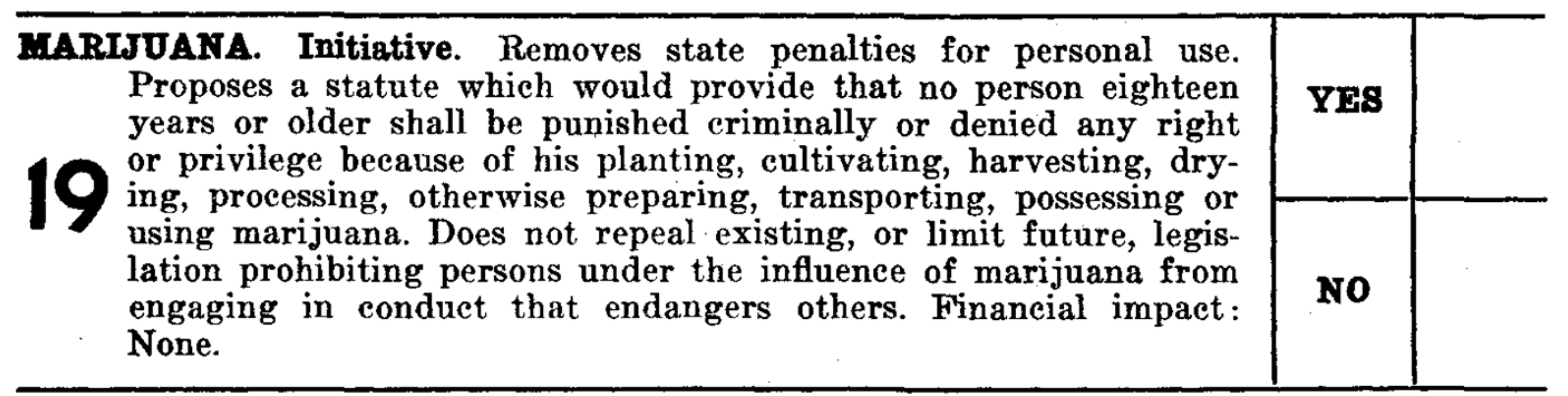
As a result of this growing momentum shown in figure 1, grassroots movements in California helped initiate a gradual process of desecuritizing marijuana. This effort made history by advancing the first-ever ballot measure to decriminalize marijuana in the United States, demonstrating that California pioneered an unprecedented level of community organization around the issue. The Ann Arbor Sun edition3 reported that “with 20,000 workers, operating out of fifty offices, and collecting nearly 400,000 signatures, the California registration drive became the only state to put the decision, to smoke or not to smoke, on the November ballot” on Proposition 19. A “Yes” vote on this initiative statute was a vote to revise California law relative to marijuana to provide that no person in the state of California 18 years of age or older shall be punished in any way for growing, processing, transporting, or possessing marijuana for personal use or for using it. A “No” vote is a vote to eject this revision as shown in figure 2 4. In fact, as Huysmans argues, the process of desecuritization is a critical strategy, “used by grassroots movements to generate responses from different levels of audience, of which the legislative body is one” which should make it possible to relocate the question to a context of ethical-political judgment in which one does not seek to find the political basis of an existential threat (Huysmans 1998), but to place the problem on the agenda in a desecuritizing strategy.

The discussion on Proposition 19 already illustrates the phenomenon known as a “divided audience” (Villa and Breda 2010; Léonard and Kaunert 2011). Securitization scholars argue that securitization is an incremental, contentious, and multidirectional process in which it is often difficult to distinguish between “securitizing actors” and “securitizing audiences,” since many of the individuals, social groups, and organizations involved in drug policy debates may assume different roles at different moments (Oberdick 2018). The debate surrounding Proposition 19 in California shows how “securitizing audiences” can diverge from consensus and express conflicting positions, resulting in divided audiences. Arguments in favor of Proposition 19 emphasized that marijuana is not addictive, does not lead to the use of other drugs, does not harm the body, does not produce mental illness, crime, or violence, and has no lethal dose.
Opposition to Proposition 19 contended that insufficient research had been conducted on the effects of marijuana use, and that legalizing it would serve as a green light for increased drug abuse — a common argument still used by opponents of marijuana reform today. On the other hand, the official ballot argument in favor of Proposition 19 stated that “Marijuana is not as harmful as our two most popular drugs — alcohol and tobacco — and there is no justification for making criminals out of people who use any of these. The current laws are expensive, destructive, and unsuccessful: soft on drugs and hard on people”. The California case shows that, although securitization theory is not exclusively concerned with normative questions, its normative dimension remains essential for opening up broader ethical debates about the framing of drugs as an international security issue (Elbe 2006).
The California case also reveals several limitations and areas of under-theorization in securitization theory, particularly regarding the assumption of audience consensus. One of the central concepts of the theory — the audience — is not characterized by consensus; rather, dissent and contestation often shape actors’ responses to the securitization of specific issues or sectors of international security (Léonard and Kaunert 2011; Balzacq 2005; McDonald 2008; Stritzel 2007). We call that dissent a “divided audience”. As a consequence of that divided audience, and despite being a progressive measure for its time, Proposition 19 was overwhelmingly defeated by voters, with 5,433,393 voting “No” (66.5%) and only 2,733,120 voting “Yes” (33.5%). At the time, simple possession of marijuana was classified as a felony, punishable by up to ten years in state prison. The growing number of arrests for marijuana-related offenses was placing a significant financial and logistical burden on law enforcement. However, as a result of the divided hearing, state legislative changes in the profiles of drug offenders, and the felony classification of possession led legislators to explore alternative strategies to reduce the strain on the criminal justice system (Aldrich and Mikuriya 1988).
By recognizing the differences in form and potency, lawmakers acknowledged the varying social, medical, and legal implications of each substance, paving the way for more nuanced policy discussions, opening the way for a process of desecuritization, albeit incipient from a historical perspective, in the state of California. It is also important in the context of securitization theory, as a process of legislative production is part of the process through which issues are constructed as security threats, but also deconstructed (or desecuritized). Williams (2003) argued that different kinds of speeches might constitute an act of securitization, and given that, notably, securitization implies depoliticization, that removes the issue from democratic debate. This created the conditions for a second moment of the process of desecuritization of cannabis in California.
The second moment of the desecuritization of cannabis in California (from Reagan to Obama)
Desecuritization is not a linear process, as it is mediated by contextual developments and the reconstruction of securitizing discourse. Moreover, desecuritization at the subnational level is not always accompanied by corresponding changes at the federal level of a country. Although California initiated, for much of the 20th century, an incomplete process of drug desecuritization, especially of marijuana consumption, this movement — expressed through the relaxation of punitive regulations — was not always accompanied by corresponding changes at the federal level. The U.S. strategy of drug prohibition has created a “regime of truth” according to which drug prohibition is necessary for the protection of the citizenry. As constructed through discourse, drug policy is an example of the nexus between knowledge and power par excellence (Heddleston 2012) mediated by that discourse of “punitive prohibition” (Reinarman and Levine 1997). At a federal level, the increasingly punitive War on Drugs, reinforced by Ronald Reagan and George H.W. Bush, who embraced the securitization legacy left by Nixon, shaped new areas of concern for drug policy reformers (Rodrigues 2003). These included threats to public health, social justice, civil liberties and public policy. Specifically, drug policy reformers addressed the AIDS epidemic and its spread through needle sharing among injection drug users, racially discriminatory policies targeting crack cocaine users, mandatory minimum sentencing guidelines, a rise in violent crime, threats to civil liberties, the incarceration boom and asset forfeiture as damaging consequences of the War on Drugs (Heddleston 2012). That reinforced a moment of securitization of drugs, as shown in the figure 3 below.
One of the features of the securitization process is the speech act. Wæver (1995) has defined security as a speech act in which security is not of interest as a sign that refers to something more real; If securitization is successful, then the issue is shifted from “normal” politics to “emergency” politics (Julita, 2006). For a matter of visual effects, when actors publicly portray issues (e.g., drugs) as a threat or not, we can see them moving in the pendulum as we discuss them.
However, the desecuritization of drugs does not necessarily occur as a result of a “speech act,” as some critics of the Copenhagen School have pointed out. These authors argue that desecuritization may also emerge in the absence of explicit discourse, or as a combination of speech acts, practices, and institutional performances that contribute to processes of securitization or desecuritization (Vuori 2011; Behnke 2006). Vuori (2011), for instance, believes that explicit speech acts can at times be desecuritization moves; whether or not something is successfully desecuritized may perhaps depend on a withering away, but this withering may begin with active movements. These active movements guided the next step in 1996, when California voters passed “Proposition 215”, the Compassionate Use Act (CUA) – the first voter-approved state ballot initiative for medical marijuana in the United States. This aligns with Behnke (2006), who conceptualizes desecuritization as a form of “withering away”: an explicit debate over whether an issue is no longer a security concern, but retains the logic and possibility of securitization. With this major win, CUA allowed qualified patients and approved caregivers to possess and cultivate medical marijuana and ultimately led to the formation of collectives and cooperatives to serve medical patients throughout the state. It represented the inauguration of an even more progressive era for cannabis in California.
These types of reforms prompted California’s state and municipal legislature to enact medical marijuana bills in 1994 and 1995, but these bills were ultimately vetoed by then-Governor of California Pete Wilson. There is a clear conflict between the state and the municipality that reflects a broader dynamic captured by the theoretical pendulum between securitization and desecuritization. Public policy on marijuana legalization does not evolve linearly; instead, it oscillates over time. This back-and-forth movement helps explain persistent tensions and policy inconsistencies across different levels of government, particularly between subnational and federal authorities. This is what Hansen (2011) called desecuritization for “replacement”. It happens when “one issue ceases to be a security issue while another is simultaneously securitized” (Hansen 2011). At first glance, it seemed that the war on marijuana and cocaine had been replaced by a war on opiates, and this would be a case of desecuritization by substitution, since municipalities, governments, and the federal level presented various forms and different timings of securitization and desecuritization.
But even with these comings and goings of legislative reforms on drugs at different levels of government, such reforms would not be possible without highlighting the crucial role of civil society in advancing drug policy reform. It shows how grassroots activism, citizen mobilization, and advocacy organizations were instrumental in initiating and supporting a cannabis regulation. That search for alternative strategies seems to match with the strategies thought by representatives from civil society and think tanks:
I don’t care if cannabis use increased. I care more about what happened to the total number of people who were arrested. Right? So, depending on what outcomes you care about, that’s important. I think that’s where there’s a lot of debate because there are some folks people are trying to achieve different things like (interview by authors with senior researcher at RAND Drug Policy Research Center, February 2, 2020).
This kind of perspective from RAND overlaps with what Manjikian (2013) and Bracante and Reis (2015) observe, when they argue that desecuritization can be seen as a type of emancipating process, by which a social problem can be reinterpreted and reconceptualized by political and social agents, in such a way that new policy solutions to an old problem might emerge, and shaping the problem itself in a new way.
However, the pendulum swing towards a desecuritizing policy is an incremental, contentious, and multidirectional process in which it is often difficult to distinguish “securitizing actors” from “securitizing audiences”, since many of the individuals, groups, and organizations contend with opposing narratives (Oberdick 2018). This shows more substantively that divided audiences sometimes generate support, and therefore desecuritization processes, and sometimes reinforce securitization processes. Regarding Proposition 215, a coalition of primary opponents of medical marijuana emerged, composed of law-enforcement organizations such as the California Narcotics Officers Association and the California Sheriffs Association. These organizations and their representatives, accustomed to lobbying for their interests through the legislative process, argued that medical decisions should not be made by popular vote (Ferraiolo 2007). Despite this opposition, public opinion was consistently in favor of the initiative. A Field Poll conducted 56% support, while a private poll commissioned by the Proposition 215 campaign found 57% approval. Similarly, the Los Angeles Times poll reported 58% supporting 36% (Goldberg 1996).
The new regulation was incorporated into legislation in the Compassionate Use Act, which encourages the federal and state governments to implement a plan to provide for the safe and affordable distribution of marijuana to all patients in medical need of marijuana. But not without a fight. The federal government under President George W. Bush occasionally raided medical-marijuana dispensaries or growers supplying the dispensaries because. This is because, although Proposition 215 legalized medical cannabis in California, at the federal level it remained a Schedule I prohibited drug. In March 2009, the Barack Obama administration announced that it would stop raids on dispensaries that followed state law, although it would continue to enforce laws against marijuana production generally (Kilmer et al. 2010). As one of the interviewees points out, the agenda-setting capacity in the issue of drug regulation, at both the local and federal levels, is very relevant because it is based on the power of influence of each state holder at different levels of government: “I struggle trying to understand how the states here [in the USA] have so much power and the federal government keeps prohibiting drugs... I find out that it’s not only the states, local levels also have a lot of power” (interview with social justice activist, 21 February, 2020). The same perception is highlighted by a senior researcher interviewed, “I don’t know if you’ve heard this phrase, ‘all politics is local.’ That’s like a phrase that’s used by a lot of politicians because people identify their interests and can kind of connect to politicians and their advocacy at a very local level, right?” (interview to senior scholar on drug policy, 20 February, 2020). However, in any case, such securitization and desecuritization movements, at different levels, local or federal, nuanced by the interviewees, give insight into how desecuritization efforts should happen and advance the normative discussions (Hansen 2011; Aras and Polat 2008; Aradau 2003), how desecuritization emerges and how it can be achieved through transformative practices by which social agents can construct the desecuritization process (Balzacq 2010; 2009).
Ferraiolo (2007) argues that this shift in venue was spearheaded by a group of drug policy and social reformers who exploited their prolific skills and resources to achieve success through the ballot initiative process, in part by transforming the way in which drug policy debates were framed in California. However, what Ferraiolo (2007) calls a shift in venue, we call it desecuritization. More specifically, we argue that these changes in how to treat the drug issue is the movement back into “normal politics.” Normal politics in California drug policy was marked by what Roe (2006) might call the three Ds – discussion, debate and deliberation – and, by contrast, emergency politics is constituted by the three Ss – silence, secrecy and suppression. Furthermore, we believe that the desecuritization process happened not only by changing how the public perceived the cannabis consumer, but also by the current political process. The strategic framing of policy can be significant not solely in shaping preferences or changing minds, but in activating public support and making it electorally relevant. At least in principle, the securitization and desecuritization theories are about language and what we see happening in California is the transformation, through language, of how the drug issue is treated. The discourse shifts from marijuana being an existential threat to being a medicine that can help people in need.
Continuing to reinforce this desecuritization movement, four years after the passage of “Proposition 215”, in November 2000, California voters passed “Proposition 36”, which was subsequently enacted as the Substance Abuse and Crime Prevention Act (SACPA). It represented a major shift in criminal justice policy, since adults convicted of nonviolent drug-related offenses in California and otherwise eligible for SACPA could then be sentenced to probation with drug treatment instead of either probation without treatment or incarceration (Longshore et al. 2007). Supported by the Drug Policy Alliance and health–related organizations, but opposed by the California Republican Party, the California District Attorneys Association, and other law enforcement organizations, SACPA shifted the state’s illicit drug policy from a punitive approach to a more rehabilitative model, although this process of legislative change was slower at the federal level:
“[for example] If you think about the origins with alcohol prohibition, so what happened, the way alcohol prohibition came about initially was it started off as being state-level prohibitions, right? And this grew up in the late 19th, early 20th century. And then it eventually resulted in a congressional legislation and... many states began to repeal their own alcohol prohibition laws while the federal prohibition remained in place” (Interview by authors with Founder of the non-profit Drug Policy Alliance (DPA), 22 February, 2020).
In this regard, Heddleston (2012) argues that, by opening a novel system of cannabis production and consumption to public and state scrutiny through the passage of Proposition 215 — and later Proposition 36 — the medical cannabis movement profoundly transformed the cultural representation of cannabis, reframing the plant from a dangerous substance to a therapeutic one. In California, as in other regions of the world, drug use has also been shaped by socially and culturally embedded forms of regulation.
Similar to the role played by traditional norms and practices surrounding coca use in Bolivia and other Andean countries, informal social controls — including community norms, rituals, and shared understandings of acceptable use — have influenced how cannabis is perceived and consumed. These cultural dynamics contributed to the gradual rearticulation of marijuana from a security threat to a matter of health, personal choice, and public policy. Controlled users have a multiplicity of meaningful roles, which give them a positive identity and a stake in conventional daily life, and both these factors anchor them against drifting toward a drug-centered life (Decorte 2001).
We would add that public opinion is of utmost importance here, since it was the public’s views on the issue that defined the production of politics. This coincides with Thierry Balzacq’s argument, who adds a social aspect of securitization that includes “the context, the psycho-cultural disposition of the audience, and the power that both the speaker and the listener bring to the interaction”. This approach increases the explanatory power of the securitization theory by including a social and cultural context that is “independent from the use of language” (Balzacq 2005). Furthermore, Balzacq’s argument demonstrates that these choices are constrained by history, memory, and discursive personifications. Likewise, Ralf Emmers (2007) shares these environmental and cultural aspects and notes that the articulation in security terms conditions the audience and provides securitizing actors with the right to mobilize state power and move beyond traditional rules.5
Thus, from a desecuritization perspective, these actions and legislative changes shifted the issue away from securitization and toward normal politics, fostering debate and political action (Figure 4).
Above all, we would highlight that this shift is being put in motion by non-states actors. Advocacy groups, grassroots movements, and local entrepreneurs are the primary drivers of efforts to broaden and publicize the debate. In this context, desecuritization emerges not from political elites, but as a societal process. The movement consists of advocacy and membership-based organizations, shifts in public opinion, and support from affluent donors. Organizations such as the Drug Policy Alliance, have spearheaded numerous drug reform campaigns, largely funded by individuals committed to the cause. One way to look at it is as to how social problems become more complex and policy makers seek more local flexibility and greater choice in delivery of services. Public policies are increasingly implemented through interdependent implementation networks involving multiple public agencies, private firms, and organizations — both for-profit and nonprofit — that work together to develop tailored approaches and innovative solutions to complex problems (Goldsmith and Eggers 2004; Koppenjan and Klijn 2004; Rhodes 1997; Van Bueren et al. 2003).
Evidence of the deepening desecuritization of marijuana in California can be found in changing public attitudes and in the broader influence of the state’s reforms across the United States. Public opinion polls from 2022 indicate that support for medical marijuana exceeds 80% among Americans (Van Green 2022). This patchwork of state-level reforms is shaping national dynamics, and should these last two states follow suit, the U.S. would face a paradoxical situation: cannabis-related policies in every single state would contradict federal law. This growing tension is likely to increase pressure on Congress and the White House to reevaluate federal marijuana restrictions and could further accelerate efforts to legalize recreational cannabis nationwide. But, as one interviewee maintains, this is an almost inevitable political-legal circuit: “it starts with Congress voting for the amendment and then the states having a period of time to ratify the amendment...” (interview with senior scholar on drug policy, 02 February, 2020). But this desecuritization process that took place in California showed institutionalized forms, which take advantage of non-discursive and institutionalized forms, for example legislatures and state governments, to repoliticize the drug issue (Bigo 2002).
The California case also showed that securitization and desecuritization can exist on a local as well as an international level. For instance, Lemanski (2012) suggests that security problems exist on a variety of scales — and security and securitization can be constructed from the bottom-up as well as from the top down. Also, McInnes and Rushton (2012) have described securitization and desecuritization as a multidimensional process that can be carried out on a variety of levels (local, state and international) as well as along a continuum, with some issues being more securitized than others. Amid this evolving national picture, California remains a key reference point, as it illustrates the possibilities of complete desecuritization.
The passage of Proposition 64 in November 2016 marked a turning point in the history of marijuana regulation in California and represented the culmination of a long and gradual process of desecuritization. Approved by 57.13% of voters, the measure authorized adults aged 21 and older to possess, transport, purchase, consume, and share up to one ounce of marijuana, as well as to cultivate up to six plants for personal use. The significance of Proposition 64 extended beyond its legal provisions: a state that had once embraced the logic of the War on Drugs now permitted the recreational use of cannabis. The main contributors to the campaign, again, were individuals and civil society organizations that formed a broad coalition of audiences with California’s two largest newspapers, the Los Angeles Times and the San Francisco Chronicle, as well as the California Democratic Party. Yet this transformation remained incomplete. While California moved marijuana further into the realm of normal politics and public regulation, federal law continued to prohibit its possession, distribution, and production, illustrating the persistent tensions between state-level reform and the broader prohibitionist framework of the United States.
However, that strong moment of desecuritization can hardly be assessed as a consequence of a simple “speech act” as the mainstream theory of securitization suggests, but also as part of a desecuritization process operating at other levels (which include conduct, institutional changes, and cultural attitudes). An extensive non-traditional literature on securitization (see: Floyd 2010; 2007; Hayes 2012; McDonald 2008; Mitzen 2006; Stritzel 2007; Taureck 2006; William, 1998; 2003) has debated whether a theory is a constant subject of constructive theoretical discussions, and whether securitization is only complete if the warning/promise made in the speech act is followed by a change in relevant behavior by a relevant agent, a security practice, but the same logic could be applied to desecuritization in the case of California: beyond the desecuritization rhetoric, a change in the conduct of the relevant actors is necessary.
This process of almost complete desecuritization, in speech and conduct, and even institutionally, appears to have happened in 2017 when regulators, legislators and a wide range of stakeholders worked on developing regulations and protocols for implementing the new law. This process included reconciliation of California’s Medical Cannabis Regulation and Safety Act with “Prop. 64”. While the possession, transportation, consumption and sharing of marijuana became legal immediately, retail sales of nonmedical marijuana only began once the state started issuing licenses in 2018. Following up on Floyd’s argument, we would go further and add that the securitization and desecuritization process of drugs is not only about bureaucratic transformation, but also about the consequences of law and enforcement, as well as their speeches, conducts and policies (Floyd 2010).
The California case suggests that the securitization of marijuana never fully achieved the conditions of “just securitization” outlined by Floyd (2019). As demonstrated by the historical process traced in this article, efforts to frame marijuana as an existential security threat were repeatedly challenged by social movements, voters, medical advocates, and local policymakers. Consequently, the moral legitimacy of treating marijuana as a security issue remained contested, facilitating its gradual desecuritization and eventual incorporation into the realm of normal politics. It is unlikely that at any point in history such a securitization process has met at least two of the four criteria specified by Floyd for securitization to be ethically acceptable: (i) the existence of a real threat; (ii) the appropriate intention by the securitizing subjects to protect fundamental values, not political gains. In fact, marijuana consumption in California has never met these two criteria established by Rita Floyd’s work because it is very difficult to evaluate and endorse the moral legitimacy of discourse or securitizing conduct on the topic of marijuana. Without this “just securitization” criterion, the path to desecuritization had been shortened in California.
Conclusion
This research makes both theoretical and empirical contributions. From a theoretical perspective, it provides further evidence for critiques of the Copenhagen School’s emphasis on the “speech act” as the primary mechanism through which securitization and desecuritization occur. While discourse remains an important component of these processes, the California case demonstrates that transformations in security framing are also shaped by social movements, institutional practices, legislative reforms, public opinion, and other forms of political action. By examining the evolution of marijuana policy in California, this study contributes to a broader and more multidimensional understanding of securitization and desecuritization. It highlights that these processes unfold through a variety of mechanisms and actors that extend beyond the relationship between securitizing agents and referent objects as expressed through speech. In doing so, the research supports efforts to expand the analytical scope of securitization theory beyond discourse alone and toward a more comprehensive account of political and social change.
Without denying the importance of the speech act as the primary securitizing mechanism identified by the original Copenhagen School studies, our investigation demonstrates that securitization and desecuritization are also shaped by the actions of social actors, the institutional arrangements through which discourses are translated into practice, and broader political and cultural contexts. In the California case, factors such as state and federal legislation, social mobilization, and a political culture historically more receptive to social change appear to have contributed to the relatively rapid normative and legislative transformations that facilitated the desecuritization of marijuana6. But also, an aspect that we believe has made an important contribution, and to which little attention is paid, is the process tracing of the historical and empirical formation of securitization and desecuritization processes. Both traditional formulations of securitization/desecuritization and critical approaches omit the historical structure in which those two processes are formed, likening them to an already existing reality. Our historical approach to desecuritization in the state of California places the formation of speech acts, and the intervention of institutional norms and political culture, within a historical framework spanning almost 60 years, generating more epistemologically solid meanings and consequences. Furthermore, from an empirical standpoint, we demonstrate how social groups can alternate as builders or deconstructors of securitization and desecuritization processes.7
One finding of the research was to show the tensions to criminalize marijuana at the federal level, while states, like California, set their own policies without federal interference, showing the key elements that make designing a prohibition at the federal level and legalization at the internal level. Considering that cannabis remains illegal at the federal level — classified by the U.S. Drug Enforcement Administration as a Schedule I drug — its legalization in California represents a significant political achievement and reflects the strength of grassroots movements in reshaping established norms and policies. However, federal policy has only changed marginally, and prohibition remains the dominant framework. Although there is an ongoing international agenda on drug deregulation, with Uruguay as a key reference case, California is also highly emblematic. Its significance has two main dimensions: first, California represents one of the world’s largest markets for drug consumption and distribution; second, its historical trajectory of drug desecuritization illustrates how social actors can contribute to regulatory change that resonates beyond the domestic level, potentially influencing broader global debates on drug policy reform.
In California, local governments and legislative authorities have shifted marijuana governance from law enforcement toward regulatory domains such as public health and zoning, reflecting its rapid normalization in law and society. Land-use regulatory bodies play a central role in this process by governing how marijuana-related practices are spatially regulated, where advocates often confront logics of private property and moral-aesthetic regulation (Polson 2015). As one of the interviewees maintains, the conflict between state regulation and federal regulation continues to exist between social and political actors:
So in 2016, that it would have been, it was during the Obama administration, Loretta Lynch, the Attorney General at that point, was asked to do this by a bunch of, you know, people who supported the marijuana movement, and she refused to do it. She said, I’m not doing it, I’m not moving out of schedule one. So it’s just this really weird situation where you have the federal government saying, you know, we’re not going to enforce the law against the states, but we’re also not going to do what we need to do to harmonize the two. We’re allowing this conflict to exist (Interview with chief of staff and Associate Deputy Atorney General at the U.S. Department of Justice, 10 October, 2019).
Finally, it should be noted that in some Latin American countries, such as Brazil, Uruguay, and Colombia, desecuritizing practices and discourses emerging from California and other parts of the United States have had important effects on regional policy debates. As Farret (2014) argues, these dynamics have influenced Brazilian border policies and helped shape the broader security agenda in South America. Similarly, Silva and Pereira (2019) show that drug trafficking was strongly securitized by the Brazilian government between 2011 and 2016, after which the issue gradually returned to the stage of “politicization,” as defined by the Copenhagen School.
Acknowledgements
The authors gratefully acknowledge CAPES for funding Natália Nunes’s PhD research, which made this study possible.
References
-
Aldrich, M., and T. Mikuriya. "Savings in California marijuana law enforcement costs attributable to the Moscone Act of 1976: a summary." Journal of Psychoactive Drugs 20, no. 1 (1988): 75-81. doi: https://doi.org/10.1080/02791072.1988.10524375
» https://doi.org/10.1080/02791072.1988.10524375 -
Aradau, C. "Beyond good and evil: ethics and securitization/desecuritization techniques." Rubikon: International Forum of Electronic Publications, December, 2001. http://venus.ci.uw.edu.pl/Brubikon/forum/claudia2.htm
» http://venus.ci.uw.edu.pl/Brubikon/forum/claudia2.htm -
Aras, B., and R. Polat. "From conflict to cooperation: desecuritization of Turkey's relations with Syria and Iran." Security Dialogue 39, no. 5 (2008): 495-515. doi: https://doi.org/10.1177/0967010608096150
» https://doi.org/10.1177/0967010608096150 -
Åtland, K. "Mikhail Gorbachev, the murmansk initiative, and the desecuritization of interstate relations in the Arctic." Cooperation and Conflict 43, no. 3 (2008): 289-311. doi: https://doi.org/10.1177/0010836708092838
» https://doi.org/10.1177/0010836708092838 - Balzacq, T. "Constructivism and Securitization Studies." In The Routledge Handbook of Security Studies, edited by M. Dunn Cavelty and V. Mauer, 56-72. Abingdon: Routledge, 2009.
- Balzacq, T. "Enquiries into methods: a new framework for securitization analysis." In Securitization theory: how security problems emerge and dissolve, edited by T. Balzacq, 31-54. Abingdon: Routledge, 2010.
-
Balzacq, T. "The three faces of securitization: political agency, audience and context." European Journal of International Relations 11, no. 2 (2005): 171-201. doi: https://doi.org/10.1177/1354066105052960
» https://doi.org/10.1177/1354066105052960 -
Baudean, M., and F. Rudnitzky. "The growth of violence in the drug markets: the case of Uruguay (2012-2019)." Revista de Ciencias Sociales 36, no. 53 (2023): 89-112. doi: https://doi.org/10.26489/rvs.v36i53.4
» https://doi.org/10.26489/rvs.v36i53.4 -
Behnke, A. "No way out: desecuritization, emancipation and the eternal return of the political - a reply to Aradau." Journal of International Relations and Development 9, no. 1 (2006): 62-69. doi: https://doi.org/10.1057/palgrave.jird.1800078
» https://doi.org/10.1057/palgrave.jird.1800078 -
Bigo, D. "Security and immigration: toward a critique of the governmentality of unease." Alternatives: Global, Local, Political 27, no. 1_suppl (2002): 63-92. doi: https://doi.org/10.1177/03043754020270S105
» https://doi.org/10.1177/03043754020270S105 -
Bouchard, M., N. Zakimi, and B. Gomis. "Cannabis legalization and its effects on organized crime: lessons and research recommendations from Canada." Sociological Inquiry 95, no. 2 (2025): 394-414. doi: https://doi.org/10.1111/soin.12619
» https://doi.org/10.1111/soin.12619 -
Bracante, H., and R. R. Reis. "Securitização da imigração: um mapa do debate sobre e algumas considerações críticas." Lua Nova: Revista de Cultura e Política, no. 77 (2009): 73-103. doi: https://doi.org/10.1590/S0102-64452009000200003
» https://doi.org/10.1590/S0102-64452009000200003 - Buzan, B., O. Wæver, and J. De Wilde. Security: a new framework for analysis London: Lynne Rienner, 1998.
- Carmali, S. "O conceito de segurança como política de excepção: uma avaliação crítica." Relações Internacionais, no. 18 (2008): 113-127.
-
Cavalcante, A. H. A. "Um estudo do 'Especial Amazônia' da RBPI sob o espectro da matriz securitização da Amazônia." Cadernos de Relações Internacionais 5, no. 1 (2012): 1-25. doi: https://doi.org/10.17771/pucrio.cadri.20322
» https://doi.org/10.17771/pucrio.cadri.20322 - Collins, J. "The economics of a new global strategy." In Ending the war on drugs, edited by J. Collins, 8-15. London: LSE Expert Group on the Economics of Drug Policy, 2014.
-
Decorte, T. "Drug users' perceptions of 'controlled' and 'uncontrolled' use." International Journal of Drug Policy 12, no. 4 (2001): 297-320. doi: https://doi.org/10.1016/S0955-3959 (01)00099-0
» https://doi.org/10.1016/S0955-3959 (01)00099-0 -
Duque, M. G. "O papel de síntese da Escola de Copenhague nos estudos de segurança internacional." Contexto Internacional 31, no. 3 (2009): 459-501. doi: https://doi.org/10.1590/S0102-85292009000300003
» https://doi.org/10.1590/S0102-85292009000300003 -
Elbe, S. "Should HIV/AIDS be securitized? The ethical dilemmas of linking HIV/AIDS and security." International Studies Quarterly 50, no. 1 (2006): 119-144. doi: https://doi.org/10.1111/j.1468-2478.2006.00395.x
» https://doi.org/10.1111/j.1468-2478.2006.00395.x -
Emmers, R. "International regime-building in ASEAN: cooperation against the illicit trafficking and abuse of drugs." Contemporary Southeast Asia 29, no. 3 (2007): 506-525. doi: https://doi.org/10.1355/CS29-3F
» https://doi.org/10.1355/CS29-3F - Fako, E. "Strategies of desecuritization." Master's thesis, Central European University, 2012.
-
Farret, N. K. "A securitização do narcotráfico nos Estados Unidos e a influência no Brasil." Conjuntura Global 3, no. 2 (2014): 117-123. doi: https://doi.org/10.5380/cg.v3i2.37592
» https://doi.org/10.5380/cg.v3i2.37592 -
Ferraiolo, K. "From killer weed to popular medicine: the evolution of American drug control policy, 1937-2000." The Journal of Policy History 19, no. 2 (2007): 147-179. doi: https://doi.org/10.1353/pho.2007.0009
» https://doi.org/10.1353/pho.2007.0009 - Floyd, R. Security and the environment: securitisation theory and US environmental security policy. Cambridge: Cambridge University, 2010.
- Floyd, R. The morality of security: a theory of just securitization. Cambridge: Cambridge University, 2019.
-
Floyd, R. "Towards a consequentialist evaluation of security: bringing together the Copenhagen and the Welsh schools of security studies." Review of International Studies 33, no. 2 (2007): 327-350. doi: https://doi.org/10.1017/S026021050700755X
» https://doi.org/10.1017/S026021050700755X - Garat, G. El camino: cómo se reguló la marihuana en Uruguay. Montevideo: Friedrich Ebert Stiftung e Junta Nacional de Drogas, 2015.
- George, A. L., and A. Bennett. Case studies and theory development in the social sciences Cambridge: MIT, 2005.
-
Goldberg, C. "Medical marijuana use winning backing." The New York Times, October 30, 1996. https://www.nytimes.com/1996/10/30/us/medical-marijuana-use-winning-backing.html
» https://www.nytimes.com/1996/10/30/us/medical-marijuana-use-winning-backing.html - Goldsmith, S., and W. D. Eggers. Governing by network: the new shape of the public sector. Washington: Brookings Institution Press, 2004.
-
Hansen, L. "Reconstructing desecuritisation: the normative-political in the Copenhagen School and directions for how to apply it." Review of International Studies 38, no. 3 (2012): 525-546. doi: https://doi.org/10.1017/S0260210511000581
» https://doi.org/10.1017/S0260210511000581 -
Hayes, J. "Securitization, social identity, and democratic security: Nixon, India, and the ties that bind." International Organization 66, no. 1 (2012): 63-93. doi: https://doi.org/10.1017/S0020818311000324
» https://doi.org/10.1017/S0020818311000324 -
Heddleston, T. R. "From the frontlines to the bottom line: medical marijuana, the war on drugs and the drug policy reform movement." PhD diss., University of California, Santa Cruz, 2012. https://escholarship.org/uc/item/1t7220hj
» https://escholarship.org/uc/item/1t7220hj -
Huysmans, J. "Revisiting Copenhagen: or, on the creative development of a security studies agenda in Europe." European Journal of International Relations 4, no. 4 (1998): 479-505. doi: https://doi.org/10.1177/1354066198004004004
» https://doi.org/10.1177/1354066198004004004 -
Jutila, M. "Desecuritizing minority rights: against determinism." Security Dialogue 37, no. 2 (2006): 167-185. doi: https://doi.org/10.1177/0967010606066164
» https://doi.org/10.1177/0967010606066164 -
Kilmer, B., J. P. Caulkins, R. L. Pacula, R. J. MacCoun, and P. Reuter. "Altered state? Assessing how marijuana legalization in California could influence marijuana consumption and public budgets." RAND Corporation, Occasional Paper OP-315-RC, July 2, 2010. Accessed March 23, 2026. https://www.rand.org/pubs/occasional_papers/OP315.html
» https://www.rand.org/pubs/occasional_papers/OP315.html - Koppenjan, J., and E.-H. Klijn. Managing uncertainties in networks: a network approach to problem solving and decision making London: Routledge, 2004.
-
Lemanski, C. "Everyday human (in) security: rescaling for the Southern City." Security Dialogue 43, no. 1 (2012): 61-78. doi: https://doi.org/10.1177/0967010611432857
» https://doi.org/10.1177/0967010611432857 - Léonard, S., and C. Kaunert. "Reconceptualizing the audience in securitization theory." In Securitization theory: how security problems emerge and dissolve, edited by T. Balzacq, 57-76. London: Routledge, 2011.
-
Longshore, D., and D. Urada. Evaluation of the substance abuse and crime prevention act final report Los Angeles: University of California, 2007. Accessed March 23, 2026. http://www.uclaisap.org/prop36/documents/SACPAEvaluationReport.pdf
» http://www.uclaisap.org/prop36/documents/SACPAEvaluationReport.pdf - Manjikian, M. Securitization of property squatting in Europe. New York: Routledge, 2013.
-
McDonald, M. "Securitization and the construction of security." European Journal of International Relations 14, no. 4 (2008): 563-587. doi: https://doi.org/10.1177/1354066108097553
» https://doi.org/10.1177/1354066108097553 -
McInnes, C., and S. Rushton. "HIV/AIDS and securitization theory." European Journal of International Relations 18, no. 1 (2012): 115-138. doi: https://doi.org/10.1177/1354066110380962
» https://doi.org/10.1177/1354066110380962 -
Mitzen, J. "Anchoring europe's civilizing identity: habits, capabilities, and ontological security." Journal of European Public Policy 13, no. 2 (2006): 341-370. doi: https://doi.org/10.1080/13501760500451883
» https://doi.org/10.1080/13501760500451883 -
Oberdick, M. R. "Reconceptualizing the Actor-Audience Dichotomy in Securitization Theory." Master's thesis, Utrecht University, 2018. https://studenttheses.uu.nl/handle/20.500.12932/31103
» https://studenttheses.uu.nl/handle/20.500.12932/31103 -
Palmer, S. "Chris Conrad and Mikki Norris: their interviews and story." Sensi Seeds, April 29, 2020. Accessed March 23, 2026. https://sensiseeds.com/en/blog/chris-conrad-mikki-norris-their-interviews-story/
» https://sensiseeds.com/en/blog/chris-conrad-mikki-norris-their-interviews-story/ -
Pereira, P. J. D. R. "Civil disobedience and bottom-up governance of cannabis for medicinal use in Brazil: the role of patient associations." Contemporary Drug Problems 52, no. 1 (2025): 1-20. doi: https://doi.org/10.1177/00914509241300000
» https://doi.org/10.1177/00914509241300000 -
Polson, M. "From outlaw to citizen: police power, property, and the territorial politics of medical marijuana in California's exurbs." Territory, Politics, Governance 3, no. 4 (2015): 387-406. doi: https://doi.org/10.1080/21622671.2015.1036913
» https://doi.org/10.1080/21622671.2015.1036913 -
Queirolo, R., M. F. Boidi, and J. M. Cruz. "Cannabis clubs in Uruguay: the challenges of regulation." International Journal of Drug Policy 34 (2016): 41-48. doi: https://doi.org/10.1016/j.drugpo.2016.03.003
» https://doi.org/10.1016/j.drugpo.2016.03.003 - Rhodes, R. A. W. Understanding governance: policy networks, governance, reflexivity and accountability Buckingham: Open University, 1997.
- Rodrigues, T. Narcotráfico: uma guerra na guerra. São Paulo: Desatino, 2003.
-
Roe, P. "Reconstructing identities or managing minorities? Desecuritizing minority rights: a response to Jutila." Security Dialogue 37, no. 3 (2006): 425-438. doi: https://doi.org/10.1177/0967010606069060
» https://doi.org/10.1177/0967010606069060 -
Silva, C. C. V., and A. E. Pereira. "International security and new threats: securitisation and desecuritisation of drug trafficking at the brazilian borders." Contexto Internacional 41, no. 1 (2019): 209-234. doi: https://doi.org/10.1590/S0102-85292019410100011
» https://doi.org/10.1590/S0102-85292019410100011 -
Stritzel, H. "Towards a theory of securitization: Copenhagen and beyond." European Journal of International Relations 13, no. 3 (2007): 357-383. doi: https://doi.org/10.1177/1354066107080128
» https://doi.org/10.1177/1354066107080128 -
Tanno, G. "A contribuição da escola de Copenhague aos estudos de Segurança internacional." Contexto Internacional 25, no. 1 (2003): 47-80. doi: https://doi.org/10.1590/S0102-85292003000100
» https://doi.org/10.1590/S0102-85292003000100 -
Tarricone, J. "Richard Nixon and the origins of the war on drugs." Boston Political Review, November 10, 2020. https://www.bostonpoliticalreview.org/post/richard-nixon-and-the-origins-of-the-war-on-drugs
» https://www.bostonpoliticalreview.org/post/richard-nixon-and-the-origins-of-the-war-on-drugs -
Taureck, R. "Securitization theory and securitization studies." Journal of International Relations and Development 9, no. 1 (2006): 53-61. doi: https://doi.org/10.1057/palgrave.jird.1800072
» https://doi.org/10.1057/palgrave.jird.1800072 -
Van Bueren, E. M., E.-H. Klijn, and J. F. M. Koppenjan. "Dealing with wicked problems in networks: analyzing an environmental debate from a network perspective." Journal of Public Administration Research and Theory 13, no. 2 (2003): 193-212. doi: https://doi.org/10.1093/jopart/mug017
» https://doi.org/10.1093/jopart/mug017 -
Van Green, T. "Americans overwhelmingly say marijuana should be legal for medical or recreational use." Pew Research Center, November 22, 2022. Accessed March 23, 2026. https://www.pewresearch.org/fact-tank/2022/11/22/americans-overwhelmingly-say-marijuana-should-be-legal-for-medical-or-recreational-use/
» https://www.pewresearch.org/fact-tank/2022/11/22/americans-overwhelmingly-say-marijuana-should-be-legal-for-medical-or-recreational-use/ -
Villa, R. D. "Paradoxo da macrossecuritização: quando a guerra ao terror não securitiza outras 'guerras' na América do Sul." Contexto Internacional 36, no. 2 (2014): 349-383. doi: https://doi.org/10.1590/S0102-85292014000200002
» https://doi.org/10.1590/S0102-85292014000200002 - Villa, R. D., and B. Santos. "Buzan, Wæver e a Escola de Copenhague: tensões entre o realismo e a abordagem sociológica nos estudos de segurança internacional." In Clássicos das relações internacionais, edited by M. C. Lima, M. A. Medeiros, R. R. Reis, and R. D. Villa, 117-151. São Paulo: Hucitec, 2011.
- Vuori, J. How to do security with words: a grammar of securitisation in the People's Republic of China. Turku: University of Turku, 2011.
- Wæver, O. "Securitization and desecuritization." In On Security, edited by R. D. Lipschutz, 46-86. New York: Columbia University Press, 1995.
-
Williams, M. C. "Modernity, identity and security: a comment on the 'Copenhagen controversy'." Review of International Studies 24, no. 3 (1998): 435-439. doi: https://doi.org/10.1017/S0260210598004355
» https://doi.org/10.1017/S0260210598004355 -
Williams, M. C. "Words, images, enemies: securitization and international politics." International Studies Quarterly 47, no. 4 (2003): 511-531. doi: https://doi.org/10.1046/j.0020-8833.2003.00277.x
» https://doi.org/10.1046/j.0020-8833.2003.00277.x
-
1
In Brazil, Pereira’s research (2025) has explored this role of civil society in relation to the use of cannabis for medicinal purposes when he explores the crucial role of Patient Associations in transforming public health policies despite regional inequalities.
-
2
President Richard Nixon was not the first to securitize drugs in the U.S., but he officially institutionalized it by formally launching the modern “War on Drugs” and elevating substance abuse to a “national emergency”, and a “national security problem”, in 1971. Earlier securitization efforts dating back to the 1909 Smoking Opium Exclusion Act and the 1914 Harrison Narcotics Tax Act, initiated federal drug criminalization (Tarricone 2020).
-
3
Ann Arbor Sun, October 5, 1972.
-
4
Marijuana - Removal of Penalty for Personal Use California Proposition 19 (1972). https://repository.uchastings.edu/ca_ballot_props/770
-
5
This same cultural and institutional logic of the State of California has been highlighted by Garat (2015) in the case of marijuana regulation in Uruguay. For Garat, the originality of the Uruguayan case regarding marijuana lies in having generated a state mechanism for the regulation and control of the production, distribution, dispensing, and acquisition of this substance, while simultaneously constituting a political and cultural experience with the potential to generate a profound restructuring of the relationship between marijuana consumers and the State. But the originality of the Uruguayan case also lies, as highlighted by Queirolo et al. (2016), in the search for regulated and institutionalized organizational forms of cannabis consumption by society, such as the Uruguayan Cannabis Clubs (UCCs).
-
6
It is important to remember that California was the U.S. state where major social movements flourished most profoundly between the 1960s and 1970s, including the hippie movement, gender rights movements, pacifist movements, musical movements, and even these on the experimentation with new drugs. But no less important, the “cultural ethos” regarding certain social issues is very pronounced in California State, and can facilitate the desecuritization, of a controversial social process such as drug use. As two American social activists argue, “In some places, if you have an arrest record for marijuana, they call that a criminal record, but in California, it’s a resumé” (Interview with Chris Conrad and Mikki Norris given to Scarlet Palmer, April 29, 2020). The audience didn’t accept ‘Prop 19’ in 2010, but it was more open to it in 2016.
-
7
However, caution is advised at this point. As Baudean and Rudnitzky (2023) have investigated for the case of Uruguay, after the executive-legislative process that led to such deregulation, some years, particularly the year 2018, were particularly violent in Uruguay, reaching an unprecedented figure of 11.8 homicides per 100,000 inhabitants. Nearly half of these homicides (47%) were linked to the criminal conflict and it is presumed that a considerable part of these is linked to the drug market. Researchers have also raised the same concern regarding the impact of organized crime groups in the case of Canada, which in October 2018, legalized and regulated its entire recreational cannabis supply chain via the Cannabis Act (Bouchard et al. 2025). However, in Brazil, Pereira (2025) has, from a critical and decolonial perspective, also shown what he calls “civil disobedience and bottom-up governance of cannabis for medicinal purposes,” which is a more optimistic perspective when considering the social consequences of the deregulation and desecuritization of marijuana.
-
Data Availability Statement:
The interviews used in this study are available on Harvard Database: https://dataverse.harvard.edu/dataset.xhtml?persistentId=doi:10.7910/DVN/ANLY6P. The dataset includes five unpublished interviews and a collection from social media. In summary, the article used six interviews: one with U.S. government officials—such as the Associate Deputy Attorney General at the U.S. Department of Justice—as well as a senior scholar on drug policy, three social justice activists, and a senior researcher at the RAND Drug Policy Research Center.
-
Associate Editors:
Haroldo Ramanzini Junior ( https://orcid.org/0000-0001-7105-6237)Wilton Dias ( https://orcid.org/0000-0002-9623-0526).
-
Scientific Editors:
Haroldo Ramanzini Junior ( https://orcid.org/0000-0001-7105-6237)Wilton Dias ( https://orcid.org/0000-0002-9623-0526).
The interviews used in this study are available on Harvard Database: https://dataverse.harvard.edu/dataset.xhtml?persistentId=doi:10.7910/DVN/ANLY6P. The dataset includes five unpublished interviews and a collection from social media. In summary, the article used six interviews: one with U.S. government officials—such as the Associate Deputy Attorney General at the U.S. Department of Justice—as well as a senior scholar on drug policy, three social justice activists, and a senior researcher at the RAND Drug Policy Research Center.

 Source: Elaborated by the authors
 Source: Elaborated by the authors
 Source: elaborated by the authors
 Source: Voter Information Guide for 1972, General Election (1972)