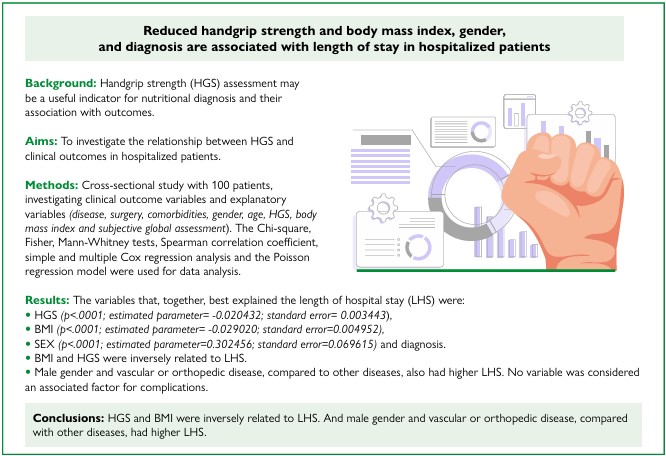
 Reduced handgrip strength and body mass index, gender, and diagnosis are associated with length of stay in hospitalized patients
ABSTRACT
Background: Handgrip strength assessment may be a useful indicator for nutritional diagnosis and association with outcomes.
Aims: To investigate the relationship between handgrip strength and clinical outcomes in hospitalized patients.
Methods: A cross-sectional study with 100 patients, investigating clinical outcome variables and explanatory variables (disease, surgery, comorbidities, gender, age, handgrip strength, body mass index, and subjective global assessment). The χ2 test, Fisher’s exact test, Mann-Whitney test, Spearman correlation coefficient, simple and multiple Cox regression analysis, and the Poisson regression model were used for data analysis.
Results: The variables that, together, best explained the length of hospital stay were handgrip strength (p<0.0001; estimated parameter=-0.020432; standard error=0.003443), body mass index (p<0.0001; estimated parameter=-0.029020; standard error=0.004952), gender (p<0.0001; estimated parameter=0.302456; standard error=0.069615), and diagnosis. Body mass index and handgrip strength were inversely associated with the length of hospital stay. Male gender and vascular or orthopedic disease, compared to other diseases, were also associated with a higher length of hospital stay. No variable was considered an associated factor for complications.
Conclusions: Handgrip strength and body mass index were inversely associated with the length of hospital stay. Male gender and vascular or orthopedic disease, compared to other diseases, were associated with a higher length of hospital stay.
Headings:
Muscle strength; Nutritional status; Disease; Length of stay
ARTICLE HIGHLIGHTS
A higher mean (or median) age, lower mean handgrip strength, and a higher rate of vascular disease, lung disease, and neoplasms were observed in patients with at least one comorbidity.
Body mass index and mean handgrip strength were inversely associated with the length of hospital stay (the lower the values, the longer the hospital stay).
Male gender and vascular or orthopedic disease, compared to other diseases, evidenced longer hospital stays.

CENTRAL MESSAGE The association between patients’ malnutrition in the hospital setting and unfavorable clinical outcomes has already been well established in the literature. The loss of muscle mass is a critical malnutrition finding observed in patients with acute and chronic diseases. An alternative method to estimate muscle mass that could contribute as a relevant indicator for assessing the nutritional status of hospitalized patients is the assessment of handgrip strength, as a marker of health status in older adults.
PERSPECTIVES Handgrip strength and body mass index were inversely associated with the length of hospital stay. Male gender and vascular or orthopedic disease, compared to other diseases, were associated with a longer hospital stay.
RESUMO
Racional: A avaliação da força de preensão palmar (FPP) pode ser um indicador útil para o diagnóstico nutricional e associação com desfechos.
Objetivos: Investigar a relação entre a FPP e desfechos clínicos em pacientes hospitalizados.
Métodos: Estudo transversal com 100 pacientes, sendo investigado variáveis de desfechos clínicos e variáveis explanatórias (doença, cirurgia, comorbidades, sexo, idade, FPP, índice de massa corporal e avaliação subjetiva global). Para análise dos dados foram utilizados os testes χ2, Fisher, Mann-Whitney, coeficiente de correlação de Spearman, análise de regressão de Cox simples e múltipla e o modelo de regressão de Poisson.
Resultados: As variáveis que, em conjunto, melhor explicaram o tempo de internação (TI) foram a FPP (p<0,0001; parâmetro estimado=-0.020432; erro padrão=0.003443), IMC (p<0,0001; parâmetro estimado=-0.029020; erro padrão=0.004952), sexo (p<0,0001; parâmetro estimado=0.302456; erro padrão=0.069615) e diagnóstico. O IMC e a FPP foram inversamente relacionados ao TI. O sexo masculino e doença vascular ou ortopédica, comparadas a outras doenças, também apresentaram maior TI. Nenhuma variável foi considerada fator associado para complicações.
Conclusões: A FPP e o IMC foram inversamente relacionados ao TI. E o sexo masculino e doença vascular ou ortopédica, comparadas com outras doenças, apresentaram maior TI.
Descritores:
Força muscular; Estado nutricional; doença; Tempo de internação
INTRODUCTION
The association between patients’ malnutrition in the hospital setting and unfavorable clinical outcomes has already been well established in the literature6,15,23. When it comes to the nutritional diagnosis of inpatients, several tools and indicators are routinely used in hospital practice to identify malnutrition or nutritional risk14,21,25,29,43. The loss of muscle mass12 is a critical malnutrition finding observed in patients with acute and chronic diseases32,33 and in hospitalized elderly patients41.
An alternative method to estimate muscle mass that could contribute as a relevant indicator for assessing the nutritional status of hospitalized patients is the assessment of handgrip strength (HGS)3,31,36. HGS has been proposed as a marker of health status in older adults4. Some studies have shown an association between reduced HGS in adults and an increased risk of functional limitations and disability at older ages31. Because muscle function is affected early by nutritional deprivation, HGS has been considered a malnutrition marker31.
It has also been observed that HGS was the most sensitive method for identifying inpatients at risk of malnutrition, compared to anthropometric indicators27. Thus, this tool could be used as an alternative measure for detecting malnutrition27 and also for assessing muscle mass and managing malnutrition in hospitalized elderly patients1. The predictive validity of HGS for the length of hospital stay is also noteworthy, as observed in a retrospective study of patients undergoing abdominal surgery. Regression models showed that HGS was significantly and inversely associated with the length of hospital stay24. Thus, HGS could be considered a reliable clinical method for nutritional assessment in different clinical situations2,19,24 and a good indicator of overall muscle strength, as described in the revised European consensus on sarcopenia2,10,19,29.
Although many studies that investigated nutritional status are already available in the literature, HGS assessment could contribute to the nutritional diagnosis of hospitalized patients. Hence, this study aimed to investigate the relationship between HGS and clinical outcomes in surgical ward inpatients.
METHODS
Study design
This was a cross-sectional study conducted in the surgical wards of a university hospital that serves a population in a large metropolitan region. The study was approved by the Institution’s Research Ethics Committee, and all subjects included in this investigation received detailed information about the study and signed the Informed Consent Form (ICF) (number 5.728.982). The Strengthening and Reporting of Observational Studies in Epidemiology (STROBE) guidelines were followed in this study39.
Subjects and inclusion criteria
Adult patients admitted through the Unified Health System to the surgical wards of a hospital to treat different clinical and surgical diseases were selected. The inclusion criteria were patients who had complete information about the diagnosis, disease type, and complications duly recorded in their medical records; patients who did not have a terminal disease; patients who had been admitted for more than 24 hours; patients who could understand the information provided, with preserved motor and cognitive function; and patients who signed the ICF. Patients with edema or ascites, hospitalized in isolation, in a critical terminal condition, presenting with any type of dementia or Parkinson’s disease, and with fractures of the upper or lower limbs were excluded. To define the study sample, all patients monitored in the hospital surgical ward during the data collection period and who met all the eligibility criteria were included in the study (n=100 patients).
Data collection and variables
Outcome variables: length of hospital stay, occurrence of complications, and hospital discharge or death.
Explanatory variables: type of disease, surgery, presence of comorbidities, gender, age, HGS, and nutritional indicators (body mass index (BMI) and subjective global assessment (SGA)).
HGS was assessed early after admission using a dynamometer at the bedside in the surgical ward, with the patient sitting. Patients were instructed to perform three maximum compressions with each hand, with brief pauses between measurements. Three measurements were taken with each hand, three with the dominant hand and three with the non-dominant hand. The mean of the three measurements was considered2,13,24,31,34. Low HGS values were obtained when the patient’s strength was <16 kg for women and <27 kg for men10,13.
To assess nutritional status, the subjective global assessment (SGA) instrument and BMI were used at the beginning of the hospitalization period. The SGA11 was assessed according to all the usual procedures, and the cutoff points were those recommended in the relevant literature. This instrument subjectively assesses the patient’s nutritional status based on weight loss, food consumption, and clinical and physical signs of malnutrition, which helped classify patients as: wellnourished, slightly malnourished, moderately malnourished, and seriously malnourished11. BMI was classified according to previously defined cutoff points42.
Statistical analysis
The population characteristics were described using absolute frequency (n) and percentage (%) values for the categorical variables, and descriptive measures (mean, standard deviation, and median) for quantitative variables. The χ2 test or Fisher’s exact test was used to compare proportions, when necessary, and the Mann-Whitney test was applied to compare continuous measures between two groups. Spearman’s linear correlation coefficient was applied to assess the linear relationship between numerical variables.
Subsequently, to identify factors associated with complication outcomes, simple and multiple Cox regression analyses were used. To identify the variables that define hospital stay (in days), the Poisson regression model, which belongs to the special class of generalized linear models, was used. The significance level adopted for the statistical tests was 5%8,35,37.
RESULTS
One hundred adult patients admitted to a surgical ward of a university hospital were evaluated; 63% (n=63) were male and 37% (n=37) female; the mean age of the subjects was 57.33±16.97 years (median=59.50 years). The most frequent diseases were vascular diseases (48%, n=48), neoplasms (20%, n=20), pulmonary diseases (9%, n=9), renal diseases (8%, n=8), orthopedic diseases (5%, n=5), digestive tract diseases (4%, n=4), and others (5%, n=5). Comorbidities were observed in 93% (n=93) of the patients, and 62% (n=62) had undergone surgical procedures. Regarding the indicators assessed, mean HGS was 22.78±10.67 (median=21.33) and BMI 26.28±5.85 kg/m2 (median=26.39 kg/m2). According to the SGA, 73% (n=73) of the patients were classified as well-nourished and 27% (n=27) as slightly malnourished. The length of hospital stay was 15.49±19.45 days (median=12 days), and complications were observed in 31% (n=31) of the patients treated. In this case series, one patient died.
In the linear correlation analysis using Spearman’s correlation coefficient, between age, HGS, and BMI with length of hospital stay as the clinical outcome, no significant linear correlations were found (age vs. length of hospital stay: - r=0.07367, p=0.4663, p>0.05; mean HGS vs. length of hospital stay: - r=-0.15878, p=0.1146, p>0.05; BMI vs. length of hospital stay: - r=-0.12207, p=0.2263, p>0.05).
Table 1 shows the comparison of variables between genders: female patients showed lower mean (or median) HGS values than male patients (p<0.0001) and a higher complication rate (p=0.0425, p<0.05).
Table 2 shows the comparison of variables between the presence or absence of complications, with a significant difference only for the nutritional status classified by the SGA. There was a higher percentage of well-nourished patients among those who suffered complications (p=0.0333, p<0.05). There was no statistical difference in mean HGS regarding the occurrence or absence of complications.
Descriptive analysis and comparison of variables between the occurrence or not of complications (n=100).
When comparing the study variables between patients who underwent surgical procedures or not, there was a significant difference only in the presence of comorbidities. All patients who did not undergo surgery had some comorbidity (p=0.0422, p<0.05).
Table 3 illustrates the comparison of the variables studied between the presence or absence of comorbidities. A significant difference was observed in relation to age (p=0.0462, p<0.05), mean HGS (p=0.0201, p<0.05), and diagnosis (p=0.0188, p<0.05). A higher mean (or median) age, lower mean HGS, and a higher rate of vascular disease, lung disease, and neoplasms were observed in patients with some comorbidity.
Descriptive analysis and comparison of variables between the presence or absence of comorbidities (n=100).
When comparing the study variables between the classifications of nutritional status by SGA, the patients classified as slightly malnourished were significantly characterized by a lower BMI (p=0.0052, p<0.05) and a higher neoplasm and lung disease rate. (p=0.0057, p<0.05).
Table 4 illustrates the factors for complications analyzed by simple and multiple Cox regression. It was found that none of the variables assessed was considered an associated factor for complications.
Table 5 illustrates the factors that influence the length of hospital stay using Poisson regression analysis. It was found that the variables that, together, best explain the length of hospital stay were BMI (p<0.0001, p<0.05); mean HGS (p<0.0001, p<0.05); gender (p<0.0001, p<0.05), and diagnosis. BMI and mean HGS were inversely associated with the length of hospital stay (the lower the values, the longer the length of hospital stay). Male gender and vascular or orthopedic disease, compared to other diseases, evidenced longer hospital stays.
DISCUSSION
The literature has demonstrated that HGS is considered an indicator of general muscle strength4,16,30,34,38 in many clinical situations18,24,27 and can also be used to assist in the assessment of malnutrition, playing a relevant role in this diagnosis27,31,36,40.
In our study, our objective was to assess the relationship between HGS and the clinical outcomes in patients admitted to a surgical ward; no linear correlation was observed between HGS and length of hospital stay. However, when analyzed using the Poisson regression, the factors influencing the length of hospital stay were HGS, BMI, gender, and diagnosis. To be specific, patients with lower HGS and BMI values experienced longer hospital stays, as did male patients and patients with vascular or orthopedic diseases. A robust study conducted with 1,136 patients reported that HGS had predictive value for length of hospital stay and quality of life26; a retrospective study conducted with 108 surgical patients selected with criteria similar to those of our investigation, also indicated that muscle strength assessed by manual dynamometry was a strong predictor of length of hospital stay in the surgical hospital setting24. Another prospective study that explored the association of HGS with clinical outcomes and its accuracy in identifying malnutrition showed that reduced HGS was associated with increased length of hospital stay and risk of death but did not show accuracy for malnutrition7. Another interesting finding in our study was the low HGS values in the population assessed: median 13.83 kg for women and 27.0 kg for men (the values of <16 kg for women and <27 kg for men were considered reduced HGS)10,13.
Although we may consider that measuring HGS is a useful, objective, relatively easy, non-invasive tool that can be performed at the bedside, and was the subject of our study, our findings did not show an association between HGS and the occurrence of complications. This differs from other studies that described this relationship17,20,28. This measurement was also not a predictor of postoperative morbidity in major hepatobiliary surgery, although it predicted a longer hospital stay, as observed in another single-center, prospective study with 81 patients5.
An association was observed between lower HGS values and the presence of comorbidities. Other investigations have also reported associations between HGS and causes of cardiometabolic multimorbidities22. In our study, an association was also observed among older age, a higher percentage of vascular and pulmonary diseases, and neoplasms in patients with some comorbidities.
Although other aspects related to other indicators of body composition and their modifications were not investigated in the present study because they were not the object of our investigation, perhaps in future studies it would be interesting to explore the differences between these indicators and HGS and between genders. It would also be relevant to explore these relationships concerning the clinical outcomes generally observed during hospitalization.
Another aspect to consider is the use of BMI. It is a widely used indicator, despite some known limitations, such as not separating lean mass from fat mass. Also, in the hospital setting, it is not used alone when it is possible to weigh patients. In routine hospital practice, other screening and nutritional diagnosis tools are strongly recommended and performed, such as nutritional risk screening, the universal malnutrition screening tool, the mini nutritional assessment in elderly patients, and the SGA, which was also used in the present study, in addition to BMI6,9,14,15,29,43.
It is important to highlight that our main objective was to investigate the association between muscle strength demonstrated by HGS and clinical outcomes during hospitalization. Therefore, our study, whose objective was not to investigate HGS in relation to the evolution or stage of the disease, has the following limitation: the impossibility to analyze the strength stratified or not in relation to the stage of the disease evolution, even because this would not be possible due to the variation of the small sample size in some clinical situations. Therefore, we suggest further investigations addressing these aspects in future studies.
CONCLUSIONS
HGS and BMI were inversely associated with the length of hospital stay. Male gender and vascular or orthopedic diseases, compared with other diseases, caused a longer hospital stay.
DATA AVAILABILITY
The datasets generated and/or analyzed during the current study are available from the corresponding author upon reasonable request.
HOW TO CITE THIS ARTICLE
Mazzini LR, Leandro-Merhi VA. Reduced handgrip strength and body mass index, gender, and diagnosis are associated with length of stay in hospitalized patients. ABCD Arq Bras Cir Dig. 2026;39:e1934. https://doi.org/10.1590/0102-67202026000005e1934.
REFERENCES
-
1 Amasene M, Besga A, Medrano M, Urquiza M, Rodriguez-Larrad A, Tobalina I, et al. Nutritional status and physical performance using handgrip and SPPB tests in hospitalized older adults. Clin Nutr. 2021;40(11):5547-55. https://doi.org/10.1016/j.clnu.2021.09.034
» https://doi.org/10.1016/j.clnu.2021.09.034 -
2 Andrade GKP, Carvalho JB, Nascimento LA, Rodrigues ALCC, Severine NA. Nutritional assessment team: body composition assessment protocol in hospitalized patients. Clin Nutr Open Sci. 2022;42:119-29. https://doi.org/10.1016/j.nutos.2022.02.006
» https://doi.org/10.1016/j.nutos.2022.02.006 -
3 Bohannon RW. Grip strength: an indispensable biomarker for older adults. Clin Interv Aging. 2019;14:1681-91. https://doi.org/10.2147/CIA.S194543
» https://doi.org/10.2147/CIA.S194543 -
4 Bohannon RW. Muscle strength: clinical and prognostic value of hand-grip dynamometry. Curr Opin Clin Nutr Metab Care. 2015;18(5):465-70. https://doi.org/10.1097/MCO.0000000000000202
» https://doi.org/10.1097/MCO.0000000000000202 -
5 Chan KS, Chia CLK, Ng FKL, Seow WHJ, Leong DY, Shelat VG. Impaired handgrip strength does not predict postoperative morbidity in major hepatobiliary surgery. J Surg Res. 2020;256:549-56. https://doi.org/10.1016/j.jss.2020.07.012
» https://doi.org/10.1016/j.jss.2020.07.012 -
6 Chávez-Tostado M, Cervantes-Guevara G, López-Alvarado SE, Cervantes-Pérez G, Barbosa-Camacho FJ, Fuentes-Orozco C, et al. Comparison of nutritional screening tools to assess nutritional risk and predict clinical outcomes in Mexican patients with digestive diseases. BMC Gastroenterol. 2020;20(1):79. https://doi.org/10.1186/s12876-020-01214-1
» https://doi.org/10.1186/s12876-020-01214-1 -
7 Chites VS, Teixeira PP, Lima J, Burgel CF, Pereira TG, Silva FM. Reduced handgrip strength in hospital admission predicts prolonged hospital stay and death but is not accurate to identify malnutrition: a longitudinal study of reduced handgrip strength in hospitalized patients. JPEN J Parenter Enteral Nutr. 2021;45(5):1016-22. https://doi.org/10.1002/jpen.1976
» https://doi.org/10.1002/jpen.1976 - 8 Conover WJ. Practical nonparametric statistics. 3rd ed. New York: John Wiley & Sons Inc.; 1999.
-
9 Cortés-Aguilar R, Malih N, Abbate M, Fresneda S, Yañez A, Bennasar-Veny M. Validity of nutrition screening tools for risk of malnutrition among hospitalized adult patients: a systematic review and meta-analysis. Clin Nutr. 2024;43(5):1094-116. https://doi.org/10.1016/j.clnu.2024.03.008
» https://doi.org/10.1016/j.clnu.2024.03.008 -
10 Cruz-Jentoft AJ, Bahat G, Bauer J, Boirie Y, Bruyère O, Cederholm T, et al. Sarcopenia: revised European consensus on definition and diagnosis. Age Ageing. 2019;48(1):16-31. https://doi.org/10.1093/ageing/afy169
» https://doi.org/10.1093/ageing/afy169 -
11 Detsky AS, McLaughlin JR, Baker JP, Johnston N, Whittaker S, Mendelson RA, et al. What is subjective global assessment of nutritional status? JPEN J Parenter Enteral Nutr. 1987;11(1):8-13. https://doi.org/10.1177/014860718701100108
» https://doi.org/10.1177/014860718701100108 -
12 Deutz NEP, Ashurst I, Ballesteros MD, Bear DE, Cruz-Jentoft AJ, Genton L, et al. The underappreciated role of low muscle mass in the management of malnutrition. J Am Med Dir Assoc. 2019;20(1):22-7. https://doi.org/10.1016/j.jamda.2018.11.021
» https://doi.org/10.1016/j.jamda.2018.11.021 -
13 Dodds RM, Syddall HE, Cooper R, Benzeval M, Deary IJ, Dennison EM, et al. Grip strength across the life course: normative data from twelve British studies. PLoS One. 2014;9(12):e113637. https://doi.org/10.1371/journal.pone.0113637
» https://doi.org/10.1371/journal.pone.0113637 -
14 Dos Santos HAV, Leandro-Merhi VA. Can the Nutritional Risk Screening (NRS-2002) predict unfavorable clinical outcome in hospitalized elderly patients? Aging Clin Exp Res. 2022;34(5):1165-9. https://doi.org/10.1007/s40520-021-02032-5
» https://doi.org/10.1007/s40520-021-02032-5 -
15 Fontes D, Generoso SV, Correia MITD. Subjective global assessment: a reliable nutritional assessment tool to predict outcomes in critically ill patients. Clin Nutr. 2014;33(2):291-5. https://doi.org/10.1016/j.clnu.2013.05.004
» https://doi.org/10.1016/j.clnu.2013.05.004 -
16 Hartog LC, Winters AM, Roijen H, Kamper AM, Inia H, Kleefstra N, et al. Association between orthostatic hypotension and handgrip strength with successful rehabilitation in elderly hip fracture patients. Arch Phys Med Rehabil. 2017;98(8):1544-1550.e3. https://doi.org/10.1016/j.apmr.2016.11.009
» https://doi.org/10.1016/j.apmr.2016.11.009 -
17 Huang DD, Yu DY, Wang WB, Song HN, Luo X, Wu GF, et al. Global leadership initiative in malnutrition (GLIM) criteria using hand-grip strength adequately predicts postoperative complications and long-term survival in patients underwent radical gastrectomy for gastric cancer. Eur J Clin Nutr. 2022;76(9):1323-31. https://doi.org/10.1038/s41430-022-01109-2
» https://doi.org/10.1038/s41430-022-01109-2 -
18 İmre E, Koçakgöl N, İmre E. Low handgrip strength is associated with diabetic foot disease in geriatric patients with type 2 diabetes. Turk J Med Sci. 2022;52(6):1854-62. https://doi.org/10.55730/1300-0144.5532
» https://doi.org/10.55730/1300-0144.5532 -
19 Jiang K, Maharjan SRS, Slee A, Davenport A. Differences between anthropometric and bioimpedance measurements of muscle mass in the arm and hand grip and pinch strength in patients with chronic kidney disease. Clin Nutr. 2021;40(1):320-3. https://doi.org/10.1016/j.clnu.2020.04.026
» https://doi.org/10.1016/j.clnu.2020.04.026 -
20 Kurita D, Oguma J, Ishiyama K, Hirano Y, Kanamori J, Daiko H. Handgrip strength predicts postoperative pneumonia after thoracoscopic-laparoscopic esophagectomy for patients with esophageal cancer. Ann Surg Oncol. 2020;27(9):3173-81. https://doi.org/10.1245/s10434-020-08520-8
» https://doi.org/10.1245/s10434-020-08520-8 -
21 Leandro-Merhi VA, Dos Santos HAV, Almendra AAR, Aquino JLB. Nutritional indicators’ performance in malnutrition diagnosis of hospitalized elderly patients. Exp Gerontol. 2023;181:112286. https://doi.org/10.1016/j.exger.2023.112286
» https://doi.org/10.1016/j.exger.2023.112286 -
22 Lu Y, Li G, Ferrari P, Freisling H, Qiao Y, Wu L, et al. Associations of handgrip strength with morbidity and allcause mortality of cardiometabolic multimorbidity. BMC Med. 2022;20(1):191. https://doi.org/10.1186/s12916-022-02389-y
» https://doi.org/10.1186/s12916-022-02389-y -
23 Meure CMF, Steer B, Porter J. Interrelationships between dietary outcomes, readmission rates and length of stay in hospitalised oncology patients: a scoping review. Nutrients. 2023;15(2):400. https://doi.org/10.3390/nu15020400
» https://doi.org/10.3390/nu15020400 -
24 Marano L, Carbone L, Poto GE, Gambelli M, Noudem LLN, Grassi G, et al. Handgrip strength predicts length of hospital stay in an abdominal surgical setting: the role of frailty beyond age. Aging Clin Exp Res. 2022;34(4):811-7. https://doi.org/10.1007/s40520-022-02121-z
» https://doi.org/10.1007/s40520-022-02121-z -
25 Mazzini LR, Aquino JLB, Camargo JGT, Leandro-Merhi VA. Is calf circumference associated with clinical and nutritional outcome in older patients? Arq Bras Cir Dig. 2023;36:e1773. https://doi.org/10.1590/0102-672020230055e1773
» https://doi.org/10.1590/0102-672020230055e1773 -
26 McNicholl T, Curtis L, Dubin JA, Mourtzakis M, Nasser R, Laporte M, et al. Handgrip strength predicts length of stay and quality of life in and out of hospital. Clin Nutr. 2020;39(8):2501-9. https://doi.org/10.1016/j.clnu.2019.11.006
» https://doi.org/10.1016/j.clnu.2019.11.006 -
27 Mendes NP, Barros TA, Faria BS, Aguiar ES, Oliveira CA, Souza ECG, et al. Hand grip strength as predictor of undernutrition in hospitalized patients with cancer and a proposal of cut-off. Clin Nutr ESPEN. 2020;39:210-4. https://doi.org/10.1016/j.clnesp.2020.06.011
» https://doi.org/10.1016/j.clnesp.2020.06.011 -
28 Miwa T, Hanai T, Nishimura K, Maeda T, Ogiso Y, Imai K, et al. Handgrip strength stratifies the risk of covert and overt hepatic encephalopathy in patients with cirrhosis. JPEN J Parenter Enteral Nutr. 2022;46(4):858-66. https://doi.org/10.1002/jpen.2222
» https://doi.org/10.1002/jpen.2222 -
29 Müller M, Dahdal S, Saffarini M, Uehlinger D, Arampatzis S. Evaluation of Nutrition Risk Screening Score 2002 (NRS) assessment in hospitalized chronic kidney disease patient. PLoS One. 2019;14(1):e0211200. https://doi.org/10.1371/journal.pone.0211200
» https://doi.org/10.1371/journal.pone.0211200 -
30 Norheim KL, Bautmans I, Kjaer M. Handgrip strength shows no improvements in geriatric patients with persistent inflammation during hospitalization. Exp Gerontol. 2017;99:115-9. https://doi.org/10.1016/j.exger.2017.10.006
» https://doi.org/10.1016/j.exger.2017.10.006 -
31 Norman K, Stobäus N, Gonzalez MC, Schulzke JD, Pirlich M. Hand grip strength: outcome predictor and marker of nutritional status. Clin Nutr. 2011;30(2):135-42. https://doi.org/10.1016/j.clnu.2010.09.010
» https://doi.org/10.1016/j.clnu.2010.09.010 -
32 Prado CM, Purcell SA, Alish C, Pereira SL, Deutz NE, Heyland DK, et al. Implications of low muscle mass across the continuum of care: a narrative review. Ann Med. 2018;50(8):675-93. https://doi.org/10.1080/07853890.2018.1511918
» https://doi.org/10.1080/07853890.2018.1511918 -
33 Resende AMS, Aquino JLB, Leandro-Merhi VA. Sex and ASA classification, not fasting time, are associated with the likelihood of complications in the postoperative period. Arq Bras Cir Dig. 2024;37:e1820. https://doi.org/10.1590/0102-6720202400027e1820
» https://doi.org/10.1590/0102-6720202400027e1820 -
34 Roberts HC, Denison HJ, Martin HJ, Patel HP, Syddall H, Cooper C, et al. A review of the measurement of grip strength in clinical and epidemiological studies: towards a standardised approach. Age Ageing. 2011;40(4):423-9. https://doi.org/10.1093/ageing/afr051
» https://doi.org/10.1093/ageing/afr051 -
35 SAS System for Windows (Statistical Analysis System), versão 9.2. Institute Inc, 802-2008, Cary, NC, USA. Available from: https://support.sas.com/software/92/ Accessed: Oct 7, 2024.
» https://support.sas.com/software/92/ -
36 Sayadizadeh M, Daliri M, Rahimi M, Salehipour P, Sadeghi M, Mozafari JK, et al. Grip and pinch strength prediction models based on hand anthropometric parameters: an analytic cross-sectional study. BMC Musculoskelet Disord. 2024;25(1):809. https://doi.org/10.1186/s12891-024-07914-z
» https://doi.org/10.1186/s12891-024-07914-z - 37 Tabachnick BG, Fidell LS. Using multivariate statistics. 4th ed. Needham Heights: Allyn & Bacon; 2001.
-
38 Tessier AJ, Wing SS, Rahme E, Morais JA, Chevalier S. Physical function-derived cut-points for the diagnosis of sarcopenia and dynapenia from the Canadian longitudinal study on aging. J Cachexia Sarcopenia Muscle. 2019;10(5):985-99. https://doi.org/10.1002/jcsm.12462
» https://doi.org/10.1002/jcsm.12462 -
39 von Elm E, Altman DG, Egger M, Pocock SJ, Gøtzsche PC, Vandenbroucke JP, et al. The Strengthening the Reporting of Observational Studies in Epidemiology (STROBE) statement: guidelines for reporting observational studies. Lancet. 2007;370(9596):1453-7. https://doi.org/10.1016/S0140-6736(07)61602-X
» https://doi.org/10.1016/S0140-6736(07)61602-X -
40 White JV, Guenter P, Jensen G, Malone A, Schofield M; Academy Malnutrition Work Group, et al. Consensus statement of the Academy of Nutrition and Dietetics/American Society for Parenteral and Enteral Nutrition: characteristics recommended for the identification and documentation of adult malnutrition (undernutrition). J Acad Nutr Diet. 2012;112(5):730-8. https://doi.org/10.1016/j.jand.2012.03.012
» https://doi.org/10.1016/j.jand.2012.03.012 -
41 Witard OC, McGlory C, Hamilton DL, Phillips SM. Growing older with health and vitality: a nexus of physical activity, exercise and nutrition. Biogerontology. 2016;17(3):529-46. https://doi.org/10.1007/s10522-016-9637-9
» https://doi.org/10.1007/s10522-016-9637-9 - 42 World Health Organization. Obesity: Preventing and managing the global epidemic: report of a WHO consultation on obesity. Geneva: WHO; 1998.
-
43 Xu YC, Vincent JI. Clinical measurement properties of malnutrition assessment tools for use with patients in hospitals: a systematic review. Nutr J. 2020;19(1):106. https://doi.org/10.1186/s12937-020-00613-0
» https://doi.org/10.1186/s12937-020-00613-0
Edited by
-
Editor:
Nelson Adami Andreollo https://orcid.org/0000-0001-7452-1165