 Educational strategies for preventing female infections in prison: a scoping review
Abstract
Objective To identify and map the main educational strategies for preventing infections of the female reproductive tract in the prison system.
Methods This is a scoping review, carried out in accordance with JBI recommendations, with research in the databases MEDLINE (PubMed), Cochrane Library, LILACS, Scopus, Science Direct, Embase, Google Scholar and Proquest, from May 23 to 29, 2023. The Preferred Reporting Items for Systematic reviews and Meta-Analyses extension for Scoping Reviews (PRISMA-ScR) for the search and selection flowchart of review articles was used. All titles that followed the PCC strategy were included:
Population Women aged 18 and older.
Concept Use of educational strategies to prevent female RTI.
Context Prison system, with sentences served in a closed regime. Those who included an educational strategy carried out for cisgender men or women who already had an RTI diagnosis were excluded.
Results A total of 13 studies published between 1995 and 2023 were selected, with a predominance of educational strategies aimed at preventing sexually transmitted infections, mainly caused by the Human Immunodeficiency Virus. Educational strategies prioritized group educational actions, dramatization strategy and behavioral approach technique, using pamphlets, booklets, posters, cartoon books, genital organ simulators, videos and games.
Conclusion Collective educational sessions were the most evidenced in the literature for infection prevention, predominantly sexually transmitted, with few studies on vaginitis or vaginosis prevention.
Health education; Women; Sexually transmitted diseases/ prevention & control; Prisons
Resumo
Objetivo Identificar e mapear as principais estratégias educativas para prevenção de infecções do trato reprodutor feminino no sistema prisional.
Métodos Revisão de escopo, realizada conforme a recomendações do Joanna Briggs Institute, com pesquisa nas bases de dados MEDLINE (PubMed), Cochrane Library, LILACS, SCOPUS, Science Direct, Embase; Google Scholar e Proquest, durante o período de 23 a 29 de maio de 2023. Utilizou-se o instrumento Preferred Reporting Items for Systematic reviews and Meta-Analyses extension for Scoping Reviews (PRISMA-ScR) para o fluxograma de busca e seleção dos artigos da revisão. Foram incluídos todos os títulos que seguiram a estratégia PCC:
População mulheres com idade a partir dos 18 anos.
Conceito uso de estratégias educativas para prevenção de ITR feminino.
Contexto sistema prisional, com cumprimento de pena em regime fechado. Foram excluídos aqueles que contemplaram estratégia educativa realizada para homens cisgênero ou com mulheres que já possuíam o diagnóstico de ITR.
Resultados Foram selecionados 13 estudos publicados entre 1995 e 2023, com predomínio de estratégias educativas voltadas para prevenção de infecções sexualmente transmissíveis, principalmente causadas pelo Vírus da Imunodeficiência Humana. As estratégias educativas priorizaram ações educativas grupais, estratégia de dramatização e técnica da abordagem comportamental, utilizando os seguintes recursos educativos: panfletos, cartilhas, cartazes, livro de desenhos animados, simuladores de órgãos genitais, vídeos e jogos.
Conclusão As sessões educativas coletivas foram as mais evidenciadas na literatura para prevenção de infecções, predominantemente, sexualmente transmissíveis, com escassos estudos de prevenção de vaginites ou vaginoses.
Educação em saúde; Mulheres; Infecções sexualmente transmissíveis/prevenção & controle; Prisões
Resumen
Objetivo Identificar y mapear las principales estrategias educativas para la prevención de infecciones del tracto reproductor (ITR) femenino en el sistema penitenciario.
Métodos Revisión de alcance, realizada de acuerdo con las recomendaciones del Joanna Briggs Institute, con búsqueda en las bases de datos: MEDLINE (PubMed), Cochrane Library, LILACS, SCOPUS, Science Direct, Embase; Google Scholar y Proquest, durante el período del 23 al 29 de mayo de 2023. Se utilizó el instrumento Preferred Reporting Items for Systematic reviews and Meta-Analyses extension for Scoping Reviews (PRISMA-ScR) para el diagrama de flujo de búsqueda y selección de los artículos de la revisión. Se incluyeron todos los títulos que siguieron la estrategia PCC.
Población mujeres a partir de 18 años.
Concepto uso de estrategias educativas para la prevención de ITR femenino.
Contexto sistema penitenciario, con cumplimiento de condena en régimen cerrado. Se excluyeron aquellos que contemplaron estrategias educativas para hombres cisgénero o con mujeres que ya tenían el diagnóstico de ITR.
Resultados Se seleccionaron 13 estudios publicados entre 1995 y 2023, con un predominio de estrategias educativas orientadas a la prevención de infecciones de transmisión sexual, principalmente causadas por el Virus de la Inmunodeficiencia Humana. Las estrategias educativas priorizaron acciones educativas grupales, estrategias de dramatización y técnicas de enfoque conductual, mediante la utilización de los siguientes recursos educativos: folletos, cartillas, carteles, libros de historietas, simuladores de órganos genitales, videos y juegos.
Conclusión Las sesiones educativas colectivas fueron las más destacadas en la literatura para la prevención de infecciones, predominantemente de transmisión sexual, con escasos estudios de prevención de vaginitis o vaginosis.
Educación en salud; Mujeres; Enfermedades de transmisión sexual/ prevención & control; Prisones
Introduction
Female reproductive tract infections (RTI) are prevalent in gynecology care and have a negative impact on women’s quality of life.1,2 They are classified into three types: endogenous (vaginitis and vaginosis), iatrogenic infections (post-abortion, post-partum infections) and sexually transmitted infections (STIs), which include the Human Immunodeficiency Virus (HIV).3
In the context of the female prison system, RTI prevention must be prioritized due to the unsanitary conditions that women are often exposed to, such as limiting the size of cells, overcrowding, structural scrapping, failures in basic sanitation, insufficient nutritional supply, greater exposure to violence, poor access to the healthcare network, weak access to personal hygiene items and underwear, among other factors.4-6
Health educational strategies can contribute to knowledge and changes in women’s attitudes, sensitizing them to adopt better hygiene habits, sexual and health practices that help prevent female RTI, since these are generally related to the maintenance of avoidable behavioral habits, which can be alleviated through an effective educational process, in addition to offering access to quality healthcare services.7-9
Thus, the present study aimed to identify and map the main educational strategies for preventing female RTI in the prison system.
The aim is, therefore, to fill a gap in knowledge regarding the search for well-planned educational strategies aimed at preventing female RTI in the prison system. In searches carried out on the International Prospective Register of Systematic Reviews (PROSPERO) and Open Science Framework (OSF) platforms, no records of systematic and/or scoping reviews on the topic were found. The result of this review has the potential to provide support for the implementation of effective educational proposals for RTI prevention, which would benefit nursing practice, which has as one of its fronts the search for reducing vulnerabilities and promoting health, through measures of health education actions based on communication, creation of bonds, exchange of knowledge and active listening.10
Methods
This is a scoping review prepared in accordance with JBI,11-13using Preferred Reporting Items for Systematic Reviews and Meta-Analyses Extension for Scoping Reviews (PRISMA-ScR) recommendations.12-14
The research question followed the PCC strategy: Population (P) - women aged 18 and over; Concept (C) - use of educational strategies to prevent female RTI; Context (C) - prison system, with sentences served in a closed regime. Thus, the following question was raised: what educational strategies are evidenced in the literature for RTI prevention in women in the prison system?
A search was carried out in databases, through the Coordination for the Improvement of Higher Education Personnel (CAPES - Coordenação de Aperfeiçoamento de Pessoal de Nível Superior) Journal Portal, via institutional remote access, from May 23 to 29, 2023, covering the following databases: MEDLINE (PubMed), LILACS (Literatura Latinoamericana y del Caribe en Ciencias de la Salud), Scopus, Cochrane Library, Embase. Furthermore, a search was carried out in other electronic libraries, such as Google Scholar and Proquest. This research was carried out on May 23 and, on May 29, 2023, a reverse search was carried out in the references of the previously identified review article. No restrictions on language, time or type of study were applied. The inclusion criteria also followed the PCC strategy: Population: Women aged 18 and older. Concept: Use of educational strategies to prevent female RTI. Context: Prison system, with sentences served in a closed regime. Studies that included an educational strategy carried out for cisgender men or with women who already had an RTI diagnosis were excluded.
For the search, combinations of keywords and descriptors from DeCS and MeSH and their synonyms were used, as shown in Chart 1. The descriptors were combined using the Boolean operators “AND” and “OR”. Initially, the search strategy was developed in MEDLINE, via PubMed, and was later adapted to other databases and electronic libraries. The research strategy used is presented in Chart 1. Study selection was carried out using the Rayyan QCR software. The titles and abstracts were analyzed by two independent researchers in order to identify potentially eligible articles. Selected titles were read in full, and disagreements were resolved by consensus among researchers.
Combination of keywords and descriptors used to search open access databases and electronic libraries
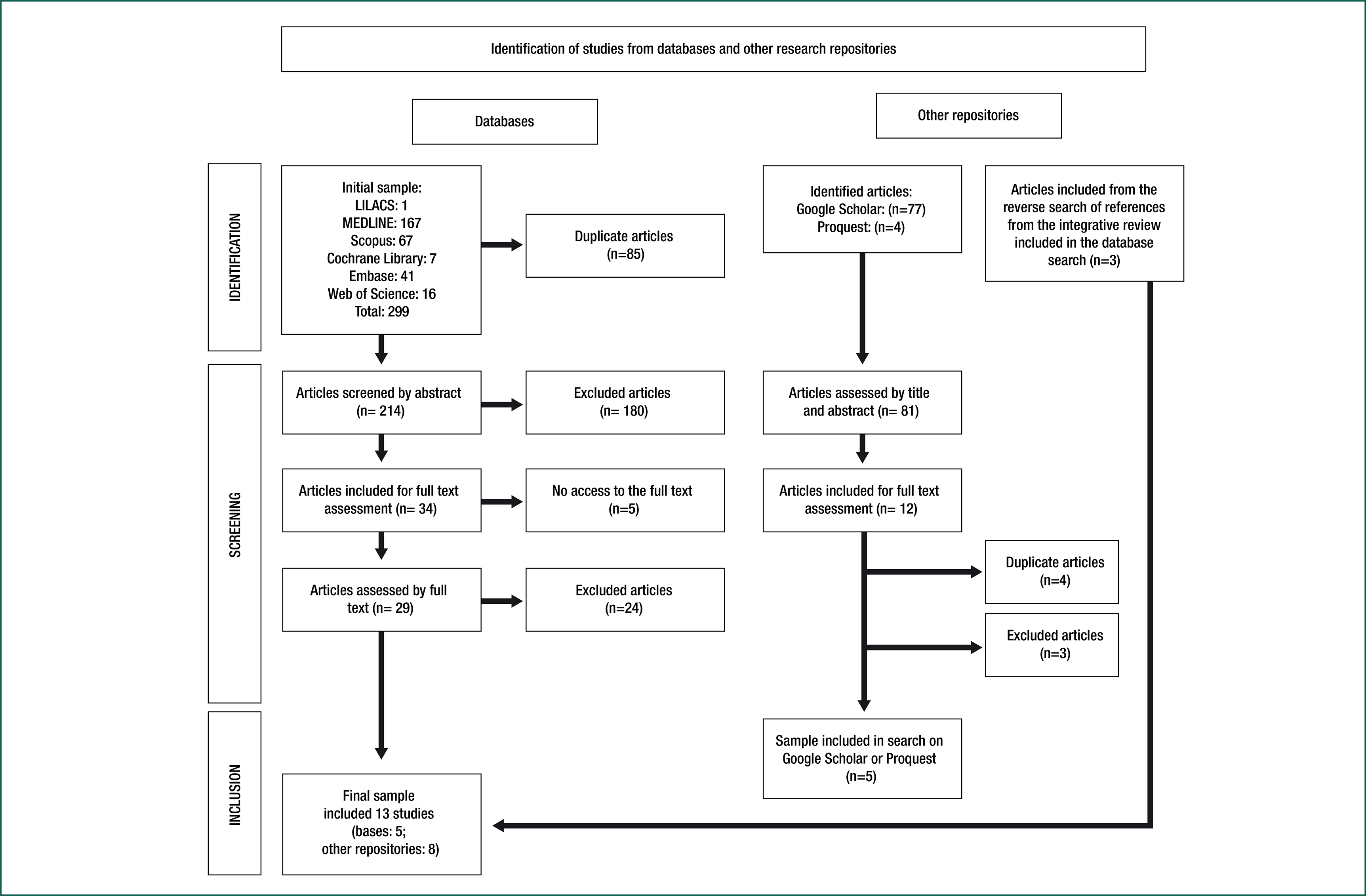
Independent data extraction was carried out, in duplicate, using a spreadsheet created by the authors and adapted to JBI recommendations. It was tested by two researchers, in a pilot test, extracting data from two articles included in the analysis. The final sample and the selection processes carried out are presented based on the PRISMA model (Figure 1).

The extraction spreadsheet sought identification of the study from the extraction database, study title, authorship, country of study identification, language and year of publication, study characteristic, objective(s), study design, population and educational strategy/technology identified, type of RTI addressed in the educational action and main results. As results, a synthesis table of selected studies was presented (Chart 2).
Results
Articles were published between 1995 and 2023 in Brazil (n=6) and the United States of America (n=7). Regarding study design, four are methodological works, construction and validation of educational technology13,14and adaptation of an educational strategy previously validated and applied to the female prison environment.15,16 Four are experimental studies and controlled and randomized clinical trials.17-20 Three are experience reports on the application of an educational strategy with women in the prison system.21-23 One is an integrative literature review and one is a quasi-experimental cohort study.24,25
The majority of selected studies (n=12) included educational strategies carried out to prevent STIs in general. Among these, three did not specify the type of infection,22-24and four worked on the topic of STIs, but prioritized HIV infection prevention.13,15,16,19 Four focused exclusively on HIV prevention,17,18,20,25 and one worked on a specific STI prevention, syphilis.14Only one study addressed vaginal discharge prevention through good intimate hygiene practices.21 Reading the latter allowed us to conclude that it was about the vaginitis and/or vaginosis prevention, despite these terms not appearing directly in the text.
The majority of educational strategies identified (n=11) focused on carrying out collective educational sessions, using active methodologies and space for speech among participants. Some of these use videos,15,19,23,25telephone calls,15,18,19educational group dynamics,21,22dramatization,22printed materials,13,22,24educational games,14,24genital organ simulators24 and other educational objects, such as the “safe sex kit”, containing male and female condoms, information leaflets on how to use them, hygiene kits, nail clippers, a whistle on a keychain, mini lubricants, dental dams and a booklet reviewing information about safe sex and community resources16 and educational materials, such as photos of sexually transmitted diseases STI/HIV, contraceptive methods, breast self-examination simulator, simulator on how to use female/male condoms, which were used as an aid in the training process.23
One of the studies assessed the effectiveness of using individual and personalized motivational interviews, according to imprisoned women’s reality, associated with the use of a traditional educational action of a behavioral nature.20
The use of a behavioral intervention approach with the aim of producing changes in risk behaviors for disease prevention was also identified in studies.15-17,20,25 Strategies using specific skills training for the use of condoms, use of materials for injecting drug consumption, importance of drug treatment, negotiation performance with partners or for handling situations in cases of violence were carried out in some selected studies.16,20,23,25 The results of studies showed positive results regarding the sexual and reproductive rights of female inmates23 aiming to reduce risky behavior among female prisoners, sexual practice without using condoms, use of psychoactive substances, high number of sexual partners,13,15-20,20,24,25 significant increase in knowledge about HIV, reduction of barriers to condom use, coping with marital abuse and conflict management16,19and improving self-esteem and confidence among women,22 in addition to a positive effect among the facilitators of educational actions, with increased knowledge about the vulnerabilities experienced by this group and breaking down prejudices and fears related to the prison context.21,22The main characteristics of included studies are in Chart 2.
Discussion
Although vaginitis and vaginosis are among the most common RTI complaints,1,2 selected studies showed a greater prevalence of educational actions aimed at STI prevention, with a focus on HIV and AIDS. Only one study addressed an educational strategy for preventing vaginitis and vaginosis, through education on intimate hygiene.21
The prevalence of HIV in prisons is still higher than in the community, posing a challenge for the health system and the judiciary.27,28 Studies reveal high rates of infections caused by HIV, syphilis, viral hepatitis and tuberculosis among the population in the prison system.28-30No studies were identified on the prevalence of vaginitis and vaginosis in the prison population.
The high prevalence of HIV in female inmates is related to drug use, unprotected sexual relations, and the risk of transmission from mother to child during prison. Furthermore, the condition may be worsened due to limited access to sexual and reproductive healthcare services, conditions of poverty, discrimination, marginalization, social prejudice and interruption of necessary healthcare services during deprivation of liberty.4-6
Syphilis is also a reality among women prisoners. The prevalence of syphilis was lower among women who received condoms at school, revealing a positive relationship between the presence of preventive reproductive health actions and the lower presence of syphilis among women prisoners.31
It is imperative that the prison environment is equipped with a healthcare service aimed at meeting the specific demands of the female population, including the insertion of preventive diagnostic measures through effective educational actions, in addition to therapeutic measures to control the progression of STIs and other RTIs.5,6,32
In the educational strategies evidenced in the literature, the predominance of group actions was noticed. Studies that assessed the effectiveness of group educational strategies, through randomized clinical trials, reported that these strategies were more beneficial in changing risk behaviors to prevent STIs.17-19 Some highlighted the use of educational tools to conduct actions, such as the use of printed materials (e.g., pamphlets, booklets, posters and cartoon books). The use of genital organ simulators and other educational objects, videos, games, educational dynamics and use of the dramatization strategy was also identified.
STI and other RTI prevention in women in the prison system must value an educational approach with an expanded health focus, including discussions about drug use, issues of gender and power in relationships, physical and sexual violence by an intimate partner, management of risky sexual behavior, family planning, in addition to contemplating issues of mental health and social reintegration projects.15, 18,19,23,25
However, despite recent discussions about the rights of people deprived of liberty, health education in this environment is still sometimes seen as a certain benefit offered to prisoners, due to the culture of prejudice and stigmatization that socially exists with this population. However, offering educational activities in this environment is one of the tools to guarantee the right to education for everyone, without exception, in addition to allowing incarceration to function as an opportunity for people to take care of their health.5,32,33
It is necessary to consider prisoners as comprehensive beings, with specific needs that need to be met to guarantee effectiveness in changing behaviors and practices.33 Inmates’ prevalent pathologies and living conditions must direct health missions towards education and promotion actions.34
In the studies included in this review, the use of active methodologies in the teaching-learning process was evident, providing greater interaction among participants, greater critical reflection and creativity. Furthermore, the use of behavioral educational approaches was evidenced, the practice of skills learned in the theoretical field, focusing on content assimilation and changing risk behaviors as a way of preventing RTI.
As a limitation, there was a lack of detailed description of the educational strategies used regarding RTI in prison systems, making it difficult to reproduce the methodology used in the action. Because the review presents titles published between 1995 and May 2023, it is possible to infer that, due to the broad temporal spectrum, changes have occurred in recommendations and clinical practices related to female RTI prevention over the years. Therefore, this point is also highlighted as a limitation, since the educational strategies described may not necessarily reflect the most up-to-date and effective practices.
Finally, the inclusion of studies with female inmates in a closed regime is also considered a limitation, given that women in a semi-open regime may have more opportunities to access health education information, whereas those in a closed regime may face additional challenges due to restricted freedom and lack of available resources. However, these observations can be explored in future research and interventions to ensure the effectiveness of educational strategies as well as promoting women’s health in the prison context.
Conclusion
Scientific evidence has elucidated that there are a small number of published studies on educational strategies for preventing female RTI in the prison system. Studies focus on STI prevention, with a lack of material on other infection prevention, which are not necessarily linked to unprotected sex practice. The educational strategies highlighted prioritized group sessions, using technologies that facilitate the teaching-learning process, using printed materials, genital simulators and other educational objects, videos, games and use of dramatization strategies. The behavioral approach and skills practice technique were also present in several studies. In terms of the knowledge gap, there was a greater prevalence of educational strategies aimed at STIs and HIV. Others need to be planned, executed and published in the literature to prevent RTIs, not necessarily sexually transmitted, but related to precarious living conditions in the prison environment.
Acknowledgments
To the Universidade Federal do Ceará Graduate Program in Nursing, for providing access to journals on scientific bases through the CAPES Portal. The research did not receive funding for its completion.
References
- 1 Saco GM, Moya JM. Update on vaginal infections: aerobic vaginitis and other vaginal abnormalities. Prog Obstet Ginecol. 2019;62(1):72-8.
- 2 Linhares IM, Amaral RL, Robial R, Eleutério Junior J. Vaginites e vaginoses: protocolo Febrasgo Ginecologia. São Paulo: Febrasgo; 2018;24:24.
- 3 Brasil. Ministério da Saúde. Secretaria de Vigilância em Saúde, Departamento de Doenças de Condições Crônicas e Infecções Sexualmente Transmissíveis. Protocolo Clínico e Diretrizes Terapêuticas para Atenção Integral às Pessoas com Infecções Sexualmente Transmissíveis - IST. Brasília (DF): Ministério da Saúde; 2022.
- 4 Mhlanga-Gunda R, Kewley S, Chivandikwa N, Van Hout MC. Prison conditions and standards of health care for women and their children incarcerated in Zimbabwean prisons. Int J Prison Health. 2020;16(3):319-36.
- 5 Paynter M, Heggie C, McKibbon S, Martin-Misener R, Iftene A, Murphy GT. Sexual and Reproductive Health Outcomes among Incarcerated Women in Canada: a Scoping Review. Can J Nurs Res. 2022;54(1):72-86. Review.
- 6 Pillay N, Chimbga D, Van Hout MC. Gender Inequality, Health Rights, and HIV/AIDS among Women Prisoners in Zimbabwe. Health Hum Rights. 2021;23(1):225-36.
- 7 Chen Y, Bruning E, Rubino J, Eder SE. Role of female intimate hygiene in vulvovaginal health: Global hygiene practices and product usage. Womens Health (Lond). 2017;13(3):58-67.
- 8 Interaminense IN, Oliveira SC, Leal LP, Linhares FM, Pontes CM. Educational technologies to promote vaccination against Human papillomavirus: integrative literature review. Texto Contexto Enferm. 2016; 25(2):e2300015. Review.
- 9 Gomes LS, Holanda VR, Barros MB. Identificação de infecções do trato reprodutivo em mulheres atendidas na Atenção Primária à Saúde. Rev APS. 2019;22(4):870-80.
- 10 Costa DA, Cabral KB, Teixeira CC, Rosa RR, Mendes JL, Cabral FD. Enfermagem e a educação em saúde. Rev Cient Esc Estadual Saúde Pública Goiás "Candido Santiago". 2020;6(3):e6000012.
-
11 Peters MD, Godfrey C, McInerney P, Munn Z, Tricco AC, Khalil, H. Chapter 11: Scoping Reviews (2020 version). In: Aromataris E, Munn Z, editors. JBI Manual for Evidence Synthesis. Australia: JBI; 2020 [cite 2023 Sep 24]. Available from: https://synthesismanual.jbi.globa
» https://synthesismanual.jbi.globa - 12 Tricco AC, Lillie E, Zarin W, O'Brien KK, Colquhoun H, Levac D, et al. PRISMA Extension for Scoping Reviews (PRISMA-ScR): Checklist and Explanation. Ann Intern Med. 2018;169(7):467-73.
- 13 Borges AV, Matos MA, Souza JH, Freire KR, Sousa FR, Florentino VD. Construção e validação de tecnologia educacional para prevenção do hiv/aids em mulheres privadas de liberdade. Cogitare Enferm. 2023;28:e84636.
- 14 Nascimento VA. Jogo de tabuleiro para prevenção e controle da sífilis em mulheres privadas de liberdade (dissertação). Recife: Universidade Federal de Pernambuco; 2022.
- 15 Fasula AM, Fogel CI, Gelaude D, Carry M, Gaiter J, Parker S. Project power: Adapting an evidence-based HIV/STI prevention intervention for incarcerated women. AIDS Educ Prev. 2013;25(3):203-15.
- 16 Johnson JE, Peabody ME, Wechsberg WM, Rosen RK, Fernandes K, Zlotnick C. Feasibility of an HIV/STI Risk-Reduction Program for Incarcerated Women Who Have Experienced Interpersonal Violence. J Interpers Violence. 2015;30(18):3244-66.
- 17 Magura S, Kang SY, Shapiro JL, O'Day J. Evaluation of an AIDS education model for women drug users in jail. Int J Addict. 1995;30(3):259-73.
- 18 Knudsen HK, Staton-Tindall M, Oser CB, Havens JR, Leukefeld CG. Reducing risky relationships: a multisite randomized trial of a prison-based intervention for reducing HIV sexual risk behaviors among women with a history of drug use. AIDS Care. 2014;26(9):1071-9.
- 19 Fogel CI, Crandell JL, Neevel AM, Parker SD, Carry M, White BL, et al. Efficacy of an adapted HIV and sexually transmitted infection prevention intervention for incarcerated women: a randomized controlled trial. Am J Public Health. 2015;105(4):802-9.
- 20 Staton M, Strickland J, Webster JM, Leukefeld C, Oser C, Pike E. HIV prevention in rural Appalachian jails: Implications for reentry risk reduction among women who use drugs. AIDS Behav. 2018;22(12):4009-18.
- 21 Vieira MC, Almeida CL, Lima KD, Barbosa KM, Costa AQ, Andrade GG, et al. A utilização de metodologias ativas no processo ensino-aprendizagem: relato de experiência no contexto prisional. Rev Educ Universidade Federal Do Vale Do São Francisco. 2020;10(21):468-86.
- 22 Lessa PR, Ribeiro SG, Lima DJ, Nicolau AI, Damasceno AK, Pinheiro AK. Presença de lesões interepiteliais de alto grau em mulheres internadas de l intraepitelial de alto grau: estudo documental. Rev Lat Am Enfermagem. 2012;20(2):354-61.
- 23 Guedes TG, Linhares FM, Morais SC, Ferreira IF, Mendonça TG, Silva FV, et al. Health education: strategy for sexual and reproductive care for women in custody. Procedia. 2015; 174:821-5
- 24 Carvalho IS, Guedes TG, Bezerra SM, Alves FA, Leal LP, Linhares FM. Educational Technologies on sexually transmitted infections for incarcerated women. Rev Lat Am Enfermagem. 2020;28:e3392.
- 25 Lawrence J, Eldridge GD, Shelby MC, Little CE, Brasfeld TL, O'Bannon RE. HIV risk reduction for incarcerated women: a comparison of brief interventions based on two theoretical models. J Consult Clin Psychol. 1997;65(3):504-9.
- 26 Shain RN, Piper JM, Newton ER, Perdue ST, Ramos R, Champion JD, et al. A randomized, controlled trial of a behavioral intervention to prevent sexually transmitted disease among minority women. N Engl J Med. 1999;14(340):93-100.
- 27 Golrokhi R, Farhoudi B, Taj L, Pahlaviani FG, Mazaheri-Tehrani E, Cossarizza A, et al. HIV Prevalence and Correlations in Prisons in Different Regions of the World. Open AIDS J. 2018; 31(12):81-92. Review.
- 28 Singh GP, Lata S, Swu AK, Virk NS, Singh J, Thakkar S. A retrospective study to find the prevalence of HIV, HCV and dual HIVHCV infection in the prison inmates. J Family Med Prim Care. 2022;11:6250-4.
- 29 Wali A, Khan D, Safdar N, Shawani Z, Fatima R, Yaqoob A, et al. Prevalence of tuberculosis, HIV/AIDS, and hepatitis; in a prison of Balochistan: a cross-sectional survey. BMC Public Health. 2019;19(1631):1-8.
- 30 Nom NA, Kyaw KW, Kumar AM, Hone S, Thida T, Nwe TW, et al. HIV Care Cascade among Prisoners of the Mandalay Central Prison in Myanmar: 2011-2018. Trop Med Infect Dis. 2020;15(1):4.
- 31 da Silva Santana R, Kerr L, Mota RS, Kendall C, Rutherford G, McFarland W. Lifetime Syphilis Prevalence and Associated Risk Factors Among Female Prisoners in Brazil. Sex Transm Dis. 2020;47(2):105-10.
- 32 Braga GD, Tavares DH, Herreira LF, Jardim VM, Franchini B. Condição de saúde das mulheres no sistema carcerário brasileiro: uma revisão de literatura. Sanare. 2021;20(1):115-30. Review.
- 33 Rodrigues VE, Olveira RC. A metodologia ativa como possibilidade na prática da Educação em direitos humanos no contexto prisional. Rev Aproximação. 2020;2(3):70-80.
- 34 Jarry A, Quinveros K, Walquan N, Terrien H, Larode A. L'infirmière, en première ligne de la demande de soins en milieu carcéral. La revue de l'infirmière. 2018;246:19-21.
Edited by
-
Associated Editor
Kelly Pereira Coca (https://orcid.org/0000-0002-3604-852X) Escola Paulista de Enfermagem, Universidade Federal de São Paulo, São Paulo, SP, Brasil