 Variables with greater discriminatory power for adaptation based on multivariate analysis
ABSTRACT.
The objective of this research is to evaluate the physiological variables altogether and determine which variables have the greatest power to explain the data variation in terms of adaptive profile, using canonical and stepwise discriminant analysis. Eighteen non-castrated male sheep of the Soinga, Morada Nova, and Santa Inês breeds were used, with an average age of 5±1.0 months and an average weight of 15 ± 2.3 Kg. The RT showed a significant correlation above 50% with the temperature of the scrotum and leg; RR showed a higher correlation with tympanic (69%) than with RT (53%) tympanic showed a correlation above 70% with the temperature of the chest, back, buttocks, testicles, and leg, and 63% with the temperature of the eye, while RT showed a correlation of less than 50% with the temperature of the chest, buttocks, back and eye, and 51% with the testicle and leg. The most discriminatory variables for native breeds at comfort temperatures and thermal stress were reat rate and tympanic temperature. Tympanic temperature proved to be an important physiological variable to aid in the study of the adaptive profile of animals.
Keywords:
adaptative profile; discriminant canonical; sheep natives; stepwise; tympanic temperature
Introduction
Brazil is rich in genetic resources of native animals, especially in semiarid regions, which are characterized by a negative water balance, resulting from average annual precipitation of less than 800 mm, insolation of 2800h year-1, average yearly temperature variation of 23.0 to 28.7ºC, evaporation of 2000 mm year-1, and relative humidity of around 60% (Gois et al., 2017). The breeding of native animals such as the Santa Inês, Morada Nova, Soinga, and No Racial Pattern is essential for the sustainability of sheep production systems due to their adaptation (Landim et al., 2021; Silveira et al., 2024).
Adaptive profiling studies are usually carried out considering a substantial number of traits, some of which are redundant (Ribeiro et al., 2015), making interpretation through univariate analyses difficult. Previous efforts to characterize breeds based on adaptive traits have often relied on analyses with this type of variance, in which the result of the univariate analysis treats each of the variables separately, therefore failing to explain how the breeds under investigation differ when all measured variables are considered together (Dossa et al., 2007; Tadesse et al., 2023). Sustainable animal production in the context of climate change requires the joint consideration of different stressors to understand their physiological adaptation mechanisms, rather than one variable separately (Tadesse et al., 2023).
A better interpretation of the data set can be obtained through multivariate analysis techniques, as they are more appropriate for the study of a set of correlated variables that will be analyzed simultaneously. Thus, multivariate analysis techniques are shown to be extremely efficient alternatives when the situation requires the combination of multiple pieces of information from an experimental plot (i.e., an observational vector) to associate or predict biological phenomena from a complex of variables essential for the development of the experimental plan (Dillon & Goldstein, 1984).
Canonical discriminant analysis is a multivariate technique for reducing data dimensionality, similar to the principal components’ technique and canonical correlation analysis. However, this technique is a specialty of discriminant analysis and is used to represent different populations in a small subspace (Guedes et al., 2018). Research on the adaptive profile of goats and sheep using the multivariate discriminant technique is scarce in the literature. The objective of this research is to evaluate the physiological variables altogether and determine which variables have the greatest power to explain the data variation in terms of adaptive profile, using canonical and ‘stepwise’ discriminant analysis.
Material and methods
Experiment location, climate chamber and climatological responses
The research procedures were approved by the Research Ethics Committee (REC) of the Federal University of Campina Grande, Paraíba State, Brazil, CEP Protocol No. 097.2019.
The experiment was conducted in a climate chamber at the Agricultural Engineering Academic Unit, Rural Constructions and Environment Laboratory of the Federal University of Campina Grande, municipality of Campina Grande-PB.
The animals were placed in two climatic chambers, each with an area of 19.71 m², a ceiling height of 2.38 m, made of laminated steel sheets with a layer of polyurethane, and interior lighting of fluorescent light.
The animals were exposed for 12 continuous hours (from 6 am to 6 pm), during 15 consecutive days, to each of the treatments (temperatures of 20, 24, 28, 32, and 36°C), with relative air humidity of 65 ± 5%, alternated with 12h of comfort temperature, previously established at 24°C, simulating the conditions of the Brazilian semiarid region. On the 15 days of each treatment, the first 10 days were for adaptation and the last 5 days were for the collection of climatological data, and between treatments, the animals remained outdoors (climate chamber off and doors open) for five days to eliminate the residual effect, totaling 20 days in each treatment.
Animals
The research procedures were approved by the Research Ethics Committee (REC) of the Federal University of Campina Grande, Paraíba State, Brazil, CEP Protocol No. 097.2019.32 non-castrated male sheep native breeds were used, with an average age of 5±1.0 months and an average weight of 15 ± 2.3 Kg.
Physiological variables
The physiological variables rectal temperature (RT), respiratory rate (RR), and surface temperature (ST) were measured in the morning, from 10:00 am to 10:30 am, and in the afternoon, from 3:00 pm to 3:30 pm, and at the end the average per animal was calculated.
Rectal temperature was determined by inserting a veterinary clinical thermometer directly into the animal's rectum (2.0 cm deep) with the bulb close to the mucosa, remaining inserted until the reading was stabilized. Respiratory rate was obtained by directly counting flank movements over 15.0 seconds, extrapolating to one minute (mov. min-1). Heart rate was measured with the aid of a flexible stethoscope, positioned directly over the left thoracic region, at approximately the height of the aortic arch, counting the number of movements over 15.0 seconds, and the value collected was multiplied by four to determine heart rate in beats.min-1.
Testicular temperature was measured using a portable digital thermometer with an infrared light device (Mult Temp Port'atil, Incoterm, Porto Alegre, RS, Brazil). Tympanic temperature was measured with the equipment (Thermometer touch care Multilaser, HC498, São Paulo, SP, Brazil), pointed at the central point of the ear cavity, under the animal's left ear, at a distance of 0.5 m.
The surface temperature was obtained using an infrared thermographic camera (Fluke Ti 25, USA) with automatic calibration, while the animals remained still, without any restrictions and with minimal handling, avoiding causing them any potential stress. Subsequently, the thermograms were analyzed using Smartview software, version 4.1, through which the average temperatures of regions that covered most of the animal's body (including neck, thorax, buttocks, back, belly, eye, and leg) were obtained, to obtain the average surface temperature, considering an emissivity of 0.98.
Statistical analysis
Pearson’s simple correlation analysis was adopted, which is a technique for measuring whether two variables are linearly related.
For this purpose, the mathematical model D(x) = L'.x = [x1−x2]'S−¹.x was employed, where D(x) represents the Fisher's linear discriminant function, L is the estimate of the discriminant vector, x1 is the sample mean of population p, and x is the sample mean of population p. The selection of variables with the highest discriminatory power was carried out using the stepwise method, which combines the addition of variables with the greatest discriminatory power and eliminates those with lesser contributions, based on the F-statistic or Wilks’ lambda value. The primary objective of this procedure is to identify the best set of variables to compose the discriminant function.
Statistical analyses were performed using Statistica 8.0 software.
Results and discussion
The RT showed a significant correlation above 50% with the temperature of the scrotum and leg, RR showed a higher correlation with Ttympanic (69%) than with RT (53%) (Table 1). HR, Tneck and Tbelly did not show a correlation above 50% with any of the variables studied, showing that they are not necessary in this study. Ttympanic showed a correlation above 70% with the temperature of the chest, back, buttocks, testicles, and leg, and 63% with the temperature of the eye, while RT showed a correlation of less than 50% with the temperature of the chest, buttocks, back and eye, and 51% with the testicle and leg. The temperature of the testicle is the one that shows the highest correlation with RR (90%). The specific temperatures (chest, buttocks, back, eye, testicle, and leg) can be replaced by the temperature of the eardrum.
Physiological variables are used to assess an animal's suitability to adverse climatic conditions (Ribeiro et al., 2015). They help select animals capable of producing satisfactorily in hostile environments and outside the thermal comfort zone (Starling et al., 2002).
Multivariate methods are based on correlations between variables and allow simultaneous analyses, allowing for more consistent and useful interpretations (Ferreira et al., 2009). Thus, multivariate analysis techniques can improve the interpretation of a large set of variables (Zepeda et al., 2002). Multivariate analyses have been used in many studies to estimate divergence between breeds based on adaptation traits in response to stress factors using sheep (Tadesse et al., 2023; Silveira et al., 2024) and goats (Correa et al., 2013; Ribeiro et al., 2015).
Using the stepwise method, we identified the variables that are important in the model: RT, RR, HR, temperature of the chest, back, eye, testicle, leg, and eardrum (Table 2), with the variables neck, buttock, and belly temperature being excluded from the model.
Animal adaptation is complex due to the large number of variables required to understand adaptive mechanisms, which requires a systematic approach to understand the dynamics of changes and the global relationships between variables and effects. This complexity can be reduced by identifying groups of animals with common and distinct adaptive mechanisms to seek to establish the adaptive profile of these animals (Silveira et al., 2024)
The low correlation between rectal temperature and the characteristics under study was expected since this variable is an indicator of the animal's homeothermic state, and not a thermoregulatory response. Rectal temperature, often used as a representative measure of the animal's internal temperature for practical purposes, is not easily affected by certain temperature ranges in sheep, since they are strictly homeothermic (Schmidt-Nielsen, 1997).
The Mahalanobis distance is a powerful statistical tool for identifying differences between analyzed temperatures, adjusting for variations and correlations in the data. In the 20 to 24°C range, this distance is remarkably high, reaching 11.71. Between 24 and 28°C, there is a significant reduction to 3.33. On the other hand, when compared to the highest temperatures, known as stress temperatures (32 and 36°C), the distance increases considerably again (Table 3).
The Mahalanobis distance is used to measure the separation between different groups of data, so we used it to see how the animals behave at different temperatures. Temperatures that are found in thermal comfort and thermal heat stress for the sheep species. It takes into account the variance and correlations between variables, allowing an accurate assessment of the closeness or distinction between groups (De Maesschalck et al., 2000).
In the classification of the groups considering the temperature of 20°C, 87%, that is, 209 animals are well classified, 29 animals adjusted to 24°C and 2 animals to 28°C (Table 4). At the temperature of 24°C, there are 190 animals, that is, 79% classified in the group, 9 animals at 20°C and 41 animals at 28°C. At the temperature of 28°C, 87% of the animals (211) are well classified within the group, with 2 animals at 20°C and 27 at 24°C. It can be observed that the animals adjust well to these temperature ranges and use similar mechanisms. At a temperature of 32°C, 231 animals, or 96%, are classified within the group, and 9 animals at a temperature of 36°C. At a temperature of 36°C, 236 animals are classified within it, or 98%, and only 4 animals at a temperature of 32°C, showing that the animals in the temperature ranges of 32 and 36°C have similar behavior and are completely different from those at lower temperatures.
In the classification of the function in general, the variables heart rate, neck, buttocks, and belly temperature are negative (Table 5).
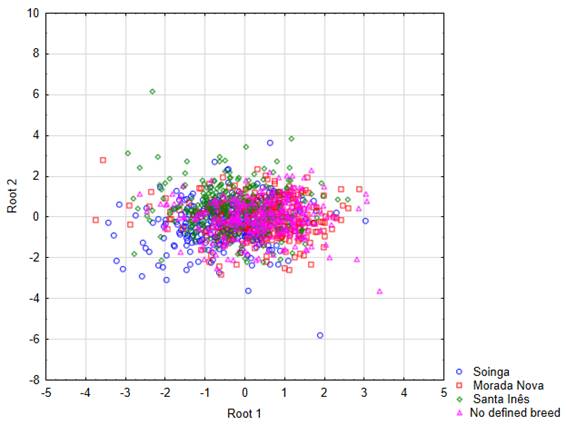
The RR has a canonical correlation of -0.62 and represents 92% of the data variation in CAN1, while the tympanic temperature in CAN2 explains another 6% of the data variation. Thus, it can be seen that these two variables present the greatest data variation and would explain the physiological mechanism of native animals subjected to different temperature ranges (Table 6). Of the 12 variables analyzed, only two represent 98% of the data variation.
The results of the multivariate analyses used in this study demonstrate that there are differences in physiological behaviors between temperatures, while the breeds did not present any differences, since they are native animals adapted to the semiarid region, in addition to being small animals, and, therefore, have better adaptation responses to hot climates (Tadesse et al., 2023). It was observed that RR and tympanic temperature are good indicators of heat stress and can be used to assess the diversity of the thermal environment. This finding is significant because it demonstrates that tympanic temperature can be more practical and as efficient as other traditionally used variables, such as rectal temperature. Furthermore, the inclusion of Ttympanic in discriminant analyses may open up space for future investigations into its applicability in adaptive management programs, especially in semi-arid regions where heat stress is a constant concern.
Canonical discriminant analysis indicated that RR (-0.62) was the highest canonical coefficient in canonical variable 1, and in canonical variable 2, the highest canonical coefficient was the tympanic temperature (0.76). Tympanic temperature and respiratory rate are highly correlated (69%), as the animals used in this research are adapted to heat stress conditions, RT is controlled by RR and thus adjusts without the animal having its core temperature increased. Rectal temperature and respiratory rate are important physiological parameters in identifying a heat-tolerant breed since they are vital processes. Evaporative latent heat loss is less induced by perspiration than by panting, and these are mechanisms used by sheep to dissipate body heat.
Tympanic temperature is considered a reflection of core temperature due to the proximity of the ear canal to the hypothalamus, the animal's body thermostat, where we find the thermoreceptors that assist in this control function (Simões & Martino, 2007). Rectal temperature measurement presents problems of reliability, safety, and comfort. The presence of feces can compromise thermal conduction in the thermometer. An animal that suddenly moves during the assessment with the thermometer in the rectum can result in mucosal injuries or injuries to the person handling it (Michaud, 1996; Kunkle et al., 2004).
The two-dimensional Figure 1 presents the temperatures in well-defined groups, where the lowest are located closer together, reaching temperatures of 24 and 28°C and spreading out, that is, the animals adjust in the same way to these temperatures. The highest temperatures form two very distinct groups, and on the opposite side are the lowest temperatures.
Boere and Mazzotti (2009) evaluated the correlation between rectal temperature and tympanic temperature in cats, and observed that tympanic temperatures were significantly lower than rectal temperatures. This finding is somewhat expected since tympanic temperatures have been observed to be lower than rectal temperatures in other animal species (Greenes & Fleische, 2004; Kunkle et al., 2004). When there is a variation in auricular temperature, the receptors send this information to the hypothalamus, which then adjusts the body's physiological responses to maintain a stable body temperature. For example, if body temperature increases, the hypothalamus may initiate responses such as increased respiration or blood circulation to dissipate heat.
Conclusion
The most discriminatory variables for native breeds at comfort temperatures and thermal stress were reat rate and tympanic temperature. Tympanic temperature proved to be an important physiological variable to aid in the study of the adaptive profile of animals, however, further studies are needed to better understand the mechanisms of this temperature in small ruminants. The present results can be used for future decisions for developing climate resilient sheep through selective breeding.
Data availability
Not applicable.
Acknowledgments
The authors would like to thank CAPES (Coordination for Improvement of Higher Level Personnel) for financing the project, the Federal University of Campina Grande - Brazil (UFCG) and the CNPq (National Council for Scientific and Technological Development).
References
- Boere, V., & Mazzotti, G. A. (2009). Comparação entre temperatura retal e temperatura da membrana timpânica em gatos (Felis catus) normotérmicos. Ciência Animal Brasileira, 10(3), 961-966.
-
Correa, M. P. C., Dallago, B. S. L., Paiva, S. R., Canozzi, M. E. A., Louvandini, H., Barcellos, J. J., & McManus, C. (2013). Multivariate analysis of heat tolerance characteristics in santa inês and crossbred lambs in the Federal District of Brazil. Tropical Animal Health and Production, 45, 1407-1414. https://doi.org/10.1007/s11250-013-0378-3
» https://doi.org/https://doi.org/10.1007/s11250-013-0378-3 -
De Maesschalck, R., Jouan-Rimbaud, D., & Massart, D.L. (2000). The Mahalanobis distance. Chemometrics and Intelligent Laboratory Systems, 50(1), 1-18. https://doi.org/10.1016/S0169-7439(99)00047-7
» https://doi.org/https://doi.org/10.1016/S0169-7439(99)00047-7 - Dillon, W. R., & Goldstein, M. (1984). Multivariate analysis: methods and applications John Wiley.
-
Dossa, L. H., Wollny, C., & Gauly, M. (2007). Spatial Variation in goat populations from Benin as revealed by multivariate analysis of morphological traits. Small Ruminant Research, 73(1-3), 150-159. https://doi.org/10.1016/j.smallrumres.2007.01.003
» https://doi.org/https://doi.org/10.1016/j.smallrumres.2007.01.003 -
Ferreira, A. C. H., Neiva, J. N. M., Rodriguez, N. M., Campos, W. E., & Borges, I. (2009). Avaliacão nutricional do subproduto da agroindústria de abacaxi como aditivo de silagem de capim-elefante. Revista Brasileira de Zootecnia, 38(2), 223-229. https://doi.org/10.1590/S1516-35982009000200002
» https://doi.org/https://doi.org/10.1590/S1516-35982009000200002 - Gois, G. C., Campos, F. S., Carneiro, G. G., Silva, T. S., & Matias, A. G. S. (2017). Estratégias de alimentação para caprinos e ovinos no semiárido brasileiro. Nutri Time, 14(4), 7001-7007.
-
Greenes, D. S., & Fleischer, G. R. (2004). When body temperature changes, does rectal temperature lag?. Journal of Pediatric, 144(6), 824-826. https://doi.org/10.1016/j.jpeds.2004.02.037
» https://doi.org/https://doi.org/10.1016/j.jpeds.2004.02.037 -
Guedes, D. G. P., Ribeiro, M. N., & Carvalho, F. F. R. (2018). Multivariate techniques in the analysis of carcass traits of Morada Nova breed sheep. Ciência Rural, 48(9), e20170746. https://doi.org/10.1590/0103-8478cr20170746
» https://doi.org/https://doi.org/10.1590/0103-8478cr20170746 -
Kunkle, G. A., Nicklin, C. F., & Sullivan-Tamboe, D. L. (2004). Comparison of body temperature in cats using veterinary infrared thermometer and a digital rectal thermometer. Journal of the American Animal Hospital Association, 40(1), 42-46. https://doi.org/10.5326/0400042
» https://doi.org/https://doi.org/10.5326/0400042 -
Landim, A. V., Roriz, N. D., & Silveira, R. M. F. (2021). Sheep meat production in the Brazilian semi-arid region: crossing between indigenous breeds. Tropical Animal Health and Production , 53, 510. https://doi.org/10.1007/s11250-021-02947-1
» https://doi.org/https://doi.org/10.1007/s11250-021-02947-1 - Michaud, A. J. (1996). Comparison of an infrared ear thermometer to rectal thermometers in cats. Feline Practice, 24(6), 25-30.
-
Ribeiro, N. L., Pimenta Filho, E. C., Arandas, J. K. G., Ribeiro, M. N., Saraiva, E. P., Bozzi, R., & Costa, R. G. (2015). Multivariate characterization of the adaptive profile in brazilian and italian goat population. Small Ruminant Research , 123(2-3), 232-237. https://doi.org/10.1016/j.smallrumres.2014.12.010
» https://doi.org/https://doi.org/10.1016/j.smallrumres.2014.12.010 - Schmidt-Nielsen, K. (1997). Animal physiology: adaptation and environment Cambridge University Press.
-
Silveira, R. M. F., McManus, C. M., Carrara, E. R., DeVecchi, L. B., Carvalho, J. R. S., Costa, H. H. A., Pilonetto, F, Fávero, L. P. L., & Landim, A. V. (2024). Adaptive, morphometric and productive responses of Brazilian hair lambs: crossing between indigenous breeds - a machine learning approach. Small Ruminant Research , 232, 107208. https://doi.org/10.1016/j.smallrumres.2024.107208
» https://doi.org/https://doi.org/10.1016/j.smallrumres.2024.107208 -
Simões, A. L. B., Martino, M. M. F. (2007). Variabilidade circadiana da temperatura oral, timpânica e axilar em adultos hospitalizados. Revista da Escola de Enfermagem da USP, 41(3), 485-491. https://doi.org/10.1590/S0080-62342007000300020
» https://doi.org/https://doi.org/10.1590/S0080-62342007000300020 -
Starling, J. M. C., Silva, R. G., Ceron-Munhoz, M., Barbosa, G. S. S. C., Paranhos, M. J. R., (2002). Análise de algumas variáveis fisiológicas para avaliacão do grau de adaptacão de ovinos submetidos ao estresse por calor. Revista Brasileira de Zootecnia , 31(5), 2070-2077. https://doi.org/10.1590/S1516-35982002000800022
» https://doi.org/https://doi.org/10.1590/S1516-35982002000800022 -
Tadesse, D., Patra, A. K., Puchala, R., Hussein, A., & Goetsch, A. G. (2023). Differentiation of hair sheep breeds based on the physiological and blood biochemical changes in response to different stressors using multivariate analysis techniques. Animals, 13(16), 2643. https://doi.org/10.3390/ani13162643
» https://doi.org/https://doi.org/10.3390/ani13162643 - Zepeda, H. J. S., Guerra, F. F. J., Garcia, M. H., Serrano, E. R., Vázquez, A. C. ., Cruz, A. B., & Bermejo, J. V. D. (2002). Estudio de los recursos genéticosde México: características morfológicas y morfoestructurales de loscaprinos nativos de Puebla. Archivos de Zootecnia, 51, 53-64.
Edited by
-
Associate Editor in charge:
Leandro Dalcin Castilha