
 Measuring Impulse buying behavior through Customer Satisfaction - A Retailer Perspective in FMCG sector
ABSTRACT
The core success of every business lies in the quality of services provided by the marketer, which is the forebearer for customer satisfaction, provoking impulsiveness in buying behavior Taking this as its core issue, this study mainly focuses on the retailer’ perspective towards service quality in the Fast Moving Consumer Goods (FMCG) sector and its impact on impulse buying behavior through customer satisfaction. For this purpose, 526 customers in the western region of Tamilnadu, India were selected through a convenience sampling technique. Tools such as structural equation modeling and correlation along with the decision tree analysis were employed and the outcome illustrated that no remarkable affiliation found amid the location of the store, reliability and empathy and the retailer’s service quality but customer satisfaction performed as a moderator between retailer’s service quality and the impulse buying behavior. Retailers are suggested to have a good customer relationship management through reliability and empathy for retaining the valuable customers as they have more knowledge towards brand preference.
Keywords:
Customer experience; perception; price; service quality; switching behavior
RESUMO
O sucesso central de toda empresa se baseia na qualidade dos serviços do profissional de marketing, e esse é o precursor da satisfação do cliente, que provoca impulsividade no comportamento de compra. Tendo isso como questão central, esta pesquisa enfoca principalmente a perspectiva do varejista em relação à qualidade do serviço no setor de FMCG e seu impacto no comportamento de compra por impulso por meio da satisfação do cliente e, para isso, 526 clientes na região oeste de Tamilnadu, Índia, foram selecionados por meio da técnica de amostragem por conveniência. Foram empregadas ferramentas como modelagem de equação estrutural, correlação e análise de árvore de decisão, e o resultado ilustrou que não foi encontrada nenhuma afiliação notável entre a localização da loja, a confiabilidade e a empatia e a qualidade do serviço do varejista, mas a satisfação do cliente atuou como moderador entre a qualidade do serviço do varejista e o comportamento de compra por impulso. Sugere-se que os varejistas tenham um bom gerenciamento do relacionamento com o cliente por meio de confiabilidade e empatia para reter os clientes valiosos, pois eles têm mais conhecimento sobre a preferência pela marca.
Palavras-chave:
Experiência do cliente; percepção; preço; qualidade do serviço; comportamento de troca
1. INTRODUCTION
Currently, the retail industry in India is witnessing dramatic growth, and the FMCG sector has seen an incredible transformation due to the proliferation of competitors and technology. This situation made it all the more critical for retailers to satisfy -a forerunner for the creation of spontaneity in purchase among the customers. This spontaneity is created through products and services (Miralam et al., 2019) and earned customer experience (Arviana & Syah, 2022), and customer value (Prasasthan & Navaprabha, 2013) (Wang, 2022) which are the basic philosophies for every marketer-“satisfying the customer’s needs and wants to earn profits”. Many earlier studies witnessed the subsistence of satisfaction based impulsive buying behavior practices among Indian customers. For instance, Hindustan Unilever LTD brought about impulsiveness in their customers through a mix of marketing and product strategy (Jayde, 2019); Customers of the Big Bazaar retail outlet in India have impulsive and spontaneous behavior created by good price and sales motivation (Harshith, 2019); 68 percent of the customers (female dominated) in D-mart, Osia, Big Bazaar, and Reliance Fresh preferred impulse buying owing to their shopping experience, a store’s floor merchandising, and the employees approach (Pandya, 2021). As a milestone, the report published in FeedVisor in the year 2021about the customers of M/s and Amazon highlighted that 49 percent of the total customers under the age of 27-40 preferred buying when the products were first listed on the platform, strongly indicating the impulsiveness of the customer. Still there exists a complexity in understanding the preference of the customers by the retailers and it is due to the heterogeneity idea that the customers have in their purchasing behavior.
But, this impulsive buying will not be permanent, and dissatisfaction, if any,in micro level (Sands et al., 2020) may lead toa switching mood among the customers despite having social, emotional and quality benefit through the product. Hence, it is very decisive for the marketer to detain the brand and the consumer demeanor (Sunardi et al., 2023) and any happening may result in damaging the market share and prosperity (Fernandas et al., 2020). This is also accepted by (Marva and Astini, 2023) who highlighted that enhanced quality in service yields better satisfaction and, in contra, inferior quality may lead to a worse level of customer satisfaction-and the sustainability of any business rests with the satisfaction level of the customers (Widodo et al., 2023) which is the soleantecedent for the impulsiveness in the buying behavior through loyalty.Hence many early studies have given importance to measuring the quality of service.
Initially, service quality was measured through parameters like Tangibility, Reliability, Responsiveness, Assurance, and Empathy (Parasuraman et al., 1988); (Firmansyah et al., 2023) and later, these parameter is applied to measure the customer satisfaction (Aruldoss et al., 2023; Ngaliman et al., 2019; Widodo et al., 2023). In addition, many researchers have measured service quality through various factors like usefulness, convenience, design, and security/privacy (Yum and Yoo, 2023); convenience, reliability, ease of use, fulfillment, and security in the banking sector (Nigatu et al., 2023) and particularly in the fast moving consumer sector, the service quality is measured by Reliability, Responsiveness, Assurance, Empathy and Tangibility (Sharma, 2021); perception in quality was examined through the word of mouth with the marketing mix (4Ps) (Khalil, 2021)of quality of object, quality of process, quality of infrastructure, quality of interaction, and quality of atmosphere (Zeneldin et al., 2014); studied the customer satisfaction through the FMCG products (Mishra and Mishra, 2022). Hence it is obvious that impulsiveness in buying is mainly depending upon the service quality followed by the customer satisfaction in the FMCG sector.
In other words, impulsiveness is intangible in character and could be measured only through there tention rate of customers, with this retention rate depending on the perceived service quality from the retailers. Singh et al. (2023) pointed out that client retention in any business is directly related to the service superiority and this withholding is resolute in the fundamental business plan of the company to gain trust and belief of the customer which in turn yield long term success. This conviction could be earned by the marketer only through continuous and consistent quality in services which enhance the impulsive buying behavior among the customers and the profit (Ali et al., 2021). Predominantly, in FMCG commodities, customers consistently seek out new products that the market has made available Selvi and Padmashri, 2023) and it is mandatory for the manufacturers to advance the features of the product as per the customer requirements (Lone and Bhat, 2023) and not be bothered about the price in the case of quality products (Andari, et al., 2023) as there is a constructive alliance between the brand equity and the operation of the business in the market (Mohan and Sequeira, 2016).
The above discussion is clearly informed about the present status of the retailers, who should remain attentive through proper understanding about their customers (Puccinelli et al., 2009) and in the FMCG sector, retailers must grasp customer preferences through their experience, as perceived shopping value plays a significant role in strengthening purchase intention, but large number of companies have not bothered about the customer value and experience and hence their improvement in the business were in trouble and in fact satisfaction mainly depended on the experience (Ray et al, 2020),which will turn on loyalty and create impulsiveness in the buying process only when the service providers solved the problems that have been raised by the customers (Manyanga et al., 2022).
Taking all the above, this study is unique as it considers various indispensable dimensions such as location, reliability, empathy, and customer satisfaction under a retailer’s service quality(RETSERVQ) that can precisely measure impulsiveness among the customers-customer satisfaction is considered as a moderator between the retailer’s service quality and the impulse buying behavior so as to ascertain whether the service quality in the FMCG sector directly induces the impulsiveness or through the customer satisfaction. Therefore, the following research questions were put forth for this study.
-
Whether the customer’sexperiences with the location, individual attention, and reliability of retailers in FMCG sector creates positive satisfaction?
-
Does a retailer’s service quality enhance customer satisfaction?
-
Whether customer satisfaction enhances impulse buying behavior in the FMCG sector?
As this study mainly focuses on the retailer’s perspective towards impulsiveness, the outcome will surely help the retailers to redefine a new phase in their business strategy for providing the products and services that align the inimitable needs and wants of the customers in the FMCG sector and thereby inducing the impulsiveness among them.
2. LITERATURE REVIEW
This section has the outcomes of various prior works that facilitated the overall understanding about the current topic of the study. The seven hypotheses as detailed below are:
2.1 Location and Service quality in FMCG sector
(Pugazhenthi, 2010), in a study about customer loyalty and choice of retailer in the FMCG sector, acknowledged that female customers preferred only the location of the store for their purchases, while men preferred location along with ambience, display, and availability of the products in the outlet. Hariyadi et al. (2018) identified hat the location and the distance of the retail outlet significantly influenced the repurchasing intention among the customers and this is substantiated by (Dey and Sharma, 2017) who informed that the place of purchase was very important and that customers were preferring neighborhood or nearby stores for purchasing FMCG products in Agartala city.
Bahri (2018) revealed that location, service, and product quality have significantly influenced the purchasing decision through customer satisfaction particularly - the management has to give importance to the parking area of the departmental store. Aronkar and Chaturvedi (2019) underlined that there is a strong relationship between store location - and the product quality-on the loyalty of customers. In addition, a retailer’s personality partially mediated the customer reactions and the retailer’s service quality (Rashid & Rokada, 2023). The above outcome shows the importance of the retail outlet’s location, and its impact on the customer buying behavior but whether the same mentality rests with the customer of this study and to test the relationship, the following hypothesis was framed.
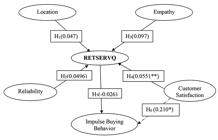
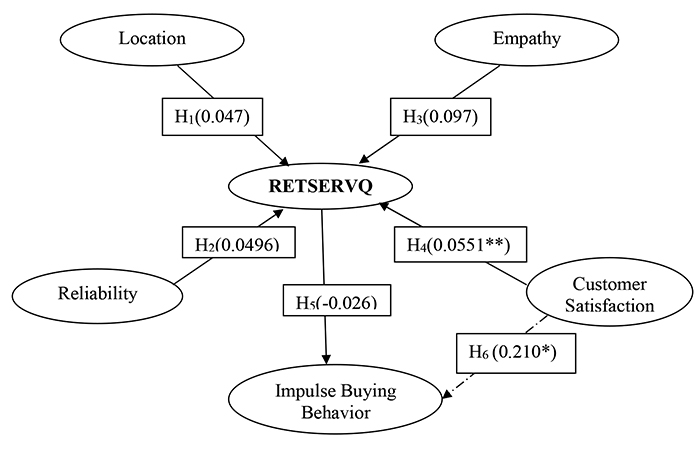
H 1 : Location of the outlet positively affects the retailer’s service quality in the FMCG sector
2.2 Reliability and Service Quality in FMCG sector
While reviewing the past literature about the impact of reliability on the retailer’s service quality, there was no direct study found, but many researchers have attempted to study the impact of reliability on the service quality through SERVQUAL among the dimensions. But, to provide lucidity to the audience, the following reviews were submitted.
Kumar et al. (2012) , in a study about retail service quality in organized retailing, established that reliability does not have a noteworthy relationship with customer satisfaction through retailer service quality but this outcome has a contradictory result with the findings of (Silva et al., 2022) who reported that reliability has a significant association with customer satisfaction through service quality in the Mini super market. Ngaliman et al. (2019) demonstrated the direct effect of reliability on customer satisfaction through service quality in the delivery services. Rashid and Rokada (2019) found that reliability in the grocery retail positively influences the customer satisfaction through service quality in terms of commitment of promises and delivery. Yuen and Chan (2010) enlightened that physical aspects, reliability, and problem solving have positively related to the loyalty among the customers in the retail sector, but this result was found in opposition to the findings of (Venkatesha and Govindappa, 2018) who found that reliability has no significant impact on the retailer’soverall service quality. To have the real position of the reliability of the retailer on the impulsive buying behavior in FMCG sector, the following alternative hypothesis is formulated.
H 2 : Reliability positively influences the retailer’s service quality in the FMCG sector
2.3 Empathy and Retailers Service Quality in FMCG sector
Bahadur et al., (2018) recognized that the employees were the prime stakeholders in delivering empathy to the customer, in orderto showthe customer a business which enhances customer satisfaction and loyalty. In fact (Wei et al., 2022) particularly pointed out that even service failure could be forgiven by the customer if they were given treatment individually-installing customers on repurchase intention.
Rashid and Rokada (2019) revealed that theem ployee’s friendly and healthy empathetic behavior played a significant role in the grocery retail service quality. (Bove, 2019) established that empathy in services reduces anti-social behavior, revenge, and discrimination thereby enhancing ethical behavior among the employees. It is compulsory for the retailers to continuously endorse service quality through empathy and to confirm this situation, the following hypothesis is provided.
H 3 : Empathy positively influences the retailer’s service quality in the FMCG sector
2.4 Customer Satisfaction and Retailer’s Service Quality in FMCG
Venkateswaran and Sundaram (2021) reported that retail service quality, and the store service quality, were increasing customer satisfaction which, in turn, created patronage intention among the customers. Kawa and Zdrenka (2023) identified the factors that create values among the customers through the e-retailing business and found that communication; convenience, reception experience, and the convenience in returning the article have satisfied the customers in turn built loyalty among them.
Sung et al. (2023) found that trust generated by the marketers through their behavior in online platform, helps reduce perceived risk and uncertainty in the purchase process. Similarly (Maqsood & Javed, 2019) emphasized that compatibility and customer satisfaction could be enhanced only through effective after-sales service and strong customer relationships, and this consistently encourages customers’ impulsive buying behavior. (Rajalakshmi & Golden, 2023) highlighted that factors like product quality, product value, and awareness were the key influencers for the customer satisfaction in the dairy industries. To identify the relationship between the retailer’s service quality and the customer satisfaction, the following alternative hypothesis is framed for this study.
H 4 : There is a positive relationship between the retailer’s service quality in the FMCG sector and the customer’s satisfaction
2.5 Impulsive Buying Behavior and Service Quality in FMCG sector
Hashmi et al. (2019) clearly stated that information quality, service quality, and system quality have significantly and positively affected the online impulse buying behavior. Susanti (2022) found that competitive prices and good service quality in the minimarket sector have an significant impact on the impulse buying behavior of which (Husnain & Akhtar, 2016) highlighted that branding has a noteworthy impact on the impulse buying behavior.
Ahmed et al. (2014) explained that impulse buying behavior is mostly determinedby the attractive color, packaging, and labeling of the product. Vinish et al. (2020) realized that staff members and their skills played an important role in creating the impulse buying behavior among the female shoppers in the case of apparel industries, despite store’s ambience and layout. This study mainly focuses on customers’ impulsive buying behavior from a retailer’s perspective which is a incomparable study with the previous research undertaken from the retailers perspective and hence the following hypothesis is considered.
H 5 : There is a positive impact of factors under retailer’s service quality and the impulse buying behavior in FMCG sector
2.6 Demographic profile and the Switching practice among the customers in FMCG sector
Verma et al. (2023) ; Kumar (2014) reported that the demographic profile of the customers influencing the decision making and buying behavior in preferring the FMCG products; particularly age, education, and occupation played an important role the decision making process. (Chen et al., 2021) confirmed that the impulse buying decision is influenced mainly by the parents and the spouses of the purchaser, other than companions in the grocery shopping, and this buying behavior mainly depend upon the retailer’s internal characteristics, atmosphere, and relationship with the customers.
Vinayagamoorthy and Kannan (2015) revealed momentous difference existed among the socio-demographic sketch of the customers and impulsiveness in buying action and, it is also seen that there was a weak association that existed between the consumer’s lifestyle, fashion involvement, and post decision stage with impulse buying behavior. Rani and Catherine (2023) told that discounts, offers, and other related promotions made the customer have impulse buying behavior through the demographic profile mainly the age and the psychographic factors. (Bogomolova et al.,2019) indicated that majority of new to store purchases mainly depend on store stimuli such as price promotions, stock outs, and, particularly display, however, no difference noticed between new and returning customers in retail purchases in terms of their demographic characteristics
Zhao et al. (2021) have proved that product pricing and packaging of the product significantly influenced the consumer’s buying decision process by pointing out that high pricing in the competitive market may lead to lose the customers permanently.(Guha,2023) revealed that there is a significant difference noticed between the male and female regarding impulse buying behavior and it is the emotion that played a good role in the impulse buying behavior and, sometimes, friends and family members may influence it among the college going students in Kolkata.
H 7 : Demographic profile positively induced the switching mood among the customers of FMCG sector
This is the research primarily focusing on the customer’s impulsive buying behavior, through service quality in the retailer’s perspective and earlier research works were available but those work mainly concentrated on the customer satisfaction and loyalty and there is no direct study about the impact of a retailer’s service quality on impulsive buying behavior. As a milestone, another effort, which have not attempted so far, was taken to study the mediating role of customer satisfaction between the retailer’s service quality and the impulsive buying behavior. This is actually an exclusive research gap to be filled, and a special hypothesis was framed.
H 6 : Customer satisfaction positively mediates a retailer’s service quality and impulse buying behavior in the FMCG sector
A consolidated framework of the hypotheses framed for this study is given in Table 1 below for easy understanding.
. Based on the research gap of this study and with the construct selected, the following theoretical model is considered (Figure 1).
3. OBJECTIVES OF THE STUDY
The following objectives were taken up for this study based on the conceptual model.
-
To establish an idiosyncratic study with unique factors under retailers service quality on the impulse buying behavior in the FMCG sector.
-
To investigate the association among the factors that influence the retailer’s service quality.
-
To identify the impact of the factors under the retailer’s service quality on the impulse buying behavior of the customers.
-
To scrutinize the mediating role of customer satisfaction between the retailers’s service quality and impulse buying behavior.
-
To spot the demographic variable that manipulating the switching practices of brand among the consumers.
4. RESEARCH METHODOLOGY
This study is basically of a quantitative and descriptive nature, and the factors considered were explored through the self-conducting questionnaire-data collection is done by two methods 1) interview method among the illiterate respondents 2) getting the opinion duly filled by them and the respondents were informed about purpose of the survey. The opinion was obtained through 5 point Likert scale ranging from 1- strongly disagrees to 5 -strongly agree. Since the population is unknown, the minimum requirement of the sample size is 384 but, based on the geographic area of the study, which constitutes 10 districts, a total of 650 samples were considered and selected through the convenience sampling method.
Here, the researcher wants to justify the representation of the geographic area and the population considered for this study. India is the second largest nation in the world, with a high population and possessed of 29 states of which, Tamil Nadu in the southern part hasa huge population, with unity in diversity. Even though they didn’t share a culture, this study found no difference in the using of FMCG products as a whole on a PAN India basis. Hence it is believed that conducting research in this selected jurisdiction would definitely represent the population of the entire country. This is the reason for selecting the western region of Tamil Nadu for this study.
Next, the questionnaire was distributed to these selected 650 respondents and the opinion was obtained from them. But it is seen that only 586 questionnaires were received, of which only 526were found to be in the reusing stage for the analysis purpose, with 80.9 %. Before conducting the actual survey, a pilot study was conducted with 150 samples to validate the consistency of the questionnaire and the value was found as 0.70 percent.
The following tools were employed in this study for the purpose noted against each.
4.1 Structural Equation Modeling
Any complex analysis through the multiple points of data could be done only through structural equation modeling through a path analysis. Through this method, multiple processes of the system are possible. It identifies the relationship of factors through measurement and structural equation which enable the researcher to have keen results on their objectives. This method’s aim is to lessen the difference that occurs between observed and expected covariance matrices. At last, validation of any model through path analysis is possible only through this technique.
The opinion collected through the questionnaire encompasses well-defined factors, and when the latent variable structure is known, the analysis proceeds directly with the confirmatory factor analysis (CFA) through AMOS by considering constructs like location, reliability, empathy and customer satisfaction as the exogenous and observed constructs, with the retailers service quality considered as the endogenous and a latent one in the first order level, and, in turn, the retailer’s service quality (RETSERVQ) as the exogenous factors, with the impulse buying behavior as the endogenous factor in the second order level.
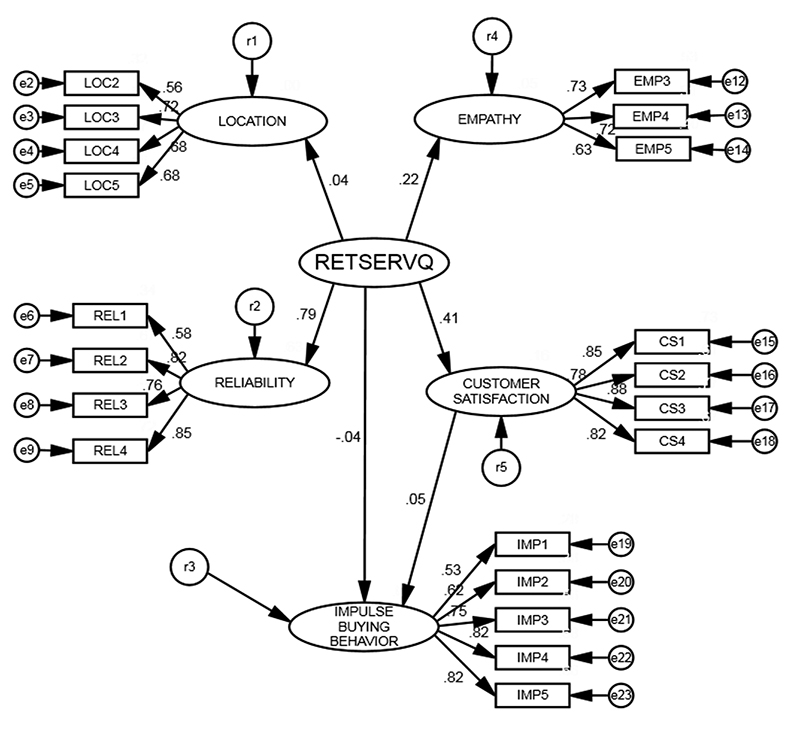
Path analysis with the above factors was done by considering the customer satisfaction as the moderator between the retailer’s service quality and the impulse buying behavior and diagram obtained is represented in figure 2 below:
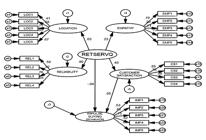
Theoretically, the items in each constructs which have factor loading with more than 0.5 (Hair et al., 2009 apudByrne, 2016); and factor with loading more than 0.4 Stevens (2002) apud (Cheung et al., 2023) may be considered for validation, and the rest of the factors having value lower than 0.4 should be deleted during the assessment and validation process. In the Figure 1 above, the following factors were found with the value less than the prescribed limit for validation. The details of the assessment of the model are given in Table 3 below:
The confirmatory factor report for every construct is given in Table 4 below:
The Average value extracted (AVE) and the Composite reliability value are found within the threshold limit as prescribed in the earlier research (Ahmed et al., 2016). At the same time, the AVE value for the “Location” is found as 0.44 (<0.5) but the Composite reliability value found with the value 0.76 which is (>0.70) and hence it is accepted as per Fornell and Larcker (1981) . Discriminant validity was further verified and the result is given in Table 5 below. The outcome confirmed there are no issues in the validity as the square root of the factor’s Average Variance Extracted (AVE) value (in the diagonal of each factor) is greater than the correlation value between the factors of this study.
The path analysis after assessing the model by deleting the factors which have not met the criteria is given in figure 3 below:

The goodness of fit indices obtained is given in Table 6 below:
From the result in Table 2 above, the CMIN/df value wasfound as 2.695which indicated the better fit of the model. The GFI value (0.925) showed that the model accounted for92.5 percent of variance in the observed data through variance and covariance. This outcome is substantiated through the value of AGFI which is found as (0.904) which explained90.4 percent of the variance. The IFI value (0.935) confirms an improvement of 93.5 percent from the baseline model and the CFI value (0.935) authenticated a 93.5 percent improvement over the base modelThe RMR value indicated an average discrepancy of 4.5 %. Additionally, the FMIN value (0.842) showed the minimum discrepancy in the model. The RMSEA value of 0.057, below than the threshold limit of 0.08, exhibited good and, overall fit with the data that is obtained from customers who prefer in purchasing the FMCG products through retailers. Also, the maximum likelihood estimates result revealed is detailed underneath.
The standard regression weight and the status of the hypothesis of this research is detailed in Table 7 below:
The above values represented the output of the SEM of Analysis through regression weights and the result confirmed that the relationship between location, reliability, empathy were not statistically significant but customer satisfaction has a positive and noteworthy relationship with the RETSERVQ (Retailers Service Quality) at p≤0.01 as the value of the critical ration is more than (>) 1.96 .
The direct, indirect and the total effects of the factors that influencing the purchasing of FMCG among the customers was analyzed and given in Table 8 below:
The impact of the exogenous factors on the endogenous one proved that increase in one unit of independent factors increases the retailers service quality to the tune of 2.7 % (Location); 79.4 % (Reliability ); 21.7 % ( empathy); customer satisfaction (40.6 %) and at the same time, the direct impact of RETSERVQ on the impulse buying behavior is found negative (-0.015) but when moderating through customer satisfaction, it is seen that the service quality through satisfaction improves the impulse buying behavior towards FMCG product at 2 %.
4.2. Descriptive Statistics
In this section, the summary of the demographic characteristics of the customers are analyzed and given in Table 9 below:
The demographic profile results highlighted that the maximum participants of this study were found to be female (71.1 %) and the maximum respondents were found under the age group of 31-40 years (38.1 %). Regarding marital status, it is found that the maximum respondents were found to be married (72.1 %) and 46.8 percent of the total population were held an undergraduate degree. It is also seen that most of the respondents were living singly (51.5 %) despite their marital status. Maximum customers had a monthly income to the tune of less than Rs.20000/= and 28.9 percent of the total population were purchasing the FMCG products in the super market and 30.8 percent of the customers have informed that they were purchasing on weekly basis.
Any growth in business is mainly depending upon the customers who are loyal with the company but even a small favor by the competitor makes this loyal customer to think about the switching pattern and those customers could be retained only through surprise promotional activities. In this study, customers were asked about their switching mentality in case of any problem with the existing FMCG and found that 33.1 percent of the total population informed that they were having the habit of switching to other brands.
4.3 Karl Pearson Correlation Analysis
In view to find the linear relationship between two continuous variables or factors, this technique was used. The main objective of finding the relationship among the factors is to determine the strength and direction of the factors taken up in the research along with prediction and forecasting for the decision-making process (Shoeber et al., 2018). Simply, it is an important diagnostic tool for the determination of association between the factors. The result of the correlation analysis of this study is detailed in Table 10:
The outcome has to bear out that constructs like location, reliability, empathy and customer satisfaction were optimistically interrelated at 1 % and 5 %level of significance. There was seen weak to moderate correlation among the factors (R =+0.095 to +0.325) and the result is corroborated with the findings of (Schober et.al., 2018). The maximum association rest with “Customer satisfaction” and “Impulse Buying behavior” (r=-0.325**) followed by “Reliability” with “Customer satisfaction”(r=0.256**) and the lowest correlation was found between “Empathy” and the “Customer Satisfaction” with the value of (r=0.095*) at5 % level of significance. Through the R2 value, 98 % variation was shown by the location with impulse buying behavior followed by empathy with 96 % towards impulse buying behavior; 89.5 % variation by the customer satisfaction towards the impulse buying behavior which revealed that total variability yet to be explained due to the inter linkage factors considered in this study.
4.4 Compare Mean Test
In order to find the association amid the demographic variables of the customers and the factors that influencing the Retailer Service Quality (RETSERVQ) and the impulse buying behavior, paired sample “t” test and one way ANOVA (“F” test) is conducted with the following result in Table 11 below:
The result revealed that demographic variables like gender, marital status, family type and the switching pattern among the customers were found to be statistically significant with all the factors like location, reliability, empathy, customer satisfaction, and impulse buying behavior at 1 % level of significance but the result of one way ANOVA confirmed that there is a significant relationship found between the age and the customer satisfaction and impulse buying behavior; educational qualification with the location, customer satisfaction and impulse buying behavior; monthly income with the location and the customer satisfaction; type of purchasing outlet with all the factors except with the empathy and frequency of purchasing of FMCG with the location and the customer satisfaction at 1 % and 5 % level of significance.
4.4 Decision Tree Analysis
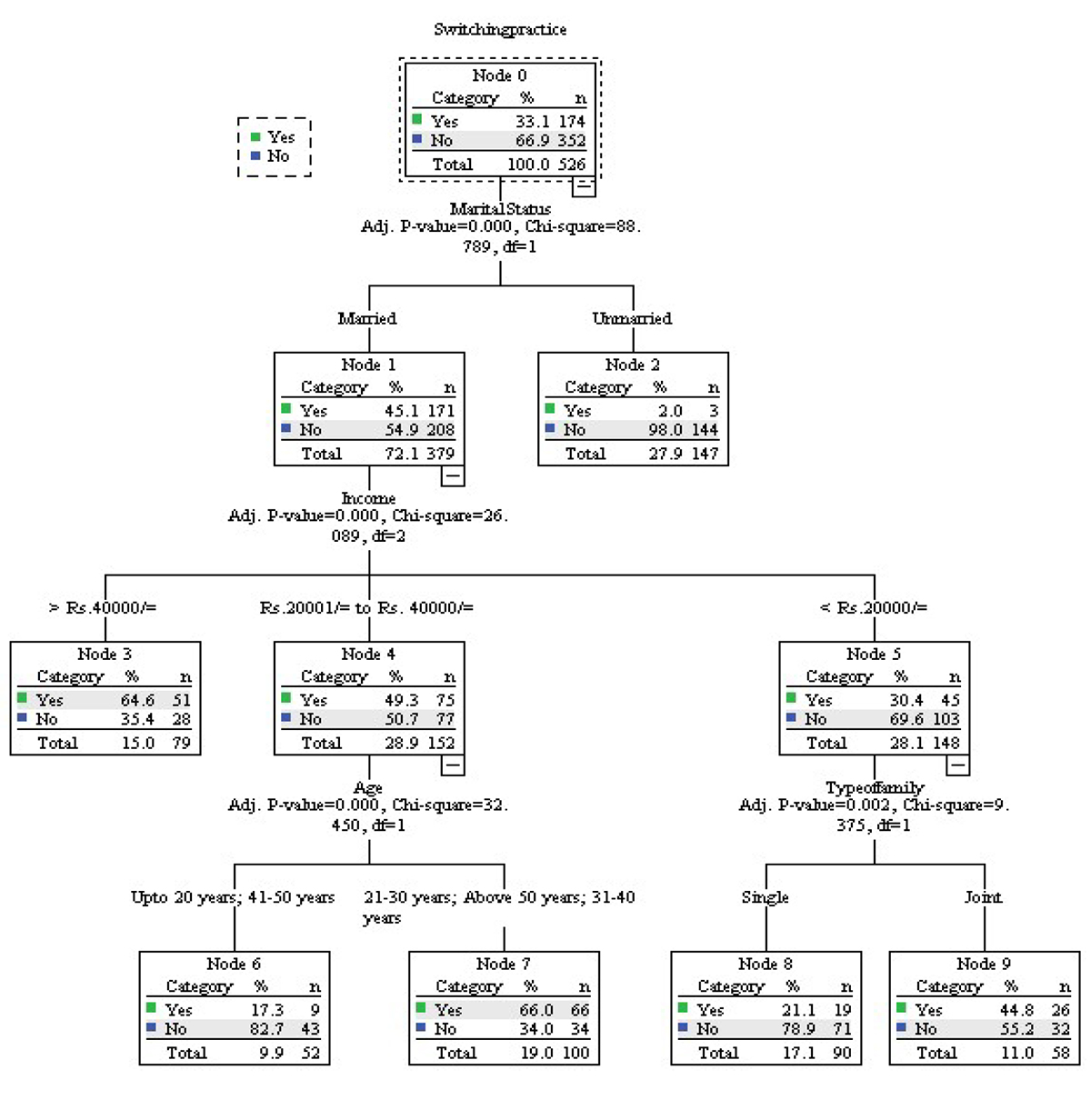
This is a statistical method where the decision-making process for a particular product could be represented based on the opinion of the respondents. In simple, it supports the strategic decision making process both for individual and for the organization but more to the marketers. In this study, the decision tree analysis is carried out and the flow chart obtained through the analysis is depicted in figure 4.
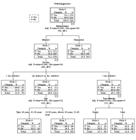
The main aim of the decision tress analysis is to find what are the demographic factors of the consumers taken as a predictor for switching the brand of the FMCG and from the result revealed through CHAID (Chi Square Automatic Interaction Decision) method, it is noticed that the primary predictor for switching the brand of FMCG among the customers is the marital status and, it is seen that 45 percent of the married respondents and 2 percent of the unmarried respondents have given consent in switching over to the other brand of FMCG. The immediate next predictor in switching the brand in FMCG among the married category is monthly incomewhere 64.6 percent of the respondents who have the monthly income above Rs.40000/= and 49.3 percent of the respondents who have a monthly income ranging from Rs.20001/= to Rs. 40000/= have given consent in switching over the brand in case of dissatisfaction with the performance of the product. The immediate next predictor for those who have switched over to the other brand of FMCG based on the monthly income ranging from Rs.20001/= to Rs. 40000/= is the age and the chi-square result proved the remarkable bond existed between the demographic profile in all the nodes from Node 0 (root node) to Node 9 (terminal node). The classification result referred in Table 12 below also confirmed that 67.2 percent of the total population who have consented for switching the brand and 82.4 percent of the total customers who have not consented for switching the brand.
Also, the risk for the marketers, as resulted from this decision tree analysis, is (0.226) which revealed that the risk estimate and the overall correct classification rate are no longer consistent with each other-the expected risk estimate by the marketer is 0.226 (22.6 %) if the overall correct classification rate is 77.4 %.
In view to finding the similarities and the differences among the customers based on their switching mentality, k means cluster analysis is done to find the relationship between and among the factors considered under retailers service quality and with the impulse buying behavior. The result of the analysis is given in Table 13 below:
From the above table, it is noticed that the “F” value of “Empathy” (103.822) found high followed by the customer satisfaction (93.503) which is the main source for the greatest separation between the 3 clusters formulated above. It is also seen that 176 customers in the cluster 1 were found as the most switching mentality persons towards FMCG product followed by 161 customers in the cluster 2 and 189 customers in the cluster 3 who were the least bothered persons in switching to other FMCG brand.
The Euclidean distance proved that customers in cluster 2 have equal similarity to cluster 1 and 3 as the distance found very short among the clusters. Large number of customers were found in the cluster 3 which revealed that customers with switching mentality were occupied this cluster.
5. RESULTS AND DISCUSSION
This is the study done to identify the forming of impulse buying behavior among the consumers-those who are purchasing the FMCG products through their satisfaction from the retailer’s perspective and hence the parameters such as location of the store, reliability, empathy and customer satisfaction were considered under retailer’s service quality and the impact of this service quality was analyzed directly through customer satisfaction as the moderator as satisfaction is the forerunner of impulse buying behavior.
Initially, the model fit was validated through structural equation modeling, followed by descriptive statistics. The findings indicated that the majority of respondents were female, which may be attributed due to the nature of the product used by them (i.e) FMCG, since women were responsible in planning of purchasing these products particularly grocery items.
Regarding the validation of the hypothesis, the path analysis of the structural equation modeling proved an insignificant relationship amongthe location with the retailer’s service quality (RETSERVQ) which found against the findings of (Faria and Carvalho, 2022) who proved that store design moderated the customer satisfaction and commitment in the retail industry and (Hunneman et al., 2023) who underscored that location invariably affects the store sales mainly the distance between the residence and the retail outlet and hence the hypothesis (H1) was not validated as expected.
Regarding the association between reliability and the retailer’s service quality, the findings of this study confirmed that there is no significant association which is not parallel with the outcome of (Sung et al., 2023), that highlighted the role of positive influence of trust and reliability on the purchase intention, and hence the hypothesis (H2) is rejected. Also, this study showed that there is no significant association between empathy and the retailer’s service quality which found controversy with the findings of (Wei et al., 2022) who informed that empathy mediating the consumer forgiveness and the repurchase intention which meant that if the retailers have a good empathy with the consumer, their sales will not be affected even if the consumers found fault in them because of their forgiveness level. However, in this study, this is totally opposite and hence the hypothesis (H3) has not validated and got rejected.
But it is the customer satisfaction that have the positive association with the retailer’s service quality and also moderating the retailer’s service quality with the impulse buying behavior thereby corroborated with the findings of (Pornpitakpan et al., 2017) who identified that the good sales person’s retail service quality yields great impulse buying behavior and it is the customer satisfactory mood mediates the repurchase intention based on the retailer’s service quality and (Maqsood and Javed , 2019) who explained that satisfaction through price of the product and the quality have significantly influenced the impulse buying behavior and this price and quality mainly depend upon the retailer’s service quality and hence the hypotheses (H4 and H6) are supported, rejecting the hypothesis (H5)
Regarding the impact of the demographic profile of the consumers on their switching habit to other brands of FMCG, the result of the decision tree analysis proved that the demographic profile marital status followed by income, type of family, and age have found as a momentous predictor for their switching mood to other brand which substantiated the findings of (Unika, 2020), and hence it is concluded that the socio- demographic characteristics of the customers/consumers have an inducement in switching to other brand of FMCG and this findings substantiated the result of (Nathiya and Kasthuri, 2021) who informed that demographic profile like income, age, gender, and education played a noteworthy role in brand awareness of FMCG products and hence the hypothesis (H7) is accepted.
A summary of the hypothesis is given in Table 14 below:
The above results have provided the answers to the research questions of the study in such a way that the customers have satisfied with the retailer’s service quality particularly in selling the FMCG products in the selected geographical area and this service quality has enhanced the satisfaction level and it moderated the effect of retailer’s service quality with the impulse buying behavior among the customers and created repurchase intention through this impulsiveness because of the trust and reliability they have with the retailers.
PRACTICAL IMPLICATIONS
Now-a-days, consumers in both urban and rural area have a wide awareness towards the brand of FMCG (Dhanaraj, 2020) through promotional activities done through the social media and this is mainly due to the improvement in the technology (Ganesha and Sinnoor, 2019). Hence there is a chance of switching over to the other brand (Ramachandran, 2013). To retain the customers/consumers, it is mandatory for the retailers to have a good service quality in terms of reliability and trust, showing empathy, and having excellent customer relationships-this alone creates loyalty, and leads to repurchase intention. But the present scenario noticed with the marketers of this study area is not satisfactory and they should concentrate on the factors under service quality-but one doubt here is: even though there is no association between location, reliability, and empathy, consumers have satisfied with the retailer’s service quality and have their impulse buying behavior. But the decision tree analysis result proved that the socio-demographic characters of the purchaser initiated a significant function in switching behavior and hence it is compulsory for the retailers to focus on the empathy in service quality based on age, marital status, income, and educational level so that they could hold the customers in their hand in this competitive market.
7. LIMITATIONS AND SCOPE FOR FUTURE RESEARCH
As this study is focused on the retailer’s service quality based on location, reliability, empathy and customer satisfaction, and the impact of RSQ on the impulse behavior directly and through customer satisfaction as the moderator, the sample size and the area selected is very small. The result would be appreciable if the study is done through cross section analysis with other state or with other country too. While doing the future research, additional factors may also be considered for getting the precise results which will be useful to the universal audience in this domain.
ACKNOWLEDGEMENT
I would to acknowledge the support of all in successfully completing this manuscript.
References
- Ahmed, R. R., Parmar, V., & Amin, A. M (2014). Impact of Product Packaging on Consumer’s Buying Behavior. European Journal of Scientific Research, 120(2), 145-157.
- Ahmed, U., Rehman, K. U., & Niazi, A. A. (2016). Impact of servant leadership on employee performance: The mediating role of psychological empowerment. Pakistan Journal of Commerce and Social Sciences, 10(2), 405-423.
- Ali, B. J., Saleh, P., Akoi, S., Abdulrahman, A. A., Muhamed, A. S., Noori, H. N., & Anwar, G. (2021). Impact of service quality on the customer satisfaction: Case study at online meeting platforms.International Journal of Engineering, Business and Management, 5(2), 236648926.
- Andari, E., Dwiwinarno, T., & Anwar, W. (2023). Satisfaction as a Mediation in the Relationship Between Service Quality and Price Perception to Customer Loyalty in Bantul Retail Store. ICBABE 2022, AEBMR 240, 207-216.
- Arviana, N., & Syah, R. Y. T. (2022). The Effect of Customer Experience on Customer Satisfaction by Creating Sustainable Profit. Budapest International Research and Critics Institute-Journal, 5(4), 31122-31134.
- Aronkar, P., & Chaturvedi, T. (2019). Effect of Store Location, Product Variety and Quality on Customer Loyalty Towards Fruits & Vegetables Stores. Proceedings of 10th International Conference on Digital Strategies for Organizational Success SSRN Electronic Journal.
- Aruldoss, R. L., Jayapal, G., Ganesan, S., & Michael, N.J. (2023). Impact of service quality dimensions on customer satisfaction in priority sector lending. International Journal of Applied Economics, Finance and Accounting, 17(1), 30-38.
- Bahadur, W., Aziz, S., & Zulfiqar, S. (2018). Effect of employee empathy on customer satisfaction and loyalty during employee - customer interactions: The mediating role of customer affective commitment and perceived service quality. Cogent, Business & Management, 5(1), 1491780.
- Bahri, - (2018). Purchasing Decisions and Consumer Satisfaction influence by Location, Service, Product Quality, Emotional Value, and Interior Design Variables that Impact the level of Purchase. Jurnal Maksipreneur, 8(1), 60-80.
- Bogomolova, S., Anesbury, Z., Lockshin, L., Kapulski, N., & Bogomolov, T. (2019). Exploring the incidence and antecedents of buying an FMCG brand and UPC for the first time. Journal of Retailing and Consumer Services, 46, 121-129.
- Bove, L. L. (2019). Empathy for service: Benefits, unintended consequences, and future research agenda. Journal of Services Marketing, 33(1), 31-43.
- Byrne, B. M. (2016). Structural equation modeling with AMOS: Basic concepts, applications, and programming. Routledge.
- Chen, X., Kasses, B., & Gao, Z. (2021). Impulsive purchasing in grocery shopping: Do the shopping companions matter? Journal of Retailing and Consumer Services , 60, 102495.
- Cheung, W. G., Thomas, C. D. H., Lau, S. R. & Wang, C. L. (2023). Reporting reliability, convergent and discriminant validity with structural equation modeling: A review and best-practice recommendations. Asia Pacific Journal of Management, 41, 745-783.
- Dey, T., & Sharma, L.S. (2017). A Study on Consumers and Place of Purchase for Select Fast Moving Consumer Goods. Asian J. Management, 8(4), 1177-1190.
- Dhanaraj, T. V. (2020). A Study on Consumer Brand Awareness of Fast-Moving Consumer Goods (FMCG) (With Special Reference to Rural- Urban Hhs of Erode District of Tamilnadu). Journal of Information and Computational Science, 10(10), 171-181.
- Faria, S., & Carvalho, S. M. J. (2022). Service Quality and Store Design in Retail Competitiveness. International Journal of Retail & Distribution Management, 50(13), 184-199.
- Fernandas, N., Barfknecht, C., & Wrigh, T. L. (2020). Keep customers coming back: Enhancing value and satisfaction in a mobile shopping application context. Cogent, Business & Management , 7(1), 1788874.
- Firmansyah, G., Kristiadi, A. L., Ilmi, I. M., & Sahroni, R. T. (2023). Analysis of the Effect of Service Quality on Customer Satisfaction with Full Time Equivalent, Customer Satisfaction Index, and Importance Performance Matrix in the Time Care Service Center Section. E3S Web of Conferences, 426, 02070.
- Fornell, C., & Larcker, D. F. (1981). Evaluating structural equation models with unobservable variables and measurement error. Journal of Marketing Research, 18, 39-50.
- Ganesha, S. K., & Sinnoor, B. G. (2019). Significance of Social Media Marketing in Brand Awareness and Product Reach. International Journal of Management and Economics, 1(30), 201-205.
- Guha, S. (2023). Relationship between Gender differences and Impulse Buying Behavior: A Case study of College- Going students in Kolkatta. International Journal of Development Research, 13(6), 62963-62966.
- Harshith, J.P. (2019). A study on impulsive purchase behaviour of customers at Big Bazaar. MBA Project Work, Acharya Institute of Technology.
- Hariyadi, S., Ningsih, A., & Away, L. J. (2018). The Effect Of Effect Of Store Image And Store Location On Purchase Decision And Customer Loyalty Of Modern Retails In The City Of Samarinda. International Journal of Scientific & Technology Research, 7(9), 15-19.
- Hashmi, H., Attiq, S., & Rasheed, F. (2019). Factors Affecting Online Impulsive Buying Behavior: A Stimulus Organism Response Model Approach. Market Forces, College of Management Studies, 14(1), 19-42.
- Hunneman, A., Bijmolt, A. H. T., & Elhorst, P. J. (2023). Evaluating store location and department composition based on spatial heterogeneity in sales potential. Journal of Retailing and Consumer Services , 73, 103355.
- Husnain, M., & Akhtar, W. M. (2016). Impact of Branding on Impulse Buying Behavior: Evidence from FMCG’s Sector Pakistan. International Journal of Business Administration, 7(1), 59-68.
- Jayde, S. G. (2019). A Study of Consumer Preference towards Marketing Mix of HUL Food Brands with special response to Amravati district. International Journal of Research and Analytical Reviews, 6(1), 1332-1344.
- Kawa, A., & Zdrenka, W. (2023). Logistics value in e-commerce and its impact on customer satisfaction, loyalty and online retailer’s performance. The International Journal of Logistics Management, 35(2), 577-600.
- Khalil, S. (2021). Marketing-Quality Interface: An Empirical Analysis of FMCG Customers. Cogent, Business & Management , 8, 1885574.
- Kumar, R. (2014). Impact of Demographic Factors on Consumer Behaviour - A Consumer Behaviour Survey in Himachal Pradesh. Global Journal of Enterprise Information System, 6(2), 35-47.
- Kumar, G. A., Manjunath,S. J., & Kumar, H. N. (2012). A study of retail service quality in orgnised retailing. International Journal of Engineering and Management Sciences, 3(3), 370-372.
- Lone, A. R., & Bhat, A. M. (2023). Impact of Product Quality on Customer Satisfaction: Evidence from Selected Consumer Durables. International Journal for Recent Trends and Innovation, 8(4), 1014-1024.
- Manyanga, W., Makanyeza, C., & Muranda, Z. (2022). The effect of customer experience, customer satisfaction and word of mouth intention on customer loyalty: The moderating role of consumer demographics. Cogent, Business & Management , 9(1), 2082015.
- Maqsood, K., & Javed, I. (2019). Impulse buying, Consumer’s Satisfaction and Brand Loyalty. Journal of Economic Impact, 1(2), 40-47.
- Marva, R., & Astini, R. (2023). Influence of Service Quality, Price Perception and Quality of the Customer Experience Customer Loyalty with Customer Satisfaction as a Variable Intervening. Saudi Journal of Business and Management Studies, 8(8), 212.
- Miralam, S. M., Junnaidi, H. M., & Moizuddin, S. (2019). A Study on Customer Satisfaction in FMCG Sector with Select Hypermarkets in Riyadh City Kingdom of Saudi Arabia. International Review of Management and Business Research, 8(2), 170-178.
- Mishra, B. H., & Mishra, P. (2022). A Study on Rural Consumer's Satisfaction towards Selected Fast Moving Consumer Goods. Journal of Management & Entrepreneurship, 16(1), 47-54.
- Mohan, C. B., & Sequeira, H. A. (2016). The impact of customer-based brand equity on the operational performance of FMCG companies in India. IIMB Management Review, 28(1), 13-19.
- Ngaliman., Eka, J. G. M., & Subarto. (2019). The Effect of Tangibles, Responsiveness, and Reliability on Customer Satisfaction of Delivery Services. SSRG International Journal of Economics and Management Studies, 6(5), 86-92.
- Nathiya, D., & Kasthuri, R. (2021). Influence of Demographic Factors on the Consumers’ awareness of FMCG products- A case of consumers in Krishnagiri District of Tamilnadu. International Journal of Multi Disciplinary Educational Research, 9(3), 86.
- Nigatu, G. A., Belete, A. A., & Habtie, M. G. (2023). Effects of automated teller machine service quality on customer satisfaction: Evidence from commercial bank of Ethiopia. Heliyon, 9(8), e19132.
- Pandya, R. P. (2021). A Study on Compulsive and Impulsive Buying Behaviour of Consumers in Gujarat State in Retail Mall with Special Focus on FMCG Products [PhD Thesis, Gujarat Technological University]. Gujarat Technological University.
- Parasuraman, A., Zeithaml, V. A., & Berry, L. (1988). SERVQUAL: A multiple-item scale for measuring consumer perceptions of service quality. Journal of Retailing, 64(1), 12-40.
- Schober, P., Boer, C., & Schwarte, L. A. (2018). Correlation Coefficients: Appropriate Use and Interpretation. Anesthesia & Analgesia, 126(5), 1763-1768.
- Pornpitakpan, C., Yuan, Y., & Han, H. J. (2017). The effect of salespersons' retail service quality and consumers' mood on impulse buying. Australasian Marketing Journal, 25(1), 2-11.
-
Prasasthan, M. K., & Navaprabha, J. (2013). Customer Satisfaction in Retailing of FMCGs in Thiruvananthapuram District 66th All India Commerce Conference SSRN, https://doi.org/10.2139/ssrn.2355752
» https://doi.org/10.2139/ssrn.2355752 - Puccinelli, M. N., Goodstein, C. R., Grewal, D., Price, R., Raghubir, P., & Stewart, D. (2009). Customer Experience Management in Retailing: Understanding the Buying Process. Journal of Retailing , 85(1), 15-30.
- Pugazhenthi, P. (2010). Factors Influencing Customer Loyalty and Choice of Retailer While Buying Fast Moving Consumer Goods [Master Thesis in Business Administration, Blekinge Institute of Technology]. Blekinge Institute of Technology.
- Rajalakshmi, V., & Golden, R. A. (2023). Impact of Consumer Buying Behavior on Satisfaction towards Dairy Products: An Empirical Study. International Journal of Professional Business Review, 8(9), 3769.
- Ramachandran, N. (2013). Brand Switching and Buying Behavior. Shanlax International Journal of Arts, Science & Humanities, 1(1), 89-97.
- Rani, M., & Catherine, S. (2023). A study on Impulsive Buying Behavior in Online Shopping. International Journal of Professional Business Review , 8(3), 1-17.
- Rashid, A., & Rokada, V. (2023). Impact of Retail Service Quality on Customer Reactions: The Mediating Effect of Retailer Personality. Indian Journal of Marketing, 53(2), 172632.
- Ray, E. L, Artha, I. N. W., & Dewi, E. K. (2020). Analisis pengaruh customer experience terhadap loyalitas pelanggan (Studi Kasus Pada Pelanggan Restoran Hokben ). Prosiding Seminar Nasional Manajemen Industri Dan Ratai Pasok, 1, 13-20.
- Rodrigues, I. R., Lopes, P., & Varela, M. (2021). Factors affecting impulsive buying behavior of Consumers. Frontiers in Psychology, 12, 697080.
- Sands, S., Campbell, C., Shedd, L., Ferarro, C., & Mavrommatis, A. (2020). How small service failures drive customer defection: Introducing the concept of microfailures. Business Horizons, 63(4), 573-584.
- Selvi, K. U.,& Padmashri, N. (2023). Impact of Consumer Behaviour towards FMCG- An Analytical Study. South Indian Journal of Social Sciences, XXI(4), 1-7.
- Sharma, Y. (2021). Analysis of Service Quality for Customer Satisfaction and Loyalty in e-Commerce pertaining to the FMCG sector Amity University.
- Silva, D.R., Ekanayake, P.T., Karunasekara, N.S.D.P.H., Wijerathne, L.A.G.W., & Mel, D.H.D.W. (2022). Impact of Service Quality on Customer Satisfaction: Evidence from A Mini Supermarket. Interntional Journal of Research and Innovation in Social Science, 6(7), 628-631.
- Singh, V., Sharma, M. P., Jayapriya, K., Kumar, K. B., Chander, N. R. A., & Kumar, R. B. (2023). Service quality, customer satisfaction and customer loyalty: A comprehensive literature review. Journal of Survey in Fisheries Sciences, 10(4S), 3457-3464.
- Sunardi, - , Mulyo, H. J., Irham, - & Jamhari, - (2023). Assessing brand switching level and behaviour of growing-up milk products in Java: A structural equation modeling and multigroup analysis. Heliyon , 9, 1-17.
- Sung, E., Chung,Y. W., & Lee, D. (2023). Factors that affect consumer trust in product quality: A focus on online reviews and shopping platforms. Humanities and Social Sciences Communications, 10, 766.
- Susanti, - (2022). The Effect of Competitive Prices and Service Quality on Impulse Buying at Pontianak Idol Minimarket. Proceeding 1st Tanjungpura International Conference on Management, Economics And Accounting (TiCMEA), 1, 353-360.
- Unika,- (2020). Study on factors influencing impulse behaviour of z generation towards food products. International Journal of Contemporary Management: Theory and Practices, 6(1), 19-30.
- Venkatesha, K. G., & Govindappa, D. (2018). Customer expectation and quality of product from FMCG and Service quality of online shopping in Bengaluru. International Journal of Academic Research and Development, 4(1), 58-66.
- Venkateswaran, S. P., & Sundaram, S. (2021). Impact of retail service quality and store service quality on patronage intention towards organized retail industry. Turkish Journal of Computer and Mathematics Education, 12(3), 1462-1471.
- Verma, S., Rojhe, C. K., Horska, E., Sharma, S., & Sedik, P. (2023). Consumer Decision-Making Rules for FMCG Products - Study of Rural in North India. Economies, 11(26), 11010026.
- Vinayagamoorthy, A., & Kannan, P. (2015). The Impulse Buying Behaviour of Consumes for the FMCG Products in Salem. International Journal of Management Research and Social Science, 2(2), 71-76.
- Vinish, P., Pinto, P., Hawaldar, T. I., & Pinto, S. (2020). Impulse buying behavior among female shoppers: Exploring the effects of selected store Environment Elements. Innovative Marketing, 16(2), 54-70.
- Wang, Y. (2022). The impacts of customer perceived value on impulse purchase intention: Evidence from China. Advances in Economics, Business and Management Research, 215, 290-296.
- Wei, J., Wang, J., Hou, Z., & Meng, Y. (2022). The influence of empathy and consumer forgiveness on the service recovery effect of online shopping. Frontiers in Psychology , 13, 842207.
- Widodo, - , Wicaksono, S. M., & Hamdzah, A. L. N. (2023). Customer Satisfaction Towards Service Quality of Purchasing Chicken Meat On-site and through WhatsApp Services (Study of UD Sulastri). E3S Web of Conferences , 020, 5.
- Yuen, T. F. E., & Chan, L. S. S. (2010). The effect of retail service quality and product quality on customer loyalty. Database Marketing & Customer Strategy Management, 17(3/4), 222-240.
- Yum, K., & Yoo, B. (2023). The impact of service quality on customer loyalty through customer satisfaction in mobile social media. Sustainability, 15(14), 11214.
- Zeneldin, M., Nessim, S. K., Thurn, E., & Gustafsson, D. (2014). Loyalty, Quality and Satisfaction in FMCG Retail Market does Loyalty in Retailing Exist? Journal of Business & Financial Affairs, 3(2), 1-8.
- Zhao, H., Yao, X., Liu, Z., & Yang, Q. (2021). Impact of pricing and product information on consumer buying behaviour with customer satisfaction in a mediating role. Frontiers in Psychology,12, 720151.
The dataset that supports the results of this study will be available upon request to author(s).

 Source: (Survey Data)
 Source: (Survey Data)
 Source: (Survey Data) Dependent Variable: Switching Practice