
 Effect of stocking density on the growth and survival of the ornamental fish Laetacara dorsigera
 ABSTRACT
Laetacara dorsigera is a fish species that has excellent economic potential for ornamental fish farming. The present study aimed to evaluate the effect of stocking density on its growth and survival in two experiments, with three treatments and four replicates, lasting 45 days each. The first experiment used 0.25, 0.50 and 0.75 fish·L-1, and the second used the best density found in the first experiment and the densities of 0.30 and 0.40 fish·L-1. The measured zootechnical parameters were survival rate, mean total length and final weights, as well as relative and specific growth, and weight gain rates. A difference was observed in the first experiment for the final length, relative and specific growth rate and survival. In the second experiment, there was no difference for the densities tested. The density of 0.50 fish·L-1 was the most viable, due to the greater final survival achieved and no significant difference for the other parameters analyzed.
Keywords
Aquarium; Native fish; Ornamental aquaculture; Zootechnical indices
RESUMO
Laetacara dorsigera é uma espécie de peixe com grande potencial para a piscicultura ornamental. O presente trabalho teve como objetivo avaliar o efeito da densidade de estocagem sobre o seu crescimento. Foram realizados dois experimentos, com três tratamentos e quatro repetições, com duração de 45 dias cada um, sendo o primeiro nas densidades de 0,25, 0,50 e 0,75 peixes·L-1 e o segundo com a melhor densidade encontrada no primeiro experimento, acrescida das densidades de 0,30 e 0,40 peixes·L-1. Os seguintes parâmetros zootécnicos foram mensurados: taxa de sobrevivência, comprimentos totais médios e pesos médios iniciais e finais, taxas do crescimento relativo e de crescimento específico e ganho de peso. Houve diferença significativa no primeiro experimento para comprimento final, taxa de crescimento relativo e específico e sobrevivência. No segundo experimento não foi verificada diferença significativa para as densidades testadas. A densidade de 0,50 peixes·L-1 se apresenta com maior viabilidade, tendo em vista a maior sobrevivência final alcançada e não ter apresentado diferença significativa quanto aos demais parâmetros analisados.
Palavras-chave
Aquário; Peixe nativo; Aquicultura ornamental; Índices zootécnicos
INTRODUCTION
There are two types of fish farming to produce fish for edible and ornamental fish, this last one specializes in the pet’s production. The ornamental fish commerce has been proven to grow worldwide, because fish can have a wide variety of sizes, colors, and resistance (Cardoso, 2011). In more recent years, the ornamental fish commerce has grown significantly, with a consequent increase in worldwide demand. It currently represents a billion-dollar sector, and ornamental fish is one of the more popular hobbies in the world, making it one of the most lucrative and important activities in aquaculture (Raja et al., 2019; Teletchea, 2019). According to Ribeiro et al. (2008), Brazil is well developed in this sector and, despite being considered by many as a hobby, the ornamental market could create jobs for needy populations, through extractivism, as a relevant source of income for the rural and urban population. Many riverside communities in the Amazon basin rely on ornamental fish as a source of income, as well aquaculture businesses are in other parts of Brazil (Hoshino et al., 2018; Junk et al., 2007; Ladislau et al., 2021).
Animal production systems show a tendency to intensify cultivation. Thus, the expansion of the productive sector of ornamental fish and the consequent supply of domestic and foreign markets depend on information related to the zootechnical potential of each cultivated species (Gonçalves Júnior et al., 2013). Therefore, studies on cultivating or raising native species are a way to prevent overfishing and preserve the Amazonian fauna, avoiding the imbalance and consequent disappearance of native species.
One of the most explored families for ornamental fish farming commonly found in rivers and lakes in the Amazon region is the Cichlidae family, which consists of an ecologically diverse group, with approximately 1,650 species in about 105 genera in fresh and salt waters (Eschmeyer & Fong, 2013; Meijide & Guerrero, 2000). Neotropical cichlids are generally described as substrate guarders and monogamy with biparental care of the offspring in the predominate substrate (Keenleyside, 1991).
According to Britski et al. (2007), Lanés et al. (2010), Ottoni and Costa (2009), Ottoni et al. (2012), and Steinhäuser (2017), Laetacara dorsigera (Heckel, 1840) is a small (110 mm length), omnivorous fish found in abundance in very degraded streams. They are found in Brazil, in the Amazon and Uruguay River basins and in the Paraná River, as well as in Argentina, Ecuador, Paraguay, Peru and Venezuela. It stands out for its six lateral pre-operculum foramina and only two series of scales on the cheek (Kullander, 1986; Teresa, 2007). After mating, the main parental activities are ventilation and cleaning of the offspring, alternated with territorial defense. The eggs adhere to the nest; later, the larvae are kept on the substrate, and the offspring are stationary (Teresa, 2007).
Stocking density is a parameter directly related to the growth and survival of fish and fish larvae (Campagnolo & Nuñer, 2006; Sahoo et al., 2010). Sahoo et al. (2010) also state that using low stocking densities can cause underutilization of space, but high-stocking densities can generate negative effects due to competition for space (cause hierarchical social stress) and the release of more nitrogen compounds by fish, deteriorating water quality (Aragon-Flores et al., 2014). This condition affects food competition and consumption, growth, therefore affecting the fish’s quality of life and welfare (Ellis et al., 2012).
Thus, determining adequate levels of stocking density during the early stages of fish development is the beginning of a technological package necessary for rational and sustainable breeding to include the species in the ornamental fish market. According to Abe et al. (2019), determining the adequate stocking density for each species and life stage is fundamental to optimize productivity, without compromising animal welfare and growth. This study aimed to analyze the stocking density of L. dorsigera juvenile in captivity conditions.
MATERIALS AND METHODS
The experiments were conducted at the Aquaculture Laboratory of the Institute of Social Sciences, Education and Animal Science of the Universidade Federal do Amazonas (UFAM). The fish were collected with the aid of a net on the banks of the “Areal” lakes (2°39’33”S, 56°46’01.5”W) in the municipality of Parintins, AM, Brazil (authorization 65482-4 of the Instituto Chico Mendes de Conservação da Biodiversidade) and transported alive. They were acclimated in the laboratory for 15 days, in addition to being conditioned to consume inert food (32% crude protein–CP) until they were satisfied. The experiments were authorized by the Ethics Committee on the Use of Animals of UFAM under number 004/2021.
Both experiments were conducted in a completely randomized experimental design, with three treatments, four replicates and duration of 45 days. In the first experiment, the densities of 0.25, 0.50 and 0.75 fish�L-1 were used. In the second, the best density found in the first experiment was used, plus the densities of 0.30 and 0.40 fish�L-1, to verify the maximum possible increase in the number of animals stocked.
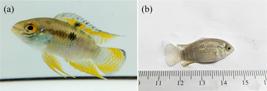
For the experiments, aquariums with a 20-L capacity of water were used, equipped with constant aeration. In the first experiment, 124 juveniles of L. dorsigera (Fig. 1) were used with the average total length of 14.79 ± 0.30 mm. The second experiment used 120 juveniles with the average total length of 17.80 ± 0.30 mm. The animals were randomly distributed between treatments.
During the experimental period, pH and temperature were monitored every two days with the aid of a digital pHmeter, and every four days dissolved oxygen, ammonia, and nitrite were measured using colorimetric kits (Labcon).
Inert feeding, containing 32% CP, was provided daily (once a day, 8 a.m.), based on an average of 20% live weight for each treatment. The siphoning of the experimental units was performed every two days, with 50% of the total water volume changed.
To evaluate the growth curve and weight gain, biometrics of all fish were performed every 15 days. We evaluated the survival rates, total lengths (measured with a digital caliper between the distance from the snout of the fish to the base of the caudal fin), and weights (obtained on a digital scale with an accuracy of 0.001 mm), as well as relative growth rates, according to Eq. 1:
Specific growth rate was calculated by Eq. 2:
Weight gain was calculated by Eq. 3:
The data were submitted to analysis of variance using SISVAR, with the criterion of 5% probability, and the means of the groups were compared using the Tukey’s test.
RESULTS
In both experiments, temperature, dissolved oxygen, ammonia, and pH remained according to the recommended standards for cichlids regardless of the increased densities in the treatments (Table 1). However, the nitrite values showed differences (p < 0.05) in both experiments.
The fish achieved a positive relative growth rate throughout the experimental period, resulting in a difference for this parameter (p = 0.03) in the first experiment, as well as for the final length and weight, RGR length, SGR weight and survival. On the contrary, the initial length, initial weight, and weight gain did not present differences between treatments (p > 0.05). In the second experiment, no differences were observed for the zootechnical parameters evaluated (p > 0.05) (Table 2). The survival rate was different (p = 0.02) for the first experiment, with the best survival obtained in the stocking density of 0.50 fish�L-1, although it did not differ significantly from the highest density of fish (0.75 fish�L-1) (Table 2).
Means (± standard deviation) of the zootechnical indices obtained for juvenile Laetacara dorsigera submitted to different stocking densities (fish�L-1)*.
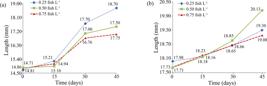
In the first experiment, the average length variation (mm) was not accentuated in the first 15 days, as the fish were still in a period of adaptation to the experimental conditions. However, at the end of the 45 days, the fish presented better growth for the densities tested (Fig. 2a). The second experiment (Fig. 2b) had more linear and continuous length over the 45 days for all treatments, demonstrating that, by decreasing the tested densities, a greater balance in terms of gain and final length can occur.
When analyzing Fig. 3, the densities of 0.25 and 0.30 fish�L-1 showed more constant weight gains during the experimental period. The densities of 0.50 and 0.40 fish�L-1 showed a more pronounced gain between days 15 and 30 of the experiment. This difference in weight resulted in a significant difference (p = 0.03) for the final weight parameter (g) in the first experiment. The higher weight gains observed for both experiments, in the treatments with lower densities (Table 2; Fig. 3), can be directly correlated with the lower survival rates observed for them, since cichlids are known to be territorial and show dominance behavior, in which the larger fish consume more food and gain more weight over time. In the treatment containing 0.25 fish�L-1, the smallest fish had a final weight of 0.20 g (15.73 mm final length), while the largest fish had a final weight of 0.36 g (24.06 mm final length), both from the same repetition. The same can be observed in the treatment containing 0.30 fish�L-1, in which the smallest fish had a final weight of 0.37 g (15.92 mm final length), and the largest fish had a final weight of 0.43 g (22.19 mm final length), also from the same repetition.
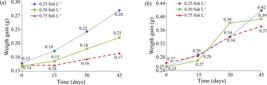
Average weight gain obtained by juvenile Laetacara dorsigera in experiments (a) 1 and (b) 2.
DISCUSSION
Increased nitrite concentration in a production system may be closely linked to increased stocking density and imbalances in ammonia nitrification and denitrification processes (Jensen, 2003; Nagata et al., 2010). Dos Santos (2013) mentioned that nitrite and ammonia are not desirable for aquatic organisms, as they are toxic, and their main sources are the oxidation of ammonia in oxidizing environments and the reduction of nitrate in reducing environments. Piedras et al. (2006) tested the acute toxicity of nitrite in chameleon fingerling (Cichlasoma facetum) in 20-L aquariums and found 45.63% mortality of individuals in 96 h at the concentration of 6.68 mg�L-1 of nitrite. The maximum concentrations found in these experiments were below the rates reported by these authors, as well as those reported by Yanbo et al. (2006). When testing the toxicity of nitrite in tilapia, these authors observed that concentrations above 28.1 mg of NO2�L-1 could cause 50% mortality after 96 h of exposure. Nevertheless, it can be concluded that this parameter did not significantly affect fish growth throughout the experimental period.
The increased stocking density increases oxygen demand. Therefore, its decrease the capacity for development and weight gain. Nevertheless, in the present study, no difference was found in dissolved oxygen that remained above the ideal range for tilapia, which is greater than 4 mg�L-1, according to Kubitza (2011). Despite their origin in the acid waters of the Amazon Basin, the currently more exploited commercial varieties of L. dorsigera stand out for their tolerance to a wide pH range (5.5 to 7.5), reproducing naturally and with good development in these variations (Teresa, 2007), which are values similar to those found here.
Gonçalves Júnior et al. (2013) and Ribeiro et al. (2008) stated that the variables linked to length are more relevant than those related to weight in evaluating the performance and commercial value of ornamental fish. In both experiments, the fish obtained a positive relative growth rate throughout the experimental period, as well as for the final length, RGR%, and SGR weight (Table 2). Similar effects were reported for Carassius auratus, whose performance also worsened as the stocking density increased (Soares et al., 2002). In the second experiment, no significant difference was found, corroborating the results reported by Da Silva et al. (2020) for Mesonauta festivus.
For the survival rate, according to Da Silva et al. (2020) and Tachibana et al. (2008), larger space in the aquariums caused by the lower density causes more conflicts between the fish, leading to less uniformity in the batch due to the establishment of dominance by some individuals. Therefore, the lower survival rate of 0.25 fish�L-1 density may be linked to these territorial disputes, which can cause small injuries to the fish, preventing their feeding and causing deaths, as also reported by Aragon-Flores et al. (2014) for Cichlasoma beani. In production systems, a higher percentage of survival is desired to obtain greater profits. Therefore, this corroborates the possibility that the higher mortality for the first treatment in the first experiment allowed a greater supply of food to the fish and, consequently, greater weight gain.
According to Oliveira et al. (2022), ornamental fish farming success is related to the production of a high number of fish in the smallest space or volume possible. So, owing to the high mortality rate in 0.30 fish�L-1 in the present study, size heterogeneity could not be statistically compared to that in experiment 2, which did not show significant differences between those treatments.
The result of final mean total weight, specific growth rate, and survival in the second experiment were similar to those reported by Nagata et al. (2010), who tested different density levels (0.33, 0.67, and 1.00 fish�L-1) in Pterophyllum scalare and by Zuanon et al. (2004) in juvenile Tricogaster at densities of 0.05, 0.10, and 0.15 fish�L-1. In the work by Soares et al. (2002), the increase in stocking density resulted in worse productive performance for C. auratus.
CONCLUSION
Increasing the stocking density of L. dorsigera in both experiments showed a positive correlation with size and weight performance, without affecting the water quality parameters of the culture. Among the densities evaluated, 0.50 fish�L-1 showed the highest survival during the experimental period, with satisfactory growth rates and weight gain, and it is recommended for rearing under similar conditions.
ACKNOWLEDGMENTS
Not applicable.
-
FUNDING
Universidade Federal do AmazonasGrant No: PIB-A/0205/2021Fundação de Amparo à Pesquisa do Estado do AmazonasGrant no: 005/2022 (POSGRAD 2022/2023)Coordenação de Aperfeiçoamento de Pessoal de Nível SuperiorGrant No. 88887.712141/2022-00
DATA AVAILABILITY STATEMENT
All data sets were generated or analyzed in the current study.
REFERENCES
-
Abe, H. A., Dias, J. A. R., Sousa, N. C., Couto, M. V. S., Reis, R. G. A., Paixão, P. E. G., & Fujimoto, R. Y. (2019). Growth of Amazon ornamental fish Nannostomus beckfordi larvae (Steindachner, 1876) submitted to different stocking densities and feeding management in captivity conditions. Aquaculture Research, 50(8), 2276-2280. https://doi.org/10.1111/are.14108
» https://doi.org/10.1111/are.14108 -
Aragon-Flores, E. A., Valdez-Hernandez, E. F., Martinez-Cardenas, L., Castañeda-Chavez, M. R., Gonzales-Diaz, A. A., Soria-Barreto, M., Ruiz-Velazco, J. M. J., & Peña-Messina, E. (2014). Effect of stocking density on growth, survival, and condition of the Mexican cichlid Cichlasoma beani Journal of the World Aquaculture Society, 45(4), 447-453. https://doi.org/10.1111/jwas.12136
» https://doi.org/10.1111/jwas.12136 - Britski, H. A., Silimon, K. Z. S., & Lopes, B. S. (2007). Peixes do Pantanal: Manual de Identificação (2ª ed.). Embrapa.
- Campagnolo, R., & Nuñer, A. P. O. (2006). Sobrevivência e crescimento de larvas de surubim, Pseudoplatystoma corruscans (Pisces, Pimelodidae), em diferentes densidades de estocagem. Acta Scientiarum, 28(2), 231-237.
-
Cardoso, R. S. (2011). Caracterização da aquicultura ornamental na Zona da Mata Mineira (Masters dissertation, Escola de Veterinária da Universidade Federal de Minas Gerais). Retrieved from https://repositorio.ufmg.br/bitstream/1843/BUOS-8M3JZX/1/disserta__o_renato_silva_cardoso_2011.pdf
» https://repositorio.ufmg.br/bitstream/1843/BUOS-8M3JZX/1/disserta__o_renato_silva_cardoso_2011.pdf -
Da Silva, H. J., da Costa, T. V., Almeida, J. P. C., dos Santos, W. G., Vieira, R. B., & Machado, N. J. B. (2020). Densidade de estocagem de Mesonauta festivus (Heckel, 1840) em cativeiro. Brazilian Journal of Development, 6(3), 15285-15294. https://doi.org/10.34117/bjdv6n3-414
» https://doi.org/10.34117/bjdv6n3-414 -
Dos Santos, M. J. S. (2013). Efeito agudo da amônia e do nitrito em tilápias Oreochromis niloticus mantidas em baixa salinidade (Masters dissertation, Escola de Veterinária da Universidade Federal de Minas Gerais). Retrieved from https://repositorio.ufmg.br/bitstream/1843/BUOS-9LSHK8/1/disserta__o_m_rcio_.pdf
» https://repositorio.ufmg.br/bitstream/1843/BUOS-9LSHK8/1/disserta__o_m_rcio_.pdf -
Ellis, T., Yildiz, H. Y., López-Olmeda, J., Spedicato, M. T., Tort, L., Øverli, Ø., & Martins, C. I. M. (2012). Cortisol and finfish welfare. Fish Physiology and Biochemistry, 38, 163-188. https://doi.org/10.1007/s10695-011-9568-y
» https://doi.org/10.1007/s10695-011-9568-y -
Eschmeyer, W. N., & Fong, J. D. (2013). Genera, species, references California Academy of Sciences. Retrieved from https://researcharchive.calacademy.org/research/ichthyology/catalog/fishcatmain.asp
» https://researcharchive.calacademy.org/research/ichthyology/catalog/fishcatmain.asp -
Gonçalves Júnior, L. P., Pereira, S. L., Matielo, M. D., & Mendonça, P. P. (2013). Efeito da densidade de estocagem no desenvolvimento inicial do acará-bandeira (Pterophyllum scalare). Arquivos Brasileiros de Medicina Veterinária e Zootecnia, 65(4), 1176-1182. https://doi.org/10.1590/S0102-09352013000400033
» https://doi.org/10.1590/S0102-09352013000400033 -
Hoshino, E. M., Hoshino, M. D. F. G., & Tavares-Dias, M. (2018). Parasites of ornamental fish commercialized in Macapá, Amapá State (Brazil). Brazilian Journal of Veterinary Parasitology, 27(1), 74-79. https://doi.org/10.1590/S1984-29612018002
» https://doi.org/10.1590/S1984-29612018002 -
Jensen, F. B. (2003). Nitrite disrupts multiple physiological functions in aquatic animals. Comparative Biochemistry and Physiology Part A: Molecular & Integrative Physiology, 135(1), 9-24. https://doi.org/10.1016/S1095-6433(02)00323-9
» https://doi.org/10.1016/S1095-6433(02)00323-9 -
Junk, W. J., Soares, M. G. M., & Bayley, P. B. (2007). Freshwater fishes of the Amazon River basin: their biodiversity, fisheries, and habitats. Aquatic Ecosystem Health & Management, 10(2), 153-173. https://doi.org/10.1080/14634980701351023
» https://doi.org/10.1080/14634980701351023 - Keenleyside, M. H. (1991). Cichlid fish: behaviour, ecology and evolution (2ª ed.). Springer Science & Business Media.
- Kubitza, F. (2011). Qualidade da água na produção de tilápias. In F. Kubitza (Ed.), Tilápia: Tecnologia e planejamento na produção comercial (pp. 89-93). Kubitza.
- Kullander, S. O. (1986). Cichlid fishes of the Amazon River drainage of Peru Swedish Museum of Natural History.
-
Ladislau, D. S., Ribeiro, M. W. S., Castro, P. D. S., Pantoja-Lima, J., Aride, P. H. R., & Oliveira, A. T. (2021). Ichthyological ethnoknowledge of the “piabeiros” from the Amazon region. Journal of Ethnobiology and Ethnomedicine, 17(1), 42. https://doi.org/10.1186/s13002-021-00468-7
» https://doi.org/10.1186/s13002-021-00468-7 -
Lanés, L. E. K., Maltchik, L., & Lucena, C. A. S. (2010). Pisces, Perciformes, Cichlidae, Laetacara dorsigera (Heckel, 1840): Distribution extension and first record for Uruguay River basin, and state of Rio Grande do Sul, southern Brazil. Check List, 6(1), 116-118. https://doi.org/10.15560/6.1.116
» https://doi.org/10.15560/6.1.116 -
Meijide, F. J., & Guerrero, G. A. (2000). Embryonic and larval development of a substrate-brooding cichlid Cichlasoma dimerus (Heckel, 1840) under laboratory conditions. Journal of Zoology, 252(4), 481-493. http://doi.org/10.1111/j.1469-7998.2000.tb01231.x
» https://doi.org/10.1111/j.1469-7998.2000.tb01231.x - Nagata, M. M., Takahashi, L. S., Gimbo, R. Y., Kojima, J. T., & Biller, J. D. (2010). Influência da densidade de estocagem no desempenho produtivo do acará-bandeira (Pterophyllum scalare). Boletim do Instituto de Pesca, 36(1), 9-16.
-
Oliveira, L. C. C., Silveira, B. G., Nascimento, E. T. S., Eiras, B. J. C. F., Moura, L. B., Salaro, A. L., Cordeiro, C. A. M., & Campelo, D. A. V. (2022). Salinized water as a strategy for increase stocking density in Heros severus larviculture, an Amazonian ornamental fish. Boletim do Instituto de Pesca, 48, e742. https://doi.org/10.20950/1678-2305/bip.2022.48.e742
» https://doi.org/10.20950/1678-2305/bip.2022.48.e742 -
Ottoni, F. P., & Costa, W. J. E. M. (2009). Description of a new species of Laetacara Kullander, 1986 from central Brazil and re-description of Laetacara dorsigera (Heckel, 1840) (Labroidei: Cichlidae: Cichlasomatinae). Vertebrate Zoology, 59(1), 41-48. http://doi.org/10.3897/vz.59.e30946
» https://doi.org/10.3897/vz.59.e30946 -
Ottoni, F. P., Bragança, P. H. N., Amorim, P. F., & Gama, C. S. (2012). A new species of Laetacara from the northern Brazil coastal floodplains (Teleostei: Cichlidae). Vertebrate Zoology, 62(2), 181-188. http://doi.org/10.3897/vz.62.e31385
» https://doi.org/10.3897/vz.62.e31385 -
Piedras, S. R. N., Oliveira, J. L. R., Moraes, P. R. R., & Bager, A. (2006). Toxicidade aguda da amônia não ionizada e do nitrito em alevinos de Cichlasoma facetum (Jenyns, 1842). Ciência e Agrotecnologia, 30(5), 1008-1012. https://doi.org/10.1590/S1413-70542006000500027
» https://doi.org/10.1590/S1413-70542006000500027 -
Raja, K., Aanand, S., Padmavathy, S., & Sampathkumar, J. S. (2019). Present and future market trends of Indian ornamental fish sector. International Journal of Fisheries and Aquatic Studies, 7(2), 6-15. Retrieved from https://www.researchgate.net/publication/331714670
» https://www.researchgate.net/publication/331714670 -
Ribeiro, F. D. A. S., Carvalho Junior, J., Fernandes, J. B. K., & Nakayama, L. (2008). Comércio brasileiro de peixes ornamentais. Panorama da Aquicultura, 110, 54-59. Retrieved from https://www.researchgate.net/publication/313904504_Comercio_Brasileiro_de_Peixes_Ornamentais
» https://www.researchgate.net/publication/313904504_Comercio_Brasileiro_de_Peixes_Ornamentais -
Sahoo, S. K., Giri, S. S., Chandra, S., & Sahu, A. K. (2010). Stocking density-dependent growth and survival of Asian sun catfish, Horabagrus brachysoma (Gunther 1861) larvae. Journal of Applied Ichthyology, 26(4), 609-611. https://doi.org/10.1111/j.1439-0426.2010.01473.x
» https://doi.org/10.1111/j.1439-0426.2010.01473.x -
Soares, C. M., Hayashi, C., Meurer, F., & Schamber, C. R. (2002). Efeito da densidade de estocagem do quinguio, Carassius auratus L., 1758 (Osteichthyes, Cyprinidae), em suas fases iniciais de desenvolvimento. Acta Scientiarum, 24(2), 527-532. https://doi.org/10.4025/actascibiolsci.v24i0.2354
» https://doi.org/10.4025/actascibiolsci.v24i0.2354 -
Steinhäuser, J. M. (2017). Geographical distribution of Neotropical Cichlid fishes (Teleostei: Cichlidae) in the Rio de la Plata (Paraná, Uruguay and Paraguay) basin. International Cichlid Research and Conservation, 1, 1-40. Retrieved from http://www.international-cichlids.org/download/cichlidae_distribution_maps_sa_parana_17_08.pdf
» http://www.international-cichlids.org/download/cichlidae_distribution_maps_sa_parana_17_08.pdf - Tachibana, L., Leonardo, A. F. G., Corrêa, C. F., & Saes, L. A. (2008). Densidade de estocagem de pós-larvas de tilápia-do-nilo (Oreochromis niloticus) durante a fase de reversão sexual. Boletim do Instituto de Pesca, 34(4), 483-488.
- Teletchea, F. (2019). Ornamental fish trade: Overview and emerging questions. Infofish International, 5(1), 8-11.
-
Teresa, F. B. (2007). Comportamento reprodutivo e cooperação no ciclídeo neotropical Laetacara sp (Masters dissertation, Instituto de Biociências, Letras e Ciências Exatas da Universidade Estadual Paulista “Júlio de Mesquita Filho”). Retrieved from https://repositorio.unesp.br/handle/11449/87586
» https://repositorio.unesp.br/handle/11449/87586 -
Yanbo, W., Wenju, Z., Weifen, L., & Zirong, X. (2006). Acute toxicity of nitrite on tilapia (Oreochromis niloticus) at different external chloride concentrations. Fish Physiology and Biochemestry, 32, 49-54. https://doi.org/10.1007/s10695-005-5744-2
» https://doi.org/10.1007/s10695-005-5744-2 -
Zuanon, J. A. S., Assano, M., & Fernandes, J. B. K. (2004). Performance of tricogaster (Trichogaster trichopterus) submitted to different feeding levels and stocking densities. Revista Brasileira de Zootecnia, 33(6 Suppl. 1), 1639-1645. https://doi.org/10.1590/S1516-35982004000700001
» https://doi.org/10.1590/S1516-35982004000700001
Edited by
-
Section editor:
Fabiana Garcia https://orcid.org/0000-0002-2897-2898


