 Seasonal variation in the ingestion of anthropogenic particles by Mylossoma duriventre in the Juruá River Valley, state of Acre, Brazil
ABSTRACT
This study aimed to investigate the seasonal variation in the presence of plastic fragments in the digestive system of Mylossoma duriventre, a species that is both abundant and commercially significant in the Juruá River Valley, state of Acre, Brazil. Two collections were conducted, the first in March 2024 and the second in July-August 2024, in the municipality of Cruzeiro do Sul, state of Acre. Our findings indicated that hydroclimatic factors play a crucial role in the occurrence of microplastics in M. duriventre, with a notable increase in fiber ingestion during the high-water period. These results contribute to a deeper understanding of the environmental risks associated with microplastics and highlight their biological consequences. In addition, this study aimed to raise awareness of the urgent need to reduce plastic usage and implement responsible waste disposal practices.
Keywords
Juruá Valley; Environmental waste; Acre
RESUMO
O presente estudo teve como objetivo analisar a diferença sazonal da quantidade de fragmentos plásticos no sistema digestório de espécimes de Mylossoma duriventre, uma espécie de grande abundância e valor comercial no Vale do Juruá, Acre, Brasil. Foram realizadas duas coletas, sendo a primeira em março de 2024 e a segunda em julho-agosto de 2024, no município de Cruzeiro do Sul, Acre. Pudemos observar que as características hidroclimáticas favorecem a ocorrência de partículas antropogênicas na espécie M. duriventre, sobretudo durante o período de inundação. Os resultados obtidos visam contribuir para um melhor entendimento dos riscos associados à presença de microplásticos no meio, bem como destacar suas consequências ambientais e biológicas, promovendo a conscientização sobre a importância da redução do uso de plásticos e da implementação de práticas de descarte responsáveis.
Palavras-chave
Vale do Juruá; Resíduo ambiental; Acre
INTRODUCTION
Contamination by anthropogenic particles is an emerging and persistent phenomenon that threatens aquatic ecosystems, including those in neotropical freshwater environments. In the Amazon region, which has the largest river basin in the world, this problem reaches critical proportions owing to variations in the hydrological cycle, high biodiversity, and increasing human activity (Barletta & Lima, 2019; Pegado et al., 2018).
For example, several studies have found plastic particles in the digestive tracts of Amazonian fish during periods of extreme drought and flooding, suggesting widespread contamination regardless of the water regime (Dantas-Filho et al., 2023; Eppehimer et al., 2021; Lahon & Handique, 2023; Pegado et al., 2018). Hydrological variation can directly influence the mobilization and redistribution of microplastics in rivers by resuspending contaminated sediments, thereby increasing the risk of ingestion by fish (Blettler et al., 2018; Zhang et al., 2023). In addition, feeding behavior, habitat use, and fish morphology can influence exposure to plastic particles, as evidenced by Cardozo et al. (2023) and Ossa-Yepes et al. (2025), who highlighted seasonal and interspecific differences in plastic ingestion by carnivorous fish from Neotropical floodplains.
Some review studies and meta-analyses have also indicated that areas impacted by fishing and urban activities may have a greater accumulation of plastic fragments, which affect both benthic and pelagic fish (Gündoğdu et al., 2024; Hossain & Olden, 2022). These contaminants can reach the early stages of the trophic chain, as demonstrated by studies on ichthyoplankton (Dantas-Filho et al., 2023), highlighting the extent of plastic contamination in river systems.
Mylossoma duriventre, belonging to the Characiformes order and Serrasalmidae family, is a widely distributed fish in the Amazon basin and is recognized for its ecological and commercial importance (Lopes et al., 2016; Pelegrini et al., 2024). Due to its detritivorous and frugivorous habits, this species plays an essential role in nutrient cycling and seed dispersal in flooded areas, particularly during high-water periods (Correa et al., 2016; Goulding, 1980). Furthermore, M. duriventre is one of the main species caught by artisanal fishing. It is valued by the riverside population for consumption and local marketing, which contributes to food security and the regional economy (Cerdeira et al., 2000; Ferreira et al., 2007). This species can also be considered a bioindicator of environmental quality as its wide distribution and feeding habits make it vulnerable to the bioaccumulation of pollutants and infection by parasites in impacted environments (Pegado et al., 2018; Pelegrini et al., 2024).
Therefore, studying the relationship between the hydrological cycle and the ingestion of anthropogenic particles by economically important Amazonian species, such as M. duriventre, is essential for generating data that can inform studies on the contamination, management, and conservation of aquatic environments.
This study aimed to evaluate the occurrence, characteristics, and influence of the hydrological cycle on the ingestion of anthropogenic particles by M. duriventre in the Juruá River Valley, in the state of Acre, Brazil. Specifically, this study sought to verify the presence and quantity of anthropogenic particles in the gastrointestinal tract of M. duriventre during low- and high-water periods, characterize the particles in terms of morphology (fibers or granules), size, and color, and correlate the number of anthropogenic particles with biometric variables of the fish, such as total length, weight, and condition factor.
MATERIAL AND METHODS
Study area
The study was conducted in the Upper Juruá region, Western Amazonia, around the municipality of Cruzeiro do Sul, state of Acre, Brazil (07°37’52”S and 72°40’12”W). Fish samples were purchased at the Resene de Souza Lima Municipal Fish Market, whose fish comes from the Juruá River, one of the main tributaries of the right bank of the Amazon River, and the Juruá Valley, which bathes the states of Acre and Amazonas, in Brazil.
Data collection
The samples from the municipal fish market were obtained through purchases and donations. They corresponded to 54 specimens of M. duriventre, 27 during the low-water period and 27 during the high-water period. These were transported in a thermal case with ice to the Aquatic Ecology Laboratory at the Universidade Federal do Acre to store and record data such as photography, measurements such as total and standard length (cm), and weight (mg).
Following the protocol described by Albuquerque (2019), the fish were necropsied using scissors, scalpels, and tweezers, which were washed with distilled water to avoid possible contamination from the environment. Thus, the gastrointestinal contents of each fish specimen were separated and washed over a 0.075-μm mesh sieve to remove excess organic matter. The contents of the washed gastrointestinal tract of M. duriventre were placed in glass Petri dishes lined with glass fiber filters (porosity from 1 to 1.2 µm) and then identified with the numbers and species. Subsequently, another layer of filter paper was added to cover the washed material, absorb excess liquid, and prevent it from contamination by anthropogenic particles from the laboratory. Soon after, the Petri dishes were placed in the oven at temperatures ranging from 55 to 63°C for 48 hours. After the resting period, the Petri dishes were analyzed using an optical stereoscope (Leica DM1000), with magnification between 10 and 100×, according to the method established by Boerger et al. (2010).
The shapes of the anthropogenic particles were identified as fibers (fine, elongated particles), fragments (irregularly shaped particles with a rough surface), and films (fine, flat particles). In addition, microplastics were categorized by size into three classes: ≤ 1, 1.1–3, and 3.1–5 mm, with particles larger than 5 mm being excluded from the analysis (Bessa et al., 2019). The size of the microplastic particles was determined on a μm scale using the IMAGEJ software. The gastrointestinal contents were removed using washed latex gloves to avoid possible airborne contamination of synthetic microplastic fibers. The Petri dishes were washed with distilled water, and the filters with 70% alcohol.
To ensure the reliability of the results in the analysis of anthropogenic particles, strict contamination control measures were adopted at all stages of the process, from collection to laboratory analysis. Among the main recommended precautions, there are:
-
The use of cotton clothing and protective equipment to prevent the release of synthetic fibers by the researchers themselves;
-
Careful cleaning of all materials and utensils with filtered or distilled water;
-
Carrying out the analyses in controlled environments, such as laminar flow hoods, to minimize the deposition of airborne particles;
-
The inclusion of blank samples (procedural blanks) that allow the identification and quantification of possible sources of contamination during processing (Hermsen et al., 2018).
Statistical analysis
The Wilcoxon test was employed to check for differences in the number of anthropogenic particles between M. duriventre specimens. This test was adopted because the dependent samples did not present a normal distribution. The host’s standard length (Ls) and weight (Wt) values were adjusted to the Wt/Ls relationship curve (Wt = a × Lsb), and the regression coefficients a and b were estimated. The values of a and b were used to estimate the expected weight values (We), using Eq. 1:
In this way, the relative condition factor (Kn) was calculated, which corresponds to the quotient between observed weight and expected weight for a given length (Kn = Wt/We) (Le Cren, 1951).
A Kruskal-Wallis’ test was run to test for differences in the number of microplastic fragments by color in the gastrointestinal content of M. duriventre individuals. The Cochran test was used to verify the homogeneity of variances (Quinn & Keough, 2002). Spearman’s correlation coefficient (rs) was calculated to estimate the relationship between the number of microplastics and the weight, length, and condition factor of the fish; p-value was calculated for the r-value to measure significance. Statistical analyses were performed using R 3.6.1 software.
RESULTS
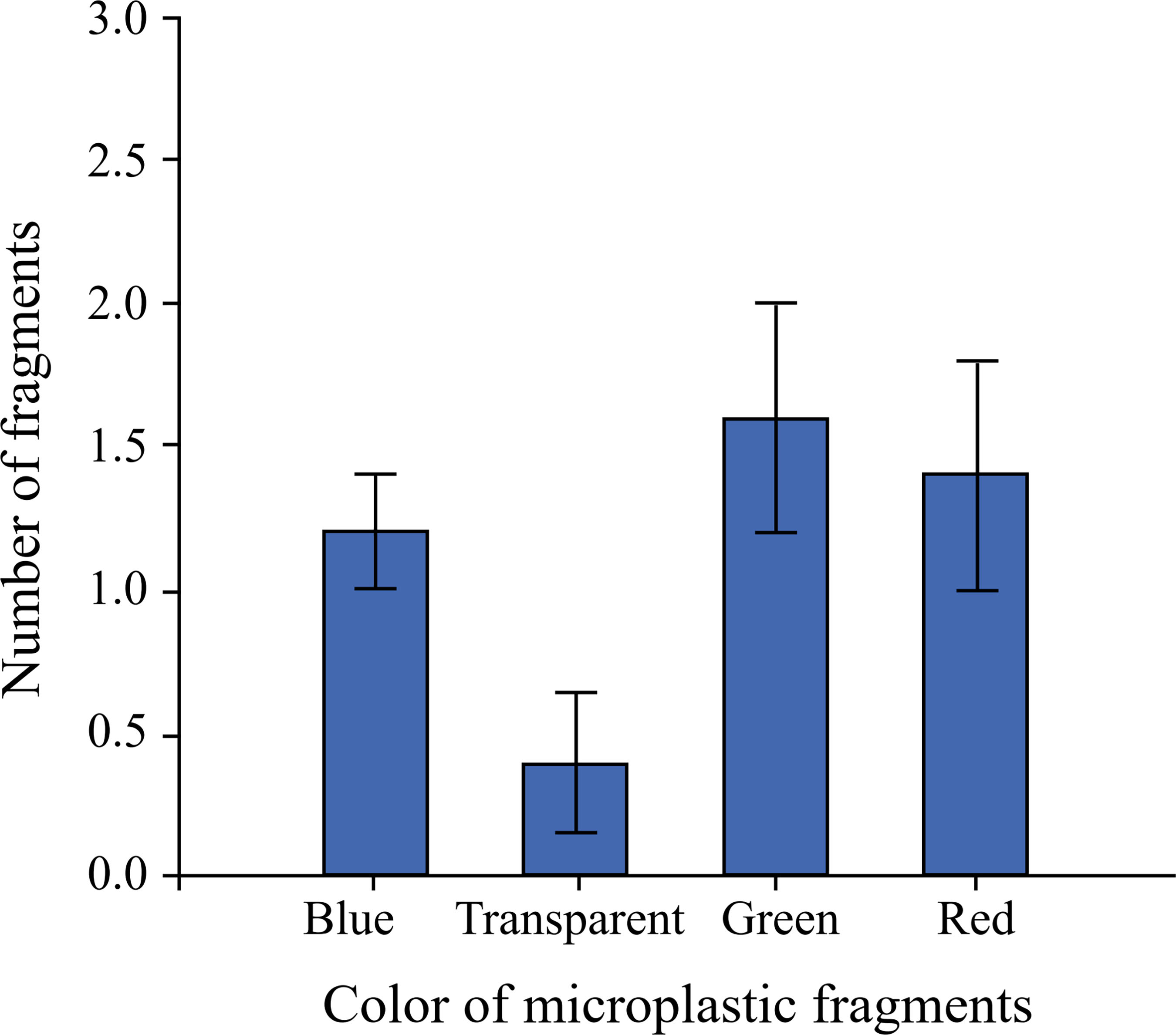
Fifty-four specimens of M. duriventre were evaluated, 27 during the low-water period and 27 during the high-water period. Anthropogenic particles were found in the low-water specimens. During the high-water period, 16 specimens showed an average of 2 ± 0.8 anthropogenic particle fragments, with 14 individuals presenting anthropogenic particle fragments as fibers and two as granules. There was a difference in the number of anthropogenic particle fragments between the M. duriventre individuals (W = 136; p = 0.00001). The size of the fragments varied between 1.42 and 4.49 µm (W = 112; p = 0.001), with the population having an average of 2.2 ± 2.1 µm. Regarding coloration, most individuals of M. duriventre presented green and red colored fragments, while the presence of transparent anthropogenic particles was significantly lower (H = 7.8; p = 0.04) (Fig. 1).

Mean and standard deviation of anthropogenic particles found in the gastrointestinal content of Mylossoma duriventre specimens in the Juruá Valley, Cruzeiro do Sul, state of Acre, Brazil.
There was a correlation between fish length and the number of anthropogenic particles (rs = 0.49, p = 0.001). However, there was no relationship between fish weight (rs = -0.31, p = 0.12) and the condition factor (rs = 0.35, p = 0.08) with the number of anthropogenic particles found.
DISCUSSION
The present study demonstrated the presence of anthropogenic particles in the gastrointestinal contents of M. duriventre only during the high-water period. During this period, differences in the quantity of anthropogenic particles, primarily fibers, were observed among specimens. Studies suggest that the ingestion of anthropogenic particles by fish may increase during the high-water period in the Amazon, as suspended sediments can redistribute these particles, especially synthetic fibers, in the water column and in floodplain areas used as feeding grounds by fish (Hurley et al., 2018; Lahon & Handique, 2023). Furthermore, research suggests that the high turbidity associated with flooding can cause fish to mistake these particles for natural food sources (Eppehimer et al., 2021), particularly in species such as M. duriventre. During periods of high water, this species tends to adopt a more generalist diet, consuming greater quantities of fruit, seeds, and allochthonous plant debris (Azevedo et al., 2022; Melo et al., 2019).
In this case, the largest quantity of anthropogenic particles in the stomach contents of M. duriventre individuals was in the form of fibers, contributing to studies on microplastics in tropical environments. These studies indicate that fibers are the predominant form of anthropogenic particles in these systems, representing up to 56.9% of the identified particles (Ganie et al., 2024; James et al., 2022). The abundance of fibers in these environments may be associated with the disposal of inadequately treated domestic effluents. Many Amazonian cities and tropical regions have poor sanitation systems that contaminate the aquatic environment with synthetic fibers such as polyester, nylon, and acrylic, which are mainly released during the washing of clothes (Ganie et al., 2024; Rodrigues et al., 2019). The opportunistic behavior of this species during flooding increases the probability of accidental ingestion of anthropogenic particles present in the environment. Thus, the combination of physicochemical changes in water and changes in the diet of M. duriventre during the high-water period may have contributed to the increased exposure to this emerging contaminant.
The present study also demonstrated the predominance of green and red colors among the anthropogenic particles identified in the gastrointestinal tract of M. duriventre. Studies suggest that green fibers are commonly associated with fishing lines, nets, and nylon ropes, which are widely used by riverside communities. In contrast, red fibers generally originate from raffia bags, plastic tapes, and food packaging that have been discarded in the environment (James et al., 2022; Sacco et al., 2024). These colors were not commonly found in the fibers evaluated in previous studies on anthropogenic particles in Amazonian fish. The most frequently reported colors in these studies were blue, transparent, white, and black (Ganie et al., 2024; Köktürk et al., 2024; Rodrigues et al., 2019). However, McNeish et al. (2018) and Nie et al. (2019) observed green and red particles in freshwater fish and associated them with fishing activity and domestic waste. These findings suggest a regional origin for anthropogenic fragments and reinforce the need for waste management policies targeting fishing practices and packaging disposal in the Amazon.
Furthermore, the anthropogenic particles found in M. duriventre were smaller than 5 µm in size. A study on serrasalmid fish species (Andrade et al., 2019) also recorded the ingestion of microplastics of similar size. The presence of such small particles is relevant from an ecotoxicological perspective, as microplastics with diameters smaller than 5 µm can cross intestinal barriers and accumulate in internal tissues, such as the liver and muscles, adversely affecting fish health (Morais et al., 2024; Souza et al., 2023). Other studies have indicated that the ingestion of microscopic anthropogenic particles is associated with intestinal inflammation, physiological changes, and oxidative stress in Amazonian species (Costa et al., 2023; Pegado et al., 2018).
Finally, a relationship was found between the body length of M. duriventre individuals and the number of ingested microplastic fragments. This suggests that larger fish tend to accumulate more particles. Some studies have reported an association between increased fish length and a greater abundance of anthropogenic particles in the organisms’ gastrointestinal contents (McNeish et al., 2018; Munno et al., 2022). This pattern may reflect greater ingestion and accumulation capacity in larger organisms, as well as a lower elimination rate.
CONCLUSIONS
Our findings suggested that M. duriventre ingests anthropogenic particles, particularly during the high-water period. The predominance of green and red fibers reveals a strong influence of local human activities, such as the use of fishing gear and improper packaging disposal. The identification of particles smaller than 5 µm indicates potential risks to fish health because these particles can cross biological barriers and accumulate them in the internal tissues. The correlation between fish length and the number of ingested particles shows that morphological characteristics may influence ingestion. Although no relationships with fish weight or condition factor were observed, the data reinforce the reality of contamination by anthropogenic particles already present in the Amazonian fish fauna. Considering the ecological, social, and economic value of M. duriventre, this study underscores the urgent need for environmental management strategies to mitigate plastic pollution. Future investigations should integrate ecological, toxicological, and socioenvironmental approaches to improve our understanding of the cumulative effects of these stressors on tropical ecosystems.
ACKNOWLEDGMENTS
Not applicable.
-
DECLARATION OF USE OF ARTIFICIAL INTELLIGENCE TOOLS
We declare that no artificial intelligence was used at any stage of the development of this work and/or in the production of the manuscript.
-
FUNDING
Not applicable.
DATA AVAILABILITY STATEMENT
Data will be available upon request to the authors.
REFERENCES
-
Albuquerque, P. S. (2019). Avaliação da incidência de plástico em conteúdo estomacal de tainhas (Mugil liza, Valenciennes, 1836) capturadas na Lagoa da Conceição, Ilha de Santa Catarina [TCC]. Universidade Federal de Santa Catarina. https://repositorio.ufsc.br/handle/123456789/197549
» https://repositorio.ufsc.br/handle/123456789/197549 -
Andrade, M. C., Winemiller, K. O., Barbosa, P. S., Fortunati, A., Chelazzi, D., Cincinelli, A., & Giarrizzo, T. (2019). First account of plastic pollution impacting freshwater fishes in the Amazon: Ingestion of plastic debris by piranhas and other serrasalmids with diverse feeding habits. Environmental Pollution, 244, 766-773. https://doi.org/10.1016/j.envpol.2018.10.088
» https://doi.org/10.1016/j.envpol.2018.10.088 -
Azevedo, L. S., Pestana, I. A., Almeida, G. M., & Souza, C. M. M. (2022). Do fish isotopic niches change in an Amazon floodplain lake over the hydrological regime? Ecology of Freshwater Fish, 31, 72-80. https://doi.org/10.1111/eff.12609
» https://doi.org/10.1111/eff.12609 -
Barletta, M., & Lima, A. R. A. (2019). Systematic review of fish ecology and anthropogenic impacts in South American estuaries: setting priorities for ecosystem conservation. Frontiers in Marine Science, 6, 237. https://doi.org/10.3389/fmars.2019.00237
» https://doi.org/10.3389/fmars.2019.00237 -
Bessa, F., Frias, J., Kögel, T., Lusher, A., Andrade, J., Antunes, J. C., Sobral, P., Pagter, E., Nash, R., O’Connor, I., Pedrotti, M. L., Keros, E., León, V. M., Tirelli, V., Suaria, G., Lopes, C., Raimundo, J., … Gerdts, G. (2019). Harmonized protocol for monitoring microplastics in biota. JPI-Oceans BASEMAN project 30pp. https://doi.org/10.13140/RG.2.2.28588.72321/1
» https://doi.org/10.13140/RG.2.2.28588.72321/1 -
Blettler, M. C. M., Abrial, E., Khan, F. R., Sivri, N., & Espinola, L. A. (2018). Freshwater plastic pollution: Recognizing research biases and identifying knowledge gaps. Water Research, 143, 416-424. https://doi.org/10.1016/j.watres.2018.06.015
» https://doi.org/10.1016/j.watres.2018.06.015 -
Boerger, C. M., Lattin, G. L., Moore, S. L., & Moore, C. J. (2010). Plastic ingestion by planktivorous fishes in the North Pacific Central Gyre. Marine Pollution Bulletin, 60(12), 2275-2278. https://doi.org/10.1016/j.marpolbul.2010.08.007
» https://doi.org/10.1016/j.marpolbul.2010.08.007 -
Cardozo, A. L. P., Yofukuji, K. Y., Silva Júnior, R. C., Castro-Hoshino, L. V., & Fugi, R. (2023). Plastic ingestion by carnivore fish in a neotropical floodplain: seasonal and interspecific variations. Environmental Science and Pollution Research, 30(14), 40712-40723. https://doi.org/10.1007/S11356-023-25135-0
» https://doi.org/10.1007/S11356-023-25135-0 -
Cerdeira, R. G. P., Ruffino, M. L., & Isaac, V. J. (2000). Fish catches among riverside communities around Lago Grande de Monte Alegre, Lower Amazon, Brazil. Fisheries Management and Ecology, 7(4), 355-373. https://doi.org/10.1046/j.1365-2400.2000.007004355.x
» https://doi.org/10.1046/j.1365-2400.2000.007004355.x -
Correa, S. B., Araujo, J. K., Penha, J., Nunes da Cunha, C., Bobier, K. E., & Anderson, J. T. (2016). Stability and generalization in seed dispersal networks: a case study of frugivorous fish in neotropical wetlands. Proceedings of the Royal Society B: Biological Sciences, 283(1837), 20161267. https://doi.org/10.1098/rspb.2016.1267
» https://doi.org/10.1098/rspb.2016.1267 -
Costa, I. D., Costa, L., Oliveira, A. S., Carvalho, C. E. V., & Zalmon, I. R. (2023). Microplastics in fishes in amazon riverine beaches: Influence of feeding mode and distance to urban settlements. Science of The Total Environment, 863(6), 160934. https://doi.org/10.1016/j.scitotenv.2022.160934
» https://doi.org/10.1016/j.scitotenv.2022.160934 -
Dantas-Filho, J. V., Pedroti, V. P., Santos, B. L. T., Pinheiro, M. M. L., Mira, A. B., Silva, F. C., Silva, E. C. S., Cavali, J., Guedes, E. A. C., & Schons, S. V. (2023). First evidence of microplastics in freshwater from fish farms in Rondônia State, Brazil. Heliyon, 9(4), e15066. https://doi.org/10.1016/j.heliyon.2023.e15066
» https://doi.org/10.1016/j.heliyon.2023.e15066 -
Eppehimer, D. E., Hamdhani, H., Hollien, K. D., Nemec, Z. C., Lee, L. N., Quanrud, M. D., & Bogan, M. (2021). Impacts of baseflow and flooding on microplastic pollution in an effluent-dependent arid land river in the USA. Environmental Science and Pollution Research, 28, 45375-45389. https://doi.org/10.1007/s11356-021-13724-w
» https://doi.org/10.1007/s11356-021-13724-w -
Ferreira, E. J. G., Zuanon, J. A. S., Forsberg, B. R., Goulding, M., & Briglia-Ferreira, S. R. (2007). Rio Branco: peixes, ecologia e conservação de Roraima Amazon Conservation Association, Instituto Nacional de Pesquisas da Amazônia, Sociedade Civil Mamirauá. https://repositorio.inpa.gov.br/handle/1/36035
» https://repositorio.inpa.gov.br/handle/1/36035 -
Ganie, Z. A., Mandal, A., Arya, L., Sangeetha, T., Talib, M., & Darbha, G. K. (2024). Assessment and accumulation of microplastics in the Indian riverine systems: Risk assessment and implications of translocation across the water-to-fish continuum. Aquatic Toxicology, 272, 106944. https://doi.org/10.1016/j.aquatox.2024.106944
» https://doi.org/10.1016/j.aquatox.2024.106944 -
Goulding, M. (1980). The fishes and the forest: explorations in Amazonian natural history University of California Press, Berkeley, California. Reviewed by Prance, G. T., Reeves, T., Lipp, F. J., Funk, V. A. (1981). Book reviews. Brittonia, 33, 257-260. https://doi.org/10.2307/2806336
» https://doi.org/10.2307/2806336 -
Gündoğdu, S., Bour, A., Köşker, A. R., Walther, B. A., Napierska, D., Mihai, F. C., Syberg, K., Hansen, S. F., & Walker, T. (2024). Review of microplastics and chemical risk posed by plastic packaging on the marine environment to inform the Global Plastics Treaty. Science of the Total Environment, 946, 174000. https://doi.org/10.1016/j.scitotenv.2024.174000
» https://doi.org/10.1016/j.scitotenv.2024.174000 -
Hermsen, E., Mintenig, S. M., Besseling, E., & Koelmans, A. A. (2018). Quality criteria for the analysis of microplastic in biota samples: a critical review. Environmental Science & Technology, 52(18), 10230-10240. https://doi.org/10.1021/acs.est.8b01611
» https://doi.org/10.1021/acs.est.8b01611 -
Hossain, M. A. R., & Olden, J. D. (2022). Global meta‐analysis reveals diverse effects of microplastics on freshwater and marine fishes. Fish and Fisheries, 23(6), 1439-1454. https://doi.org/10.1111/faf.12701
» https://doi.org/10.1111/faf.12701 -
Hurley, R., Woodward, J., & Rothwell, J. J. (2018). Microplastic contamination of river beds significantly reduced by catchment-wide flooding. Nature Geoscience, 11(4), 251-257. https://doi.org/10.1038/s41561-018-0080-1
» https://doi.org/10.1038/s41561-018-0080-1 -
James, K., Kripa, V., Vineetha, G., Padua, S., Prema, D., Abhilash, K. S., Babu, A., John, S., John, S., Lavanya, R., & Joseph, R. V. (2022). Microplastics in the environment and in commercially significant fishes of mud banks, an ephemeral ecosystem formed along the southwest coast of India. Environmental Research, 204(Part D), 112351. https://doi.org/10.1016/j.envres.2021.112351
» https://doi.org/10.1016/j.envres.2021.112351 -
Köktürk, M., Özgeriş, F. B., Atamanalp, M., Uçar, A., Özdemir, S., Parlak, V., Duyar, H. A., & Alak, G. (2024). Microplastic-induced oxidative stress response in turbot and potential intake by humans. Drug and Chemical Toxicology, 47(3), 296-305. https://doi.org/10.1080/01480545.2023.2168690
» https://doi.org/10.1080/01480545.2023.2168690 -
Lahon, J., & Handique, S. (2023). Impact of flooding on microplastic abundance and distribution in freshwater environment: a review. Environmental Science and Pollution Research, 30(56), 118175-118191. https://doi.org/10.1007/s11356-023-30819-8
» https://doi.org/10.1007/s11356-023-30819-8 -
Le Cren, E. D. (1951). The length-weight relationship and seasonal cycle in gonad weight and condition in the perch (Perca fluviatilis). Journal of Animal Ecology, 20(2), 201-219. https://doi.org/10.2307/1540
» https://doi.org/10.2307/1540 -
Lopes, G. C. S., Catarino, M. F., Lima, A. C., & Freitas, C. E. C. (2016). Small-Scale Fisheries in the Amazon Basin: general patterns and diversity of fish landings in five sub-basins. Boletim do Instituto de Pesca, 42(4), 889-900. https://doi.org/10.20950/1678-2305.2016v42n4p889
» https://doi.org/10.20950/1678-2305.2016v42n4p889 -
McNeish, R. E., Kim, L. H., Barrett, H. A., Mason, S. A., Kelly, J. J., & Hoellein, T. J. (2018). Microplastic in riverine fish is connected to species traits. Scientific Reports, 8(1), 11639. https://doi.org/10.1038/s41598-018-29980-9
» https://doi.org/10.1038/s41598-018-29980-9 -
Melo, T., Torrente-Vilara, G., & Röpke, C. P. (2019). Flipped reducetarianism: A vegan fish subordinated to carnivory by suppression of the flooded forest in the Amazon. Forest Ecology and Management, 435, 138-143. https://doi.org/10.1016/j.foreco.2018.12.050
» https://doi.org/10.1016/j.foreco.2018.12.050 -
Morais, L. M. S., Queiroz, A. F. D. S., Brito, B. K. F., Fenzl, N., Soares, M. O., Giarrizzo, T., & Martinelli Filho, J. E. (2024). Microplastics in the Amazon biome: State of the art and future priorities. Heliyon, 10(7), e28851. https://doi.org/10.1016/j.heliyon.2024.e28851
» https://doi.org/10.1016/j.heliyon.2024.e28851 -
Munno, K., Helm, P. A., Rochman, C., George, T., & Jackson, D. A. (2022). Microplastic contamination in Great Lakes fish. Conservation Biology, 36(1), e13794. https://doi.org/10.1111/cobi.13794
» https://doi.org/10.1111/cobi.13794 -
Nie, H., Wang, J., Xu, K., Huang, Y., & Yan, M. (2019). Microplastic pollution in water and fish samples around Nanxun Reef in Nansha Islands, South China Sea. Science of The Total Environment, 696, 134022. https://doi.org/10.1016/j.scitotenv.2019.134022
» https://doi.org/10.1016/j.scitotenv.2019.134022 -
Ossa-Yepes, M., Ríos-Pulgarín, M. I., Villabona-González, S. L., Zapata-Vahos, I. C., Martínez, F. A., Barletta, M. (2025). Microplastics and other anthropogenic particles contamination and their potential trophic transfer in a tropical Andean reservoir, Colombia. Hydrobiologia, 1-20. https://doi.org/10.1007/s10750-025-05899-x
» https://doi.org/10.1007/s10750-025-05899-x -
Pegado, T. S. S., Schmid, K., Winemiller, K. O., Chelazzi, D., Cincinelli, A., Dei, L., & Giarrizzo, T. (2018). First evidence of microplastic ingestion by fishes from the Amazon River estuary. Marine Pollution Bulletin, 133, 814-821. https://doi.org/10.1016/j.marpolbul.2018.06.035
» https://doi.org/10.1016/j.marpolbul.2018.06.035 -
Pelegrini, L. S., Ramos, K. F., Silva, R. J., & Anjos, M. R. (2024). Diversity and similarity in parasitic infracommunities of Mylossoma aureum and Mylossoma duriventre (Characiformes, Serrasalmidae) from the middle Madeira River Basin, Southern Amazonas, Brazil. Boletim do Instituto de Pesca, 50, e807. https://doi.org/10.20950/1678-2305/bip.2024.50.e807
» https://doi.org/10.20950/1678-2305/bip.2024.50.e807 -
Quinn, G. P., & Keough, K. J. (2002). Experimental design and data analysis for biologists. Cambridge University Press. https://doi.org/10.1017/CBO9780511806384
» https://doi.org/10.1017/CBO9780511806384 -
Rodrigues, S. M., Almeida, C. M. R., Silva, D., Cunha, J., Antunes, C., Freitas, V., & Ramos, S. (2019). Microplastic contamination in an urban estuary: Abundance and distribution of microplastics and fish larvae in the Douro estuary. Science of The Total Environment, 659, 1071-1081. https://doi.org/10.1016/j.scitotenv.2018.12.273
» https://doi.org/10.1016/j.scitotenv.2018.12.273 -
Sacco, V. A., Zuanazzi, N. R., Selinger, A., Costa, J. H. A., Lemunie, E. S., Comelli, C. L., Abiloa, V., Souza, F. C., Fávaro, L. F., Mendoza, L. M. R., Ghisi, N. C., & Deliriva, R. L. (2024). What are the global patterns of microplastic ingestion by fish? A scientometric review. Environmental Pollution, 350, 123972. https://doi.org/10.1016/j.envpol.2024.123972
» https://doi.org/10.1016/j.envpol.2024.123972 -
Souza, M. T. V., Sales-Shimomoto, V., Silva, G. S., & Val, A. L. (2023). Microplastics and the Amazon: from the rivers to the estuary. Química Nova, 46(6), 655-667. https://doi.org/10.21577/0100-4042.20230066
» https://doi.org/10.21577/0100-4042.20230066 -
Zhang, Y., Dai, W., & Liu, X. (2023). Impact of water level fluctuation on microplastic transportation and redistribution in a floodplain Lake system. Water, 15(20), 3658. https://doi.org/10.3390/w15203658
» https://doi.org/10.3390/w15203658
Edited by
-
Section editor:
Welber Senteio Smith https://orcid.org/0000-0001-9803-7394