
 Parkinsonia aculeata supplementation attenuates metabolic disorders in westernized diet-induced obese female Wistar rats
Abstract
The present study evaluated the effects of supplementation with the polar fraction of Parkinsonia aculeata on metabolic alterations induced by a Westernized diet in female Wistar rats. Twenty-three recently weaned female rats were distributed into three groups: control (C), obese (O), and obese treated with P. aculeata (OP; 140 mg/kg). Obesity was induced through exposure to a Westernized diet for eight weeks, followed by treatment for 30 days. Murinometric parameters, food and caloric intake, lipid profile, IL-6 levels, liver weight, hepatic lipid infiltration, and liver histology were evaluated. Animals fed the Westernized diet exhibited increased body weight, visceral fat deposition, thoracic and abdominal circumferences, and plasma cholesterol fractions. Treatment with P. aculeata significantly reduced perigonadal and retroperitoneal fat, relative liver weight, total cholesterol, LDL-C, HDL-C, IL-6 levels, and hepatic lipid infiltration compared with untreated obese animals (p<0.05), although body weight remained elevated. Despite lower food intake in grams, caloric intake remained similar among groups due to the higher energy density of the Westernized diet. Histological analysis corroborated the reduction in hepatic steatosis in treated animals. These findings suggest that P. aculeata exerts beneficial metabolic and anti-inflammatory effects and may represent a promising adjuvant therapeutic strategy for obesity-related metabolic disorders.
Keywords:
Western diet; metabolism; obesity; food intake; Parkinsonia aculeata
Resumo
O tratamento com P. aculeata reduziu significativamente a gordura perigonadal e retroperitoneal, o peso relativo do fígado, o colesterol total, os níveis de LDL-C, HDL-C e IL-6, e a infiltração lipídica hepática em comparação com animais obesos não tratados (p<0,05), embora o peso corporal tenha permanecido elevado. Apesar da menor ingestão alimentar em gramas, a ingestão calórica permaneceu semelhante entre os grupos devido à maior densidade energética da dieta ocidentalizada. A análise histológica corroborou a redução da esteatose hepática nos animais tratados. Esses achados sugerem que P. aculeata exerce efeitos metabólicos e anti-inflamatórios benéficos e pode representar uma estratégia terapêutica adjuvante promissora para distúrbios metabólicos relacionados à obesidade.
Palavras-chave:
dieta ocidental; metabolismo; obesidade; ingestão alimentar; Parkinsonia aculeata
1. Introduction
The Western Diet (WD) is characterized by elevated levels of saturated fat, sodium, and simple sugars and low in fiber. This dietary pattern is increasingly prevalent globally, particularly in Western countries (Clemente-Suárez et al., 2023). Daily intake of WD has been identified as a risk factor for the development of chronic non-communicable diseases such as arterial hypertension, type 2 diabetes mellitus, dyslipidemia, non-hepatic fatty liver disease, and obesity (Guimarães et al., 2017; Vidal-Santos et al., 2017).
Although healthy eating habits, physical activity, and pharmacotherapy are effective interventions in the treatment of metabolic disorders, there is an increasing interest in new plant-based strategies for adjuvant treatment of nutritional disorders (Veluswamy et al., 2017; Chen et al., 2023). It has been shown that adjuvant treatments combined with dietary changes can have minimal side effects and promote a good impact on metabolic control (Perdomo et al., 2023).
Medicinal herbs, which have a rich history of use in alternative and complementary medicine, are frequently regarded as safe and cost-effective substitutes for conventional medicine. The Parkinsonia aculeata (P. aculeata) is popularly known as “Turkish” or “Jerusalem thorn.” It is recognized that P. aculeata is safe and well tolerated in male and female rats (Menezes et al., 2021). The related sex differences can lead to sex-dependent changes in systemic immunity, low-grade inflammation, oxidative stress, and response to medicinal therapy (Martinez-Muniz and Wood, 2020).
Although early findings showed that treatment with P. aculeata reduced insulin resistance and dyslipidemia in male rats fed a high-fat diet (Araújo et al., 2016; Franco et al., 2022), the metabolic effects of P. aculeata in females have been little studied and remain to be elucidated. This is relevant because sex can influence treatment outcomes (Fabiaña et al., 2016; Macêdo et al., 2021), and understanding the metabolic effects of P. aculeata in females could expand its use for special conditions, such as pregnancy. Therefore, the aim is to evaluate the effects of P. aculeata on murinometry, food intake, food energy, lipid and inflammatory profile, and liver histology of obese female rats.
2. Materials and Methods
2.1. Ethical statement
The experiment with Wistar rats followed the National Institutes of Health guide for the care and use of laboratory animals (NIH Publications Nº. 8023, revised 1978). All experimental procedures involving animals were approved by the Animal Use Ethics Committee (CEUA) of the Federal University of Pernambuco Biosciences Center under protocol Nº 0017/2023. The analyzes were carried out blindly.
2.2. Laboratory animals
Experimental study, consisting of 23 recently weaned female Wistar rats, obtained from the colony of the Department of Nutrition of the Federal University of Pernambuco. The animals were housed in a temperature-controlled room at 22 °C ± 1 °C with relative humidity of 45 - 50% and 12:12h light-dark cycle. For 8 weeks, the animals were exposed to a control diet (C, n=7) or a westernized diet (W, n=16) to induce metabolic, munirometric and feeding behavioral changes. After this period, the rats were randomly allocated into three experimental groups for 4 weeks: control group (C, n=7), obese group (O, n=8), and obese group treated with P. aculeata (OP, n=8). Animals were euthanized by guillotine after one week of testing. The control diet, a standard commercial diet (Nuvilab CR-1®), contains 3.5 Kcal/g, 29% protein, 60% carbohydrate and 11% lipids. The Westernized diet was adapted from Ferro Cavalcante et al. (2014), contains 4.6Kcal/g, 40% carbohydrate, 24% protein, and 36% lipids was prepared at the Nutrition Biochemistry Laboratory of the Federal University of Pernambuco.
2.3. Parkinsonia aculeata extract
The aerial parts of P. aculeata were collected in the Xingó region, located in the semi-arid northeast, between the states of Alagoas, Bahia, Pernambuco and Sergipe, corresponding to an area of approximately 45.000 km2, which is crossed by the São Francisco River. The plant species have already been identified by Hortênsia Botânica Pousada Bautista (INCRA-BA) and is deposited (No. 500) in the Xingó Herbarium (Canindé de São Francisco, Sergipe, Brazil), registered in the National Plant Management System. Genetic Heritage and Traditional Knowledge Associated nº A196F9D.
The aerial parts of P. aculeata were dried in an oven, with forced circulation at 50 °C, and crushed in a knife mill until pulverized. The vegetable drug obtained was stored under refrigeration until the extraction process. The hydroalcoholic extract was obtained from the maceration of plant material (500g) in ethanol/water (1:1, v/v) under mechanical agitation (TECNAL®, model TE-1400), for 48 hours at 23°C, and subsequently filtered through qualitative filter paper. The residual plant material was again subjected to extraction with a 50% hydroalcoholic solution; this process being repeated six times to completely exhaust the plant material. Then, the extract was concentrated in a rotary evaporator (TECNAL®, model TE-211) to eliminate the ethanol.
The hydroalcoholic extract of P. aculeata without ethanol was partitioned with ethyl acetate (1:1). This mixture was placed in a decantation funnel to obtain the polar fraction. Subsequently, the polar fraction was placed in a rotary evaporator to remove residual solvent. The product obtained was identified as partition of the hydroalcoholic extract of aerial parts of P. aculeata into ethyl acetate. At 77 days post-weaning, the OP group received the plant extract by gavage at a dose of 140 mg/kg, daily, for 30 days at 12:00. The chosen dose is based on previous results (Franco et al., 2022). The groups that were not treated (C and O) received filtered water (1.5 ml/kg) for an equal period to the treatment period. This procedure was adopted to mimetize the stress effect on animals due to the gavage procedure.
2.4. Murinometric evaluation
Animal weight evolution was recorded weekly during the experimental period using a digital electronic scale (Bel©️, model L2102). The measurement of the animal’s thoracic and abdominal circumferences, BMI (calculated using the formula body weight (g)/naso-anal length (cm2)) and the Lee index (calculated through the relationship between the cubic root of body weight and the animals naso-anal length (3√Weight (g)/animals naso-anal length (cm)]) followed the protocol by Macêdo et al. (2021).
2.5. Average weekly food intake (g), average total caloric intake (kcal) and caloric intake of macronutrients
Feed intake was measured for the animals individually, throughout the entire experimental period. The intake values were aggregated to obtain the total amount of diet ingested by each animal throughout the experimental study, being obtained from the subtraction every two days between the food offered and leftovers in the cage. From the total diet intake, the total caloric intake was calculated by multiplying the food intake and its energy value. The caloric intake of each macronutrient was obtained from the decomposition of the total caloric intake depending on the energy contribution of each macronutrient present in the diet.
2.6. Euthanasia
The method used on the animals was decapitation by guillotine at 2:00 pm (dark phase of the cycle), after an 8-hour fast. The weights of the organs (stomach, liver, retroperitoneal and perigonadal fat) were recorded using the digital electronic scale (Bel©️, model L2102) and trunk blood samples were collected for biochemical analysis.
2.7. Analysis of metabolic parameters
At the end of the experimental period, blood samples were collected from the animals for biochemical analyses and transferred into tubes containing coagulation gel for lipid profile evaluation. The samples were then centrifuged at 3,000 rpm for 15 minutes to obtain plasma, which was subsequently analyzed using an automated biochemical analyzer (Labmax 240) with commercial kits (Labtest®, Lagoa Santa, MG, Brazil). The biochemical parameters analyzed were total cholesterol (TC), triglycerides (TG), high-density lipoprotein cholesterol (HDL-C), low-density lipoprotein cholesterol (LDL-C), and the HDL-C/LDL-C ratio (Friedewald et al., 1972).
2.8. Interleukin-6 (IL-6) analysis
The IL-6 marker was analyzed following the ELISA KIT instructions (ABKIT, São Paulo, Brazil).
2.9. Liver histological analysis
The liver was immersed in 10% buffered formalin, remaining there for 48 hours. Subsequently, the samples were cleaved and subjected to the histological technique of impregnation and paraffin inclusion. Transverse sections with a thickness of 2 mm were made in the liver, which was dehydrated in ethyl alcohol in increasing concentrations (70%, 80%, 90%, absolute), cleared with xylene, impregnated, and embedded in paraffin. Subsequently, 3 µm sections were made for subsequent Hematoxylin-Eosin (H.E) staining technique, analyzed under a light microscope, from the NIS Elements Nikon® brand, and photographed using a Nikon Eclipse 80i photomicroscope.
2.10. Assessment of lipid infiltration in liver tissue
The analysis consists of extracting and determining the percentage of lipids linked to proteins and carbohydrates in liver tissue, using polar solvents (chloro-form solution: methanol (2:1) and 1.5% sodium sulfate solution). To evaluate the lipid infiltration, was considered the fat percent (w/w) = (P1 x Vb) x 100 / (Va x P2), where P1 = weight of lipids in the aliquot, P2 = weight of the sample, Va = Volume of the aliquot (5 ml) and Vb = lower volume of the extract read in the beaker (Folch et al., 1957).
2.11. Statistical analysis
The normality of the variables was verified by the Shapiro-Wilk test. For multiple comparisons between groups, one-way analysis of variance (ANOVA) was used. Differences among various treatment groups were analyzed by two-way ANOVA test with repeated measures. When a difference was detected among groups, the Bonferroni or Tukey's post-test was used. Data are expressed as mean and standard deviation. Statistical analysis was performed using the GraphPad Prism 9.0 (GraphPad software Inc, USA). A statistical difference was considered significant at p<0.05.
3. Results
The body weight at 21 days of age was similar among groups (C = 41.8 g ± 4.3 g; O = 50.9 g ± 11.1 g; OP = 53.3 g ± 6.2 g, p = 0.0806). The intake of westernized diet by the groups after weaning caused an increase of 28% in body weight in O group and 38% in OP group compared to the group fed with a standard diet (C group) at the end of the study. The increase in body weight was not reproduced in the increase in animal size, consequently, the BMI was higher in the O and OP groups than C group (Table 1). The intake of the Westernized diet increased perigonadal and retroperitoneal fat and thoracic and abdominal circumference (p<0.05, Table 1). The supplementation of P. aculeata reduced perigonadal and retroperitoneal fat but did not change body weight, and circumferences (Table 1).
Murinometric parameters and organs weight of female Wistar rats exposed to the standard diet or Westernized diet, treated or not with P. aculeata.
Regarding the food intake of both diets, it was possible to observe that groups O and OP consumed a smaller volume of food (g/week) compared to group C (Table 2). On the other hand, the average caloric intake (g/kcal) did not differ between groups (C, O and OP, Table 2). The average dietary caloric intake of each macronutrient (g/kcal) showed that the caloric consumption of carbohydrates in groups O and OP reduced by 37% and 39%, respectively, when compared to C, as well as reducing the caloric intake of protein by 21% in group O and 23% in group OP (p<0.05, Table 2). However, there was a significant increase in lipid caloric intake in group O (219%) and group OP (212%) (p<0.05, Table 2).
Food and energy consumption of macronutrients in Wistar rats exposed to a standard diet or Westernized diet, treated or not with P. aculeata.
Concerning metabolic analyses, intake of westernized diet increased plasma levels of total cholesterol, HDL-C, and LDL-C levels (p<0.05, Table 3), but did not change triglyceride, HDL-C/LDL-C ratio and IL-6 plasma levels (Table 3). The supplementation with P. aculeata decreased plasma levels of cholesterol, LDL-C, HDL-C, and IL-6 (p<0.05, Table 3).
Plasma metabolic and IL-6 levels of female Wistar rats exposed to the standard diet or Westernized diet, treat-ed or not with P. aculeata.
The images of hepatic histology showed an increase in the infiltration of lipid vesicles characteristic of hepatic steatosis in the O group (Figure 1B), while the OP group showed a reduction in this infiltration (Figure 1C). The results of the histological analysis corroborate the results of the liver lipid measurement analysis by Folch’s method, where group O comes from a higher percentage of liver fat and the OP group from a lower percentage (C = 5.25% ± 0.59%; O = 9.77% ± 2.02%; OP = 7.83% ± 0.58%, p = 0.0483).
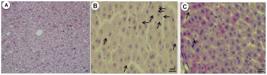
Histomicrograph of the liver of young adult rats fed a standard diet (A) westernized (B) and/or P. aculeata extract (C). C = Control group; O = Obese group; OP = Obese group treated with P. aculeata. A- Group C containing hepatocytes (arrows), kupffer cells (arrowhead) and centrilobular vein (vc). B- Group O with lipid vesicles (arrows) characteristic of hepatic steatosis. C- OP group presenting lipid vesicles in a smaller amount than those found in the westernized group. HE staining.
4. Discussion
The supplementation with P. aculeata for 30 days was effective in reducing fat deposition, cholesterol, LDL-C and HDL-C plasma levels, and the proinflammatory cytokine IL-6 in female rats fed a westernized diet.
The increase in weight and fat deposition resulting from the intake of a Westernized diet during childhood, as well as its influence on the metabolic profile, is a recurring target of studies (Arnone et al., 2022; Mascarenhas et al., 2023). Supplementation with P. aculeata reduced fat deposition. Extracts from plants in the same botanical family as P. aculeata have shown similar results. For example, supplementation with C. cauliflora (Seyedan et al., 2019) reduced the deposition of visceral fat (perigonadal and retroperitoneal) in male mice fed a high-fat diet. However, further studies on females are needed.
Rats fed the Westernized diet had a decrease in stomach weight. It is recognized that the Westernized diet can increase insulin levels in the central nervous system, leading to a decrease in food intake through the cortico-mesolimbic circuit, especially through the dopaminergic system (Cifuentes et al., 2021). Gastric volume is an important inhibitor of food intake and is delimited according to oral intake (Cifuentes et al., 2021). In younger rats, the mechanism of age-related changes in gastric accommodation is poorly understood, but it is known that there is a reduction in gastric volume as the animal ages due to a reduced emptying rate (Wang et al., 2021).
It is worth noting that the gastric emptying rate of newborn rats depends on volume and not on development (Ferreira et al., 2018). This reduction of gastric capacity in part is responsible for lesser food consumption observed in O and OP groups, but not necessarily lesser energy since a Westernized diet has 30% more calories compared to a standard diet. An early study also found no difference in energy dietary intake between the groups fed a standard diet and a westernized diet (Franco et al., 2022). Therefore, based on this result, it is suggested that not only the amount of calories offered influences weight gain, but also the distribution of macronutrients.
Our results show that the OP group presented a reduction in plasma concentrations of total cholesterol, HDL-C, and LDL-C. In addition, the reduction of these lipid parameters is consistent with the lower amount of fat infiltrated in the liver, which can be observed through the results of Folch analysis and histological analysis in the OP group. In males, a previous study showed that treatment with P. aculeata reduced total cholesterol, LDL-C, and triglycerides and had no effect on plasma HDL-C levels (Franco et al., 2022). Taken together, these results indicate that sex may influence the response to P. aculeata therapy.
Flavonoids are one of the main bioactive compounds in the P. aculeata extract (Leite et al., 2011). Bioactive compounds such as flavonoids exert an action in inhibiting HMG-CoA reductase through binding to the catalytic site of this hepatic enzyme as an endogenous substrate (Ibrahim et al., 2020; Mahdavi et al., 2020). In this way, the cholesterol biosynthesis process is inhibited, in addition to reducing the uptake of cholesterol esters through the nuclear receptors SREBP and LXR, thus improving the lipid profile (Ibrahim et al., 2020).
Plasma levels of IL-6 were reduced in female rats treated with P. aculeata. A previous study showed that treatment with P. aculeata reduced IL-6 and TNF-alpha in the adipose tissue of male rats (Franco et al., 2022), suggesting that P. aculeata may exert important anti-inflammatory effects. Further studies in well-characterized pro-inflammatory conditions are needed to confirm the anti-inflammatory effect of P. aculeata.
5. Conclusion
The results of this study showed that treatment with P. aculeata at 140mg/kg for 30 days is effective in reducing cholesterol, LDL-C, hepatic lipid deposition, and pro-inflammatory IL-6 plasma levels in WD-fed female rats.
Acknowledgements
This study was financed in part by the Coordenação de Aperfeiçoamento de Pessoal de Nível Superior, Brasil (CAPES) — Finance Code 001. CNPq (Nº 406911/2021-5 CNPq/MCTI/FNDCT Nº 18/2021).
Data Availability Statement
The dataset analyzed or produced in this study can be requested from the corresponding author.
References
-
ARAÚJO, T.G., OLIVEIRA, A.G., VECINA, J.F., MARIN, R.M., FRANCO, E.S., ABDALLA SAAD, M.J. and MAIA, M.B.S., 2016. Parkinsonia aculeata (Caesalpineaceae) improves high-fat diet-induced insulin resistance in mice through the enhancement of insulin signaling and mitochondrial biogenesis. Journal of Ethnopharmacology, vol. 183, pp. 95-102. https://doi.org/10.1016/j.jep.2016.02.048 PMid:26940900.
» https://doi.org/10.1016/j.jep.2016.02.048 -
ARNONE, D., CHABOT, C., HEBA, A.C., KÖKTEN, T., CARON, B., HANSMANNEL, F., DREUMONT, N., ANANTHAKRISHNAN, A.N., QUILLIOT, D. and PEYRIN-BIROULET, L., 2022. Sugars and gastrointestinal health. Clinical Gastroenterology and Hepatology : The Official Clinical Practice Journal of the American Gastroenterological Association, vol. 20, no. 9, pp. 1912-1924.e7. https://doi.org/10.1016/j.cgh.2021.12.011 PMid:34902573.
» https://doi.org/10.1016/j.cgh.2021.12.011 -
CHEN, Y.K., LIU, T.T., TEIA, F.K.F. and XIE, M.Z., 2023. Exploring the underlying mechanisms of obesity and diabetes and the potential of traditional Chinese medicine: an overview of the literature. Frontiers in Endocrinology, vol. 14, no. 1218880, pp. 1218880. https://doi.org/10.3389/fendo.2023.1218880 PMid:37600709.
» https://doi.org/10.3389/fendo.2023.1218880 -
CIFUENTES, L., CAMILLERI, M. and ACOSTA, A., 2021. Gastric sensory and motor functions and energy intake in health and obesity-therapeutic implications. Nutrients, vol. 13, no. 4, pp. 1158. https://doi.org/10.3390/nu13041158 PMid:33915747.
» https://doi.org/10.3390/nu13041158 -
CLEMENTE-SUÁREZ, V.J., BELTRÁN-VELASCO, A.I., REDONDO-FLÓREZ, L., MARTÍN-RODRÍGUEZ, A. and TORNERO-AGUILERA, J.F., 2023. Global impacts of Western diet and its effects on metabolism and health: a narrative review. Nutrients, vol. 15, no. 12, pp. 2749. https://doi.org/10.3390/nu15122749 PMid:37375654.
» https://doi.org/10.3390/nu15122749 -
FABIAÑA, N.L., CHEN, C.L., VENKETASUBRAMANIAN, N., LEE, C.F., WONG, K.S. and DE SILVA, D.A., 2016. Sex and the treatment effect in the Chinese Medicine NeuroAiD Efficacy on Stroke Recovery (CHIMES) trial. Journal of Clinical Neuroscience : Official Journal of the Neurosurgical Society of Australasia, vol. 33, pp. 269-270. https://doi.org/10.1016/j.jocn.2016.04.013 PMid:27469414.
» https://doi.org/10.1016/j.jocn.2016.04.013 -
FERREIRA, C.H.F., SHIFRIN, Y., PAN, J., IVANOVSKA, J., MCNAMARA, P.J. and BELIK, J., 2018. The newborn rat gastric emptying rate is volume and not developmentally dependent. Neurogastroenterology and Motility, vol. 30, no. 4, pp. e13233. https://doi.org/10.1111/nmo.13233 PMid:29024213.
» https://doi.org/10.1111/nmo.13233 -
FERRO CAVALCANTE, T.C., MARCELINO DA SILVA, A.A., LIRA, M.C., AMARAL ALMEIDA, L.C., MARQUES, A.P. and NASCIMENTO, E., 2014. Early exposure of dams to a westernized diet has long-term consequences on food intake and physiometabolic homeostasis of the rat offspring. International Journal of Food Sciences and Nutrition, vol. 65, no. 8, pp. 989-993. https://doi.org/10.3109/09637486.2014.950208 PMid:25198159.
» https://doi.org/10.3109/09637486.2014.950208 -
FOLCH, J., LEES, M. and STANLEY, G.H.S., 1957. A simple method for the isolation and purification of total lipids from animal tissues. The Journal of Biological Chemistry, vol. 226, no. 1, pp. 497-509. https://doi.org/10.1016/S0021-9258(18)64849-5 PMid:13428781.
» https://doi.org/10.1016/S0021-9258(18)64849-5 -
FRANCO, E.S., NASCIMENTO, E., VASCONCELOS, D.A., SILVA, P.A., NOVAES, T.L., FEITOSA, M.G., SILVA, A.A. and MAIA, M.B., 2022. Polar fraction from Parkinsonia aculeata aerial parts extract improves imbalanced metabolic profile and reduces proinflammatory interleukin levels in white adipose tissue in obese rats induced by Western diet. Journal of Ethnopharmacology, vol. 282, no. 114557, pp. 114557. https://doi.org/10.1016/j.jep.2021.114557 PMid:34481874.
» https://doi.org/10.1016/j.jep.2021.114557 -
FRIEDEWALD, W.T., LEVY, R.I. and FREDRICKSON, D.S., 1972. Estimation of the concentration of low-density lipoprotein cholesterol in plasma, without use of the preparative ultracentrifuge. Clinical Chemistry, vol. 18, no. 6, pp. 499-502. https://doi.org/10.1093/clinchem/18.6.499 PMid:4337382.
» https://doi.org/10.1093/clinchem/18.6.499 -
GUIMARÃES, K.S.L., ARAÚJO, E.V., AQUINO, J.S., GADELHA, D.A., BALARINI, C.M., COSTA-SILVA, J.H., MAGNANI, M., VIDAL, H., BRAGA, V.A. and BRITO ALVES, J.L., 2017. Effect of maternal dyslipidaemia on the cardiorespiratory physiology and biochemical parameters in male rat offspring. The British Journal of Nutrition, vol. 118, no. 11, pp. 930-941. https://doi.org/10.1017/S0007114517003014 PMid:29173205.
» https://doi.org/10.1017/S0007114517003014 -
IBRAHIM, A., SHAFIE, N.H., MOHD ESA, N., SHAFIE, S.R., BAHARI, H. and ABDULLAH, M.A., 2020. Mikania micrantha extract inhibits HMG-CoA reductase and ACAT2 and ameliorates hypercholesterolemia and lipid peroxidation in high cholesterol-fed rats. Nutrients, vol. 12, no. 10, pp. 3077. https://doi.org/10.3390/nu12103077 PMid:33050310.
» https://doi.org/10.3390/nu12103077 -
LEITE, A.C., ARAÚJO, T.G., MELO CARVALHO, B., MAIA, M.B. and MENEZES LIMA, V.L., 2011. Characterization of the antidiabetic role of Parkinsonia aculeata (Caesalpineaceae). Evidence-Based Complementary and Alternative Medicine : eCAM, vol. 2011, no. 692378, pp. 692378. https://doi.org/10.1155/2011/692378 PMid:20953386.
» https://doi.org/10.1155/2011/692378 -
MACÊDO, A.P.A., CORDEIRO, G.S., SANTOS, L., SANTO, D.A.E., PEREZ, G.S., COUTO, R.D., MACHADO, M.E.P.C. and MEDEIROS, J.M.B., 2021. Murinometric measurements and retroperitoneal adipose tissue in young rats exposed to the high-fat diet: is there correlation? Brazilian Journal of Biology, vol. 81, no. 2, pp. 246-250. https://doi.org/10.1590/1519-6984.221405 PMid:32428096.
» https://doi.org/10.1590/1519-6984.221405 -
MAHDAVI, A., BAGHERNIYA, M., FAKHERAN, O., REINER, Ž., XU, S. and SAHEBKAR, A., 2020. Medicinal plants and bioactive natural compounds as inhibitors of HMG-CoA reductase: a literature review. BioFactors (Oxford, England), vol. 46, no. 6, pp. 906-926. https://doi.org/10.1002/biof.1684 PMid:33053603.
» https://doi.org/10.1002/biof.1684 -
MARTINEZ-MUNIZ, G.A. and WOOD, S.K., 2020. Sex differences in the inflammatory consequences of stress: implications for pharmacotherapy. The Journal of Pharmacology and Experimental Therapeutics, vol. 375, no. 1, pp. 161-174. https://doi.org/10.1124/jpet.120.266205 PMid:32759370.
» https://doi.org/10.1124/jpet.120.266205 -
MASCARENHAS, P., FURTADO, J.M., ALMEIDA, S.M., FERRAZ, M.E., FERRAZ, F.P. and OLIVEIRA, P., 2023. Pediatric overweight, fatness and risk for dyslipidemia are related to diet: a cross-sectional study in 9-year-old children. Nutrients, vol. 15, no. 2, pp. 329. https://doi.org/10.3390/nu15020329 PMid:36678200.
» https://doi.org/10.3390/nu15020329 -
MENEZES, T.M., SOUZA FRANCO, E., ALMEIDA SOUSA LIMA, L.C., SOUZA PEREIRA, Á.M., SANTOS LIMA, L.W., QUIXABEIRA, C.M.T., SILVA, J.F., CAHU, T.B., SOUZA BEZERRA, R., LIRA, E.C., MILITÃO, G.C.G. and SOUSA MAIA, M.B., 2021. Non-clinical repeated dose 28-day oral toxicity, reproductive toxicity and cytotoxicity studies of the polar fraction of Parkinsonia aculeata aerial parts extract. Toxicology Research, vol. 10, no. 4, pp. 792-799. https://doi.org/10.1093/toxres/tfab052 PMid:34484670.
» https://doi.org/10.1093/toxres/tfab052 -
PERDOMO, C.M., COHEN, R.V., SUMITHRAN, P., CLÉMENT, K. and FRÜHBECK, G., 2023. Contemporary medical, device, and surgical therapies for obesity in adults. Lancet, vol. 401, no. 10382, pp. 1116-1130. https://doi.org/10.1016/S0140-6736(22)02403-5 PMid:36774932.
» https://doi.org/10.1016/S0140-6736(22)02403-5 -
SEYEDAN, A., MOHAMED, Z., ALSHAGGA, M.A., KOOSHA, S. and ALSHAWSH, M.A., 2019. Cynometra cauliflora Linn. attenuates metabolic abnormalities in high-fat diet-induced obese mice. Journal of Ethnopharmacology, vol. 236, pp. 173-182. https://doi.org/10.1016/j.jep.2019.03.001 PMid:30851371.
» https://doi.org/10.1016/j.jep.2019.03.001 -
VELUSWAMY, S.K., BABU, A.S. and SUNDAR, L.M., 2017. Complementary role of herbal medicine and exercise in cardiovascular disease prevention and management: a review of evidence. Current Pharmaceutical Design, vol. 23, no. 8, pp. 1253-1264. https://doi.org/10.2174/1381612822666161010122252 PMid:27748189.
» https://doi.org/10.2174/1381612822666161010122252 -
VIDAL-SANTOS, R., MACEDO, F.N., SANTANA, M.N., DE MELO, V.U., DE BRITO ALVES, J.L., SANTOS, M.R., BRITO, L.C., NASCIMENTO, E., COSTA-SILVA, J.H. and SANTANA-FILHO, V.J., 2017. Western diet in the perinatal period promotes dysautonomia in the offspring of adult rats. Journal of Developmental Origins of Health and Disease, vol. 8, no. 2, pp. 216-225. https://doi.org/10.1017/S2040174416000623 PMid:27931267.
» https://doi.org/10.1017/S2040174416000623 -
WANG, H., ESEMU-EZEWU, P., PAN, J., IVANOVSKA, J., GAUDA, E.B. and BELIK, J., 2021. Adiponectin and the regulation of gastric content volume in the newborn rat. World Journal of Gastroenterology, vol. 27, no. 33, pp. 5566-5574. https://doi.org/10.3748/wjg.v27.i33.5566 PMid:34588752.
» https://doi.org/10.3748/wjg.v27.i33.5566
Edited by
-
Editor:
Marcelo A.M. Esquisatto

