 Growth modeling in diameter and height at individual tree level for seasonal semi-deciduous forest
Abstract
The objective of this study was to evaluate and compare two methodologies for estimating diameter at breast height (dbh) and total height at the individual tree level over time: (i) direct projection of future tree diameter and height (dbh2 and Ht2) and (ii) projection of the annual periodic increment in diameter (APId) and height (APIHt), which, when added to the initial values, provide estimates of future dbh and height. The data were obtained from 10 permanent plots installed in a seasonal semi-deciduous forest fragment located in the municipality of Viçosa, Minas Gerais, Brazil, monitored over a 14-year period with measurements conducted in 1994, 1997, 2000, 2004, and 2008. The dataset was randomly divided into two subsets, with six plots used for model fitting and four plots for validation. The results indicated that equations based on the direct projection of future diameter and height provided a better fit to the observed data than those based on estimating annual periodic increments and subsequently reconstructing the state variables. In the validation process, both methodologies showed satisfactory performance, with a slight superiority for the approach based on the projection of annual periodic increments.
Keywords:
increment; competition; forest growth
Resumo
O objetivo deste trabalho foi avaliar e comparar duas metodologias para estimar diâmetros à altura do peito (DAP) e alturas em nível de árvore individual ao longo do tempo: (i) a projeção direta dos diâmetros e alturas futuros das árvores (DAP2 e Ht2) e (ii) a projeção do incremento periódico anual em diâmetro (IPAd) e em altura (IPAHt), que, somados aos valores iniciais, permitem obter as estimativas futuras de DAP e altura. Os dados utilizados são provenientes de 10 parcelas permanentes instaladas em um fragmento de Floresta Estacional Semidecidual no município de Viçosa, Minas Gerais, monitoradas ao longo de 14 anos, com medições realizadas em 1994, 1997, 2000, 2004 e 2008. A base de dados foi dividida aleatoriamente em dois conjuntos, sendo seis parcelas utilizadas para ajuste dos modelos e quatro para validação. Os resultados indicaram que as equações baseadas na projeção direta dos diâmetros e alturas futuros apresentaram melhor ajuste aos dados observados quando comparadas às equações que estimam os incrementos periódicos anuais e posteriormente reconstroem as variáveis de interesse. No processo de validação, ambas as metodologias apresentaram desempenho satisfatório, com leve superioridade para a abordagem baseada na projeção dos incrementos periódicos anuais.
Palavras-chave:
incremento; competição; crescimento florestal
1. Introduction
Diameter and height growth models are essential components of individual tree-level growth modeling, as they support the representation of forest structural dynamics and growth processes over time (Vanclay, 1994; Sánchez-González et al., 2006; Hasenauer, 2006; Campos and Leite, 2017; Orso et al., 2020; Oliveira et al., 2021, 2024; Bianchi et al., 2022; Murta Júnior et al., 2025). In tropical forests, these growth patterns are closely linked to vegetation structure, species interactions, and environmental variability, which reinforces the importance of size- and structure-based modeling approaches (Felfili et al., 2017; Hofmann et al., 2021).
Growth assessment in modeling at the individual tree level is often done by two approaches: growth estimation made from a potential growth function multiplied by a modifying function (Soares and Tomé, 1997); or the use of equations which estimate growth as a function of tree attributes, such as size and competition indices and forest stand characteristics (Uzoh and Oliver, 2006).
According to Vanclay (1994), the increase in stem diameter can be expressed as a production function, which estimates future diameters, or as a growth function, which estimates the increment during a specific period. Bueno and Bevilacqua (2010) compared the two methodologies to model the diameter growth of Pinus occidentalis Sw. trees and concluded that the diameter projection resulted in better estimates than the diameter growth projection.
Although there are many works addressing individual tree-level modeling in the world (Sánchez-González et al., 2006; Crecente-Campo et al., 2010), studies for tropical uneven forests are still incipient. There is still a gap to be filled aiming to evaluate more efficient methodologies for modeling at the individual tree level for these forests.
Therefore, the objective of this work was to evaluate and compare two methodologies to estimate diameters and heights at the individual tree level for a seasonal semi-deciduous forest based on the future diameter and height projections and on the annual periodic increment projections in the tree diameter and height.
2. Material and Methods
2.1. Data
The data used in this study come from 10 permanent plots installed in a fragment of approximately 17 ha of montane seasonal semi-deciduous forest in an intermediate successional stage (Figueiredo et al., 2013), located in the municipality of Viçosa, Minas Gerais, Brazil (20°45′ S and 42°51′ W). The age of individual trees was not directly determined, which is common in uneven-aged tropical forests. However, growth dynamics were indirectly accounted for through tree size variables (initial diameter and height) and stand structure descriptors, which act as proxies for ontogenetic stage and competitive status.
The plots have a fixed area of 1000 m2 (20 m × 50 m). Diameter at breast height (dbh, 1.30 m) and total height (Ht) of all tree individuals with dbh ≥ 5 cm were measured in each plot. Measurements were carried out over a 14-year period, in 1994, 1997, 2000, 2004, and 2008. Species identity was recorded in the permanent plots; however, species was not included as an explicit predictor in the growth models. Instead, the modeling approach focused on tree size and stand structure variables, which capture a substantial portion of the interspecific variability in growth. Climatic variability was not modeled explicitly, but its effects are implicitly reflected in the observed growth increments across measurement periods, as all trees were exposed to the same regional climatic conditions.
2.2. Diameter and height growth models
Data from six randomly selected permanent plots were used to fit the diameter and height growth models, whereas data from the remaining four plots were independently used for model validation. The two methodologies tested were: 1) the projection of future tree diameters and heights (dbh2 and Ht2); 2) the projection of the annual periodic increment in diameter (APId) and in height (APIHt), which provide estimates of future diameters and heights when added to the diameters and heights of the trees at the beginning of the monitoring period.
In this work, we chose not to evaluate pre-existing linear and non-linear models in the literature. Thus, in constructing the models, the projections of future diameter and height (dbh2 and Ht2) and of the annual periodic increments in diameter and height (APId and APIHt) were related to a set of characteristics of the forest and the trees themselves (Hasenauer, 2006) to define the model to be selected, such as: dbh1 = diameter with bark measured at a height of 1.30 m, in centimeters (cm), at the beginning of the monitoring period; Ht1 = total height, in meters (m), at the beginning of the monitoring period; Davg and Dmax = average of the diameters and maximum diameter of the trees, in cm, in the plots; = average of the total heights, in m; Hdom = average height of dominant trees, in m, considering the average of the ten tallest trees in each plot, in each measurement year; and CI = competition index.
Distance-independent competition indices used in other growth modeling work at the individual tree level were evaluated (Equation 1, 2 and 3) (Martins et al., 2011; Castro et al., 2014, 2020):
In which: Hti = total height of the object tree (m); = average total height of trees in the sample unit (m); ASi = sectional area of the trunk of the object tree, measured at 1.30 m height (m2), ASq = sectional area corresponding to the average diameter (q) of the tree trunks in the plots (m2); BALi = sum of sectional areas of trees larger than the object tree.
The explanatory variables were analyzed separately and in combination with others, and was done through an analysis of the simple correlation between them and the diameter and height of the trees and the growth in diameter and height; and of the statistical significance and coherence of the signals associated with the model parameters. Furthermore, the presence of multicollinearity in the case of linear models was verified through the analysis of the variance inflation factor (VIF), and the variables that presented an VIF greater than 10 were excluded from the model (Gujarati and Porter, 2011).
Next, the empirical adjusted coefficient of determination () and root mean squared error (RMSE (%)) were used as a criterion for evaluating the fitted Equations 4, 5 and 6 (Sánchez-González et al., 2006):
Such that:
In which: = observed value of the dependent variable; = estimated value of the independent variable; n = number of observations.
2.3. Validation of the methodologies
After selecting the equations referring to the two methodologies, they were applied to the data of plots which were not used in fitting the equations to obtain the future diameter and height estimates. The projections were made considering the data observed at the beginning of each monitoring period, meaning from 1994 to 1997; from 1997 to 2000; and so on. Thus, the BIAS (%) given by (Sánchez-González et al., 2006) was then used to compare the two methodologies, in addition to the statistics discussed above, as follows (Equation 7):
In addition to these statistics, graphs were created relating the observed diameters and heights and those estimated by the equations in order to verify the accuracy of the estimates over time.
3. Results
The average diameter observed in the fitted plots in the total monitoring period (1994 to 2008) was equal to 11.5 cm, while the average annual periodic increase in diameter was 0.14 cm year-1. The mean height and annual mean periodic increase in height were 11.2 m and 0.21 cm year-1, respectively (Table 1).
Diameter at breast height (dbh), height (Ht) and annual periodic increments in diameter (APId) and height (APIH) of the plots used in the model fitting.
3.1. Selected models and equation fitting
The models selected in the modeling process to estimate diameters and heights or their respective annual periodic increments were (Equations 8, 9, 10 and 11):
In terms of competition indices, BAI presented the best performance in the equation in which the response variable was the future diameter (dbh2). The BAL index performed better in the other equations.
The diameter at the beginning of the monitoring period (dbh1) showed a statistically significant contribution to the estimates of future diameter and diameter increment, as well as to the estimates of future height and height increment, since the parameter associated with this variable was significant in the fitted models.
All coefficients of the equations that project diameter and height (DBH2 and Ht2) were significant (p<0.01), while only the β0 parameter of the equation fitted to estimate APId was non-significant at 95% probability (p = 0.237) for the annual periodic increment in diameter (APId) and height (APIHt) (Table 2).
Estimates of parameters, standard error (SE) and p-values associated to the coefficients of the parameters to estimate growth in diameter and height in a seasonal semi-deciduous forest.
The signs of all coefficients were consistent in all fitted equations regarding competition indices, since the BAI index has a positive correlation with growth in diameter and height and the BAL index has a negative correlation.
3.2. Validation of the methodologies
The equations presented in Table 2 were applied to the independent data to validate the two methodologies by comparing the observed and estimated diameters at the end of each monitoring period. It is observed that the root mean square error (RMSE (%)) presented very close values (Table 3), and the error due to the dbh2 projection was only lower than that obtained by the annual periodic increment estimation in the period from 2000 to 2004.
BIAS (%) and RMSE (%) estimates considering the diameter (dbh2) and the annual periodic increment in diameter (APId) projections for each monitoring period.
The estimates in terms of BIAS (%) in the methodology that projects future diameters and heights (dbh2) ranged from -1.71% to 1.23%, while the BIAS (%) in the methodology that estimates the annual periodic increments ranged from -1.74% to 2.21%. It is observed that there was a tendency to overestimate the diameter of the trees for the diameter estimates based on the annual periodic increment estimate, with the exception of the first projection period (Table 3).
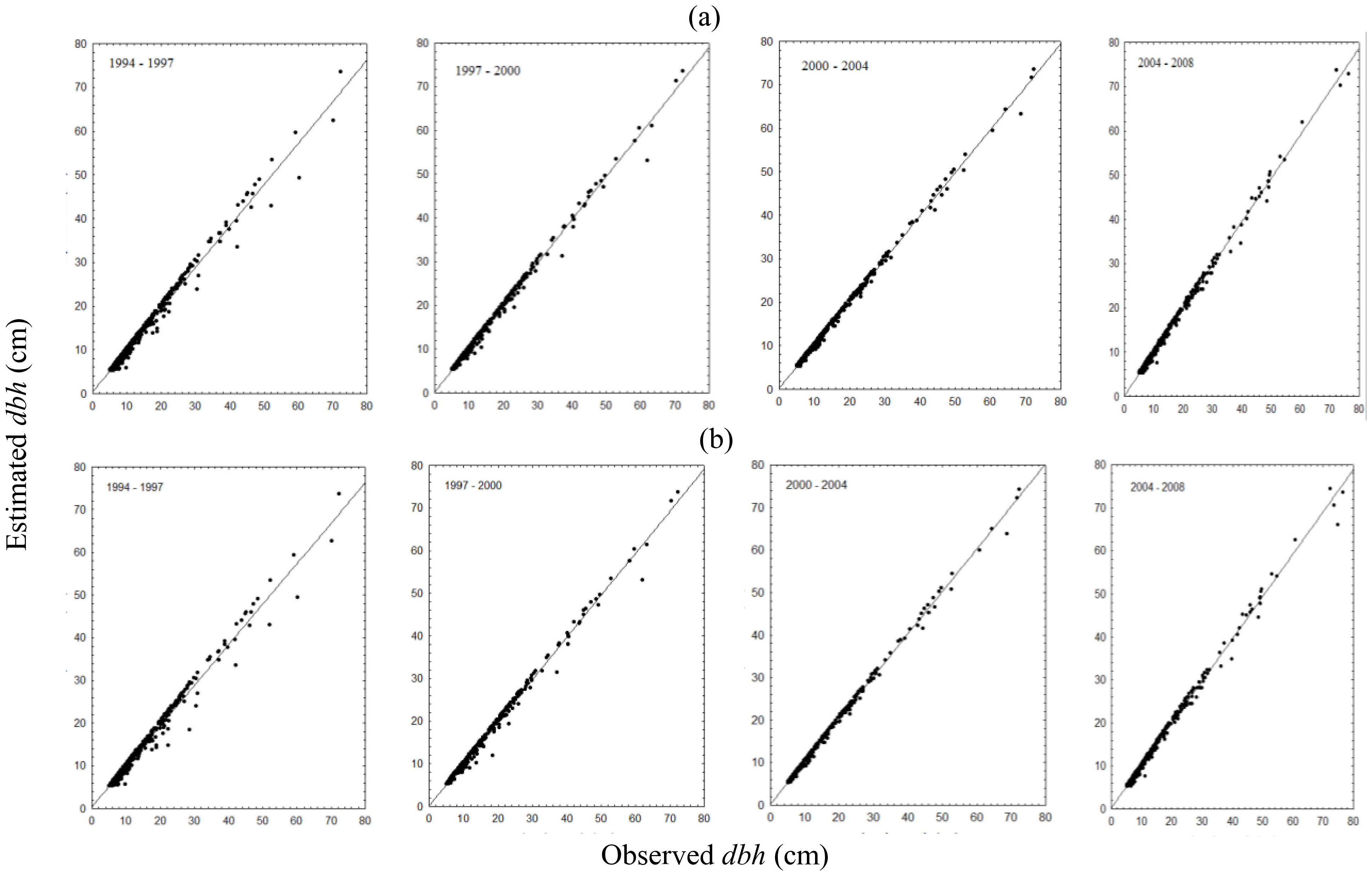
It can be seen in Figure 1 that both the diameter estimated by the diameter projection and the diameter obtained by the estimation of the average annual periodic increment are concentrated close to the 1:1 line, indicating the accuracy of the two methodologies used.
Observed and estimated tree diameters obtained by: (a) direct diameter projection (dbh2) and (b) estimation of the annual periodic increment in diameter, considering the projection periods 1994–1997, 1997–2000, 2000–2004, and 2004–2008.
It was observed that the highest RMSE (%) values for height growth were for height estimates from the initial height projection (Table 4), ranging from 21.09% to 26.49%, while the values for the height obtained by the annual periodic increment were between 8.25% and 13.51%.
Estimates of BIAS (%) and RMSE (%) considering the total height (Ht2) and the periodic annual average in height (IPAHt) projection for each monitoring period.
Bias values (%) for the initial height projection showed that the equation tends to underestimate the height estimates (Table 4).
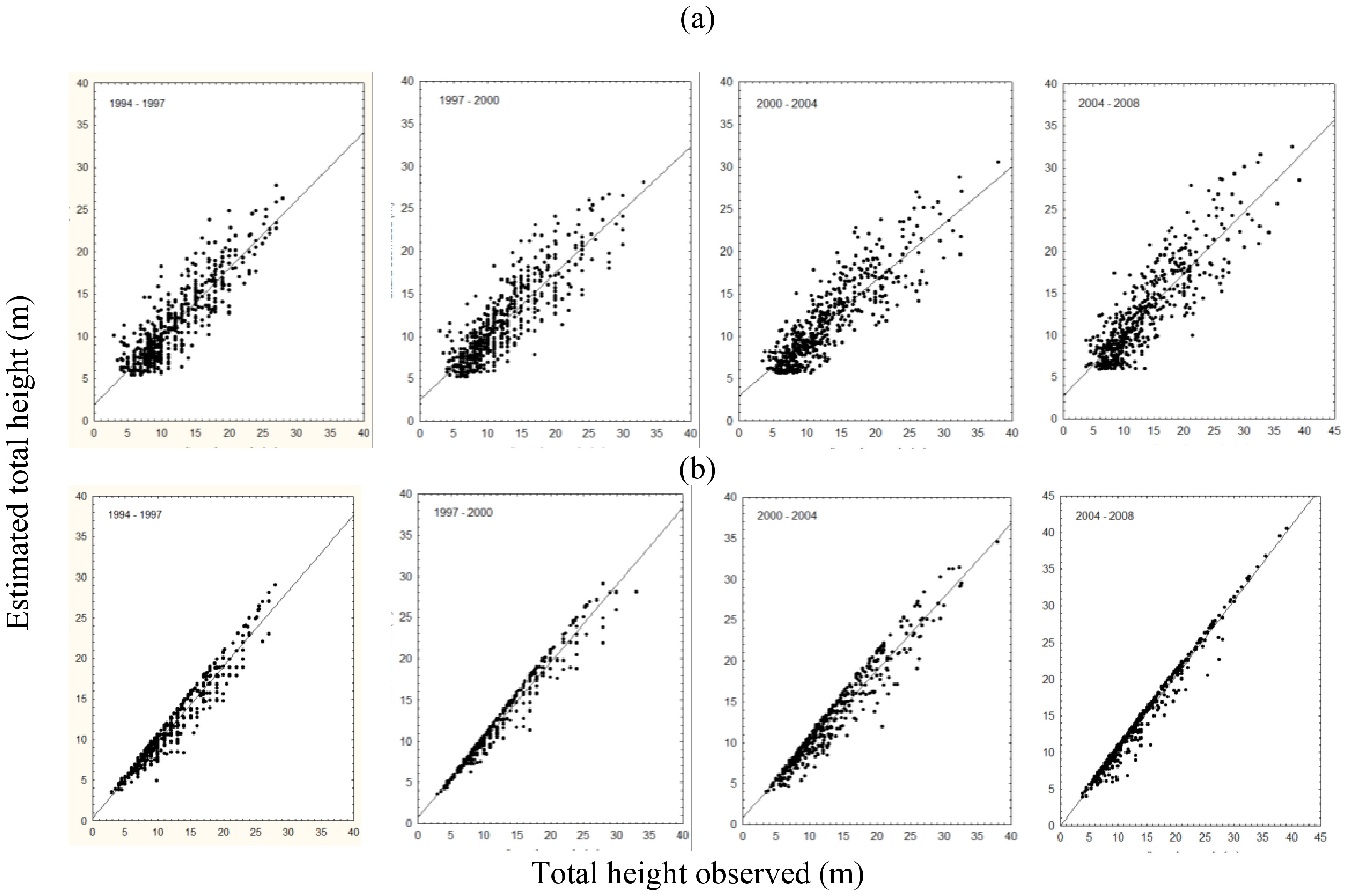
According to Figure 2, a slight underestimation tendency of the heights of smaller trees and an overestimation of the heights of larger trees can be observed for the annual periodic increase in height projection, mainly in the first and third monitoring periods.
Observed and estimated total height of trees by: (a) total height projection and (b) by estimating the annual increment in height in each projection period.
4. Discussion
This work obtained similar results in terms of average diameters and heights by other studies conducted in the region. For example, in a work carried out in the same area, Amaro et al. (2013) obtained a value of 10.18 m for the average total height. In a study aimed at estimating the biomass and carbon stored in a mature forest in the municipality of Viçosa, Ribeiro et al. (2009) found average diameter and height values equal to 11.6 cm and 19.4 m, respectively.
The values found in this work with regard to the annual periodic increase in diameter were lower than those found by Ferreira et al. (1998) in a study of forest dynamics in the municipalities of Rio Vermelho and Serra Azul de Minas, in which they observed that the average annual periodic increments in diameter in ten years of monitoring were equal to 0.185 cm year-1 and 0.3 cm year-1, respectively. In a study modeling the growth of individual trees of native Amazonian species, Silva et al. (2002) found an annual average periodic increment equal to 0.164 cm year-1, constituting a value close to the one found in this work.
The BAL and BAI indices used as predictor variables in growth models have often been used as explanatory variables in growth equations, as they describe the position of a tree in relation to all trees measured in a plot (Bueno and Bevilacqua, 2010; Chassot et al., 2011; Soares et al., 2015). According to Bevilacqua (1999), the current size of a tree is a significant predictor of its growth since it is a reflection of its past competitive interactions.
The signs of the coefficients that accompany the competition index variable were consistent. The greater the growth in diameter for the BAI index, the more competitive the tree and the greater the competition index value. Moreover, the greater the growth in diameter and height for the BAL index, the lower the index value, since this index consists of the sum of the sectional areas of the trunks larger than the trunk of the object tree (Sanchez-Gonzalez et al., 2006; Bueno and Bevilacqua, 2010; Castro et al., 2014).
Regarding the adjusted coefficient of determination [(%)] and the root mean square error [RMSE (%)] values found for the fitted equations in this work, it can be observed that the values are in agreement with the values found in other modeling works growth at the individual tree level in native forests. Using data from the same area of this study, Soares et al. (2015) fitted an equation to estimate the annual periodic increment in diameter and obtained a low value (8.35%) and a high RMSE value (192.16%). The (%) and RMSE (%) values of the equation for estimating the total height of trees were similar to those found in this study, namely 76.61% and 22.06%, respectively. Phillips et al. (2004) fitted an equation to estimate the average annual periodic increment in diameter for groups of Amazonian species and found values that ranged from 3.3% to 18.3%.
According to Soares et al. (2015), accurate estimates of future diameter from equations that estimate annual average periodic increment, with a low (%) and high RMSE (%) values, contrary to what was expected, occur due to the fact that in addition to the short evaluation period, the trees in uneven forests present a low annual increment in diameter. Estimates of future diameter from the diameter projection are more accurate in fast-growing species which show larger increments compared to slow-growing species than the annual periodic increment projection (Bueno and Bevilacqua, 2010).
According to Hasenauer and Monserud (1997), the wide dispersion of tree heights in tropical forests can result in equations with low explanatory power, introducing higher error estimates than the periodic increments. The BIAS (%) values found in this work were higher than those found by Uzoh and Oliver (2006) in a work on modeling the height increment of Pinus ponderosa through regression models (bias (%) mean of - 0.2495%).
In the evaluation of the analyzed methodologies, it was observed that although the(%) and RMSE (%) values indicated a greater precision of the equations which directly project the diameter and the height in relation to the estimation models of the annual average periodic increment, both the methodologies result in accurate estimates of future diameter and height in the validation process. According to Vanclay (1994), this is because these differences in model accuracy are related to the error structure and the implicit functional relationship and not necessarily to the superiority of one model over the other.
5. Conclusion
In this study, it was observed that:
-
Equations that project future diameters and heights better present the observed data when compared to those that project the annual periodic increment in diameter and height.
-
Both methodologies showed satisfactory performance in the validation process, with slight superiority to the methodology that projects the annual periodic increments.
Acknowledgements
To the Coordenação de Aperfeiçoamento de Pessoal de Nível Superior (CAPES) for granting a scholarship to the first author.
Data Availability Statement
The dataset used and/or analyzed during the current study is available from the corresponding author upon reasonable request via email.
References
-
AMARO, M.A., SOARES, C.P.B., SOUZA, A.L., LEITE, H.G. and SILVA, G.F., 2013. Estoque volumétrico, de biomassa e de carbono em uma floresta Estacional Semidecidual em Viçosa, Minas Gerais. Revista Árvore, vol. 37, no. 5, pp. 849-857. https://doi.org/10.1590/S0100-67622013000500007
» https://doi.org/10.1590/S0100-67622013000500007 - BEVILACQUA, E., 1999. Growth responses in individual eastern white pine (Pinus strobus L.) trees following partial cutting treatments Toronto: University of Toronto, 137 p. Ph D.
-
BIANCHI, S., HUUSKONEN, S., HYNYNEN, J., NIEMISTÖ, J.S. and PENTTI, S., 2022. Tree-level differences in Norway spruce and Scots pine growth after extreme thinning treatments. Scandinavian Journal of Forest Research, vol. 37, no. 2, pp. 109-118. https://doi.org/10.1080/02827581.2022.2045348
» https://doi.org/10.1080/02827581.2022.2045348 -
BUENO, S. and BEVILACQUA, E., 2010. Modeling stem increment in individual Pinus occidentalis Sw. trees in La Sierra, Dominican Republic. Forest Systems, vol. 19, no. 2, pp. 170-183. https://doi.org/10.5424/fs/2010192-01312
» https://doi.org/10.5424/fs/2010192-01312 - CAMPOS, J.C.C. and LEITE, H.G., 2017. Mensuração florestal: perguntas e respostas 5. ed. Viçosa: UFV.
- CASTRO, R.V.O., SOARES, C.P.B.S., SOUZA, A.L., MARTINS, F.B., NOGUEIRA, G.S., OLIVEIRA, M.L.R. and SILVA, F., 2014. Competição em nível de árvore individual em uma Floresta Estacional Semidecidual. Silva Lusitana, vol. 22, no. 1, pp. 43-66.
-
CASTRO, R.V.O., SOARES, C.P.B., LEITE, H.G., SOUZA, A.L., MARTINS, F.B., NOGUEIRA, G.S. and OLIVEIRA, M.L.R., 2020. Validação de um modelo completo em nível de árvore individual para uma floresta estacional semidecidual. Scientia Forestalis, vol. 48, no. 126, pp. e3061. https://doi.org/10.18671/scifor.v48n126.10
» https://doi.org/10.18671/scifor.v48n126.10 -
CHASSOT, T., FLEIG, F.D., FINGER, C.A.G. and LONGUI, S.J., 2011. Modelos de crescimento em diâmetro de árvores individuais de Araucaria angustifolia (Bbertol.) Kuntze em floresta Ombrófila mista. Ciência Florestal, vol. 21, no. 2, pp. 303-314. https://doi.org/10.5902/198050983234
» https://doi.org/10.5902/198050983234 -
CRECENTE-CAMPO, F., SOARES, P., TOMÉ, M. and DIÉGUEZ-ARANDA, U., 2010. Modelling annual individual-tree growth and mortality of Scots pine with data obtained at irregular measurement intervals and containing missing observations. Forest Ecology and Management, vol. 260, no. 11, pp. 1965-1974. https://doi.org/10.1016/j.foreco.2010.08.044
» https://doi.org/10.1016/j.foreco.2010.08.044 - FELFILI, J.M., EISENLOHR, P.V. and MELO, M.M.R.F., 2017. Diversity, structure and dynamics of cerrado vegetation in Central Brazil. Brazilian Journal of Biology = Revista Brasileira de Biologia, vol. 77, no. 3, pp. 562-574.
- FERREIRA, R.L.C., SOUZA, A.L. and JESUS, R.M., 1998. Taxa de crescimento de uma floresta secundária de transição. Revista Árvore, vol. 22, no. 4, pp. 451-461.
-
FIGUEIREDO, L.T.M., SOARES, C.P.B., SOUZA, A.L. and MARTINS, S.V., 2013. Alterações florísticas em uma floresta Estacional Semidecidual no município de Viçosa, MG, entre 1994 e 2008. Floresta, vol. 43, no. 2, pp. 169-180. https://doi.org/10.5380/rf.v43i2.28869
» https://doi.org/10.5380/rf.v43i2.28869 - GUJARATI, D.N. and PORTER, D.C., 2011. Econometria básica 5. ed. Porto Alegre: Bookman, 920 p.
-
HASENAUER, H. and MONSERUD, R.A., 1997. Biased predictions for tree height increment models developed from smoothed ‘data’. Ecological Modelling, vol. 98, no. 1, pp. 13-22. https://doi.org/10.1016/S0304-3800(96)01933-3
» https://doi.org/10.1016/S0304-3800(96)01933-3 -
HASENAUER, H., 2006. Sustainable forest management: growth models for Europe Berlim: Springer-Verlag, 398 p. https://doi.org/10.1007/3-540-31304-4
» https://doi.org/10.1007/3-540-31304-4 - HOFMANN, G.S., CARDOSO, M.F. and TOLEDO, P.M., 2021. Effects of climate variability on woody vegetation of the Brazilian Cerrado. Brazilian Journal of Biology = Revista Brasileira de Biologia, vol. 81, no. 2, pp. 401-412.
- MARTINS, F.B., SOARES, C.P.B., LEITE, H.G., SOUZA, A.L. and CASTRO, R.V.O., 2011. Índices de competição em árvores individuais de eucalipto. Pesquisa Agropecuária Brasileira, vol. 46, no. 9, pp. 1089-1098.
- MURTA JÚNIOR, L.S., CASTRO, R.V.O., OLIVEIRA, K.B.E., NAPPO, M.E., COSTA, L.S. and OLIVEIRA, M.L.R., 2025. Índices de competição em um povoamento de eucalipto após o desbaste no Brasil Central. Agrária, vol. 20, no. 3, pp. e3291.
-
OLIVEIRA, E.K.B., REZENDE, A.V., MAZZEI, L., MURTA JÚNIOR, L.S., CASTRO, R.V.O., D’OLIVEIRA, M.V.N. and BARROS, Q.S., 2021. Competition indices after reduced impact logging in the Brazilian Amazon. Journal of Environmental Management, vol. 281, pp. e111898. https://doi.org/10.1016/j.jenvman.2020.111898 PMid:33434760.
» https://doi.org/10.1016/j.jenvman.2020.111898 -
OLIVEIRA, E.K.B., REZENDE, A.V., MURTA JÚNIOR, L.S., MAZZEI, L., CASTRO, R.V.O., D’OLIVEIRA, M.V.N. and DELGADO, R.C., 2024. Individual tree mortality: risks of climate change in the eastern Brazilian Amazon region. Ecological Informatics, vol. 84, pp. 102880. https://doi.org/10.1016/j.ecoinf.2024.102880
» https://doi.org/10.1016/j.ecoinf.2024.102880 -
ORSO, G.A., MALLMANN, A.A., PELISSARI, A.L., BEHLING, A., FIGUEIREDO FILHO, A. and MACHADO, S.A., 2020. How competition indices behave at different neighborhood coverages and modifications in a natural araucaria forest in southern Brazil. Cerne, vol. 26, no. 2, pp. 293-300. https://doi.org/10.1590/01047760202026022706
» https://doi.org/10.1590/01047760202026022706 -
PHILLIPS, P.D., AZEVEDO, C.P., DEGEN, B., THOMPSON, I.S., SILVA, J.N.M. and VAN GARDINGEN, P.R., 2004. An individual-based spatially explicit simulation model for strategic forest management planning in the eastern Amazon. Ecological Modelling, vol. 173, no. 4, pp. 335-354. https://doi.org/10.1016/j.ecolmodel.2003.09.023
» https://doi.org/10.1016/j.ecolmodel.2003.09.023 - RIBEIRO, S.C., JACOVINE, L.A.G., SOARES, C.P.B., MARTINS, S.V., SOUZA, A.L. and NARDELLI, A.M.B., 2009. Quantificação de biomassa e estimativa de estoque de carbono em uma floresta madura no município de Viçosa, Minas Gerais. Revista Árvore, vol. 33, no. 5, pp. 917-926.
-
SÁNCHEZ-GONZÁLEZ, M., DEL RÍO, M., CANELLAS, I. and MONTERO, G., 2006. Distance independent tree diameter growth model for cork oak stands. Forest Ecology and Management, vol. 225, no. 1-3, pp. 262-270. https://doi.org/10.1016/j.foreco.2006.01.002
» https://doi.org/10.1016/j.foreco.2006.01.002 -
SILVA, R.P., SANTOS, J., TRIBUZY, E.S., CHAMBERS, J.Q., NAKAMURA, S. and HIGUCHI, N., 2002. Diameter increment and growth patterns for individual tree growing in Central Amazon, Brazil. Forest Ecology and Management, vol. 166, no. 1-3, pp. 295-301. https://doi.org/10.1016/S0378-1127(01)00678-8
» https://doi.org/10.1016/S0378-1127(01)00678-8 - SOARES, C.P.B., GEZAN, S.A., SILVA, G.F. and CASTRO, R.V.O., 2015. Individual-tree growth and mortality models for a Semideciduous Atlantic forest in Brazil. Australian Journal of Basic and Applied Sciences, vol. 9, no. 11, pp. 542-552.
- SOARES, P. and TOMÉ, M., 1997. A distance dependent diameter growth model for first rotation eucalyptus plantation in Portugal, In: A. AMARO and M. TOMÉ, eds. Empirical and Process - Bases models for forest tree and stand growth simulation Salamandra, pp. 267-270.
-
UZOH, F.C.C. and OLIVER, W.W., 2006. Individual tree height increment model for managed even - aged stands of ponderosa pine throughout the western United States using linear mixed effects models. Forest Ecology and Management, vol. 21, no. 1-3, p. 147-154. https://doi.org/10.1016/j.foreco.2005.09.012
» https://doi.org/10.1016/j.foreco.2005.09.012 - VANCLAY, J.K., 1994. Modelling forest growth and yield: aplications to mixed tropical forests Copenhagen: CAB International, 312 p.
Edited by
-
Editor:
Takako Matsumura Tundisi