 JOURNALISTIC COVERAGE OF A POLITICAL SCANDAL IN DEMOCRACY: Vaza Jato in Folha de S.Paulo
ABSTRACT
The article aims to identify the narratives and understand the news, the editorial discourse, and decisions of Folha de S.Paulo that defend the publication of Vaza Jato and reveal quality journalism practices. The mixed method includes narrative and discourse analyses and interview. The results show the presence of three narratives linked to accusations against judge Sergio Moro and prosecutors, validation of message veracity and criticism of Lava Jato. The discourse and the interview emphasize that direct access to the conversations, confirmation of the veracity and public interest of these conversations and the context influenced the publication.
Key words
News coverage; Political scandal; Democracy; Vaza Jato; Folha de S.Paulo
RESUMO
O artigo pretende identificar as narrativas e perceber o discurso noticioso e editorial e as decisões da Folha de S.Paulo que defendem a publicação da Vaza Jato e revelam práticas de jornalismo de qualidade. O método misto inclui análise narrativa e de discurso e entrevista. Os resultados mostram a presença de três narrativas ligadas a acusações contra o juiz Sergio Moro e procuradores, validação da veracidade das mensagens e críticas à Lava Jato. O discurso e a entrevista realçam que o acesso direto às conversas, a confirmação de veracidade e o interesse público dessas conversas e o contexto influenciaram a publicação.
Palavras-chave
Cobertura jornalística; Escândalo político; Democracia; Vaza Jato; Folha de S.Paulo
RESUMEN
El artículo pretende identificar las narrativas y comprender el discurso y las decisiones informativas y editoriales de Folha de S.Paulo que defienden la publicación de Vaza Jato y revelan prácticas periodísticas de calidad. El método mixto incluye análisis narrativos y discursivos y entrevistas. Los resultados muestran la presencia de tres narrativas vinculadas a las acusaciones contra el juez Sergio Moro y los fiscales, la validación de la veracidad de los mensajes y las críticas a Lava Jato. El discurso y la entrevista destacan que el acceso directo a las conversaciones, la confirmación de la veracidad y el interés público de las mismas y el contexto influyeron en la publicación.
Palabras clave
Cobertura periodística; Escándalo político; Democracia; Vaza Jato; Folha de S.Paulo
1 Introduction
The media have been regarded as the “lifeblood” (Psychogiopoulou, 2014) and the “backbone” (Jadhav, 2014) of democracy. The literature demonstrates that the media, by providing information on public affairs and offering a platform for public debate, are seen as key facilitators of participatory decision-making. Additionally, their role as a social and political watchdog and their potential to compel governments to respond to citizens – thus increasing government accountability and transparency – have been widely acknowledged (Psychogiopoulou, 2014).
Political scandals are important indicators of social values and can have significant and lasting consequences, fostering cultures of debate and criticism in democracies (Argyle, 2015). The media play significant roles in both the occurrence and the impact (e.g., public outrage and citizen mobilization) of political scandals, particularly in Western democracies (Ekström & Johansson, 2008), to the extent that Waisbord (2004) states that all scandals are media scandals.
This article aims to study the journalistic coverage by Folha de S.Paulo (Folha) of a political scandal, the Vaza Jato series of reports, initially published by the website The Intercept Brasil (TIB). Leaked conversations from Brazil’s major anti-corruption investigation, “Lava Jato” (car wash), appear to show collaboration between prosecutors and Judge Sergio Moro, raising concerns about political interference, impartiality, and ethical conduct.
This case was selected for several reasons: (1) according to Greenwald, TIB’s editor-in-chief, “the revelations [from the series] strengthened Brazilian democracy. We corrected errors, reversed injustices, and exposed corruption”, demonstrating that “a free press remains the central element for guaranteeing democracy” (Greenwald & Pougy, 2023), although some authors agree that the setbacks in media coverage of Lava Jato are irreparable for democracy; (2) it has already secured its place in the history of Brazilian journalism (Oliveira, 2020); (3) it forced the Brazilian press to self-reflect (Oliveira, 2020); (4) it motivated some international outlets to associate power abuse and political persecution with Lava Jato investigations (Bernardes, 2022); (5) besides undue collaborations between Lava Jato prosecutors and Sergio Moro, the leaked messages also pointed to other improper actions, such as favoring journalists allied with Lava Jato agents (Dalmonte & Queiroz, 2020); (6) it represented a turning point in media publications, changing how some Brazilian outlets covered Lava Jato (Oliveira, 2020), such as Folha. However, this shift was not universally observed – for instance, Grupo Globo and O Estado de S. Paulo initially opted not to cover or include Vaza Jato in their agenda; (7) it required reflection on ethical and legal principles associated with the leaked messages, such as journalists’ watchdog role, the value of public interest as a guide for journalistic decisions, and the need to verify the authenticity of the messages, to avoid publishing disinformation that could harm democracy; (8) it sparked significant repercussions in Brazilian legal, political, and media circles (Gabardo et al., 2021), contributing to the release of former President Lula da Silva in 2019 and the subsequent ruling in 2021 that declared Sergio Moro was biased. Moro was the former judge and, at the time, Minister of Justice, responsible for Lula’s imprisonment, which excluded him from the 2018 election. With the biased verdict, the case against Lula was annulled, allowing him to run for and win the 2022 presidential election; and (9) it enabled various journalistic approaches, which were amplified by the unprecedented partnership between TIB and several news outlets, including Folha, which is studied in this article, generating dozens of new original reports (Duarte, 2020). The Vaza Jato case demonstrated its significance by sparking reflections on the principle of journalistic impartiality, essential to a democratic judicial system, having political impacts by altering political outcomes and raising questions about the political motivation behind certain rulings. It also spurred debate on stronger oversight of public officials and judicial transparency, highlighting the media’s role in judicial investigations and the interplay between justice and public perception.
The theoretical relevance of the Vaza Jato case extends across various disciplines. In communication and media studies, Vaza Jato highlights the role of investigative journalism as a mechanism for social control, emphasizing ethics and journalistic quality in the dissemination of sensitive information. Furthermore, the case illustrates how media construct narratives that influence the political and judicial systems, warning of media sensationalism risks. In political science and democracy studies, the case raises questions about the separation of powers, suggesting a potential violation of this separation between the judiciary and the executive, prompting reflections on power abuse and the judiciary’s role in politics.
Additionally, the case contributes to the debate on the judicialization of politics, where the judiciary assumes a more active role in political and social issues, entailing risks of judicial activism. This case highlights the need for unbiased courts and fair legal proceedings, particularly when considering the judiciary’s extensive involvement in major political cases. It also addresses the conflict between transparency and privacy, questioning the ethical and legal boundaries of disseminating private information of public interest. In state theory and governance, the case contributes to discussions on democratic accountability, suggesting that all branches of power should be monitored to ensure compliance with legality and ethics. The case also reflects on the challenges of fighting corruption, which must be conducted within the limits of the rule of law.
This article specifically aims to: (1) identify the narratives used by Folha to justify the publication of the leaked conversations in exclusive reports; (2) understand how the discourse in Folha’s news and editorials was used to defend the choice to publish the Vaza Jato conversations; and (3) comprehend the decisions made by Folha to ensure journalistic quality in covering Vaza Jato.
Theoretically, this article focuses on framing theory by examining the selection and emphasis of certain aspects of the political scandal over others, on journalistic gatekeeping theory, analyzing editorial and news decisions from the perspective of the decision-maker (editor-in-chief), on the media as the fourth estate, scrutinizing its role as a counterbalance to political power, and on deliberative democracy theory, focusing on the contribution of journalistic coverage to political debate and public opinion formation regarding Vaza Jato. Folha is chosen for analysis in this article as it is a century-old newspaper with the second-largest national circulation value (print + digital) (Yahya, 2022). It was the first media outlet invited by TIB, due to its credibility, to partner in the dissemination of Vaza Jato’s exclusive material. The newspaper has also won several national and international journalism awards. Officially, the paper positions itself politically as non-partisan and pluralist.
This article seeks to contribute to operational theory (McQuail, 2010) by providing knowledge based on journalistic practice, focusing on how to build quality journalism when covering a political scandal. This research commitment is even more relevant considering that, according to Freedom House (2024), which promotes media independence and democracy, Brazil ranks 72nd among 100 countries in the global freedom index.
2 Journalism, politics, and democracy
An independent and credible media is crucial for the functioning of a democracy (Knight Foundation, 2023; Michailidou et al., 2023), as it serves as a watchdog for the government, educates the public, and promotes political awareness and diversity (Das, 2011; Sharma & Dubey, 2018). These functions are essential for transparency, accountability, and public participation, which are hallmarks of a healthy democracy (Harrison & Sayogo, 2014).
The understanding of what constitutes journalistic quality or quality journalism has been the subject of academic inquiry. For example, Shapiro (2010) clarifies that quality journalism is independent, accurate, open to scrutiny, edited without censorship, ambitious, fearless, contextual, engaging, and original. Abramson (2010) argues that it is vital to hold institutions accountable and provide intelligence, energy, and depth to complex stories. Scheuer (2007) notes that, for journalistic excellence in a democratic context, truth is essential for news value, context is crucial for meaning, and integrity promotes both (pp. 56-57).
Political journalism focuses on the actions of political actors and institutions, although the boundaries with other types of journalism are not always clear (Strömbäck & Sehata, 2020). It is one of the most traditional journalistic specializations, considered “essential for the functioning of democracy” (Strömbäck & Sehata, 2020, p. 2), and shapes much of the media news agenda (McNair, 2002). Political news coverage is thus the joint product of an interactive process involving political communicators and media professionals (Semetko et al., 1991, p. 3).
The coverage of politics unfolds at four levels that affect editorial and news production processes (de Vreese et al., 2016), which include: a) the event environment, encompassing journalists’ perceptions of what constitutes news or priority topics; b) organizational influence, considering editorial lines, limitations, and goals; c) media system structures, considering the market competition, commercialization, and the professionalization of journalism; and d) political system structures – governments and parties – which may influence based on the ideals of independence or ideological positioning of each media outlet (de Vreese et al., 2016).
Journalism has become a contested field for different groups seeking space and influence within society (McNair, 2002). Journalists themselves become political actors by shaping the political agenda, whether by working in conjunction with or in competition with political actors (Cook, 2011, p. 13). The author also highlights that many political actors gain influence due to their ability to adhere to the norms of authority, objectivity, and factuality expected by the media.
Journalists have the power to decide whether a certain issue deserves coverage, which context and framing it will receive, and which sources will be called upon to comment on political topics. In this way, journalists “not only reflect authority but reinforce it as well” (Cook, 2011, p. 92). Journalism can harbor implicit and hidden biases, as well as prioritize political processes and acts at the expense of public policies and actions that bring concrete public benefits (McNair, 2002).
3 The value of political scandal for journalism and democracy
While the existence of scandals is seen as inherent to liberal democracies due to transparency and media freedom, they also become part of the media interest, as scandals can attract audiences and generate economic gains (Prior, 2015). Geiss et al. (2012) explain that political scandals are valuable resources for the media because they can “boost the reputation of the media outlet and its self-image as a guardian of public life” (p. 19). Furthermore, if the scandal is tied to powerful figures, it can demonstrate the outlet’s power and effectiveness. The exposure of scandals thus reinforces ideals of economic and editorial independence (Mancini, 2018), and strengthens satisfaction with democracy when wrongdoers are exposed, as the public can conclude that the system is competently performing its functions overall (Kumlin & Esaiasson, 2012, p. 64). On the other hand, empirical studies (e.g., Ares & Hernández, 2017; Solé-Ollé & Sorribas-Navarro, 2017; Zaloznaya et al., 2022) show that scandals undermine citizens’ trust in politicians. Other effects also seem to arise after a political scandal, such as government fragmentation and increased fiscal pressure, which impacts daily activities and can negatively affect citizens’ attitudes toward the government over a longer period (Solé-Ollé & Sorribas-Navarro, 2017). When a political scandal involves legislators, it can negatively influence voters’ attitudes toward institutions and the political process (Bowler & Karp, 2004).
Regarding the potential political bias of news outlets, Puglisi and Snyder (2011) point out that they tend to adopt more favorable biases in line with political motivations, which can translate into a higher volume of potentially unfavorable coverage toward one side. For instance, US newspapers with a more Democratic-leaning orientation tend to cover more political scandals involving Republican politicians, and vice versa (Puglisi & Snyder, 2011). From this perspective, Mancini (2018) highlights the instrumentalization of the media, explaining that political scandals can be used to benefit certain groups or can serve as “politics of trust”, functioning as “credibility tests” for public officials (Thompson, 2000, p. 112). In new and transitioning democracies, where the connection between politicians and citizens is weak, and the media serves as the primary channel for reaching the public, the coverage of corruption scandals may be a way to destroy opponents’ reputations (Mancini, 2018, p. 3.075).
Thompson (2000) classifies political scandals into sexual scandals, financial scandals – such as tax evasion and corruption – and power scandals, which involve violations of democratic norms. The scandals revealed by Vaza Jato fall under the category of power scandals, as they show cooperation between the judge and then Minister of Justice Sergio Moro, and the other prosecutors of the Lava Jato task force, involving abuse of power and deviation from proper legal purposes.
Corruption is one of the most prominent elements in political scandals, although not every case of corruption becomes a scandal (Thompson, 2000). Corruption is a “phenomenon of power” (Sousa, 2011), where public agents form a pact that involves “context, actors, an ethical predisposition to violate the law or act dishonestly, resources and power, strategic trust, and exchange processes” (Moreira et al., 2019, p. 175). Costas-Pérez et al. (2012) emphasize that this phenomenon has a “devastating potential” (p. 469) for the development of various countries, becoming a “social pathology” (Cunha, 2017, p. 65) with the potential to inflict significant harm on democracy, such as eroding trust in institutions and normalizing unethical behavior.
Among the most notable political scandals, Rottinghaus (2019) highlights Watergate as the most significant, which was exposed by journalists Bob Woodward and Carl Bernstein in 1972, and led to the resignation of U.S. President Richard Nixon in 1974. In Brazil, one of the major political scandals involved President Fernando Collor de Mello, who was impeached after allegations made by his brother, Pedro Collor (Aldé & Vasconcellos, 2008). Prior et al. (2015) also underscore the crucial role of the media in the Mensalão scandal, which was reported by Folha and exposed a corruption scheme within the federal government in 2005. From 2014 onwards, Operation Lava Jato gained visibility, leading to significant political events in the country (Damgaard, 2018).
Considered by the Federal Police as the largest corruption investigation in Brazil’s history (Pereira, 2018), Operation Lava Jato began on March 17, 2014, as a task force involving the Brazilian Federal Police and the Federal Public Prosecutor’s Office, coordinated by the 13th Federal Court in Curitiba, Paraná. The investigation aimed to uncover the misappropriation of public funds in contracts involving Petrobras, one of Brazil’s and the world’s largest energy and oil companies. Concluded on February 1st, 2021, the Operation spanned over 80 authorized phases – during which more than 100 people were arrested and convicted – and involved over a thousand searches, arrests, and coercive measures. It targeted Petrobras executives, businesspeople, congressmen, governors, and former politicians, including ex-presidents. The name Lava Jato (that means “car wash’, as mentioned above) refers to the investigation’s first phase, which uncovered the use of a gas station to launder illicit funds, leading to the arrest of money launderer Alberto Youssef. Among the notable events was the April 2018 imprisonment of former president Luiz Inácio Lula da Silva, following accusations related to the “Guarujá triplex” in September 2016. After his conviction was upheld on appeal, Lula’s candidacy for the 2018 presidential election was barred by the courts.
Seen as an example of the “judicialization of politics”, Former Judge Sergio Moro, who presided over the Lava Jato cases at the first-instance level until the end of 2018, repeatedly claimed that the Brazilian Operation was inspired by Italy’s “Operation Clean Hands” (Pereira & Silva, 2021). Moro, often portrayed by the media as a “hero of transparency” (Pereira & Silva, 2021), acknowledged his political intervention, suggesting that Lava Jato was not just a legal-investigative operation, but a political movement capable of diagnosing, creating an agenda, and even sparking a “revolution” in the country. This narrative helped propel Bolsonaro into the political mainstream, embracing denialism and anti-politics sentiments, particularly anti-Workers Party (PT) rhetoric, while backing a reformist agenda rooted in neoliberal and conservative programs (Pereira & Silva, 2021).
Operation Lava Jato had wide-ranging consequences in Brazil: it undermined legal processes, constitutional rights, and the political system, fostering simplistic and polarizing anti-corruption discourses while weakening the country’s fragile political and institutional landscape (Mészáros, 2020). A 2024 Genial/Quaest poll found that half of the Brazilian population (50%) believes that the Operation “did more good” for the country, compared to 28% who think it “did more harm”. Additionally, nearly half (49%) believe Lava Jato “helped combat corruption”, while 37% disagree, and 4% say it “did so to some extent” (Iory, 2024).
The mainstream press and major media outlets – “which always supported Lava Jato” and “never investigated allegations against the Operation” (Moretzsohn, 2019, p. 181) – played a crucial role in covering events related to Lava Jato. Various studies have highlighted their role in intensifying the criminalization of politics, which, for example, contributed to the impeachment of Dilma Rousseff in 2016 (van Dijk, 2017). Moretzsohn (2019) emphasizes that the traditional press, with its coup-driven history, frequently uses the theme of corruption to destabilize democratically elected governments.
Several studies also note that the way Moro was portrayed (as a hero or fighter) contributed significantly to Lava Jato widespread impact (Cruz & Kunsch, 2020; Prado, 2018). However, the press could have been “more eclectic, hermeneutic, and critical” (Prado, 2018, p. 13). Its failure to do so meant that the media missed “a unique opportunity in its own history to improve political discourse. It is unfair, unlikely, and inhumane to believe that a single judge could solve all the ethical issues of the nation” (p. 13).
According to Albuquerque (2017), since the first Workers Party (PT) government, the major media gradually created the conditions that led to Dilma Rousseff’s impeachment and the subsequent democratic crisis, rhetorically employing the notion of the “fourth estate” to portray itself as a watchdog over the other powers. This self-proclamation acted as a “legitimacy shield” (p. 915), enabling the press to play an active political role. This was inspired by advanced Western democracies, where the media is seen as a guardian of democracy. However, in Brazil, this role was executed differently. Albuquerque argues that the “fourth estate” discourse is used by Latin American elites and the media to maintain and justify their privileges. The particularity in Brazil’s case is that the mainstream press claims to speak for the entire nation, but, in reality, it serves specific interests, as evidenced by studies on Lava Jato’s media coverage (Albuquerque, 2017).
The Vaza Jato revelations emerged in a political context marked by the rise of Jair Bolsonaro’s government, following his inauguration as president of Brazil in 2019. During this period, Sergio Moro, the former federal judge responsible for Operation Lava Jato, was invited by Bolsonaro to take up the position of Minister of Justice and Public Security, increasing suspicions that the ex-judge had deliberately acted to pave the way for Bolsonaro’s election (Moretzsohn & Pinto, 2020, p. 193). This proximity between Moro and the Bolsonaro administration, coupled with the Vaza Jato revelations, raised questions regarding the impartiality of Lava Jato’s actions and the relationship between the judiciary, the executive, and the media.
For this study, a Boolean search was conducted in September 2023 using the terms “Vaza Jato”, “Lava Jato” AND “journalistic coverage”, and “political scandal” AND “Lava Jato” on the EBSCO and Google Scholar platforms. To ensure a refined selection, empirical studies published in the past eight years were considered, covering the period of Lava Jato operation (2014 to 2021) and the Vaza Jato series’ publication (2019).
The studies related to Lava Jato primarily focus on how agenda-setting and framing became key determinants in media coverage that favored the operation (Cioccari, 2015; Silva Cruz, 2023; Fontana, 2020). Cioccari (2015) analyzed the front pages of Folha and identified patterns of increased coverage during the 2014 elections, and in 2015 when new names of politicians involved in corruption were revealed. Silva Cruz (2023) conducted a framing analysis of ten Folha reports on Lula’s coercive interrogation, concluding that Moro and Lula were depicted as opposing figures, with a predominance of official sources and a pattern of “preemptive denunciation” (p. 299). Delving deeper, Damgaard (2018) introduces the concept of cascades, where information is transmitted in series, leading to actors making the same assumptions, replicating the same actions, and passing on the same signals, “even when they are not true” (p. 115). The author emphasizes that the front pages of Folha, O Globo, and O Estado de S. Paulo in the six months preceding Dilma Rousseff’s impeachment demonstrate how Lava Jato became a priority in the media. Medeiros and Silveira (2017) highlighted that in 74 reports by Folha and Veja magazine, the discursive constructions aimed to reinforce the gravity of corruption acts committed by the Workers’ Party (Partido dos Trabalhadores [PT]). Bello et al. (2021) underscore that Lava Jato produced its narrative by transmitting messages, creating characters, and outlining a storyline, along with a concrete ideological process and historical development (p. 1672). Prior (2018) follows this reasoning and highlights the presence of heroes, narrative cores, and connecting threads that structure the story into a coherent narrative. Similarly, Medeiros and Silveira (2017) analyze the elements of the hero’s journey and the idolization of Sergio Moro.
From a broader perspective, scholars have delved into journalistic coverage of corruption cases from a historical dimension (Castro & Ansari, 2017; Fernandes et al., 2021). In this context, some works critically address how the Brazilian press’s left-leaning biases have adversely affected Brazilian democracy, particularly following the impeachment of former President Dilma Rousseff in 2016, while also relating these events to similar cases in Latin America (Albuquerque, 2017; Albuquerque & Gagliardi, 2020; Van Dijk, 2017).
In contrast to Operation Lava Jato, there are still relatively few studies directly dedicated to Vaza Jato and its journalistic approaches. Among these is a study by Lima and Pilau (2022), which provides a framing analysis of 876 reports from Folha and O Estado de S. Paulo regarding the coverage of Vaza Jato and Operation Spoofing (which apprehended the hackers responsible for invading the cell phones of authorities), concluding that Folha prioritized Vaza Jato and print media, while Estadão focused more on online coverage and Operation Spoofing. Dalmonte and Queiroz (2020) discuss the news values present in 98 Vaza Jato publications from June 2019 to March 2020 through quantitative and qualitative analysis, concluding that the investigative reporting reinforced the principles of oversight, ethics, and transparency while highlighting the public interest of its content. Gabardo et al. (2021) and Moretzsohn and Pinto (2020) concentrate on ethical discussions and the impacts of the series of reports. Gabardo et al. (2021) note the reinforcement of principles of transparency and public interest, aiming to underscore the credibility and legal validity of the series of reports. Moretzsohn and Pinto (2020) explore the ethical implications of using information derived from leaks and the quest for credibility by an independent outlet. Larangeira and Junior (2020) choose to situate Vaza Jato within the context of the “unmasking” (p. 195) of the narrative surrounding Operation Lava Jato. Thus, from this literature review, it is evident that studies on Vaza Jato have primarily focused on the news coverage of the TIB, with few studies examining the coverage of this series of reports by other journalistic outlets. This gap in investigation is what this article aims to address.
4 Method
Using a mixed-methods approach, narrative analysis was conducted to identify the narratives employed by Folha to justify the publication of leaked dialogues in exclusive reports. In addition, critical discourse analysis illuminated how Folha’s articles and editorials used discourse to support publishing the Vaza Jato conversations. Furthermore, in-depth, semi-structured individual interviews were conducted to gain insights into the decisions made by Folha to ensure journalistic quality in its coverage of Vaza Jato. This explanatory sequential mixed-methods approach uses interviews to clarify results from prior methods.
The corpus for achieving the first objective comprises 530 articles about Vaza Jato published on the Folha portal during the three months of its dissemination, from June 9 to September 9, 2019. This analysis period encompasses a full three-month interval starting from the publication of the first report by TIB on June 9, 2019. It also represents the time of greatest social, political, and legal repercussions, as well as the highest volume of publications on the subject. All categories used in this study were generated concurrently from the literature and the corpus.
4.1 Narrative analysis
This technique focuses on the challenges, choices, conflicts, and developments of the characters/active agents within the Vaza Jato reports. Harcourt et al. (2020) explain that after the numerical coding of the news texts and the identification of prominent topics, an analysis/reconstruction is performed to identify the stories told through these data. Therefore, this technique adopts a quantitative-qualitative configuration. Based on the narrative political framework (Shanahan et al., 2018), a meso-level narrative analysis was conducted of the political actors present in the aforementioned corpus. Following the model proposed by Harcourt et al. (2020), narratives were identified focusing on justifying the decision to publish the conversations from Vaza Jato, categorized into: 1. impactful events that initiate the story; 2. active agents involved; and 3. actions taken by these agents in response to the events. In the narrative reconstruction, categories were considered and subjected to quantitative treatment using the Statistical Package for the Social Sciences (SPSS), such as time (month, exact day, and day of the week of publication), narrative style (framing, first-person statements, journalistic genre, article length, type of approach, thematic focus, direction, focus scandal, and sources used), as well as protagonists (primary active agent) and their actions.
4.2 Critical discourse analysis
This technique, requiring depth, was applied to two corpora: 1. a corpus of 28 articles about the initial reports of each covered scandal; 2. a corpus of six editorials from Folha that directly address Vaza Jato and its developments during the analyzed trimester. A three-dimensional framework was utilized (table 1).
4.3 Interview
Sergio Davila, the editor-in-chief at Folha, was interviewed after being informed about the context and objectives of the investigation. It took place on August 25, 2023, via video call (Google Meet), accommodating the interviewee’s availability and circumventing geographical obstacles. The interview guide included thematic dimensions related to editorial criteria regarding publications, journalistic processes, justifications, and ethical challenges.
Afterward, the content of the interview was transcribed and processed. A framework analysis (Ritchie & Lewis, 2003) was chosen as the basis for data analysis, which involved the phases of familiarization, coding, framework development, and interpretation. This analysis, using categories, creates a new structure for the data (as opposed to the complete original accounts provided by the participants) that is useful for summarizing/reducing the data. To enhance readability, quotes were shortened, but the essence of the interviewee’s discourse was preserved.
5 Results and discussion
5.1 Narratives of Folha justifying the publication of leaked dialogues in exclusive reports
From the first report, the outlet disseminated materials from The Intercept Brazil and sought to create its own journalistic repercussions, peaking in publications from the very first day, between June 9 and June 14 (16.79%). With each new development, the outlet was concerned with producing texts that aimed to inform its audience about the dissemination of the scandals, contextualize the information (“Understand the leaked conversation…” – June 10), and display, at the end of each article, questions and answers about the case (“How were the messages obtained?”; “What do the conversations obtained by The Intercept Brazil show?” – June 11).
Narrative 1 – Sergio Moro and other prosecutors with illegal or immoral conduct
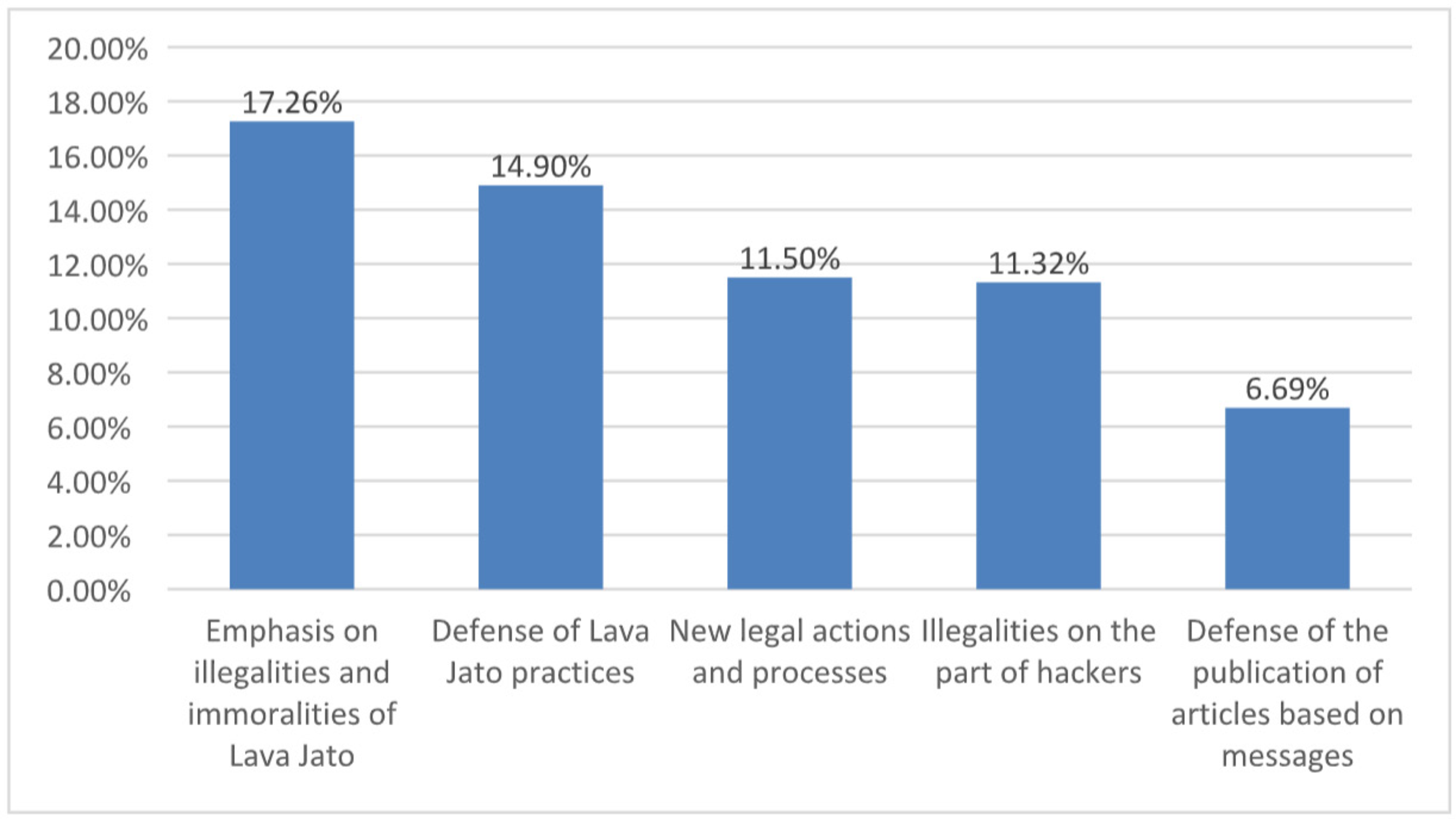
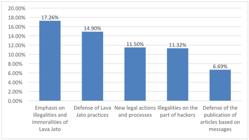
The first narrative guides all of Folha’s coverage during the period analyzed. Most of the pieces had a negative focus (38.56%), with the emphasis on the illegalities and immoralities of Lava Jato (17.26%) being the predominant action taken – graph 1. This negativity and unethical nature, present in scandals, could lead to the erosion of citizens’ trust in politicians (Ares & Hernández, 2017; Solé-Ollé & Sorribas-Navarro, 2017; Zaloznaya et al., 2022).
In the framing analysis, the negative tone of the publications regarding the scandals is frequent. The publications in the Problem Definition framing (framing that attacks Moro and the prosecutors of Lava Jato) indicate that violations of norms and laws, as well as the partiality of public agents, are among the most common subcategories.
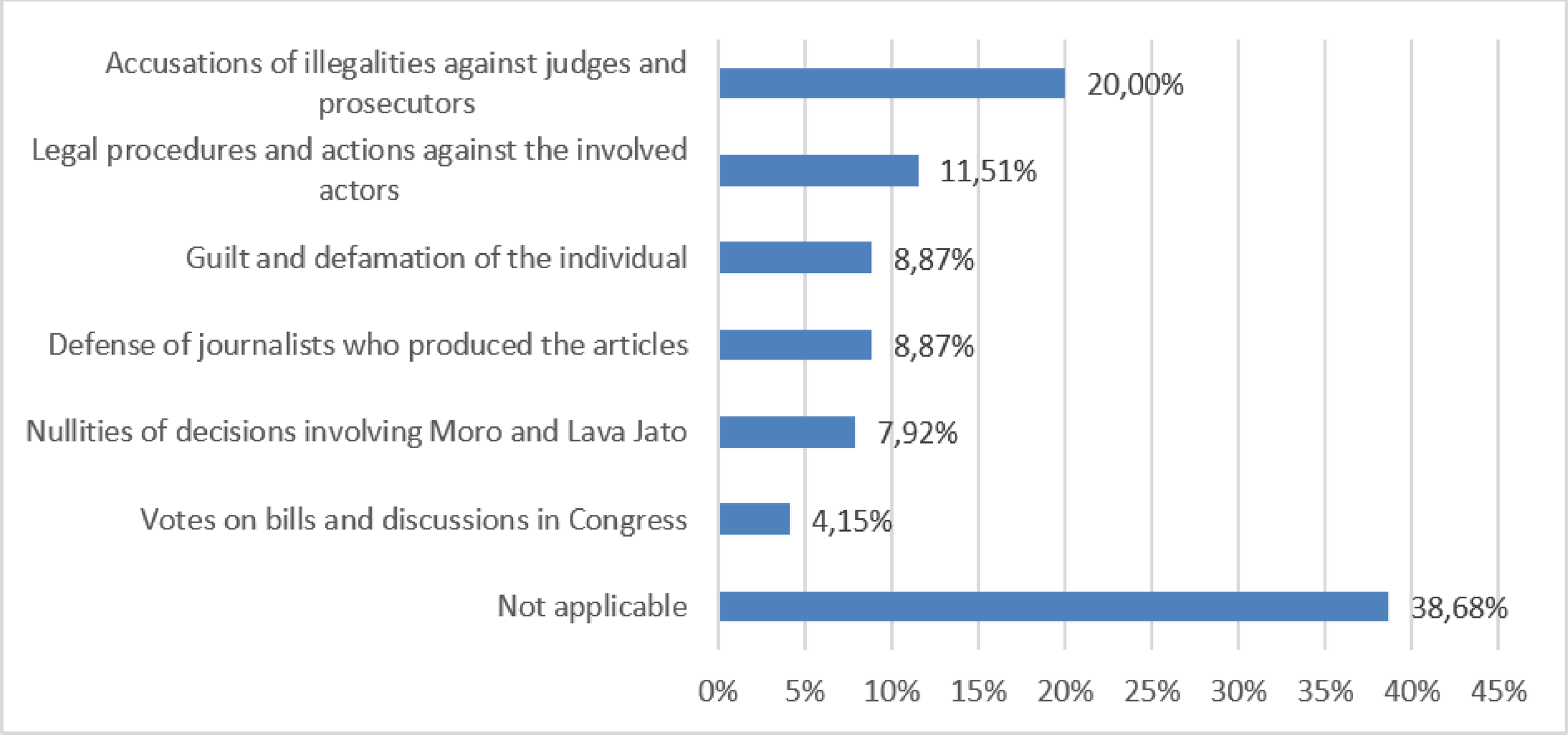
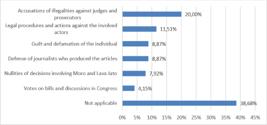
In the Solution Suggestion framing (framing that attacks Moro and the prosecutors of Lava Jato), the accusations of illegalities against judges and prosecutors are also the most frequent category (20%), followed by legal procedures and actions against the involved actors (11.51%) – graph 2. It is possible to note the antithesis in the coverage of Moro, who was previously represented as a hero by Folha (Cruz & Kunsch, 2020; Medeiros & Silveira, 2017; Pereira & Silva, 2021; Prado, 2018). As a parallel, in the case of Snowden – which exposes the mass surveillance conducted by the U.S. government and its allies – both The New York Times and The Washington Post construct Snowden positively as a new type of leaker and as a hero, in the sense that he revitalizes the importance of freedom of speech as a living myth in the United States of America (USA) (Nugroho, 2020).
On June 23, the outlet announced its partnership with The Intercept Brasil (TIB) and began publishing exclusive reports based on the leaked messages, generating a new peak of articles between June 24 and June 26 (8.14% of the total). The revelations stood out in the coverage of Vaza Jato. This is especially clear in the Thematic focus category, with 56 news stories (10.56%) covering the scandal’s revelation.
To strengthen the argument regarding the improper conduct of Moro, Dallagnol, and other prosecutors, excerpts from the Code of Criminal Procedure, the Federal Constitution, and the Code of Ethics for Judges are cited, relating to the independence of powers and the impartiality required of a judge. Expert opinions corroborate the gravity of the scandals (“the manner in which this was done contradicts the legislation”; “there are indications of Moro’s bias”; “there are grounds for administrative proceedings” – June 10).
Despite this narrative, Moro and the prosecutors had their defenses reported and were the most frequently mentioned active agents in the journalistic pieces. This contributed to the action taken in the Defense of Lava Jato being the second most frequent.
Narrative 2 – The messages disseminated by TIB were authentic, and there was no crime in their dissemination
Since the initial publications, Folha emphasized that it “had access to the material and found no evidence that it may have been tampered with” (June 23) and that the reporters dedicated considerable time to “analyzing the dialogues, examining the context of discussions in the various messaging groups, and verifying the information found to assess the consistency of the material” (June 23). There are also examples of specific cases that helped confirm facts mentioned in the messages: “messages about a meeting with Fausto Silva and Lava Jato that were confirmed by the host” (June 10).
Folha also explained that its journalists did not commit crimes by publishing articles derived from illegal means and that source confidentiality is guaranteed by the Constitution, thus constituting an integral element of democracy. “Folha does not engage in illegal acts to obtain information; however, it may publish information that resulted from illegal acts if there is public interest in the material obtained” (June 25). In some scientific studies on Vaza Jato, public interest was emphasized (Dalmonte & Queiroz, 2020; Gabardo et al., 2021). Davis and Meckel (2013) report how WikiLeaks – a scandal related to the leak of classified documents about the wars in Afghanistan and Iraq and U.S. diplomatic communications – also relied on the argument of public interest for the dissemination of documents. The authors discuss the debate surrounding this term and how public support for the dissemination of documents has diminished over time.
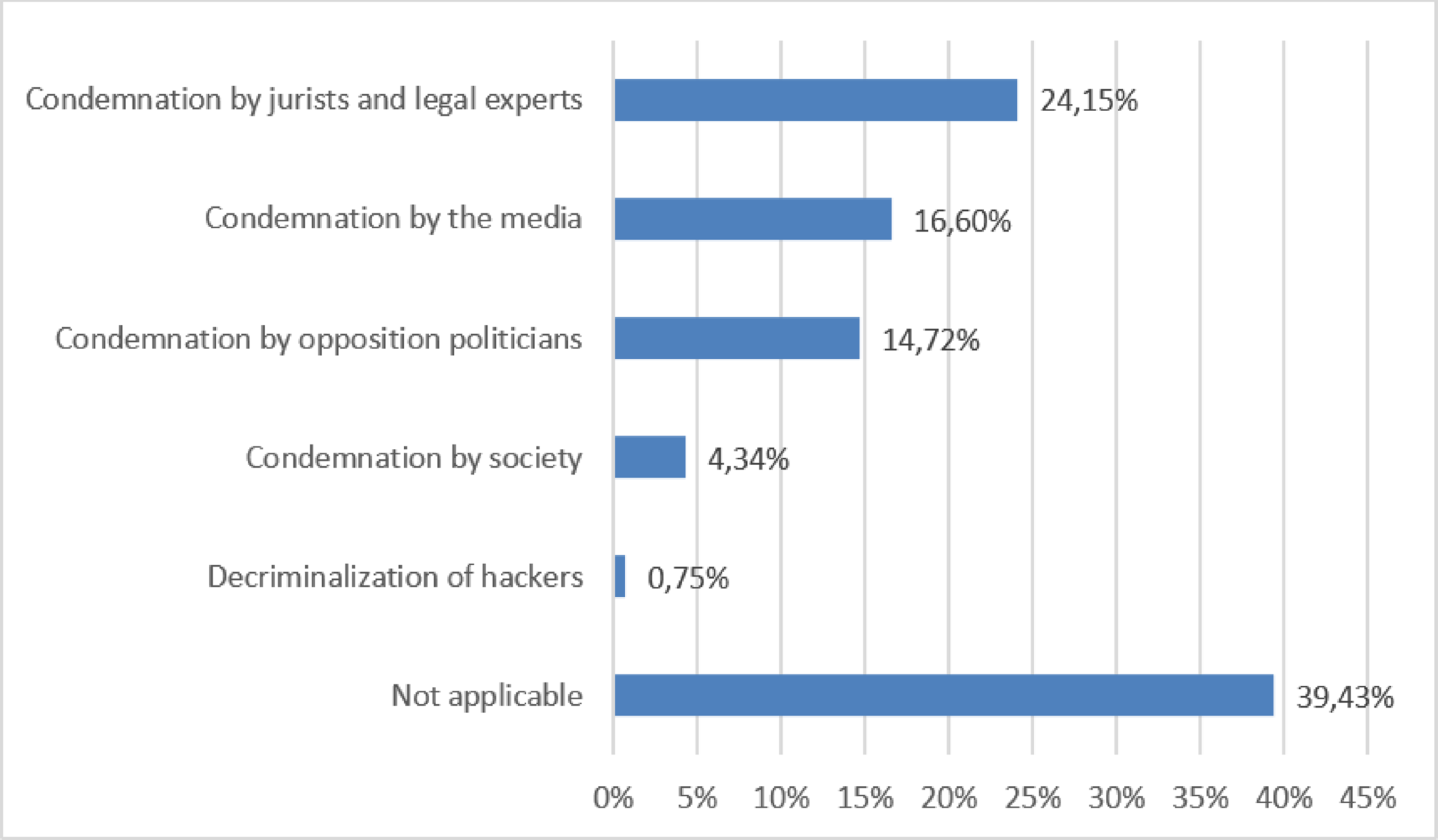
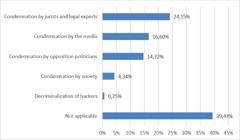
The scandal regarding the Investigation of Glenn Greenwald and threats to the journalist was among the most cited (6.03%). This scandal concerned the potential investigation of the editor-in-chief of TIB, who had suspicions raised by defenders of Lava Jato regarding involvement in collusion with hackers for the illegal acquisition of conversations. On the other hand, the Defense of publications derived from the messages ranked among the primary actions taken by the active agents in Folha’s articles. Moreover, in the framing analysis, the presence of publications in Moral Judgment (framing attacking Moro and the prosecutors of Lava Jato) indicates Condemnation by the media as the second most common subcategory (16.60%) – graph 3.
Narrative 3 – Lava Jato distorted content and denied evidence, presenting inconsistencies in its defenses
Folha gave voice to experts who agreed with the notion that Moro might have been biased and could have made defensive claims that contrasted with the law. Various judges and legal experts, including ministers of the Supreme Federal Court (STF), were consulted by the publication, corroborating the possibility of bias: “If it is understood that Moro was compromised with the Prosecutor’s Office (i.e., was suspect), the sentences he issued may be annulled” (August 6).
The narrative also incorporated commentary on the repercussions of exclusive journalistic pieces published by the outlet following its partnership with TIB (“Moro Distorts Report When Justifying Omission of Paid Lecture as Judge” – August 4; “Moro Distorts Laws When Explaining Conversation with Deltan, Experts Say” – June 14). This narrative further served to expose contradictory behaviors between the statements and actions of the Lava Jato prosecutors. It was emphasized that, initially, the prosecutors did not deny the authenticity of the conversations and that “four days later, the Lava Jato task force’s narrative changed, and possible tampering was suggested” (June 13).
5.2 News and editorials discourse in Folha justifying the decision to publish the Vaza Jato conversations
From the outset, the journalistic pieces published by Folha reproduced the full dialogues featured in the Vaza Jato series, accepting them as true and relevant for reporting. In most cases, excerpts from the messages appeared in the title or lead (“In Fux We Trust” – June 12; “Aha Uhu, Fachin Is Ours” – July 9). It makes sense to use these components (title or lead) to highlight the messages, as they are the most-read elements and reflect the most important aspects of any piece.
The publication adopts a cautious stance regarding possible illegalities committed: “Collaborations call into question the impartiality of the Justice system”; “There may have been ethical breaches” – June 10. Regarding the hacking attacks, terms such as “it is suspected” and “they may have accessed” are used – June 10. In the scientific literature, Moretzsohn and Pinto (2020) also observe that the immediate reaction in the case of Vaza Jato fluctuates between caution and suspicion.
With Folha’s access to TIB’s database, messages are exposed to provide the reader with a broader context (“Read excerpts of messages exchanged by the Lava Jato prosecutors…” – July 7; August 1). Details in “To Understand the Conversations” (June 10) and summaries became constants. There is also a noticeable reinforcement of the positioning strategy in favor of the authenticity of the leaked conversations. “The reporters sought names of Folha journalists and found several messages exchanged with members of the task force over the past few years, thereby obtaining strong evidence of the material’s integrity” – June 23.
The editorials also defend the legitimacy and authenticity of the dialogues and the right of TIB and other outlets to publish the leaked conversations (“Evident public interest justifies the publication of its content” – July 27). Moretzsohn and Pinto (2020) highlight that, in Brazil, traditional media have become accustomed to using information from leaks, which has generated some of the most significant political scandals in the country. It is further emphasized that Folha “found no signs of tampering upon examining the messages” (July 27). There is an effort to counter the contestation arguments put forth by Moro and Dallagnol regarding the messages (“The argument attempting to question the reliability of the messages is weak” – July 27) and to adopt a critical tone toward the defense strategy that seeks to question the veracity of the conversations (“There was no denial among the participants of the conversations”; “The defense strategy is diversionary and likely ineffectual” – August 10).
Additionally, there is a clear defense by Folha concerning TIB’s position on the origins of the messages, attributed to an anonymous source, which underpinned the initial publications on the website (“According to TIB, the leak is not related to the attack on Sergio Moro’s cell phone that occurred on June 4” – June 10). The publication also notes that at that time, there was “no evidence that the dialogues were obtained by Intercept’s anonymous source from a hacking attack” – June 10. Over the months, it was discovered that the hackers had provided the messages to TIB anonymously. However, during the entire period, journalists were defended, exonerating them from any kind of illegal conduct. It is emphasized that source confidentiality is a guarantee established by the Brazilian Constitution, as is the principle of freedom of the press guaranteed by democracy. Folha may “publish information that is the result of an illegal act if there is a public interest in the gathered material” – June 25.
Another notable point is the possibility of investigating Greenwald, who received the leaked conversations. Following the publication of a report stating that an agency linked to the Ministry of Finance would investigate his financial transactions, there were allegations of threats to “freedom of the press and expression” (July 9–12). In the subsequent weeks, the outlet also produced articles about Greenwald’s public statements and covered events supporting press freedom, and TIB. A similar situation arises when Moro claims he would destroy the files containing the leaked messages found with the hackers at the time of their arrests. Moro’s statement, which would involve eliminating messages that compromised him, garnered strong critical reactions in the editorials (“unjustifiable interference in the investigation of hackers”; “Moro’s actions are shocking” – July 27). The publication further emphasizes that “Moro’s haste sounded like an attempt to intimidate Intercept and other outlets that have published the messages, such as this Folha”. Thus, Folha positions itself as one of the actors who would be intimidated by Moro and whose freedom of expression is under attack.
5.3 Editorial decisions by Folha to ensure journalistic quality in reporting on Vaza Jato
Folha was “the first media outlet approached. They [TIB] were seeking that credibility” (Sergio Davila). Davila emphasizes that the partnership involved the credibility of Folha and that of Greenwald, “a renowned journalist who had broken a world story”, globally known for producing reports based on data leaked by former Central Intelligence Agency (CIA) agent Edward Snowden. Moretzsohn and Pinto (2020) explain that the strategy adopted for the dissemination of the Vaza Jato series involved partnerships with traditional media outlets – Folha de S.Paulo, UOL, Veja, El País Brasil, and columnist Reinaldo Azevedo, who was a radical critic of the PT – with a dual purpose: on one hand, to gain more resources and expertise to work on the extensive material obtained and reach a broader audience, and on the other hand, to provide the allegations with more legitimacy beyond the leftist bubble in which TIB is situated, which is directly related to the issue of credibility.
Due to the extent and potential of the material publication, the production of reports on the subject became a priority for the newsroom. “It was priority content, our main agenda at that moment. We even assigned a team of four reporters to it, which is uncommon”. Davila emphasizes that “Folha would control everything it published; everything would be edited and fact-checked. The documents would not be published uncritically”. The editor clarifies the necessary precautions surrounding the dissemination of the materials, including the confirmation of their authenticity: “Our team would investigate, and when we found something consistent, we would publish it. Without much concern for timing or exclusivity. We only published when we were certain”. All material was obtained through primary sources, that is, through access to the original documents obtained by the hackers.
Moretzsohn and Pinto (2020) clarify that it was easy to believe in the integrity of the confidential source, the integrity of the dialogues, their proper contextualization, and the criteria used by the journalism team to select what was relevant to publish. This was because, on the one hand, it dealt with “the proof of what had already been denounced since the beginning of Operation Lava Jato: its selectivity, partisanship, and arbitrariness, and its decisive role in the process that led to the downfall of the PT government” (p. 198), and on the other hand, due to Greenwald’s proven competence and international prestige thanks to the Snowden case. Regarding the WikiLeaks case, it is possible to observe that the responsible journalists also sought to fulfill the norms of fairness and accuracy through a refined mechanism to prove the authenticity of the leaked documents (Thomaß, 2011). The protection of sources was also an absolute principle of WikiLeaks, which had as its fundamental principles maintaining the anonymity and security of whistleblowers (Thomaß, 2011).
In the case of Vaza Jato, Sergio Davila states that Folha produced more contextualized reports so that the leaked messages would not be the only presented elements. “The material would serve as a starting point. We contextualized it, sought data, consulted experts, and clarified whether any laws had been broken or not”. Among major newspapers, Folha was the one that reported the content of the leaks the most. However, before Vaza Jato, Folha had expressed a pro-Lava Jato stance and a markedly “anti-PT” rhetoric (Feres et al., 2021).
The concern to emphasize the independence of the newspaper is constant throughout Davila’s interview. The editor reinforces that Folha’s ideals of independence were decisive for the partnership proposal (“Glenn identified with the position of independence and with the editorial project of critical and nonpartisan journalism”) and for the newspaper to maintain its credibility over time, even after the criticisms suffered due to its partnership with a left-leaning website (“Part of the audience following Folha questioned whether this was a shift to the left. I wasn’t worried about that questioning at the time because I knew we would quickly prove that independence would continue”). Davila emphasizes the concern to maintain independence, but notes that it was not “a deliberation or an order, but something that was naturally proven in day-to-day operations”, through journalistic quality. Externally, the partnership faced questioning from other journalists. “My response was: wait and see if independence is compromised or not. The years show that it is not”.
The editor-in-chief also highlights that Folha spent “weeks publishing the results of our investigation into Vaza Jato alone, until other media outlets began to focus on its repercussions”, attributing this reactive sluggishness to a reluctance on the part of those outlets to displease sources from Lava Jato. “If you touched on the leaks subject, perhaps those sources would stop providing information to you. This happened, and the doors of Lava Jato were closed to us. It was a risk we decided to take”.
The editor also assesses that the Brazilian press coverage of Lava Jato suffered from an excess of “source dependency”, preventing journalists from having a comprehensive view of the facts, focusing only on “selected facts of interest to the sources themselves”. Davila includes Folha itself as part of a biased coverage. “We participated in this cycle”. Various criticisms have been directed at Folha. For instance, Feres et al. (2021) argue that Folha should “engage in a mea culpa instead of awarding its own reports or, worse, commissioning journalists it employs to weave fanciful narratives about the newspaper’s critical oversight of Lava Jato and Sérgio Moro”. Similarly, Cittadino and Oliveira (2021) point out that, during the coverage of Lava Jato, media monitoring was “completely uncritical: sensationalist coverage of arrests, coercive measures, and search and seizure warrants; automated reproduction of excerpts from plea bargains without filters or context”.
For Davila, the selected leaks from Operation Lava Jato helped to “define the political climate of the country in the prior years (between 2014 and 2018)” and to determine “the direction of Brazilian politics, to the extent that it helped define a presidential election”, while the reports of Vaza Jato contributed to “leveling the playing field in the following years, placing in perspective all those elements that had led to the president’s conviction”. “We decided to prioritize this new investigation to counterbalance that previous investigation and to better contextualize what we had been publishing until then”.
The previous investigation, which Davila assumes was biased, can be explained by the mechanism of information cascades that occurs in decision-making based on social proofs derived from publicly available signals rather than the confirmation of knowledge (Damgaard, 2018, p. 115). The cascades emerge when all actors make the same assumptions, reproduce the action, and transmit the same signal, even when it may be false. This functioning can be precipitated by the news value of competition and by intermediary agenda-setting, which refers to the inter-influences among outlets in thematic agendas. According to Damgaard (2018), who also analyzes in his study articles published in Folha, the inflated value of information regarding the perceived center of power will devalue news about other powerful political actors, reducing accountability and transparency for the electorate.
What occurs, then, is not the media informing the Brazilian public about the fight against corruption but rather a strong public with decision-making power (the Brazilian Congress) deliberating internally, through the media, on solutions for corruption investigations (p. 138). This happens because, by gathering certain public signals sent by political actors and reproduced by the media, political issues can become so confounded that the anticipation and overvaluation of political disturbances by the media obscure both the potential consequences and the intentions behind the processes that lead to those disturbances. The consequences of an information cascade can explain the bias in general media attention, such as the documented anti-government bias in the Brazilian media (p. 115). In turn, Cittadino and Oliveira (2021) are more critical, stating “Folha de S.Paulo and Lava Jato, the uncomfortable truth”, and underpinning the partial and biased behaviors of newspapers in ignorance or complicity, in “sensationalist and irresponsible journalism”.
6 Final considerations
Journalism should serve as a social and political watchdog, promoting democratic functions, transparency, and accountability (Harrison & Sayogo, 2014). Folha, faced with the dilemma of whether to publish the Vaza Jato series of reports, chose to attempt to be a democratic instrument and to adhere to principles of journalistic quality. Thus, based on authors such as Abramson (2010), Scheuer (2007), and Shapiro (2010), it can be assessed that Folha sought to convey ideas of independence when covering stories that questioned and would negatively impact agents of Lava Jato, who had significant public appeal. Although it did not issue a public “mea culpa” as suggested by Feres et al. (2021), the editor-in-chief of Folha admits that the newspaper’s coverage of Lava Jato was flawed due to excessive reliance on sources and trust in the transmitted information. Nevertheless, he seeks to reinforce the ideals of independence by emphasizing that the outlet risked having Lava Jato sources close their doors and reiterates that it was the only traditional media outlet to publish stories until others did, thereby contributing to the effect of intermediary agenda-setting. Throughout the publication of these stories, the outlet underscores the seriousness of the actions taken by agents of Lava Jato and Former Judge Sergio Moro, seeking new angles and approaches based on the leaked messages, along with contextualization and analyses of their content. It also demonstrated a concern for highlighting and ensuring the veracity of the dialogues as a means of defending the disseminated information authenticity and upholding ethical journalistic principles. There appears to be an alignment between the narratives and discourses of the news pieces and editorials with the interview given by the editor-in-chief.
The adoption of a critical stance towards the actions of Lava Jato must, however, be contrasted with Folha’s previous position when it utilized and benefited from the actions and information provided by Lava Jato. This stance does not absolve it from prior criticisms that it did not foster a democratic environment (Cittadino & Oliveira, 2021; Feres et al., 2021).
This shift in approach towards Lava Jato, in the context of Vaza Jato beginning in June 2019 and following the partnership with TIB may have been motivated by a combination of factors. While the commitment to ethical and journalistic principles may have played a significant role, it is important to acknowledge that the decision to distance itself from and criticize Lava Jato and its key protagonists may also have been influenced by strategic considerations aimed at restoring and maintaining credibility, reinforcing the outlet’s ideals of independence, and capitalizing on the broadcast of a political scandal that could generate substantial visibility and increase audience ratings. In complex media contexts, these dimensions often overlap and influence each other.
Folha invoked public interest as a motivating factor for dissemination. While there are discussions regarding which information fits the principles of public interest, it is necessary to ensure a legal and judicial safeguard for journalists, lest there be a retreat from the possibility of publishing original content of public interest. For instance, Pacific and Asian countries criminalize journalists who publish leaked information. The results derived from the three investigative techniques applied also demonstrated ethical considerations in confirming the veracity of the published information, fulfilling the standards required for a fully functioning democracy (Knight Foundation, 2023; Michailidou et al., 2023).
In the Brazilian context, journalists would not be committing a crime by publishing articles derived from illegal means. According to Brazilian law, the crime occurs when an individual violates privacy and gains illegal access to conversations, not when the journalist disseminates material received from third parties (provided the journalist is not involved in the hacking).
Based on the present study, recommendations can be made for addressing a political scandal derived from leaked messages with journalistic quality, including disseminating the content only if authenticity is guaranteed and there is evident public interest, providing a complete exposition of the messages, constructing a broader context with elements that serve as anchors for interpretation, using clear language and accessible formats, publishing original reports with exclusive information, confirming the veracity of information before incorporating excerpts from dialogues into headlines, using the term “it is suspected” and the conditional future tense in cases of doubt, monitoring what competing outlets are doing and saying (the news value of competition), forming partnerships with credible outlets and journalists, not publishing content uncritically, controlling everything that is published, consulting experts, making decisions that respect the newspaper’s editorial identity, demonstrating the newspaper’s independence, adhering to the argument of primary sources, distinguishing between information and opinion, providing exclusive information, understanding and deciding within the ethical and legal framework in which the journalist operates, ensuring source confidentiality, and being steadfast in the freedom to inform and express.
The Vaza Jato case offers several lessons for studies in journalism and political communication, emphasizing ethical issues, the contributions and roles of the media in democracy, and the impact of investigative journalism on the political landscape. One key lesson derived from this case is the role of investigative journalism as a tool for social control and oversight of power. Information leaked about Judge Sergio Moro and Lava Jato prosecutors revealed potential abuses of power, highlighting the media’s role in ensuring transparency within public institutions. The case also underscored the importance of whistleblowing – the use of denouncements and anonymous sources as a means of revealing information of public interest – highlighting the ethical and legal challenges associated with protecting these sources and the use of data obtained through unofficial means.
In the realm of journalistic ethics, the case sparked debates over the responsibility involved in using leaked information, emphasizing the need to balance the right to privacy with public interest. Another lesson emphasizes that maintaining impartiality in a highly politicized environment is essential for preserving the credibility of journalism. In political communication, Vaza Jato exposed the connections between the judiciary and the media, demonstrating how media narratives can influence public perception of justice and politics, affecting electoral processes and institutional decisions. This highlights the necessity for a critical analysis of the relationship between media and justice, particularly in cases of significant political repercussions.
Furthermore, a key lesson is that transparency and accountability are fundamental during political and institutional crises. Governments and institutions require effective communication strategies to manage leaks and reporting while balancing damage control with the duty to inform the public with transparency. It can also be inferred that the media have a responsibility to avoid false equivalencies that may confuse the public and undermine democratic debate. Additionally, the media’s exposure of judicial acts can either strengthen or weaken public trust in institutions, affecting their public image. Consequently, the lesson that media plays a role in shaping the public image of institutions through what and how it reports becomes significant.
Finally, this study can offer various contributions: a) at the academic level, it consolidates knowledge for operational theory and fills a research gap, b) at the professional level, it facilitates reflection on journalistic practices in the context of disseminating a political scandal and provides recommendations based on the practices of the first newspaper to report on Vaza Jato, and c) at the social level, it may contribute to transparency and enhance readers’ trust in quality journalism and press freedom, which are essential for democracy.
REFERENCES
-
Abramson, J. (2010). Sustaining quality journalism. Daedalus, 139(2), 39-44. DOI: 10.1162/daed.2010.139.2.39
» https://doi.org/10.1162/daed.2010.139.2.39 -
Albuquerque, A. (2017). Protecting democracy or conspiring against it? Media and politics in Latin America: A glimpse from Brazil. Journalism, 20(7), 906-923. DOI: 10.1177%2F1464884917738376
» https://doi.org/10.1177%2F1464884917738376 - Albuquerque, A., & Gagliardi, J. (2020). Democracy as corruption: The news media and the debunking of democracy in Brazil. In X. Orchard, S. G. Santamaria, J. Brambila & J. Lugo-Ocando (Eds.), Media and governance in Latin America (pp. 77-95). Peter Lang.
-
Aldé, A., & Vasconcellos, F. (2008). Ao Vivo, de Brasília: escândalo político, oportunismo midiático e circulação de notícias. Revista de Ciências Sociais, 39(2), 61-69. Retrieved from https://dialnet.unirioja.es/descarga/articulo/8437069.pdf
» https://dialnet.unirioja.es/descarga/articulo/8437069.pdf -
Ares, M., & Hernández, E. (2017). The corrosive effect of corruption on trust in politicians: Evidence from a natural experiment. Research & Politics, 4(2), 1–8. DOI: 10.1177/2053168017714185
» https://doi.org/10.1177/2053168017714185 - Argyle, E. (2015). Politicians gone wild: A comparative analysis of political scandals in New Zealand, The United States and France Victoria University of Wellington.
-
Bello, E., Capela, G., & Keller, R. J. (2021). Operação Lava Jato: Ideologia, narrativa e (re)articulação da hegemonia. Revista Direito e Práxis, 12(3), 1645-1678. DOI: 10.1590/2179-8966/2020/53884
» https://doi.org/10.1590/2179-8966/2020/53884 -
Bernardes, J. (2022, May 31). Questionamentos sobre a Lava Jato mudaram visão da imprensa internacional sobre a operação Jornal da USP. Retrieved from www.jornal.usp.br/ciencias/questionamentos-sobre-a-lava-jato-mudaram-visao-da-imprensa-internacional-sobre-a-operacao-aponta-pesquisa/
» www.jornal.usp.br/ciencias/questionamentos-sobre-a-lava-jato-mudaram-visao-da-imprensa-internacional-sobre-a-operacao-aponta-pesquisa/ -
Bowler, S., & Karp, J. (2004). Politicians, scandals, and trust in government. Political Behavior, 26, 271-287. DOI: 10.1023/B:POBE.0000043456.87303.3A
» https://doi.org/10.1023/B:POBE.0000043456.87303.3A -
Carvalho, A. (2008). Media(ted) discourse and society: Rethinking the framework of critical discourse analysis. Journalism Studies, 9(2), 161-177. DOI: 10.1080/14616700701848162
» https://doi.org/10.1080/14616700701848162 -
Castro, A., & Ansari, S. (2017). Contextual “Readiness” for institutional work. A study of the fight against corruption in Brazil. Journal of Management Inquiry, 26(4), 351-365. DOI: 10.1177%2F1056492617696887
» https://doi.org/10.1177%2F1056492617696887 -
Cioccari, D. (2015). Operação Lava Jato: Escândalo, enquadramento e agendamento. Revista Alterjor, 12(2), 58-78. Retrieved from www.revistas.usp.br/alterjor/article/view/aj12-a04/104083
» www.revistas.usp.br/alterjor/article/view/aj12-a04/104083 -
Cittadino, G., & Oliveira, T. (2021, October 18). Folha de S. Paulo e Lava Jato, a verdade que incomoda CartaCapital. Retrieved from www.cartacapital.com.br/opiniao/folha-de-s-paulo-e-lava-jato-a-verdade-que-incomoda/
» www.cartacapital.com.br/opiniao/folha-de-s-paulo-e-lava-jato-a-verdade-que-incomoda/ - Cook, T. (2011). Governing with the news: the news media as a political institution University of Chicago Press.
-
Costas-Pérez, E., Solé-Ollé, A., & Sorribas-Navarro, P. (2012). Corruption scandals, voter information, and accountability. European Journal of Politic Economy, 28(4), 469–484. DOI: 10.1016/j.ejpoleco.2012.05.007
» https://doi.org/10.1016/j.ejpoleco.2012.05.007 -
Cruz, D.P. da, & Kunsch, D.A. (2020). O direito e a direita: A operação lava-jato, a mídia e o poder. Proceedings of the Congreso Latinoamericano de Comunicación de la UNVM. Universidad Nacional Villa María. Retrieved from www.aacademica.org/segundo.congreso.latinoamericano.de.comunicacion.de.la.unvm/123.pdf
» www.aacademica.org/segundo.congreso.latinoamericano.de.comunicacion.de.la.unvm/123.pdf - Cunha, I. F. (2017). Democracia e corrupção política mediatizada. In A. Moreira, E. Araújo & H. Sousa (Eds.), Comunicação e política: Tempos, contextos e desafios (pp. 65-90). Centro de Estudos Comunicação e Sociedade (CECS) – Universidade do Minho.
-
Dalmonte, E., & Queiroz, C. C. (2020). A vigilância como prática e valor jornalístico na cobertura da #VazaJato. Estudos em Jornalismo e Mídia, 17(2), 238-250. DOI: 10.5007/1984-6924.2020v17n2p238
» https://doi.org/10.5007/1984-6924.2020v17n2p238 -
Damgaard, M. (2018). Cascading corruption news: Explaining the bias of media attention to Brazil’s political scandals. Opinião Pública, 24(1), 114-143. DOI: 10.1590/1807-01912018241114
» https://doi.org/10.1590/1807-01912018241114 - Das, B. (2011). Importance of independent media in democracy. Scholar’s Voice: A New Way of Thinking, 2(1), 43-49.
-
Davis, J. W., & Meckel, M. (2013). Political power and the requirements of accountability in the age of WikiLeaks. Zpol Zeitschrift für Politikwissenschaft, 22(4), 463-491. DOI: 10.5771/1430-6387-2012-4-463
» https://doi.org/10.5771/1430-6387-2012-4-463 - De Vreese, C., Esser, F., & Hopmann, D. N. (2016). Comparing political journalism. Routledge.
- Duarte, L. (2020). Vaza Jato: Os bastidores das reportagens que sacudiram o Brasil. Mórula Editorial.
-
Ekström, M., & Johansson, B. (2008). Talk scandals. Media, Culture & Society, 30(1), 61-79. DOI: 10.1177/0163443707084350
» https://doi.org/10.1177/0163443707084350 -
Feres, J. Jr., Cavassana, F., Madruga, A., & Vieira, L. (2021, April 1). Olhar crítico em relação a Lava Jato: uma homenagem da Folha ao dia da mentira. Manchetômetro Retrieved from www.manchetometro.com.br/2021/04/01/olhar-critico-em-relacao-a-lava-jato-uma-homenagem-da-folha-ao-dia-da-mentira/
» www.manchetometro.com.br/2021/04/01/olhar-critico-em-relacao-a-lava-jato-uma-homenagem-da-folha-ao-dia-da-mentira/ -
Fernandes, C., Oliveira, L., & Chagas, G. (2021). Diálogos inconvenientes no Palácio do Jaburu: a midiatização do escândalo político no Jornal Nacional. Chasqui. Revista Latinoamericana de Comunicación, 1(146), 279-302. DOI: 10.16921/chasqui.v1i146.3980
» https://doi.org/10.16921/chasqui.v1i146.3980 -
Fontana, V. (2020). News frames and their influence on political participation and media engagement: A study of the Brazilian Car Wash Operation. Journal of Latin American Communication Research, 8(1-2), 109-129. DOI: 10.55738/journal.v8i1-2p.109-129
» https://doi.org/10.55738/journal.v8i1-2p.109-129 -
Freedom House. (2024, n.d.). Freedom in the world. Brazil Retrieved from www.freedomhouse.org/country/brazil/freedom-world/2024
» www.freedomhouse.org/country/brazil/freedom-world/2024 -
Gabardo, E., Lazzarotto, G. S., & Watzko, N. A. M. (2021). Ética pública e parcialidade no combate à corrupção: o caso The Intercept Brasil vs. Operação Lava Jato. International Journal of Digital Law, 2(1), 151–198. DOI: 10.47975/IJDL/1gabardo
» https://doi.org/10.47975/IJDL/1gabardo -
Geiss, S., Allern, S., & Pollack, E. (2012). Scandalous! The mediated construction of political scandals in four Nordic countries. International Journal of Public Opinion Research, 26(2), 269–272. DOI: 10.1093/ijpor/eds026
» https://doi.org/10.1093/ijpor/eds026 - Greenwald, G., & Plougy, V. (2023). Em defesa da democracia Autonomia Literária.
-
Harcourt, R., Bruine de Bruin, W., Dessai, S., & Taylor, A. (2020). What adaptation stories are UK newspapers telling? A narrative analysis. Environmental Communication, 14(8), 1–18. DOI: 10.1080/17524032.2020.1767672
» https://doi.org/10.1080/17524032.2020.1767672 -
Harrison, T. M., & Sayogo, D. S. (2014). Transparency, participation, and accountability practices in open government: A comparative study. Government Information Quarterly, 31(4), 513-525. DOI: 10.1016/j.giq.2014.08.002
» https://doi.org/10.1016/j.giq.2014.08.002 -
Iory, N. (2024, March 3). Dez anos da Lava-Jato: reação dos políticos é motivo mais citado pelos brasileiros para o fim da operação, revela pesquisa O Globo. Retrieved from www.oglobo.globo.com/blogs/pulso/post/2024/03/dez-anos-da-lava-jato-reacao-dos-politicos-e-motivo-mais-citado-pelos-brasileiros-para-o-fim-da-operacao-revela-pesquisa.ghtml
» www.oglobo.globo.com/blogs/pulso/post/2024/03/dez-anos-da-lava-jato-reacao-dos-politicos-e-motivo-mais-citado-pelos-brasileiros-para-o-fim-da-operacao-revela-pesquisa.ghtml -
Jadhav, T. (2014). A study of role played by Mediain consumer interest. Indian Streams Research Journal, 4(8), 1–7. Retrieved from https://papers.ssrn.com/sol3/papers.cfm?abstract_id=2502734
» https://papers.ssrn.com/sol3/papers.cfm?abstract_id=2502734 -
Knight Foundation. (2023, February 15). American views 2022: Part 2, Trust media and democracy Retrieved from https://knightfoundation.org/reports/american-views-2023-part-2/
» https://knightfoundation.org/reports/american-views-2023-part-2/ -
Kumlin, S., & Esaiasson, P. (2012). Scandal fatigue? Scandal elections and satisfaction with democracy in Western Europe, 1977–2007. British Journal of Political Science, 42(2), 263–282. DOI: 10.1017/S000712341100024X
» https://doi.org/10.1017/S000712341100024X - Larangeira, A. N., & Junior, T. P. (2020). Idolatria e desmascaramento do Judiciário de exceção: Sérgio Moro, Operação Lava Jato e a Vaza Jato. In J.M. Gómez, M.C. Turón-Padial & M.J. Cartes Barroso (Eds.), Más sobre Periodismo y Derechos Humanos Emergentes (pp. 176-201). Universidad de Sevilla.
-
Lima, A. E. C., & Pilau, L. S. B. (2022). Os usos da Vaza Jato. Revista De Ciências Sociais, 53(2), 153–196. DOI: 10.36517/rcs.53.2.d05
» https://doi.org/10.36517/rcs.53.2.d05 -
Mancini, P. (2018). “Assassination Campaigns”: Corruption scandals and news media instrumentalization. International Journal of Communication, 12(1), 3067-3086. Retrieved from https://ijoc.org/index.php/ijoc/article/view/7098
» https://ijoc.org/index.php/ijoc/article/view/7098 - McNair, B. (2002). Journalism and democracy: An evaluation of the political public sphere. Routledge.
- McQuail, D. (2010). Mass communication theory Sage.
-
Medeiros, C. R. O., & Silveira, R. A. (2017). A Petrobrás nas teias da corrupção: mecanismos discursivos da mídia brasileira na cobertura da Operação Lava Jato. Revista de Contabilidade e Organizações, 11(31), 11-20. DOI: 10.11606/rco.v11i31.134817
» https://doi.org/10.11606/rco.v11i31.134817 -
Mészáros, G. (2020). Caught in an authoritarian trap of its own making? Brazil’s “Lava Jato” anti‐corruption investigation and the politics of prosecutorial overreach. Journal of Law and Society, 47(S1), S54-S73. DOI: 10.1111/jols.12245
» https://doi.org/10.1111/jols.12245 - Michailidou, A., Eike, E., & Trenz, H.J. (2023). Journalism, truth and the restoration of trust in democracy: Tracing the EU ‘fake news’ strategy. In M. Conrad, G. Hálfdanarson, A. Michailidou, C. Galpin & N. Pyrhönen (Eds.), Europe in the age of post-truth politics (pp. 53-75). Springer.
-
Moreira, A., Araújo, E., & Sousa, H. (2019). A corrupção e os média: Um olhar dos jornalistas sobre a relevância do tempo. Comunicação e Sociedade, 35(1), 173-192. DOI: 10.17231/comsoc.35(2019).3137
» https://doi.org/10.17231/comsoc.35(2019).3137 -
Moretzsohn, S. (2019). Entrevista: Imprensa brasileira historicamente fragiliza a democracia. Estudos em Jornalismo e Mídia, 16(2), 177-184. DOI: 10.5007/1984-6924.2019v16n2p177
» https://doi.org/10.5007/1984-6924.2019v16n2p177 - Moretzsohn, S. D., & Pinto, M. (2020). O caso Vaza Jato: Uma discussão sobre verdade, política, ética e credibilidade. In Z. Pinto-Coelho, T. Ruão & S. Marinho (Eds.), Dinâmicas comunicativas e transformações sociais (pp. 182-201). CECS – Universidade do Minho.
-
Nugroho, C. (2020). The construction of Edward Snowden as a whistleblower in the New York Times and the Washington Post and how it represents American freedom of speech. Jurnal Bahasa, Sastra, dan Studi Amerika, 26(2), 126–144. DOI: 10.20961/jbssa.v26i2.41800
» https://doi.org/10.20961/jbssa.v26i2.41800 -
Oliveira, R. (2020, October 23). ‘Vaza Jato’, a investigação que obrigou a imprensa brasileira a se olhar no espelho El País. Retrieved from https://brasil.elpais.com/brasil/2020-10-23/vaza-jato-a-investigacao-que-obrigou-a-imprensa-brasileira-se-olhar-no-espelho.html
» https://brasil.elpais.com/brasil/2020-10-23/vaza-jato-a-investigacao-que-obrigou-a-imprensa-brasileira-se-olhar-no-espelho.html -
Pereira, M. H. de F., & Silva, D. P. (2021). Sergio Moro negacionista? Operação Lava Jato, transparência atualista e negação da política. Revista Brasileira de História, 41(87), 135-159. DOI: 10.1590/1806-93472021v42n87-08
» https://doi.org/10.1590/1806-93472021v42n87-08 -
Pereira, R. (2018, March 16). Números mostram por que Lava Jato é a maior operação contra corrupção da história. Paraná Portal. Retrieved from https://paranaportal.uol.com.br/destaque-2/numeros-mos tram-por-que-lava-jato-e-maior-operacao-contra-corrupcao-da-historia/
» https://paranaportal.uol.com.br/destaque-2/numeros-mos tram-por-que-lava-jato-e-maior-operacao-contra-corrupcao-da-historia/ -
Prado, G. dos S. (2018). “A personificação do herói”: As representações de Sérgio Moro nas capas das revistas Veja, IstoÉ e Época. Proceedings of the XIX Congresso de Ciências da Comunicação (Intercom) Sociedade Brasileira de Estudos Interdisciplinares da Comunicação. Retrieved from https://portalintercom.org.br/anais/sul2018/resumos/R60-0513-1.pdf
» https://portalintercom.org.br/anais/sul2018/resumos/R60-0513-1.pdf -
Prior, H. (2015). O escândalo político como experiência narrativa. Brazilian Journalism Research, 11(2), 100–119. DOI: 10.25200/BJR.v11n2.2015.722
» https://doi.org/10.25200/BJR.v11n2.2015.722 -
Prior, H. (2018). Escândalo político e narratologia: Tecendo os fios narrativos dos casos Face Oculta e Lava Jato. Revista Famecos, 25(1), 1–25. DOI: 10.15448/1980-3729.2018.1.28191
» https://doi.org/10.15448/1980-3729.2018.1.28191 -
Prior, H., Guazina, L., & Araújo, B. (2015). Corrupção e escândalo político: o enquadramento dos escândalos Face Oculta e Mensalão na imprensa portuguesa e brasileira. Media & Jornalismo, 14(26), 167–185. DOI: 10.14195/2183-5462_26_10
» https://doi.org/10.14195/2183-5462_26_10 - Psychogiopoulou, E. (2014). Media freedom and independence in contemporary democratic societies. In E. Psychogiopoulou (Ed.), Media policies revisited (pp. 22-38). Palgrave.
-
Puglisi, R., & Snyder, J. M. (2011). Newspaper coverage of political scandals. The Journal of Politics, 73(3), 931–950. DOI: 10.1017/S0022381611000569
» https://doi.org/10.1017/S0022381611000569 - Ritchie, J., & Lewis, J. (2003). Qualitative research practice. Sage.
- Rottinghaus, B. (2019). Why scandals (might) be good for democracy. In H. Tumber & S. Waisbord (Eds.), The Routledge Companion to Media and Scandal (pp. 55–66). Routledge.
- Scheuer, J. (2007). The big picture: Why democracies need journalistic excellence Routledge.
- Semetko, H., Blumler, J.G., Gurevitch, M., Weaver, D.H. & Barkin, S. (1991). The Formation of Campaign Agendas: A Comparative Analysis of Party and Media Roles in Recent American and British Elections. Lawrence Erlbaum.
-
Shanahan, E. A., Jones, M. D., & McBeth, M. K. (2018). How to conduct a narrative policy framework study. The Social Science Journal, 55(3), 332-345. DOI: 10.1016/j.soscij.2017.12.002
» https://doi.org/10.1016/j.soscij.2017.12.002 -
Shapiro, I. (2010). Evaluating journalism. Journalism Practice, 4, 143-162. DOI: 10.1080/17512780903306571
» https://doi.org/10.1080/17512780903306571 -
Sharma, J. K., & Dubey, K. G. (2018). The role of media is vital in ensuring democracy and good governance. Journal of Emerging Technologies and Innovative Research, 5(4), 291-296. Retrieved from https://www.jetir.org/papers/JETIR1804057.pdf
» https://www.jetir.org/papers/JETIR1804057.pdf -
Silva Cruz, A. C. (2023). Operação Lava Jato e Lula: enquadramento e memória na Folha de S.Paulo. Pauta Geral – Estudos Em Jornalismo, 10(1), 283-303. DOI: 10.5212/RevistaPautaGeral.v.10.21729
» https://doi.org/10.5212/RevistaPautaGeral.v.10.21729 -
Solé-Ollé, A., & Sorribas-Navarro, P. (2017). Trust no more? On the lasting effects of corruption scandals. European Journal of Political Economy, 55, 185–203. DOI: 10.1016/j.ejpoleco.2017.12.003
» https://doi.org/10.1016/j.ejpoleco.2017.12.003 - Sousa, L. (2011). Corrupção Fundação Francisco Manuel dos Santos.
- Strömback, J., & Sehata, A. (2020). Political journalism. In H. Örnebring (Ed.), The Oxford encyclopedia of journalism studies (pp. 1319–1338). Oxford University Press.
-
Thomaß, B. (2011). Wikileaks and the question of responsibility within a global democracy. European View, 10(1), 17-23. DOI: 10.1007/s12290-011-0170-6
» https://doi.org/10.1007/s12290-011-0170-6 - Thompson, J. B. (2000). Political scandal: Power and visibility in the media age Polity Press.
-
Van Dijk, T. A. (2017). How Globo media manipulated the impeachment of Brazilian President Dilma Rousseff. Discourse & Communication, 11(2), 199-229. DOI: 10.1177%2F1750481317691838
» https://doi.org/10.1177%2F1750481317691838 -
Yahya, H. (2022, February 01). Jornais em 2021: impresso cai 13%; digital sobe 6%. Poder 360. Retrieved from https://www.poder360.com.br/economia/jornais-em-2021-impresso-cai-13-digital-sobe-6/
» https://www.poder360.com.br/economia/jornais-em-2021-impresso-cai-13-digital-sobe-6/ -
Waisbord, S. R. (2004). Scandals, media, and citizenship in contemporary Argentina. American Behavioral Scientist, 47(8), 1072-1098. DOI: 10.1177/0002764203262278
» https://doi.org/10.1177/0002764203262278 -
Zaloznaya, M., Glanville, J., & Reisinger, W. M. (2022). Explaining Putin’s impunity: public sector corruption and political trust in Russia. Post-Soviet Affairs, 38(5), 386–409. DOI 10.60586X.2022.2063633
» https://doi.org/10.60586X.2022.2063633
Edited by
-
Desk Review Editor:
Silvio Waisbord and Liziane Guazina
History
-
Received
26 Mar 2024 -
Reviewed
30 May 2024 -
Reviewed
17 Aug 2024 -
Reviewed
23 Sept 2024 -
Accepted
04 Oct 2024