 Prognostic value of preoperative coagulation scoring system in patients with oral squamous cell carcinoma
Abstract
Abnormal coagulation function is closely associated with the prognosis of patients with malignant tumors. In this study, we aimed to explore the prognostic value of preoperative coagulation scoring system in patients with oral squamous cell carcinoma (OSCC). A total of 267 patients with OSCC who were treated at the Affiliated Huaian No.1 People’s Hospital of Nanjing Medical University between January 2016 and December 2019 were included. Survival prediction values for fibrinogen level and international normalized ratio (INR) were identified according to receiver operating characteristic (ROC) cut-off analysis. Patients were divided into three groups based on the F-INR score combined with fibrinogen and INR: score 2 group (both high fibrinogen and high INR), score 1 group (either elevated fibrinogen or INR), and score 0 group (neither abnormality). The association between F-INR score and clinicopathological parameters was evaluated. The clinical risk factors were evaluated using univariate and multivariate Cox regression analyses. Kaplan-Meier analysis was used to estimate the survival of patients with OSCC. The predictive value of preoperative F-INR in OSCC was better than that of fibrinogen and INR alone (area under the curve, (AUC): 0.766 vs. 0.704 vs. 0.611). Multivariate Cox regression analysis showed that F-INR may be an independent predictor of cancer-specific survival (CSS) in OSCC (F-INR 1, hazard ratio [HR] = 8.210, 95%CI: 1.156–58.282, p = 0.035; F-INR 2, HR = 2.475, 95%CI: 1.284–4.772, p = 0.007). Kaplan-Meier analysis indicated that patients with high fibrinogen levels or F-INR had a poor prognosis (p < 0.05). Preoperative F-INR may be an independent prognostic factor in patients with OSCC.
Descriptors
Squamous Cell Carcinoma of Head and Neck; Fibrinogen; International Normalized Ratio; Prognosis
Introduction
Oral cancer ranks 18th among malignant tumors, with 377,713 new cases and 177,757 cancer deaths worldwide annually.1 Oral squamous cell carcinoma (OSCC) is the most common type of oral cancer, with strong invasion and metastatic abilities in the early stages. It has been reported that OSCC is caused by a variety of etiological factors, including smoking, alcohol consumption, betel quid chew, and human papillomavirus (HPV) infection.2 Treatment options for OSCC primarily include surgical resection, radiation, targeted therapy, and chemotherapy. Nevertheless, the 5-year survival rate of patients with OSCC has not improved significantly due to cervical lymph node metastasis, locoregional recurrence, and therapeutic resistance.3At the same time, the high heterogeneity and complex etiology of oral squamous cell carcinoma often make treatment and survival difficult to predict. Currently, there are limitations in parameter selection and tissue invasiveness assessment methods of prediction models for the pathological grading of oral squamous cell carcinoma in clinical applications.4 Therefore, there is an unmet need for effective indicators to predict and assess the prognosis of patients with OSCC during initial clinical evaluation.
Coagulation is a conservative process involving activation, adhesion, platelet aggregation, and the formation of fibrin networks.5Multiple studies have demonstrated that coagulation factors and coagulation functions are critically involved in the occurrence, development, and prognosis of OSCC.6-8 Fibrinogen is a crucial protein in the coagulation system and is produced in the liver by activation of interleukin-6 (IL-6) and IL-1β.9 In the coagulation cascade, fibrinogen is converted into fibrin by activated thrombin, which can regulate the initiation and development of malignant tumors.10 Accumulating evidence has demonstrated that elevated plasma fibrinogen levels play an oncogenic role in poor outcomes in several human cancers including OSCC.11-16 International normalized ratio (INR) is commonly used to monitor the coagulation status and the efficacy of anticoagulant therapy. INR and fibrinogen could be utilized as predictors of colorectal and lung cancers.17,18 However, the potential prognostic value of the combination of these two parameters is yet to be evaluated in OSCC.
Therefore, we aimed to explore the prognostic value of F-INR (combined fibrinogen level and INR score) in patients with OSCC. To the best of our knowledge, this is the first study to reveal the correlation and clinical significance of the preoperative coagulation scoring system in OSCC, which may guide OSCC patient stratification and predict patient survival.
Methodology
Patient enrollment
A total of 267 patients with OSCC who underwent radical resection in the Oral and Maxillofacial Surgery Department of XX Hospital between January 2016 and November 2019 were included in this retrospective study. The inclusion criteria15were as follows: a) patients with a confirmed pathological diagnosis of OSCC, b) no history of cancer and no distant metastasis, c) receiving standard surgical procedures including primary tumor resection and neck dissection, and d) available clinical and follow-up data. Exclusion criteria were as follows: a) patients with other causes for changes in blood values, b) adjuvant radiotherapy or chemotherapy before surgery, c) patients who had discontinued treatment or had not received standard treatment for other reasons, d) previous history of malignant tumors, e) primary tumor located in the oral cavity, but pathologically diagnosed with non-squamous cell carcinoma, f) and having missing or partial data. The study protocol was reviewed and approved by the Research Ethics Committee of the XXXXX Hospital (KY-2023-114-01), and conformed to the principles of the Declaration of Helsinki (2024). All patients provided written informed consent.
Data collection
Patient characteristics were obtained through a retrospective review of medical records using a standardized data collection form. Based on the medical records, the following data were collected: sex, age, smoking, alcohol consumption, hypertension, diabetes mellitus (DM), platelet (PLT) count, INR, fibrinogen level, tumor size, cervical node metastasis, and pathological grade.
Clinical treatment and follow-up assessments
All patients underwent radical surgery for oral cancer. They were followed up via telephonic interviews. Monthly follow-ups were conducted for the first 6 months, and subsequently telephonic or clinical follow-ups were conducted every 6 months. The final follow-up date for this study was October 2022. Cancer-specific survival (CSS) from surgery to death from OSCC was recorded. CSS was defined as the time from surgery to death due to OSCC or the last follow-up.
Calculation of prognostic scores
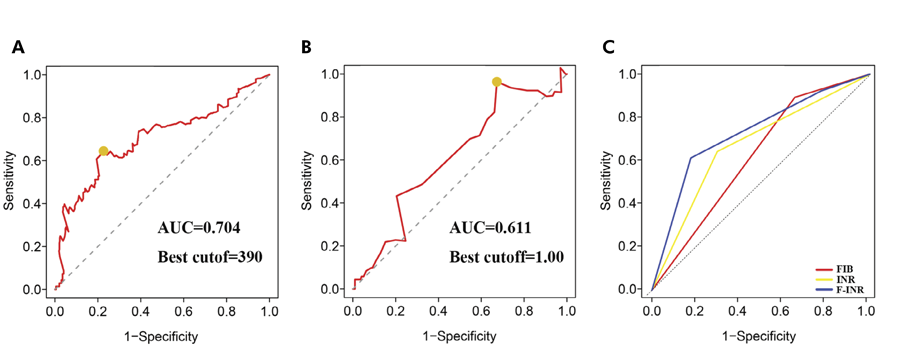
A receiver operating characteristic (ROC) curve for CSS prediction was constructed to estimate the optimal cutoff values for fibrinogen and INR, which allowed us to treat these indicators as binary variables. According to our data, the cutoff value for fibrinogen was 390 mg/dL and the cutoff value for INR was 1.0. Based on these findings, we obtained a new indicator named the F-INR score, which was divided into three groups: F-INR 2, high fibrinogen (> 390 mg/dL) and high INR (> 1.0); F-INR 1, high fibrinogen or high INR; and F-INR 0, neither high fibrinogen nor high INR.
Statistical analysis
All statistical analyses were performed using the R package, GraphPad Prism 8 or SPSS 26.0. The cutoff value and area under the curve (AUC) were determined using ROC curve analysis. Correlations between the F-INR score and clinicopathological parameters were evaluated using the Chi-square or Fisher’s exact tests. Univariate Cox analysis was used to screen for variables that could predict prognosis. Statistically and clinically significant indicators were analyzed using a multivariate Cox regression model to determine the independent prognostic risk factors. Kaplan-Meier analysis was used to estimate the CSS of patients with OSCC using the log-rank test. A probability level of p < 0.05 (two-sided) was considered statistically significant.
Results
Clinical characteristics
This study included 145 men (54.3 %) and 122 women (45.7 %). They aged 17–90 years, with an average age of 64.07 ± 24.52 years for males and 63.59 ± 22.71 years for females. There were 241 (90.2 %) patients with a history of smoking and 244 (91.3%) with a history of alcohol consumption. Ninety (33.7%) patients had a history of hypertension and 37 (13.9%) had DM before surgery. Moreover, 84.6% of the patients had a smaller tumor size (0–4 cm), 72.3% had no lymph node metastasis, and 81.6% had highly differentiated squamous cell carcinoma (Table 1).
ROC curves and AUC of fibrinogen and INR in predicting CSS of OSCC patients
The AUCs for fibrinogen (Figure 1A) and INR (Figure 1B) were 0.704 (95%CI: 0.616–0.791; cutoff value = 390 mg/dL) and 0.611 (95% CI: 0.508–0.692; cutoff value = 1.0), respectively. A comparison of the ROC curves showed that the F-INR score had a better role in predicting the survival of patients with OSCC, with an AUC of 0.766 (Figure 1C), suggesting that the F-INR score could be used as an alternative prognostic staging tool for patients with OSCC.
Correlation of fibrinogen or INR with clinicopathological characteristics
Eighty (30.0%) patients had an F-INR of 0, 135 (50.5%) had an F-INR of 1, and 52 (19.5%) had an F-INR of 2. As shown in Table 2, the chi-squared or Fisher’s exact test suggested that the F-INR score was significantly associated with the tumor size (p = 0.0177), cervical node metastasis (p = 0.0002), and pathological grade (p = 0.0047) of OSCC patients. This indicates that the F-INR score can be a useful tool for guiding tumor/pathological staging and predicting cervical lymph node metastasis.
Predictive value of F-INR for OSCC patients
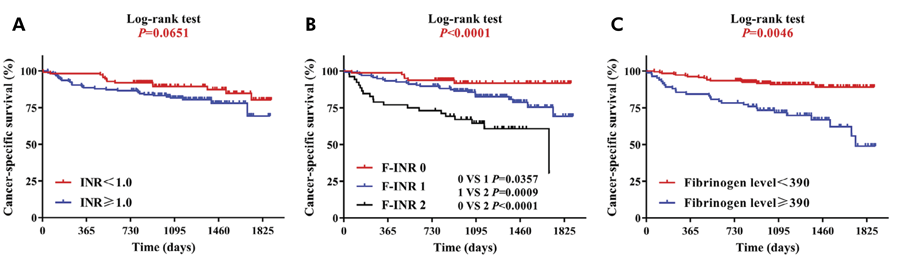
As shown in Table 3, univariate Cox regression analysis of CSS showed that age (HR: 3.266, 95%CI: 1.382–7.716, p = 0.007), INR (HR = 5.534, 95%CI: 2.171–14.106, p < 0.001), fibrinogen (HR = 3.513, 95%CI: 1.944–6.350, p < 0.001), tumor size (HR = 2.693, 95%CI: 1.409–5.146, p = 0.003), cervical nodal metastasis (HR = 3.047, 95%CI: 1.697–5.470, p < 0.001) and F-INR (F-INR 1, HR = 19.607, 95%CI: 4.629–83.333, p < 0.001 and F-INR 2, HR = 3.311, 95%CI: 1.812–6.033, p < 0.001) were significantly associated with poor CSS. Multivariate Cox regression analysis showed that F-INR was an independent prognostic factor for CSS of OSCC patients (F-INR 1, HR = 8.210, 95%CI: 1.156–58.282, p = 0.035 and F-INR 2, HR = 2.475, 95%CI: 1.284–4.772, p = 0.007), along with age (HR: 3.377, 95%CI: 1.389–8.212, p = 0.007), fibrinogen (HR = 2.555, 95%CI: 1.368–4.771, p = 0.003), tumor size (HR = 2.136, 95%CI: 1.1088–4.194, p = 0.027) and lymph node metastasis (HR = 2.185, 95%CI: 1.195–3.995, p = 0.011) (Table 3). Consistent with these findings, Kaplan-Meier analysis also demonstrated that patients with high fibrinogen (p = 0.0046, Figure 2A) or F-INR (p < 0.001, Figure 2B) had a poor prognosis, except for INR (p = 0.0651, Figure 2C).
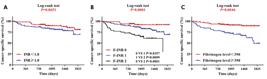
Kaplan–Meier curves for CSS according to INR (A), F-INR (B), and fibrinogen (C) in OSCC patients.
Stratified analysis in the prognostic role of F-INR for OSCC patients
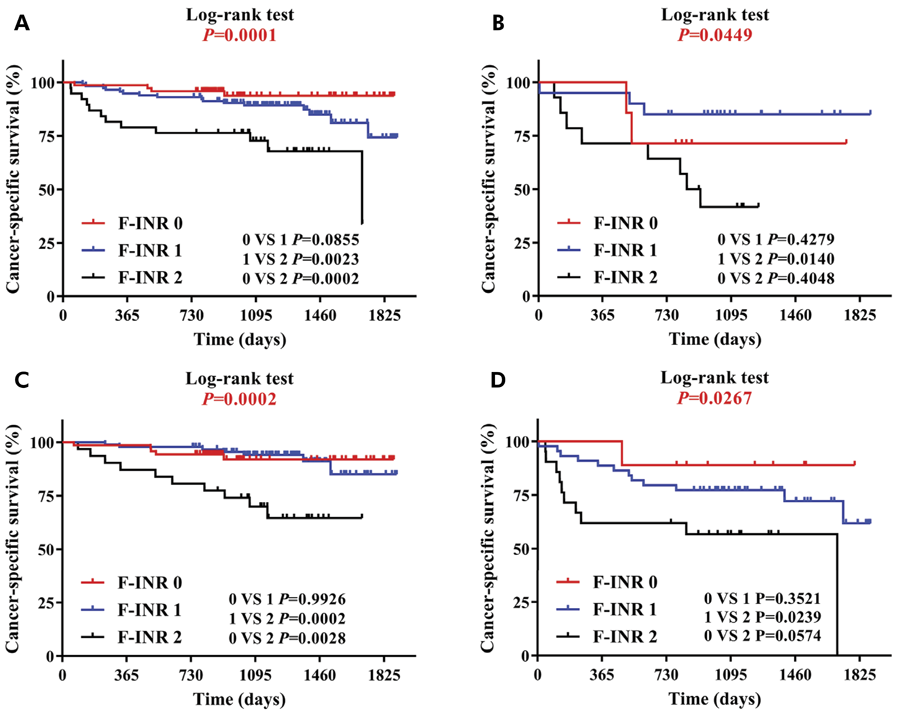
Stratified analysis based on tumor size and lymph node metastasis indicated that the predictive value of F-INR was maintained for patients with T1-T2 stage (p < 0.0001, Figure 3A), T3-T4 stage (p = 0.0449, Figure 3B), N(−) (p = 0.0002, Figure 3C) and N(+) (p = 0.0267, Figure 3D).
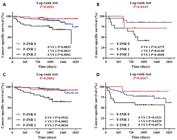
CSS based on F-INR in OSCC patients with T1-T2 tumors (A), patients with T3–T4 tumors (B), patients with lymphatic metastasis (C), and patients without lymphatic metastasis (D).
Discussion
The clinical risk factors of OSCC are critical for its prevention and diagnosis.19 In this study, we analyzed and compared the clinical data of 267 patients with OSCC and found that OSCC was more common in elderly and male patients. This conclusion is consistent with previous studies.20-22 Interestingly, there were 145 males (54.3%) and 122 females (45.7%) in our cohort, contrary to previous studies. For example, there were estimated 38,800 new male cases (71.8%) and 15,210 new female cases (28.2%) in 2021 in USA.21 In Eastern Asia, the proportion of male cases was 67.6%, while the proportion of females was 32.4% in 2020.1 We speculate that the difference in gender distribution is largely attributed to our limited sample size and regional differences. Consequently, a multicenter study with a larger number of patients with OSCC is needed to establish the gender distribution. The high incidence of OSCC males may be attributed to poor lifestyle (smoking, alcohol consumption, and betel quid chewing), occupational exposure, and physiological factors.2,23,24 Moreover, the proportion of smoking and drinking alcohol was lower in our study than in previous studies.2,25 We speculate that the difference is due to regional differences and a relatively high proportion of females in our cohort. It is necessary to conduct regular oral examinations of individuals who smoke or drink excessively.
Tumor recurrence and cervical lymph node metastasis are the primary causes of poor survival in patients with OSCC.3 Even after gross total excision and chemoradiotherapy, the 5-year and 10-year survival rates are 56% and 41%, respectively.26 Early diagnosis is critical for patients with OSCC and the survival probability could reach 80%.27 Therefore, it is critical to determine the prognostic factors for stratifying patients with OSCC before surgery. Although there has been significant progress on biomarkers of OSCC in the current diagnosis, most of them cannot be utilized by surgeons for the preoperative diagnosis and stratification of OSCC. Non-invasive plasma biomarkers have enormous potential for the diagnosis and stratification of tumors, and are easy to analyze, rendering their practicability and cost-effectiveness.
Accumulating evidence has shown that coagulation is a dynamic process that usually affects the development of malignant tumors. In patients with OSCC, the coagulation system promotes a procoagulant state through components such as tissue factor (TF) and plasminogen activators, which not only increases the risk of thrombosis but may also contribute to immunosuppression and tumor progression by influencing the tumor immune microenvironment (TIME).7,28,29 The coagulation system may interact with the tumor vascular microenvironment through the formation of platelet microthrombi (PLT-MT), thereby inhibiting anti-tumor immune responses.30 Recent studies have also found that combining the coagulation system with single-cell level, systems biology analysis may reveal its mechanism of regulating tumor immunity through thrombus formation matrix.31 Fibrinogen, a crucial component of the coagulation system, has been established as a significant modulator of systemic inflammatory responses and cancer development in various tumor types, including OSCC. Studies have demonstrated that fibrinogen accelerates cancer progression by promoting inflammatory reactions and immunosuppressive mechanisms in the tumor microenvironment. Its abnormal deposition can activate immune cell receptors in the tumor microenvironment, enhancing the release of inflammatory cytokines.32 In patients with esophageal squamous cell carcinoma and gastroesophageal junction adenocarcinoma, preoperative hyperfibrinogenemia has been significantly associated with advanced tumor staging, lymph node metastasis, and poor prognosis, confirming its role as a biomarker of systemic inflammatory responses.33 Clinical investigations targeting OSCC indicate a direct correlation between elevated preoperative plasma fibrinogen levels and increased tumor invasion depth, lymph node metastasis, and reduced postoperative survival rates, suggesting its involvement in the tumor metastasis process through modulation of the inflammatory microenvironment.6
A previous systematic review suggested that both pretreatment plasma D-dimer and fibrinogen are robust predictors of poor survival in patients with digestive cancer with different traits.34 Complementary, elevated fibrinogen levels are associated with poor outcomes in patients with OSCC.15,16 In our study, patients with higher preoperative fibrinogen levels had lower cancer-specific survival, and multivariate analysis demonstrated that fibrinogen level could be an independent factor for patient survival. Therefore, fibrinogen level may be a reliable predictor of OSCC prognosis. INR, as well as fibrinogen, can be utilized as predictors of tumor stage and metastasis in certain cancers.17,18,35 Plasma fibrinogen is the substrate at the final stage of coagulation and is converted into fibrin to form clots. INR reflects the activity of exogenous coagulation factors (II, VII, and X). However, if fibrinogen is severely deficient, thrombin cannot effectively generate fibrin, leading to a prolonged thrombin time and an indirect increase in the INR. In our study, multivariate survival analysis and Kaplan-Meier analysis demonstrated that INR could not independently predict the prognosis of patients with OSCC, which may be largely due to the possibility of an insufficient sample size and short follow-up time.
The combination of fibrinogen and the neutrophil-lymphocyte ratio (F-NLR) could be utilized as a prognostic marker in ovarian cancer, rectal cancer, and gastric cancer.36 The fibrinogen-to-albumin ratio may be a predictor of prognosis in patients with cancer.37 Moreover, these studies indicated that fibrinogen can combine with inflammatory or nutritional indicators to play a crucial role in predict tumor prognosis. In our study, we evaluated the prognostic effect of preoperative fibrinogen levels and INR in patients with OSCC and found a moderate predictive value of fibrinogen levels in OSCC. In addition, INR had a low predictive value. Therefore, we developed a novel F-INR scoring system, and to the best of our knowledge, this is the first study to determine the predictive value of the F-INR in the prognosis of patients with cancer.
In our study, OSCC patients with T3-T4 or N(+) tended to have a high F-INR score, exhibiting that the F-INR scoring system may be an indicator of tumor stage and cervical lymph node metastasis. Multivariate Cox analysis revealed that the F-INR score was an independent prognostic factor for cancer-specific survival with OSCC. Patients with an F-INR score of 1 had a 2.475-fold higher risk of relapse/death than those with a score of 0, whereas the risk of relapse/death in patients with an F-INR score of 2 was 8.210-fold higher. Additionally, we performed a stratified analysis according to the tumor size and cervical nodal metastasis. Kaplan-Meier assessments revealed that different F-INR scores correlated with significantly different cancer-specific survival rates for OSCC patients with T1-T2, T3-T4, N(–), and N(+). This revealed that the F-INR scoring system remains valuable in predicting the cancer-specific survival of OSCC patients with different stages of cervical nodal metastasis. These results demonstrated that the F-INR scoring system is associated with cancer-specific patients with OSCC.
Although we found that the F-INR may be a low-cost prognostic factor in patients with OSCC, there are certain limitations that need to be addressed. First, the chi-squared test indicated that patients with pathological grades II-III tended to have a low F-INR score, which is contrary to our hypothesis. This may be due to the limited number of moderately or poorly differentiated cases. As this was a single-center retrospective study, selection bias may have occurred in the patient population. Additionally, the short follow-up period did not provide sufficient information for further assessment of survival. Therefore, a multicenter study with a large sample size and long-term follow-up is needed to establish the prognostic significance of the F-INR and its clinical benefits for patient stratification.
Conclusion
In conclusion, our study indicates a significant clinical implication of the preoperative F-INR scoring system for OSCC prognosis. The F-INR scoring system is a useful tool for guiding tumor staging, predicting lymphatic metastasis, and prognosis of patients with OSCC. Studies involving multicentric large scale patient cohorts are imperative to further validate the accuracy of the F-INR scoring system in predicting OSCC prognosis.
References
-
1 Sung H, Ferlay J, Siegel RL, Laversanne M, Soerjomataram I, Jemal A, et al. Global Cancer Statistics 2020: GLOBOCAN estimates of incidence and mortality worldwide for 36 cancers in 185 countries. CA Cancer J Clin. 2021 May;71(3):209-49. https://doi.org/10.3322/caac.21660
» https://doi.org/10.3322/caac.21660 -
2 Zhang W, Li J, Wu Y, Ge H, Song Y, Wang D, et al. TEAD4 overexpression promotes epithelial-mesenchymal transition and associates with aggressiveness and adverse prognosis in head neck squamous cell carcinoma. Cancer Cell Int. 2018 Nov;18(1):178. https://doi.org/10.1186/s12935-018-0675-z
» https://doi.org/10.1186/s12935-018-0675-z -
3 Chaurasia A, Alam SI, Singh N. Oral cancer diagnostics: an overview. Natl J Maxillofac Surg. 2021;12(3):324-32. https://doi.org/10.4103/njms.NJMS_130_20
» https://doi.org/10.4103/njms.NJMS_130_20 -
4 Xie F, Gleue CA, Deschaine M, Dasari S, Lau JS, Sartori-Valinotti JC, et al. Whole-exome sequencing of transforming oral lichen planus reveals mutations in DNA damage repair and apoptosis pathway genes. J Oral Pathol Med. 2022 Apr;51(4):395-404. https://doi.org/10.1111/jop.13284
» https://doi.org/10.1111/jop.13284 -
5 Repetto O, De Re V. Coagulation and fibrinolysis in gastric cancer. Ann N Y Acad Sci. 2017 Sep;1404(1):27-48. https://doi.org/10.1111/nyas.13454
» https://doi.org/10.1111/nyas.13454 -
6 Liang YJ, Mei XY, Zeng B, Zhang SE, Yang L, Lao XM, et al. Prognostic role of preoperative D-dimer, fibrinogen and platelet levels in patients with oral squamous cell carcinoma. BMC Cancer. 2021 Feb;21(1):122. https://doi.org/10.1186/s12885-021-07841-5
» https://doi.org/10.1186/s12885-021-07841-5 -
7 Lottin M, Soudet S, Fercot J, Racine F, Demagny J, Bettoni J, et al. Molecular landscape of the coagulome of oral squamous cell carcinoma. Cancers (Basel). 2022 Jan;14(2):460. https://doi.org/10.3390/cancers14020460
» https://doi.org/10.3390/cancers14020460 -
8 Racine F, Soudet S, Sevestre MA, Galmiche A, Saidak Z. The coagulome of oral squamous cell carcinoma: examining the role and regulation of coagulation in oral cancers using a systems approach. Curr Opin Otolaryngol Head Neck Surg. 2023 Apr;31(2):73-7. https://doi.org/10.1097/MOO.0000000000000870
» https://doi.org/10.1097/MOO.0000000000000870 -
9 Vilar R, Fish RJ, Casini A, Neerman-Arbez M. Fibrin(ogen) in human disease: both friend and foe. Haematologica. 2020 Jan;105(2):284-96. https://doi.org/10.3324/haematol.2019.236901
» https://doi.org/10.3324/haematol.2019.236901 -
10 Weisel JW, Litvinov RI. Fibrin formation, structure and properties. Subcell Biochem. 2017;82:405-56. https://doi.org/10.1007/978-3-319-49674-0_13
» https://doi.org/10.1007/978-3-319-49674-0_13 -
11 Wang M, Zhang G, Zhang Y, Cui X, Wang S, Gao S, et al. Fibrinogen alpha chain knockout promotes tumor growth and metastasis through Integrin-AKT signaling pathway in lung cancer. Mol Cancer Res. 2020 Jul;18(7):943-54. https://doi.org/10.1158/1541-7786.MCR-19-1033
» https://doi.org/10.1158/1541-7786.MCR-19-1033 -
12 Chan JP, Merlini M, Gao HX, Mendiola AS, Akassoglou K, Rubenstein JL, et al. Blood coagulation factor fibrinogen in tumor pathogenesis of central nervous system b-cell lymphoma. Am J Pathol. 2021 Mar;191(3):575-83. https://doi.org/10.1016/j.ajpath.2020.12.010
» https://doi.org/10.1016/j.ajpath.2020.12.010 - 13 Palumbo JS, Degen JL. Fibrinogen and tumor cell metastasis. Haemostasis. 2001;31 Suppl 1:11-5.
-
14 Palumbo JS, Talmage KE, Liu H, La Jeunesse CM, Witte DP, Degen JL. Plasminogen supports tumor growth through a fibrinogen-dependent mechanism linked to vascular patency. Blood. 2003 Oct;102(8):2819-27. https://doi.org/10.1182/blood-2003-03-0881
» https://doi.org/10.1182/blood-2003-03-0881 -
15 Wu M, Ye P, Zhang W, Zhu H, Yu H. Prognostic role of an inflammation scoring system in radical resection of oral squamous cell carcinoma. BMC Oral Health. 2022 Jun;22(1):226. https://doi.org/10.1186/s12903-022-02261-8
» https://doi.org/10.1186/s12903-022-02261-8 -
16 Zhu H, Zhang W, Ye P, Wu M. Preoperative circulating fibrinogen to albumin ratio in predicting 5-year prognosis of oral cancer radical surgery. Neoplasma. 2022 Sep;69(5):1246-52. https://doi.org/10.4149/neo_2022_220422N441
» https://doi.org/10.4149/neo_2022_220422N441 -
17 Kilic L, Yildiz I, Sen FK, Erdem MG, Serilmez M, Keskin S, et al. D-dimer and international normalized ratio (INR) are correlated with tumor markers and disease stage in colorectal cancer patients. Cancer Biomark. 2015;15(4):405-11. https://doi.org/10.3233/CBM-150477
» https://doi.org/10.3233/CBM-150477 -
18 Tas F, Kilic L, Serilmez M, Keskin S, Sen F, Duranyildiz D. Clinical and prognostic significance of coagulation assays in lung cancer. Respir Med. 2013 Mar;107(3):451-7. https://doi.org/10.1016/j.rmed.2012.11.007
» https://doi.org/10.1016/j.rmed.2012.11.007 -
19 D'souza S, Addepalli V. Preventive measures in oral cancer: an overview. Biomed Pharmacother. 2018 Nov;107:72-80. https://doi.org/10.1016/j.biopha.2018.07.114
» https://doi.org/10.1016/j.biopha.2018.07.114 -
20 Du M, Nair R, Jamieson L, Liu Z, Bi P. Incidence trends of lip, oral cavity, and pharyngeal cancers: Global Burden of Disease 1990-2017. J Dent Res. 2020 Feb;99(2):143-51. https://doi.org/10.1177/0022034519894963
» https://doi.org/10.1177/0022034519894963 -
21 Siegel RL, Miller KD, Fuchs HE, Jemal A. Cancer Statistics, 2021. CA Cancer J Clin. 2021 Jan;71(1):7-33. https://doi.org/10.3322/caac.21654
» https://doi.org/10.3322/caac.21654 -
22 Miranda-Filho A, Bray F. Global patterns and trends in cancers of the lip, tongue and mouth. Oral Oncol. 2020 Mar;102:104551. https://doi.org/10.1016/j.oraloncology.2019.104551
» https://doi.org/10.1016/j.oraloncology.2019.104551 -
23 Gupta B, Johnson NW, Kumar N. Global epidemiology of head and neck cancers: a continuing challenge. Oncology. 2016;91(1):13-23. https://doi.org/10.1159/000446117
» https://doi.org/10.1159/000446117 -
24 Clegg D, Hevener AL, Moreau KL, Morselli E, Criollo A, Van Pelt RE, et al. Sex hormones and cardiometabolic health: role of estrogen and estrogen receptors. Endocrinology. 2017 May;158(5):1095-105. https://doi.org/10.1210/en.2016-1677
» https://doi.org/10.1210/en.2016-1677 -
25 Kavarthapu A, Gurumoorthy K. Linking chronic periodontitis and oral cancer: a review. Oral Oncol. 2021 Oct;121:105375. https://doi.org/10.1016/j.oraloncology.2021.105375
» https://doi.org/10.1016/j.oraloncology.2021.105375 - 26 Glassman AB. Cytogenetics, in situ hybridization and molecular approaches in the diagnosis of cancer. Ann Clin Lab Sci. 1998;28(6):324-30.
-
27 Bagan J, Sarrion G, Jimenez Y. Oral cancer: clinical features. Oral Oncol. 2010 Jun;46(6):414-7. https://doi.org/10.1016/j.oraloncology.2010.03.009
» https://doi.org/10.1016/j.oraloncology.2010.03.009 -
28 Racine F, Louandre C, Godin C, Chatelain B, Prekovic S, Zwart W, et al. The Tumor Coagulome as a Transcriptional Target and a Potential Effector of Glucocorticoids in Human Cancers. Cancers (Basel). 2023 Feb;15(5):1531. https://doi.org/10.3390/cancers15051531
» https://doi.org/10.3390/cancers15051531 -
29 Wahab R, Hasan MM, Azam Z, Grippo PJ, Al-Hilal TA. The role of coagulome in the tumor immune microenvironment. Adv Drug Deliv Rev. 2023 Sep;200:115027. https://doi.org/10.1016/j.addr.2023.115027
» https://doi.org/10.1016/j.addr.2023.115027 -
30 Duan W, Wu Z, Mei X, Li J, Lu H, Liang Y, et al. Intratumoral platelet microthrombi in oral squamous cell carcinoma: a marker of lymph node metastasis. Oral Dis. 2024 Jul;30(5):2894-906. https://doi.org/10.1111/odi.14575
» https://doi.org/10.1111/odi.14575 -
31 Galmiche A, Rak J, Roumenina LT, Saidak Z. Coagulome and the tumor microenvironment: an actionable interplay. Trends Cancer. 2022 May;8(5):369-83. https://doi.org/10.1016/j.trecan.2021.12.008
» https://doi.org/10.1016/j.trecan.2021.12.008 -
32 Wu X, Yu X, Chen C, Chen C, Wang Y, Su D, et al. Fibrinogen and tumors. Front Oncol. 2024 May;14:1393599. https://doi.org/10.3389/fonc.2024.1393599
» https://doi.org/10.3389/fonc.2024.1393599 -
33 Tianxing G, Xiaojie P, Lihuan Z, Yangyun H. Combination of preoperative fibrinogen and neutrophil to lymphocyte ratio is a predictive prognostic factor in ESCC and AEG systematic review. Biosci Rep. 2019 Oct;39(10):BSR20190480. https://doi.org/10.1042/BSR20190480
» https://doi.org/10.1042/BSR20190480 -
34 Lin Y, Liu Z, Qiu Y, Zhang J, Wu H, Liang R, et al. Clinical significance of plasma D-dimer and fibrinogen in digestive cancer: A systematic review and meta-analysis. Eur J Surg Oncol. 2018 Oct;44(10):1494-503. https://doi.org/10.1016/j.ejso.2018.07.052
» https://doi.org/10.1016/j.ejso.2018.07.052 -
35 Lee YH, Hsu CY, Huang YH, Su CW, Lin HC, Hsia CY, et al. a-fetoprotein-to-total tumor volume ratio predicts post-operative tumor recurrence in hepatocellular carcinoma. J Gastrointest Surg. 2013 Apr;17(4):730-8. https://doi.org/10.1007/s11605-012-2081-5
» https://doi.org/10.1007/s11605-012-2081-5 -
36 Yang J, Ma J, Cheng S, Wang Y. The combination of plasma Fibrinogen Concentration and Neutrophil Lymphocyte Ratio (F-NLR) as a prognostic factor of epithelial ovarian cancer. OncoTargets Ther. 2020 Jul;13:7283-93. https://doi.org/10.2147/OTT.S264118
» https://doi.org/10.2147/OTT.S264118 -
37 Fang L, Yan FH, Liu C, Chen J, Wang D, Zhang CH, et al. Systemic inflammatory biomarkers, especially fibrinogen to albumin ratio, predict prognosis in patients with pancreatic cancer. Cancer Res Treat. 2021 Jan;53(1):131-9. https://doi.org/10.4143/crt.2020.330
» https://doi.org/10.4143/crt.2020.330
-
Availability of data and materials:
The datasets generated during and/or analyzed during the current study are available from the corresponding author on reasonable request.
-
Financial support:
This work was supported by the Science and Technology Development Fund of Nanjing Medical University (Grants No. NMUB20220213, NMUB20220206).
Edited by
-
Editor-in-Chief:
Lucianne Maia
-
Associate Editor:
Martinho Campoia Rebello Horta
The datasets generated during and/or analyzed during the current study are available from the corresponding author on reasonable request.