 Self-care for people with asthma in light of Dorothea Orem’s Theory
ABSTRACT
Objective: To investigate the self-care of people with asthma in light of Dorothea Orem’s Theory.
Method: Qualitative study conducted between June and July 2024 in the city of Recife-PE, using a semi-structured script; 15 people with asthma followed in an outpatient clinic were interviewed, and their responses were transcribed, categorized, and analyzed using Bardin’s content analysis, with the help of ATLAS.ti software.
Results: 192 codes were identified, leading to three categories: asthma, factors related to the daily living activities of people with asthma, and self-care of people with asthma.
FINAL CONSIDERATIONS: The self-care of people with asthma reveals that health education plays a fundamental role in strengthening autonomy, managing the disease, and improving quality of life.
DESCRIPTORS:
Asthma; Self Care; Nursing Care; Health Education; Nursing Theory.
HIGHLIGHTS
1. Self-care impacts the continuity of care.
2. Self-care helps in controlling and identifying triggers.
3. Self-care is directly related to education and health.
4. In self-care, the person is the protagonist of their own care.
RESUMO
Objetivo: Investigar o autocuidado de pessoas com asma à luz da Teoria de Dorothea Orem.
Método: Estudo qualitativo, realizado entre junho e julho de 2024, na cidade do Recife-PE, utilizando roteiro semiestruturado; 15 pessoas com asma acompanhadas em ambulatório foram entrevistadas e tiveram suas respostas transcritas, categorizadas e tratadas por meio da análise de conteúdo de Bardin, com o auxílio do software ATLAS.ti.
Resultados: Evidenciaram-se 192 códigos que deram origem a três categorias: asma, fatores relacionados às atividades de vida diária de pessoas com asma e autocuidado de pessoas com asma.
Considerações finais: O autocuidado de pessoas com asma revela que a educação em saúde desempenha papel fundamental no fortalecimento da autonomia, no manejo da doença e na qualidade de vida.
DESCRITORES:
Asma; Autocuidado; Cuidados de Enfermagem; Educação em Saúde; Teoria de Enfermagem.
HIGHLIGHTS
1. O autocuidado impacta na continuidade do cuidado.
2. Autocuidado ajuda no controle e identificação de gatilhos.
3. Autocuidado está diretamente relacionado à educação e saúde.
4. No autocuidado, a pessoa é protagonista do seu cuidar.
RESUMEN
Objetivo: Investigar el autocuidado de las personas con asma desde la perspectiva de la teoría de Dorothea Orem.
Método: Estudio cualitativo, realizado entre junio y julio de 2024 en la ciudad de Recife (estado de Pernambuco), utilizando un guion semiestructurado; se entrevistó a 15 personas con asma que recibían seguimiento en un centro de atención ambulatoria, y sus respuestas se transcribieron, categorizaron y analizaron mediante el método de análisis de contenido de Bardin, con la ayuda del software ATLAS.ti.
Resultados: Se identificaron 192 códigos que dieron lugar a tres categorías: asma, factores relacionados con las actividades de la vida diaria de las personas con asma y autocuidado de las personas con asma.
Consideraciones finales: El autocuidado de las personas con asma pone de manifiesto que la educación sanitaria desempeña un papel fundamental en el fortalecimiento de la autonomía, el control de la enfermedad y la calidad de vida.
DESCRIPTORES:
Asma; Autocuidado; Atención de Enfermería; Educación en Salud; Teoría de Enfermería.
HIGHLIGHTS
1. El autocuidado influye en la continuidad de la atención.
2. El autocuidado ayuda a controlar e identificar los factores desencadenantes.
3. El autocuidado está directamente relacionado con la educación y la salud.
4. En el autocuidado, la persona es la protagonista de su propio cuidado.
INTRODUCTION
Asthma, as a chronic respiratory disease, affects millions of people worldwide and presents main symptoms such as shortness of breath, wheezing, and coughing. It is triggered by various factors, such as allergies, pollution, and respiratory infections, and although there is no cure, asthma can be controlled with appropriate treatment, particularly emphasizing health education focused on self-care1.
Although people with asthma understand basic aspects of the disease and the use of medications, doubts still persist regarding the importance of self-care, especially in self-management, where the individual manages their respiratory condition autonomously and effectively, also considering environmental and social factors related to daily living activities2.
Activities of daily living are part of the human routine and are related to the autonomous execution of essential motor and cognitive tasks for maintaining life. In this context, asthma, as a chronic disease, can sometimes be neglected in self-care, both by affected individuals and by health professionals and services. Its slow progression can compromise quality of life and favor the development of functional disabilities, especially in performing routine activities3.
In light of this scenario, in 2022, the Brazilian Ministry of Health launched the Asthma Care Line in partnership with the Health Technology Assessment Institute, providing care guidelines within the Health Care Network (HCN), with Primary Health Care managing the care flows4.
The HCN is made up of a multidisciplinary team, and among them, the nurse implements health education strategies to raise awareness in individuals about their health condition, personal responsibility for their lifestyle, proper management of symptoms and therapeutic regimen, and self-care strategies. Self-care, understood as taking care of oneself or the environment, consists of practices that seek benefits for the maintenance of life, health, and well-being. Education for self-care prioritizes the choice of needs, problems, and priorities defined by the individual4-5.
In this sense, a self-care practice is essential for promoting and maintaining health, treating diseases, and preventing complications, principles advocated by the theoretical framework of Dorothea Orem, whose Self-Care Deficit Nursing Theory consists of three interrelated theories: Self-Care Theory; Self-Care Deficit Theory; and Nursing Systems Theory6-7.
Among these approaches, the Self-Care Deficit Theory, with its requirements classified as universal, developmental, and health deviation, enables guiding nursing care for individuals with asthma. In the realm of universal requirements, maintaining an adequate air intake is highlighted. The health deviation requirements relate to awareness of the effects and outcomes of the pathological condition, adherence to prescribed therapeutic measures, regulation of uncomfortable and harmful treatment effects, as well as learning to cope with the limitations imposed by the clinical condition and promoting continuous personal development. Based on these self-care requirements, development can be promoted through health education using teaching strategies6-7.
Knowledge empowers individuals with asthma to promote self-care by knowing how to control and identify triggers of an attack, recognizing factors such as dust, mites, pet dander, smoke, environmental pollution, and temperature changes as the main causes of acute and chronic symptoms, and it is crucial to acknowledge that when exposed and sensitized, it is necessary to adopt self-care measures to improve their quality of life8.
In the literature, it is identified that the knowledge of individuals with asthma about self-care is still scarce regarding the update of theoretical frameworks as a guiding axis to understand which basic conditioning factors such as age, sex, developmental status, health situation, sociocultural orientation, and the health system affect learning for self-care in different assistance scenarios in the Brazilian context. This knowledge gap weakens the understanding of what self-care means for individuals with asthma, which factors affect their disease self-management, and when nursing is necessary for this self-care within the support-education system.
Thus, this study aims to investigate the self-care of individuals with asthma in light of Dorothea Orem’s Theory.
METHOD
This is an exploratory study with a qualitative approach in which the interview technique was used, with a semi-structured script organized into closed and open questions.
The interviews took place in June and July 2024 with individuals with asthma undergoing treatment at the Pulmonology Outpatient Clinic of a reference hospital located in the city of Recife-PE. To preserve privacy, the interviews took place in a private room, allowing the researcher and the interviewee to freely discuss the topic. Before the interview, the reading and signing of the Informed Consent Form was conducted.
The interview guide was developed by the researchers inspired by a study on the construction and validation of an educational video for promoting self-care in the post-operative period of valve surgery conducted in Recife-PE5.
The closed questions focused on sociodemographic and clinical characterization, while the open questions addressed content about asthma, asthma care, the daily living activities of a person with asthma, and post-diagnosis behavior regarding asthma. Before conducting the interviews with the target audience, the question guide was tested with two participants to verify if it was understandable and replicable. No changes were suggested according to Chart 1.
Open questions from the interview about self-care in people with asthma. Recife, Pernambuco, Brazil, 2024
The interviewees’ statements were recorded and transcribed in full by the responsible researcher, a nurse, immediately after the interviews, and Microsoft Word was used for data recording. There was no therapeutic or clinical follow-up relationship between the researcher and the study participants. The inclusion criteria were: people diagnosed with asthma; age 18 years or older; and both sexes. There were no exclusion criteria.
The sample was convenience-based of the simple random type until responses were repeated, using the data saturation criterion, meaning that interviews were conducted until no new information was obtained. To identify the participants, alphanumeric codes were used: PWASTHMA (PWASTHMA1, PWASTHMA2, PWASTHMA3…), where P stands for person, W stands for with, and ASTHMA identifies the disease, with the numbers indicating the order of interviews.
The confirmation of theoretical saturation occurred through 5 (five) steps. Step 1: transcription of raw data (primary sources) immediately after the interviews; Step 2: immersion in the data as the interviews were conducted. Step 3: compilation of individual analyses of each interview and thematic grouping; Step 4: organization of themes and subthemes. Step 5: confirmation of saturation through thematic grouping by identifying the absence of new elements. Such information was primarily treated as codes, followed by subcategories and, finally, categories9-10.
The codes were extracted in identifying the central ideas of the interviewees’ speeches, and the coding process was done openly. The categories were determined as coding was performed; thus, meanings were detected and differentiated through interconnected indicators11.
With the help of the software ATLAS.ti, version 24, in Portuguese, the data were examined through content analysis in three stages: pre-analysis; material exploration; and treatment of results, inference, and interpretation12.
The software provided tools for organizing, analyzing, and interpreting large volumes of data, such as texts and interviews. It supported coding methods and allowed for marking data segments with codes that represented themes, concepts, and emerging categories, serving as support for identifying patterns and themes in the data12.
The quantitative analysis occurred in the frequency of characteristics that repeated in the transcriptions, supporting the naming of categories.
The study was approved by the Research Ethics Committee of the Otávio de Freitas Hospital, with Opinion number 6.855.723.
RESULTS
Fifteen people with asthma participated in the research; six (40%) were aged between 45 and 60 years; 12 (80%) were women; 11 (71%) were mixed-race; eight (53%) were married; seven (47%) had incomplete elementary education; and nine (56%) had been undergoing treatment for asthma for 1 to 5 years.
The transcribed speeches in the interviews were organized into three categories of care: 1) Asthma; 2) Factors related to the daily living activities of people with asthma; and 3) Self-care of people with asthma. To extract these categories, 10 subcategories (grouping of codes) and 192 codes were used, as shown in Figure 1:
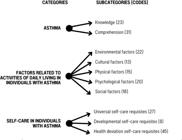
Description of the categories, codes, and quotes by grouping of interviews of people with asthma about self-care based on the universal, developmental, and health deviation requirements presented by Dorothea Orem. Recife, Pernambuco, Brazil, 2024 Source: The authors (2024).
The categories identified from the propositional analysis of the discourse are organized into Asthma, Factors related to the daily living activities of people with asthma, and Self-care of people with asthma, namely:
1) Asthma
In this category, the person with asthma understands their condition, as well as their perspective on the respiratory disease, primarily wrapped in the requirement of health deviation self-care. The interviewees identify asthma as a chronic and incurable disease and its main triggers for the onset of the disease’s symptoms:
(…) asthma is something that has no cure, but there is treatment, right?! (PWASTHMA7)
(…) I know it has no cure because it is chronic (…) the lungs get affected. (PWASTHMA9)
As far as I know, you can’t have a dog at home, inside the house, avoid a lot of dust, I myself would get sick with just a little thing, my neighbors, when they started using the barbecue, the smell of smoke would make me feel bad (…), also about animals, birds, those things couldn’t be in the house, I can’t, right?! (PWASTHMA5)
The participants express a desire to deepen their knowledge and access information that improves their treatment, quality of life, and well-being and deconstructs beliefs:
(…) a more advanced treatment, how is it done, what can be done… in daily life, how asthma is transmitted, how it comes, whether it is through contact or not. (PWASTHMA13)
I wanted to know about the care, how to behave, about medication, if it’s something I will have for the rest of my life or not. (PWASTHMA14)
I would like to know how asthma manifests in a person because you never know when it’s good and when it’s worse, you never know. (PWASTHMA10)
How is a patient with asthma treated? An asthmatic? What is this disease like? How come we don’t discover it, is there no cure? (PWASTHMA15)
(…) people who have this problem cannot touch cold water, what is the reason? You cannot wash a dish, you cannot take a cold shower. Why? (PWASTHMA3)
It should be noted that interviewees say they have no knowledge about the disease and that although they have been undergoing treatment for some time, relevant information about their condition has not been shared by the professionals providing care:
I don’t understand asthma. I can’t explain how it starts, what causes it. No one has ever explained it to me. (PWASTHMA11, in treatment for 13 years)
I can’t explain it either […] I think it’s respiratory failure, that it causes. (PWASTHMA8, in treatment for over 10 years)
I practically know nothing. I don’t know anything, because no information was passed to me, just the medications I take, I have no knowledge of other things. (PWASTHMA10, in treatment for 2 years)
I know it’s a fatigue, it’s a fatigue in the lung, right, about the lung, (…) but what causes it I can’t explain. Why is it so hard, right?! (PWASTHMA1, in treatment for 3 years)
2) Factors related to the daily living activities of people with asthma
Regarding environmental factors, there is a need and difficulty in adapting the living space, the seasons, and the work routine as pointed out by the interviewees:
(…) I can’t get rid of dust, I live in a place where I can’t get rid of dust, there is dust, there is dirt, I can’t get rid of these things, even in my own house, I’m sure it must be bad for me because there is dust, I use a fan, I don’t have tiles (…) (PWASTHMA10)
I have a lot of difficulty with asthma, depending on what I’m doing I get very tired, depending on the change in weather, I get very tired, I have a runny nose a lot, and that’s how it is. (PWASTHMA4)
(…) I couldn’t work in my field, I walked a lot because I am a health agent, and sometimes by the time I left home and even got to work, I was already dead tired… (PWASTHMA6)
And what happens now is that I can no longer work because I have limits; if I do something and get tired, I have to stop, and that is something no company will accept, right?! (PWASTHMA12)
Physical factors draw attention to the direct impairment of daily activities that limits vitality and the integrity of the body’s structure and functioning:
Everything you do is tiring; if you do any activity too quickly, it tires you out; if you walk fast, it tires you out. Everything is tiring. (PWASTHMA2)
It’s hard for a person to have this problem because they want to do things but can’t; they can’t do anything, climbing a hill, everything is difficult for them. (PWASTHMA3)
I have some difficulties; when walking, I get tired, I do physical effort, some days are okay, and some days I have shortness of breath, sometimes like sweeping the house, taking a shower especially. (PWASTHMA6)
Social factors, intrinsically related to culture, manifest themselves evidently in discourses about health and well-being:
Since I was from the countryside, my grandmother cooked over a wood fire, there was pipe smoke, and all of this influences, right?! [on the development of asthma]. (PWASTHMA2)
My mother wouldn’t let me swim in rivers, food… I love cold things but I can’t because it makes me sick and tired. (PWASTHMA15)
(…) the disease is not how we want it, right? It is how God wants it. (PWASTHMA9)
My habits have changed completely; I used to drink. Nowadays, I won’t say I don’t drink, but I drink little. I think the drink, like..., has changed a lot, now I get tired much less, before I used to get much more tired. (PWASTHMA14)
Intense emotions directly impact the respiratory system, exacerbating asthma attacks:
It’s terrible! [having asthma]. (PWASTHMA11)
(…) I don’t sleep like I used to, I sleep almost sitting up, but for me it’s all good, I have to carry on until the end. (…) I have to live my life until the day God allows. (PWASTHMA9)
It’s a bit complicated but if you set your mind to it, you can [carry out daily activities]. (PWASTHMA15)
(…) some people have asthma and have attacks and end up in the hospital, they stay in ICU and even die from an asthma attack, I get scared. (PWASTHMA6)
3) Self-care for people with asthma
This category is directed towards self-care and its requirements: universal, developmental, and health deviation. People with asthma point out difficulties related to the universal requirement:
Asthma attacks are [terrible], I just need to get help quickly with the inhaler, the Aerolin, the medication, the nebulizer… the medication, if I don’t rush to the hospital, I might not be able to survive (…) (PWASTHMA11)
(…) there was a time I had an attack where I was carried in, when I took a step I fainted, I was already short of breath because I couldn’t anymore… I had no strength left, right?! (PWASTHMA15)
I have always been asthmatic, I have been asthmatic since childhood, but I had an attack in 2022, in November, where I needed to be intubated, that’s when I started to feel more limited. (PWASTHMA12)
The requirements for developing self-care are derived from specific circumstances that the individual is facing, whether associated with a particular event or not. In these situations, it is necessary for the individual to develop the ability to overcome or mitigate the effects, requiring adaptive skills. This need for adaptation is observed in the participants’ reports:
I would go home and have an attack again and be hospitalized again, I would have an attack again and then go back to the UPA, and that went on until the moment I sought out, um... what is it?!, a doctor, right?! (PWASTHMA5)
The medication I didn’t take, that I didn’t have access to, and I didn’t even know I had asthma, and it improved a lot because before I had a lot of difficulty and didn’t know what I really had. I was always rescued. (PWASTHMA4)
I had two pregnancies… In my first pregnancy, I had no problems, but in the second pregnancy from start to finish, I had attacks and that hindered me because in my daily life I couldn’t work. (PWASTHMA12)
The requirements for health deviation encompass people who are ill, in the process of diagnosis, or in treatment, and are part of self-care measures, strategies for prevention, control, and cure of diseases, as well as compensating for disabilities. People with asthma point out that:
The focus is really on seeking treatment, right?! To seek a doctor to analyze your situation and start treatment. (PWASTHMA5)
(…) Be very careful with cleaning, hygiene, and using the inhaler; you have to use it and then brush your tongue. (PWASTHMA15)
(…) we have to clean the house, remove things that trigger our allergic crises like carpets, dust, pets, and… have a well-ventilated, clean house, free of mold… (PWASTHMA7)
These health care actions are essential to promote recovery and maintain quality of life, even in the face of limitations imposed by the disease condition.
DISCUSSION
Dorothea Orem’s Self-Care Theory provides an important theoretical framework for understanding the needs of people with asthma, a chronic condition that requires ongoing and conscious care. By understanding their condition, a person with asthma can make more assertive decisions about their own treatment and daily care, taking a leading and autonomous role in practices directed towards themselves and developed by themselves13.
This autonomy, however, is directly related to access to clear information and appropriate guidance. The findings of this study reveal that individuals with a long diagnosis still face difficulties in managing the disease and in self-care, highlighting the need for continuous and personalized educational strategies. A recent study indicates that health professionals who adapt language and simplify the technical aspects of treatment, respecting age and educational diversity, achieve better adherence results14.
In this study, participants indicate that they wish to deepen their knowledge and access information that contributes to self-care, improvement of treatment, quality of life, and well-being, as well as demystifying beliefs related to the condition. In addition to technical knowledge, the ability for self-care is influenced by cultural factors, behavior patterns, and life experiences. The environment in which the individual is situated contributes both to the onset and worsening of asthma, also influencing how they adapt to the limitations imposed by the disease15.
Reports show that intense emotions have a direct impact on the respiratory system, contributing to the worsening of asthma attacks. In this sense, psychological factors cannot be neglected in the context of self-care. Situations of stress and anxiety are known to trigger or worsen asthma symptoms, revealing the strong connection between mind and body. Studies with children and adolescents with asthma demonstrate that anxiety can directly impact quality of life, making it essential to investigate how this psychological impairment also manifests in adulthood16.
Considering these multifactorial aspects (biological, social, emotional, and environmental), it is possible to affirm that effective asthma control requires a broader perspective on self-care needs. Environmental control, for example, is one of the main preventive strategies, involving actions such as keeping domestic animals away, eliminating dust mites, and reducing exposure to dust, mold, and cigarette smoke17-18. In this way, the participants in this study are able to identify and avoid environmental triggers, which is essential to minimize crises and maintain clinical stability.
In light of Orem’s Self-Care Theory, universal requirements apply to all people, including those with asthma, and relate to preserving the structural and functional integrity of the organism19. The reports reveal the commitment to meeting the universal self-care requirements, especially those related to maintaining adequate air supply and preventing life-threatening risks. These situations characterize a self-care deficit and greater dependence on the Nursing system.
The developmental requirements represent specific needs that emerge at different stages of the life cycle, such as childhood, adolescence, aging, pregnancy, or transitional situations, such as job change or loss of a loved one. Authors point out that such events may require adjustments in the way of living and caring for oneself, which also applies to people with asthma, who face constant changes in health patterns and care demands19-20. Thus, in this study, we identified people with asthma who redefined their lives, as they abandoned their work activities due to the condition and progression of the disease.
Health deviation requirements become central when there is the presence of disease or injury, as in the case of asthma, requiring recognition of the condition, acceptance of the changes imposed by it, adherence to treatment, and, above all, the development of skills to adapt to new demands19. The reports from this study frequently observe asthma exacerbations, resulting in hospitalizations. A British study with people diagnosed with severe and difficult-to-control asthma revealed that the greater the instability and frequency of crises, the greater the need for direct and indirect assistance20.
Thus, identifying the self-care needs of people with asthma, in light of Orem’s Theory, according to the participants’ statements, allows us to understand that effective management of the condition goes beyond simple medical prescriptions, requiring educational interventions, emotional support, environmental adaptation, and, above all, strengthening the autonomy and decision-making capacity of the individual regarding their care18,20.
This study was limited to being conducted in a single reference clinic, which may restrict the generalization of the findings to other contexts.
FINAL CONSIDERATIONS
The self-care of people with asthma, in light of Dorothea Orem’s Theory, refers to the ability that these individuals develop to care for themselves and their environment in order to maintain life and health. This understanding highlights that managing the condition goes beyond the clinical dimension, involving biological, psychological, social, cultural, and environmental factors. Recognizing these multiple determinants allows for an expanded therapeutic approach, promoting educational interventions, emotional support, and environmental control strategies that favor the management of signs and symptoms and also quality of life.
Thus, valuing the autonomy and decision-making capacity of the individual becomes central to facing the disease, reinforcing the importance of care practices that integrate science, education, and health.
-
*
Article extracted from the master’s thesis: “Desenvolvimento e avaliação de um aplicativo para o autocuidado de pessoas com asma”, Universidade Federal de Pernambuco, Recife, PE, Brasil, 2025.
-
HOW TO REFERENCE THIS ARTICLE:
Silva DIB, de Paula WKAS, Morais SCRV. Self-care for people with asthma in light of Dorothea Orem’s Theory. Cogitare Enferm [Internet]. 2026 [cited “insert year, month and day”];31:e101712en. Available from: https://doi.org/10.1590/ce.v31i0.101712en
Data availability:
The authors declare that the data can be made available upon request to the corresponding author.
References
-
1 de Carvalho-Pinto RM, Cançado JED, Pizzichini MMM, Fiterman J, Rubin AS, Cerci Neto A, et al. 2021 Brazilian Thoracic Association recommendations for the management of severe asthma. J Bras Pneumol [Internet]. 2021 [cited 2025 Dez 14];47(6):e20210273. Available from: https://doi.org/10.36416/1806-3756/e20210273
» https://doi.org/10.36416/1806-3756/e20210273 -
2 Makki S, Siddiqua A, Alqahtani BA, Alkhuwaylidi H, Alhefzi L, Hussain M, et al. A cross-sectional study on the self-management of asthma and asthma control among adult asthmatic patients in the Aseer region, KSA. Sci Rep [Internet]. 2024 [cited 2025 Dez 16];14:16095. Available from: https://doi.org/10.1038/s41598-024-67136-0
» https://doi.org/10.1038/s41598-024-67136-0 -
3 de Carvalho EA, das Neves Júnior TT, Nogueira ILA, Silva CJA, de Queiroz AAR, de Menezes RMP. Self-care of users with chronic diseases in primary care in the light of Orem’s theory. Enferm Glob [Internet]. 2022 [cited 2025 Dez 15]; 68:187-201. Available from: https://doi.org/10.6018/eglobal.508511
» https://doi.org/10.6018/eglobal.508511 -
4 Queiroz L. Em 2021, SUS registrou 1,3 milhão de atendimentos a pacientes com asma na Atenção Primária à Saúde. Ministério da Saúde [Internet]. 2022 Nov 3 [cited 2025 Dez 14];Saúde Respiratória:[ about 5 screens] Available from: https://www.gov.br/saude/pt-br/assuntos/noticias/2022/maio/em-2021-sus-registrou-1-3-milhao-de-atendimentos-a-pacientes-com-asma-na-atencao-primaria-a-saude-1
» https://www.gov.br/saude/pt-br/assuntos/noticias/2022/maio/em-2021-sus-registrou-1-3-milhao-de-atendimentos-a-pacientes-com-asma-na-atencao-primaria-a-saude-1 -
5 da Silva JI. Construção e avaliação de um vídeo educacional para promoção do autocuidado no pós-operatório de cirurgia valvar [dissertation on the Internet]. Recife: Universidade Federal de Pernambuco; 2020. [cited 2025 Feb 26]. 130 p. Available from: https://repositorio.ufpe.br/handle/123456789/40102
» https://repositorio.ufpe.br/handle/123456789/40102 - 6 Orem DE. Nursing: concepts of practice. New York: Mosby, 2001. 542p.
-
7 Floriano DR, Tavares DMS. Health self-care practices among community older adults with morbidity. Rev Bras Enferm [Internet]. 2022 [cited 2026 Mar 7];75(Suppl 4):e20210545. Available from: https://doi.org/10.1590/0034-7167-2021-0545pt
» https://doi.org/10.1590/0034-7167-2021-0545pt -
8 Sivori M, Pascansky D, Pascansky M, Saldarini F, Brichetti V, Csipka P, et al. ¿Cómo llega el paciente asmático al servicio de emergencias? Datos del estudio multicéntrico Sabina Emergencias. Respirar [Internet]. 2024 [cited 2025 Nov 11];16(3):3. Available from: https://dx.doi.org/10.55720/respirar.16.3.3
» https://dx.doi.org/10.55720/respirar.16.3.3 -
9 Szwarcwald CL. National health surveys: overview of sampling techniques and data collected using complex designs. Epidemiol Serv Saúde [Internet]. 2023 [cited 2025 Nov 11];32(3):e2023431. Available from: https://doi.org/10.1590/S2237-96222023000300014.EN
» https://doi.org/10.1590/S2237-96222023000300014.EN -
10 Nascimento LCN, de Souza TV, Oliveira ICS, de Moraes JRMM, de Aguiar RCB, da Silva LF. Theoretical saturation in qualitative research: an experience report in interview with schoolchildren. Rev Bras Enferm [Internet] 2018 [cited 2025 Dez 15];71(1):228-33. Available from: https://doi.org/10.1590/0034-7167-2016-0616
» https://doi.org/10.1590/0034-7167-2016-0616 -
11 Caregnato RCA, Mutti R. Pesquisa qualitativa: análise de discurso versus análise de conteúdo. Texto Contexto Enferm [Internet]. 2006 [cited 2025 Dez 14];15(4):679-84. Available from: https://doi.org/10.1590/S0104-07072006000400017
» https://doi.org/10.1590/S0104-07072006000400017 -
12 ATLAS.ti Scientific Software Development GmbH. ATLAS.ti windows: analyze anything, faster. Berlin, 2025 [cited 2025 Dez 15]. Available from: https://manuals.atlasti.com/Win/en/manual/ATLAS.ti_ManualWin.pdf
» https://manuals.atlasti.com/Win/en/manual/ATLAS.ti_ManualWin.pdf -
13 Bub MBC, Medrano C, da Silva CD, Wink S, Liss PE, dos Santos EKA. A noção de cuidado de si mesmo e o conceito de autocuidado na enfermagem. Texto Contexto Enferm [Internet]. 2006 [cited 2025 Dez 15];15(Esp.):152-7. Available from: https://doi.org/10.1590/S0104-07072006000500018
» https://doi.org/10.1590/S0104-07072006000500018 -
14 Valle PRD, Ferreira JL. Análise de conteúdo na perspectiva de Bardin: contribuições e limitações para a pesquisa qualitativa em educação. Educ Rev [Internet]. 2024 [cited 2025 Dez 17];41:e49377. Available from: https://doi.org/10.1590/0102-469849377
» https://doi.org/10.1590/0102-469849377 -
15 Figueroa R, Taramasco C, Pérez-Villalobos C, Lagos ME, Nazar G, Rimassa C, et al. Education of patients with asthma leading to the self-management of their condition? The primary health care providers’ approach. Rev Med Chile [Internet]. 2024 [cited 2025 Dez 16];152(7):808-17. Available from: https://doi.org/10.4067/s0034-98872024000700808
» https://doi.org/10.4067/s0034-98872024000700808 -
16 Pitrez P. The challenges of asthma care in lowand middle-income countries: what’s next? J Bras Pneumol [Internet]. 2023 [cited 2025 Dez 15];49(3): e20230215. Available from: https://doi.org/10.36416/1806-3756/e20230215
» https://doi.org/10.36416/1806-3756/e20230215 -
17 Queiroz APA, Fonseca FR, de Rê A, Maurici R. Clinical, laboratory, and functional characteristics of asthma-COPD overlap in patients with a primary diagnosis of COPD. J Bras Pneumol [Internet]. 2021 [cited 2025 Dez 17];47(1):e20200033. Available from: https://doi.org/10.36416/1806-3756/e20200033
» https://doi.org/10.36416/1806-3756/e20200033 -
18 Silva NFAssociação entre variáveis psicológicas e asma: uma revisão de literatura. Psicol Rev [Internet]. 2012 [cited 2025 Dez 18];18(2):293-315. Available from: https://doi.org/10.5752/P.1678-9563.2012v18n2p293
» https://doi.org/10.5752/P.1678-9563.2012v18n2p293 -
19 Bavaresco M, Manfredini GMSG, Santos RP, Resck ZMR, Fava SMCL, Dázio EMR. Aplicabilidade da teoria de Orem no autocuidado de pessoas com ostomia intestinal: estudo reflexivo. Cult Cuid (Ed Digit) [Internet]. 2020 [cited 2025 Dez 13];24(57):307-17. Available from: https://doi.org/10.14198/cuid.2020.57.21
» https://doi.org/10.14198/cuid.2020.57.21 -
20 Di Tullio F, Pascua J, Ernst G, Bosio M. Asma grave y de difícil control. Rev Am Med Respir [Internet]. 2022 [cited 2025 Dez 18];22(1):17-23. Available from: https://www.researchgate.net/publication/373900330_Asma_grave_y_de_dificil_control
» https://www.researchgate.net/publication/373900330_Asma_grave_y_de_dificil_control
-
Associate editor:
Dr. Gilberto Tadeu Reis da Silva