 Carbamazepine: usage profile, associated medications, adverse events, and treatment adherence - a cross-sectional study
ABSTRACT
Objective: To describe the profile, associated medications, potential adverse events (AE), anxiety levels, and treatment adherence among carbamazepine (CBZ) users.
Method: Cross-sectional, descriptive, and analytical study conducted through a questionnaire and consultation of secondary data in medical records. The study was conducted in the public health system of the municipality of Ijuí.
Results: 45.9% of participants used carbamazepine for some mood disorder and 35.3% for epilepsy. 60% of the population reported adverse events, and 20% believed these were associated with the use of carbamazepine. Drowsiness (40%) and dizziness (35.3%) were the most frequent adverse events. 51.8% of participants were considered polypharmacy users. Only 3.5% of respondents were considered fully adherent to treatment.
Conclusion: It was possible to identify the profile of carbamazepine users, contributing to the understanding of the topic, given that there are few studies on this population in the literature.
DESCRIPTORS:
Epilepsy; Patient Health Questionnaire; Prescription Drugs; Polypharmacy; Mood Disorders.
HIGHLIGHTS
1. Most patients have low adherence to treatment.
2. Adverse events are associated with moderate to severe anxiety symptoms.
3. Most patients used carbamazepine for some type of mood disorder.
4. 60% of participants reported experiencing adverse events.
RESUMO
Objetivo: Descrever o perfil, os medicamentos associados, os eventuais eventos adversos (EA), o nível de ansiedade e a adesão ao tratamento entre usuários de carbamazepina (CBZ).
Método: Estudo transversal, descritivo e analítico, realizado por meio de questionário e consulta a dados secundários em prontuários médicos. O estudo foi conduzido no sistema público de saúde do município de Ijuí.
Resultados: 45,9% dos participantes utilizavam carbamazepina para algum transtorno de humor e 35,3% para epilepsia. 60% da população relatou eventos adversos e 20% acreditavam que estes estavam associados ao uso de carbamazepina. Sonolência (40%) e tontura (35,3%) foram os eventos adversos mais frequentes. 51,8% dos participantes foram considerados polimedicados. Apenas 3,5% dos respondentes foram considerados totalmente aderentes ao tratamento.
Conclusão: Foi possível identificar o perfil dos usuários de carbamazepina, contribuindo para o conhecimento sobre o tema, visto que há poucos estudos sobre essa população na literatura.
DESCRITORES:
Epilepsia; Questionário de Saúde do Paciente; Medicamentos Sob Prescrição; Polimedicação; Transtornos de Humor.
HIGHLIGHTS
1. A maioria dos pacientes tem baixa adesão ao tratamento.
2. Os eventos adversos estão associados a sintomas de ansiedade moderados ou graves.
3. A maioria dos pacientes utilizava carbamazepina para algum tipo de transtorno de humor.
4. 60% dos participantes relataram ter eventos adversos.
RESUMEN
Objetivo: Describir el perfil, los medicamentos asociados, los posibles eventos adversos (EA), el nivel de ansiedad y la adherencia al tratamiento entre usuarios de carbamazepina (CBZ).
Método: Estudio transversal, descriptivo y analítico, realizado mediante cuestionario y consulta a datos secundarios en historias clínicas. El estudio fue conducido en el sistema público de salud del municipio de Ijuí.
Resultados: El 45,9% de los participantes utilizaban carbamazepina para algún trastorno del estado de ánimo y el 35,3% para epilepsia. El 60% de la población reportó eventos adversos y el 20% creía que estos estaban asociados al uso de carbamazepina. Somnolencia (40%) y mareo (35,3%) fueron los eventos adversos más frecuentes. El 51,8% de los participantes fueron considerados polimedicados. Solo el 3,5% de los encuestados fueron considerados totalmente adherentes al tratamiento.
Conclusión: Fue posible identificar el perfil de los usuarios de carbamazepina, contribuyendo al conocimiento sobre el tema, dado que hay pocos estudios sobre esta población en la literatura.
DESCRIPTORES:
Epilepsia; Cuestionario de Salud del Paciente; Medicamentos bajo Prescripción; Polifarmacia; Trastornos del Humor.
HIGHLIGHTS
1. La mayoría de los pacientes tiene baja adherencia al tratamiento.
2. Los eventos adversos están asociados a síntomas de ansiedad moderados o graves.
3. La mayoría de los pacientes utilizaba carbamazepina para algún tipo de trastorno del estado de ánimo.
4. El 60% de los participantes reportaron haber tenido eventos adversos.
INTRODUCTION
Carbamazepine (CBZ) is a tricyclic compound initially used to treat trigeminal neuralgia; it later became indicated for bipolar depression and epilepsy1-2. Despite the variety of options available, CBZ is among the five most widely consumed medications for epilepsy worldwide, due to its established use for decades3. In Brazil, it is an essential medication and is part of the National List of Medicines4-5. It is the first-line treatment for adults with focal epilepsy, along with phenytoin and valproic acid. In addition to being indicated by clinical protocols for schizophrenia, bipolar disorder, and mania, it can also be used, in conjunction with lithium, as a mood stabilizer for anxiety and depression4.
The frequency of CBZ use varies according to the therapeutic indication. In a study with epilepsy patients in Kazakhstan, 64.3% of participants used it6. Among patients at the Psychosocial Care Center (CAPS) in the state of Minas Gerais, prescriptions for CBZ were 5.11%7, and in the municipality of Ijuí (northwest of Rio Grande do Sul), it was 6.4%8.
The mechanism of action of carbamazepine (CBZ) consists of blocking sodium channels in neurons and, consequently, inhibiting high-frequency repetitive neuronal activity4. Adverse events include dizziness, ataxia, mental and motor changes, hyponatremia, and arrhythmias1-2. The incidence of adverse events and adherence to treatment vary according to the population profile9-10. Therefore, it is extremely important to verify this data, as the level of adherence to medication is significantly associated with adverse effects9,11.
Considering the particularities described above related to the use of CBZ, the objective of the study was to describe the profile, associated medications, any adverse events (AE), the level of anxiety, and the adherence of CBZ users.
METHOD
The study has an observational, cross-sectional, analytical, and quantitative design, aiming to describe the sociodemographic, clinical, and medication use profile of carbamazepine (CBZ) users in the public health system of Ijuí, Rio Grande do Sul. This work follows the STROBE (Strengthening the Reporting of Observational Studies in Epidemiology) guidelines. The research was conducted with patients from the Psychosocial Care Center (CAPS) Colmeia and with users of the Primary Care Dispensing Pharmacy of the Unified Health System (SUS) in Ijuí, Rio Grande do Sul, Brazil. The data collection period was from January to July 2023.
Patients were identified through a) a report of carbamazepine (CBZ) dispensing in the computerized medication dispensing system of the municipality; b) access to the medical records of the CAPS and identification of CBZ use. Once identified, they were invited to participate in the study during their consultations at CAPS or when picking up CBZ at the SUS pharmacy in Ijuí. Another recruitment strategy was to schedule participation in the research, inviting individuals according to their availability to participate at CAPS, the Central Pharmacy, or at home.
From the reports, a population of 237 individuals was selected. After exclusions and losses, a sample of 85 participants was obtained (Figure 1). The inclusion criteria for the study were: having used carbamazepine (CBZ) for at least one week and being over 18 years of age at the time of data collection. Patients with a diagnosis of cancer or who were unable to answer the questionnaires were excluded.
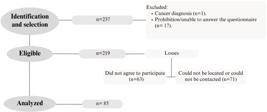
Flowchart for the selection and recruitment of participants. Ijuí, RS, Brazil, 2023 Source: The authors (2023).
Data were collected after the signing of the Informed Consent Form. A structured questionnaire was used. Data collection was conducted by the study proposer and a previously trained team. The medical records of the participants were also consulted to confirm the diagnosis and the medication administered.
Treatment adherence was assessed using the Brief Medication Questionnaire (BMQ), a previously validated instrument. The total score of the BMQ corresponds to the sum of its three domains: Regimen, Belief, and Recall. When the scores of the three domains are combined, the classification is defined as: adherent, including all patients with no positive responses in any domain; probable adherence, when the patient has a positive response in one domain; probable low adherence, when there are positive responses in two distinct domains; and low adherence, when all domains have a score ≥ 212.
The medications used were classified according to the Anatomical, Therapeutic, and Chemical Classification (ATC)13. The classification levels used were level 1 (main anatomical/pharmacological), level 2 (pharmacological or therapeutic), and level 5, referring to the medication itself. Adverse events (AEs) were self-reported by the participants, who first reported whether or not they had experienced these effects and then whether they believed these effects were related to carbamazepine (CBZ) or not.
The participants’ anxiety was assessed using the Beck Anxiety Inventory (BAI), which identifies 21 anxiety symptoms observed in the previous week. Each symptom can be scored from 0 to 3, with 3 being the most severe. In the end, the total score can vary from 0 to 63 (the higher the score, the greater the anxiety). The overall score classification is: minimal anxiety (0-7), mild anxiety (8-15), moderate anxiety (16-25), and severe anxiety (26-63)14.
The body mass index (BMI) was calculated by dividing the weight in kilograms (measured on a Multilaser© digital scale) by the square of the height (measured with a tape measure).
The study variables were: sex, age, education, BMI, medications used, diseases, AEs (according to the medication package insert), anxiety level, and degree of adherence. This study was approved by the Research Ethics Committee of the Regional University of Northwestern State of Rio Grande do Sul, with opinion no. 5.840.304, dated December 27, 2022.
All analyses were performed using the Statistical Package for the Social Sciences (SPSS Inc., Chicago, IL, USA), version 23.0.
The normality of the data was tested using the Kolmogorov-Smirnov test. Continuous data are presented as mean ± standard deviation (SD), and categorical data as absolute and relative frequency. The Pearson chi-square test was used to verify the association between two or more qualitative variables. A significance level of 5% was adopted for all tests.
RESULTS
Of the 85 participants, 47 were male (55.3%), 91.8% identified as white, 7.1% as mixed race, and 1.2% as black. The majority were married 39 (45.9%) and had incomplete elementary education 38 (44.7%) (Table 1). The average age was 49.00 ± 15.2 years, with a minimum of 20 and a maximum of 79 years.The average BMI was 29.5 ± 8.1.
Marital status, education level, and BMI of carbamazepine users in the Unified Health System of the municipality of Ijuí (n=85). Ijuí, RS, Brazil, 2023
Regarding general diseases (self-reported), epilepsy was the most common, present in 37 cases (43.5%), followed by hypertension. Additionally, 14 participants (16.5%) stated they did not know the reason for using carbamazepine. The average duration of use of this medication was 160.2 ± 127.5 months, with a minimum of 1 month and a maximum of 624 months. Most participants reported having experienced adverse events (AEs), with 51 cases (60.0%), and 17 (20.0%) believed that these events were associated with the use of carbamazepine. The most commonly mentioned effect by participants was drowsiness, with 34 cases (40%), followed by dizziness, with 30 cases (35.3%). The other data are presented in Table 2.
Self-reported diseases and adverse events among carbamazepine users in the Unified Health System in the municipality of Ijuí (n=85). Ijuí, RS, Brazil, 2023
The majority of participants, 82 (96.5%), were using another medication in addition to carbamazepine continuously. The average number of medications was 5.2 ± 2.6, with fluoxetine being the most used, 24 (28.20%), followed by omeprazole and simvastatin, 18 (21.2%). In addition to the medications presented in Table 3, another 47 were reported by the participants. However, these were used by only 1.20% of the sample and are not included in the table. More than half of the participants were considered polypharmacy users, 43 (51.8%), for using 5 or more medications.
Anatomical, therapeutic, and chemical classification of medications used by carbamazepine users in the health system of Ijuí (n=85). Ijuí, RS, Brazil, 2023
According to the Beck Anxiety Inventory, the average score obtained was 14.02 ± 11.8, with a minimum of 0, a maximum of 50, and a median of 11. When classifying patients using the Beck Anxiety Inventory, the majority of participants, 34 (40.0%), exhibited minimal anxiety, and 13 (15.3%) showed severe anxiety symptoms (Table 4). Regarding treatment adherence, 38 participants (44.7%) demonstrated likely low adherence, while only three (3.5%) were adherent. As for the confirmed medical diagnosis in the records, most participants had some mood disorder (Table 4).
Diagnosis according to the ICD-10 described in the medical records, level of treatment adherence, and anxiety among carbamazepine users in the Unified Health System (SUS) of the municipality of Ijuí (n=85). Ijuí, Rio Grande do Sul, Brazil, 2023
Regarding anxiety symptoms, patients were divided into two groups: patients with low anxiety, 54 (63.5%) and patients with moderate/high anxiety, 31 (36.5%). The occurrence of adverse events (AEs) related to medication use (not necessarily carbamazepine) was assessed in these groups. Among patients with low anxiety, 29 (34.1%) reported no AEs, while among patients with moderate/high anxiety, only 5 (5.9%) reported no AEs. Thus, a significant association was observed between lower frequency of AEs and low anxiety (p=0.001). Additionally, when stratifying the population by therapeutic indication, the frequency of moderate/high anxiety was higher in patients with mood disorders (19; 76%), while in those with epilepsy, it was 6 (24%) (p=0.030).
DISCUSSION
In the present study, greater use of anticonvulsants in the management of mood disorders was observed, indicating a distinct prescribing profile compared to other contexts. In a study conducted in Colombia, for example, epilepsy was the main indication for the use of these medications, followed by neuropathic pain (26.8%), affective disorders (14.2%), and migraine prophylaxis (12.3%)15.
Although most participants showed low treatment adherence, other studies16-17, with patients whose conditions indicate the use of CBZ, described participants with higher treatment adherence. In a survey of individuals with bipolar disorder, 51% reported low adherence, and non-adherent individuals were younger, had family conflicts, polypharmacy, lower functioning, greater severity of mood symptoms, and comorbidities17.
Similar results were found in a study in the United States with patients with bipolar disorder, in which only 28% were considered adherent18. However, it is worth noting that the differences observed in the literature may be attributed to the different populations, the diseases included, the medications used, and the various adherence questionnaires employed. Factors affecting treatment adherence include difficulties in accessing medication, multimorbidities, polypharmacy, the degree of trust in healthcare professionals, beliefs, negative self-perception of health, functional disability, adverse drug reactions, lower education levels, and logistical barriers (access to medication, timely prescription renewal)10,19-20. Low adherence to pharmacological treatment impacts disease control, potentially leading to therapeutic failure, worsening of the condition, and an increase in adverse events20.
Differences in the profile of adverse events were observed compared to studies involving epileptic patients, in which fatigue (30.4%), headache (22.5%), and difficulty concentrating (19.6%) were the most frequently reported symptoms9. However, the symptoms are consistent with the carbamazepine package insert, which describes ataxia, dizziness, drowsiness, vomiting, and nausea as very common adverse events21. No comparative studies were found that included patients with mood disorders and epilepsy in their populations, as is the case in this study. Although the adverse events analyzed are possibly due to carbamazepine, since they were attributed to it in previous studies, the concomitant use of other medications should be considered, a practice that occurred among the participants in this study.
Patients on polypharmacy, who represented half of the sample, may be more susceptible to adverse events (AE) and drug interactions2,5. Additionally, some medications used by the participants in this study may result in similar AEs, such as simvastatin, which can cause side effects like headache, abdominal pain, nausea, vomiting, and dizziness2,5. Regarding drug interactions, it is noteworthy that fluoxetine is an inhibitor of the CYP3A4 enzyme, which metabolizes carbamazepine, increasing plasma concentrations of carbamazepine and consequently its side effects when used concomitantly. Other medications reported in this population have the potential to interact with carbamazepine, such as valproic acid, quetiapine, amitriptyline, and omeprazole2,5,21. These data justify the occurrence of AEs attributed to both carbamazepine and the medications used concomitantly.
Regarding the anxiety state of the participants, 15.3% exhibited more severe symptoms. These results are similar to those of epileptics treated at a hospital center in Canada, which used two assessment questionnaires, where 12.3% showed positive results for anxiety symptoms (BAI ≥ 22) and 30.3% for GAD symptoms (GAD-7 > 7 - Generalized Anxiety Disorder-7)22. As in the present study, a survey conducted in Mexico identified a correlation between AEs and the Hospital Anxiety and Depression Scale (HADS); however, this study evaluated various anticonvulsants and also indicates that the severity of side effects may be correlated with psychiatric disorders23. The low level of anxiety in part of the population may also be explained by the study’s own results, as some users of CBZ use the medication for neurological conditions where anxiety is not a central symptom. This was observed in the statistical analysis, which demonstrated greater anxiety specifically in patients with mood disorders. It is important to highlight that more than one-third of the studied population exhibited moderate or high anxiety (36.2%).
Regarding self-reported diseases, the high prevalence of epilepsy is justified by the fact that it is one of the therapeutic indications for carbamazepine (CBZ)24 and a criterion for inclusion in this study, while hypertension is due to the high prevalence of this disease among Brazilians25. It is worth noting that diseases not related to the prescription of CBZ were obtained solely through self-report. This occurred because local clinical records are incomplete, as patients in Brazil consult both public and private medical services, and there is no single database to access this information. This justifies obtaining some information through self-report, although the bias of this data collection method is known.
The presence of various diseases in the population may be related to the high frequency of polypharmacy. Among the most commonly used medications are fluoxetine, omeprazole, and simvastatin. In a study with CAPS users in a region of Minas Gerais, the most prescribed medications were haloperidol, clonazepam, biperiden, diazepam, and valproic acid, and CBZ was used by only 5.11% of CAPS users7. In Colombia, analgesics, antiulcer medications, antihistamines, and antidepressants were more frequent in a population with epilepsy15. Similar to the results of the present work, in the Brazilian Federal District, fluoxetine was one of the most dispensed psychotropics.in a public pharmacy of the SUS26. It is important to highlight that the studies used for comparison differ in terms of location and target audience, which may explain certain differences in the results. Furthermore, carbamazepine is part of the National List of Essential Medicines (RENAME) in Brazil and is an essential medication for primary health care. In the study city, it was available for free through the SUS, as it was listed in the Municipal List of Essential Medicines (REMUME)4.
The higher frequency of fluoxetine use in the population can be explained by the fact that it is one of the medications available for free through the SUS in the study city. This may also be related to its therapeutic indication as an antidepressant, being a selective serotonin reuptake inhibitor (SSRI)2,5. According to medical records, 16.8% had a diagnosis of depression (isolated or associated), while 15.3% self-reported this condition in the questionnaire. Various other psychiatric disorders also show clinical response to the use of selective serotonin reuptake inhibitors, including obsessive-compulsive disorder, panic disorder, generalized anxiety disorder, and bipolar disorder2,5.
The high frequency of simvastatin use could be related to the risk of developing dyslipidemia due to carbamazepine (CBZ) use27. In vitro results suggest that CBZ is associated with an increase in non-HDL cholesterol levels, caused by a reduction in the expression of CYP7A1 (cholesterol 7-hydroxylase), an enzyme that controls the cholesterol metabolism rate28. Additionally, according to animal studies, CBZ promotes changes in enzymatic activities and transcription levels of enzymes/genes related to lipid metabolism, positively regulating lipogenesis29. This use could, therefore, be justified by iatrogenesis or the dietary characteristics of this population, which requires further research.
Regarding sociodemographic data, the majority were male, similar to the study conducted in Turkey30, while in Jordan, the prevalence was female16. The average age of participants in the study conducted in the Turkish hospital was 45 years 30, similar to that observed in the present study, which was 49 years. In contrast, the study conducted in the United States reported a lower average age of patients, at 35 years, but it is worth noting that this study included only patients with mood disorders18.
Based on the data found in this study, such as polypharmacy and adverse events among carbamazepine users, along with low adherence, this information needs to be used to support the development of a differentiated and careful follow-up for these patients, in order to achieve better treatment outcomes and quality of life.
Limitations include the lack of information in medical records, including the absence of a diagnosis (ICD-10) for 15% of study participants, as well as the lack of data to identify the type of epilepsy. Few studies on the same population and the use of carbamazepine for mood disorders were found, which complicates comparisons; in addition to the self-reported data on how the diseases and adverse events were reported. However, a distinguishing feature of this study is that it sought to provide more information about carbamazepine users.
CONCLUSION
Among the main findings, a higher frequency of carbamazepine (CBZ) use for mood disorders was observed. Fluoxetine, omeprazole, and simvastatin were the most commonly used medications by the participants, followed by carbamazepine. Half of the population was identified as polypharmacy users, with only 3.5% adhering to treatment, and the frequency of self-reported adverse events (AEs) was high. The study’s distinguishing feature was the inclusion of different diagnoses for the use of CBZ, which allowed for a deeper understanding of the profile of these patients in Brazil, given that there is little data about this population in the literature.
-
*
Article extracted from the master’s thesis: “Carbamazepina: perfil de uso, biomarcadores de estresse oxidativo e variantes genéticas”, Universidade Regional do Noroeste do Estado do Rio Grande do Sul, Ijuí, RS, Brasil, 2024.
-
HOW TO REFERENCE THIS ARTICLE:
Kleibert KRU, Andres ATG, Krause LS, de Melo VF, Kolankiewicz ACB, Botton MR, et.al. Carbamazepine: usage profile, associated medications, adverse events, and treatment adherence - a cross-sectional study. Cogitare Enferm [Internet]. 2026 [cited “insert year, month and day”];31:e100997en. Available from: https://doi.org/10.1590/ce.v31i0.100997en
-
FUNDING
This study was partially funded by the Coordination for the Improvement of Higher Education Personnel - Brazil (CAPES) - Financial Code 001.
Data availability:
The authors declare that all data are fully available within the article.
References
-
1 Boaventura V, Lyrio RR, Nardi AE, Cheniaux E. Carbamazepine in the treatment of bipolar disorder: a systematic review. J Bras Psiquiatr [Internet]. 2023 [cited 2024 Jan 19];72(4)247-55. Available from: https://doi.org/10.1590/0047-2085000000434
» https://doi.org/10.1590/0047-2085000000434 - 2 Rang HP, Ritter JM, Flower RJ, Henderson G. Farmacología. 9th ed. S.L.U: Elsevier España; 2020. 808 p.
-
3 Chan AYL, Yuen ASC, Hsia Y, Lau WCY, Cross JH, Walker MC, et al. Antiseizure medications consumption in 73 countries and regions from 2012 to 2022: a longitudinal trend study. eClinicalMedicine [Internet]. 2025 [cited 2024 Jan 19];89:103558. Available from: https://doi.org/10.1016/j.eclinm.2025.103558
» https://doi.org/10.1016/j.eclinm.2025.103558 -
4 Brasil. Ministério da Saúde. Secretaria de Atenção à Saúde; Secretaria de Ciência, Tecnologia e Insumos Estratégicos. Portaria conjunta nº 17, de 21 de junho de 2018. Aprova o protocolo clínico e diretrizes terapêuticas da epilepsia [Internet]. Brasília (DF): Ministério da Saúde; 2018 [citado 2024 Jan 19]. Available from: https://www.gov.br/conitec/pt-br/midias/protocolos/pcdt_epilepisia_2019.pdf/view
» https://www.gov.br/conitec/pt-br/midias/protocolos/pcdt_epilepisia_2019.pdf/view - 5 Katzung BG, Trevor AJ. Farmacologia básica e clínica. 15th ed. Porto Alegre: AMGH Editora Ltda; 2023. 1328 p.
-
6 Kalinina D, Aimyshev T, Muxunov A, Utebekov Z, Kyrgyzbay G, Kimadiev D, et al. Prescription patterns of antiseizure medication in adult patients with epilepsy in kazakhstan (2021-2023). Med Sci (Basel) [Internet]. 2025 [cited 2024 Jan 19];13(4):276. Available from: https://doi.org/10.3390/medsci13040276
» https://doi.org/10.3390/medsci13040276 -
7 Silva SN, Lima MG, Ruas CM. Uso de medicamentos nos Centros de Atenção Psicossocial: análise das prescrições e perfil dos usuários em diferentes modalidades do serviço. Ciênc Saúde Colet [Internet]. 2020 [cited 2024 Jan 20];25(7):2872-82. Available from: https://doi.org/10.1590/1413-81232020257.23102018
» https://doi.org/10.1590/1413-81232020257.23102018 -
8 Zanetti LL, Stumm E, Bosse FG, Oliveira R, Bandeira VAC, Colet CF. Tratamento medicamentoso e não medicamentoso de usuários de um Centro de Atenção Psicossocial. Sci Med [Internet]. 2017 [cited 2024 Jan 19];27(4):28277. Available from: https://doi.org/10.15448/1980-6108.2017.4.28277
» https://doi.org/10.15448/1980-6108.2017.4.28277 -
9 Fadare JO, Sunmonu TA, Bankole IA, Adekeye KA, Abubakar SA. Medication adherence and adverse effect profile of antiepileptic drugs in Nigerian patients with epilepsy. Neurodegener Dis Manag [Internet]. 2018 [cited 2025 Aug 18];8(1):25-36. Available from: https://doi.org/10.2217/nmt-2017-0044
» https://doi.org/10.2217/nmt-2017-0044 -
10 Shumet S, Wondie M, Ayano G, Asfaw H, Kassew T, Mesafint G. Antiepileptic drug adherence and its associated factors among epilepsy patients on follow-ups at amanuel mental specialized hospital: Ethiopia. Ethiop J Health Sci [Internet]. 2022 [cited 2024 Jan 19];32(5):913-22. Available from: https://doi.org/10.4314/ejhs.v32i5.6
» https://doi.org/10.4314/ejhs.v32i5.6 -
11 Ogunjimi L, Alabi A, Aderinola A, Ogunjimi O, Oladunjoye Y, Kasali A, et al. Predictors and associated factors with adverse drug reaction in people with epilepsy. Epilepsy Behav [Internet]. 2024 [cited 2024 Jan 20];150:109152. Available from: https://doi.org/10.1016/j.yebeh.2023.109566
» https://doi.org/10.1016/j.yebeh.2023.109566 -
12 Ben AJ, Neumann CR, Mengue SS. Teste de Morisky-Green e brief medication questionnaire para avaliar adesão a medicamentos. Rev Saúde Pública [Internet]. 2012 [cited 2024 Jan 19];46(2):279-89. Available from: https://doi.org/10.1590/S0034-89102012005000013
» https://doi.org/10.1590/S0034-89102012005000013 -
13 WHO Collaborating Centre for Drug Statistics Methodology. ATC/DDD Index [Internet]. Oslo: Norwegian Institute of Public Health; 2026 [cited 2022 May 2]. Available from: https://www.whocc.no/atc_ddd_index/?code=N03AF01
» https://www.whocc.no/atc_ddd_index/?code=N03AF01 -
14 Beck AT, Epstein N, Brown G, Steer RA. An inventory for measuring clinical anxiety: psychometric properties. J Consult Clin Psychol [Internet]. 1988 [cited 2024 Jan 13];56(6):893-7. Available from: https://doi.org/10.1037//0022-006x.56.6.893
» https://doi.org/10.1037//0022-006x.56.6.893 -
15 Machado-Alba JE, Calvo-Torres LF, García-Betancur S, Aguirre-Novoa A, Bañol-Giraldo AM. Drug utilisation study in patients receiving antiepileptic drugs in Colombia. Neurologia [Internet]. 2016 [cited 2024 Jan 20];31(2):89-96. Available from: https://doi.org/10.1016/j.nrleng.2015.06.002
» https://doi.org/10.1016/j.nrleng.2015.06.002 -
16 Al-Taani GM, Yehya A, Albals D, Alsous M. Assessment of adherence to carbamazepine using plasma and saliva samples, a study from Jordan. Heliyon [Internet]. 2024 [cited 2024 Jan 19];10(5):e26736. Available from: https://doi.org/10.1016/j.heliyon.2024.e26736
» https://doi.org/10.1016/j.heliyon.2024.e26736 -
17 Elhosary MY, Merranko JA, Goldstein TR, Hafeman DM, Goldstein BI, Gill MK, et al. Examining Factors Associated With Medication Adherence in Youth With Bipolar Disorder. JAACAP Open [Internet]. 2023 [cited 2024 Jan 19];1(2):105-15. Available from: https://doi.org/10.1016/j.jaacop.2023.06.001
» https://doi.org/10.1016/j.jaacop.2023.06.001 -
18 Baldessarini R, Henk H, Sklar A, Chang J, Leahy L. Psychotropic medications for patients with bipolar disorder in the United States: polytherapy and adherence. Psychiatr Serv [Internet]. 2008 [cited 2025 Aug 18];59(10):1175-83. Available from: https://doi.org/10.1176/ps.2008.59.10.1175
» https://doi.org/10.1176/ps.2008.59.10.1175 -
19 Benatti B, Girone N, Conti D, Cocchi M, Achilli F, Leo S, et al. The Role of lifestyle on adherence to treatment in a sample of patients with unipolar and bipolar depression. Int J Environ Res Public Health [Internet]. 2023 [cited 2026 Jan 13];20(3):1994. Available from: https://doi.org/10.3390/ijerph20031994
» https://doi.org/10.3390/ijerph20031994 -
20 Patel S, Huang M, Miliara S. Understanding treatment adherence in chronic diseases: challenges, consequences, and strategies for improvement. J Clin Med [Internet]. 2025 [cited 2024 Jan 19];14(17):6034. Available from: https://doi.org/10.3390/jcm14176034
» https://doi.org/10.3390/jcm14176034 -
21 Agência Nacional de Vigilância Sanitária (Anvisa). Bula do Carbamazepina. Anvisa [Internet]. 2022 [cited 2022 May 5]. Available from: https://consultaremedios.com.br/carbamazepina/bula
» https://consultaremedios.com.br/carbamazepina/bula -
22 Injar I, Keezer M, Lapalme-Remis S, Chamelian L, Assi EB, Nguyen DK. Screening and Management of Depression and Anxiety in People With Epilepsy: A Quality Improvement Study. Can J Neurol Sci [Internet]. 2025 [cited 2026 Jan 13]1-9. Available from: https://doi.org/10.1017/cjn.2025.10491
» https://doi.org/10.1017/cjn.2025.10491 -
23 Gómez-Arias B, Crail-Meléndez D, López-Zapata R, Martínez-Juárez IE. Severity of anxiety and depression are related to a higher perception of adverse effects of antiepileptic drugs. Seizure [Internet]. 2012 [cited 2024 Feb 14];21(8):588-94. Available from: https://doi.org/10.1016/j.seizure.2012.06.003
» https://doi.org/10.1016/j.seizure.2012.06.003 -
24 Nevitt SJ, Sudell M, Cividini S, Marson AG, Tudur Smith C. Antiepileptic drug monotherapy for epilepsy: a network meta-analysis of individual participant data. Cochrane Database of Systematic Reviews [Internet]. 2022 [cited 2024 Jan 19];(4)CD011412. Available from: http://doi.wiley.com/10.1002/14651858.CD011412.pub4
» http://doi.wiley.com/10.1002/14651858.CD011412.pub4 -
25 Malta DC, Bernal RTI, Prates EJS, de Vasconcelos NM, Gomes CS, Stopa SR, et al. Self-reported arterial hypertension, use of health services and guidelines for care in Brazilian population: National Health Survey, 2019. Epidemiol Serv Saúde [Internet]. 2022 [cited 2024 Feb 24];31(nspe1):e2021369. Available from: https://doi.org/10.1590/SS2237-9622202200012.especial
» https://doi.org/10.1590/SS2237-9622202200012.especial -
26 Rolim CHS, Carneiro RG, de Araújo FJ. Análise do consumo de medicamentos psicotrópicos em Unidades Básicas de Saúde. Rev Contexto Saúde [Internet]. 2023 [cited 2024 Jan 21];23(47):e13272. Available from: https://doi.org/10.21527/2176-7114.2023.47.13272
» https://doi.org/10.21527/2176-7114.2023.47.13272 -
27 Trinka E, Rocamora R, Chaves J, Koepp MJ, Rüegg S, Holtkamp M, et al. Lipid profile with eslicarbazepine acetate and carbamazepine monotherapy in adult patients with newly diagnosed focal seizures: post hoc analysis of a phase III trial and open-label extension study. Ther Adv Neurol Disord [Internet]. 2023 [cited 2026 Jan 13];16:17562864231193530. Available from: https://doi.org/10.1177/17562864231193530
» https://doi.org/10.1177/17562864231193530 -
28 Gibbons GF. The role of cytochrome P450 in the regulation of cholesterol biosynthesis. Lipids [Internet]. 2002 [cited 2024 Aug 18];37(12):1163-70. Available from: https://doi.org/10.1007/s11745-002-1016-x
» https://doi.org/10.1007/s11745-002-1016-x -
29 Xin J, Yan S, Hong X, Zhang H, Zha J. Environmentally relevant concentrations of carbamazepine induced lipid metabolism disorder of Chinese rare minnow (Gobiocypris rarus) in a gender-specific pattern. Chemosphere [Internet]. 2021 [cited 2024 Jan 21];265:129080. Available from: https://doi.org/10.1016/j.chemosphere.2020.129080
» https://doi.org/10.1016/j.chemosphere.2020.129080 -
30 Uskur T, Güven O. Therapeutic drug monitoring of carbamazepine and valproic acid: interindividual variability in epilepsy patients. J Health Sci Med [Internet]. 2025 [cited 2024 Jan 19];8(5):884-8. Available from: https://doi.org/10.32322/jhsm.1751139
» https://doi.org/10.32322/jhsm.1751139
-
Associate editor:
Dra. Cremilde Aparecida Trindade Radovanovic