
 Growth of Parapiptadenia rigida inoculated with rhizobia and arbuscular mycorrhizal fungi in the nursery and field
ABSTRACT
Parapiptadenia rigida is a N-fixing arboreal legume native to the Atlantic Forest of southern Brazil. It is commonly used in urban afforestation, restoring riparian forests and agroforestry systems (AFSs). In this study, an experiment was conducted with nine treatments with the objective of evaluating the growth of Parapiptadenia rigida seedlings inoculated with rhizobia and arbuscular mycorrhizal fungi (AMF) under nursery conditions and in the field, with the seedlings being inoculated with: (a) BR 9004 strain (Paraburkholderia sp); (b) BR 3804 strain (Mesorhizobium plurifarium); (c) BR 827 strain (Ensifer fredii); (d) BR 9004 strain+AMF; (e) BR 3804 strain+AMF; (f) BR 827 strain+AMF; (g) Mycorrhizal control (AMF inoculation only); (h) Nitrogen control (with nitrogen fertilization only); (i) Absolute control (without inoculation and without fertilization). The seedlings were evaluated for height and root collar circumference (SC) after 120 days in the nursery, and then for root, shoot and nodule dry mass, mycorrhizal colonization, counting and identification of spores in the substrate after 150 days in the nursery. The seedlings were transplanted into the field at 330 days and monitored in relation to height growth, SC and survival up to 420 days after planting. The BR3804+AMF and BR9004+AMF treatments stood out in growth and survival, respectively, and were related to the occurrence of Glomus sinuosum and Acaulospora scrobiculata spores in the rhizosphere of seedlings.
Keywords:
Inoculation; Symbiosis; Recovery of degraded areas; Fabaceae; Glomeromycota
RESUMO
Parapiptadenia rigida é uma leguminosa arbórea fixadora de N, nativa da Mata Atlântica do Sul do Brasil, comumente usada na arborização urbana, restauração de matas ciliares e SAFs. Com objetivo de avaliar o crescimento de mudas de Parapiptadenia rigida inoculadas com rizóbios e fungos micorrízicos arbusculares (FMAs) em condições de viveiro e no campo, foi realizado um experimento com nove tratamentos, sendo as mudas inoculadas com: (a) estirpe BR 9004 (Paraburkholderia sp); (b) estirpe BR 3804 (Mesorhizobium plurifarium); (c) estirpe BR 827 (Ensifer fredii); (d) estirpe BR 9004+FMAs; (e) estirpe BR 3804+FMAs; (f) estirpe BR 827+FMAs; (g) Testemunha micorrizada (apenas inoculação de FMAs); (h) Testemunha nitrogenada (apenas com fertilização de nitrogênio); (i) Testemunha absoluta (sem inoculação e sem fertilização). Após 120 dias no viveiro as mudas foram avaliadas quanto à altura e circunferência do colo (CAC), e após 150 dias quanto à massa seca de raízes, da parte aérea e de nódulos, colonização micorrízica, contagem e identificação de esporos no substrato. Com 330 dias as mudas foram transplantadas no campo e monitoradas em relação ao crescimento em altura, CAC e sobrevivência até 420 dias após o plantio. Os tratamentos BR3804+FMAs e BR9004+FMAs se destacaram em crescimento e sobrevivência, respectivamente, e se relacionaram à ocorrência de esporos de Glomus sinuosum e Acaulospora scrobiculata na rizosfera das mudas.
Palavras-chave:
Inoculação; Simbiose; Recuperação de áreas degradadas; Fabaceae; Glomeromycota
1 INTRODUCTION
The association of legumes with nitrogen-fixing bacteria (rhizobia) and arbuscular mycorrhizal fungi (AMF) in a tripartite interaction is capable of providing the plant with a large part of the nutrients necessary for its initial development and establishment in the field, and can contribute to successful planting of tree species in projects to recover degraded areas (Franco et al., 1995).
Mycorrhizal plants have better nutritional status (Koide, 1991), greater access to soil water and increased photosynthetic rate (Smith; Read, 1997), in addition to greater root density and longevity and greater protection against pathogens (Sylvia; Williams, 1992). This symbiosis can generate benefits in terms of reducing damage during transplantation, a higher seedling retention rate, a reduction in the time it takes for seedlings to form in the nursery, greater production of reserve substances and an increase in the interspecific competitiveness of plants in the field (Haas; Menge, 1990; Azcón-Aguilar et al., 1992).
The nutrient absorption capacity of mycorrhizal plants is mainly evidenced by phosphate nutrition, where P is absorbed in the form of orthophosphate (PO43-). This offers a great nutritional advantage since the phosphate anion has a low diffusion and concentration rate in tropical soils, where it is easily immobilized (Smith; Smith; Jakobsen, 2003). The symbiosis also favors increased absorption of Cu2+, Mg2+ and Zn2+ nutrient cations which, like the phosphate anion, have reduced mobility in the soil (Berbara et al., 2006).
Some legume species are highly dependent on mycorrhizae, and despite nodulating in the absence of AMF, the nodules are not efficient in carrying out biological nitrogen fixation (BNF), requiring mycorrhizal association for effective symbiosis with rhizobia functioning (Bournaud et al., 2018). Among some forest species dependent on mycorrhizae, we can mention: Acacia mangium, Acacia auriculiformis (De La Cruz et al., 1988), Albizia lebeck (Faria et al., 1995a), Centrolobium tomentosum (Marques; Pagano; Scotti, 2001), Anadenanthera peregrina (Gross; Cordeiro; Caetano, 2004), Piptadenia gonoacantha and Piptadenia paniculata (Jesus; Schiavo; Faria, 2005; Bournaud et al., 2018).
The Parapiptadenia genus has already demonstrated development problems in sterilized substrates (Faria et al., 1995b), making the selection of rhizobia strains difficult. This may be indicative of the mycorrhizal dependence of species in this genus to establish tripartite symbiosis. The Parapiptadenia rigida (Benth.) Brenan species, popularly known as angico-amarelo, angico-vermelho or angico-gurucaia in Brazil, is a N-fixing legume species which is native to the Atlantic Forest and Pampas biomes. Its natural distribution in Brazil is restricted to the states of Mato Grosso do Sul, Mato Grosso, São Paulo, Paraná, Rio Grande do Sul and Santa Catarina (Morim, 2020). It can also be found in Argentina, Paraguay and Uruguay (Carvalho, 2003). It reaches a height of between 4 and 35 m (Carvalho, 2002), being recommended for the recovery of degraded areas (Souto, 1984) and urban afforestation (Lorenzi, 1992).
This work aimed to evaluate the growth of Parapiptadenia rigida seedlings inoculated with rhizobia and arbuscular mycorrhizal fungi (AMF) in nursery and field conditions.
2 MATERIALS AND METHODS
The experiment was conducted on the premises of the Horto Florestal de Guaratiba (HFGUA) facility, located in Rio de Janeiro, RJ, Brazil. The place has a tropical Atlantic climate, Aw according to the Köppen-Geiger climate classification, has an average rainfall of 1200 mm to 2200 mm annually and an average temperature of 24℃.
The experiment was set up following the Official Protocol for Assessing the Viability and Agronomic Efficiency of Strains, Inoculants and Technologies Related to the Biological Nitrogen Fixation Process in Legumes of Ministry of Agriculture, Livestock, and Supply (MAPA). A total of nine treatments were tested, with: (a) BR 9004 strain (Paraburkholderia sp); (b) BR 3804 strain (Mesorhizobium plurifarium); (c) BR 827 strain (Ensifer fredii); (d) BR 9004 strain+AMF; (e) BR 3804 strain+AMF; (f) BR 827 strain+AMF; (g) Mycorrhizal control (AMF inoculation only); (h) Nitrogen control (with nitrogen fertilization only); (i) Absolute control (without inoculation and without fertilization). The treatments were performed in a completely randomized design with 5 replications in a factorial scheme 3 (inoculants) x 2 (with and without mycorrhizae), and 3 more controls with 10 seedlings, totaling 450 seedlings in the experiment and 45 plots. Each seedling was produced in a 15 cm x 24 cm (1.2 liters) plastic bag containing clay soil and sand substrate in a 1:1 ratio, without disinfection treatments, in beds under shade. The substrate was characterized in terms of fertility (Table 1), and based on this soil analysis, it was fertilized as recommended by Freire et al. (2013) for seedlings of tree legumes by applying fertilization of 89 g of simple superphosphate, 40 g of potassium chloride and 4 g of FTE BR-12 micronutrients in 800 kg of substrate.
Chemical analysis of the clay:sand substrate (1:1) used in the experiment before fertilization
The BR 9004, BR 3804 and BR 827 bacterial inoculants and AMF were supplied by the Johanna Döbereiner Biological Resources Center (CRB-JD) of Embrapa Agrobiologia. All rhizobia strains come from Linhares (ES), and their inoculants were prepared using peat as a vehicle. The AMF inoculant was applied in the form of soil-inoculum (5 g per seedling), prepared through a mixture of the following seven strains from the Embrapa Agrobiology Fungi Collection (COFMEA): Acaulospora colombiana A15, Acaulospora scrobiculata A38, Claroideoglomus etunicatum A44, Dentiscutata heterogama A2, Gigaspora margarita A1, Rhizophagus clarus A5, and Scutellospora calospora A80. The AMF inoculant contained 13 spores of each fungal strain per 5-gram dose, in addition to pieces of colonized roots and hyphae, which were not quantified.
Bacterial inoculation was performed by moistening the seeds with distilled water and mixing them with the peat inoculant, followed by exposure to air for approximately 2 hours to eliminate excess moisture.
After seed emergence, 5 mg of N per bag was applied weekly to the nitrogen control using ammonium nitrate (NH4NO3), totaling 160 mg of N per seedling after 8 months. Additionally, 50 mL per bag of Norris nutrient solution modified to half the salt concentration (Gruzmán; Döbereiner, 1968), containing macro [(KCl, CaCl2, KH2PO4, MgSO4(H2O7)] and micronutrients [(H3B1O3; MnSO4, ZnSO4-(H2O)7, CuSO4-(H2O)5, Na2MoO4(H2O)2], preventing the lack of other nutrients from interfering with the results of the experiment. The amount of P contained in the nutrient solution was 3.1 ppm.
Next, height and root collar circumference (SC) were measured 120 days after implementing the experiment. Then, 5 seedlings were collected from each plot after 150 days and the shoot, root and nodule dry mass were quantified. The roots were washed, the nodules were manually removed and all parts of the plant were dried in a forced air circulation oven at 65ºC for 72 hours to evaluate the dry matter mass.
Before drying the roots, fresh root samples were taken for analysis of mycorrhizal colonization. For this analysis, fine root samples were clarified and stained according to the methods described by Koske and Gemma (1989) and Grace and Stribley (1991), respectively. The mycorrhizal colonization rate was estimated using the gridline intersect method of Giovannetti and Mosse (1980).
Then, 50 mL of the substrate was separated to extract AMF spores using the wet sieving method in order to count spores and identify AMF present in the seedling substrate (Gerdemann; Nicolson, 1963), complemented by the density gradient centrifugation methodology (with water and 45% sucrose) described by Jenkins (1964). The spores were counted using a stereoscopic microscope and were subsequently mounted on microscopy slides with polyvinyl alcohol in lactoglycerol (PVLG) and with PVLG + Melzer’s reagent (1:1), and mechanically broken under a coverslip to expose the internal walls. They were photographed and identified according to the Schenck and Pérez identification manual (1988), consulting the original species description publications and the INVAN website (https://invam.ku.edu/).
The seedlings were transplanted to the experimental station (terrace) at Embrapa Agrobiologia, Seropédica, RJ (22°45'30.35"S; 43°40'19.00"W) at the end of the rainy season when the seedlings were 330 days old to continue their evaluation in the field. To do so, 4 seedlings were planted from each plot, maintaining the 5 replications conducted during seedling formation in the nursery, and the 9 inoculation treatments. The experimental design of the nursery was maintained, planting the seedlings at 2 m x 2 m spacing. No type of fertilization or correction of the field soil was carried out. The area was mowed with brushcutters every 3 months. Field evaluations were carried out 60 days, 240 days and 420 days after planting, evaluating survival, height and root collar circumference. The increase in height and root collar circumference was calculated, subtracting the values at 60 days from the values obtained at 240 days (INCRH1 and INCRCAC1), and those measured at 240 days from those obtained at 420 (INCRH2 and INCRCAC2).
The data were tabulated, tested for normality and homogeneity of variance, with the mycorrhizal colonization percentage transformed into arcsen (root(x/100)). First, an analysis of variance was carried out with the 9 treatments, including additional controls in order to compare them with the other treatments using the Scott-Knott grouping method at 5% probability. Another analysis of variance was subsequently performed only with the 6 treatments which composed the 3x2 factorial, three bacteria strains x two mycorrhizal inoculation levels, comparing the means of mycorrhiza (with and without) using the F-test of the analysis and bacteria levels using the Scott Knott test at 5% probability. Both analyzes were done using the Sisvar (Ferreira, 2011) and R (R Core Team, 2018) programs.
The multivariate principal components analysis (PCA) technique was applied to data on fungal species found in seedlings subjected to different treatments, making it possible to graphically visualize the relationship between the different variables and treatments in a two-dimensional space using the Canoco program (Ter Braak; Smilauer, 2002).
3 RESULTS
Under nursery conditions, the analysis of variance with the 9 treatments indicated a significant effect (p<0.05) for all variables, with the exception of nodule dry mass, mycorrhizal colonization and average number of spores (Figure 1). The controls without inoculation with nitrogen fertilization showed greater height, root collar circumference, root and shoot dry mass, being superior to all other treatments (Figure 1), suggesting that all rhizobia strains fixed lower N amounts than that applied in mineral form. This result is common, since treatment with mineral nitrogen is programmed to have maximum plant response to N application, representing the maximum N demand by the plant.

Species in the seedling stage of P. rigida, inoculated with strains and AMF after 120 days in the nursery
The factor analysis for the shoot and root dry mass variables indicated a significant interaction between rhizobia strains and mycorrhizal inoculation, with the BR 827 strain being the most prominent in the nursery phase (Table 1).
Mycorrhizal colonization of Parapiptadenia rigida seedlings varied from 25.5% in the BR 3804+AMF treatment to 49.8% in the BR 827 treatment, but showed no significant difference between treatments, nor interaction between factors (Table 2). There was also no difference in relation to the controls studied (Figure 1F). The average number of spores varied from 159 in the absolute control to 777 in the mycorrhizal control only (Figure 1G), but there was also no difference or significant interaction between the treatments with bacteria and AMF (Table 2). The average number of AMF species in the seedling substrate ranged from 1.25 in the BR 3804+AMF treatment to 3.75 in BR 9004+AMF, with this variable showing a difference between treatments and interaction between factors (Table 2). Moreover, there was sporulation of a smaller number of AMF species in the BR 827+AMF and BR 3804+AMF treatments compared to the others.
Breakdown of means in the factor analysis of the variables analyzed in the seedling phase of Parapiptadenia rigida inoculated with three rhizobia strains with and without inoculation of arbuscular mycorrhizal fungi (AMF) after 120 days in the nursery
A total of 11 AMF species belonging to seven genera were found in all treatments, listing the 7 genera first, followed by the 11 species: Acaulospora (3), Ambispora (1), Cetraspora (1), Dentiscutata (1), Glomus (3), Gigaspora (1), Rhizophagus (1); Acaulospora foveata, Acaulospora mellea, Acaulospora scrobiculata, Ambispora leptoticha, Cetraspora pellucida, Dentiscutata heterogama, Glomus clavisporum, Glomus macrocarpum, Glomus sinuosum, Gigaspora sp, and Rhizophagus clarus.
From the 11 species, A. foveata, A. mellea, A. scrobiculata, A. leptoticha, G. clavisporum, G. macrocarpum and C. pellucida were not inoculated, meaning they came native to the substrate used or were introduced into the nursery by wind, irrigation water or another dispersion form of AMF propagules, such as small animals. AMF spore dispersion has already been observed by Castillo-Guevara, Lara and Pérez (2012), having been carried out effectively by wild rodents such as Peromyscus maniculatus and Neotomodon alstoni. These authors observed that the metabolic activity of the spores remained active even after passing through the digestive tract of these animals.
The most frequent AMF species in the substrate were R. clarus, D. heterogama, C. pellucida, A. mellea, A.foveata and G. sinuosum. R. clarus was predominant in both mycorrhizal and non-mycorrhizal treatments. A. mellea, A. foveata and G. sinuosum species were not inoculated, and even so, they were more frequent than the other species.
The treatments inoculated with non-mycorrhizal rhizobia (BR 827, BR 3804 and BR 9004) and the nitrogen treatment were more associated with the occurrence of Rhizophagus clarus, which was a generalist between treatments, as demonstrated by principal component 1 of the multivariate analysis (Figure 2). According to principal component 2, the control only inoculated with AMF (MC) was associated with the occurrence of A. mellea and D. heterogama, with the latter being present in the inoculant. Furthermore, the BR 3804+AMF and BR 9004+AMF treatments were associated with the occurrence of Glomus sinuosum and Acaulospora scrobiculata, with the latter being present in the inoculant. The absolute control (not inoculated and not fertilized) was not related to the occurrence of any of the AMF species, assuming a uniform and non-abundant distribution of AMF species in this treatment.

Multivariate analysis relating the fungal species found in Parapiptadenia rigida seedlings inoculated only with rhizobia and AMF
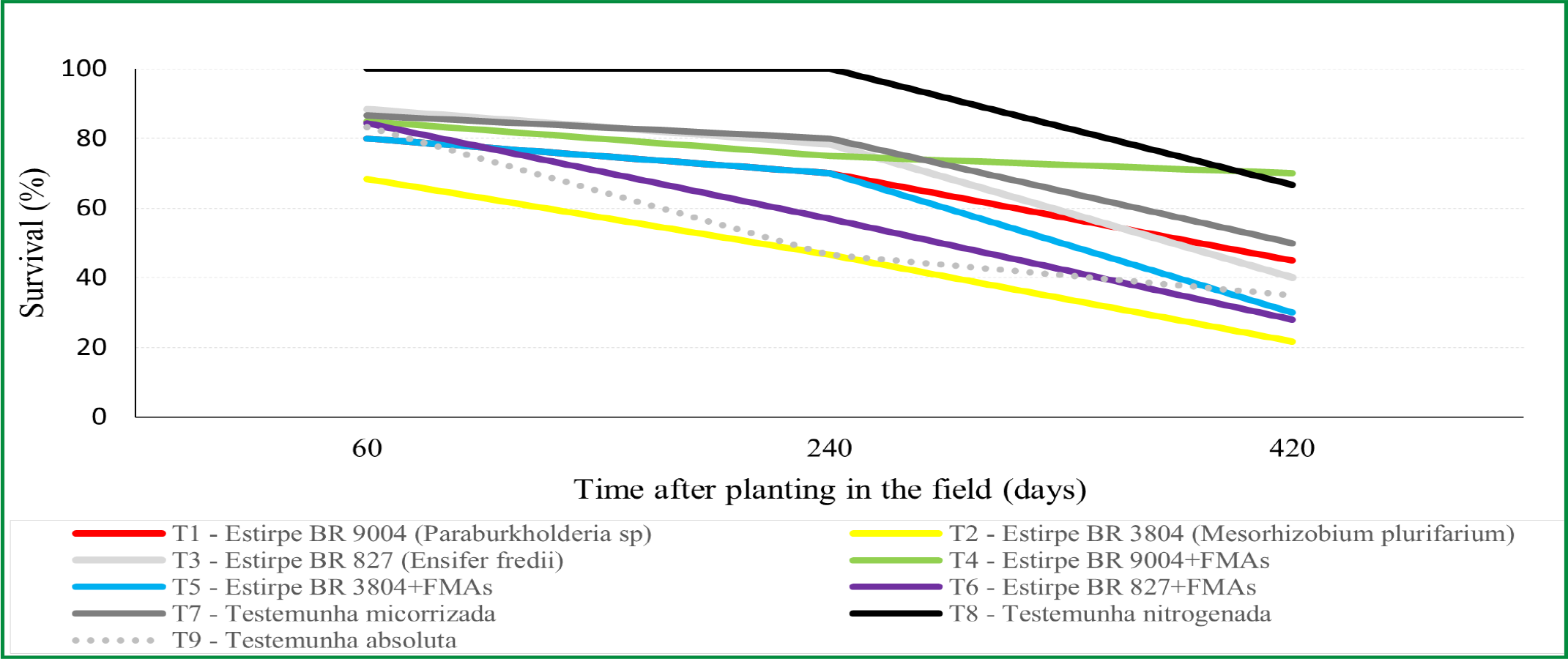
The survival of Parapiptadenia rigida seedlings in the field was an average of 80% at 60 days after planting (DAP), falling to 66% at 240 DAP and 39% at 420 DAP, with a significant difference between the factorial and the control samples (p<0.05). The low seedling survival at 420 DAP was possibly related to the strong summer in February 2017 (270 DAP), where in addition to the high temperatures, there were 13 consecutive days without rain (11 to 23/02). Even so, the seedlings from the BR 9004+AMF treatment showed high survival (70%) after 420 days, standing out in relation to the average survival (Table 2; Figure 3).

Survival of Parapiptadenia rigida seedlings in the field, inoculated with rhizobia strains and/or arbuscular mycorrhizal fungi, and controls
There was no effect of inoculation treatments regarding the increase in height in the period between 60 and 240 DAP (INCRH1). Then in the later period between 240 and 420 days (INCRH2), associated with greater stress and mortality of the seedlings, it was observed that the BR 3804 and BR 9004 treatments without AMF inoculation showed significantly lower growth. Thus, the average increase in height at 420 DAP in seedlings inoculated with AMF was 5.58 cm, more than double the increase in seedlings not inoculated with AMF (2.31 cm). Furthermore, in the same way as height, the increase in root collar circumference did not show an effect of inoculation treatments in the first evaluation period (INCRCAC1); it only appeared in the second period, when there was an effect of inoculation with rhizobia. The BR 9004 and BR 3804 strains with AMF showed a greater increase in the field than the BR 827 strain (Table 3).
Height, root collar circumference and survival of Parapiptadenia rigidia seedlings at 60, 240 and 420 days after planting in the field
In observing the total development in height and stem circumference up to 420 days after planting in the field (Figure 4), the largest size was observed for seedlings inoculated with BR3804+AMF. Although the seedlings inoculated with BR 827 stood out in the nursery phase in terms of shoot and root dry mass (Table 1), their growth in the field did not achieve the same yield. At the end of the experiment, they had grown 22.67 cm in height and 6.25 mm in SC, much lower than the 40.17 cm in height and 8.24 mm in SC observed for the BR 3804+AMF treatment, which was considered the best treatment (Figure 4). The same occurred with the nitrogen control, which grew 28.38 cm in height in the nursery, but only grew 18.08 cm in the field, totaling 46.46 cm in height and 8.37 mm in SC (Figure 3).

Height and root collar circumference (SC) of Parapiptadenia rigida seedlings inoculated with and without rhizobia and arbuscular mycorrhizal fungi (AMF) at 120 days after sowing and inoculation (nursery), and at 60, 240 and 420 days after planting in the field (DAP)
4 DISCUSSIONS
The growth of Parapiptadenia rigida was slow for a species classified as a pioneer, although Carvalho (2002) classifies the species’ growth as moderately slow. The species reached an average height of 15.52±5.11 cm after 120 days in the nursery. Then, it reached an average height of 30.25±12.15 cm after 420 days of planting in the field, reaching a maximum height of 66.50 cm. Steffen, Steffen, Morais, Saldanha, Maldaner and Loiola (2017) also did not find very different growth values in the seedling phase, finding height values in P. rigida seedlings planted in 100 cm3 tubes varying from 8.91 to 10.36 cm after 90 days in Rio Grande do Sul.
In testing different phosphorus doses, Schumacher, Ceconi and Arruda (2004) found a maximum height of 20 cm in P. rigida seedlings fertilized with the best phosphorus dose (450 mg/kg) after 130 days in a nursery in 2 dm3 containers. In evaluating different volumes of containers and doses of controlled-release fertilizer (CRF), Gasparin, Araujo, Zavistanovicz, Aimi, Léon and Berghetti (2017) found the greatest height (45 cm) in P. rigida seedlings after 210 days in a nursery with the largest container (180 cm3) and best fertilizer treatment (between 6 and 9 g L-1). Patreze and Cordeiro (2004) found a height varying from 24 to 40 cm for the species in a nursery after 255 days with different mineral fertilization forms and inoculation with rhizobia and AMF in 4 L containers.
The low growth observed in this work may also be related to the high amount of aluminum found in the substrate, which may have made nutrients unavailable to the seedlings. The calcium source used in the nutrient solution (calcium sulfate) was not sufficient to neutralize the aluminum. The harmful effects of aluminum on plants are already well known and documented, and mainly occur when the pH is low (Rao; Miles; Beebe; Horst, 2016; Peleja; Rego; Da Silva Junior; Furtado; Felsemburgh; Tribuzy, 2020).
The species has a distribution restricted to the Atlantic Forest of southern Brazil and São Paulo, whose predominant climates are tropical (Af) and (Am), humid subtropical (Cfa), humid temperate (Cfb) and high-altitude subtropical (Cwa and Cwb) according to the Koppen climate classification, with average annual temperature varying from 15.5°C to 25°C. The predominant climate in Rio de Janeiro (where the seedlings were produced), and in Seropédica (where they were planted in the field) is Aw, while the average annual temperature is 24°C, an average minimum temperature of 21°C and an average maximum temperature of 27.3° C. This factor may have stressed and caused low survival and growth of the seedlings.
The P. rigida species belongs to the Mimoseae tribe. There is evidence that several genera of this family present specificity in relation to the genus of N-fixing bacteria, and only nodulate with strains isolated from species of the tribe itself (Andrews; Andrews, 2017; Mello; Faria, 1998). In the present work, the seedlings inoculated with BR 3804 (Mesorhizobium plurifarium), and BR 9004 (Paraburkholderia sp), both originating from Linhares (ES), stood out in relation to the other treatments.
The mycorrhizal colonization values found in this work (25.5-49.8%) were higher than those obtained by Stoffel, Armas et al. (2016), which ranged from 9 to 26% for P. rigida inoculated with arbuscular mycorrhizal fungi: Acaulospora colombiana, A. morrowiae, Dentiscutata heterogama, Rhizophagus clarus and R. irregulares. The most frequent AMF species in the nursery substrate in the present work were: Rhizophagus clarus, Dentiscutata heterogama, Cetraspora pellucida, Acaulospora mellea, A. foveata and Glomus sinuosum. Of these, A. foveata, A. mellea, C. pellucida and G. sinuosum they were not inoculated, that is, they came from the nursery environment.
Although not inoculated with AMF, the seedlings in the nursery inoculated with BR 827 showed high mycorrhizal colonization and a high number of spores, being particularly associated with the fungus Rhizophagus clarus. This treatment presented the highest shoot and root dry mass values, second only to the nitrogen control, and was equal to the BR 9004+AMF and BR 3804+AMF treatments. Mycorrhizal colonization in treatments that were not inoculated is expected since the experiment was not carried out under sterile conditions. According to Pan and Smith (2000), experiments in non-sterile conditions are important to evaluate the competitiveness and efficiency of introduced microorganisms in relation to native ones in the soil. In studying sweet potatoes and corn, Souza et al. (2019) also detected R. clarus spores in all treatments, including the non-inoculated one, with linear responses being observed, with an increase in the number of spores as the inoculation dose increased in these cultures.
Although many studies detect the advantage of double inoculation of rhizobia and AMF for seedling establishment and survival in the field (Marques; Pagano; Scotti, 2001; Dias et al., 2012), this relationship was not identified in the establishment in the present work, but only for survival 420 days after planting for the BR 9004+AMF treatment. Planting was carried out in May at the end of the rainy season. The dry season that followed had a short dry period (only July), and then the rains returned in August. The summer, which occurred in the middle of the following rainy season, more precisely in February, affected seedling survival, since temperatures were high and with a dry period of more than 10 consecutive days without rain.
The BR 9004+AMF and BR 3804+AMF treatments showed better growth performance in the field, surpassing treatment BR 827. These treatments inoculated with AMF were related to the occurrence of Glomus sinuosum and Acaulospora scrobiculata, of which only A. scrobiculata was inoculated. A. scrobiculata is a fungus which has a very restricted spectrum of efficiency and is specific to some species, while R. clarus can be considered to have generalist behavior (Pouyu-Rojas; Siqueira; Santos, 2006).
Despite greater development, it is observed that the BR 9004+AMF and BR 3804+AMF treatments presented a low number of AMF species, showing that efficient combinations between P. rigida and fungal strains can restrict by competition, inhibition, or another mechanism (i.e. the establishment of symbiosis with many AMF species). Some tree species present efficient symbiosis with a few AMF species, as is the case of Acacia polyphylla (maricá), which only benefits from the association with Rhizophagus clarus, Cetraspora pellucida and Claroideoglomus etunicatum; and Enterolobium contortisiliquum (tamboril), which only benefits from Rhizophagus clarus and Cetraspora pellucida (Pouyu-Rojas; Siqueira; Santos, 2006).
The benefit of double inoculation was evident in the increases in height and root collar circumference in the period between 240 and 420 days after planting in the field. The increases in height and root collar circumference were higher in the period mentioned for the seedlings inoculated with the BR 9004+AMF and BR 3804+AMF treatments. However, total growth in height at the end of the experiment was only greater for BR 3804+AMF, which was equal to the nitrogen control, and was superior to the other treatments. This treatment provided 135% greater height than the same strain without mycorrhiza at 420 days after planting, and also presented a greater magnitude of root collar circumference, but without a significant difference in relation to the other treatments for this variable. Despite this, this treatment did not have good survival in the field, with only 30% survival 420 days after planting (DAP). On the other hand, the BR 9004+AMF treatment showed 70% survival at 420 DAP, having equaled growth in root collar circumference and height to BR 3804+AMF and the nitrogen control.
5 CONCLUSIONS
In conclusion, no effect of double inoculation of rhizobia and AMF on seedling growth was observed in the nursery, with all inoculation treatments being inferior to the nitrogen control. Double inoculation favored increases in height and root collar circumference of seedlings in the field in the period between 240 and 420 days after planting, with this difference being observed in the BR 3804 and BR 9004 strains. At the end of 420 days after planting in the field, the seedlings inoculated with BR 9004+AMF stood out in terms of survival, matching the nitrogen control. Glomus sinuosum and Acaulospora scrobiculata fungal species were more associated with the BR 3804 treatment (Mesorhizobium plurifarium) + AMF and BR 9004 (Paraburkholderia sp) + AMF, with greater performance in growth and survival.
REFERENCES
-
ANDREWS, M.; ANDREWS, M. E. Specificity in Legume-Rhizobia Symbiosis. International Journal of Molecular Sciences, Basel, v. 18, n. 705, 2017. DOI: 10.3390/ijms18040705.
» https://doi.org/10.3390/ijms18040705. -
AZCÓN AGUILAR, C.; BARCELO, A.; VIDAL, M. T.; VINA, G. Further studies on the influence of mycorrhiza on growth and development of micropropagated avocado plants. Agronomie, Paris, v. 46, n. 12, p. 837-840, 1992. https://hal.science/hal-00885438
» https://hal.science/hal-00885438 - BERBARA, R. L.; SOUZA F. A.; FONSECA, H. M. A. C.; FERNANDES, M. S. Fungos micorrízicos arbusculares: muito além da nutrição. In: Nutrição Mineral de Plantas Sociedade Brasileira de Ciência do Solo, p. 72, 2006.
-
BOURNAUD, C.; JAMES, E. K.; FARIA, S. M. de; LEBRUN, M.; MELKONIAN, R.; DUPONNOIS, R., ...; PRIN, Y. Interdependency of efficient nodulation and arbuscular mycorrhization in Piptadenia gonoacantha, a Brazilian legume tree. Plant, cell & environment, v. 41, n. 9, p. 2008-2020, 2018. DOI: https://doi.org/10.1111/pce.13095
» https://doi.org/10.1111/pce.13095 - CARVALHO, P. E. R. Angico-Gurucaia 1. ed. Colombo: Embrapa Florestas. 2002. 14p. (Circular Técnica, 58).
- CARVALHO, P. E. R. Espécies arbóreas brasileiras 1. ed. Brasília: Embrapa Informação Tecnológica, 2003. v. 1, 1039 p.
-
CASTILLO-GUEVARA, C.; LARA, C.; PÉREZ, G. Micofagia por roedores en un bosque templado del centro de México. Revista Mexicana de Biodiversidad, Cidade do México, n. 83, p. 772-777, 2012. DOI: https://doi.org/10.7550/rmb.27445
» https://doi.org/10.7550/rmb.27445 -
DE LA CRUZ, R. E.; MANALO, M. Q.; AGGANGAN, N. S.; TAMBALO, J. D. Growth of trees inoculated with VA mycorrhizal fungi and Rhizobium Plant and Soil, The Hague, v. 108, p. 111-115, 1988. https://link.springer.com/article/10.1007/BF02370105
» https://link.springer.com/article/10.1007/BF02370105 -
DIAS, P. C.; PEREIRA, M. D. S. F.; KASUYA, M. C. M.; PAIVA, H. N. D.; OLIVEIRA, L. S. D.; XAVIER A. Micorriza arbuscular e rizóbios no enraizamento e nutrição de mudas de angico-vermelho. Revista Árvore, Viçosa, n. 36, p. 1027-1038, 2012. DOI: https://doi.org/10.1590/S0100-67622012000600004
» https://doi.org/10.1590/S0100-67622012000600004 - FERREIRA, D. F. Sisvar: Um sistema computacional de estatística. Ciência e Agrotecnologia, Lavras, v. 35, p. 1039-1042, 2011.
- FRANCO, A. A.; DIAS, L. E.; FARIA, S. M. de; CAMPELLO, E. F. C.; SILVA, E. M. R. Uso de leguminosas florestais noduladas e micorrizadas como agentes de recuperação e manutenção de vida no solo: um modelo tecnológico. In: ESTEVES, F. A. De. Estrutura, funcionamento e manejo de ecossistemas brasileiros S1p., 1995. P 459-467.
- FARIA, M. P.; SIQUEIRA, J. O.; VALE, F. R. do; CURI, N. Crescimento de leguminosas arbóreas em resposta a fósforo, nitrogênio, fungo micorrízico e rizóbio. I. Albizia lebbeck (L.) Benth. Revista Árvore, Viçosa, v. 19, n. 3, p. 293-307, 1995a.
- FARIA, M. P.; VALE, F. R. do; SIQUEIRA, J. O.; CURI, N. Crescimento de leguminosas arbóreas em resposta a fósforo, nitrogênio, fungo micorrízico e rizóbio. II. Peltophorum dubium (Spreng.) Taub. Revista Árvore, Viçosa, v. 19, n.4, p. 433-446, 1995b.
- FREIRE, L. R.; BALIEIRO, F. de C.; ZONTA, E.; dos ANJOS, L. H. C.; PEREIRA, M. G.; LIMA, E.; GUERRA, J. G. M.; FERREIRA, M. B. C.; LEAL, M. A. de A.; CAMPOS, D. V. B.; POLIDORO, J. C. (Eds Tec.) Manual de Calagem e Adubação do Estado do Rio de Janeiro EMBRAPA/Editora Universidade Rural. 2013. 430p.
-
GASPARIN, E.; ARAUJO, M. M.; ZAVISTANOVICZ, T. C.; AIMI, S. C.; LÉON, E. B.; BERGHETTI, Á. L. P. Supervivencia y crecimiento inicial de Parapiptadenia rigida en campo. Floresta, Viçosa, v. 47, n. 4, p. 533-541, 2017. DOI: http://dx.doi.org/10.5380/rf.v47i4.54234
» http://dx.doi.org/10.5380/rf.v47i4.54234 -
GERDEMANN, J. W.; NICOLSON, T. H. Spores of mycorrhizal Endogene species extracted from soil by wet sieving and decanting. Transactions of British Mycological Society, Cambridge, v. 46, n. 2, p. 235-244, 1963. DOI: https://doi.org/10.1016/S0007-1536(63)80079-0
» https://doi.org/10.1016/S0007-1536(63)80079-0 -
GIOVANNETTI, M.; MOSSE, B. An evaluation of techniques for measuring Vesicular Arbuscular Mycorrhizal infection in roots. New Phytologist, Oxford, v. 84, p. 489-500, 1980. DOI: https://doi.org/10.1111/j.1469-8137.1980.tb04556.x
» https://doi.org/10.1111/j.1469-8137.1980.tb04556.x -
GRACE, C.; STRIBLEY, D. P. A safer procedure for routine staining of vesicular-arbuscular mycorrhizal fungi. Mycological Research, Amsterdam, v. 95, n. 10, p. 1160-1162, 1991. DOI: https://doi.org/10.1016/S0953-7562(09)80005-1
» https://doi.org/10.1016/S0953-7562(09)80005-1 -
GROSS, E.; CORDEIRO, L.; CAETANO, F. H. Nodulação e micorrização em Anadenanthera peregrina var. falcata em solo de cerrado autoclavado e não autoclavado. Revista Brasileira de Ciência do Solo, Viçosa, v. 28, p. 95-101, 2004. DOI: https://doi.org/10.1590/S0100-06832004000100010
» https://doi.org/10.1590/S0100-06832004000100010 - GRUZMÁN I.; DÖBEREINER J. Effect of Azotobacter chroococcum and tryptophan on the inoculation of soybean (Glycine max (L.) Merr.) with Rhizobium japonicum In: Reunião latino americana sobre inoculantes para legum, 4, Anais; 1968. Porto Alegre: Secretaria de Agricultura; 1968. p. 46-57.
-
HAAS, J. H.; MENGE, J. A. VA-mycorrhizal fungi and soil characteristics in avocado (Persea americana Mill.) orchard soil. Plant and Soil, The Hague, v. 127, n. 2, p. 207-212, 1990. https://www.jstor.org/stable/42938645
» https://www.jstor.org/stable/42938645 -
JENKINS W. R. A rapid centrifugal-flotation technique for separating nematodes from soil. Plant Disease Report, Beltsville, v.48, p.692, 1964. DOI: https://doi.org/10.1007/s10333
» https://doi.org/10.1007/s10333 -
JESUS, E. C.; SCHIAVO, J. A.; FARIA, S. M. de. Dependência de micorrizas para a nodulação de leguminosas arbóreas tropicais. Revista Árvore, Viçosa, v. 29, n. 4, p. 545-552, 2005. DOI: https://doi.org/10.1590/S0100-67622005000400006
» https://doi.org/10.1590/S0100-67622005000400006 -
KOSKE, R. E.; GEMMA, J. N. A Modified Procedure for Staining Roots to Detect VA Mycorrhizas. Mycological Research, Amsterdam, v. 92, p. 486-488, 1989. DOI: https://doi.org/10.1016/S0953-7562(89)80195-9
» https://doi.org/10.1016/S0953-7562(89)80195-9 -
KOIDE, R. T. Nutrient supply, nutrient demand and plant response to mycorrhizal infection. New Phytologist, Oxford, v. 117, n. 3, p. 365-386, 1991. DOI: https://doi.org/10.1111/j.1469-8137.1991.tb00001.x
» https://doi.org/10.1111/j.1469-8137.1991.tb00001.x - LORENZI, H. Árvores brasileiras: manual de identificação e cultivo de plantas arbóreas nativas do Brasil. Nova Odessa: Plantarum, 1992. 352p.
- MAINIERI, C. Madeiras do Parque Estadual Morro do Diabo. Silvicultura em São Paulo, São Paulo, v.7, p.147-150, 1970.
-
MARQUES, M. S.; PAGANO, M.; SCOTTI, M. R. M. M. L. Dual inoculation of a woody legume (Centrolobium tomentosum) with rhizobia and mycorrhizal fungi in south-eastern Brazil. Agroforestry Systems, Berlim, v. 52, p. 107-117, 2001. DOI: https://doi.org/10.1023/A:1010637401475
» https://doi.org/10.1023/A:1010637401475 - MELLO, R. B.; FARIA, S. M. de. Compatibilidade de bactérias fixadoras de nitrogênio, rizóbio, com espécies da família Leguminosae. Embrapa Agrobiologia-Comunicado Técnico (INFOTECA-E), Seropédica, RJ, 1998.
-
MORIM, M. P. 2020. Parapiptadenia in Flora do Brasil 2020. Jardim Botânico do Rio de Janeiro. Available at: http://floradobrasil.jbrj.gov.br/reflora/floradobrasil/FB31381 Accessed in: 07 Feb. 2022
» http://floradobrasil.jbrj.gov.br/reflora/floradobrasil/FB31381 -
PAN, B.; SMITH, D. L. Genistein preincubation of Bradyrhizobium japonicum cells improves strain competitiveness under greenhouse, but not field conditions. Plant and soil, The Hague, v. 223, n. 1-2, p. 231-236, 2000. DOI: https://doi.org/10.1023/A:1004880305826
» https://doi.org/10.1023/A:1004880305826 -
PELEJA V. L.; REGO A. K. C.; DA SILVA JÚNIOR M. L.; FURTADO A. C. S.; FELSEMBURGH C. A.; TRIBUZY E. S. Interferência do alumínio no crescimento radicular, absorção e acúmulo de fósforo em plantas de paricá. Revista Ibero-Americana de Ciências Ambientais, Aquidabã, v.11, n. 1, p. 1-8, 2020. DOI: https://doi.org/10.6008/cbpc2179-6858.2020.001.0001
» https://doi.org/10.6008/cbpc2179-6858.2020.001.0001 -
PATREZE, C. M.; CORDEIRO L. Nitrogen-fixing and vesicular-arbuscular mycorrhizal symbioses in some tropical legume trees of tribe Mimoseae. Forest Ecology and Management, Netherland, v.196, p. 275-285, 2004. DOI: https://doi.org/10.1016/j.foreco.2004.03.034
» https://doi.org/10.1016/j.foreco.2004.03.034 -
POUYÚ-ROJAS, E.; SIQUEIRA, J. O.; SANTOS, J. G. D. Compatibilidade simbiótica de fungos micorrízicos arbusculares com espécies arbóreas tropicais. Revista Brasileira de Ciência do Solo, Viçosa, v. 30, p. 413-424, 2006. DOI: https://doi.org/10.1590/S0100-06832006000300003
» https://doi.org/10.1590/S0100-06832006000300003 - R CORE TEAM (2018). R: A language and environment for statistical computing Version 3.5. 2. R Foundation for Statistical Computing, Vienna, Austria.
-
RAO, I. M.; MILES, J. W.; BEEBE, S. E.; HORST, W. J. Root adaptations to soils with low fertility and aluminium toxicity. Annals of Botany, Oxford, v. 118, n. 4, p. 593-605, 2016. DOI: https://doi.org/10.1093/aob/mcw073
» https://doi.org/10.1093/aob/mcw073 -
SCHUMACHER, M. V.; CECONI, D. E.; ARRUDA, C. S. Influência de diferentes doses de fósforo no crescimento de mudas de angico-vermelho (Parapiptadenia rigida (Bentham) Brenan). Revista Árvore, Viçosa, v. 28, n. 1, p. 149-155, 2004. DOI: https://doi.org/10.1590/S0100-67622004000100019
» https://doi.org/10.1590/S0100-67622004000100019 - SCHENCK, N. C.; PÉREZ, Y. Manual for the identification of VA mycorrhizal fungi. IFAS, University of Florida, Gainesville. p. 241, 1988.
- SMITH, S. E.; READ, D. J. Mycorrhizal symbiosis London: Academic Press, 1997, 605p.
-
SMITH, S.; SMITH, F.; JAKOBSEN, I. Mycorrhizal fungi can dominate phosphate supply to plants irrespective of growth responses. Plant physiology, Oxford, v. 133, p. 16-20, 2003. DOI: https://doi.org/10.1104/pp.103.024380
» https://doi.org/10.1104/pp.103.024380 - SOUTO, J. J. P. Deserto, uma ameaça? Estudos dos núcleos de desertificação na fronteira sudoeste do Rio Grande do Sul. Porto Alegre: Secretaria da Agricultura - Departamento de Recursos Naturais Renováveis, 1984. 169 p.
-
SOUZA, J. R.; MAGALHAES, R. S.; RIBEIRO, B. N.; MINGOTTE, F. L. C.; CASTRO, G. S. A; GUERRA, J. G. M.; ESPINDOLA, J. A. A. Desempenho agronômico da batata-doce em sucessão a milho e crotalaria inoculados com fungos micorrízicos. Science and Technology Innovation in Agronomy, Bebedouro, v. 3, p. 106-114, 2019. http://www.alice.cnptia.embrapa.br/alice/handle/doc/1120181
» http://www.alice.cnptia.embrapa.br/alice/handle/doc/1120181 -
STEFFEN, G. P. K.; STEFFEN, R. B.; MORAIS, R. M. D.; SALDANHA, C. W.; MALDANER, J.; LOIOLA, T. M. Parapiptadenia rigida mycorrhization with spores of Scleroderma citrinum Cerne, Lavras, v. 23, n. 2, p. 241-248, 2017. DOI: https://doi.org/10.1590/01047760201723022342
» https://doi.org/10.1590/01047760201723022342 -
STOFFEL, S. C. G.; ARMAS, R. D. D.; GIACHINI, A. J.; ROSSI, M. J.; GONZALEZ, D.; MEYER, E.; SOARES, C. R. F. S. Micorrizas arbusculares no crescimento de leguminosas arbóreas em substrato contendo rejeito de mineração de carvão. Cerne, Lavras, v. 22, n. 2, p. 181-188, 2016. DOI: https://doi.org/10.1590/01047760201622021969
» https://doi.org/10.1590/01047760201622021969 - SYLVIA, D. M.; WILLIAMS, S. E. Vesicular-arbuscular mycorrhizae and environmental stress. In: BETHLENFALVAY, G. J.; LINDERMAN, R. G. (Eds.). Mycorrhizae in sustainable agriculture Madison: ASA Special Publication, p.101-124, 1992.
-
TER BRAAK, C. J.; SMILAUER, P. CANOCO reference manual and Cano Draw for Windows user's guide: software for canonical community ordination (version 4.5). Available at: https://www.canoco.com Accessed in: 20 June 2002.
» https://www.canoco.com

 Source: Authors (2023)In where: (A) Height; (B) root collar circumference; (C) shoot dry mass; (D) root dry mass; (E) nodule dry mass; (F) mycorrhizal colonization; (G) average number of spores; (H) number of AMF; Tmic - mycorrhizal control; TN - nitrogen control; TA - absolute control.
 Source: Authors (2023)In where: Inoculation with rhizobia without AMF (BR 9004SM, BR 3804SM, BR 827SM); Inoculation with rhizobia and AMF (BR 9004CM; BR 3804CM; BR 827CM), only with AMF (Tmic), not inoculated, fertilized with mineral nitrogen (TN), and not inoculated and not fertilized (TA); Afovea=Acaulospora foveata; Amellea=Acaulospora mellea; Ascrobi=Acaulospora scrobiculata; Arlepto=Ambispora leptoticha; Cetraspellu=Cetraspora pellucida; Dentishete=Dentiscutata heterogama; Gclavispo=Glomus clavisporum; Gmacrocarp=Glomus macrocarpum; Gsinuos=Glomus sinuosum; Gigasp=Gigaspora sp; Rhizocla=Rhizophagus clarus.
 Source: Authors (2023)
 Source: Authors (2023)In where: Lowercase letters between the bars compare treatment means on the last evaluation date (420 days after planting).