
 Association among spatial arrangement, morphometry and quality of Eucalyptus grandis wood produced in silvipastoral system
ABSTRACT
The aim of the present study is to assess the effect of trees’ spatial location on their growth, yield, morphometry and wood quality features, such as bark thickness rate, heartwood/sapwood ratio, taper, pith displacement, basic density and log-end splitting. Data were collected from a silvipastoral system of eucalyptus trees installed at the experimental field of Embrapa Pecuária Sul in Bagé City, Rio Grande do Sul State, between January 2019 and September 2022. The gathered data were assessed for variance normality and homogeneity through Shapiro-Wilk and Bartlet tests; means were compared through Student’s t test and Kruskal-Wallis test was applied to independent samples, depending on the variance distribution and homoscedasticity of each variable. Trees located in the central rows of plantations arranged based on triple rows presented lower diametric growth and volumetric yield, but they developed morphometric features favorable for higher-quality wood production, besides recording higher stem symmetry and canopy, which led to lower pith displacement and more cylindrical logs presenting lower log-end splitting indices.
Keywords
Crop-livestock-forest integration; GPC-23 clone; Log-end splitting index; Growth
RESUMO
O trabalho foi realizado com o objetivo de avaliar o efeito da localização espacial das árvores sobre o seu crescimento, sua produção, sua morfometria e as características da qualidade da madeira, como percentual de espessura de casca, relação de cerne e alburno, conicidade, deslocamento da medula, densidade básica e as rachaduras no topo das toras. Os dados foram coletados em um sistema silvipastoril com árvores de eucalipto, instalado no campo experimental da Embrapa Pecuária Sul em Bagé/RS entre janeiro de 2019 a setembro de 2022 e foram avaliados em relação a normalidade e homogeneidade de variância pelos testes de Shapiro-Wilk e Bartlet, e as médias comparadas pelo teste T de Student para amostras independentes e Kruskal-Wallis conforme as características de distribuição e homocedasticidade da variância para cada variável. Concluiu-se que em arranjo de plantio com linhas triplas, as árvores localizadas nas linhas centrais apresentaram menor crescimento diamétrico e produção volumétrica, mas, desenvolveram características morfométricas favoráveis a produção de madeira de qualidade superior como maior simetria de troncos e copas, resultando em menor deslocamento da medula, e toras mais cilíndricas com menores índices de rachadura de topo.
Palavras-chave
Integração lavoura-pecuária-floresta; Clone GPC-23; Índice de rachadura; Crescimento
1 INTRODUCTION
Silvipastoral systems (SPS) refer to production techniques encompassing domestic animals, foraging plants and trees in the same site (Macedo et al., 2018). Afforesting pasture benefits farmers by improving microclimate conditions (Souza et al., 2010; Pezzopane et al., 2015), generating well-being and improving animal performance Pezzopane et al., 2019; Deniz et al., 2020; Reiz et al., 2021). Yet, it sequesters soil and trees’ biomass carbon (Haile et al., 2010; Howlett et al., 2011a; Torres et al., 2014; Schettini et al., 2021), neutralizes animals’ enteric methane emissions (Oliveira et al., 2008; Silva et al., 2021) and, consequently, becomes an important strategy to reduce climate variations and the impact of greenhouse gas emissions on livestock.
SPS can also lead to significant economic gains (Weimann et al., 2017) by promoting business diversification, reducing risks, increasing business resilience and optimizing the use of the resources available (Daniel et al. 2014).
In Brazil, the advantages of the Integrated crop livestock forest systems (ICLFS) have led to an adoption rate of 0.72 to 0.96 million hectares per year, which leads to the expectation of reaching between 22.7 and 29.3 million hectares in 2030 (Polidoro et al., 2020). If the adoption rate of integrated systems with trees remains at 17%, as observed in the 2015/2016 harvest (Rede ILPF, 2016), one can expect reaching total planted area ranging from 3.8 to 5 million hectares. In other words, the country will have a quite significant forest base with trees integrated to livestock. These forests will be implemented by independent farmers who are not bond to the forest-based industry.
Eucalyptus composes the very basis of the Brazilian forest production chain; it corresponds to 76% of planted trees (7.6 million hectares). This plant is used in pulp, paper, wood panels, sawn wood, laminated flooring and charcoal industries, which, altogether, generate 2.6 million direct and indirect job positions, and US$14.29 billion in revenues. These industries ranked the fourth position in the ranking of Brazilian agro-exports in 2022 (IBÁ, 2023).
Similar to forest monocultures, Eucalyptus is the most used genus in ICLFS (Lopes et al., 2021). Its adoption is encouraged by the market, given its great adaptability to agroforestry due to its large number of available genotypes/phenotypes and good adaptation to the Brazilian weather conditions, to its multiple applicability, fast growth and high yield, as well as to its desired morphological features, such as straight branch-free stems, small canopy and branches that do not produce much shade (Macedo et al., 2018; Cezana et al., 2012).
Accordingly, studies focusing on the quality of eucalyptus wood produced in ILPF became relevant, because produced-wood applicability is essential to plan this activity and investments in it.
The main issues linked to turning eucalyptus trees into solid products result from growth stress generated by forces from inside the growth process. These forces lead to several wood defects, such as splitting and warping, which impair wood application for nobler aims (Santos et al., 2004; Biechele et al., 2009, Hernandez et al., 2014).
These issues can be worsened by ICLFS, since it is common using lower tree density to achieve balance among tree, foraging and/or agricultural components, if one plants trees in alleys with one or multiple rows. Trees grow under different environmental conditions than those often observed in monoculture. However, they find lower specific competition for water and light under these specific conditions, since they are exposed to stronger wind actions, besides getting exposed to shocks with animals (Ferreira et al, 2020a; Triches et al., 2020).
Trees will grow faster in this environment than under monoculture systems given the larger vital space available and the lower competition in it (Balandier e Dupraz, 1999; Tonini et al., 2021). Moreover, this process can lead to larger heartwood (juvenile wood) and, consequently, to changes in basic density (Torres et al., 2016; Ferreira et al., 2020a; Kruchelski et al., 2021) and to more eccentric crown (Ferreira et al., 2020a) with more vigorous branches accounting for greater Knotty timber and taper (Radomsky and Ribasky, 2010).
Studies comparing the wood-quality aspects of Eucalyptus spp. produced in ICLFS and monoculture systems, in traditional spacing, at the same age and site, remain scarce in the literature. Authors, such as Ferreira et al., (2020a) and Ferreira et al. (2020b), assessed this topic and observed greater Compressive Strenght and flexure, and larger contents of ashes, extractives and holocellulose in wood produced in ICLFS. This finding points towards good applicability to industrial and energy-generation use.
ICLFS planting arrangement can, or cannot, influence properties like basic density, calorific value, ash content, fixed and volatile carbon in the same genetic material (Torres et al., 2016; Tonini et al., 2020). This finding highlights the need of carrying out local studies.
The herein tested hypothesis advocates that trees located in central rows, in planting arrangements based on multiple rows, present the best morphometric features for higher-quality solid wood production for the industry, because light and exposure to sun light can influence the growth, morphometry and biomass allocation of eucalyptus trees grown in ICLFS (Tonini et al., 2019; Tonini et al., 2021). This process is justified by the fact that these trees are subjected to growth and competition conditions closer to those observed in installed monoculture crops, with higher tree density.
The aim of the present study was to assess the effect of eucalyptus trees’ spatial location on their growth, yield, morphometry, and on some wood-quality features, such as bark percent, heartwood/sapwood ratio, taper, pith displacement, low density and log-end splitting.
2 MATERIALS AND METHODS
2.1 Local features
The study was carried out in the experimental field of Embrapa Pecuária Sul, in Bagé City, Rio Grande do Sul State (coordinates 31°18'4.52 S latitude and 53°59'3.10" W longitude), from January 2019 to September 2022.
Climate in the region is subtropical (Cfa), according to Köppen’s classification, with evenly distributed rainfall over the year and yearly normal ranging from 1,350nn to 1,650 mm, and monthly normal ranging from 90 mm to 170 mm (Machado, 1950). Mean yearly temperature reaches 17.6°C, and mean temperature in the warmest month (January) reaches 24°C, as well as 12.5°C in the coldest month (June). Extreme temperatures range from -4°C, in the coldest month, to 41°C in the warmest one. Frost formation is observed from April to November, and it mostly happens from June to August (Macedo, 1984).
Soil in the experimental site belongs to Unidade de Mapeamento Bexigoso, which encompasses shallow and clayey-texture soils of the Brunizem class, actual Chernossolos, according to the Brazilian Soil Classification System, and Mollisols, according to the Soil Taxonomy. These soils are acidic, with average saturation bases and mild natural fertility under slight water shortage in the dry season (Macedo, 1984).
2.2 Data collection and analysis
Eucalytus grandis (clone GPC 23) trees planted in April 2013, in silvipastoral system with triple rows, under North-South alignment and spacing of (3 m x 2 m) + 34 m, with 375 trees per hectare, were herein assessed.
Soil preparation was carried out through minimum cultivation, based on herbicide application on trees in the planting rows (5 L ha-1), on limestone application (4 t ha-1) and on NPK fertilization (50 g per seedling).
Data of diameter at breast height (d) expressed in cm, total height (h) and height of crown insertion point (hci) were collected through forest inventory in September 2022. It was done by measuring 424 living trees in 22 randomly distributed sampling rectangular fixed-area units presenting 30 m x 17 m (510 m2), in dimension. DBH was measured with diametric tape (cm) and heights were taken with Vertex IV electronic hypsometer (m).
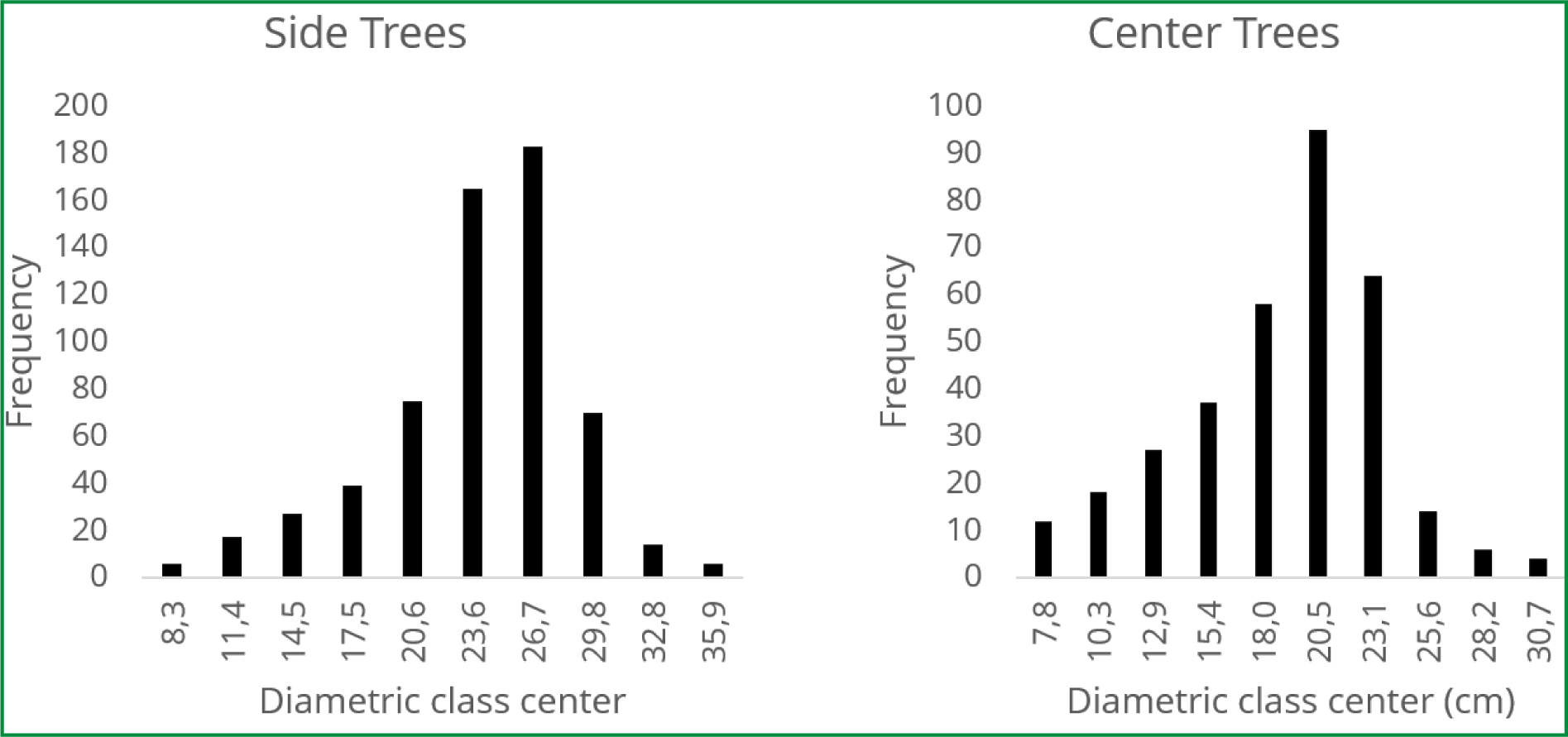
This database was stratified into trees located in central and side positions for crown measurements. Later on, these trees were subdivided into 10 DBH classes. In total, 44 trees were selected (22 from the sides and 22 from the center); 2 were measured in each diametric class and 2 additional ones, in the central class (Figure 1). Four opposite crown radiuses (between lines and ranks directions) were measured with electronic measuring tape and clinometer.
Crown asymmetry was found through the index by Shi et al. (2018), which was modified by Kong et al. (2021), in Equation (1):
wherein: CAI = Crown asymmetry index; Np = number of measured paired crown radiuses; Ri and Ri = pairs of measured radiuses that headed to the crown opposite direction.
Length (l) and crown diameter data (CD) were used to calculate crown ratio (C%) and Slenderness Coefficient (SC), according to Durlo and Denardi (1998), in equations (2), (3), (4), and (5):
wherein: l = crown length (m); h = total height (m); cih = crown insertion height (m); CD = Crown diameter (m); Rmed = crown mean radius (m); SD = Slenderness coefficient; DBH = diameter at breast height, taken 1.30 m from soil surface (cm).
Dendrometer bands were used to measure diameter growth on a monthly basis, from January 2019 to January 2022, from 20 average DBH trees – 10 located in side rows and 10, in central ones. Growth data expressed in circumference (mm) recorded in dendrometer bands were turned into diameter (cm) by dividing the observed values by π and, subsequently, by 10, to find the DBH periodical accumulated increment (∑I 80-120) over the assessed period-of-time (80 to 120 months).
Individual tree volume (v), form factor (f), bark percentual (B%), heartwood/sapwood ratio (H/S), log taper (LT), pith displacement (Pd), basic density (Bd) and log-end splitting index (LESI) data were set based on the 10 sampled trees (five from the center and 5 from the sides), which were defined according to the recorded mean DBH.
Individual tree volume (v) and form factor (f) were found through rigorous Smalian-based stem cubing, at positions 0.10 cm, 0.7 cm, 1 m, 1.30 m and, from this position, at every 1m, up to the tree’s total height. Subsequently, these variables were calculated based on Finger (1992).
Bark percentual (B%), Equation (6), heartwood/sapwood ratio (H/S), Equation (8), and pith displacement (PD) were also found in each disc. Bark percentual was determined through the equation by Spurr (1952).
wherein: B% = bark percentual; K = Meyer’s constant of each tree based on the ratio of summed diameters, with and without bark.
wherein: K = Meyer’s constant of each tree based on the ratio of summed diameters, with and without bark; dcc = diameter with bark (cm); dsc = diameter without bark (cm).
The edge between heartwood and sapwood was visually identified in each disc, based on color differences. Two perpendicular lines crossed the center of the pith. These lines were used to measure total diameter and heartwood diameter, and heartwood-sapwood ratio with the aid of precision ruler, according to Silave et al. (2017).
wherein: DC = Heartwood diameter expressed in cm; D = disc diameter.
Log quality was assessed based on both the taper criteria and Log-end splitting Index (LESI), Equation (9), applied to 18 logs: 9 logs coming from trees located in the central rows and 9, from the side rows. Plant bole was sectioned into wooden fence (first and second): 2.2 m in length, in order to assess log quality. Bark was removed from each log, which was shade-dried in the field - splitting was assessed 14 days after tree cutting. The Log-end splitting index was used based by Lima (2002).
wherein: LESI = maximum splitting opening (cm); Ci = splitting length to the pith-bark direction (cm); D = mean diameter of the cross-section where the splitting is in (cm); n = number of splittings.
The mean diameter of each cross-section was calculated based on two perpendicular measurements taken with measuring tape to determine the taper. Splitting length was measured with ruler (cm), and splitting opening and depth were measured with digital caliper.
Log taper (LT) was calculated according to Hornburg et al. (2012), in Equation (10):
wherein: LT = log taper (cm m-1); D1 and D2 = crossed diameters on the thickest log-end; d1 and d2 = crossed diameters in the thinner log-end; L = log length (m).
Pith displacement was calculated according to Silva et al. (2017) by adopting the mean recorded for the five discs taken from each sampled tree as variable, in equations (11) and (12):
wherein: PD = pith displacement (cm); RM = the longest distance between pith and the log’s periphery (cm).
wherein: RM = longer distance between pith and log’s periphery (cm); Rm = shortest distance between pith and log’s periphery (cm); Rp1 = value of perpendicular radius 1 (cm); Rp2 = value of perpendicular radius 2 (cm).
Basic density was set based on Vital (1984), at the Wood Drying Laboratory (LASEMA) in the Engineering Center (CEng) of Federal University of Pelotas (UFPel). Wood discs (approximately 2.5 cm thick) were removed from stem basis, and at 25%, 50%, 70% and 90% of its total height. The basic density of each tree was calculated trough, as following in Equation (13):
wherein: Bd = mean individual basic density (g cm-3); Dbase = mean density on the basis (g cm-3); D25h = basic density at 25% of the total height (g cm-3); D50h = basic density at 50% of the total height (g cm-3); D70h = basic density at 75% of the total height (g cm-3); D90h = basic density at 90% of the total height (g cm-3).
Data of variance normality/homogeneity were analyzed through Shapiro-Wilk and Bartlett tests. Mean values recorded for the independent samples were compared through Student’s t test and Mann-Whitney test, depending on variance distribution and on the homoscedasticity of each variable, at 5% confidence level (bilateral).
Form factor (f), heartwood/sapwood ratio (H/S), bark percentual (B%), crown area (CA), DBH periodical accumulated increment (∑I 80-120), crown ratio (CR), basic density (Bd), Log taper (LT), and Log-end splitting index (LESI) were the variables presenting normal residues’ distribution. Variables ‘f’, ‘CA’, ‘B%’ and ‘Bd’ did not significantly differ from population variances. Their mean values were compared through T test by assuming homogeneous variances. T test was applied to the other variables to find heterogeneous variances. Height (h), individual volume (v), crown asymmetry index (CAI), Slenderness Coefficient (SC) and pith displacement (PD) measurements, whose residues’ distribution was not normal, were compared through Mann-Whitney test.
3 RESULTS E DISCUSSIONS
There was no statistical difference recorded for variables ‘h’, ‘f’, ‘S/H’ and Bd. Trees located in the central rows showed the highest Slenderness Coefficient (SC) and bark percentual (B%), as well as the lowest growth in diameter; individual volume; and crown area, crown ratio and crown asymmetry (Table 1).
Analyzed variables for eucalyptus trees due to their planting position in silvipastoral systems in Bagé City, Rio Grande do Sul State
Trees showed greater branch growth towards the side ranks, which represent competition-free sites. Crown radii toward the ranks were 2.4 m longer than ones observed toward tree lines, on average, (difference = 68.7%). This difference only reached 23 cm in the central trees (difference = 18%) and this finding justifies the larger area and the crown asymmetry observed for trees located in side positions.
Crown development reflects the cumulative competition level, overtime, which is closely related to the growth and quality of the produced wood (Biechele et al., 2009; Forrester et al., 2010). Crown proportion in relation to total height points towards the potential use of available resources (Soares and Tomé, 2001); yet, the higher this proportion, the more productive the tree (Durlo and Denardi, 1998).
According to some studies carried out with eucalyptus trees, competition between trees reduces branch and canopy dimensions (Neilsen and Gerrand 1999; Pinkard and Neilsen, 2003). Therefore, the higher crown ratio recorded for side trees derive from less competition towards the rank and, consequently, from the larger amount of solar radiation available in crown vertical extension. This feature allows more vigorous and persistent branches to develop in the lower parts of the stem.
Longer and thicker branches produce greater stem growth, but also larger knots (Seitz, 1995) that reduce wood quality, resistance, value and usefulness, whether alive or dead (Schneider et al., 1999).
This feature reflected on stem growth, since side trees showed diameter increase 36.7% higher than that of central trees, as well as higher individual volumetric yield (gain of 0.216 m3 tree-1).
However, smaller diameter growth can be good for Eucalyptus, since the stem will be less likely to produce log-end splitting and warping as trees grow more slowly. This process requires stripping at sawmills, as well as reduces sawn wood yield and log dimensions (Lima et al., 2007).
The brighter light reaching in the lower parts of the stem also ends up stimulating the formation of epicormic buds and branches, whose vessels have no connection to the central part of the stem and reduce wood quality (Seitz, 1995). Longer and more vigorous crown can also promote and prolong juvenile wood formation periods and reduce late wood rate in plant bole’s lowest portion (Jozsa and Middleton, 1994). This quality outcome is not desirable, since juvenile wood is associated with lower resistance of structural parts, and with greater warping and splitting (Vidaurre et al., 2011).
However, this trend was not observed at the herein assessed ages, since h/s did not significantly differ among them. This result indicates no significant association between adult wood production and tree’s spatial location.
The greater competition for light makes central-row trees proportionally grow more in height than in diameter, and become slenderer (greater SC). Thus, they get more unstable to the action of winds, and get prone to both falls and stem breaks.
SC should not be higher than 1 from the perspective of stability to wind action (Wood et al., 2008). The herein assessed population already exceeded this number due to late thinning. According to Biechele et al. (2009), SC is also essential to keep low growth stress indices in young crops. It is recommended adopting larger initial planting spacing to reduce these growth stress values.
Central-row trees had more symmetrical stems with shorter pith displacement. The eccentric pith resulted from differences in cambial activity caused by canopy unbalance or asymmetry. There was trees’ gradual cell-orientation when they deviated from their vertical position. This feature is associated with wood presenting atypical structure, the so-called reaction wood (Vidaurre et al., 2013).
The future quality of the produced wood is a quite relevant feature, since reaction wood leads to primary splitting and finishing difficulty because it releases the internal stress accountable for log warping and splitting (Vidaurre et al., 2013). Logs presenting eccentric pith are more prone to warp, in addition to be problematic for mechanical processing, since they require adequate log positioning in the saw (Grosser, 1980). Pith displacement can also interfere with log unfolding due to uneven stress release, which forces the saw and accounts for miscalibration of log thickness (Lima et al., 2007).
Bark percentual was higher in central-row trees (13.5%), and this is a negative feature, since it represents a larger amount of residue in sawn wood production. These values were close to those observed by Oliveira et al. (1999) for E. grandis monocultures under conventional spacing (10.8%); and lower than those recorded by Torres et al. (2016) and Anjos et al. (2016) for Eucalyptus urophylla x Eucalyptus grandis clones in ICLF systems at 9 m x 1 m, 8 m x 3 m and 12 m x 3 m and (3.5 m x 3 m) + 30 m spacing, at 22.6%, 16 .2% and 17.5%, 18.3%, respectively, on average. This finding indicates the good quality of the herein assessed genetic material.
Lower form factor values were observed in comparison to those reported by Ferreira et al. (1997) and Lopes et al. (2004), which ranged from 0.51 to 0.59 for E. grandis in monoculture under conventional spacing, at planting ages from 6 to 27 years. Higher taper than that recorded for trees planted in monocultures was expected to be found as the consequence of the larger number of thicker branches at canopy basis.
The recorded basic density can be considered lower than that of E. grandis monoculture crops in different Rio Grande do Sul sites, whose values ranged from 0.43 to 0.47 g cm-3 in the age group 6-27 years (Ferreira et al., 1997; Lopes et al., 2004; Oliveira et al., 2016). However, these numbers are within the range (0.34 to 0.50 g cm-3) reported by Pereira et al. (2000) and Silva (2002) for seminal and clonal E. grandis crops, in the age group 6-10 years. The basic density of Eucalyptus grandis tends to increase with tree aging and to stabilize after they reach a certain age (Silva 2002; Sette Junior et al., 2012). According to Silva (2002), this Bd stability was observed at the age of 20 years.
Anjos et al. (2016) also observed no significant difference in the basic density of Eucalyptus grandis x Eucalyptus urophylla clones in silvipastoral systems featured by triple row arrangement, at spacing of (3.5 m x 3 m) + 30 m, at the age of 3 years. Lower growth rate was also observed for central-row trees in the herein adopted planting system (Tonini et al., 2021). This finding indicates that these trees’ lower growth does not influence basic density, which is positively correlated to wood’s retractability, drying, workability, impregnability, natural durability and mechanical resistance properties (Silva 2002).
Trees located in central rows produced a more cylindrical second log; their first log presented lower long-end splitting rate than the side logs 14 days after falling (Table 2).
Log taper values lower than 1 cm m-1 are used to categorize the produced logs into the higher quality class, since this feature has no influence on sawn wood yield, up to this limit (Glosser, 1980). Values observed in our study were not higher than those observed for some eucalyptus species grown in monoculture under traditional spacing (2.5 m x 3.0 m): mean taper values ranged from 0.53 to 0.73 for C. torelliana, E . cloeziana, E. grandis, E. pilularis and E. resinifera logs, and diameters ranged from 14 to 25 cm and reached 2.5 m, in length, in the age group 14-17 years (Hornburg et al., 2012).
The highest taper observed for the second logs of side trees can be justified by the longest crown length. This feature is closely related to stem tapering (Pinkard and Neilsen, 2003). The development of more vigorous and persistent branches in the lowest parts of the crown leads to larger stem diameter in its lowest portion, and fast diameter decrease towards the apex, which causes higher stem tapering (Martins et al., 2000). Thick and persistent branch formation in the lowest stem positions also implied the need of a larger number of prunings to avoid knots’ formation in the wood.
Trees in central rows showed smaller log-end splitting. According to Beltrame et al. (2015), this feature is positively and significantly correlated to longitudinal residual deformations and longitudinal growth stress in the tree bole. This stress reflects on sawn wood yield reduction, which can cause large losses at different production chain stages as well as defects, such as splitting and warping, depending on its magnitude (Carvalho et al., 2010).
However, it should be noticed that wood quality can change during its formation process due to silvicultural treatments (Biechele et al., 2009) like cutting and tree towing techniques (Aguiar and Jankowsky, 1986; Matos et al., 2003; Touza 2001), and log storage and processing (Severo and Tomaselli, 2000; Santos et al., 2004; Rocha and Trugilho, 2006; Hernandez et al., 2014). These treatments can minimize defects that may emerge from eucalyptus wood splitting in trees produced in ILPF.
Growth stress reduction can also be achieved by increasing log dimensions either by using thinning or by lengthening the age of rotation, since stress tends to decrease as trees age (Touza, 2001). Age is a paramount factor for sawn wood quality because it is correlated to mature wood ratio, which guarantees produced wood’s higher stability and resistance (Silva, 2002).
Growth stress in Eucalyptus trees is associated with competition and it can be minimized by maintaining the growth rates, reducing competition and keeping the spatial distribution as uniform as possible during the rotation process, so that trees can expand their canopies in a balanced way (Touza, 2001; Biechele et al., 2009). This outcome can be achieved with a larger number of moderate weight interventions aimed at avoiding abrupt canopy rearrangement and sudden changes in their growth (Touza, 2001; Biechele et al., 2009).
4 CONCLUSIONS
Trees of a Eucalyptus clone located in the central rows of a silvipastoral system based on triple row planting arrangement showed lower diameter growth and volumetric yield. However, they developed morphometric features favorable for higher-quality wood to be used in sawn timber, such as higher stem and crown symmetry. These features, in their turn, lead to shorter pith displacement and to more cylindrical logs with lower long-end splitting indices.
ACKNOWLEDGEMENTS
The authors would like to thank Associação Rede ILPF for the financial support.
REFERENCES
- AGUIAR, O. J. R; JANKOWSKY, I.P. Prevenção e controle de rachaduras de topo em tora de Eucalyptus grandis Hill ex Maiden. IPEF, Piracicaba, n. 33, p.39-46, ago. 1986.
- ANJOS, A.F.T; SARTORI, W.W; TONINI, H; MORALES, M.M; SILVA, V.P. Performance and quality of wood in a clone of Eucalyptus in monoculture and silvipastoral system. Nativa, Sinop, v.4 n.2, p.77-81, mar./abr. 2016.
- BALANDIER, P.; DUPRAZ, C. Growth of widely spaced trees. A case study from Young agroforestry plantations in France. Agroforestry Systems, v. 43, p. 151–167, 1999.
- BELTRAME, R; PERES, M. L ; LAZAROTTO, M ; GATTO, D. A ; SCHENEID, E ; HASELEIN, C. R. Tensão de crescimento e sua relação com as rachaduras de topo em toras de Eucalyptus spp. Scientia Forestalis, Piracicaba, v.43 n.105, p. 63-74, mar. 2015.
- BIECHELE, T; NUTTO, L; BECKER, G. Growth Strain in Eucalyptus nitens at different stages of development. Silva Fennica, v.43 n.4, p. 669–679, 2009.
- CARVALHO, A. M; GONÇALVES, M. P. M; AMPARADO, K. F; LATORRACA, J. V. F; GARCIA, R. A. Correlações da altura e diâmetro com tensões de crescimento em árvores de Corymbia citriodora e Eucalyptus urophylla Revista Árvore, Viçosa, v. 34 n. 2, p.323-331, abr. 2010.
- CEZANA, D. P; CHICHORRO, J. F; MARTINS, L. J; COTTA, T. R; SILVA, J.L. Efeitos de diferentes classes de altura e intensidades de desrama artificial sobre o crescimento de um híbrido de eucalipto. Floresta, Curitiba, v. 42 n. 1, p. 137-144, jan./mar. 2012.
- DANIEL.O; CARVALHO, R.P; HELD, D.M; MATOS. F.A. Economic sustanability of silvipastoral systems using eucalyptus for timber. In: BUNGENSTAB, D. J.; ALMEIDA, R. G. de (ed.). Integrated crop-livestock-forestry systems: a brazilian experience for sustainable farming Brasília, DF: Embrapa, 2014. P219-235.
- DENIZ, M; SCHIMITT FILHO, A. L; HÖTZEL, M. J; SOUZA, K.T; MACHADO FILHO, L. C. P.; SINISGALLI, P. A. Microclimate and pasture area preferences by dairy cows under high biodiversity silvopastoral system in Southern Brazil. International Journal of Biometeorology, v. 64, p.1877–1887, 2020.
- DURLO. M. A; DENARDI, L. Morfometria de Cabralea canjerana, em mata secundária nativa do Rio Grande do Sul. Ciência Florestal, Santa Maria, v.8 n.1, p.55-56, 1998.
- FERREIRA G. W; GONZAGA, J. V; FOELKEL, C. E. B; ASSIS, T. F; RATNIEKS, E; SILVA, M.C.M. Qualidade da celulose Kraft-antraquinona de Eucalyptus dunnii plantado em cinco espaçamentos em relação ao Eucalyptus grandis e Eucalyptus saligna. Ciência Florestal, Santa Maria, v. 7 n. 1, p.41-63, jan./dez. 1997.
- FERREIRA, M. D; MELO, R. R; TONINI, H; STANGERLIM, D; BELTRAME, R; GATTO, D. A; MASCARENHAS, A. R. P. Growth, production and wood quality in integrated crop-livestock-forest and monoculture systems Revista Brasileira de Ciências Agrarias, Recife, v. 15 n. 3, ago. 2020a.
- FERREIRA, M. D; MELO, R. R; TONINI, H; PIMENTA, A. S; GATTO, D. A; BELTRAME, R; STANGERLIM, D. M. Physical–mechanical properties of wood from a eucalyptus clone planted in an integrated croplivestock-forest system. International Wood Products Journal, v. 11 n. 1, p.1-8, 2020b.
- FINGER, C. A. G. Fundamentos de Biometria Florestal Santa Maria: UFSM/CEPF/FATEC, 1992.
- FORRESTER, D. I; MEDHURST, J. L; WOOD, M ; BEADLE, C.L ; VALENCIA, J.C. Growth and physiological responses to silviculture for producing solid-woodproducts from Eucalyptus plantations: An Australian perspective. Forest Ecology and Management, v. 259, p.1819–1835, 2010.
- GROSSER, D. Defeitos de madeira Curitiba: Fupef, 1980.
- HAILE, S. G; NAIR, V.D; NAIR, P. K. R. Contribution of trees to carbon storage in soils of silvopastoral systems in Florida, USA. Global Change Biology, v. 16, p. 427–438, 2010.
- HERNÁNDEZ, M; ZADERENKO, C; MONTEOLIVA, S. Efecto de las tensiones de crescimento em el rendimento y calidad dela serrado de Eucalyptus dunnii. Maderas, Ciencia y Tecnologia, v. 16 n. 4, p. 403-412, 2014.
- HORNBURG, K. F; ELEOTÉRIO, J.R; BAGATTOLI, T. R; NICOLETTI, A. L. Qualidade das toras e da madeira de seis espécies de eucalipto cultivadas no litoral de Santa Catarina. Scientia Forestalis, Piracicaba, v. 40 n. 96, p. 463-471, dez. 2012.
- HOWLETT, D.S; MOSQUERA-LOSADA, M. R; NAIR, P. K. R; NAIR,V. D, RODRIQUEZ, A.R. Soil Carbon Storage in Silvopastoral Systems and a Treeless Pasture in Northwestern Spain. Journal of Environmental Quality, v. 40, p.825–832, 2011.
- INDÚSTRIA BRASILEIRA DE ÁRVORES. Relatório anual São Paulo: IBA, 2023.
- JOZSA, L.A; MIDDLETON, G. R. A. Discussion of Wood Quality Attributes and Their Practical Implications Special Publication, SP-34, Forintek Canada Corporation, 1994.
- KRUCHELSKI, S; TRAUTENMÜLLER. J, W; DEISS, L; TREVISAN, R; CUBBAGE, F; SILVA, V.P. Eucalyptus benthamii Maiden et Cambage growth and wood density in integrated crop-livestock systems. Agroforest Systems, v. 95, p.1577–1588, 2021.
- KONG, F; BI, H; McLEAN, M; LI, F. Comparative performances of new and existing indices of crown asymmetry: an evaluation using tall trees of Eucalyptus pilularis (Smith). Journal of Forest Research, v. 32 n 1, p.43–65, jun.2021.
- LIMA, I.R; GARCIA, J. N; PIEDADE, S. M. S. Rachaduras de extremidades de tora e suas implicações nas rachaduras de madeira serrada. Scientia Forestalis, Piracicaba, n. 61, p.13-24, jun.2002.
- LIMA, I.L; GARCIA, J. N; STAPE, J. L. Influência do desbaste e da fertilização no deslocamento da medula e rachaduras de extremidade de tora de Eucalyptus grandis ex-maiden. Cerne, Lavras, v. 13 n. 2, p. 170-177, abr./jun. 2007.
- LOPES, M.C; HASELEIN, C.R; SANTINI, H.J; LONGHI, S.J; ROSSO, S; FERNANDES, D.L.G; MENEZES, L.F. Agrupamento de árvores matrizes de Eucalyptus grandis em função das variáveis dendrométricas e das características tecnológicas da madeira. Ciência Florestal, Santa Maria, v. 14, n. 2, p.133-144, 2004.
- LOPES, L.C.A; SANTOS, A. J. M.; BACKES, C; SILVA, L. L; MAGALHAES, A. F. Forest development in an integrated crop-livestock-forestry systems. Scientific Electronic Archives , v.14 n.11, p.7-17, nov. 2021.
- MACEDO, W. Levantamento de reconhecimento dos solos do município de Bagé RS. Bagé: Embrapa Pecuária Sul, 1984.
- MACEDO, R. L. G; VALE, A.B.; CARVALHO, F.; VENTURINI, N.; NIERI, E.M. Eucalipto em sistemas agroflorestais Lavras: Editora da UFLA, 2018.
- MACHADO, F.P. Contribuição ao estudo do clima no Rio Grande do Sul Rio de Janeiro: IBGE,1950.
- MARTINS, E.G; SHIMIZU, J. Y; FERREIRA, C. A. Desempenho de procedências de grevílea em Quedas do Iguaçu, PR. Boletim de Pesquisa Florestal, Colombo, n. 40, p.45-56, jan./jun.2000.
- MATOS, J. L. M; IWAKIRI, S; ROCHA, M. P; PAIM, R. M; ANDRADE, L. O. Redução do efeito das tensões de crescimento em toras de Eucalytus dunnii Scientia Forestalis, Piracicaba, n. 64, p.128-135, dez. 2003.
- NEILSEN, W. A; GERRAND, A. M. Growth and branching habit of Eucalyptus nitens at different spacing and the effect on final crop selection. Forest Ecology and Management, v. 123, p.217-229, 1999.
- OLIVEIRA, J. T. S; HELLMEISTER, J. C; SIMÕES, J. W; TOMAZELLO FILHO, M. Caracterização da madeira de sete espécies de eucaliptos para a construção civil: 1 - avaliações dendrométricas das árvores. Scientia Forestalis, Piracicaba, n. 56, p.113–124, dez.1999.
- OLIVEIRA, E.B; RIBASKI, J; ZANETTI, E.A; PENTEADO JUNIOR, J.F. Produção, Carbono e Rentabilidade Econômica de Pinus elliottii e Eucalyptus grandis em Sistemas Silvipastoris no Sul do Brasil. Pesquisa Florestal Brasileira, Colombo, n.57, p.45-56, jul./dez. 2008.
- OLIVEIRA, M; RIL, F. L; PERETTI, C; CAPELLESSO, E. S; SAUSEN, T.L; BUDKE, J.C. Biomassa e estoques de carbono em diferentes sistemas florestais no sul do Brasil. Perspectiva, Erechim, v.40 n.149, p.09-20. mar,2016.
- PEREIRA, J.C.D.; STURION, J.A.; HIGA, A.R.; HIGA, R.C.V.; SHIMIZU, J.Y. Características da madeira de algumas espécies de eucalipto plantadas no Brasil Colombo: Embrapa Florestas, 2000.
- PEZZOPANE, J. R. M; BOSI, C; NICODEMO, M. L. F; SANTOS, P. M; CRUZ, P. G; PARMEJIANI, R. S. Microclimate and soil moisture in a silvopastoral system in southeastern Brazil. Bragantia, Campinas, v.74 n. 1, p.110-119, 2015.
- PEZZOPANE, J. R. M; NICODEMO, M. L. F; BOSI, C; GARCIA, A. R.; LULU, J. Animal thermal comfort indexes in silvopastoral systems with different tree arrangements. Journal of Thermal Biology, v.79, p.103-111, 2019.
- PINKARD, E.A; NEILSEN, W.A. Crown and stand characteristics of Eucalyptus nitens in response to initial spacing: implications for thinning. Forest Ecology and Management, n. 172, p.215-227, 2003.
- POLIDORO, J. C; FREITAS, P. L; HERNANI, L. ANJOS, L; RODRIGUES, R; CESÁRIO,F.;ANDRADE, A; RIBEIRO, J.The impact of plans, policies, practices and technologies based on the principles of conservation agriculture in the control of soil erosion in Brazil. Authorea Preprints, apr. 2020.
- RADOMSKI, M.I; RIBASKI, J. Excentricidade da medula em Grevilea robusta e Corymbia citriodora cultivados em sistema silvipastoril Curitiba: Embrapa Florestas, 2010.
- REDE ILPF. A ILPF em números Brasília: Embrapa, 2016.
- REIZ, L.S; MARQUES, L. R; SANTOS, S.N; PAIM, T. P; GUIMARAES, T.P; MARQUES, T.C; LEÃO, K. M. Produção de leite em sistema silvipastoril: Revisão. Research, Society and Development, v. 10 n. 4, 2021.
- ROCHA, M.P; TRUGILHO, P. F. Qualidade de madeira serrada de Eucalyptus dunnii em função do método de desdobro e condição de umidade. Cerne, Lavras, v.12 n.4, p.314-321, out./dez. 2006.
- SANTOS, P. E. T; GARCIA, J. N; GERALDI, I. O. Posição da tora e sua relação com a qualidade da madeira serrada de Eucalyptus grandis Scientia forestalis, Piracicaba n.66, p.142-151, dez.2004.
- SCHNEIDER, P.R; FINGER. C. A. G; HOPPE, J. M. Efeito da intensidade de desrama na produção de Pinus elliotii Engelm, implantado em solo pobre no estado do Rio Grande do Sul. Ciência Florestal, Santa Maria, v.9 n.1, p.35-46.1999.
- SCHETTINI, B. L. S.; JACOVINE, L. A. G; TORRES, C.M. M. E. Sistemas silvipastoris com eucalipto: estocagem de carbono em diferentes espaçamentos e clones. Ciência Florestal, Santa Maria, v. 31n. 3, p.1047-1062, jul./set. 2021.
- SEITZ, R.A. Manual de poda de espécies arbóreas florestais Curitiba: FUPEF, 1995.
- SETTE JUNIOR, C. R; OLIVEIRA, I. R; TOMAZELLO FILHO, M; YAMAJI, F. M; LACLAU, J. P. Efeito da idade e posição de amostragem na densidade e características anatômicas da madeira de Eucalyptus grandis Revista árvore, Viçosa, v. 36 n. 6, p.1183-1190, dez. 2012.
- SEVERO, E.T.D.; TOMASELLI, I. Vaporização no alivio das tensões de crescimento em toras de Eucalyptus dunnii de duas procedências. Scientia Agraria, Curitiba v. 1 n. 1-2, p.29-32, 2000.
- SILVA. J. C. Caracterização da madeira de Eucalyptus grandis Hill ex Maiden de diferentes idades visando a sua utilização na indústria moveleira 2002 160 p. Tese (Doutorado em Ciências Florestais), Universidade Federal do Paraná, Curitiba, 2002.
- SILVA, L. F; LOPEZ, Y. M; FERREIRA, G; LIMA, A. C. B; J. K. B. A; SILVA, J. G. M.; CASTRO, M. E .B. Relação cerne/alburno e da excentricidade da medula de clones de Eucalyptus spp. In: CONGRESSO BRASILEIRO DE CIÊNCIA E TECNOLOGIA DA MADEIRA, 3.; 2017 Florianópolis. Anais[,,,] Florianópolis: UDESC, n.p.
- SILVA, R. R; RODRIQUES FILHO, J. A; CARVALHO, E. J. M; SANTIAGO, A. V; VELOSO, C. A. C; MARTINEZ, G. B. Estoque de carbono e mitigação de metano produzido por bovinos em sistema integração pecuária-floresta (IPF) com eucalipto no Sudeste Paraense. Brazilian Journal of Development, Curitiba, v.7 n.4, p.39997-40016, apr. 2021.
- SOARES, P; TOMÉ, M. A tree crown ratio prediction equation for eucalypt plantations. Annals of forest Science, v. 8, p.193-202, 2001.
- SOUZA, W; BARBOSA, O. R; MARQUES, J. A; GASPARINO, E; CECATO. U; BARBERO, L. M. Behavior of beef cattle in silvipastoral systems with eucalyptus. Revista Brasileira de Zootecnia, Viçosa, v. 39 n.3, p.677-684, mar.2010.
- SPURR, S. Forest inventory New York: The Ronald Press, 1952.
- TRICHES, G.P; MORAES, A; SILVA, V. P; LANG, C.R; LUSTOSA, S. B. C; BONATTO, R. A. Damage caused by cattle to Eucalyptus benthamii trees in pruned and unpruned silvopastoral systems. Pesquisa Agropecuária Brasileira, Brasília, v.55, e01275, 2020.
- TONINI, H; MORALES, M. M; SILVA, V.P; LULU, J; FARIAS NETO, A. L. Efeito do sistema de plantio e da exposição solar sobre a alocação da biomassa no desenvolvimento inicial do eucalipto. Ciência Florestal, Santa Maria, v. 29 n. 1, p.86-95, jan./mar. 2019.
- TONINI, H; MORALES, M. M; WRUCK, F. J; DELIBERALI, R. M. Growth and energy quality of eucalyptus wood in diferente crop-livestock forest spatial arrangements. Floresta, Curitiba, v. 50 n. 4, p.1707 - 1716, out./dez. 2020.
- TONINI, H; MORALES, M. M; MAGALHÃES, C. A. S; SILVA, V.P. Increment in eucalyptus diameter as affected by seasonality and production system. Pesquisa Agropecuária Brasileira, Brasília v. 56, e02544?, 2021.
- TORRES, C. M. M. E; JACOVINE, L. A. G; OLIVEIRA NETO, S. N; BRIANEZI, D; ALVES, E. B. B. M. Sistemas agroflorestais no Brasil: uma abordagem sobre a estocagem de carbono. Pesquisa florestal Brasileira, Colombo, v. 34 n. 79, p.235-244, jul./set. 2014.
- TORRES, C. M. M. E; OLIVEIRA, A. C; PEREIRA, B. L. C; JACOVINE, L. A. G; OLIVEIRA NETO, S.N.; CARNEIRO A. C. O; TORRES, C. M. M. E. Estimativas da produção e propriedades da madeira de eucalipto em Sistemas Agroflorestais. Scientia Forestalis, Piracicaba, v. 44 n. 109, p.137-148, mar. 2016.
- TOUZA, M. Proyecto de investigación sobre sistemas de aserrado adecuados para processar Eucalyptus globulus con tensiones de crecimiento San Cibrao das Viñas: Centro de Innovacion y Servicios Tecnológicos de la Madera de Galicia, 2001.
- VIDAURRE, G. B; LOMBARDI, L. R; OLIVEIRA, J. T. S; ARANTES, M. D. C. Lenho Juvenil e Adulto e as propriedades da madeira. Floresta e Ambiente, Rio de Janeiro, v. 18 n. 4, out./dez. 2011.
- VIDAURRE, G. B; LOMBARDI, L. R; NUTTO, L; FRANÇA, F. J. N.; OLIVEIRA, J. T. S.; ARANTES, M. D. C. Propriedades da madeira de reação. Floresta e Ambiente, Rio de janeiro, v. 20 n. 1, p.26-37, jan./mar.2013.
- VITAL, B. R. Método de determinação da densidade básica. Viçosa: SIF, 1984. 21 p. (Série Técnica, 1).
- WEIMANN, C; FARIAS, J.A; DEPONTI, G. Viabilidade econômica do componente arbóreo de sistema agrossilvipastoril comparado ao plantio de florestal na pequena propriedade rural. Pesquisa Florestal Brasileira, Colombo, v. 37 n.2. p.429-436, out./dez. 2017.
- WOOD M.J; SCOTT R; VOLKER, P.W; MANNES, D; 2008. Windthrow in Tasmania, Australia: monitoring, prediction and management. International Journal of Forest Research, v. 81, p.415–427, 2008.

 Source: Authors (2024)