
 Association among spatial arrangement, morphometry and quality of Eucalyptus grandis wood produced in silvipastoral system
The aim of the present study is to assess the effect of trees’ spatial location on their growth, yield, morphometry and wood quality features, such as bark thickness rate, heartwood/sapwood ratio, taper, pith displacement, basic density and log-end splitting. Data were collected from a silvipastoral system of eucalyptus trees installed at the experimental field of Embrapa Pecuária Sul in Bagé City, Rio Grande do Sul State, between January 2019 and September 2022. The gathered data were assessed for variance normality and homogeneity through Shapiro-Wilk and Bartlet tests; means were compared through Student’s t test and Kruskal-Wallis test was applied to independent samples, depending on the variance distribution and homoscedasticity of each variable. Trees located in the central rows of plantations arranged based on triple rows presented lower diametric growth and volumetric yield, but they developed morphometric features favorable for higher-quality wood production, besides recording higher stem symmetry and canopy, which led to lower pith displacement and more cylindrical logs presenting lower log-end splitting indices.
Keywords
Crop-livestock-forest integration; GPC-23 clone; Log-end splitting index; Growth
 Thumbnail
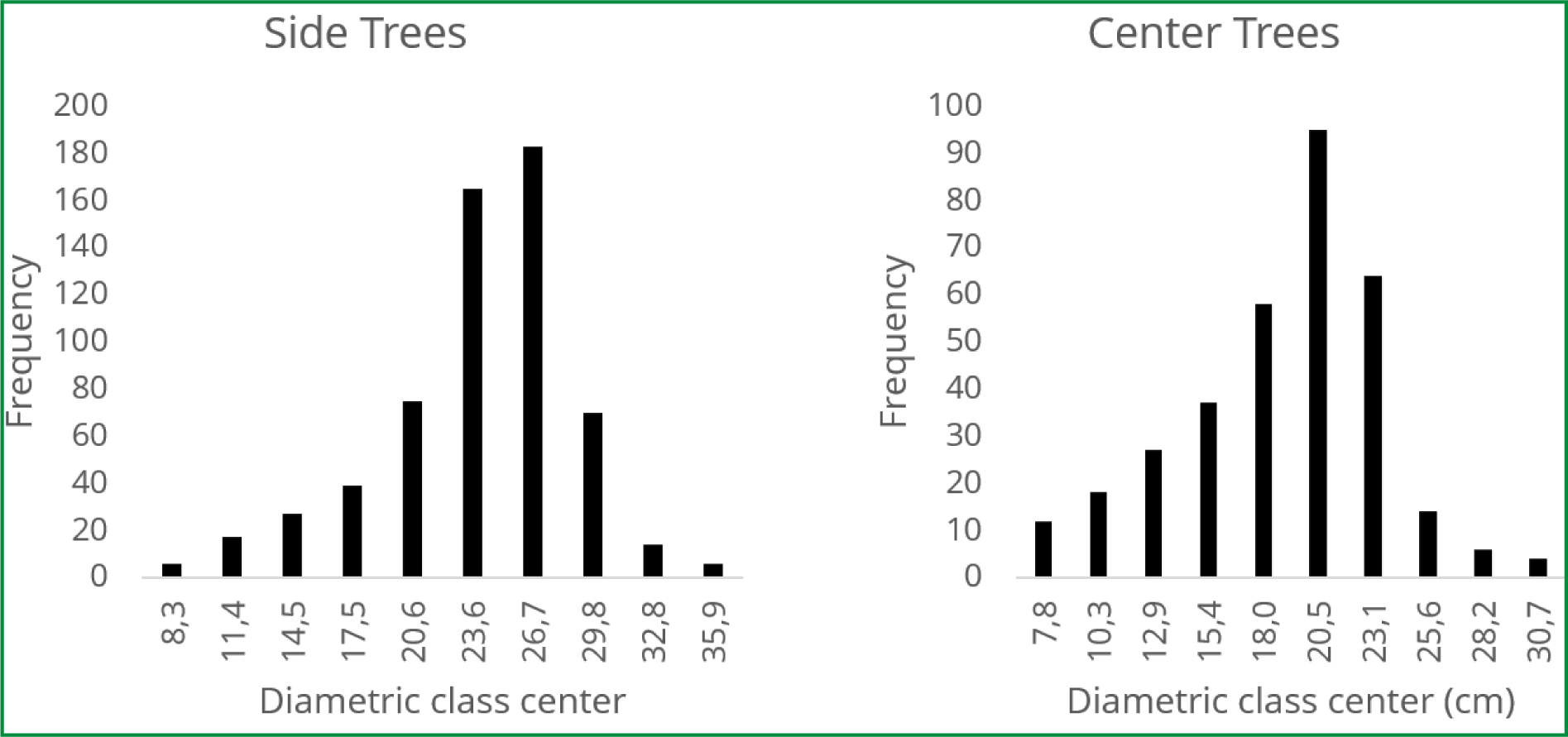 Source: Authors (2024)