
 The evaluations of manufacturing pencil from waste of thermally-modified lumber
ABSTRACT
This study evaluated the feasibility of using thermally modified wood waste in pencil production, highlighting benefits such as dimensional stability, natural darkening, and environmental sustainability. In this context, thermally-modified wood production wastes which was especially from the cut-to-length process and bigger dimensions from pencil slats were used. Production and pencil performance of four species were investigated: Scots pine (Pinus sylvestris), ash (Fraxinus spp.), ayous (Triplochiton scleroxylon) and iroko (Chlorophora excelsa). Initially, pencil production was tried with thermally modified slats on the commercial production line. Results showed that pencils could be produced from modified ash and iroko species with actual machining adjustments. Then the quality of produced pencils were tested according to national, international and company (market) standards. The pencils successfully passed the conditioning and especially the mechanical (lead break and free fall) tests, although thermal modification process generally decreases the mechanical strengths. Only insufficient results were observed on the ash pencils during the sharpening tests due its strict structure, however better results could be obtained with sharpening machines. The results generally indicated that the woods studied meet the quality requirements, with the potential to reduce costs and attract consumers interested in natural products. Because paraffin impregnation for gaining stability and darkening with chemicals will be removed in the pencil production from thermally modified woods.
Keywords:
Ash; Ayous; Iroko; Modification; Waste utilization
RESUMO
Este estudo avaliou a viabilidade do uso de resíduos de madeira termicamente modificados na produção de lápis, destacando benefícios como estabilidade dimensional, escurecimento natural e sustentabilidade ambiental. Neste contexto, foram utilizados resíduos de produção de madeira termicamente modificados, provenientes principalmente do processo de corte em comprimento e de dimensões maiores das ripas utilizadas na fabricação de lápis. A produção e o desempenho de lápis de quatro espécies foram investigados: pinheiro-silvestre (Pinus sylvestris), freixo (Fraxinus spp.), ayous (Triplochiton scleroxylon) e irocô (Chlorophora excelsa). Inicialmente, a produção de lápis com ripas termicamente modificadas foi testada em uma linha de produção comercial. Os resultados mostraram que os lápis podem ser produzidos a partir de freixo e irocô modificados, com ajustes de usinagem. Em seguida, a qualidade dos lápis produzidos foi testada de acordo com normas nacionais, internacionais e de mercado. Os lápis passaram com sucesso nos testes de condicionamento e, principalmente, nos testes mecânicos (quebra da mina e queda livre), embora o processo de modificação térmica geralmente diminua a resistência mecânica. Devido à sua estrutura rígida, os lápis de freixo apresentaram resultados insuficientes nos testes de afiação. No entanto, melhores resultados poderiam ser obtidos com apontadores mecânicos. De modo geral, os resultados indicaram que as madeiras estudadas atendem aos requisitos de qualidade, com potencial para reduzir custos e atrair consumidores interessados em produtos naturais. Isso porque a impregnação com parafina para conferir estabilidade e escurecimento com produtos químicos será eliminada na produção de lápis a partir de madeiras termicamente modificadas.
Palavras-chave:
Freixo; Ayous; Irocô; Mudança; Utilização de resíduo
1 INTRODUCTION
The disadvantages of wood such as shrinkage/swelling, decay etc. can be reduced by using different modification methods such as lamination, impregnation, thermal treatment etc. Thermal modification is one of the most common industrial modification methods due to its relatively simple process and its ability to improve various properties of a material. Although it is a modification process, it can be misunderstood with other treatment methods (Batista, 2019) using heat such as heat treatment which is a sterilization method for wooden pallets and packaging.
By thermal modification, the stability and durability of wood is improved (Esteves; Pereira, 2009; Batista et al., 2011; Hill et al., 2021; Sandberg et al., 2021) and it is generally preferred alternative to traditional preservation methods such as impregnation. Furthermore, it can be considered eco-friendly due to not using toxic chemicals (Batista et al., 2016) although some gases and oils may occur during the modification process (Tomak et al., 2011; Candelier et al., 2013). All these advantages contribute to its wide usage in industrial perspective. Thermally-modified wood is used especially in exterior conditions such as decking and cladding in the market. In addition, its place in the market is expanding with a better understanding of its features. The evaluation of its residues has become important with the increase in its use. Due to ecological value of wood, wood industry has started to implement the zero-waste approach in recent years and whole stem with branches is generally evaluated. The waste of the solid wood industry is usually used as raw materials in particle and fiberboard, bio-composite and pellet industries. Accordingly, wastes of thermally modified wood material were studied in similar industries (Kuka et al., 2016; Iždinský et al., 2021).
There are some requirements from wood to be used as raw material for pencil production: Homogeneous wood texture for easy sharpening, good machinability for profiling, availability for mass production, dimensional stability for easy machining and final product quality, dyeability for increasing aesthetic properties etc. On the other hand, pencil is a non-load-bearing product that requires relatively lower mechanical strength when compared with other usage areas. Lower mechanical properties can be advantageous for easily sharpening. Moreover, in the past, good smelling was desired by market. Therefore, traditional pencils were generally made of red cedar (Juniperus virginiana), California incense-cedar (Libocedrus decurrens Torr.) species. However, substitute tree species continued to be searched to achieve sustainable supply. In this context, many tree species were studied: cedar, linden, spruce, American white pine, western red cedar (Thuja plicata), Taiwan cypress (Chamaecyparis taiwanensis) (Berkel, 1952), some Burmese timbers (Kywe; Tint, 1987), poplar (Populus spp.) (Calderón, 1996), paulownia (Paulownia spp.) (Kaygin et al., 2015), some pine species (Pinus spp.) (Loiola et al., 2021) etc. In recent years, depending on the change of demand for market, wood species, production process changed. Reddish light-brown wood colour is still desired from market due to tradition of red cedar appearance, while good smelling is less desired. Manufacturers use staining to set a reddish colour and impregnation to increase stability. Accordingly, nowadays, poplar, linden, juniper (red cedar) species are generally preferred.
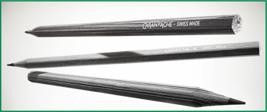
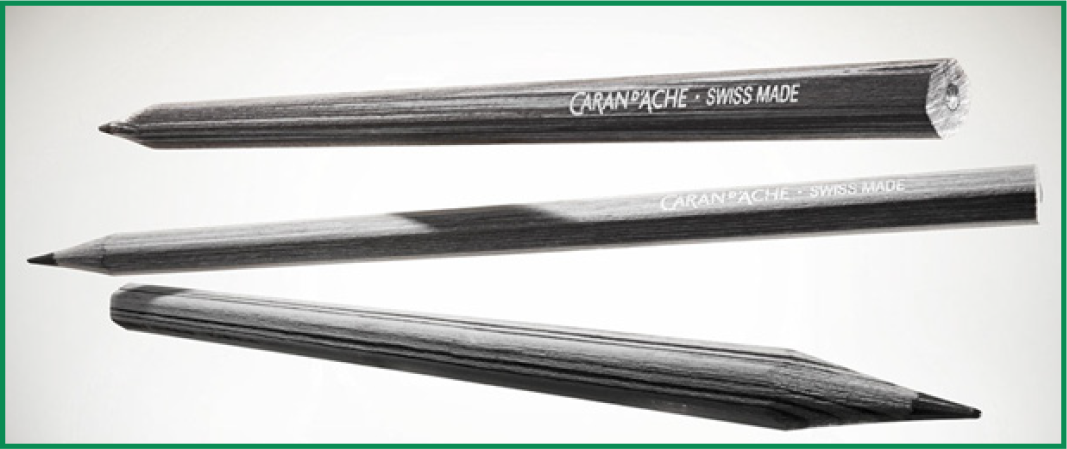
Laminated wood materials (plywood, LVL etc.) or wood-plastic composites are generally preferred to obtain better dimensional stability in wood industry. Although pencils are already a two-layered material, some companies have been trying new techniques for increasing stability and aesthetic properties. A Swiss company produced pencils from Alpi-type layered material (Fig. 1) (Alpi, 2022). The thinner-layered material may provide a more stable and aesthetic product. The curved design and relatively small material width of pencils allow for different textures when using layered materials. A German company produce pencils from wood-plastic composites (WOPEX - Wood Pencil Extrusion) to provide high degree of break-resistance and to use waste material (Wopex, 2022). The company started to produce the first extruded pencils in 2009 and coloured pencils in 2015 made from WOPEX (Staedtler, 2022).
When all requirements for production and product of pencil are considered, it was thought that, thermally modified wood could be evaluated. For example, thermally modified solid wood waste, especially from the cut-to-length process have similar dimensions with pencil slats. The reduction in ductility makes the use of thermally-modified timber problematic for many load-bearing applications (Hill, 2007). As mentioned before, the decline of the strength could still meet the pencil requirements. Additionally, it was thought that slats from thermally-modified timber may provide two main advantages to pencil production: Natural darkening and stability without impregnation process. Colour tones may vary with the use of other feasible tree species and different thermal-modification conditions (duration, temperature etc.). On the other hand, slats are impregnated with paraffin to increase stability by filling the cells in conventional method. Thermally-modified timber is naturally more stable than untreated wood material with having lower equilibrium moisture content (TSE CEN/TS 15679, 2010). Accordingly, if the dimensional change values of pencil from thermally-modified timber were found under usage area limits, impregnation process can be removed.
In this study, usage possibilities of waste from solid thermally-modified wood for pencil production was evaluated in two different aspects: Producibility and end-product quality.
2 MATERIALS AND METHODS
2.1 Materials
Four modified wood species were tested: Scots pine (Pinus sylvestris), ash (Fraxinus spp.), ayous (Triplochiton scleroxylon) and iroko (Chlorophora excelsa). These species were chosen due to their availability on the thermal modification companies and market.
The lumbers were thermally-modified at 180oC for 2 hours according to the ThermoWood method (Viitaniemi and Jämsä, 1996) in a commercial modification company. After the modification, waste from the cut-to-length process were obtained. They were sawn into defective free specimens with (slat) dimensions of 5 x 72 x 183 mm for pencil production. In this study, HB “Hard” and “Black” grade hardness class graphite, which can be used in both writing and drawing pencils, was examined. The bending strength of this class graphite should be at least 3000 gf/mm2 (~29.42 MPa) according to standard (TS 5171, 2019).
2.2 Research Methodology
2.1.1 Pencil production evaluation
There are some standards about the producibility or the testing of pencils. However, commercial companies may add more criteria to meet market requirements. Therefore, the criteria of company were referenced in addition to related national/international standards. For instance, the dimensional limits for producibility are generally specified according to profiling machine requirements of company. Some slat sized specimen limits according to company were shown in Table 1.
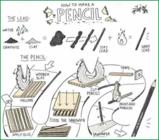
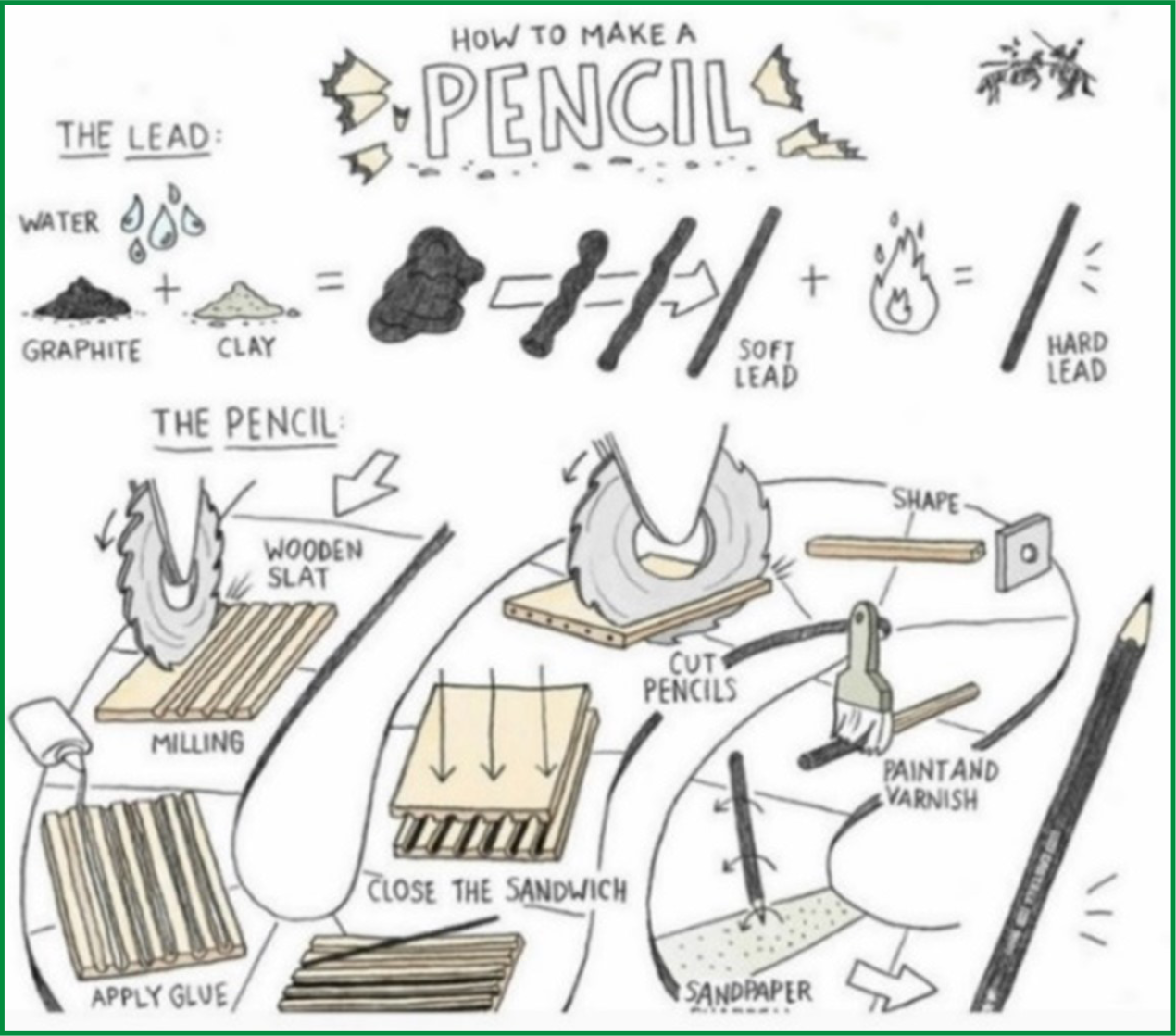
Pencils were manufactured from slats and graphite (lead) on a commercial production line. An illustration about pencil production was shown in Fig. 2. In this study, water based PVA adhesives were used for lamination of specimens (Rakoll Express SR, H.B. Fuller, USA) and graphite areas gluing (Rakoll 125, H.B. Fuller, USA).
2.1.2 Producibility and appearance
The experiments were conducted on the commercial pencil production line. In conventional production, all machines and adjustments in this line were prepared for pencil manufacturing using slats from linden (Tilia americana) and poplar (Populus spp.). All processes were the same and the pencils were conducted with same production parameters and quality requirements.
Firstly, producibility of used species was investigated with same machining properties. The shape and aesthetic properties of successfully produced pencils were checked after production. The pencil qualities without painting were evaluated according to TS 5171 (2019). The moisture contents of the slats measured according to EN 13183-1 standard.
2.1.3 Conditioning tests
The pencils can be exposed to different atmospheric conditions in a wide range in the usage areas. Extreme conditions can force the material, bond line and (if any) paint adherence. Therefore, they were conditioned in a climatic cabin with 40oC temperature and 98% relative humidity for 24 hours according to company quality standard. Pencils were visually evaluated for cracking, splitting the slats and graphite holding after conditioning.
2.1.4 Sharpening ability
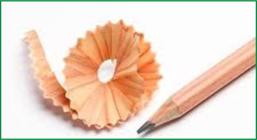
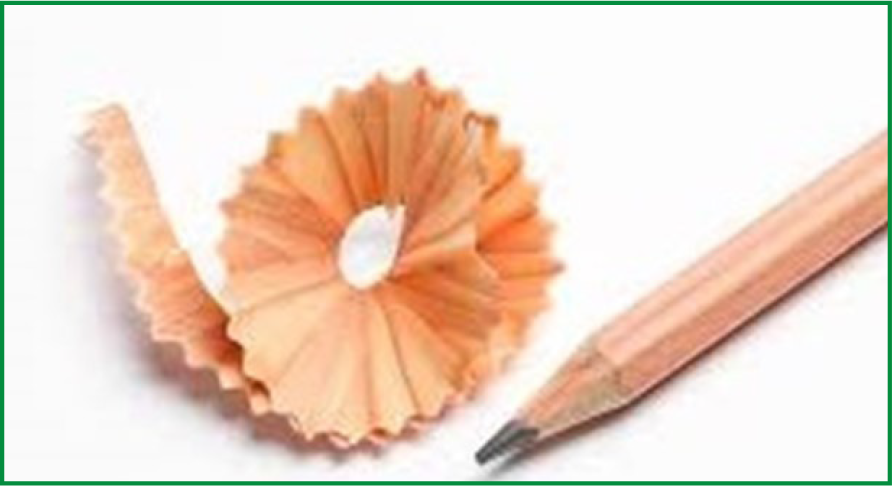
TS 5171 (2019) standard suggests using sharpener that meets the requirements of TS 8961 (1991) standard. However, sharpening was tested in commercial pencil sharpeners. Because end-users may buy lower quality sharpeners. The sharpening tests were realized at constant speed with low force, which might represent applied force of the kids. Although the standard did not specify a limit for sharpening, the company has 9/12 limits that means each nine sharpening processes should meet the requirements for 12 pencils for acceptance. Sharpening abilities were evaluated by having an even and smooth surface with ensuring continuously sharpening, removing one-piece or long pieces for stub, no graphite breaking. Additionally, the company desires longer stub and seeing curly stub as “rose shape” (Fig. 3).
2.1.5 Adhesion performance
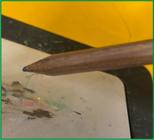
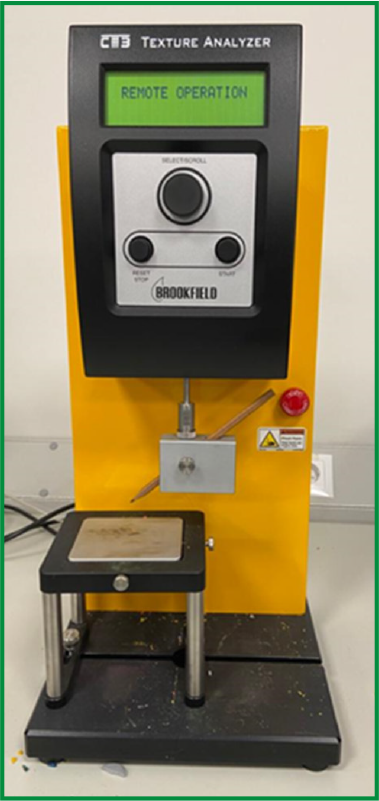
Adhesion tests were performed in two groups: Wood - wood and wood - graphite adhesions according to TS 5171 (2019). In the wood - wood adhesion (free fall) test, pencil samples were horizontally dropped from 1.5 m height to a concrete floor 5 times and the separation of the wooden part of the pencil from the adhesion places was evaluated. In the wood - graphite adhesion (in other words, “lead break”, “graphite break” or “point break”) tests for sharpened pencils were performed on Brookfield CT3 Texture Analyzer (Brookfield Engineering Laboratories, Inc., USA). The pencils were placed at 45o angle over the machine surface, and they were pushed down with a constant speed to the surface until graphite breaking (Fig. 4). Company specified that the maximum load should be 20 N at least for HB hardness class graphite.

3 RESULTS AND DISCUSSIONS
3.1 Producibility and General Appearance
Slat-sized specimens met the all-dimensional, smoothness and colour (colour homogeneity and staining) requirements. It was thought that there were advantages on physical properties of thermal modification process. For instance, many researchers indicated that the process decreased the surface roughness of studied species (Korkut, 2012; Korkut et al., 2012; Pinkowski et al., 2016).
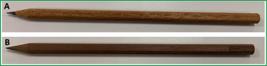
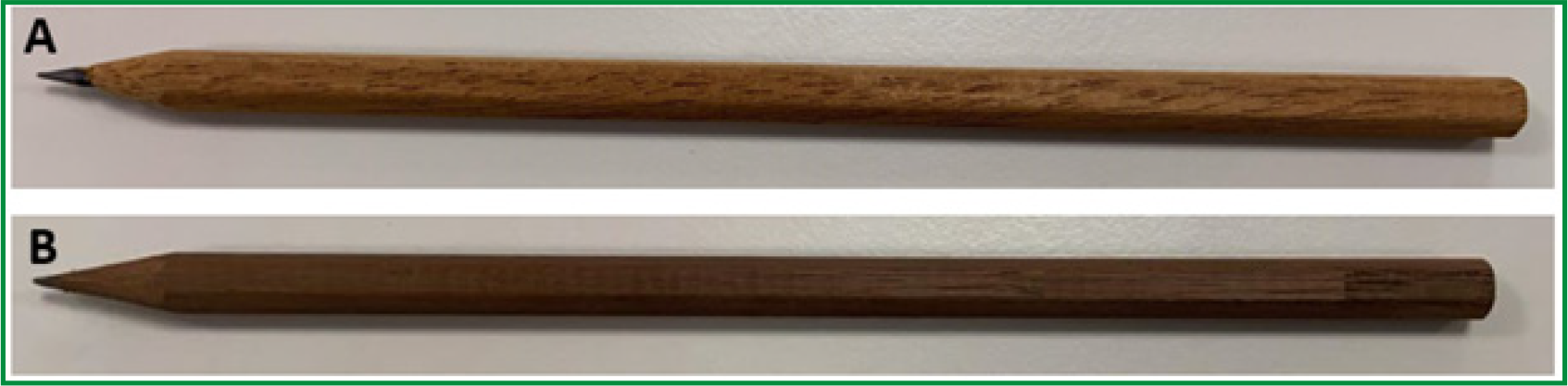
During production, thermally modified pine and ayous specimens were broken in the profiling machine. They might break due to the machine settings that were adjusted according to untreated wood properties (linden and poplar). The decrease in mechanical strength may be due to the thermal modification process (Bal, 2014; Gennari et al., 2020). However, the pencils from ash and iroko species were successfully produced with smooth surfaces (Fig. 5).
General pencil quality was found good according to TS 5171 (2019). It was observed that both halves of the wooden part of the pencil were homogeneous, and the surfaces were firmly adhered to each other along the length of the pencil. No wounds, dents, splinters or cracks in the body were observed. Both ends of the pencil were cut straight and smooth, perpendicular to the length axis of the pencil. The graphite was unbroken and one piece throughout the pencil after production. Good adhesion was observed without any gaps. Although the machining properties were different for thermally modified wood and different wood species, pencils could be produced within the limits of graphite being in the center of the entire pencil within a tolerance of 0.25 mm. Although the standard requires maximum 10% moisture content (MC) for wooden parts of pencil, the pencils had 5% MC on average due to thermal modification process.
3.2 Pencil Quality Tests - Conditioning & Sharpening Ability
Although some problems could occur for linden and poplar pencils, there was no problem with cracking, splitting of the slats and graphite holding after conditioning for thermally modified pencils. It was thought that the good results without paraffin impregnation were obtained due to stability advantages of thermally modified wood.
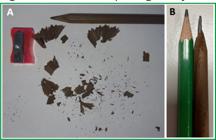
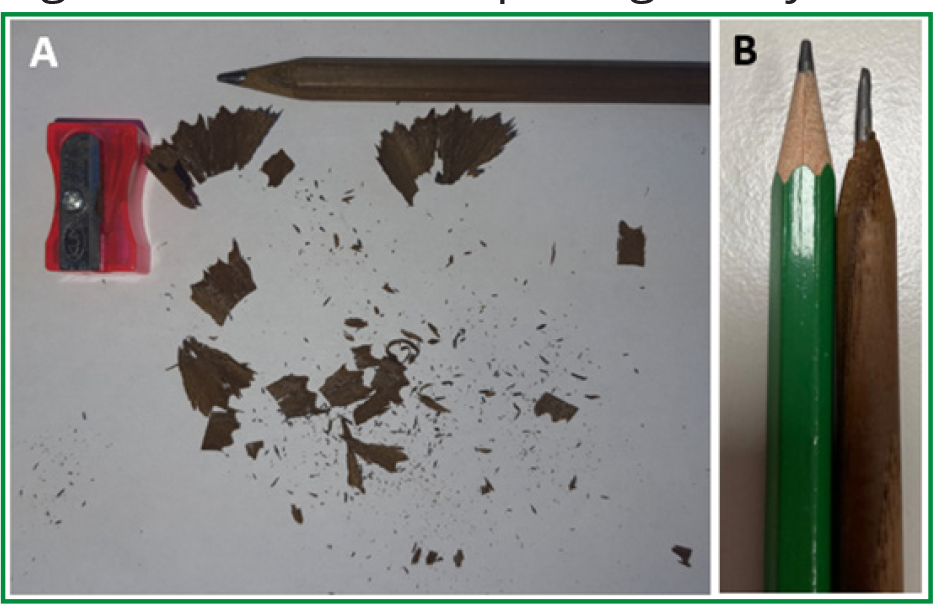
Iroko pencils had good sharpening abilities as untreated pencils. However, the sharpening was more difficult and some failures (some graphite breaking, pulling of fibers) were observed as seen in Fig. 6 in ash pencils. However, the good sharpening ratio were higher than “9/12” limit. The reason for the observed failures might be because of relatively higher density for the thermally modified ash (0,68 g/cm3 - Korkut et al., 2012). Additionally, the desired “rose shape” wasn’t observed in ash pencils, because of its smaller stubs (max. 3 cm length). It was thought that increasing brittleness with thermal modification and/or ring-porous cell distribution might be affected. Better results might be observed with pencil sharpener machines with faster and tougher blades.
3.4 Pencil Quality Tests - Mechanical Tests
After all mechanical tests, there was no separation on either iroko or ash samples. Although thermal modification process changes the chemical and physical characteristics of the wood, it seemed that commercially preferred adhesives gave sufficiently strong adhesion for thermally modified slats (Fig. 7).
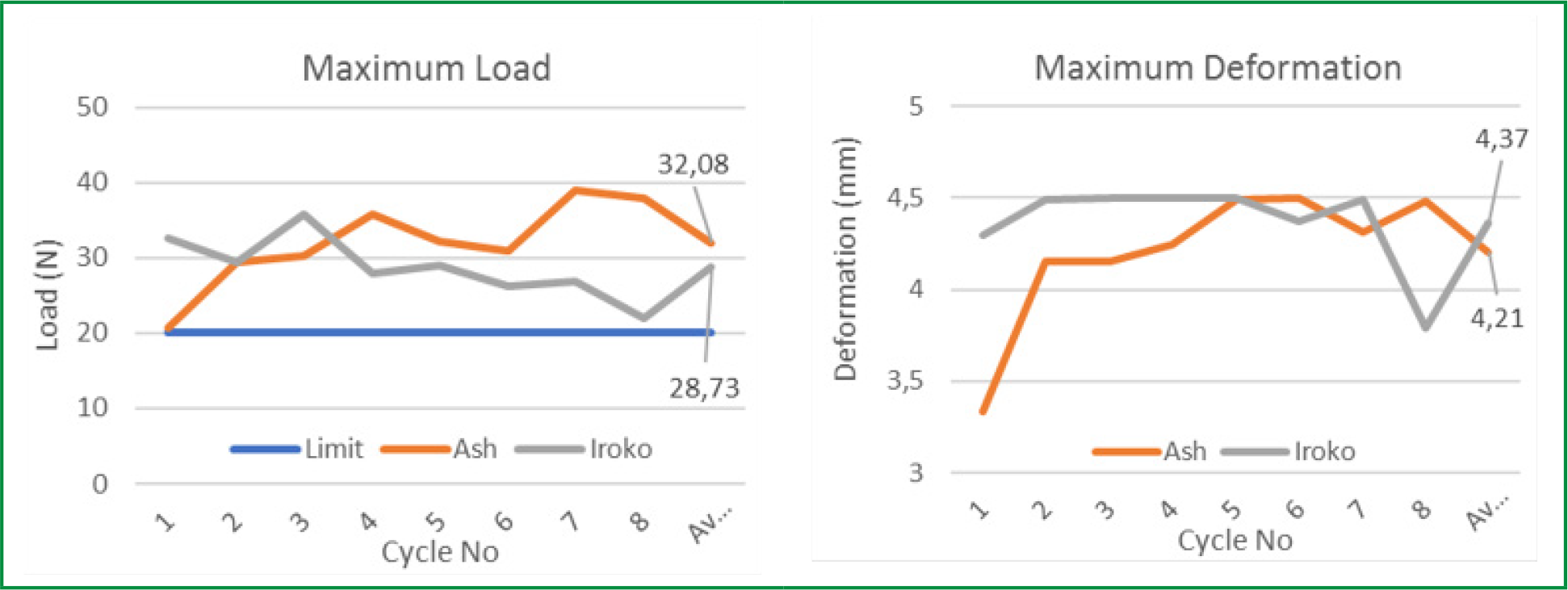
As seen in Fig. 8, all results passed the 20 N limit after point break test. When the species were evaluated, ash was in range between 20.8 N - 39.0 N, while iroko was in range between 22.0 N - 35.8 N. However, when they were compared, the values were not significantly different (p = 0.204 > 0.050). There were similar results for deformations, and the values were not significantly different (p = 0.337 > 0.050), too.
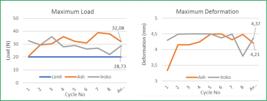
In where: *Av: Average.
4 CONCLUSIONS
This study showed that waste from thermally-modified wood could be used for pencil production with conventional production techniques. Although some studied wood species were broken during production, they might be successful after modifying the manufacturing properties. In this study, commonly preferred species were tried to be able to find waste. Other species can be tried in further studies. Because thermally modified slats bring many advantages. Wood (and pencil) gains stability without paraffin impregnation. Wood gains natural darkening without using painting (chemical). These gains may interest the end-users. Because users touch the pencil while using it and naturalness may make them feel more comfortable. Therefore, thermally modified pencils may be presented as a special product series and sold more expensively in the market.
When the production was considered, thermally modified lumbers have relatively higher costs in general than untreated lumbers. However, evaluating waste could be a good option for costs. Because slats have relatively smaller sizes and they give an option for evaluating the waste from other thermally wood productions (e.g. pieces from cross-cut). If the waste fulfils the slat size and quality requirements, there will be possibility for decreasing the cost of raw materials. On the other hand, in addition to reducing production costs, the use of waste promotes sustainable practices, decreasing environmental impact and adding value to materials that would otherwise be discarded. The recycled wood waste can decrease consuming virgin raw materials for pencil production. It reduces the expenses arisen from logging, transportation, sawing, drying, finishing. The recycling of wood waste can decrease environmental burdens through the reduction of materials, water, and energy used in production processes compared to when virgin raw materials are used (Kim and Song, 2014).
Consequently, future research could explore the use of other wood species or investigate large-scale economic viability. Additionally, adjustments to the thermal modification parameters could further improve the quality of the pencils."
ACKNOWLEDGEMENT
The subject of this article is derived from a patent application (Application number: 2022/008881, Date: 31th May 2022) filed by the authors.
Data Availability Statement:
Datasets related to this article will be available upon request to the corresponding author.
REFERENCES
-
ALPI. Caran d'Ache, Product Design. Alpi S.p.A., Italy, 2022. Available at: https://www.alpi.it/en/portfolio/product+design/caran+d27ache/114
» https://www.alpi.it/en/portfolio/product+design/caran+d27ache/114 -
BAL, B.C.. Some physical and mechanical properties of thermally modified juvenile and mature black pine wood. European Journal of Wood and Wood Products, v.72, n.1, p. 61-66, 2014. DOI: https://doi.org/10.1007/s00107-013-0753-9
» https://doi.org/10.1007/s00107-013-0753-9 -
BATISTA, D.C., TOMASELLI, I., KLITZKE, R.J., Efeito Do Tempo E Da Temperatura De Modificação Térmica Na Redução Do Inchamento Máximo Da Madeira De Eucalyptus grandis Hill ex Maiden. Ciência Florestal, v.21, n.3 p.533-540, 2011. DOI: https://doi.org/10.5902/198050983810
» https://doi.org/10.5902/198050983810 -
BATISTA, D.C.. Retificação térmica, termorretificação, tratamento térmico, tratamento com calor ou modificação térmica?. Ciência Florestal, v.29, p. 463-480, 2014. DOI: https://doi.org/10.5902/1980509832109
» https://doi.org/10.5902/1980509832109 - BATISTA, D.C., NISGOSKI, S., OLIVEIRA, J.T.S., MUÑIZ, G.I.B., PAES, J.B., Resistance of thermally modified Eucalyptus grandis W. Hill ex Maiden wood to deterioration by dry-wood termites (Cryptotermes sp.). Ciência Florestal, v.26, p. 671-678, 2016.
-
BERKEL, A. Kurşun kalem sanayiimiz ve ham madde istekleri (In Turkish), Journal of the Faculty of Forestry, Istanbul University, v.2, n.2, p. 24-31, 1952. Available at: https://dergipark.org.tr/tr/pub/jffiu/issue/18654/196839
» https://dergipark.org.tr/tr/pub/jffiu/issue/18654/196839 -
CALDERÓN, A.D. Pencil slats made with poplar. Revista de la Facultad de Ciencias Agrarias Universidad Nacional de Cuyo, v. 28, n.2, p.39-44, 1996. Available at: https://www.cabidigitallibrary.org/doi/full/10.5555/19970610630
» https://www.cabidigitallibrary.org/doi/full/10.5555/19970610630 -
CANDELIER, K., DUMARÇAY, S., PÉTRISSANS, A., DESHARNAIS, L., GÉRARDIN, P., PÉTRISSANS, M. Comparison of chemical composition and decay durability of heat-treated wood cured under different inert atmospheres: Nitrogen or vacuum. Polymer degradation and Stability, v.98, n. 2, p. 677-681, 2013. DOI: https://doi.org/10.1016/j.polymdegradstab.2012.10.022
» https://doi.org/10.1016/j.polymdegradstab.2012.10.022 -
EN 13183-1. Moisture content of a piece of sawn timber - Part 1: Determination by oven dry method. European Committee for Standardization, Brussels, 2002. Available at: https://www.en-standard.eu/bs-en-13183-1-2002-moisture-content-of-a-piece-of-sawn-timber-determination-by-oven-dry-method/?gad_source=1&gclid=CjwKCAjw7-SvBhB6EiwAwYdCAevfD8BTId3JwvE0vi0fodWxrbugErj231WXGW6C7qCNVazidIBTJBoCuQoQAvD_BwE
» https://www.en-standard.eu/bs-en-13183-1-2002-moisture-content-of-a-piece-of-sawn-timber-determination-by-oven-dry-method/?gad_source=1&gclid=CjwKCAjw7-SvBhB6EiwAwYdCAevfD8BTId3JwvE0vi0fodWxrbugErj231WXGW6C7qCNVazidIBTJBoCuQoQAvD_BwE -
ESTEVES, B.M., PEREIRA, H.M. Wood modification by heat treatment: A review. BioResources, v. 4, n.1, p. 370-404, 2009. DOI: https://doi.org/10.15376/biores.4.1.370-404
» https://doi.org/10.15376/biores.4.1.370-404 -
FABER-CASTELL OFFICIAL (@fabercastellglobal), September 9. How to make a pencil, [Photograph]. Instagram page, 2020. Available at: https://www.instagram.com/p/CE6xlFACnO9
» https://www.instagram.com/p/CE6xlFACnO9 -
GENNARI, E., PICCHIO, R., TOCCI, D., MONACO, A.L. Modifications of Physical and Mechanical Characteristics Induced by Heat Treatment: Case Study on Ayous Wood (Triplochiton scleroxylon K. Schum). Environmental Sciences Proceedings, v.3, n. 1, p. 27, Multidisciplinary Digital Publishing Institute, 2020. DOI: https://doi.org/10.3390/IECF2020-07874
» https://doi.org/10.3390/IECF2020-07874 -
HILL, C.A.. Wood modification: chemical, thermal and other processes. John Wiley & Sons Ltd, The Átreium, Southern Gate, Chichester. ISBN: 978-0-470-02173-6, 2007. Available at: https://www.wiley.com/en-gb/Wood+Modification%3A+Chemical%2C+Thermal+and+Other+Processes-p-9780470021736
» https://www.wiley.com/en-gb/Wood+Modification%3A+Chemical%2C+Thermal+and+Other+Processes-p-9780470021736 -
HILL, C., ALTGEN, M., RAUTKARI, L. Thermal modification of wood - A review: Chemical changes and hygroscopicity. Journal of Materials Science, v. 56, n. 11, p. 6581-6614, 2021. DOI: https://doi.org/10.1007/s10853-020-05722-z
» https://doi.org/10.1007/s10853-020-05722-z -
IŽDINSKÝ, J., VIDHOLDOVÁ, Z., REINPRECHT, L.. Particleboards from recycled thermally modified wood. Forests, v.12, n.11, p. 1462, 2021. DOI: https://doi.org/10.3390/f12111462
» https://doi.org/10.3390/f12111462 -
KAYGIN, B., KAPLAN, D., AYDEMIR, D. Paulownia tree as an alternative raw material for pencil manufacturing. BioResources, v.10, n. 2, p. 3426-3433, 2015. DOI: https://doi.org/10.15376/biores.10.2.3426-3433
» https://doi.org/10.15376/biores.10.2.3426-3433 -
KIM, M.H., SONG, H.B. Analysis of the global warming potential for wood waste recycling systems. Journal of Cleaner Production, v. 69, p. 199-207, 2014. DOI: https://doi.org/10.1016/j.jclepro.2014.01.039
» https://doi.org/10.1016/j.jclepro.2014.01.039 -
KORKUT, S. Performance of three thermally treated tropical wood species commonly used in Turkey. Industrial Crops and Products, v. 36, n.1, p. 355-362, 2012. DOI: https://doi.org/10.1016/j.indcrop.2011.10.004
» https://doi.org/10.1016/j.indcrop.2011.10.004 -
KORKUT, S., KORKUT, D.S., KOCAEFE, D., ELUSTONDO, D., BAJRAKTARI, A., ÇAKICIER, N. Effect of thermal modification on the properties of narrow-leaved ash and chestnut. Industrial Crops and Products, v. 35, n.1, p. 287-294, 2012. DOI: https://doi.org/10.1016/j.indcrop.2011.07.016
» https://doi.org/10.1016/j.indcrop.2011.07.016 -
KUKA, E., CIRULE, D., KAJAKS, J., ANDERSONE, I., Andersons, B. Wood plastic composites made with thermally modified birch wood residues. International Wood Products Journal, v.7, n. 4, p. 225-230, 2016. DOI: https://doi.org/10.1080/20426445.2016.1214439
» https://doi.org/10.1080/20426445.2016.1214439 -
KYWE, T., TINT, S.. Study on Some Burmese Timbers Suitable for Pencil Making, Leaflet No. 11/86-87, Forest Department, Ministry of Forestry, Government of the Union of Myanmar, 1987. Available at: https://www.forestdepartment.gov.mm/sites/default/files/Research%20Books%20file/11%281987%29.pdf
» https://www.forestdepartment.gov.mm/sites/default/files/Research%20Books%20file/11%281987%29.pdf -
LOIOLA, P.L., KLITZE, R.J., ROCHA, M.P., VIDAURRE, G.B.. Physical Properties of Wood Pinus caribaea var. caribaea, Pinus caribaea var. hondurensis and Pinus oocarpa for Pencil Production. Floresta, v.51, n.2, p. 354-362, 2021. DOI: http://dx.doi.org/10.5380/rf.v51i2.68955
» http://dx.doi.org/10.5380/rf.v51i2.68955 -
PINKOWSKI, G., KRAUSS, A., PIERNIK, M., SZYMAŃSKI, W. Effect of thermal treatment on the surface roughness of scots pine (Pinus sylvestris L.) wood after plane milling. BioResources, v.11, n.2, p. 5181-5189, 2016. DOI: https://doi.org/10.15376/biores.11.2.5181-5189
» https://doi.org/10.15376/biores.11.2.5181-5189 -
SANDBERG, D., KUTNAR, A., KARLSSON, O., JONES, D. Wood modification technologies: principles, sustainability, and the need for innovation. CRC Press, 2021. DOI: https://doi.org/10.1201/9781351028226
» https://doi.org/10.1201/9781351028226 -
STAEDTLER. From the idea to the pencil, History, Staedtler, Germany, 2022. Available at: https://www.staedtler.com/intl/en/discover/staedtler-how-to-make-a-world-famous-company-out-of-a-pencil
» https://www.staedtler.com/intl/en/discover/staedtler-how-to-make-a-world-famous-company-out-of-a-pencil -
TOMAK, E.D., VIITANEN, H., YILDIZ, U.C., HUGHES, M. The combined effects of boron and oil heat treatment on the properties of beech and Scots pine wood. Part 2: Water absorption, compression strength, color changes, and decay resistance. Journal of Materials Science, v. 46, n. 3, p. 608-615, 2011. DOI: https://doi.org/10.1007/s10853-010-4860-2
» https://doi.org/10.1007/s10853-010-4860-2 -
TS 5171, 2019. Pencil. Turkish Standards Institute Ankara, Turkey, 2019. Available at: https://intweb.tse.org.tr/standard/standard/Standard.aspx?053107106111065067115113049116090107100056052055108081090071086075069085047110067109075073081116103090081086073108065117084119101074117109087118088108048057056098065120103052111065067081069077
» https://intweb.tse.org.tr/standard/standard/Standard.aspx?053107106111065067115113049116090107100056052055108081090071086075069085047110067109075073081116103090081086073108065117084119101074117109087118088108048057056098065120103052111065067081069077 -
TS 8961, 1991. Pencil Sharpener. Turkish Standards Institute Ankara, Turkey, 1991. Available at: https://intweb.tse.org.tr/standard/standard/Standard.aspx?053107106111065067115113049116090107100056052055108081090071086075069085047110067109075073081116103090081086073108065117084119101075087119097068043079115077052053084106083115055107071073089081
» https://intweb.tse.org.tr/standard/standard/Standard.aspx?053107106111065067115113049116090107100056052055108081090071086075069085047110067109075073081116103090081086073108065117084119101075087119097068043079115077052053084106083115055107071073089081 -
TSE CEN/TS 15679, 2010. Thermal Modified Timber - Definitions and characteristics. Turkish Standards Institute. Ankara, Turkey, 2010. Available at: https://intweb.tse.org.tr/Standard/Standard/Standard.aspx?081118051115108051104119110104055048065082077055103076076056084103118110100122076043076114106082047068053101055112110103057115115103116055069085083053085107108082074077068068109056050077113052053103048056043068056070109056088070048050070119047077118120107090120111087121069073105067082107097105052057047108112113117057116076067103113079121114085053051073068121100118057056066075112098120083111108078057103079072051080083120066111069108117069115113119061061
» https://intweb.tse.org.tr/Standard/Standard/Standard.aspx?081118051115108051104119110104055048065082077055103076076056084103118110100122076043076114106082047068053101055112110103057115115103116055069085083053085107108082074077068068109056050077113052053103048056043068056070109056088070048050070119047077118120107090120111087121069073105067082107097105052057047108112113117057116076067103113079121114085053051073068121100118057056066075112098120083111108078057103079072051080083120066111069108117069115113119061061 - VIITANIEMI, P., JÄMSÄ, S., 1996. Modification of wood by heat treatment. VTT publications, 814. Espoo, 57 p (In Finnish, English abstract).
-
WOPEX, Wopex (Wood Pencil Extrusion), Graphite Pencils, Staedtler, Germany, 2022. Available at: https://www.staedtler.com//intl/en/products/pencils-and-accessories/graphite-pencils/?tx_solr%5Bpage%5D=5
» https://www.staedtler.com//intl/en/products/pencils-and-accessories/graphite-pencils/?tx_solr%5Bpage%5D=5
-
Evaluators in this article:
Prof. Dr. Cristiane Pedrazzi, Section Editor
-
Editorial Board:
Prof. Dr. Cristiane Pedrazzi, Editor-in-ChiefProf. Dr. Dalton Righi, Associate EditorMiguel Favila, Managing Editor

 Source:
  Source:
  Source: Authors (2026)
 Source: Authors (2026)
 Source: Authors (2026)
 Source: Authors (2026)
 Source: Authors (2026)
 Source: Authors (2026)