
 Validation and standardization of the Scale of Self-Perception of Central Auditory Processing Skills (EAPAC) - expanded
Purpose To validate and standardize the online application of the Scale of Self-Perception of Central Auditory Processing Skills (EAPAC) – expanded for Brazilian adults.
Methods The EAPAC was expanded and answered by 1,274 Brazilian individuals aged 18 to 59 years. Of these, 116 subjects underwent neuropsychological and auditory evaluation, and 63 were selected to answer the scale at a second time point. Those with any type and degree of hearing loss, history of speech-language-hearing therapy for central auditory processing disorder, and psychiatric and/or neurological alteration were excluded. Descriptive analysis of the variables, exploratory factor analysis, and ROC curve were performed for validation and standardization. The Wilcoxon test was used to compare the responses of the subjects who answered the scale at two time points.
Results After exploratory factor analysis, five questions were excluded, as they did not correlate with the scale domains. The ROC curves, constructed considering the presence of auditory processing disorder and the result by auditory processes, did not indicate significant values. Thus, the scale presented fragile sensitivity and specificity values. There was no significant difference in the subjects’ responses to the scale between the two time points.
Conclusion The expanded scale did not present adequate psychometric standards for identifying the risk for central auditory processing disorder, but it proved useful for investigating auditory complaints in everyday tasks, thus helping to select strategies to minimize the negative impact of the difficulties mentioned.
Keywords:
Hearing; Auditory Perception; Surveys and Questionnaires; Self Report; Validation Study; Cognition; Communication; Adult
 Thumbnail
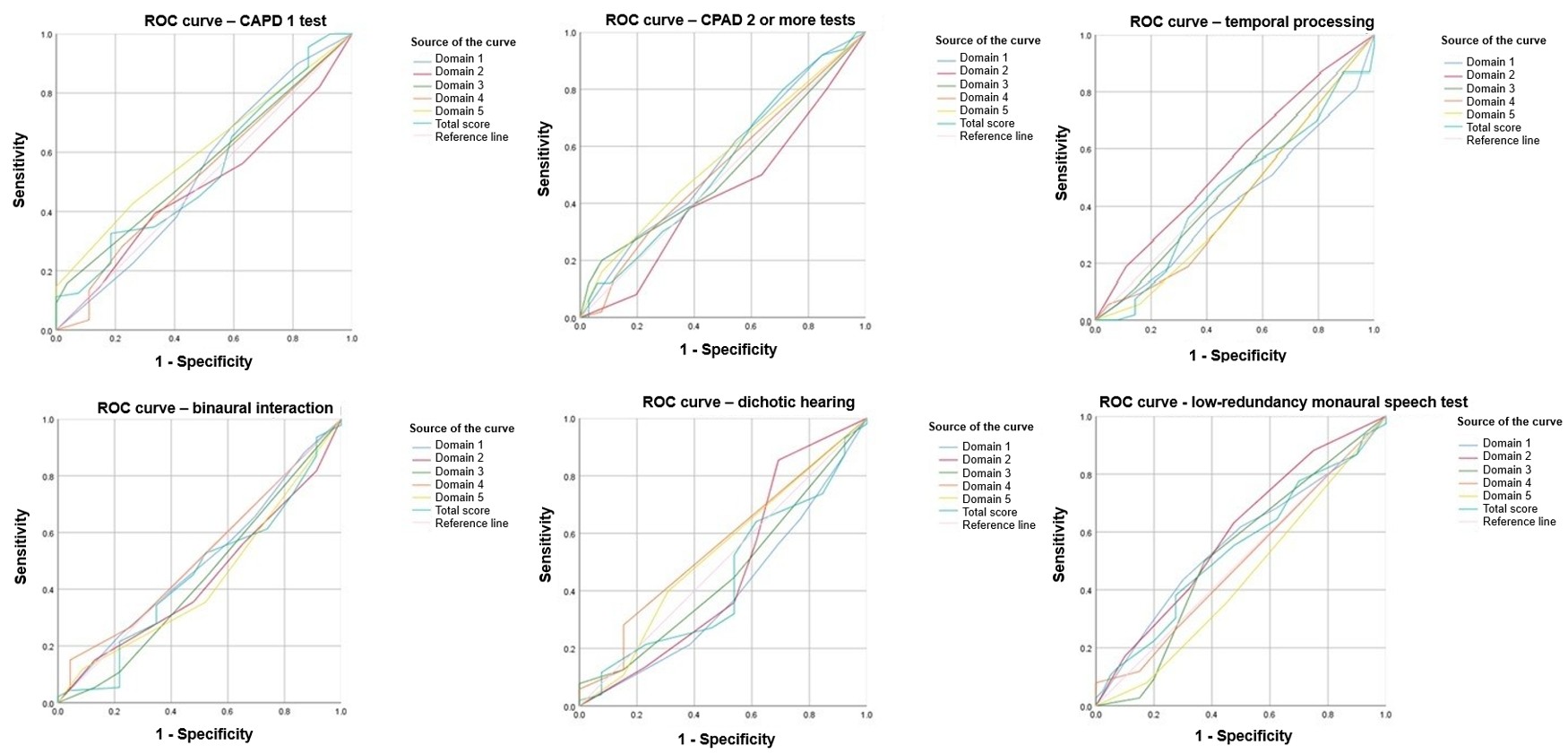 Caption: CAPD = central auditory processing disorder