 Enhancing genetic gains in conilon coffee through intra-population recurrent selection in Espírito Santo, Brazil
ABSTRACT:
Recurrent intrapopulation selection is a key approach for the plant breeding of Coffea canephora, enabling the development of progenies superior to their parents while preserving genetic variability. This study was conducted in Espírito Santo, a major Conilon coffee production hub in Brazil, across two environments with contrasting soil and climatic conditions. This study to evaluated the agronomic performance, selection gains, and genetic divergence of 56 hybrid progenies from a late-maturing population, along with six parental plants. Genetic parameter estimates confirmed the presence of genetic variability and selection potential among the genotypes. Using Mulamba and Mock and Additive selection indices, 16 promising progenies were identified for the development of new cultivars. The strategy proved effective in recommending high-yielding genotypes adapted to each environment, highlighting its importance for sustainable cultivation under diverse edaphoclimatic conditions.
Key words:
Coffea canephora; plant breeding; hybrid progenies; cultivar; selection gains
RESUMO:
A seleção intrapopulacional recorrente é uma abordagem fundamental para o melhoramento genético de Coffea canephora, permitindo o desenvolvimento de progênies superiores aos seus pais, preservando a variabilidade genética. Este estudo foi conduzido no Espírito Santo, um importante polo produtor de café Conilon no Brasil, em dois ambientes com condições edafoclimáticas contrastantes. O objetivo foi avaliar o desempenho agronômico, os ganhos de seleção e a divergência genética de 56 progênies híbridas de uma população de maturação tardia, juntamente com seis plantas parentais. As estimativas dos parâmetros genéticos confirmaram a presença de variabilidade genética e potencial de seleção entre os genótipos. Utilizando os índices de seleção Mulamba e Mock e Additive, 16 progênies promissoras foram identificadas para o desenvolvimento de novas cultivares. A estratégia se mostrou eficaz na recomendação de genótipos de alta produtividade adaptados a cada ambiente, destacando sua importância para o cultivo sustentável sob diversas condições edafoclimáticas.
Palavras chave:
Coffea canephora; melhoramento genético; progênies híbridas; cultivar; ganhos de seleção
INTRODUCTION
To tackle the challenges in improving Coffea canephora, it is crucial to develop commercial clones with a broad genetic base. The species’ self-incompatibility, coupled with widespread clonal plantations, heightens the risk of pollination inefficiency and reduced yields. Breeding strategies should combine asexual and sexual reproduction to ensure genetic recombination, maintain variability, and enhance adaptability while sustaining high yields (FERRÃO et al., 2019).
Self-incompatibility and cross-pollination play a key role in preserving the genetic diversity of C. canephora. This diversity is vital for overcoming abiotic and biotic stressors and improving traits like yield, fruit quality, and nutrient absorption. Intra-population recurrent selection is particularly effective for outcrossing species, enabling cumulative genetic gains in both qualitative and quantitative traits by continuously selecting and recombining superior progeny over successive cycles (HULL, 1945; BERNARDO, 2020; CAMPUZANO-DUQUE & BLAIR, 2022).
Intrapopulation recurrent selection, paired with the use of clones from distinct genetic compatibility groups, effectively mitigates fertilization challenges and preserves genetic variability. These strategies stabilize production and foster long-term sustainability in commercial plantations (CAMPUZANO-DUQUE & BLAIR, 2022).
By integrating diverse germplasm and systematic breeding, the risks of inbreeding and productivity losses can be minimized, ensuring resilient coffee production across varying conditions. This study evaluated the agronomic performance and genetic variability of 62 C. canephora genotypes (56 hybrid progenies and 6 parent clones) from the first cycle of intra-population recurrent selection. These genotypes were assessed over three harvests in two contrasting edaphoclimatic environments in Espírito Santo, Brazil, to estimate genetic parameters and selection gains.
MATERIALS AND METHODS
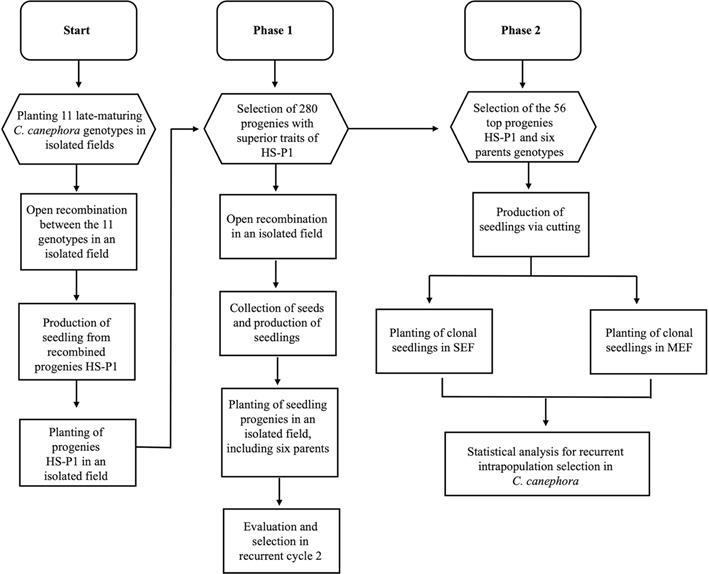
The experiment was initially implemented in 1998 by planting 11 late-maturing C. canephora genotypes in isolated fields at the Marilândia Experimental Farm (MEF), Espírito Santo, Brazil (19°23’56” S, 40°32’07” W). The experiment was conducted in a randomized complete block design with 10 plants per clone and four blocks.
Flowering and recombination occurred in 2000 by open natural pollination in an isolated field. 100 grams of hybrid seeds (seeds from each plant within each parental plot) were harvested in 2001 to compose the half-sib progenies of cycle 01 (HS-P1) in an isolated field.
HS-P1 was established in 2002, totaling 1,120 plants. The plants were evaluated over eight growing seasons (2005 to 2013) for productivity, vegetative vigor, disease resistance, drought tolerance, and fruit ripening uniformity. A total of 280 plants with superior traits were selected within each HS-P1 to advance the selection cycle. Selection was made within the HS-P1 so as not to reduce the genetic base. Unselected progenies were eradicated. The 280 selected progenies were conducted with natural open pollination occurring in an isolated field. The result of the fruiting resulting from recombination generated a new population to compose the half-sib progenies of the second intra-population recurrent selection cycle (HS-P2).
Among the progenies of the HS-P1 population (280 progenies) selected for open pollination recombination in an isolated field to generate the new HS-P2 population, the most promising HS-P1 (56 progenies) were selected based on morphoagronomic characteristics for the clonal competition assay.
The 56 progenies were propagated vegetatively through cuttings in MEF. Once the seedlings developed four pairs of leaves, field experiments commenced. In addition to the 56 progenies, six parental genotypes were also propagated, resulting in a total of 62 genotypes. These six parental genotypes were chosen because they are commercial clones commonly used by farmers in the primary coffee Conilon producing regions.
The experiments with 62 genotypes were conducted in two edaphoclimatic environments contrastant: MEF and the Sooretama Experimental Farm (SEF) in Espírito Santo, Brazil. The MEF site is located at 19°23’56” S, 40°32’07” W, with an altitude of 223 meters and wavy relief. The soil type is typical red-yellow latosol dystrophic A moderate (LVAd1; FEITOZA et al., 2018), with average annual precipitation of 1,164 mm and an average annual temperature of 24.2°C. The SEF site is located at 19°07’11” S, 40°04’52” W, with an altitude of 60 meters and flat terrain. The soil type is yellow Argissolo distrocoeso typical A moderate (PAdx5; FEITOZA et al., 2018), with average annual precipitation of 1,249 mm and an average annual temperature of 25.8 °C <https://meteorologia.incaper.es.gov.br/>. The experiments were established in January 2017 (SEF) and September 2017 (MEF).
The progeny from the recurrent intra-population selection was evaluated for three harvests (2019, 2020, and 2021). Fourteen phenotypic traits were assessed in the field during the fruit granulation and maturation stages. These traits included morpho-agronomic characteristics (maturation time (MAT); uniformity of the maturation period (UNIF); bean size (GSIZ); percentage of floating fruits (Bo); plant architecture (PRT); degree of plant inclination (DI); vigor (VIGOR); general scale (GSCE), resistance to diseases and pests (incidence rosette cochineal (COCH); reaction to rust (RUST); Cercospora spot (CER); coffee leaf miner incidence (LMINER); tip/branch dryness (TD), and yield (YIELD) in the field. Measurements were performed as described by ADUNOLA et al. (2023).
The experimental design was randomized blocks with 62 genotypes (treatments), three blocks and five plants per plot. The field experiments were implemented using a spacing of 3 meters between rows and 1 meter between plants, conducted with supplemental irrigation during periods of high water deficit, and management practices were adopted in accordance with current recommendations for conilon coffee cultivation in Espírito Santo (FERRÃO et al., 2019).
The traits were analyzed using mixed linear models with Restricted Maximum Likelihood (REML) and Best Linear Unbiased Prediction (BLUP) methods. The statistical model used was:
y = µ + Xf + Zg + Qgl +Tgm + Wgml +Sp + e
where y is the vector of phenotypic value, µ is the overall mean, g is the vector of random effects of genotypes, gl is the vector of random effects of genotype × site interactions, gm is the vector of random effects of genotype × measurement interactions, gml is the vector of the triple interaction genotype × measurement × site effects (assumed to be random), p is the vector of the random effects of plot within site, and e is the vector of errors. Capital letters represent the incidence matrices for their respective effects (RESENDE, 2016). The environmental effects of block within site (b), measurement (m), site (l) and the interactions block within site × measurement, and site × measurement were considered as fixed effects in a single fixed effect vector (f) given by the combination block-measurement-site (RESENDE, 2016). Based on this model the genetic values of the clones (BLUP) and the variance components (individual REML) were estimated.
The superior genotypes and the selection gain were determined via a selection analysis using the average rank index adapted from Mulamba and Mock (MULAMBA & MOCK, 1978). In this index, the genotypic values are ranked for each trait, and the average of the rankings of each genotype for all traits is presented as the result. An additive index was provided, in which the selection direction and the relative economic importance or weights assigned to each evaluated trait were established.
The genetic diversity of the clones was analyzed based on genetic values by means of the statistical Mahalanobis distance matrix (MAHALANOBIS, 2008) followed by UPGMA hierarchical clustering and modified Tocher method (SATHURI et al., 2023). All statistical analyses described were performed by the computerized Statistical System for Genetic Selection (Selegen) (RESENDE, 2016). Flowchart with the general schematic description of the methodological strategy is described in figure 1.
A: Cross-section showing aliform parenchyma (AP) with solitary vessels (SV); B: Detail of the twinned vessel (TV); C: Tangential section showing paired pores (TP), solitary pore (SP), obstructed pore (OP), and axial parenchyma (PR); D: Tangential section showing PR surrounded by fibres (FB); E: Tangential section showing septum (SP) of the FB and PR; F: Radial section; G: Tangential section showing the perforation plates (PP), inter vessel pits (IP) and fibres (FB); H: Libriform fibres obtained in the maceration process.
RESULTS AND DISCUSSION
Estimation of variance components by REML and genetic values via BLUP
Among the genetic parameters important for plant selection, variance components are particularly noteworthy, especially genotypic variance (ROCHA et al., 2021). Higher magnitudes of genotypic variances (Vg) compared to the variances of genotype × measurement interactions (Vgm), genotype × site interactions (Vgl), and permanent plot effects (Vp) suggested a predominant influence of genotypes on the phenotypic expression of YIELD, GSIZ, and RUST traits. This is due to the distinct genetic expressions among different genetic materials (Table 1).
For the traits MAT, VIGOR, and DI, Vg was higher than Vgl and Vperm but lower than Vgm, indicating that year-to-year variability had a greater influence on the phenotypic expression of these traits. In contrast, the traits PRT, GSCE, and TD showed Vg greater than Vgm and Vperm but lower than Vgl, indicating that site-specific variations had a more significant impact on phenotypic expression. For the traits Bo, UNIF, CERC, LMINER, and COCH, environmental variances exceeded Vg, highlighting a strong influence of environmental factors on phenotypic expression (Table 1).
The selective accuracy parameter (Acgen), which measures the correlation between predicted and true genetic values, is crucial in genetic studies and is linked to trait heritability (AMBRÓSIO et al., 2020). Based on its magnitude, the accuracy values (Acgen) were low for Bo, UNIF, CERC, LMINER, and COCH; moderate for PRT, GSCE, DI, and TD; and high for YIELD, MAT, GSIZ, VIGOR, and RUST. This indicated favorable conditions for selection, given the significance of these traits in the selection process. Accuracy values above 0.7 suggested good selection potential with just three harvests; however, additional harvests are necessary to validate results for other traits (Table 1). Based on the results of the Deviance analysis, the significance of the genotypic, permanent and interaction effects is verified for each characteristic evaluated (Table 2).
CARIAS et al. (2016) evaluated the productivity of eight half-sib progenies from Incaper’s breeding program, MEF, using experimental data from three harvests analyzed by the REML/BLUP methodology. They reported Acgen values of 0.6979 and average heritability of genotype (h2mg) at 0.4870. Later, SENRA et al. (2020), working with 27 clones from the same breeding program and applying the REML/BLUP mixed linear model methodology, estimated Acgen values of 0.768, 0.385, and 0.577 for productivity traits, defoliation, and percentage of dead plants, respectively, with corresponding h2mg values of 0.589, 0.148, and 0.333.
CARVALHO et al. (2019) evaluated 20 full-sib progenies derived from crosses between genotypes of the Conilon and Robusta botanical groups across two harvests. They found Acgen values of 0.49 and 0.45, and h2mg values assuming complete survival, respectively, for the productivity trait.
Genetic selection and estimation of selection gains
In the selection analysis using the average rank index, adapted from Mulamba and Mock, and the Additive index, the direction of selection and the relative economic importance or weights of the traits are established. The weight for each agronomic trait was initially defined based on its importance and the results of accuracy and heritability, as shown in table 3.
Economic weight and direction of selection for selection analysis via average rank index, adapted from Mulamba and Mock and Additive index.
The list of genotypes ranked by selection index is provided in table 4. Selection gains ranged from 77.543 to 207.317 for the average rank index, adapted from Mulamba and Mock, and from 16.064 to 30.895 for the Additive index. A selection index threshold of 25% was applied, resulting in the selection of 16 progenies with superior performance and genetic variability.
Ranking of the 25% best genotypes using selection indexes via average rank, adapted from Mulamba and Mock and Additive index, with estimates of genetic gains in percentage (GS) through the joint evaluation of variables via REML/BLUP and genealogy of the genotypes.
The high selection gains observed may be attributed to the considerable genetic variability of the evaluated genotypes, which leads to a high selection differential and, consequently, high estimated gains. Although, the average rank index, adapted from Mulamba and Mock, showed higher magnitudes of selection gains, there were no significant differences in the genetic materials selected by either index. Notably, genotypes 39 and 31 were included in the average rank index but not in the Additive index, while genotypes 12 and 26 were included by both indices. Among the top-ranked genotypes, genotype 57 (clone 305 of the Centenary Cultivar ES8132, RNC 31001) ranked ninth according to the average rank index, adapted from Mulamba and Mock, and eleventh according to the Additive index.
The other selected genotypes are hybrid progenies, demonstrating the effectiveness of the intra-population recurrent selection process in generating superior genotypes in this study. Genotypes ranked higher than genotype 57 may be considered for final trials and future cultivar recommendations, as they appear to be superior to the clone already released in the cultivar.
In breeding programs utilizing the intra-population recurrent selection strategy, the sample of progenies drawn from the population under selection should represent its genetic variability. Small samples risk losing favorable alleles or fixing undesirable alleles, while very large samples may be impractical due to high experimental costs (MISTRO et al., 2019).
The high genetic gains achieved using the Mulamba and Mock index are consistent with the findings of (CARIAS et al., 2016), who conducted similar work within Incaper’s plant breeding program for Conilon coffee.
Genetic divergence analysis
Genotype grouping was conducted using the modified Tocher method, with the genetic dissimilarity measured by a distance matrix obtained through the Mahalanobis method. This analysis utilized a set of 14 morphoagronomic traits and resulted in the formation of 11 distinct groups (Table 5). The findings indicate that the intra-population recurrent selection strategy effectively increased genetic variability and aided in selecting genotypes with superior agronomic traits.
Group I contained 48 genotypes, Group III had three genotypes, and Groups II and IV each had two genotypes. Groups V to XI consisted of only one genotype each, including two parents (clones 153 and 76/2). The parents were distributed across different groups, with genitors 57, 60, 61, and 62 in Group I, genitor 58 in Group VII, and genitor 59 in Group IX (Table 5). It is worth noting that the 56 progenies originate from 11 parents, but only six parents that are widely commercialized are being evaluated in this study. This method often forms groups with only one genotype when dealing with those that exhibit greater dissimilarity since grouping is influenced by the distance between already-grouped genotypes (SATHURI et al., 2023).
Similar studies by IVOGLO et al. (2008) and CARIAS et al. (2016) on C. canephora, Conilon variety, identified 13 and 4 different groups of genetic dissimilarity, respectively. FONSECA et al. (2006) grouped 32 Conilon coffee clones from three improved clonal varieties into three distinct groups, with the first group subdivided into 10 subgroups, using the same method. More recently, (FERRÃO et al., 2021) analyzed the genetic diversity of 600 C. canephora accessions from Incaper’s active germplasm bank using 38 traits. Their grouping with the modified Tocher method revealed the formation of 30 groups, with the highly dissimilar clone 76/2 among them. SENRA et al. (2020) and FERRÃO et al. (2021) also observed significant genetic variability among accessions in the Active Germplasm Bank of C. canephora at Incaper, based on traits related to plant architecture, fruit production, and ripeness.
Among the selected materials (Table 4), 14 progenies were selected in Group I using both indexes, with one selected progeny in Group III and one in Group VII. Group I is particularly noteworthy because it includes progenies from seven different parents. Specifically, genotypes 6 and 27 are progeny of clone 139; genotypes 17 and 52 are progeny of clone 153; genotype 12 is progeny of clone 25+8; genotype 31 is progeny of clone 76/1; genotypes 38, 42, 48, and 26 are progeny of clone 76/2; genotype 49 is progeny of clone 79; and genotypes 13, 7, 8, and 40 are progeny of clone 80.
Some selected progenies share the same female parent. Given the genetic self-incompatibility of the species, this should be carefully considered. When determining which progenies to group for developing a new clonal hybrid cultivar, it is essential to select genetically diverse and compatible materials to ensure effective pollination, fruit set, and adequate production (FERRÃO et al., 2019).
Furthermore, to enhance genetic compatibility, improve pollination efficiency, and broaden the genetic base, it is recommended to include new genotypes with genetic divergence in the ongoing improvement process through a intra-population recurrent selection strategy.
CONCLUSION
The study confirmed that there is significant genetic variability among Conilon coffee genotypes (C. canephora), which makes them suitable for selection using a intra-population recurrent selection strategy. This genetic diversity is crucial for developing improved coffee cultivars in the future.
The research identified 15 hybrid progenies and one parent with outstanding agronomic traits. These selected genotypes provide valuable opportunities for developing heterotic hybrids and enhanced populations. These can be used in coffee breeding programs to boost yield, enhance disease resistance, and improve other important traits.
The intra-population recurrent selection strategy was effective in choosing superior genotypes while preserving genetic diversity. This approach resulted in high selection gains due to the significant genetic variability found among the evaluated genotypes, reinforcing its value for ongoing breeding efforts in C. canephora.
ACKNOWLEDGMENTS
We acknowledge the support of the Instituto Capixaba de Pesquisa, Assistência Técnica e Extensão Rural, Empresa Brasileira de Pesquisa Agropecuária - Embrapa Café and Centro de Ciências Agrárias e Engenharias da Universidade Federal do Espírito Santo (CCAE/UFES). We also thank all the staff and trainees that indirectly collaborated in the execution of this research. This research was supported financially by Fundação de Amparo à Pesquisa e Inovação do Espírito Santo (FAPES), Conselho Nacional de Desenvolvimento Científico e Tecnológico, (CNPq), and Coordenação de Aperfeiçoamento de Pessoal de Nível Superior (CAPES), Brasil - Finance code 001.
REFERENCES
-
ADUNOLA, P. et al. Genomic selection for genotype performance and environmental stability in Coffea canephora G3: Genes, Genomes, Genetics, v.13, 2023. Available from: <Available from: https://doi:10.1093/g3journal/jkad062 >. Accessed: Aug. 21, 2024. doi: 10.1093/g3journal/jkad062.
» https://doi.org/10.1093/g3journal/jkad062.» https://doi:10.1093/g3journal/jkad062 -
AMBRÓSIO, M. et al. Genotypic superiority of Psidium Guajava S1 families using mixed modeling for truncated and simultaneous selection. Scientia Agricola, v.78, 2020. Available from: <Available from: https:// doi:10.1590/1678-992x-2019-0179 >. Accessed: Mar. 17, 2024. doi: 10.1590/1678-992x-2019-0179.
» https://doi.org/10.1590/1678-992x-2019-0179.» https:// doi:10.1590/1678-992x-2019-0179 -
BERNARDO, R. Reinventing quantitative genetics for plant breeding: something old, something new, something borrowed, something BLUEHeredity Springer Nature, 2020. Available from: <Available from: https://doi.org/10.1038/s41437-020-0312-1 >. Accessed: Jun. 10, 2022. doi: 10.1038/s41437-020-0312-1.
» https://doi.org/10.1038/s41437-020-0312-1.» https://doi.org/10.1038/s41437-020-0312-1 -
CAMPUZANO-DUQUE, L. F.; BLAIR, M. W. Strategies for Robusta Coffee (Coffea canephora) Improvement as a New Crop in Colombia Agriculture (Switzerland) MDPI, 2022. Available from: <Available from: https://doi.org/10.3390/agriculture12101576 >. Accessed: Aug. 18, 2024. doi: 10.3390/agriculture12101576.
» https://doi.org/10.3390/agriculture12101576.» https://doi.org/10.3390/agriculture12101576 -
CARIAS, C. M. et al. Predição de ganhos genéticos via modelos mistos em progênies de café conilon. Coffee Science, v.11, p.39-45, 2016. Available from: <Available from: http://www.sbicafe.ufv.br:80/handle/123456789/8171 >. Accessed: Feb. 02, 2024.
» http://www.sbicafe.ufv.br:80/handle/123456789/8171 -
CARVALHO, H. F. et al. Selection and genetic parameters for interpopulation hybrids between kouilou and robusta coffee. Bragantia, v.78, p.52-59, 2019. Available from: <Available from: https://doi.org/10.1590/1678-4499.2018124 >. Accessed: Feb. 07, 2024. doi: 10.1590/1678-4499.2018124.
» https://doi.org/10.1590/1678-4499.2018124.» https://doi.org/10.1590/1678-4499.2018124 -
FEITOZA, L. et al. Atualização da legenda do mapa de reconhecimento de solos do Estado do Espírito Santo e implementação de interface no Geobases para uso de dados em SIG. Artigo em periódico indexado, 2018. Available from: <Available from: http://biblioteca.incaper.es.gov.br/digital/handle/123456789/4257 >. Accessed: Jun. 15, 2022.
» http://biblioteca.incaper.es.gov.br/digital/handle/123456789/4257 -
FERRÃO, L. F. V. et al. Accurate genomic prediction of Coffea canephora in multiple environments using whole-genome statistical models. Heredity, v.122, p.261-275, 2019. Available from: <Available from: https://doi.org/10.1038/s41437-018-0105-y >. Accessed: Aug. 15, 2024. doi: 10.1038/s41437-018-0105-y.
» https://doi.org/10.1038/s41437-018-0105-y.» https://doi.org/10.1038/s41437-018-0105-y -
FERRÃO, M. A. G. et al. Characterization and genetic diversity of Coffea canephora accessions in a germplasm bank in Espírito Santo, Brazil. Crop Breeding and Applied Biotechnology, v.21, p.36132123, 2021. Available from:<Available from:https://doi.org/10.1590/1984-70332021v21n2a32 >. Accessed: Sept. 18, 2024. doi: 10.1590/1984.
» https://doi.org/10.1590/1984.» https://doi.org/10.1590/1984-70332021v21n2a32 -
HULL, F. H. Recurrent selection for specific combining ability in corn. Agronomy Journal, v.37, p.134-145, 1945. Available from: <Available from: https://doi.org/10.2134/agronj1945.00021962003700020006x >. Accessed: Jun. 10, 2022. doi: 10.2134/agronj1945.00021962003700020006x.
» https://doi.org/10.2134/agronj1945.00021962003700020006x.» https://doi.org/10.2134/agronj1945.00021962003700020006x -
IVOGLO, M. G. et al. Divergência genética em café robusta. Bragantia, v.67, p.823-831, 2008. Available from: <Available from: https://doi.org/10.1590/S0006-87052008000400003 >. Accessed: Jun. 05, 2024. doi: 10.1590/S0006-87052008000400003.
» https://doi.org/10.1590/S0006-87052008000400003.» https://doi.org/10.1590/S0006-87052008000400003 -
MAHALANOBIS, P. C. On The Generalized Distance in Statistics. The Indian Journal of Statistics, Series A, v.80, p.1-7, 2008. Available from: <Available from: https://www.jstor.org/stable/48723335 >. Accessed: Jun. 12, 2023.
» https://www.jstor.org/stable/48723335 -
MISTRO, J.C. et al. Effective population size and genetic gain expected in a population of Coffea canephora Crop Breeding and Applied Biotechnology, v.19, p.1-7, 2019. Available from: <Available from: https://doi.org/10.1590/1984-70332019v19n1a01 >. Accessed: Jul. 17, 2024. doi: 10.1590/1984.
» https://doi.org/10.1590/1984.» https://doi.org/10.1590/1984-70332019v19n1a01 -
MULAMBA, N. N.; MOCK, J. J. Improvement of yield potential of the ETO blanco maize (Zea mays L.) population by breeding for plant traits [Mexico]. Egyptian Journal of genetics and Cytology, 1978. Available from: <Available from: https://www.cabidigitallibrary.org/doi/full/10.5555/19791677302 >. Accessed: Jun. 12, 2022.
» https://www.cabidigitallibrary.org/doi/full/10.5555/19791677302 -
RESENDE, M. D. V. Software Selegen-REML/BLUP: a useful tool for plant breeding. Crop Breeding and Applied Biotechnology, v.16, p.330-339, 2016. doi: 10.1590/1984. Available from:<Available from:https://doi.org/10.1590/1984-70332016v16n4a49 >. Accessed: Jun. 10, 2022. doi: 10.1590/1984-70332016v16n4a49.
» https://doi.org/10.1590/1984-70332016v16n4a49.» https://doi.org/10.1590/1984-70332016v16n4a49 -
ROCHA, R. B. et al. Coffea canephora breeding: Estimated and achieved gains from selection in the western amazon, Brazil. Ciencia Rural, v.51, 2021. Available from: <Available from: https://doi.org/10.1590/0103-8478cr20200713 >. Accessed: Sept. 18, 2024. doi: 10.1590/0103-8478cr20200713.
» https://doi.org/10.1590/0103-8478cr20200713.» https://doi.org/10.1590/0103-8478cr20200713 -
SATHURI, P. et al. Genetic grouping of selected RILs for yield and attributing traits in determinate type of Indian bean. Electronic Journal of Plant Breeding, v.14, p.1206-1214, 2023. Available from: <Available from: https://doi.org/10.37992/2023.1403.146 >. Accessed: Sept. 19, 2024. doi: 10.37992/2023.1403.146.
» https://doi.org/10.37992/2023.1403.146.» https://doi.org/10.37992/2023.1403.146 -
SENRA, J. F. B. et al. Genetic Variability of Access of the Active Germplasm Bank of Coffea canephora of Incaper in Southern Espírito Santo. J Genet, v.6, p.172-184, 2020. Available from: <Available from: http://biblioteca.incaper.es.gov.br/digital/handle/123456789/4231 >. Accessed: Oct. 19, 2024.
» http://biblioteca.incaper.es.gov.br/digital/handle/123456789/4231
Edited by
-
Editors
Alessandro Dal’Col Lúcio (0000-0003-0761-4200)Luiz Antônio dos Santos Dias (0000-0002-1828-6938)