
 Teleconsultation in primary care: conceptual model and implementation in favela territories
Abstract
Primary Health Care is central to ensuring access to healthcare and is the preferred gateway to the Unified Health System. The municipality of Rio de Janeiro has made progress in coverage, but still faces challenges, especially in vulnerable areas. An innovative teleconsultation model was proposed in the Maré favelas compound, integrating public authorities (Ministry of Health and Rio de Janeiro Municipal Health Department), academia (Fiocruz), and community-based organizations (Redes da Maré). Therefore, this article presents the pilot implementation stages, emphasizing the territorial context, stakeholders involved, resources, and governance. It proposes a conceptual framework, combined with qualitative and quantitative methods, to describe the experience. A total of 1.017 teleconsultations were conducted (November 2024 to June 2025) with the following profiles: follow-up on recent appointments (58%), chronic conditions and life cycles (33%), acute conditions (5%), and prescription issuance (2%), even during territorial conflicts. However, barriers were encountered, such as difficulty using the tools, data insecurity, and accessibility. The model proved successful in its initial phase, providing support for a national teleconsultation policy for vulnerable territories.
Key words:
Primary Health Care; Social Vulnerability; Remote Consultation
Resumo
A Atenção Primária em Saúde é central na garantia do acesso à saúde, sendo a porta de entrada preferencial para o Sistema Único de Saúde. O município do Rio de Janeiro avançou em cobertura, mas ainda enfrenta desafios, especialmente nos territórios vulnerabilizados. Nesse sentido, propôs-se um modelo inovador de teleconsulta, no conjunto de favelas da Maré, integrando poder público (Ministério da Saúde e Secretaria de Saúde do Município do Rio de Janeiro), academia (Fiocruz) e organização de base comunitária (Redes da Maré). O artigo apresenta as etapas da implementação do piloto, enfatizando o contexto territorial, atores envolvidos, recursos e modelo de governança e propõe um framework conceitual, combinado a métodos qualitativos e quantitativos, para descrever a experiência. Entre novembro de 2024 e junho de 2025, foram realizadas 1.017 teleconsultas: seguimento à atendimentos recentes (58%), condições crônicas e ciclos de vida (33%), condições agudas (5%) e emissão de receitas (2%), mesmo em conflitos territoriais. Contudo, foram encontradas barreiras, como: dificuldade em manusear as ferramentas, insegurança dos dados e acessibilidade. O modelo mostrou-se exitoso em sua fase inicial, trazendo subsídios para uma política nacional de teleconsultas para territórios vulnerabilizados.
Palavras-chave:
Atenção Primária à Saúde; Vulnerabilidade Social; Consulta Remota
Resumen
La Atención Primaria de Salud es fundamental para garantizar el acceso a la atención médica y es la puerta de entrada preferida al Sistema Único de Salud. El municipio de Río de Janeiro ha avanzado en la cobertura, pero aún enfrenta desafíos, especialmente en áreas vulnerables. En ese sentido, se propuso un modelo innovador de teleconsulta en el complejo de favelas de Maré, con la integración de las autoridades públicas (Ministerio de Salud y Secretaría Municipal de Salud de Río de Janeiro), la academia (Fiocruz) y organizaciones comunitarias (Redes da Maré). Este artículo presenta los pasos de la implementación piloto, enfatizando el contexto territorial, los actores involucrados, los recursos y el modelo de gobernanza. Propone un marco conceptual, combinado con métodos cualitativos y cuantitativos, para describir la experiencia. Entre noviembre de 2024 y junio de 2025, se realizaron 1.017 teleconsultas: seguimiento de servicios recientes (58%), enfermedades crónicas y ciclos de vida (33%), enfermedades agudas (5%) y emisión de recetas (2%), incluso durante conflictos territoriales. Sin embargo, se encontraron barreras, como la dificultad para usar las herramientas, la inseguridad de los datos y la accesibilidad. El modelo resultó exitoso en su fase inicial, trayendo subsidios a una política nacional de teleconsulta para territorios vulnerables.
Palabras clave:
Atención Primaria de Salud; Vulnerabilidad Social; Telesalud
Introduction
The World Health Organization (WHO) defines digital health as a field focused on developing and applying digital technologies in health. It mainly aims to promote people-centered health systems. This approach is a key strategy for expanding access to health services and improving population living conditions. Technologies like artificial intelligence and telehealth offer substantial potential as they improve individual care by enabling more accurate diagnoses, care continuity, and better clinical guidance for health promotion and disease prevention. These technologies also strengthen large-scale interventions and public health actions1.
Although it is a relatively recent field, digital health has been gaining prominence in health policies worldwide2. The United Kingdom3 and Portugal4, for example-countries with universal health systems-have escalated digital transformation policies, especially strengthening of interoperable electronic health records and the expansion of telehealth.
The Brazilian Ministry of Health has implemented foundational initiatives in this area. One example is the National Health Information and Informatics Policy (PNIIS)5, enacted in 2015. This policy sets guidelines for organizing systems and advancing interoperability. These actions built the regulatory and technological basis for service digitalization. They also enabled the development of national solutions such as the National Health Data Network (RNDS) and Conecte SUS, established by Ordinance No. 1,434 of May 28, 2020.
The digital health agenda became more consolidated with the creation of the Information and Digital Health Secretariat (SEIDIGI). SEIDIGI coordinates digital transformation at the national level. For SUS public policies, GM/MS Ordinance No. 3,232 of May 1, 20246, established the SUS Digital Program. This program stands on three pillars: digital culture; technological solutions and digital health services; and interoperability, analysis, and dissemination of health data. It also defines guidelines to structure the digital transformation project in three stages: planning, implementation, and evaluation. This program provides financial incentives to states and municipalities for implementing and consolidating these actions.
The strategic actions in GM/MS Ordinance No. 3,691 of May 23, 20247 marked another advance in the national digital health policy. They established the SUS Digital Strategic Action-Telehealth as a main part of the SUS Digital Program. This action strengthened the digital transformation of the Brazilian Unified Health System (SUS). It aimed to expand access, problem-solving capacity, and integration across all care levels. This action seeks to consolidate health care networks. It places special focus on Primary Health Care (PHC) using telehealth resources like teleconsulting, telediagnosis, tele-education, and remote support for health teams. It also adds new care resources for PHC consultations in regions with limited access and greater vulnerability.
Within this context of digital innovation in Brazilian public health, PHC represents a strategic setting for implementation because it is the preferred gateway to the SUS. Organized around the Family Health Strategy (ESF), PHC operates with a family-and-community-centered focus through the registration of a defined clientele, delimited by a specified number of people and their families through territorial assignment, which favors longitudinal and comprehensive follow-up of users8.
PHC is responsible for providing resolutive care and coordinating care for individuals and families within SUS across all life stages and throughout the health care network, ensuring access to prevention, health promotion, treatment, and rehabilitation actions, whether through individual or collective activities9.
Rio de Janeiro began the Primary Health Care Reform (RCAPS) in 2009. This effort increased investment and expanded ESF coverage10. Coverage reached 70% in 2020 and 79.8% in 202411. The reform included management changes, the adoption of health indicators, and a new management model. It also involved opening new units, improving infrastructure and supplies, expanding the service portfolio, and encouraging professional qualification12.
Within this context of health digitalization, since November 2024, Rio de Janeiro has been developing an interinstitutional pilot project built through a partnership among SEIDIGI, the Municipal Health Secretariat of Rio de Janeiro (SMS-Rio), the Oswaldo Cruz Foundation (FIOCRUZ), and Redes da Maré (Maré’s Networks)13. The project consists of implementing the SUS Digital Strategic Actions focusing on Telehealth in PHC, in a suburban territory marked by high social vulnerability and armed violence-the Maré’s compound of favelas.
This collaborative initiative allows teleconsultation. It also develops indicators and methodologies for building inclusive public policies in digital health. The approach is guided by evidence and territoriality. The goal is to build solutions that can be replicated in other violent and inequality-burdened urban areas. The project helps strengthen SUS health care networks by ensuring continuous, safe, and high-quality care for residents of suburban areas.
This study aims to organize the stages of establishing teleconsultation in Primary Health Care units in the Maré’s compound of favelas. It highlights the governance system developed in this setting and the preliminary results achieved. The findings are expected to guide other local efforts to consolidate this care model in Brazilian PHC, especially in highly vulnerable areas.
Methods
This article presents a descriptive case study. It covers the implementation process of a teleconsultation model in Primary Health Care. The service is offered only to residents registered in the catchment areas of the relevant health units in the Maré’s compound of favelas, an urban territory with high social vulnerability.
The experience focuses on the initial eight-month implementation period from November 2024 to June 2025. It includes four of the six family clinics serving the territory’s 15 Maré favelas. Data sources were institutional and regulatory documents and care databases from the health units. These are derived from the Electronic Patient Records (EPR), which health units use for clinical documentation and follow-up.
The territory selected for this study was the Maré’s compound of favelas, located in Rio de Janeiro. It comprises 15 communities and has more than 124,000 residents14. Maré is the largest favela cluster in the municipality. In population, Maré is larger than 96% of Brazilian municipalities. It is also the ninth-most populous neighborhood in Rio de Janeiro. The region has two Municipal Health Centers (CMS), four Family Clinics (CF), and one Emergency Care Unit (UPA).
We selected this territory because of its history of public health initiatives and shared governance between the state and local organizations15,16. It has extensive knowledge of territorial dynamics and local data production17,18. There is a long history of partnerships and strong local capacity for mobilization and adaptation of the teleconsultation model.
This study developed two analytical dimensions. First, it examined the collaborative and interinstitutional governance system. This process included three stages: documentary analysis of national guidelines and regulations related to the SUS Digital Strategy, with emphasis on GM/MS Ordinance No. 3,691/20247; mapping of the main institutional stakeholders (Ministry of Health/SEIDIGI, Fiocruz, Municipal Health Secretariat, and Redes da Maré); and participatory development of a conceptual and operational governance model, shown in the results flowcharts. The second dimension analyzed the profile of teleconsultations in the selected PHC units. This involved examining the total number, participating family clinics, executive professionals, average teleconsultations per clinic and per professional, and user or consultation profiles.
This process led to a model adapted to the territory’s conditions. It was based on institutional alignment, clear roles, and operational feasibility. The collective approach gave the model legitimacy, helping integrate management levels and implement teleconsultation as a care strategy in highly vulnerable contexts. As this was an institutional experience report and used no individual data, the study was not submitted for ethical review (CEP-CONEP system).
Results
Governance Architecture and Strategic Axes
Teleconsultation in the Maré territory was built on an interinstitutional governance architecture with four key pillars (Figure 1). This model places the Maré’s compound of favelas at the center. It connects the territory to institutions with distinct roles and competencies.
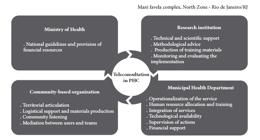
The model presents a shared governance structure in which the Ministry of Health assumes responsibilities related to policy promotion, definition of national guidelines, provision of financial resources, and technical monitoring of project execution; the research institution (Fiocruz) provides technical-scientific support, methodological advising, production of training materials, and monitoring and evaluation of implementation; the community-based organization (Redes da Maré) acts in territorial coordination, providing logistical support, community listening, and mediation between users and teams; and the Municipal Health Secretariat, as the SUS manager in Rio de Janeiro, is responsible for operationalizing the service, from the allocation and training of human resources to service integration, technological availability, and supervision of actions, besides ensuring comprehensive care for the patients served.
This interinstitutional configuration reflects an integrated approach that seeks to combine technical competencies, financial resources, territorial knowledge, and local management, promoting articulation across the federal, municipal, academic, and community levels. The proposed design aims to ensure both the project’s technical and operational sustainability and its adequacy to the specificities and needs of the Maré population.
Chart 1 details the operational components of this governance architecture, showing the specific distribution of responsibilities among the institutions involved. The structure reveals eight main components that underpin implementation of the strategy: Federal Coordination (Ministry of Health), responsible for national guidelines, financing, and technological support; Municipal Coordination (Rio de Janeiro Municipal Health Secretariat), focused on operationalizing the service itself; Technical-Scientific Support (Fiocruz), encompassing methodological support, monitoring, data analysis, and academic production; and Community Coordination (Redes da Maré), centered on territorial articulation and community communication. In addition, the structure includes cross-cutting components such as Interinstitutional Agreement and Governance, involving all institutions in periodic meetings and definition of operational flows; Technological Instrumentation, shared by the Ministry of Health, SMS/RJ, and Fiocruz; Training and Technical Support, coordinated by SMS and Fiocruz; and Mobilization and Communication, conducted by Redes da Maré for territorial dissemination of the strategy.
This distribution of components consolidates a collaborative governance model that articulates complementary institutional competencies-technical-scientific expertise, public management capacity, federal resources, and territorial knowledge-to ensure both the technical quality and the local adequacy of the teleconsultation strategy.
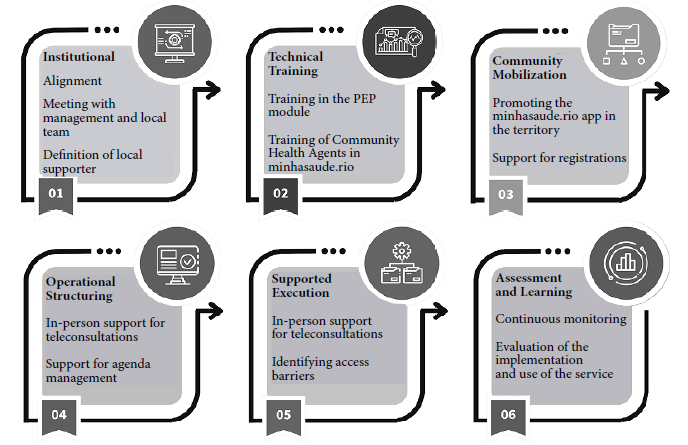
Implementation of teleconsultation in the Maré clinics occurred gradually and stagewise. The operationalization of this governance architecture followed a sequential six-stage structured plan (Figure 2). The process began with Institutional Alignment, involving meetings between management and the local team to define the local supporter responsible for territorial coordination of the actions. This stage included presentation of the project to the unit’s professionals and selection of the reference professional, who then acted as the focal point for teleconsultation actions in the unit, in coordination with the local manager.
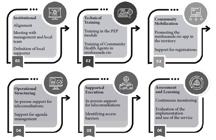
The second stage, Technical Training, included training teams in the Electronic Patient Record (EPR) module customized for video-based teleconsultation, as well as training Community Health Workers (ACS) in the use of the platform. This training was delivered by the Digital Health team-composed of the nurse leading project implementation in the territory and five coordinators residing in the territory-to support the units throughout the process. The training included real-time simulations of the process for scheduling and conducting teleconsultations via Google Meet, in addition to reviewing records to align them with the national CADWEB SUS database19.
The third stage focused on Community Mobilization and Communication, initially through dialogue with local organizations, residents’ associations, and key stakeholders for strategic dissemination of the new service. Later, through the team of young articulators, the project promoted the minhasaude.rio app20 in the territory, assisting health unit users with registration, answering questions, and serving as a point of reference for residents. This stage involved waiting-room activities, continuing education, and coordination with territorial leaders to raise users’ awareness of this new mode of access to health services. This stage was grounded in the local institution’s legitimacy and recognition among residents and in its capacity for mobilization and communication, built through its long trajectory of work in the territory.
In the fourth stage, operational structuring organized in-person support for teleconsultations and schedule management, including the provision of technological equipment (webcams and headsets) for professionals and the configuration of institutional email accounts for host access to video calls.
In the fifth stage, supported execution consolidated in-person support for teleconsultations and the systematic identification of access barriers. It included schedule management to identify eligible demands according to the municipal protocol, joint action by ACS and coordinators to identify technical problems, and the Digital Health team direct support to minimize operational barriers.
Finally, in the sixth stage, evaluation and learning established continuous monitoring and assessment of the implementation and use of the service, including surveillance activities by project leadership in coordination with area management. This stage also involved the development of a dashboard for systematic monitoring of indicators related to the use and performance of the teleconsultation strategy.
The process followed a timeline of approximately two months per unit, allowing the development of professional expertise and the territorial dissemination of the tool. By June 2025, four units in the territory had implemented the tool, although they were at different stages of consolidation and improvement. The fifth clinic was in its first week of testing, and the sixth unit was in the preparation stage for implementation.
This plan reflects a progressive approach that integrates institutional preparation, technical training, community mobilization, and continuous monitoring, ensuring that the teleconsultation strategy is adapted to the territorial context of Maré.
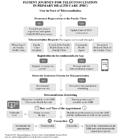
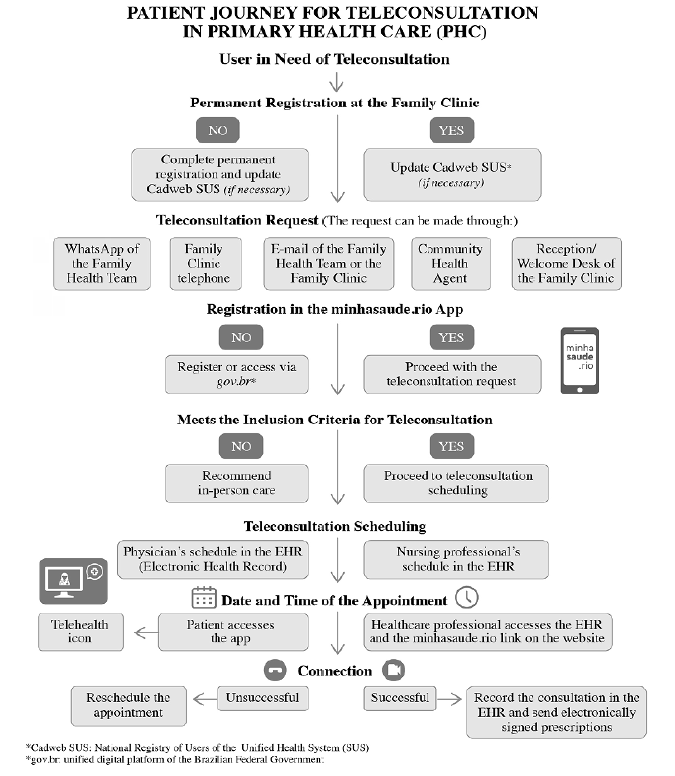
Figure 3 provides a graphic synthesis of how a PHC teleconsultation is conducted, presenting the stepwise process from linking the patient to their reference family health team, through the request for and scheduling of the teleconsultation, up to the final appointment through the minhasaude.rio app.
Initial Profile of Teleconsultation Implementation
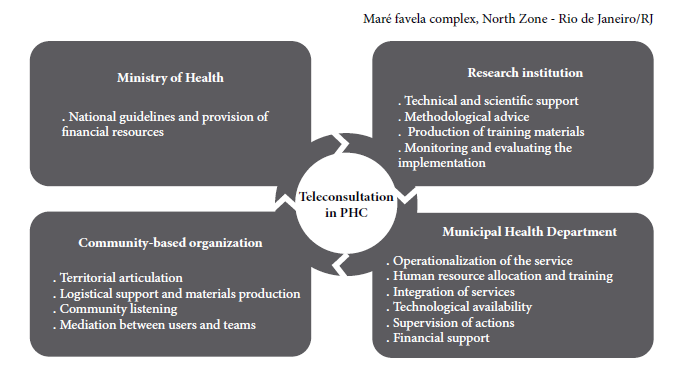
During the initial project implementation period, 1,017 teleconsultations were held and involved four family clinics and 72 health professionals (38 doctors and 34 nurses). The monthly median was 74 (95%CI: 42-156) teleconsultations, with 51 teleconsultations per clinic (95%CI: 32-70). Each professional performed, on average, 64 consultations (95%CI: 37-91), with a mean duration of 23 minutes per consultation.
Analysis of the teleconsultation profile showed that follow-up consultations related to recent appointments accounted for the largest proportion of visits (589 teleconsultations; 58%), followed by monitoring of chronic conditions and life cycles (333 teleconsultations; 33%), evidencing prioritization of the tool for care continuity. Simple acute conditions (56 teleconsultations; 5%), issuance and renewal of continuous-use prescriptions (19 teleconsultations; 2%), and other reasons (12 teleconsultations; 2%) accounted for smaller proportions (Table 1).
The demographic profile of users served showed a predominance of females (745 users; 73%) over males (236 users; 23%), with 36 undeclared cases. Age distribution was concentrated in the 18-39-year (444 users; 44%) and 40-59-year (350 users; 34%) groups, followed by the 60-79-year (109 users; 11%), 0-17-year (67 users; 7%), and 80 years or older (11 users; 1%) groups. The mean number of visits per family clinic was 106 consultations (95%CI: 73-139) (Table 1).
Discussion
The present study highlights the strategic role of the shared governance model in implementing teleconsultation in vulnerable territories, based on the experience of the Maré’s compound of favelas. The initiative was made possible through coordination among the State, civil society, and academia, creating an institutional arrangement capable of responding to local specificities. This collaborative governance, which had already been mobilized in the territory during the pandemic20, adapted actions to local conditions and reinforced the legitimacy and sustainability of the proposal21.
The institutional design that guided the teleconsultation implementation process in the Maré territory was developed as an outcome of this integrated effort. It begins with a meeting presenting the project to professionals from all categories within the unit and then progresses through in-service training focused on the tools used, territorial mobilization and communication, support for teleconsultation delivery, schedule management, and continuous performance monitoring.
Recent studies emphasize the importance of network-based work throughout the implementation of teleconsultation nationwide, keeping PHC at its core given its role in coordinating care in the territory22. They also confirm that the ideal scenario for implementing teleconsultation in favela territories must be process-based, gradual, and evolutionary, organized into stages that lead to successful implementation and, therefore, incorporation of a new way of providing care that adds value to the services offered to the population22,23.
Thus, teleconsultation implementation in Maré involved a gradual transition, with increasing adherence by teams working in the different PHC units. Under these conditions, teleconsultation has proven essential for ensuring care continuity when in-person services are suspended, such as on days of armed conflict or police operations - a recurrent reality in favela and peripheral territories21-24. In 2024, Redes da Maré recorded 42 police operations resulting in 20 deaths, 30 days of suspended health services-interrupting an average of 360 consultations per day-and 37 days without classes, affecting approximately 8,099 students per day18. During the first half of 2025, with application of the “Safer Access” method-developed and adapted by the International Committee of the Red Cross (ICRC)25 to prevent and mitigate the risks of security incidents in public facilities-the health units recorded, on the SUBPAV Platform (www.subpav.org), 20 red-level notifications, which implied closure of the units and safe evacuation of professionals and users in the face of critical-risk situations. In addition, 15 orange-level occurrences were recorded, resulting in the temporary suspension of internal and external activities because of elevated risk in the territory, as well as 11 yellow-level notifications, which require the suspension of home visits in the flagged micro-areas and maintenance of internal work only because of moderate risk.
The use of teleconsultation in territorial instability has been effective in ensuring care continuity, as observed in Israel during the 2023 war26 and in territories such as Syria, Gaza, and Yemen, even under severe access restrictions27. In addition, this modality has been used to support actions such as active case finding and home visits, helping to reduce care gaps and strengthen longitudinal follow-up28.
Eight months after the implementation of teleconsultation in Maré, we can assess that the strategy strengthened the local care network and expanded access to the local reference PHC service, considering the volume of visits (1,017 teleconsultations) observed during the period. This performance is especially relevant in the PHC context because it contributes to continuous, comprehensive, and coordinated care and, consequently, to the potential it holds for strengthening PHC.
From a practical standpoint, teleconsultations in the Maré’s compound of favelas promoted maintenance and expansion of access in this territory, considering the profile of teleconsultations generated since implementation, which is aligned with the scope of Official Letter No. SMS-OFI 2025/25576, dated June 30, 2025, concerning the Protocol for the Use of Teleconsultation Resources in Primary Health Care in the Maré’s compound of favelas29.
The combination of in-person and remote care has been effective in maintaining health care delivery in contexts marked by social, symbolic, and operational challenges, also reducing access inequalities in peripheral territories and among historically underserved populations30.
A substantial number of follow-up teleconsultations (57%), monitoring of chronic conditions and life cycles (33%), simple acute conditions (56%), and issuance and renewal of prescriptions (2%)-including contraception, special control prescriptions, and pre-exposure prophylaxis (PrEP)-were observed. Recent studies confirm these findings by showing that teleconsultations make continuous population health care possible, support monitoring of health conditions, stratification of health demands, and health promotion and prevention guidance, while at the same time helping to bridge the gap between professionals and users-making them strategic in distant territories. Therefore, the tool has been considered satisfactory from both sides: for users, because it ensures access to the service from their own homes; and for professionals, because it has proven effective in helping reduce demand and waiting lists for care31.
Despite the advances described, use of this modality still requires a learning curve on the part of both users and professionals, as it depends on changes in practice and understanding of how to use the technology, and it still faces professional resistance to changes in the work process, concerns about data security, difficulty of use among older age groups, among other challenges. In addition, we can identify a predominance of teleconsultations directed to the young and economically active population (85%), which may reflect difficulties faced by older adults in the digital world at this early stage (only 12% of teleconsultations occurred among the population over 60).
Some authors are consistent with these findings in reporting the main barriers and difficulties identified throughout the process of implementing teleconsultation in PHC, including resistance to sharing personal information, lack of patient support, lack of access to the internet and technology, organizational difficulties, and technical quality issues31.
The experience accumulated thus far indicates that, in territories of high social vulnerability, teleconsultation implementation requires strategies integrated with the territory, qualified listening to the teams, and solutions that can overcome the digital barriers described above. Care continuity has depended on responses adapted to unstable settings32, which reinforces the alignment of the initiative with the SUS Digital guidelines. In addition to incorporating actions provided for in national regulations-such as inclusion of teleconsultation in the SUS reimbursement table and the structuring of remote care points in municipalities33-the proposal strengthens PHC, reduces technological asymmetries, and is anchored in collaborative governance. In this scenario, the marked regional inequalities in digital infrastructure in Brazil reinforce the urgency of structural investments in Digital Health33, considering that effective teleconsultation may be limited by connectivity. Although the health units have infrastructure and internet access and, in most cases, users have Wi-Fi networks near or in their homes, factors related to insecurity in the territory and the influence of groups exercising local control can make connectivity unstable and signal quality poor. Even so, the initiative may provide concrete inputs for improving the national teleconsultation policy.
This preliminary analysis provides relevant information on the process of implementing the teleconsultation service in PHC within a complex, unequal, and conflict-affected territory that requires innovative actions capable of delivering comprehensive and continuous health care even under adverse conditions.
Final considerations
Based on the premise that teleconsultation has become a reality and a working tool throughout the Maré’s compound of favelas, reaching 100% of this territory, this advance reveals possible pathways for expanding access and improving the quality of care in contexts marked by inequality and armed violence. The model adopted was based on territorial coordination and shared governance-responded to local specificities with solutions integrated into the daily routine of services and the reality of users, preserving care continuity even in the face of structural and contextual challenges.
Implementation of teleconsultation in the Maré territory is consistent with PHC’s attributes and the SUS Digital guidelines, giving the proposal institutional relevance and positioning it as a reference for strengthening care networks in similar contexts. It is still in the consolidation stage, but it is a promising experience with potential for scalability and for making a concrete contribution to improving the national teleconsultation policy.
References
-
1 Organização Pan-Americana de Saúde (OPAS). Oito Princípios Orientadores da Transformação Digital do Setor da Saúde. Um apelo à ação pan-americana [Internet]. 2021 [acessado 2023 ago 2]. Disponível em: https://iris.paho.org/bitstream/handle/10665.2/54669/OPASEIHIS210004_por.pdf?sequence=1&isAllowed=y
» https://iris.paho.org/bitstream/handle/10665.2/54669/OPASEIHIS210004_por.pdf?sequence=1&isAllowed=y -
2 World Health Organization (WHO). Global strategy on digital health 2020-2025 [Internet]. 2021 [acessado 2025 jul 25]. Disponível em: https://www.who.int/docs/default-source/documents/gs4dhdaa2a9f352b0445bafbc79ca799dce4d.pdf
» https://www.who.int/docs/default-source/documents/gs4dhdaa2a9f352b0445bafbc79ca799dce4d.pdf - 3 Sheikh A, Anderson M, Albala S, Casadei B, Franklin BD, Richards M, Taylor D, Tibble H, Mossialos E. Health information technology and digital innovation for national learning health and care systems. Lancet Digit Health 2021; 3(6):e383-e396.
- 4 Portela D, Brito DV, Monteiro H. Using Digital Technologies in Response to the COVID-19 Pandemic in Portugal. Port J Public Health 2022; 39(3):170-174.
- 5 Brasil. Ministério da Saúde (MS). Política Nacional de Informação e Informática em Saúde - PNIIS. Brasília: MS; 2015.
- 6 Brasil. Ministério da Saúde (MS). Portaria GM/MS nº 3.232, de 1º de março de 2024. Institui o Programa SUS Digital no âmbito do Sistema Único de Saúde (SUS). Diário Oficial da União; 2024.
- 7 Brasil. Ministério da Saúde (MS). Portaria GM/MS nº 3.691, de 23 de maio de 2024. Altera a Portaria de Consolidação GM/MS nº 5, de 28 de setembro de 2017, para instituir a Ação Estratégica SUS Digital - Telessaúde. Diário Oficial da União; 2024.
- 8 Will TK, Dalbello-Araujo M. Princípios da atenção primária à saúde nos dias de hoje: uma revisão. Rev Enferm Atenção Saude 2023; 12(2):e202393.
- 9 Nascimento LC, Viegas SMF, Menezes C, Roquini GR, Santos TR. O SUS na vida dos brasileiros: assistência, acessibilidade e equidade no cotidiano de usuários da Atenção Primária à Saúde. Physis 2020; 30(3):e300330.
- 10 Soranz D, Pinto LF, Penna GO. Eixos e a Reforma dos Cuidados em Atenção Primária em Saúde (RCAPS) na cidade do Rio de Janeiro, Brasil. Cien Saude Colet 2016; 21(5):1327-1338.
-
11 Brasil. Ministério da Saúde (MS). Relatórios Públicos da APS: cobertura APS [Internet]. [acessado 2025 dez 5]. Disponível em: https://relatorioaps.saude.gov.br/cobertura/aps
» https://relatorioaps.saude.gov.br/cobertura/aps - 12 Costa NR, Silva IM, Lima PT, Silva TSD, Costa ICMD, Figueiredo IVO. A implantação em larga escala da Estratégia de Saúde da Família na cidade do Rio de Janeiro, Brasil: evidências e desafios. Cien Saude Colet 2021; 26(6):2075-2082.
-
13 Brasil. Ministério da Saúde (MS). Grupo técnico vai elaborar projeto-piloto de transformação digital no Complexo da Maré [Internet]. 2024 [acessado 2025 jul 8]. Disponível em: https://www.gov.br/saude/pt-br/assuntos/noticias/2024/outubro/grupo-tecnico-vai-elaborar-projeto-piloto-de-transformacao-digital-no-complexo-da-mare
» https://www.gov.br/saude/pt-br/assuntos/noticias/2024/outubro/grupo-tecnico-vai-elaborar-projeto-piloto-de-transformacao-digital-no-complexo-da-mare -
14 Instituto Brasileiro de Geografia e Estatística (IBGE). Censo Demográfico de 2022 [Internet]. 2022 [acessado 2024 jan 27]. Disponível em: https://censo2022.ibge.gov.br/panorama/.
» https://censo2022.ibge.gov.br/panorama - 15 Batista-da-Silva AA, Moraes CB, Bozza HR, Bastos LDSL, Ranzani OT, Hamacher S, Bozza FA; Comitê Gestor Conexão Saúde. Effectiveness of a multicomponent intervention to face the COVID-19 pandemic in Rio de Janeiro's favelas: difference-in-differences analysis. BMJ Global Health 2023; 8(5):e009997.
- 16 Batista-da-Silva AA, Bastos LSL, Arouca LE, Gonzaga-da-Silva TW, Hamacher S, Bozza FA, Ranzani OT. #VacinaMare campaign: addressing vaccine inequity in socially vulnerabilised communities. Lancet Reg Health Am 2024; 36:100827.
-
17 Redes da Maré. Censo populacional da Maré [Internet]. 2019 [acessado 2025 jul 4]. Disponível em: https://www.redesdamare.org.br/media/downloads/arquivos/CensoMare_WEB_04MAI.pdf
» https://www.redesdamare.org.br/media/downloads/arquivos/CensoMare_WEB_04MAI.pdf - 18 Redes da Maré. Infográficos do boletim direito à segurança pública na Maré 2023. Rio de Janeiro: Redes da Maré; 2023.
-
19 Brasil. Ministério da Saúde (MS). Cartão do SUS. CADWeb [Internet]. 2019 [acessado 2025 ago 7]. Disponível em: https://cartaosus.org/cadweb-sus
» https://cartaosus.org/cadweb-sus -
20 Secretaria Municipal de Saúde do Rio de Janeiro (SMSRJ). Minha saúde.rio [Internet]. [acessado 2025 jul 9]. Disponível em: https://web2.smsrio.org/portalPaciente/login/#/.
» https://web2.smsrio.org/portalPaciente/login - 21 Ye J, Lu H, Molly B. Implications for implementation and adoption of telehealth in developing countries: a systematic review of China's practices and experiences. NPJ Digit Med 2023; 6(1):174.
- 22 Catapan SC, Willemann MCA, Calvo MCM. Structure and work process for implementing medical teleconsultation in the Brazilian National Health System, a cross-sectional study using 2017-2018 data. Epidemiol Serv Saude 2021; 30:e2020305.
- 23 Catapan SC, Willemann MCA, Calvo MCM. Structure and work process for implementing medical teleconsultation in the Brazilian National Health System, a cross-sectional study using 2017-2018 data. Epidemiol Serv Saude 2021; 30(1):e2020305.
-
24 Pecanha V, Guerra J, Rocha R, Millett C, Hone T. The Effects of Urban Violence on Primary Health Care Services: Evidence from Poor Neighborhoods in Rio de Janeiro [Internet]. 2024 [acessado 2025 jul 9]. Disponível em: https://grcmlesydpcd.objectstorage.sa-saopaulo-1.oci.customer-oci.com/p/OQwcvnO-c63O08Gc2Kv4OTbJttj5ik60dguiDIyyQ0wuo5SWn-jHOLW9wNbylNqI/n/grcmlesydpcd/b/dtysppobjmntbkp01/o/media/doity/submissoes/artigo-91a2afdd8a2a63984b78e77a92df28bc0df84ee1-arquivo.pdf
» https://grcmlesydpcd.objectstorage.sa-saopaulo-1.oci.customer-oci.com/p/OQwcvnO-c63O08Gc2Kv4OTbJttj5ik60dguiDIyyQ0wuo5SWn-jHOLW9wNbylNqI/n/grcmlesydpcd/b/dtysppobjmntbkp01/o/media/doity/submissoes/artigo-91a2afdd8a2a63984b78e77a92df28bc0df84ee1-arquivo.pdf -
25 Comitê Internacional da Cruz Vermelha. Acesso Mais Seguro para Serviços Públicos Essenciais - Resumo Executivo [Internet]. 2023 [acessado 2025 jul 9]. Disponível em: https://www.icrc.org/pt/publication/acesso-mais-seguro-para-servicos-publicos-essenciais-resumo-executivo
» https://www.icrc.org/pt/publication/acesso-mais-seguro-para-servicos-publicos-essenciais-resumo-executivo - 26 Sberro-Cohen S, Moriah EE. From Conflict to Care-Telemedicine Utilization During Wartime: A Retrospective Cohort Study. J Med Syst 2025; 49(1):83.
- 27 Parkes P, Pillay TD, Bdaiwi Y, Simpson R, Almoshmosh N, Murad L, Abbara A. Telemedicine interventions in six conflict-affected countries in the WHO Eastern Mediterranean region: a systematic review. Conflict Health 2022; 16(1):64.
- 28 Nascimento IJB, Abdulazeem H, Vasanthan LT, Martinez EZ, Zucoloto ML, Østengaard L, Azzopardi-Muscat N, Zapata T, Novillo-Ortiz D. Barriers and facilitators to utilizing digital health technologies by healthcare professionals. NPJ Digit Med 2023; 6(1):161.
-
29 Secretaria Municipal de Saúde do município do Rio de Janeiro. Subsecretaria Geral. Plataforma SMS Rio - Subsecretaria Geral [Internet]. 2025. [acessado 2025 ago 8]. Disponível em: https://web2.smsrio.org/subgeral/#/profissional/materiaisTecnicos/
» https://web2.smsrio.org/subgeral/#/profissional/materiaisTecnicos - 30 Shah DA, Sall D, Peng W, Sharer R, Essary AC, Radhakrishnan P. Exploring the role of telehealth in providing equitable healthcare to the vulnerable patient population during COVID-19. J Telemed Telecare 2024; 30(6):1047-1050.
- 31 Melo Filho JF, Silva LLL, Oliveira FBM, Santos CJA, Moura AF, Rodrigues ARM, Ribeiro JMS, Santos RRL, Paz JCVJ. Use of teleconsulta in primary care and the effectiveness of care: integrative review. Arq Cien Saude UNIPAR 2023; 27(10):5804-5819.
- 32 Bowsher G, El Achi N, Augustin K, Meagher K, Ekzayez A, Roberts B, Patel P. eHealth for service delivery in conflict: a narrative review of the application of eHealth technologies in contemporary conflict settings. Health Policy Plan 2021; 36(6):974-981.
- 33 Catapan SC, Willemann MCA, Calvo MCM. Estrutura e processo de trabalho para implantação da teleconsulta médica no Sistema Único de Saúde do Brasil, um estudo transversal com dados de 2017-2018. Epidemiol Serv Saude 2021; 30(1):e2020305.
-
Data availability declaration
The databases used in the article, including the extraction codes, analyses, and results, are available in the repository: (https://web2.smsrio.org/minhasaudeRio/#/dados-transparencia, in “PBI do minhasaude.rio).
The databases used in the article, including the extraction codes, analyses, and results, are available in the repository: (https://web2.smsrio.org/minhasaudeRio/#/dados-transparencia, in “PBI do minhasaude.rio).

 Source: Authors.
 Source: Authors.
 Note: Types of consultations included in the teleconsultation modality in Primary Health Care: Follow-up consultations related to recent appointments; Issuance and/or renewal of prescriptions for continuous use; Video call consultations, in situations of territorial instability, which may initially be scheduled as a Teleconsultation or correspond to a conversion of consultation modality from in-person to telehealth; Monitoring of chronic conditions and life cycles; Simple acute conditions (e.g., acute gastroenterocolitis, upper airway respiratory symptoms, and headache without warning signs). Source: Authors.