
 Evaluation Indicators for the Implementation of the Accident and Violence Prevention Policy Guidelines
Abstract
Twenty years after the creation of the National Policy for Reducing Morbimortality from Accidents and Violence, these events remain significant causes of morbimortality in the country. This study presents the process of developing a set of evaluative indicators for the implementation of the guidelines of the Policy. Its formulation initially involved the analysis of indicators from a previous study and subsequently employed the nominal group technique. The proposed indicators were then applied to a database containing responses to questionnaires completed by managers and health professionals from municipal SUS services across the three care levels (Primary, Hospital, and Rehabilitation). We found that most municipalities were classified as having a fair level of policy implementation; some guidelines achieved good implementation, while others showed unsatisfactory performance, particularly those related to training and research. The indicators highlighted important issues regarding the policy, its progress, and its weaknesses. Therefore, this proposal would be considered to provide support to municipalities in evaluating the policy as a whole or in specific guidelines.
Key words:
Indicators; Violence; Accidents; Morbidity; Mortality
Resumo
Vinte anos após a criação da Política Nacional de Redução da Morbimortalidade por Acidentes e Violências, esses eventos permanecem como importantes causas de morbimortalidade no país. Este estudo apresenta o processo de elaboração de um conjunto de indicadores avaliativos da implementação das diretrizes da referida política. Sua formulação envolveu inicialmente a análise de indicadores de estudo prévio e, na sequência, utilizou a técnica de grupo nominal. Os indicadores propostos foram então aplicados a um banco de dados referente a questionários respondidos por gestores e profissionais de serviços de saúde municipais do SUS para os três níveis de atenção (Primária, Hospitalar e Reabilitação). Verificou-se que a maioria dos municípios foi classificada como tendo implementação regular da política; algumas diretrizes alcançaram boa implementação, enquanto outras apresentaram desempenho insatisfatório, especialmente as relacionadas à capacitação e à realização de pesquisas. Os indicadores apontaram questões importantes sobre a política, seus avanços e fragilidades. Considera-se que esta proposta possa subsidiar municípios na construção de avaliação da política como um todo ou de diretrizes específicas.
Palavras-chave:
Indicadores; Violência; Acidentes; Morbidade; Mortalidade
Resumen
Veinte años tras la creación de la Política Nacional de Reducción de la Morbimortalidad por Accidentes y Violencia, estos eventos continúan siendo causas importantes de morbimortalidad en el país. Este estudio presenta el proceso de elaboración de un conjunto de indicadores evaluativos para la implementación de las directrices de la Política. Su formulación implicó inicialmente el análisis de indicadores de un estudio previo y, posteriormente, se empleó la técnica de grupo nominal. Los indicadores propuestos se aplicaron a una base de datos que contenía respuestas a cuestionarios completados por gestores y profesionales de salud de servicios municipales del SUS en los tres niveles de atención (Básica, Hospitalaria y Rehabilitación). Se encontró que la mayoría de los municipios fueron clasificados con un nivel pasable de implementación de la política; algunas directrices alcanzaron una buena implementación, mientras que otras mostraron un desempeño insatisfactorio, en particular las relacionadas con la capacitación y la investigación. Los indicadores destacaron cuestiones importantes sobre la política, su progreso y sus debilidades. Por lo tanto, esta propuesta sería considerada para brindar apoyo a los municipios en la evaluación de la política en su conjunto o en directrices específicas.
Palabras clave:
Indicadores; Violencia; Accidentes; Morbilidad; Mortalidad
Introduction
Violence in its several manifestations has been recognized as a global public health problem of concern1, affecting individual and collective health, reducing quality of life, and posing challenges to the health sector2.
In Brazil, this perception led to the formulation of the National Policy for Reducing Morbimortality from Accidents and Violence (PNRMAV)3 in 2001, five years after the World Assembly held by the World Health Organization identified it as a priority theme2, and one year before the World Report on Violence and Health 2002. This policy was a strategic response by the government to confront and mitigate the impacts of violence and accidents on the health of the Brazilian population.
The PNRMAV was developed with well-defined guidelines and objectives to integrate and coordinate efforts at all government levels for effective action in combating violence. Its guidelines3 include promoting and adopting healthy behaviors and environments; monitoring the occurrence of accidents and violence; systematizing, expanding, and consolidating pre-hospital care; providing interdisciplinary and intersectoral assistance to victims; structuring and consolidating recovery and rehabilitation care; training human resources; and offering support for developing studies and research.
In 2007, a detailed diagnostic analysis was conducted in five Brazilian municipalities (Curitiba, Federal District, Manaus, Recife, and Rio de Janeiro), and its findings were compiled in the book “Diagnostic Analysis of the National Health Policy for Reducing Accidents and Violence”4. This analysis used triangulation of quantitative and qualitative methods, including interviews with managers and applying a questionnaire. It covered all the policy guidelines and focused on pre-hospital, hospital, and rehabilitation care. This assessment highlighted significant progress in the PNRMAV implementation but also pointed out important challenges, such as the need for greater intra- and inter-institutional integration and the provision of continued resources to support the actions implemented. One aspect that deserves to be highlighted is the non-inclusion of Primary Care, which did not yet have the importance in the country it has today.
Other studies were conducted to analyze elements that underpin the policy, such as notification and recording of intrafamily violence and sexual exploitation of children and adolescents5, evaluation of the mobile pre-hospital emergency service6,7, diagnostic analysis of rehabilitation services that assist accident and violence victims8-10, evaluation of care for children and adolescents in situations of violence11, and studies that analyzed the integration between the health sector and other government sectors within the PNRMAV in the Federal District12 and specific research on the application of the policy in the state of Amapá13.
Twenty-three years of the PNRMAV implementation require evaluating its performance14. Thus, Brazil, aligned with international recommendations, now faces the challenge of reassessing and strengthening the PNRMAV in the face of social changes and the progressive dismantling of public policies.
This article aims to present the development of a set of indicators to evaluate the implementation of the PNRMAV guidelines, their combination into composite indicators that summarize the guidelines, and another composite indicator that aggregates these guidelines and allows an evaluation by states and municipalities to understand the advances and barriers and propose ways to strengthen prevention actions and improve the public health response to violence and accidents.
The context of elaborating indicators
The proposal presented here was part of the “Evaluative Research of the National Policy for Reducing Morbimortality from Accidents and Violence”, a request from the Ministry of Health (MS) to the Jorge Careli Department of Studies on Violence and Health of the National School of Public Health (CLAVES/ENSP) at Fiocruz. This study began in 2020 and aimed to evaluate the PNRMAV implementation process from its enactment in 2001 to 2023, based on its seven Guidelines.
This evaluative research used the triangulation of quantitative and qualitative methods. It involved five stages: (1) Analyzing data on violence and accidents under the national information systems (Mortality Information System-SIM, Hospital Information System-SIH and National System of Notifiable Diseases-SINAN); (2) Developing and applying a questionnaire to collect data in Brazilian municipalities on the implementation of the policy; (3) Developing evaluative indicators; (4) Selecting municipalities to participate in the qualitative stage based on the indicators developed in stage 3; and (5) Conducting interviews with managers and professionals.
The Research Ethics Committee of the National School of Public Health approved the project, respecting the precepts established in Resolutions N° 466/2012 and 510/2016 (N° 4732884, on 05/25/2021). The participants signed the Informed Consent Form.
The construction process of indicators
Developing the indicators was based on two data sources: (1) the indicators originating from previous research carried out by CLAVES and found in the publication “Diagnostic Analysis of the National Health Policy for Reducing Accidents and Violence”4; and (2) the questionnaire developed by the research team in collaboration with the Ministry of Health for this study.
The questionnaire included the following blocks of questions: (1) Identification of the service and program; (2) Existing structure for conducting actions guided by the PNRMAV; (3) Organization and coordination in the existing network between services and programs; (4) Training in human resources for addressing cases of victimization by accidents and violence; (5) Monitoring the occurrence of accidents and violence; (6) Actions to prevent accidents and violence and promote healthy environments and a culture of peace.
The nominal group technique15 was applied based on the two sources mentioned, through which a group of experts, led by the research coordinator, exhaustively discussed the representative elements of each guideline, which, again, were the structuring axes of the evaluation from start to finish. At the end of this process, which mobilized the team from May 2021 to January 2022, 14 simple indicators were built for primary care, 27 for the pre-hospital and hospital care level, and 22 for the rehabilitation care level. These were grouped into five, six, and five composite indicators, respectively, one for each guideline evaluated at each care level (Chart 1).
Chart 2 shows the guidelines, the number of questionnaire questions, and the calculation method. Chart 3 summarizes the procedure for calculating the composite indicators for the healthcare levels. Each was calculated by adding the indicators relevant to each care level. The evaluation scores were categorized as good, fair, or poor per the PNRMAV implementation level at each of these levels (Chart 2).
Applying the evaluative indicators
As mentioned, developing indicators also served as a basis for selecting ten other municipalities that, besides the capitals, would be the target of the qualitative stage of the research. In order to calculate the indicators for selecting municipalities, we adopted the data collected through the questionnaire, which was applied online via the Redcap platform between July and November 2021. The questionnaire access links were sent to the municipal health secretaries of the 5,570 Brazilian municipalities. They were asked to forward them to the municipal officials responsible for the three care levels. Thus, the indicators were analyzed based on the data from the 531 questionnaires answered by 379 municipalities (290 for Primary Care, 128 for Pre-hospital/Hospital Care, and 113 for Recovery/Rehabilitation Care). They were stratified by region and municipality size (large ≥100,000; small ≤99,999). All analysis procedures were performed using the SPSS 24 statistical package (IBM Corp, 2016)16.
Results
Table 1 shows the classification of the municipalities that participated in the survey regarding the implementation of the PNRMAV guidelines by healthcare level. This table shows the results of the composite indicator that aggregates all the guidelines and the indicators that represent them, and the condition of implementation of the Policy in the responding municipalities. When analyzing the composite indicator, we found that most of these territories were classified as fair in implementing the Policy. In Primary Care, we observed a higher proportion of municipalities with good implementation (43.4%), while Pre-Hospital/Hospital Care recorded the lowest (18.0%).
The implementation of Guideline 1, measured by a single indicator related to the “mobilization of the media and society regarding accidents and violence”, shows that more than 50% of municipalities performed well at all care levels.
Regarding Guideline 2, assessed using three indicators that encompass “the reporting of cases of violence by services”, “the creation of inter- and intra-sector reporting flows”, and “the improved quality of information”, the municipalities’ performance was also classified as good. Primary Care stood out in this guideline with a percentage of 84.7%.
Guideline 3 refers to pre-hospital care and includes seven indicators to assess “infrastructure, equipment, materials/supplies, care/referral of cases and effectiveness of the Regulatory Center”. In its assessment, approximately 60% of the municipalities showed good implementation for the Pre-Hospital Care level.
When analyzing “infrastructure, equipment, materials/supplies, human resources, care/referral of cases, prevention actions, use of protocols and care lines, availability of referral centers and specialized services, and intersectoral coordination”, Guideline 4 showed a different pattern from the previous ones. Twelve indicators were selected to evaluate it and most municipalities had a good classification regarding Primary Care (56.9%), while most had fair implementation (45.1%) in Hospital Care. Notably, this guideline does not include Recovery/Rehabilitation services.
Guideline 5 precisely concerns Recovery/Rehabilitation Care and covers 15 indicators related to “infrastructure, equipment, materials/inputs, human resources, care/referral of cases, prevention actions, use of routines/protocols and availability of specialized outpatient clinics/services”. In this regard, the most significant portion of services was classified as having fair implementation (44.2%).
Guideline 6 refers to “human resource training” and was assessed using four indicators. Most municipalities performed poorly. Once again, Primary Care stood out regarding the other levels, but still with a relatively low percentage of 36.4% of municipalities with good implementation.
Finally, the assessment of Guideline 7 involved only one indicator that aimed to verify the “availability of partnerships with universities in developing research, teaching, and extension activities”, which also performed poorly, exceeding 80% of services with this classification, and highlighting Pre-Hospital and Hospital Care, with 91.4%.
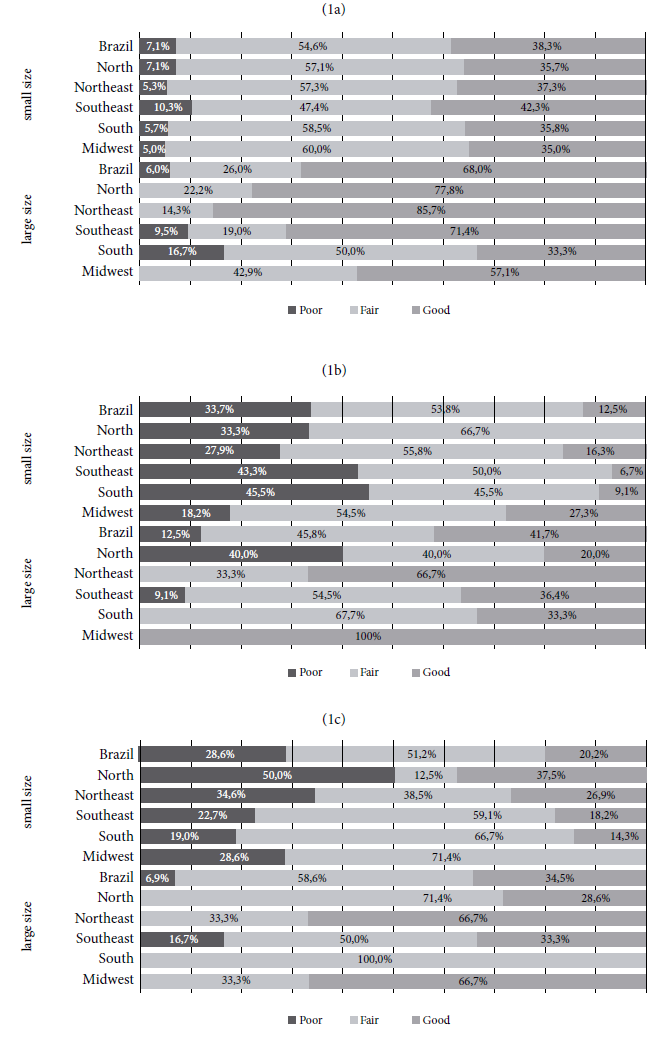
Graph 1a presents the results of the composite indicator for Primary Care per size of the country’s municipalities and regions. The data by size (Brazil) show that the good category predominated in large municipalities (68.0%) and the fair category in small municipalities (54.6%). In Pre-hospital/Hospital Care, the fair classification predominated in evaluating municipalities of any size (Graph 1b), with percentages of 45.8% and 53.8% in small and large municipalities, respectively. Approximately 33.7% of small municipalities showed poor implementation at this care level. The fair category also predominated in the assessment of Recovery/Rehabilitation Care in more than 50% of municipalities of both sizes (Graph 1c). At this care level, 28.6% of smaller localities had poor implementation. Comparing the levels, we observed a more significant disparity between small and large municipalities.
Evaluative indicators of the implementation of the PNRMAV in Primary care (1a), Pre-hospital and Hospital care (1b) and Rehabilitation care (1c), according to region and size of the municipality..
When observing the distribution of municipalities by size and region, we can see that most of the smaller ones had a fair assessment of the PNRMAV implementation at all care levels (Graphs 1a to 1c), except for the North, where the poor category in Recovery/Rehabilitation Care stood out. The evaluation of good performance of Primary Care predominated in all regions among the larger municipalities, except for the South, which was mostly fair.
At the pre-hospital/hospital level, respondents from the Northeast and Midwest considered the implementation good. This care level was assessed as fair in the Southeast and South. In the North, the same percentage of municipalities were classified as fair and poor (40% each). A similar result was observed for large municipalities regarding the Recovery/Rehabilitation level: the Northeast and Midwest had most municipalities with good implementation. At the same time, the fair category prevailed in the other regions.
Discussion
This article presents the process of developing a set of indicators to assess the implementation of the PNRMAV and its application in a database originating from the “Evaluative Research of the National Policy for Reducing Morbimortality from Accidents and Violence” developed by CLAVES at the request of the Ministry of Health.
The results of the application of the indicators reveal the complexity of implementing the PNRMAV guidelines in the Brazilian municipalities studied. Most of them were classified as having fair implementation of the policy, with some areas showing good performance, such as Primary Care. The most significant shortcomings are in the Pre-Hospital/Hospital Care and Recovery/Rehabilitation Care levels.
We observed that Guideline 2 of the PNRMAV, “Monitoring the occurrence of accidents and violence”, performs best in evaluating most municipalities. At the same time, Guideline 7, “Support for developing studies and research”, had the highest proportion of locations with poor implementation. Likewise, Guideline 6, “Human resource training”, was critical at all care levels. An important discussion is in order regarding these two issues. The respondents indeed referred to the actions (or lack thereof) in their specific units because, from a broader perspective, there was a considerable investment in the organization of refresher, specialization, master’s, and doctoral courses focused on issues of violence and health by the Ministry of Health, Fiocruz, and several Universities. The latest ten-year review of the country’s academic production showed a flourishing field of knowledge with over 2,500 published articles on the several expressions of violence, many written by researchers and professionals working at several care levels17. Two hypotheses can be raised on this topic: the first is that the academic community’s connection with services remains deficient. The second is that the frontline professionals who were interviewed complain about the lack of continuing education that cannot be filled by academic material alone. However, it must be said that both complement and feed off each other. The lack of investment in professional training and research on the issues at hand limits the effectiveness of interventions and the generation of evidence to guide political decision-making. These findings corroborate previous studies highlighting the relevance of ongoing training for health professionals18 and investment in research as essential components for the success of violence prevention policies19.
Media and society mobilization (Guideline 1) appears to be an area where notable progress has been made, with more than half of the municipalities showing good implementation. This can be attributed to the growing awareness of the importance of violence prevention, driven by sensitization and advocacy campaigns by civil society organizations and government agencies. In this sense, we observe progress vis-à-vis the previous study4,8, which indicated poor investment in this guideline.
Monitoring accidents and violence (Guideline 2) was considered good in most municipalities at all three care levels. We should underscore, however, that despite this performance, we observe a significant percentage of municipalities in which its implementation was fair or poor. In the diagnostic analysis mentioned above4, the authors highlighted the need to raise awareness among managers and professionals regarding the importance of quality records for adequate monitoring. This challenge persists, especially in smaller municipalities. Furthermore, there is a lack of a national registry of emergency care for accidents and violence. The VIVA Survey, an initiative in place since 2006 and has had six editions (2006, 2007, 2009, 2011, 2014, and 2017), aims to fill this gap by providing data on the magnitude of these conditions that reach selected emergency services. Its last edition, however, was in 2017. The seventh edition of the survey was conducted in 2024, which, for the first time, involved a representative sample of emergency services that address accidents and violence. It included Brazilian capitals and municipalities in the metropolitan regions of the capitals and the rural region of the country.
The systematization, expansion, and consolidation of pre-hospital care (Guideline 3) has been well implemented in most municipalities. Notably, the deficiencies highlighted in the previous diagnostic analysis4 persist, especially regarding the coordination of the several levels of services. The same result was observed in a study conducted in the state of Santa Catarina7, which evaluated the mobile emergency care service (SAMU) in 2013-2014. In this study, besides the lack of coordination and integration between the services that offer rescue and salvage, the authors reported difficulties related to the information system, which is constantly changing and incapable of offering regular and structured subsidies for management.
Regarding the implementation of interdisciplinary and intersectoral assistance to accident and violence victims, as provided for in Guideline 4, its performance was considered fair or poor in more than 60% of the municipalities that responded to the questionnaire regarding the hospital level. The assessment also shows deficiencies in the performance of care aimed at recovery and rehabilitation (Guideline 5), classified as fair or poor in 60% of the municipalities, and this was the weakest point in the provision of services provided by the PNRMAV. Problems highlighted in several assessments persist, such as lack of services, infrastructure, personnel, information, communication, coordination4,8, resources, and access to training and continuing education10. Therefore, we assessed that this guideline is the least widespread in the country, with professionals still lacking specific training that transcends the biological vision for addressing cases of after-effects resulting from accidents and violence and with services that are poorly coordinated with the rest of the care and support network for these victims.
We should mention a positive point identified in this research, which was the growth and organization of Primary Care, by far the best performer in implementing the policy according to this research, different from a previous assessment already mentioned4.
Analyzing data by size and region of municipalities highlights significant disparities in the PNRMAV implementation. Small municipalities, especially in the North and Northeast, tend to have fair implementation, while large municipalities, especially in the South and Southeast, display varying implementation levels. These differences can be attributed to several factors, including the availability of infrastructure, technological and human resources, management capacity, and political prioritization. These findings reinforce the difficulties in spreading the PNRMAV throughout Brazil.
Conclusions
Strengthening monitoring and evaluation mechanisms ensures that violence and accident prevention policies are effective and evidence-based. The data generated by applying the indicators is significant and unprecedented in identifying the strengths and critical points related to implementing this policy, whose issues significantly impact the morbidity of the Brazilian population. From a broader perspective, we highlight the progress of this study in constructing evaluation indicators as management tools.
The results of this study provide important insights into the PNRMAV implementation in Brazilian municipalities and highlight areas that require additional attention and investment. Addressing the identified challenges requires a comprehensive and collaborative approach involving the health sector and other relevant areas, such as Education, Justice, and Social Assistance.
Adopting the proposed indicators yielded valuable results, showing that they can be used to guide health managers’ and governments’ strategic decisions. By identifying areas where the PNRMAV has been successfully implemented and those that need investment, managers can direct resources and interventions more effectively, prioritizing critical areas that deserve more investment in all aspects. Understanding regional specificities and the different healthcare levels allows for a more adapted and personalized approach to address local challenges. These are the areas where the focus should be.
Employing indicators also supports accountability, helping governments monitor progress in implementing the PNRMAV and identify successful and deficient areas, which is essential to promote effective and accountable governance. Thus, we understand that this assessment strengthens the commitment to preventing accidents and violence in the country and improving the quality of health services that serve victims of these events, contributing to societal well-being.
We should underscore a significant limitation of the study. Brazil was experiencing the COVID-19 pandemic when the research was conducted, which greatly hindered the response of professionals and managers to the questionnaire and interview, as they were overwhelmed with providing care to patients. Likewise, there was a lack of political support from the Ministry of Health, which was experiencing hardships, culminating in dismantling the Violence Surveillance and Prevention Technical Area. This disinvestment and lack of technical and financial support were evident in the research findings. The teams that had been trained were demobilized, and several professionals were transferred, leaving only those who individually adopted the issue as a social commitment to continue working, often in silence, keeping the flame of their commitment to the promotion of life and peace.
References
- 1 World Health Organization (WHO). World Report on Violence and Health. Geneva: WHO; 2002.
- 2 Minayo MCS, Souza ER, Silva MMA, Assis SG. Institucionalização do tema da violência no SUS: avanços e desafios. Cien Saude Colet 2018; 23(6):2007-2016.
- 3 Brasil. Ministério da Saúde (MS). Política Nacional de Redução da Morbimortalidade por Violência. Brasília: MS; 2001.
- 4 Minayo MCS, Deslandes SF, organizadores. Análise diagnóstica da política nacional de saúde para redução de acidentes e violência. Rio de Janeiro: Editora FIOCRUZ; 2007.
- 5 Deslandes S, Mendes CHE, Lima JS, Campos DS. Indicadores das ações municipais para a notificação e o registro de casos de violência intrafamiliar e exploração sexual de crianças e adolescentes. Cad Saude Publica 2011; 27(8):1633-1645.
- 6 Minayo MCS, Deslandes SF. Análise da implantação do sistema de atendimento pré-hospitalar móvel em cinco capitais brasileiras. Cad Saude Publica 2008; 24(8):1877-1886.
- 7 Ortiga AMB, Lacerda JT, Natal S, Calvo MCM. Avaliação do Serviço de Atendimento Móvel de Urgência em Santa Catarina, Brasil. Cad Saude Publica 2016; 32(12):e00176714.
- 8 Lima MLC, Deslandes SF, Souza ER, Lima MLLT, Barreira AK. Análise diagnóstica dos serviços de reabilitação que assistem vítimas de acidentes e violências em Recife. Cien Saude Colet 2009; 14(5):1817-1824.
- 9 Lima MLLT, Lima MLC. Avaliação da implantação de uma Rede Estadual de Reabilitação Física em Pernambuco na perspectiva da Política Nacional de Redução da Morbimortalidade por Acidentes e Violência, 2009. Epidemiol Serv Saude 2013; 22(4):597-607.
- 10 Santos FC, Costa EA, Aleluia IRS, Pinto Júnior EP. Diagnóstico situacional dos serviços ambulatoriais de reabilitação física do SUS em Salvador-Ba. Rev Cien Med Biol 2018; 17(2):175-184.
- 11 Ferreira AL, Souza ER. Análise de indicadores de avaliação do atendimento a crianças e adolescentes em situação de violência. Cad Saude Publica 2008; 24(1):28-38.
- 12 Marques MCO. A integração entre o setor de saúde e os demais setores governamentais no desenvolvimento da política nacional de redução de morbimortalidade por acidentes e violência no Distrito Federal [dissertação]. Recife: Centro de Pesquisas Aggeu Magalhães; 2010.
- 13 Santos CA. Implantação da política nacional de redução da morbimortalidade por acidentes e violências: a experiência do Estado do Amapá [dissertação]. Rio de Janeiro: Escola Nacional de Saúde Pública Sergio Arouca, Fundação Oswaldo Cruz; 2004.
- 14 Minayo MCS, Souza ER, Assis SG. É preciso retomar com força a Política Nacional de Redução da Morbimortalidade por Acidentes e Violência. Cien Saude Colet 2023; 28(6):1598.
- 15 Deslandes SF, Mendes CHF, Pires TO, Campos DS. Use of the Nominal Group Technique and the Delphi Method to draw up evaluation indicators for strategies to deal with violence against children and adolescents in Brazil. Rev Bras Saude Mater Infant 2010; 10:s29-s37.
- 16 IBM Corp. Released 2016. IBM SPSS Statistics for Windows, Version 24.0. Armonk, NY: IBM Corp; 2016.
- 17 Minayo MCS, Assis SG, organizadores. Novas e velhas faces da violência no século XXI. Um estudo da literatura da área da saúde. Rio de Janeiro: Editora Fiocruz; 2017.
- 18 Minayo MCS, Deslandes SF. Análise da implantação da rede de atenção às vítimas de acidentes e violências segundo diretrizes da Política Nacional de Redução da Morbimortalidade sobre Violência e Saúde. Cien Saude Colet 2009; 14(5):1641-1649.
- 19 Reichenheim ME, Souza ER, Moraes CL, Jorge MHPM, Silva CMFP, Minayo MCS. Violência e lesões no Brasil: efeitos, avanços alcançados e desafios futuros. Lancet 2011; (n. esp.):75-89.
The data sources used in the research are indicated in the body of the article.

 Source: Authors.