
 Analysis of sexual violence against children and adolescents in the Southern region of Brazil (2017-2022): an ecological study
Abstract
The present study aimed to analyze the spatial distribution of sexual violence against children and adolescents in the Southern region of Brazil, considering differences between border and non-border municipalities and the pre- and post-COVID-19 pandemic periods. This is an ecological study, with spatial analysis of cases registered in the Notifiable Diseases Information System (SINAN) from January 2017 to December 2022. A total of 39,751 cases were identified, showing an upward trend, with a temporary interruption in 2020, the first year of the pandemic, and a resumption in subsequent years. Paraná reported the highest number of records, followed by Rio Grande do Sul and Santa Catarina. The analysis by sex indicated a higher number of cases among females when compared to males. It was found that municipalities located in border regions had higher average rates. No significant differences were found between the pre- and post-pandemic periods in terms of temporal averages; however, the spatial characteristics showed significant variations between border and non-border regions. The results reinforce the urgency of effective and targeted public policies for the protection of childhood and adolescence.
Key words:
Sexual violence; Child sexual abuse; Abuse notification; Spatial analysis
Resumo
O objetivo foi analisar a distribuição espacial da violência sexual contra crianças e adolescentes na região Sul do Brasil, considerando diferenças entre municípios de fronteira e não fronteira e os períodos pré e pós-pandemia de COVID-19. Trata-se de um estudo ecológico com análise espacial dos casos registrados no Sistema de Informação de Agravos de Notificação no período de janeiro de 2017 a dezembro de 2022. Foram identificados 39.751 casos, sendo observada tendência de crescimento, com interrupção temporária em 2020, ano de início da pandemia, e retomada nos anos seguintes. O Paraná apresentou o maior número de registros, seguido por Rio Grande do Sul e Santa Catarina. A análise por sexo aponta um número maior de casos no sexo feminino em comparação com o sexo masculino. Identificou-se que municípios em regiões de fronteira apresentaram médias de taxas superiores. Não foram encontradas diferenças significativas entre os períodos pré e pós-pandêmico em termos de médias temporais, contudo as características espaciais mostraram variações significativas entre as regiões de fronteira e não fronteira. Os resultados reforçam a urgência de políticas públicas eficazes e direcionadas para a proteção da infância e adolescência.
Palavra-chave:
Violência sexual; Abuso sexual infantil; Notificação de abuso; Análise espacial
Resumen
El objetivo fue analizar la distribución espacial de la violencia sexual contra niños, niñas y adolescentes en la región Sur de Brasil, considerando diferencias entre municipios de frontera y no frontera, así como los períodos antes y después de la pandemia de Covid-19. Se trata de un estudio ecológico, con análisis espacial de los casos registrados en el Sistema de Información de Agravios de Notificación en el período de enero de 2017 a diciembre de 2022. Se identificaron 39.751 casos, observándose una tendencia creciente, con una interrupción temporal en 2020, año de inicio de la pandemia, y una reanudación en los años siguientes. Paraná presentó el mayor número de registros, seguido por Rio Grande do Sul y Santa Catarina. El análisis por sexo revela una mayor cantidad de casos en el sexo femenino en comparación con el masculino. Se identificó que los municipios en regiones fronterizas presentaron medias de tasas más elevadas. No se encontraron diferencias significativas entre los períodos pre y postpandémico en términos de medias temporales, sin embargo, las características espaciales mostraron variaciones significativas entre las regiones fronterizas y no fronterizas. Los resultados refuerzan la urgencia de políticas públicas eficaces y dirigidas a la protección de la infancia y la adolescencia.
Palabras clave:
Violencia sexual; Abuso sexual infantil; Notificación de abuso; Análisis espacial
Introduction
Sexual violence against children and adolescents represents one of the most serious forms of human rights violations. It is a complex phenomenon, multicausal and persistent, in Brazil and worldwide. This violent phenomenon needs to be understood in its many facets and addressed. Its physical, emotional, and social impacts compromise the integral development of the victims, requiring qualified responses by public health policies, education, and social assistance policies1. Understanding this phenomenon requires the recognition that violence is supported by power structures and social inequalities¹, as well as by adult centered relationships, which reinforce the subordination of childhood to adult authority, as well as by the patriarchal logic that hierarchizes gender relationships and naturalizes domination2,3. Overcoming such practices requires, more than institutional interventions, represents a cultural transformation, leading to the recognition that children and adolescents are subjects with full rights and to the promotion of environments for their development that are violence free.
The definition of violence involves the use of force, power, and privileges to subjugate, dominate, and harm others, be they individuals, groups or collectives. Violence is, above all, the practice that strips human beings of their individuality, transforming them into objects destitute of autonomy, due to the phenomenon of alienation1.
This article is focused, specifically, on interpersonal violence of a sexual nature, as defined by the directives of the Ministry of Health, which characterize it as any sexual act or attempted sexual act, or use of a person’s sexuality without consent, or practices associated with coercion, threat or physical strength, independently of the relationship between the aggressor and the victim4.
In the context of 21st century Brazil, addressing children and adolescents is to confront the phenomenon of violence, of the social dynamics of the responsibility flaws shared between family, society and State in terms of ensuring their rights. Recognizing children as subjects with rights is crucial for overcoming violent practices, which are legitimized by society and internalized within the family5.
Therefore, it is essential to understand the dynamics of violence in order to create protection strategies that are more assertive to the reality of each scenario, encompassing the entire protection network and the diverse professional categories of this network (health, education, justice, safety)6.
Violence against children and adolescents is a phenomenon that is deeply rooted in Brazilian culture, present in every social sphere and including educational practices that reproduce domination relationships and adult superiority over the child7. It is important to note that, according to the Statute of the Child and Adolescent (Law no. 8069/1990), children and adolescents have absolute priority in terms of ensuring rights, among which we mention the right to health, life, education, dignity, freedom, and family and community life. Such rights are violated when an act of social violence is perpetrated against children and adolescents8.
From a geographic perspective, the Brazilian strip of borderland, 150 km wide along the land borders, is divided into three arches: (1) North Arch, corresponding to the state of Amapá, Pará, Amazonas, Roraima, and Acre; (2) Central Arch, corresponding to the states of Rondônia, Mato Grosso, and Mato Grosso do Sul; and (3) South Arch, which is the object of this study, corresponding to the borders of Paraná, Santa Catarina, and Rio Grande do Sul9,10.
The South region of Brazil shows high rates of sexual violence, and the presence of towns in the border strip creates additional challenges, which is a place of more populational mobility, with fragile protection networks and accentuated social vulnerability. Literature indicates that border areas tend to be more exposed to a context of diverse forms of violence, making it necessary to understand its territorial specificities11,12.
A study conducted by Miura13 found that 43,509 children and adolescents were victims of violence in the border regions of Brazil; of those, 4,597 (10,6%), residents of the South Arch, were victims of sexual violence. Regarding the 2009 to 2017 temporal variation, the author observed that physical violence, negligence, psychological and sexual violence, and self-inflicted harm increased in rates during the study period.
This research is justified by the scarcity of studies addressing incidence and the factors related to sexual violence against children and adolescents in the South region of Brazil, especially in relation to living in border areas. Therefore, this study aims to analyze the spatial distribution of the cases of sexual violence against children and adolescents in the South region of Brazil, highlighting the differences between border and non-border towns, and comparing the COVID-19 pre-pandemic and pandemic periods.
This data exploration and information production aims to provide greater societal visibility and awareness of the phenomenon of sexual violence against children and adolescents, and its relation to living in a border area, thus contributing to the planning of strategic actions as an integral part of the already implemented policies.
Methodology
This is an ecological study focused on the spatial analysis of sexual violence against children and adolescents in towns in the South region of Brazil, between 2017 and 2022, taking into consideration the aspect of living in border regions or not, and the pre-pandemic and pandemic periods of COVID-19.
The study population was defined according to the National Policy of Integral Healthcare to Children14 and to the World Health Organization15, which considers children to be individuals between 0 and 9 years of age, and adolescents to be individuals between 10 and 19 years of age. Population information was obtained from the DATASUS, based on estimates by the IBGE16. To calculate the rates between 2017 and 2019, the estimated population for 2018 was considered; whereas for the period of 2020 to 2022, the population estimate for 2021 was used. This approach considered the estimated population of the middle year of each period, considering age and sex.
Data collection was conducted based on the SINAM database, for the month of September 2023. It is important to mention that for statistical purposes, we considered the town of residence of the child or adolescent for data collection. Initially, cases were collected by town, followed by the calculation of the municipal incidence rate. For each town, the rate was obtained by dividing the number of cases according to age and sex, by the populational contingent corresponding to the same sex and to the age ranges of 0 to 4, 5 to 9, 10 to 14, and 15 to 19 years of age, and multiplying the result by 100,000 inhabitants17.
For the first analysis, a simple temporal regression was performed, analyzing the number of cases according to time (in years) and to the state of the South region that they belonged to. This analysis was conducted using the Microsoft Excel Program.
The formula used to calculate the standardized rates, taking into consideration age and sex specific to cases and to population, was as follows:
In which NCis represents the number of specific cases according to age and sex; r pop.eis is the specific population number by age and sex, estimated in the analyzed period; T is the time in years of the period evaluated. For this study, the divider was number 3 for both the first (2017 to 2019) and the second (2020 to 2022) evaluated periods. The calculation of the rates was done in the Microsoft Excel software.
After the rates were calculated, they were initially analyzed in a summarized manner, including average, median, and maximum and minimum standard deviation. The rates were also analyzed considering the entire region and the division of towns as being or not in the border region, as well as the time periods (pre-pandemic and pandemic). Thus, in the southern arch of the border strip, 418 towns were considered to be in the border region, and 773 to be non-border towns, according to criteria established by the Ministry of Health11.
The Shapiro-Wilk test was used to test normality, and the Mann-Whitney test was used to compare averages (since normality indicates that the rates did not follow a normal distribution). Statistical analyses were conducted with the support of the Jamovi software, version 2.3.21.
Finally, a thematic map was produced based on the rates, considering the two evaluated periods. The map was created using the QGIS software, version 3.28.2.
Regarding ethical aspects, the study did not require approval from a human research ethics committee, since it was based on data obtained from public access databases. The study respected all current Brazilian legislation, based on Resolution no. 466/2012 of the National Health Council.
Results
The present study aimed to analyze the 2017 to 2022 period, conducting a spatial analysis of both the pre-pandemic and the pandemic periods, based on data from DATASUS. During this period, in the three Southern states of Brazil, 39,751 cases of children and adolescent victims of sexual violence were reported. The leading state in number of cases was Paraná (PR), with 18,474 records (46.47%), followed by Rio Grande do Sul (RS), with 13,591 (34.2%), and Santa Catarina (SC), with 7,686 cases (19.3%).
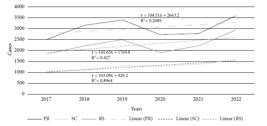
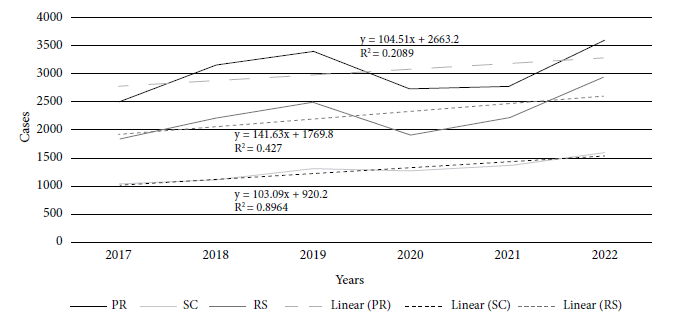
A growth trend was identified in the three states, as demonstrated in Figure 1. In the first years of the COVID-19 pandemic (2020), there was a reduction in the number of reports, going back to the growth pattern in 2021 and 2022. Although PR recorded the highest number of cases in this period, Rio Grande do Sul had the highest annual growth trend, with an estimated increase of 141.63 cases per year. Santa Catarina, with a lower absolute volume of reports, presented a more stable growth curve, with less oscillation (R² = 0.8964).
Time series and reporting trend of infant/juvenile sexual violence, according to the states of Paraná, Santa Catarina, and Rio Grande do Sul, South region, Brazil, 2017 to 2022.
The distribution of cases by sex shows a pronounced prevalence among girls: 33,499 cases (84.3%) of the total. The states followed this trend, with Paraná accounting for 46.1% of the female cases, followed by RS with 34.1% and SC with 19.8%. There were 6,251 cases involving males (15,7%), distributed as follows: PR with 48.4%, RS with 34.8% and SC with 23.8%.
The averages and standard deviations were calculated by period: therefore, between 2017 and 2019, the average was 501 cases, with a median of 302 cases and a standard deviation of 650. In the second period (2020-2022), these figures increases to a 519 average, with a median of 314 and a standard deviation of 706. The distributions did not follow normality (p < 0.001), justifying the use of non-parametric tests for analysis of average comparison.
Seeking to standardize data in relation to the population/sex base, standardized rates were obtained, considering the 2017 to 2019 and the 2020 to 2022 periods.
The average rate of sexual violence against children and adolescents in the South region was 501 per 100,000 inhabitants in the age range of 0 to 19 years in the 2017 to 2019 period, and 519 per 100,000 inhabitants in the age range of 0 to 19 years between 2020 and 2022. These figures were calculated based on reporting data from SINAN and in population estimates by IBGE for the respective years.
When comparing the average municipal rates of sexual violence against children and adolescents by state, PR showed the highest average in both periods, followed by RS and SC. The states of PR and SC recorded an increase in the average rates from the first to the second studied period, indicating a growth trend in the number of cases throughout the years. Municipal rates were analyzed according to state, and the statistical parameters are shown in Table 1.
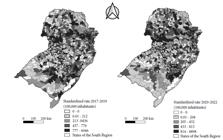
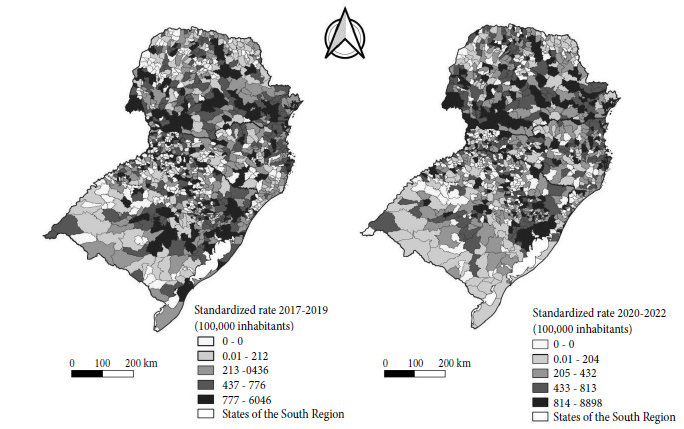
Figure 2 presents the standardized rates of sexual violence against children and adolescents in towns from the South region of Brazil, in the 2017 to 2022 period. When analyzing the standardized rates of sexual violence, considering age and sex, an upward trend in cases was observed, which is even more pronounced in the second period. In the first period, there were 6,046 cases, while in the second period, this number increased to 8,898 cases, a 47% quantitative growth in the number of reported cases of sexual violence against children and adolescents. PR registered the most areas with higher violence rates.
Distribution of the standardized rates of sexual violence against children and adolescents in the states and towns of Paraná, Santa Catarina, and Rio Grande do Sul, South region, Brazil, 2017 to 2022.
It is important to note that the towns with high rates (shown in darker colors) show dispersion in SC and RS. Meanwhile, in PR, even though a dispersion of towns with high rates can be observed, one can notice a line, close to the border with Santa Catarina, going from the metropolitan area of Curitiba to the far western portion of the state.
In relation to border regions, PR stands out in terms of border and non-border regions, with a total of 4,338 cases reported in the border strip and 13,836 cases outside of the strip (Table 2). It is important to mention that nearly ⅓ of the towns in PR are located in the border strip. Table 2 shows the absolute and relative frequency of cases of sexual violence in the South of Brazil, according to years, state, and being in border regions or not.
The comparison of rates, considering whether the town is in the border strip or not, as well as the parameters of this comparison (averages, medians, standard deviations, confidence intervals, and p-values) are shown in Table 3. The results displayed in this table indicate three main aspects: (1) The average sexual violence rates were higher in towns located in the border strip when compared to non-border towns, in both of the studied periods; (2) a slight reduction of the rates in the border towns is noticeable between the first (2017 to 2019) and the second (2020 to 2022) period, while the non-border towns witnessed an upward trend in the average rates during the same interval; and (3) the application of the Mann-Whitney test to compare the averages within each period revealed that, in the first period, although the averages were different, the difference did not reach statistical significance (p = 0.196). In the second period, despite the reduction in the difference between the group averages (border = 538/100,000 inhabitants; non-border = 515/100,000 inhabitants), statistical significance was identified (p = 0.017). This difference observed between the periods may be related to the redistribution of municipal rates over time.
Thus, spatial differences can be observed when comparing border and non-border groups. This suggests that, although temporal averages indicate some variation, spatial characteristics play an important role in understanding regional disparities in cases of sexual violence against children and adolescents.
Discussion
The spatial analysis of cases of sexual violence against children and adolescents in towns in the South region of Brazil, from 2017 and 2022, revealed an uneven distribution between states and between border and non-border towns. The state of PR presented the highest number of reports, followed by RS and SC. The predominance in PR requires further investigation. One of the hypotheses relates to the state’s higher population density in urban areas, which concentrates situations of social vulnerability, domestic violence, and fragility of community networks. Moreover, the state is part of the so-called Triple Border, with Paraguay and Argentina, characterized by intense migratory movements, circulation of people and products, and the presence of transnational criminal organizations, posing logistical challenges for the actions by surveillance and protection agencies7,15.
These conditions tend to hinder access to public services, favoring the victims’ invisibility and overwhelming local reporting and support systems. Previous studies indicate that border regions have institutional weaknesses, low intersectoral articulation, and intense population turnover - elements that heighten the risk of violation of rights and compromise the continuity of care7, 17.
Although there is an upward trend in sexual violence reports in the three states of the South region, the interpretation of this data requires caution, considering a possible influence of such factors as increased reports, changes in reporting processes, and increased awareness among healthcare teams. The increase in the number of reports should not be considered, automatically, as an indicator of true increase in the incidence of cases. As discussed by Minayo1, the increase in number of reports may reflect, to a great extent, the improvements in information systems, more awareness and better training of health teams, the adoption of more efficient recording protocols, and the growing public debate and social mobilization regarding violence According to the Ministry of Health4, strengthening surveillance actions and the institutionalization of reporting processes have a direct impact upon the increase in recorded cases. Therefore, distinguishing between an actual increase in violence and an increase in recording capability is crucial for the epidemiological understanding of the phenomenon, especially in contexts historically defined by underreporting of interpersonal violence. Critical analysis of the data requires one to consider improvements in recording systems as a positive element, but it also leads to the recognition that the number of reports still represents only a fraction of the real magnitude of the problem.
An ecological time-series study conducted by Sartori et al.18 on reports of physical, sexual and psychological violence, and child negligence in Brazil, in the 2011 to 2019 period, indicated that the South region, in the beginning of the studied period, had the highest physical violence reporting rates. As far as sexual violence, the study showed the highest rate in the North region. However, in the last year of the study (2019), the South states presented the highest rates of all forms of violence, with a growth trend in rates of sexual violence and negligence throughout the evaluated period.
The growth trend was interrupted briefly in 2020, coinciding with the onset of the COVID-19 pandemic. This reduction can be attributed to various factors, including underreporting due to the measures of social isolation, interruption in recording and care services, or even to an actual reduction in the number of cases. The resumption of growth in reporting in 2021 suggests a possible adaptation of the reporting systems to the pandemic conditions, as well as the reopening of children and adolescent care and protection services.
These results should be interpreted with caution, as they reflect a reduction in reports of cases of violence, and not necessarily an actual reduction in the cases of violence against children and adolescents. The increase in violence against children, adolescents, and women during the pandemic was noted in several countries, including China, the United States, France, and Brazil. In the Brazilian context, data obtained by the researchers from contacts at Public Prosecutors offices and Military Police indicated an increase in reports of domestic violence in several states, including Rio de Janeiro, Paraná, Pernambuco, Ceará, and São Paulo¹. Moreover, the authors highlight that, in households where violence against women takes place, situations of violence against children and adolescents are also frequently reported19.
Another study indicated that, in the South region of Brazil, professionals are not fully reporting cases, leading to underreporting and invisibility of these abuses. For the author, there is scarce knowledge regarding the adequate standards for an efficient structuring of the reporting process for cases of violence20.
Analysis by sex demonstrated a significantly higher prevalence of reports about girls. Although this pattern is consistent with literature, its naturalization may obscure structural factors. Brazilian patriarchal culture contributes to the subordination of women, favoring asymmetrical power relationships that increase vulnerability of girls and adolescents to sexual abuse. Such subordination relates to the objectification of the female body, the denial of autonomy, and the naturalization of violence as a form of control. These practices are reproduced not only in the family environment, but also in social institutions, such as school and health services21.
Moreover, adultcentrism - understood as the social organization that subordinates children and adolescents to interests and decisions of the adults - needs to be understood as part of the phenomenon. Generation hierarchy, often made invisible, legitimates forms of symbolic and physical violence, making it difficult to recognize and address abusive situations22. The boys’ invisibility as victims, for example, may be explained by gender norms associating masculinity to invulnerability, making reporting of sexual violence even more difficult and contributing to the underreporting of these cases1.
In this sense, the predominance of reports of sexual violence involving girls and women, in comparison to boys, in Brazil, may be attributed to the difficulty boys face in reporting these incidents. This difficulty is influenced by gender issues that generate feelings of fear and shame. Moreover, abusive acts may be interpreted as a sort of initiation to sex life, also leading to an underreporting of cases23.
The current study indicated that, when considering standardized rates, the state of Paraná recorded the highest averages in both studied periods, followed by Rio Grande do Sul and Santa Catarina. According to UNICEF24 data, the five Brazilian states with the worst rates in 2020 were Mato Grosso do Sul (186.0), Rondônia (146.2), Paraná (139.7), Mato Grosso (136.5), and Santa Catarina (135.2). However, the rates in Paraná and Santa Catarina fluctuated over time, but in the last year they also had a reduction in their rates, besides being among the five states with the highest rates.
Descriptive statistical analysis regarding the border regions indicated, across all study periods, a trend of higher rates in those areas. During the 2017 to 2019 period, border regions reached an average of 534 and a median of 268.8, suggesting a significant incidence of cases of sexual violence against children and adolescents. The lower median may indicate that some towns face even harder challenges, contributing to an asymmetrical distribution. In the 2020 to 2022 period, the border region recorded a decrease in the average to 528, suggesting stabilization, when compared to the previous period. Meanwhile, the reduction of the median to 239.1 suggests that, despite the average increase, the distribution of cases may have been concentrated in lower numbers.
By contrast, the non-border regions presented, between 2017 and 2019, an average of 483. In these regions, cases were significant as well, but the distribution of data seems to be more well-balanced. Notably, between 2020 and 2022, there was an increase in the average in non-border regions. The increase to an average of 515 may indicate an average intensification of cases, suggesting a worsening situation in some towns.
The analysis of standardized rates revealed higher averages of sexual violence in towns in the border strip. These findings support the hypothesis that border regions, given their socioeconomic and geopolitical characteristics, are more vulnerable to the violation of rights. The region of the Triple Border in southern Brazil is known as a zone of complex transnational dynamics, defined by an intense immigration flow, human trafficking, and drug and weapons trafficking. According to Singh and Lasmar25, a combination of criminal organization activities and institutional fragility compromises the efficiency of local protection networks, hindering the reporting and investigating of situations of violence. In this scenario, we can notice what Lira26 defines as an architecture of fear”, when fear of violence interferes in social dynamics and access to rights. This environment of structural vulnerability primarily impacts children and adolescents, demanding integrated actions and public policies that are sensitive to the territorial specificities of the border regions.
This context of vulnerability is worsened by the complexity of formulating and implementing public policies in border regions, compromised by a superposition of administrative competencies and by the distance of decision-making centers. Furthermore. studies indicate that these areas face specific challenges in intersectoral articulation, compounded by the presence of multiple vulnerabilities - poverty, poor coverage of services, and invisibility of temporary populations - creating a scenario prone to the naturalization of sexual violence, especially against girls and adolescents. These are elements that indicate the need for territorialized epidemiological surveillance strategies and protection policies that can dialogue with the local complexity7,17.
Given the territorial complexity seen in the South region of Brazil, especially in the border towns, this study reinforces the importance of analyses that consider, not just quantitative data, but also the social and institutional contexts in which violence occurs. Spatialization of data revealed significant inequalities, which need to be addressed with intersectorial strategies, based on territorialized epidemiological surveillance1,5,7.
Public policies aimed at the protection of children and adolescents in border regions must be designed with attention to local specificities, to population circulation, and to the fragility of local care and reporting networks. Such policies should coordinate health, education, social assistance, and public safety actions, prioritizing regions with greater vulnerability identified by the spatial analyses7,23. Health surveillance must consider territories as dynamic units, rather than just administrative ones, so as to produce more effective interventions to fight sexual violence4.
Regarding the limitations of this study, it is important to note that calculating rates using estimated populations may lead to some distortions. Furthermore, collecting data from the victims’ place of residence, and not from the place of reporting, may have been a limitation as well. Furthermore, it is important to mention that the limitations in this study are associated with the lack of updated data and the possibility of underreporting bias, which is particularly relevant, since this is an analysis of secondary data, and underreporting of sexual violence cases may well occur5.
Final considerations
Sexual violence against children and adolescents in the South region of Brazil is a serious public health problem and a violation of human rights, with spatial patterns that show regional inequalities. This study revealed a growth trend in reporting during the 2017 to 2022 period, particularly in the state of Paraná and in towns located in the border strip.
Comparative analysis between border and non-border towns, as well as between the pre-pandemic and pandemic periods, allowed us to identify that border regions have a higher average rate of incidence, indicating specific vulnerabilities associated with geographic, social, and institutional factors. Such a territorial approach enabled a more detailed analysis of the distribution of infant/juvenile sexual violence, contributing to the production of evidence capable of subsidizing more efficient public policies.
Our findings reinforce the urgency for intersectoral strategies, aligned with territorial specificities, with emphasis on health surveillance and on strengthening child and adolescent protection networks. More than providing subsidies for managers and policymakers, this study also contributes to the academic field by deepening the understanding of territorial determinants of sexual violence and by highlighting gaps in knowledge production regarding border contexts. The systematization and dissemination of this data has the potential to raise awareness among professionals, researchers, and society towards the adoption of structuring and preventive measures, consolidating its position as a strategic instrument to address this serious form of violence.
References
- 1 Minayo MCS. Conceitos, teorias e tipologias de violência: a violência faz mal à saúde. In: Njaine K, Assis SG, Constantino P, Avanci JQ, organizadores. Impactos da violência na saúde. Rio de Janeiro: Coordenação de Desenvolvimento Educacional e Educação a Distância da Escola Nacional de Saúde Pública Sergio Arouca, ENSP, Fiocruz; 2020. p. 15-38.
- 2 Sarmento MJ. As culturas da infância nas sociedades contemporâneas: da amnésia ao reconhecimento. Rev Bras Educ 2003; 22:35-47.
- 3 Saffioti HIB. Gênero, patriarcado, violência. São Paulo: Fundação Perseu Abramo; 2004.
- 4 Brasil. Ministério da Saúde (MS). Instrutivo de notificação de violência interpessoal e autoprovocada (VIVA). Brasília: MS; 2016.
- 5 Teodoro CC. Criança e adolescente: da invisibilidade social e naturalização da violência à perspectiva da proteção integral. Humanidades em Perspectivas [Internet]. 2020 [acessado 2022 set 01]. Disponível em: Revista Humanidades
- 6 Amaro S, Santos CMB, Pereira APM. Violência intrafamiliar contra crianças: risco, proteções a profissionais no Brasil e em Portugal. Porto Alegre: Novas Práxis Editorial; 2020.
- 7 Vieira MS, Costa RG, Oliveira SB. A invisibilidade da violência contra crianças e adolescentes: análise cartográfica do fenômeno em município da Fronteira Oeste do Rio Grande do Sul. Serv Soc Rev 2021; 24(1):349-366.
- 8 Brasil. Presidência da República. Lei nº 8.069, de 13 de julho de 1990. Dispõe sobre o Estatuto da Criança e do Adolescente e dá outras providências. Diário Oficial da União 1990; 16 jul.
- 9 Brasil. Senado Federal. Constituição da República Federativa do Brasil. Brasília: Senado Federal; 1988.
- 10 Neves AJ, Baptista GC, Engel CL, Machado LO, organizadores. Segurança pública nas fronteiras: diagnóstico socioeconômico e demográfico. Brasília: Ministério da Justiça e Cidadania, Secretaria Nacional de Segurança Pública; 2016.
- 11 Brasil. Ministério da Saúde (MS). Violência interpessoal e autoprovocada na faixa de fronteira brasileira: perfil das notificações de 2011 a 2018. Bol Epidemiol 2020; 51(46):1-20.
- 12 Bordignon MO, Bittencourt RJ. Violência nas regiões de fronteira: análise da situação no Sul do Brasil. Rev Saude Publica 2017; 51:111.
- 13 Miura AS. Análise espacial dos casos de violência infanto-juvenil em regiões de faixa de fronteira do Brasil [dissertaçãp]. Foz do Iguaçú: Universidade Estadual do Oeste do Paraná; 2020.
- 14 Brasil. Ministério da Saúde (MS). Política Nacional de Atenção Integral à Saúde da Criança: orientações para implementação. Brasília: MS; 2018.
- 15 World Health Organization (WHO). Health for the world's adolescents: a second chance in the second decade. Geneva: WHO; 2014.
-
16 Brasil. Ministério da Saúde (MS). Banco de dados do Sistema Único de Saúde - DATASUS. [Internet]. [acessado 2022 set 21]. Disponível em: www.datasus.gov.br
» www.datasus.gov.br -
17 Brasil. Ministério da Saúde (MS)/Secretaria de Vigilância em Saúde (SVS). Sistema de informações de agravos de notificação. SINAN [Internet]. 2007 [acessado 2022 set 21]. Disponível em: http://portalsinan.saude.gov.br/violencia-interpessoal-autoprovocada
» http://portalsinan.saude.gov.br/violencia-interpessoal-autoprovocada - 18 Sartori RM, Oliveira KAS, Moura KF, Soares PO, Matos VVGM, Karam SA. Notificações de violência física, violência sexual, violência psicológica e negligência praticadas contra crianças no Brasil, 2011-2019: estudo ecológico de série temporal. Epidemiol Serv Saude 2023; 32(3):e2023246.
- 19 Marques ES, Moraes CL, Hasselmann MH, Deslandes SF, Reichenheim ME. A violência contra mulheres, crianças e adolescentes em tempos de pandemia pela COVID-19: panorama, motivações e formas de enfrentamento. Cad Saude Publica 2020; 36(4):e00074420.
- 20 Silva PA, Luinardi VL, Meucci RD, Algeri S, Silva MP, Franciscatto FP. (In)visibilidade das notificações de violência contra crianças e adolescentes registradas em um município do sul do Brasil. Invest Educ Enferm 37(2):e12.
- 21 Minayo MCS. Violência e saúde. Rio de Janeiro: Fiocruz; 2006.
- 22 Sarmento MJ. A criança e o adulto: a ordem geracional e o status da infância. Cad Pesqui 2001; 113:35-52.
- 23 Rovinski SLR, Pelisoli CDL. Violência sexual contra crianças e adolescentes: testemunho e avaliação psicológica. Porto Alegre: Editora Psico-Pedagógica; 2019.
- 24 Fundo das Nações Unidas para a Infância (UNICEF). Panorama da violência letal e sexual contra crianças e adolescentes no Brasil. Brasília: UNICEF; 2021.
-
25 Singh R, Lasmar JM. A tríplice fronteira do Brasil: um centro de comércio ilícito com implicações globais [Internet]. 2023 [citado 2025 abr 28]. Disponível em: https://traccc.gmu.edu/wp-content/uploads/2023/06/HIT-Presentation-SP-for-public-release.pdf
» https://traccc.gmu.edu/wp-content/uploads/2023/06/HIT-Presentation-SP-for-public-release.pdf - 26 Lira PS. Geografia do crime e arquitetura do medo. Rio de Janeiro: Letra Capital; 2017.
-
Funding
In the project’s development period, some of the researchers received grants. Scientific Initiation by Fundação Araucária, and post-doc grant awarded by the Conselho Nacional de Desenvolvimento Científico e Tecnológico (CNPQ).
-
Data availability statement
The data sources used in the research are indicated in the body of the article.
The data sources used in the research are indicated in the body of the article.

 Source: Authors, based on DATASUS data (2023).
 Source: Authors.