
 Development of Clinical and Health Governance: Primary Health Care in the Lisbon and Tagus Valley Region
Abstract
The Clinical and Health Councils (Conselhos Clínicos e de Saúde - CCS) became responsible for implementing Clinical and Health Governance (Governação Clínica e de Saúde - GCS) in primary health care (PHC) in Portugal. However, this project suffered political abandonment, although there are cases of continuity due to the dedication of CCS professionals. Considering the lack of evidence on the impact of GCS concerning the horizontal integration of the Functional Units of Health Center Groups (Agrupamentos de Centros de Saúde - ACES), the present study sought to identify micropolitical elements that could enhance this horizontal integration. The modified Delphi technique (Policy Delphi) was used as a methodology involving a group of ten experts with experience in academia, in administrative structures, and in the CCS, who shared their experiences to answer the research questions. The results revealed, on the one hand, a general tendency, on the part of the experts to accept that the CCS fulfilled the competences that were assigned. On the other hand, they identified economic and social limitations in the development of the project, as well as the fragmentation of care and tensions generated by disparities between the Functional Units. This study also made it possible to suggest a set of micropolicies capable of promoting the integration of GCS in PHC.
Key words:
Primary Health Care; Clinical and Health Governance; Horizontal Integration; Micropolicies
Resumo
Os Conselhos Clínicos e de Saúde (CCS) tornaram-se responsáveis pela implementação da Governação Clínica e de Saúde (GCS) nos cuidados primários em Portugal. Contudo, este projeto sofreu abandono político, embora existam casos de continuidade devido à dedicação dos profissionais dos CCS. Considerando a ausência de evidências sobre o impacto da GCS na integração horizontal das Unidades Funcionais dos Agrupamentos de Centros de Saúde (ACES), a investigação buscou identificar elementos micropolíticos que pudessem potencializar essa integração horizontal. Como metodologia foi utilizada a técnica Delphi modificada (Policy Delphi) envolvendo um grupo de 10 especialistas com experiência acadêmica, nas estruturas administrativas e nos CCS, que compartilharam suas vivências para responder às questões da pesquisa. Os resultados revelaram uma tendência geral, por parte dos especialistas, para aceitarem que os CCS cumpriram as competências que foram atribuídas. No entanto, identificaram limitações econômicas e sociais no desenvolvimento do projeto, bem como a fragmentação dos cuidados e as tensões geradas por disparidades entre as Unidades Funcionais. A pesquisa possibilitou ainda sugerir um conjunto de micropolíticas capazes de promover a integração da GCS na APS.
Palavras-chave:
Atenção Primária à Saúde; Governação Clínica e de Saúde; Integração Horizontal; Micropolíticas
Resumen
Los Consejos Clínicos y de Salud (CCS) pasaron a ser responsables de implementar la Gobernanza Clínica y Sanitaria (GCS) en la atención primaria en Portugal. Sin embargo, este proyecto sufrió un abandono político, aunque hay casos de continuidad por la dedicación de los profesionales de la CCS. Considerando la falta de evidencia sobre el impacto de GCS en la integración horizontal de las Unidades Funcionales de los Grupos de Centros de Salud (ACES), la investigación buscó identificar elementos micropolíticos que podrían potenciar esta integración horizontal. Se utilizó como metodología la técnica Delphi modificada (Policy Delphi) involucrando a un grupo de 10 expertos con experiencia académica, en estructuras administrativas y en CCS, quienes compartieron sus experiencias para responder las preguntas de investigación. Los resultados revelaron, por un lado, una tendencia general, por parte de los expertos, a aceptar que la CCS cumplía con las competencias asignadas. Por otro lado, identificaron limitaciones económicas y sociales en el desarrollo del proyecto, así como la fragmentación de la atención y las tensiones generadas por las disparidades entre las Unidades Funcionales. La investigación también permitió sugerir un conjunto de micropolíticas capaces de promover la integración de las GCS en la APS.
Palabras clave:
Atención Primaria de Salud; Gobernanza Clínica y Sanitaria; Integración Horizontal; Micropolíticas
Introduction
The World Health Organization (WHO), as set forth in the Declaration of Alma-Ata in 1978, understands that Primary Health Care (PHC) can cover the majority of a person’s health needs throughout one’s life1. In Portugal, in 1971, the first network of health centers was created, which were primarily dedicated to preventive activities and the promotion of maternal and child health2. Over time, health centers have undergone several changes, and between 2005 and 2010, a major boost was given to the transformation of PHC, with the creation, in 2006, of the Family Health Units (FHUs), which develop their activity based on the contracting of objectives, making financial and institutional incentives correspond to their fulfillment, and based on Health Center Groups (ACES) in 20083,4.
The reconfiguration of health centers followed a twofold movement. The approximately 360 health centers, which had a pyramidal hierarchical organizational structure, now have an organization of multidisciplinary teams with varying degrees of technical autonomy and self-organization capacity. In this sense, the health centers gave rise to approximately 1,300 multidisciplinary teams with their own “identity” differentiated by type of unit: person-centered and family-centered comprehensive and longitudinal general care (FHU/Personalized Health Care Units (Unidades de Cuidados de Saúde Personalizados - UCSP)); selective care for groups with special needs and interventions in the community (Community Care Units - CCUs); diagnosis and monitoring of the health status of the population, as well as the coordination of programs to protect and promote the health of the general population (Public Health Units - PHUs); health care, participation in common health projects, and consultancy services provided to other units, composed of psychologists, nutritionists, physiotherapists, social workers, among others (Shared Assistance Resource Units (Unidades de Recursos Assistenciais Partilhados - URAP))4.
This “decentralization” process was accompanied by a process in the opposite direction - concentration of resources and management structures, that is, of devices for clinical governance and organizational management, to allow scales of epidemiological analysis and action results, as well as to achieve economies of scale to maximize resource management. The approximately 360 health centers gave way to 70 ACES, later restructured into 55.
Health systems have always been complex, and difficult to understand and change, but due to limited resources, most countries seek ways to improve the efficiency of their health systems5,6. In this context, the Mission for PHC (2005-2010) established three axes of action in its Strategic Plan for the three-year period of 2007-2009: quality and organizational change; clinical governance (CG); and knowledge management, sustainability, and development7.
Clinical and Health Governance Devices
Governance comes from the Greek word kubernân, which means ‘to pilot’. Using the metaphor of a journey, it is assumed that its purpose is to pilot the ship to reach the desired destination safely and economically. It is a comprehensive, multidimensional system that aims to achieve specific objectives by improving common practices8-10.
The concept of CG was imported to Portugal in 2001 and was further developed in the PHC, where it gained relevance with the term Clinical and Health Governance (Governação Clínica e de Saúde - GCS), bringing together the WHO concept of Health Governance with that of CG from the British system, and combining two ideas: improving health levels, and obtaining clinical results at an individual level (each person) and health results at a group or population level (in this case, ACES). The latter is the responsibility of the Clinical and Health Council (Conselho Clínico e da Saúde - CCS, a GCS device in each ACES, in the legislation that was in force until December 31, 2023)11,12.
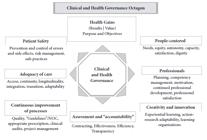
The GCS in the PHC had the following dimensions: focus on people, professionals, innovation, assessment (accountability), continuous improvement of processes, adequacy of care, patient safety, and health results/gains (Figure 1)12.
This network organization model would enable the development of collective and collaborative intelligence in ACES. The appropriation by professionals of this new paradigm required more than a mere transformation of the organization. It implied a change in thinking and in the pattern of institutional relations. To this end, focus was placed on the development and qualification of a GCS culture in the PHC, by: defining the conceptual and technical-scientific framework of reference; training new leaders; creating the CG community, involving all the CCS and a monitoring device through a matrix of indicators.
With limited evidence in the PHC, the first indicators were initially developed in the MCSP, for the FHU and UCSP. Performance evaluation efforts often focused on process indicators rather than outcome indicators, which is one of the main limitations highlighted in this study. However, they did allow for the analysis of data that appears to show consistent progress in more than four dozen performance indicators.
In 2017, the BI-PHC portal was created, with public access and different access profiles13. In addition to other features, it has supported the contracting process and the development of the GCS culture. It provides a matrix of performance indicators that considers the GCS areas, enabling the monitoring of the various dimensions of Figure 1. This assessment resulted in the Global Performance Index (GPI), which in 2024 was replaced by the TPI (Team Performance Index), which includes the disruption index (professional-user ratio, absences, user complexity, sociodemographic conditions).
Clinical and Health Governance in the Lisbon and the Tagus Valley Region
In December 2008, the Regional Health Administration of Lisbon and Tagus Valley, I.P. (ARSLVT), developed a project to promote the CCS (DiCCA Project), carried out by a multidisciplinary working group that, with the participation of professionals, developed guidelines and procedures for each strategic axis, developed meetings/workshops/discussion groups, which subsequently favored the creation of a community (Network) of practices with the sharing of documents, experiences, methodologies and innovative strategies.
During the years that followed, there was a lack of continuous training for CCS at a national level, in addition to the frequent change of its members, which contributed to the gradual loss of knowledge of the role of CCS and the relevance of GCS. Thus, ARSLVT, in 2017:
-
a) revived the DiCCA (II) project;
-
b) designed and implemented the Oncology Screening Programs (Programas de Rastreio Oncológicos - PRO), Cervical Cancer (cancro do colo do útero - CCU), and Colon and Rectal Cancer (CRC) from the GCS perspective, in close connection with the CCS, through their integration with the projects worked on in DiCCA II.
At ARSLVT, there had already been two decades of unsuccessful attempts to implement PROs, with much resistance crystallized in various points of the system (health centers and hospitals). Thus, ARSLVT invested in their design and implementation, now from a GCS perspective, in order to maximize the effects of these interventions in terms of individual and collective health, with positive impacts on organizational and systemic development14,15.
Between 2017 and 2024, the annual population coverage rate went from 0% to 16.6% (97,815 people invited and 73,544 of them screened) in the case of RCCR and from 0% to 51.4% of women screened for CC (100,998 invited and 98,245 screened). These results exemplify what could be good public health intervention practices and how GCS can be implemented at a local level, on a population scale of 105.
c) created the instrument to support the organizational development of all UFs (FHU, UPHC, CCU, URAP, and PHU) - the DORA manual. A qualitative instrument that emphasizes dimensions such as teamwork, people-centeredness, community, openness, cooperation, adaptive capacity, learning culture, and achievement of health results. The motto was “May each Team be a master and disciple of itself, a master and disciple of its peers (other teams), and a master and disciple of the recipients/partners of its services” (quote from Victor Ramos)16.
The current moment of GCS
On January 1, 2024, the National Health Service (NHS) was reorganized again with the abolition of the ARS and the creation of 39 Local Health Units (LHUs), which integrate hospitals and ACES17,18. This merger involves organizations providing different levels of care with a view to improving the quality of life of a given population (vertical integration). The risk of prioritizing the allocation of resources to immediate needs (almost always curative hospital care activities) to the detriment of health promotion and disease prevention activities must be considered. On the other hand, the existence of very different cultures may lead to the dominant culture being that of the largest organization, that is, the hospital. The vertical integration that exists in hospital units may constitute a threat and obstacle to the horizontal integration achieved in PHC.
Societal changes, which are associated with changes in a health system that is moving towards increasingly decentralized structures, have required an evolution in GCS models.
The present study was intended to answer the following research questions (a) What is the perception of a panel of experts about the role of the CCS in the development of GCS and what impact did this have on the application of performance indicators in clinical practice; and (b) Which micropolicies would best serve GCS in the new LHU organizational model.
Methodology
An exploratory, descriptive, cross-sectional, and qualitative study was designed to obtain the perceptions of a panel of experts on the development of GCS and its impact on performance, as well as which micro-policies could contribute to GCS in the new LHU model.
The Policy Delphi technique is a method for structuring a group communication process around a complex problem, exploring areas of consensus and dissent among experts19-23. The sample was considered heterogeneous, since the members did not work in the same places, belonged to different professional groups, and dealt with GCS at different levels.
The selection of experts was intentional, as it was intended that they would have prior and direct contact with the development of GCS in PHCs, both at the academic level and at the level of the central, regional, and local structures of the health system.
Ten experts were invited, of whom seven were doctors, one senior health technician, one physiotherapist, and one nurse. Although seven of these experts were family doctors (the profession with the greatest role in implementing GCS), the roles they played were at different levels. Five experts worked at the central and regional levels of the health system, two at the academic level, and three worked on implementing and developing GCS at the local level.
Participation in the study was voluntary and informed consent was obtained from all participants. This study complied with the World Medical Association’s Declaration of Helsinki and the Personal Data Protection Act, which transposed the Regulation (EU) 2016/679 of the European Parliament and of the Council, from April 27, 2016, into national law.
In this study, we used three rounds over three months. The questionnaire (comprised of a Likert scale, with the possibility of expressing comments and open-ended responses) was created in Google Forms and the link was sent individually. The first submission took place on September 27, 2024. We obtained responses from all those invited. These in turn gave rise to many nuances about the problems under study, which allowed for a constructivist approach, to which the phenomenological approach was associated, in the sense that the relationships discussed in the study (between people, groups, institutions) are processes that are inaccessible to what appears to the senses, allowing for the deduction of empirically observable consequences. It also served for the inductive analysis of the data, which was accompanied by the inclusion of many of the experts’ responses in the article, common in the phenomenological analysis of practices experienced by the subjects24. Approaches were maintained in the following round.
The second questionnaire contained three open-ended questions on topics that had not been fully clarified in the previous round. It was sent on November 10, 2024, using the same format and platform, and all participants responded. The questionnaire was accompanied by a narrative summary of the responses received in the previous round, highlighting areas of consensus and disagreement. The link to the first questionnaire was also sent, and the possibility of changing the initial positions was given, as was a copy of the respective responses from the previous round. None of the experts made any changes.
At the end of the two rounds, material for the construction of the decision matrix had been gathered and was sent to the panel for the next round, which began on November 25, 2024. This next round focused on micropolicies aimed at integrating GCS, resulting from the analysis of all previous responses. Only 6 participants responded (60.0%).
Our research followed studies that used mixed methods25,26. A Likert scale was used and the most recent studies on productivity, access, and effectiveness in PHC, from official sources, were used to triangulate the data. The research group had previous experience in qualitative and quantitative research and professional experience in CAPS, as well as direct contact with GCS, which enabled them to understand the responses in context.
Data analysis followed a constructivist approach, since the study is structured around “truths” freely shared by experts, resulting from their social interactions, i.e., situated knowledge, which is thus produced and shared. The analytical work used a thematic analysis27,28. This type of analysis is referred to as a method and not as a methodology. The sequence of stages were: transcription and familiarization with the data; identification of key words in the responses; and selection of codes, thematic development, and development of the conceptual model. No computer programs were used in the data analysis, with each analytical phase being developed by the research team.
Results
Descriptive statistics
The sociodemographic characteristics of the members of the expert panel indicated the weak representation of the “non-physician” group, which may represent a weakness of the study.
The results of the Likert scale, whose questions summarized the competencies of the CCS, were analyzed (Table 1)29,30. The distribution of responses shows polarization, with a concentration of positive responses (Agree and Strongly agree), but also a significant number of negative responses. The answer in all categories indicates the diversity of opinions among professionals.
The mean of 2.93 indicates a slightly positive core tendency in the answers, suggesting a general inclination towards moderate agreement. The mode shows that “Agree” was the most frequent response, demonstrating a general tendency towards approval of the statements contained in the scale. The standard deviation of 1.34 suggests considerable dispersion in the answers. Although there is a positive core tendency, there is significant variability in the opinions of the participants. The value of the standard deviation suggests that there is a lack of clear consensus among the participants, which may reflect differences in the experiences or perspectives of the experts. The predominance of positive responses (65% - Agree and Strongly agree) suggests that, despite the divergences, there is a general tendency to accept that the CCS fulfilled the responsibilities that had been assigned to them.
The questions showing the greatest polarization were: 1) that referring to the support of the CCS regarding the achievement of health gains and 2) the issue of complementarity and cooperation between functional units and between levels of care.
Results of iterative dialogue
The main ideas identified and their respective examples are summarized in Chart 1.
Based on the set of factors that influenced the development of GCS summarized in Chart 1, three questions were asked in the second round about the recommendation of micropolicies that would promote GCS in the LHU model. From this set of ideas, the following themes were organized, which are presented in Chart 2.
Expert decision on micro-policies for GCS in the LHU model
In accordance with the recommendations of the Policy Delphi technique, a decision matrix was organized with the items resulting from the iterative debate, in which the experts were faced with a set of situational criteria: desirability, feasibility, importance, trust (in the validity of the argument or premise), and simplicity of implementation19.
Values between 1 and 4 were assigned to each criterion, with 1 being the least important and 4 the most important. The weighting of each criterion also varied from 1 to 4, with the corresponding percentage. Each expert filled out a table and the score for each criterion corresponded to its mode19. Finally, a single table was organized with all the valid responses and the mode of the scores obtained was calculated again. The mode obtained for these values shows that which was most frequent, as well as a general tendency to approve the micropolicy options presented to the experts.
As can be seen in Table 2, there was no micropolicy option that received unanimous values, although only one (Actions Based on the Best Scientific Evidence) received a value of 3. For this reason, we considered that all the remaining ideas could include our proposal for micropolicies that will contribute to an integrated CG.
Discussion
The legislation that was created successively recognized the strategic importance of CCS in the implementation and development of a GCS culture in PHC. In general, the experts recognized that CCS assumed this importance through their commitment to the skills that were assigned to them. However, despite the revisions to the law that governs the organization of ACES, the legal and regulatory framework for the exercise of CCS functions, their responsibilities, rights, and guarantees was never reviewed and improved, which may have contributed to a turnover of CCS teams, with the loss of acquired knowledge and experience. The low financial recognition does not seem to have overcome the internal motivation of some to seek a role that was perceived as important. The experts understood that it was the CCS that played a significant role in the development of GCS, since it was a project that became dependent on the motivation of the professionals involved, which began when it no longer had the support that had been guaranteed in the beginning. Several participants acknowledged that these were interested and dedicated professionals who carried out their responsibilities.
Changes cannot be seen only in terms of intentions. GCS requires a transformation at the level of the entire organization, for which clinical leadership and organizational cultures are particularly important. Organizational culture is the social glue that holds the entire organization together35. However, in order to introduce changes, we must always consider, on the one hand, the rationalizing pressure of the state and, on the other, the technical-scientific aspect and the health professionals36.
Experts understand that the development of GCS in the PHC was greatly conditioned by political drifts, which created discontinuity in the process, but they still voted for the initiative to be abandoned. Peering into the institutions, we can discuss strategic priorities, as is the case with CG|, but it will also be important to look at the context outside the organization. The impact of crises on health has been highly debated, particularly the 2010-2012 crisis, when Portugal was forced to sign a Memorandum of Understanding, with more than 50 measures and actions to be implemented in the health sector alone37. With regard to budgetary policy, Portugal had to control costs in the sector, aiming to achieve savings of 550 million euros38. The reinforcement should be in PHC, with the aim of reducing an unnecessary use of hospital consultations and emergencies.
It is in this context of discontinuing investments in CCS that ARSLVT, in 2017, took measures to frame and support CCS in their mission, as explained in the introduction.
Another essential aspect in this regard was highlighted by the experts when they stated that, although political choices did not prioritize GCS, a path was opened that could continue, largely at the expense of the culture of the interprofessional teamwork that had been created, which also influences the satisfaction of professionals. Interprofessional work is defined as a partnership with a collaborative, participatory, and coordinated approach, often focused on by experts, for shared decision-making on citizens’ social and health issues, tends to achieve better results and greater satisfaction when compared to multidisciplinary teams39.
Health organizations are “complex adaptive systems” and for there to be a true integration of care, it is necessary to set up multidisciplinary teams that are sufficiently flexible and open to continually adapt and respond to the needs of individuals and families40.
The PROs implemented in the ARS-LVT, from a GCS perspective, continue to be considered among the best examples of care integration, since, among other features, through a single IT platform, they are able to integrate all of the answers that people need, from screening to future treatment14,15.
Despite this good example, the relationship between ACES, functional units, and ARS (PHC) was identified as a constraint on the integration of care. These were created as intermediate regional structures with the aim of obtaining greater gains in efficiency and productivity at the local level41. Since their creation, they have become the intermediate level of management intended for the implementation of health policy at the regional level. This role was often understood as a hindrance to the development of local projects and a hierarchical level, which could be abolished, especially because, since their inception, the autonomy of ACES was a legislative designation.
The concept of autonomy in health care is evolving from an individualistic approach to one that emphasizes relational responsibility, which promotes collaboration and shared decision-making between caregivers and users. This shift is essential to creating a more integrated and agile health system42. Portugal is currently facing a major organizational change that could negatively impact this issue. On January 1, 2024, the ARS (PHC) and respective ACES were extinguished with the creation of the LHU, merging the PHC with the hospitals17. Although it could be an opportunity to bring hospital and PHC professionals closer together, and therefore facilitate more integrated clinical practices, the new organizational model does not provide for a clinical and health governance device (the CCS of the former ACES have disappeared), and is structurally organized by professional hierarchies (clinical medical directors, nursing directors) and not by multidisciplinary teams to treat the needs of people and families, which could become an obstacle and even a setback with regard to the desired integration of care.
The experts reported that there was no collaboration or complementarity between UFs and organizations outside the ACES, which was evident both in the first round in response to a set of closed questions and in the second round, which allowed the experts’ ideas to emerge through open questions. Person-centered care is based on mutual respect and understanding, as well as on the promotion of the patient’s right to self-determination, which requires collaboration between professionals and between different structures43. The increasing specialization of professionals and services represents, on the one hand, an opportunity for efficiency in the continuum of care, but, at the same time, a growing difficulty in coordination and integration44. It is in this context that the experts understand that there has been specific cooperation. When multiple organizations are involved in the healthcare continuum, the limits to care integration are defined by policies, laws, regulations, cost assumptions, and cultural differences45. Process management is nothing more than a methodology dedicated to creating horizontal management structures to facilitate the flow of value within and between organizations. We recognize that it is difficult to combine vertically oriented management with horizontal process management in health care. From the testimonies gathered, we understand that this incompatibility is the biggest problem facing CG.
The experts highlighted the issue of overvaluing the indicators and the consequences of the asymmetries and inequalities that emerged from this. It is important to note that although the initial idea was to cover the entire country with FHUs, only partial coverage (around 67%) was possible until 2024, which has generated inequalities that have continued over time for professionals and users13,46. The FHU (voluntary membership by professionals) began to have a “controlled” population with incentives for performance, while the UCSP had to bear the pressure of users without a family doctor, proportionally with fewer professionals, without incentives for performance and, in general, with access to less investment in working conditions. These inequalities added even more challenges to the work of the CCS in supporting the UF and the GCS’s goals.
Although these types of indicators provide an objective and quantifiable means of assessing performance, reliance on quantitative data can introduce problems, such as reductionism (indicators reduce the complexity of facts to simple numbers) and potential misalignment with real objectives. Measurement will always depend on the quality of the recording47,48.
These difficulties led to the search for indicators that assessed the overall performance of PHC (as in the case of IDG), a multifaceted concept that involves metrics and frameworks to assess the quality, access, and effectiveness of PHC in many countries49.
However, in terms of overvaluing indicators, it is important to note that the comparison of international quality indicators revealed that Portugal performs above the average of the countries of the Organization for Economic Cooperation and Development (OECD), both in terms of indicators related to avoidable hospital admissions and in the indicator related to hospital admissions due to major lower limb amputations in diabetic patients (year 2022)50. This creates internal tension between those who claim that the results of the indicators do not always correspond to better health outcomes for citizens and the positive results obtained in comparative studies.
Incentives, particularly financial incentives, serve as mechanisms to stimulate improvements in the quality of care provided in PHC, as demonstrated by the results obtained, in order to respond effectively to the changing health needs of the population51.
The micropolicy components that were presented to the experts were given equal emphasis, with the exception of actions based on the best scientific evidence. Compliance with the minimum requirements describes what is the starting point for the project to begin, without which results will not be achieved. Citizen and community participation should be the starting point, as it will guarantee relevance and responsiveness. The digitalization and integration of information systems, in close conjunction with the learning organization, facilitate the adaptive process, creating rapid responses to new situations and challenges. The valorization of work in the area of GCS should be negotiated with all stakeholders and is intended to guarantee integration. The definition of roles and responsibilities deserves emphasis, as it ensures that all stakeholders are aware of their responsibilities. Ensuring strategic alignment requires sequential planning of responsibilities and contributes to the creation of trust. A culture of trust is centered on a shared and dynamic understanding of the group’s stories and values. Quality assessment strategies should also be aligned with the national strategy, recognizing that any intervention to improve quality will have an impact on the quality perceived by the user.
Study limitations
An exploratory, cross-sectional, qualitative study conducted with a group of 10 experts has important limitations to consider. The number of participants, even if adequate, may not encompass the full range of views and perceptions on the subject19. There is a possible sampling bias, since the selection of experts may not represent the relevant community, possibly omitting significant views. As it is an exploratory study, it does not offer conclusive answers, but only indicates paths for further studies. The qualitative methodology works with the subjectivity of the statements, which reflect participant experiences. The final agreement may result from the wear and tear of a process divided into three distinct stages, each with several dissertative questions.
Conclusions
Despite its limitations, the study represents an initial analysis of GCS in PHC.
The panel’s experts identified the importance of CCS in advancing GCS. They also highlighted economic and sociopolitical obstacles to the project’s progress, recognizing that the dispersion of care and the disparities between the UFs that make up the system create real difficulties for horizontal integration in PHCs. They agreed that clinical activities, especially in FHUs, are geared towards performance indicators.
The generalization of LHUs needs to be accompanied by the development of a new model of clinical and health governance that frames, interconnects, and guides all teams in health centers and hospitals (vertical integration).
The socioeconomic limitations highlighted in this study do not justify unfinished projects, since they do not always depend on financial resources, but rather on effective leadership.
Acknowledgements
The authors would like to thank the review board, whose contributions were essential to producing this article.
References
-
1 Organização Mundial da Saúde (OMS). Cuidados de saúde primários [Internet]. [acessado 2024 nov 20]. Disponível em: https://www.who.int/world-health-day/world-health-day-2019/fact-sheets/details/primary-health-care
» https://www.who.int/world-health-day/world-health-day-2019/fact-sheets/details/primary-health-care - 2 Serviço Nacional de Saúde: Breve Interpretação e linhas para a sua transformação [Internet]. Lisboa: Fundação para a Saúde - Serviço Nacional de Saúde; 2019 [acessado 2024 nov 20]. Disponível em: http://www.FSNS.pt.
- 3 Portugal. Ministério da Saúde. Decreto-Lei n.º 157, de 10 de maio de 1999. Estabelece o regime de criação, organização e funcionamento dos centros de saúde. Diário da República; 1999.
- 4 Portugal. Ministério da Saúde. Decreto-Lei n.º 28, de 22 de fevereiro de 2008. Estabelece o regime da criação, estruturação e funcionamento dos agrupamentos de centros de saúde do Serviço Nacional de Saúde. Diário da República; 2008.
- 5 Hunter DJ. Role of politics in understanding complex, messy health systems: an essay by David J Hunter. BMJ 2015; 350(mar09 5):h1214-4.
- 6 Botezat D, Oprea L, Gavrilovici C. The integration of health services. Health Networks. Soc Res Reports 2013; 23:68-81.
- 7 Portugal. Resolução do Conselho de Ministros n.º 157, de 22 de setembro de 2005. Determina a criação de uma estrutura de missão para a reforma dos cuidados de saúde primários. Diário da República; 2005.
- 8 Branco A, Ramos V. Cuidados de Saúde Primários em Portugal. Rev Portug Saude Publica 2001; 2:5-12.
- 9 Phillips CB, Pearce CM, Hall S, Travaglia J, Lusignan S, Love T, Kljakovic M. Can clinical governance deliver quality improvement in Australian general practice and primary care? A systematic review of the evidence. Med J Aust 2010; 193(10):602-607.
- 10 Scally G, Donaldson LJ. Looking forward: Clinical governance and the drive for quality improvement in the new NHS in England. Br Med J 1998; 317(7150):61-65.
-
11 World Health Organization (WHO). Health Systems Governance [Internet]. 2019 [cited 2024 nov 20]. Available from: https://www.who.int/health-topics/health-systems-governance#tab=tab
» https://www.who.int/health-topics/health-systems-governance#tab=tab -
12 Serviço Nacional de Saúde. Grupo Técnico Nacional da Governação Clínica e Governação de Saúde nos Cuidados de Saúde Primários. Perguntas e respostas essenciais [Internet]. 2017 [acessado 2024 nov 20]. Disponível em: https://bicsp.min-saude.pt/pt/biblioteca/Biblioteca/Governa%C3%A7%C3%A3o%20Clinca%20e%20de%20Sa%C3%BAde.pdf
» https://bicsp.min-saude.pt/pt/biblioteca/Biblioteca/Governa%C3%A7%C3%A3o%20Clinca%20e%20de%20Sa%C3%BAde.pdf -
13 Serviço Nacional de Saúde. Bilhete de identidade dos Cuidados de Saúde Primários [Internet]. [acessado 2024 nov 20]. Disponível em: bicsp.min-saude.pt
» bicsp.min-saude.pt - 14 Equipa Regional de Rastreios da ARSLVT. Programa de Rastreio do Cancro do Cólon e Reto [Internet]. Lisboa: ARSLVT; 2019 [acessado 2024 nov 20]. Disponível em: http://www.arslvt.min-saude.pt/.
- 15 Equipa Regional de Rastreios da ARSLVT. Programa de Rastreio do Cancro do Colo do Útero [Internet]. Lisboa: ARSLVT; 2019 [acessado 2024 nov 20]. Disponível em: http://www.arslvt.min-saude.pt/.
- 16 ERA-LVT. DORA: Apoio ao Desenvolvimento Organizacional das Unidades Funcionais dos ACES [Internet]. Lisboa: ARSLVT; 2019 [acessado 2024 nov 20]. Disponível em: http://www.arslvt.min-saude.pt/.
- 17 Portugal. Presidência do Conselho de Ministros. Decreto-Lei n.º 102, de 7 de novembro de 2023. Procede à criação, com natureza de entidades públicas empresariais, de unidades locais de saúde. Diário da República; 2023.
-
18 Santana R. Almeida CN. Acompanhamento do modelo de implementação, desenvolvimento e monitorização das ULS [Internet]. NOVA Escola Nacional de Saúde Pública; 2024 [acessado 2024 nov 20]. Disponível em: https://www.sns.min-saude.pt/wp-content/uploads/2024/04/Relatorio-Final_ULS.pdf
» https://www.sns.min-saude.pt/wp-content/uploads/2024/04/Relatorio-Final_ULS.pdf -
19 Turoff M, Linstone HA, The B, Policy Delphi, Gibran K. The Policy Delphi. Technological Forecasting [Internet]. 2002; 2:80-96 [cited 2024 nov 20]. Available from: https://www.researchgate.net/publication/265086472_The_Policy_Delphi
» https://www.researchgate.net/publication/265086472_The_Policy_Delphi - 20 Franklin KK, Hart JK. Idea Generation and Exploration: Benefits and Limitations of the Policy Delphi Research Method. Innovative Higher Educ 2006; 31(4):237-246.
- 21 Loë RC, Melnychuk N, Murray D, Plummer R. Advancing the state of Policy Delphi practice: a systematic review evaluating methodological evolution, innovation, and opportunities. Technol Forecast Soc Change 2016; 104:78-88
- 22 Sossa JWZ, Halal W, Zarta RH. Delphi method: analysis of rounds, stakeholder and statistical indicators. Foresight 2019; 21(5):525-544.
- 23 Niederberger M, Spranger J. Delphi technic in health sciences: a map. Front Public Health 2020; 8:457.
- 24 Silva JCB, Oliveira CR, Oliveira GS, Ghelli KGM, Santos AO. Algumas considerações acerca da fenomenologia e a fenomenologia de Merleau-Ponty. Cad FUCAMP 2024; 29:119-132.
- 25 Sisk BA, Antes AL, Bereitschaft C, Bourgeois F, DuBois J. Acceptability of Adolescent Portal Access Policies to Parents and Adolescents: A Delphi Study. J Adolesc Health 2024; 76(3):448-454.
- 26 Chamberlain D, Harvey C, Hegney D, Tsai L, Mclellan S, Sobolewska A, Wood E, Hendricks J, Wake T. Facilitating an early career transition pathway to community nursing: A Delphi Policy Study. Nurs Open 2019; 7(1):100-126.
- 27 Maguire M, Delahunt B. Doing a thematic analysis: A practical, step-by-step guide for learning and teaching scholars. All Ireland J Higher Educ 2017; 9(3):3351-33514.
- 28 Naeem M, Ozuem W, Howell KE, Ranfagni S. A step-by-step Process of Thematic Analysis to Develop a Conceptual Model in Qualitative Research. Int J Qualit Methods 2023; 22(1):1-18.
- 29 O'Brien BC, Harris IB, Beckman TJ, Reed DA, Cook DA. Standards for Reporting Qualitative Research. Academic Medicine 2014; 89(9):1245-1251.
- 30 Portugal. Ministério da Saúde. Decreto-Lei n.º 253, de 27 de novembro de 2012. Procede à quarta alteração ao Decreto-Lei n.º 28/2008, de 22 de fevereiro, relativo à criação, estruturação e funcionamento dos agrupamentos de centros de saúde do Serviço Nacional de Saúde, no que respeita ao critério geodemográfico da sua implantação, à designação dos diretores executivos e à composição dos conselhos clínicos e de saúde. Diário da República; 2012.
- 31 Ghavamabad LH, Vosoogh-Moghaddam A, Zaboli R, Aarabi M. Establishing Clinical Governance Model in Primary Health care: a Systematic Review. J Educ Health Prom 2021; 10(10):338.
- 32 Balding C. Strengthening clinical governance through cultivating the line management role. Aust Health Rev 2005; 29(3):353.
- 33 Kapur K, McAleer S, Persson F, Bjerre-Christensen U. Improving the effectiveness of short-term courses for multidisciplinary health care professionals. Practical Diabetes 2015; 32(5):180-185.
- 34 Mowday RT, Steers RM, Porter LW. The measurement of organizational commitment. J Vocational Behav 1979; 14(2):224-247.
- 35 Tsai Y. Relationship between organizational culture, leadership behavior and job satisfaction. BMC Health Serv Res 2011; 11:98.
- 36 Adam P, Herzlich C. Sociologie de la maladie et de la médecine. 1994.
- 37 Coelho P, José JS, Martins JE. "Quando a saúde ficou a perder ou a crise passou ao lado": Um olhar sociológico sobre os efeitos da crise e da austeridade na saúde autopercebida dos mais velhosi. Forum Soc 2022; 40:11-19.
-
38 Banco de Portugal. Memorando de entendimento sobre as condicionalidades de política económica [Internet]. 2011 [acessado 2024 nov 24]. Disponível em: https://www.bportugal.pt/sites/default/files/anexosmou_pt.pdf
» https://www.bportugal.pt/sites/default/files/anexosmou_pt.pdf - 39 Körner M, Wirtz MA, Bengel J, Göritz AS. Relationship of Organizational culture, Teamwork and Job Satisfaction in Interprofessional Teams. BMC Health Serv Res 2015; 15:243.
- 40 Kelly S, Allison MA. The Complexity Advantage: How the Science of Complexity Can Help Your Business Achieve Peak Performance. New York: McGraw-Hill; 1999.
- 41 Organização Mundial da Saúde (OMS). PortugalHealth system performance assessment. Copenhagen: WHO Regional; 2010.
- 42 Ricardo E, Mendonça EM. Características e Autonomia dos Gestores das Unidades de Saúde na Atenção Básica. Rev Psicol 2022; 16(63):550-559.
- 43 McCormack B, Dewing J, Mccance T. Developing person-centred care: addressing contextual challenges through practice development. Faculty of Science Medicine and Health 2011; 16(2): part A.
- 44 Lawrence PR, Lorsch JW. Differentiation and Integration in Complex Organizations. Admin Sci Quarterly 1967; 12(1):1-47.
- 45 Karlsson M, Garvare R, Zingmark K, Nordström B. Organizing for sustainable inter-organizational collaboration in health care processes. J Interprof Care 2019; 34(2):241-250.
-
46 Entidade Reguladora da Saúde. Estudo cuidados de saúde primários. Qualidade e eficiência nas UCSP e USF [Internet]. 2024 [acessado 2024 nov 20]. Disponível em: https://www.ers.pt/pt/atividade/regulacao-economica/selecionar/estudos/lista-de-estudos/estudo-cuidados-de-saude-primarios-qualidade-e-eficiencia-nas-ucsp-e-usf/.
» https://www.ers.pt/pt/atividade/regulacao-economica/selecionar/estudos/lista-de-estudos/estudo-cuidados-de-saude-primarios-qualidade-e-eficiencia-nas-ucsp-e-usf - 47 Batterham R. How Can We Argue with Performance Indicators. 2017.
- 48 Patton MQ. Qualitative evaluation and research methods. 2ª ed. Thousand Oaks: Sage Publications; 1990.
- 49 Saraiva M, Alfaiate C, Gomes LP, Correia AR, Jorge F. The Perception of quality and the performance in primary health Care of central Alentejo - Portugal. Cogent Business Manag 2023; 10(1):2208423.
-
50 Entidade Reguladora da Saúde. Cuidados de saúde primários - Qualidade e eficiência nas UCSP e USF [Internet]. 2024 [acessado 2024 nov 20]. Disponível em: https://www.ers.pt/pt/atividade/regulacao-economica/selecionar/estudos/lista-de-estudos/estudo-cuidados-de-saude-primarios-qualidade-e-eficiencia-nas-ucsp-e-usf/.
» https://www.ers.pt/pt/atividade/regulacao-economica/selecionar/estudos/lista-de-estudos/estudo-cuidados-de-saude-primarios-qualidade-e-eficiencia-nas-ucsp-e-usf - 51 Hanson K. Introducing The Lancet Global Health Commission on financing primary health care: putting people at the centre. Lancet Global Health 2022; 10(1):e20-e21.

 Source: Adapted by Victor Ramos from: “Essential components of clinical and health governance” (APMCG - Workshop on Clinical and Health Governance - Consolação, Peniche, May 8, 2010).