
 Fifteen years of the Primary Health Care Reform (RCAPS) in Rio de Janeiro, Brazil
Abstract
Rio de Janeiro has become a paradigm for Brazilian Primary Health Care (PHC). How did the city, which until 2008 was the capital city of the country with the lowest coverage of complete Family Health Strategy (FHS) teams, with 3.5% of its population, manage to give access to more than 70% of cariocas (residents of the city of Rio de Janeiro) by 2024? The present study analyzes the main axes and results of the Primary Health Care Reform (Reforma dos Cuidados em Atenção Primária à Saúde - RCAPS) over a 15-year period, inspired by PHC in Lisbon, Portugal. Limits, challenges, and advances are discussed. Our study highlights changes in the organizational chart, the management model, health care by results, and the strengthening of PHC as a network organizer and care coordinator. The feasibility of RCAPS for a large city is demonstrated, with the following limitations: (i) the need to reorganize continuing education processes, (ii) improved communication with the SUS user population, and (iii) insufficient tripartite funding, especially from the state government. Digital Health as an axis for improving communication, expanding access, and greater resolutiveness is today consolidated as management’s greatest challenge.
Key words:
Primary Health Care; Health evaluation; Primary care attributes; Rio de Janeiro
Resumo
O Rio de Janeiro transformou-se em um paradigma para a Atenção Primária à Saúde (APS) brasileira. Como a cidade, que até 2008 era a capital do país com menor cobertura de equipes completas da Estratégia Saúde da Família, com 3,5% de sua população, conseguiu dar acesso a mais de 70% dos cariocas em 2024? Analisamos os principais eixos e resultados da RCAPS em uma trajetória de 15 anos, com inspiração nos cuidados primários de Lisboa, Portugal. Nessa trajetória são debatidos limites, desafios e avanços. Entre esses últimos, destacam-se as mudanças do organograma organizacional, do modelo de gestão, da atenção à saúde por resultados, e o fortalecimento da APS como ordenadora da rede e coordenadora do cuidado. Demonstra-se a viabilidade da RCAPS para uma grande cidade, apontando como limites, (i) a necessidade de reorganização dos processos de educação permanente, (ii) a melhoria da comunicação com a população usuária do SUS e, (iii) a insuficiência do financiamento tripartite, especialmente do Governo Estadual. A Saúde Digital como eixo para melhoria da comunicação, da ampliação do acesso e maior resolutividade consolida-se hoje como o maior desafio da gestão.
Palavras-chave:
Atenção Primária à Saúde; Avaliação em saúde; Atributos da atenção primária; Rio de Janeiro
Resumen
Río de Janeiro se ha convertido en paradigma de la Atención Primaria de Salud (APS) brasileña. ¿Cómo la ciudad, que hasta 2008 era la capital del país con menor cobertura de equipos completos de la Estrategia Salud de la Familia, con 3,5% de su población, consiguió dar acceso a más de 70% de los cariocas hasta 2024? Analizamos los principales ejes y resultados de la RCAPS en una trayectoria de 15 años, inspirada en la atención primaria de Lisboa (Portugal). Esta trayectoria analiza límites, retos y avances. Entre estos últimos, destacamos los cambios en el organigrama, el modelo de gestión, la atención sanitaria basada en resultados y el fortalecimiento de la APS como organizadora de la red y coordinadora de los cuidados. Se demuestra la viabilidad de la RCAPS para una gran ciudad, con las siguientes limitaciones: (i) la necesidad de reorganizar los procesos de formación continuada, (ii) la mejora de la comunicación con la población usuaria del SUS y (iii) la insuficiente financiación tripartita, especialmente del gobierno estatal. La Salud Digital como eje para la mejora de la comunicación, ampliación del acceso y mayor resolutividad se consolida hoy como el mayor desafío de gestión.
Palabras clave:
Atención Primaria de Salud; Evaluación de la salud; Atributos de la atención primaria; Río de Janeiro
Introduction
In the city of Rio de Janeiro, the then “Family Health Program” (FHP) created in 1994 in the Brazilian Northeast, faced a desolate scenario: some FHP teams had been implemented in a residual manner by the local Municipal Health Department (Secretaria Municipal de Saúde de Rio de Janeiro - SMS-RJ), beginning with the pioneering work conducted on Paquetá Island in 1995 and other occasional FHP teams in the communities of Borel (Tijuca), Parque Royal (Ilha do Governador), Canal do Anil (Jacarepaguá), Vila Canoas (São Conrado), and Vilar Carioca (Campo Grande)1. This configuration changed little until 2008, when an estimated population coverage of only 3.5% was recorded, the lowest among Brazilian capitals.
Since 2009, however, Primary Health Care Reform (Reforma dos Cuidados em Atenção Primária à Saúde - RCAPS) has brought innovation and a new management model to public health in Rio de Janeiro. Access to Primary Health Care (PHC) services has gradually increased, reaching nearly 70% of the population in December 2016, but then dropping to 40% in the period of 2017-2020. Starting in 2021, in the midst of the COVID-19 pandemic, the city of Rio de Janeiro once again began to prioritize PHC, providing coverage to around 70% of cariocas (residents of the city of Rio de Janeiro). In 2024, the city once again had complete Family Health teams, with an average of five to six community health agents (CHAs) per team.
It is important to note that, in 2008, the city of Rio de Janeiro, among all the capitals in Brazil, had, according to the Public Health Budget System (Sistema de Orçamento Público em Saúde - Siops), the lowest municipal public funding2. In December of that same year, the coverage for complete Family Health teams in the city was 3.5% of its population, the lowest among Brazilian capitals, including São Paulo (26.6%), Belo Horizonte (71.5%), Porto Alegre (22.3%), and Curitiba (32.6%)3,4.
When comparing the city of Rio de Janeiro with other Brazilian capitals and with the previous situation of the city itself, as indicated by the Ministry of Health, between 2005 and 2012, of the total of 1,644 new Family Health teams created in Brazil, 638 (38.8%) were in the city of Rio de Janeiro5.
In 2022, according to the Demographic Census of the Brazilian Institute of Geography and Statistics (Instituto Brasileiro de Geografia e Estatística - IBGE), the city of Rio de Janeiro has 165 neighborhoods, grouped into 33 Administrative Regions (ARs) and ten Planning Areas (PAs) by the Municipal Health Department. These areas have territorial health responsibility, presenting themselves as: PA 1.0 (Center and surroundings), 2.1 (South Zone), 2.2 (Greater Tijuca), 3.1 (Leopoldina Region), 3.2 (Greater Méier), 3.3 (Madureira Region and surroundings), 4.0 (Jacarepaguá Region and surroundings), 5.1 (Bangu Region and surroundings), 5.2 (Campo Grande Region and surroundings), and 5.3 (Santa Cruz Region and surroundings) (Supplementary Material 1, available at: https://doi.org/10.48331/scielodata.PNW6YL).
Going back in history, in mid-2009, the Santa Cruz neighborhood - west of the city, 62 km from the City Hall’s Administrative Center (which is actually located in the eastern part of the city) - was selected to launch the Program entitled “Saúde Presente” (Present Health), which aimed to promote coordination between health services and between these and the population, ensuring a single command of municipal management and closer ties, based on the Family Health Strategy (FHS) network, designed regionally, as “Integrated Health Care Territories” (“Territórios Integrados em Atenção à Saúde” - Teias), in an attempt to overcome the fragmentation of health care4.
In this light, the FHS began to receive new investment and funding resources for its expansion, planned to take effect by 2012, in the order of 35%. In the words of the City Hall Strategic Plan for the period of 2009-2013, the goal was to increase the population’s coverage of the Family Health Strategy by 10-fold5. In addition to this Strategic Plan, the Municipal Health Plan for the same period6,7 also contributed to planning the expansion of PHC services of the Unified Health System (SUS) in the city, based on the principles described by several authors5,8, considering each PA and a pace of expansion for access for each neighborhood in the city.
The city is quite heterogeneous, with different levels of development in its regions, with the consequent inequality in the distribution and use of available resources, including health services. Indicators of the living conditions of a population, when applied to the City of Rio de Janeiro, point to large variations between areas that are sometimes very close together, due to its peculiar geographic location, with very poor settlements, mainly on mountain slopes, beside the wealthiest sectors of the population. [...] The disorderly growth of the city is one of the factors that has had a direct impact on the health sector, both due to the vertiginous increase in urban violence and the difficulty of access by part of the population to public health services6.
The municipal managers of Rio de Janeiro, from the periods of 2009-2012, 2013-2016, and 2021-2024, selected the PHC system formed by the teams that make up the FHS as the basis for RCAPS. The main argument was that, in addition to federal co-financing, several cities in Brazil and around the world had already been developing this model with significant results in improving the quality of life of their populations. The proposed changes involved changes in the organizational and administrative structures as well as in the attributes of the health care model4.
After fifteen years of expanding access to PHC services, it is possible to describe some of the results obtained. The objective of this article is to analyze the experience of Rio de Janeiro in implementing a public policy aimed at the RCAPS in the period from 2008 to 2024.
Methodological Aspects
The methodological framework used was the case study, which, according to Hartz9, is recommended whenever the intention is to analyze a set of relationships between different variables necessary to understand a complex phenomenon, in a situation in which the researcher has little control over events, as can be seen when evaluating planned vs. implemented public policies.
To this end, a documentary analysis7,10-12 and a survey of primary and secondary data were carried out between 2008 and 20245,12,13. A time period was chosen, which we will call “axes” here, to enable a comparison of different cycles of municipal management. The year 2008 ends a pre-reform municipal management cycle (2005-2008), and the years (2009-2012), (2013-2016), (2017-2020), and (2021-2024) represent four-year periods with new guidelines for SMS-RJ. It is also important to note that the years 2013 and 2025 represent the continuity of the previous management with the same political group in charge of the City Hall of Rio de Janeiro.
Results
As a way of planning the first management cycle (2009-2012), the Rio de Janeiro Municipal Health Department, from the onset, published a set of axes and guidelines that it intended to follow. In this sense, the transparency and movements that generated the RCAPS were well designed and implemented throughout the city, beginning with giving greater credibility to PHC based on the FHS; but not just any primary care was provided. From the beginning of the journey, all actions were based on creating and developing the attributes of PHC mentioned above. The speed of implementation in this initial period was also crucial to guaranteeing budgetary resources for the subsequent periods. All areas of the city had their public calls for proposals to gain support for the management of family health teams published in 2009.
Strategic axes and guidelines of Primary Health Care Reform (RCAPS)
RCAPS can be didactically divided into strategic guidelines, as proposed by SMS-RJ, for each of its phases. Each guideline/activity had an initial milestone in a given year, and was developed and consolidated in the subsequent periods. The first axis of RCAPS, defined for the first cycle of the 2009-2012 administration, carried out a situational diagnosis during the transition government between October and December 2008. One of the findings at the time was the observation of incomplete teams, without doctors, that is, in the field work carried out by the health transition team in the few existing health units, there were only 63 complete Family Health (Saúde da Família - FHS) teams, equivalent to 3.5% of estimated coverage of cariocas by the PHC, divergent from what was reported in the National Health Establishment Registry System (SCNES), which at the time was not properly updated by the health units.
This initial phase corresponded to the radical transformation and change of organizational and administrative models, with the subsequent elimination of hundreds of positions of trust and a restructuring of the new organizational chart of the SMS-RJ, with the creation of the Subsecretariat of Health Care Promotion, Primary Care, and Surveillance (Subsecretaria de Promoção, Atenção Primária e Vigilância em Saúde - SUBPAV). It also marked the beginning of the expansion of access to public health services with the creation of the first Family Clinic in the Padre Miguel neighborhood, on November 14, 2009, which brought innovation through the implementation of clinical governance and electronic patient records, adapted from those used by PHC in Portugal14,15. Nevertheless, the implementation of knowledge management was also launched, with the creation of technical and specialization courses, funding, and the creation of a major in PHC in the professional Master’s degree at Fiocruz. In 2024, this program also obtained the professional doctoral degree and new residency programs, including Family and Community Medicine, Family Health Nursing, Multidisciplinary programs16-18. Finally, the greatest innovation of the Rio de Janeiro SUS in the area of continuing education was also created - the Network of Observatories of Information and Communication Technologies in Health (Rede de Observatórios de Tecnologias de Informação e Comunicação em Saúde - the “OTICS-Rio” Network), integrating the areas of teaching, research, and community extension programs in PHC. Moreover, in the following decade, the Rio de Janeiro SUS also gained support in pre-hospital and hospital care in short courses within the scope of the SUS (Supplementary Material 2, available at: https://doi.org/10.48331/scielodata.PNW6YL).
In this first stage, the configuration and design of the RCAPS was based on the models of Portugal, which in 2005 created the “Mission for Primary Health Care”14,15, and of the United Kingdom through the National Health Service19,20. An important collection of European PHC experiences was also considered and used as a reference in RCAPS21.
The second stage is represented by the period from 2013 to 2016, in which the following components stand out: (i) the decentralization of outpatient regulation by family and community doctors with the monitoring of waiting times and queues by the National Regulatory System (Sistema Nacional de Regulação - SISREG) of the Ministry of Health for a “timely response”; (ii) the first evaluation survey of PHC services, which, in 2014, demonstrated that the attribute “coordination of care” was strongly present in PHC units in all ten planning areas of the city; and (iii) creation of a seminar to report on the annual activities carried out by each health unit (“Accountability Seminars”). With all this, the peak of RCAPS was reached during this period, with 70% of the population of Rio de Janeiro covered by FHS teams in December 2016. Once again, it is important to note that a two-to three-month delay was observed in recording the increase in teams in the SCNES, as this information only appeared in February 2017. Recently, the IBGE released the results of the survey that identifies the resident population in the city of Rio de Janeiro for the 2022 Demographic Census, which suffered a decline, meaning that the estimates of population coverage by the FHS in the period from 2011 to 2020 need to be revised, based on the retroprojection estimates to be made available by the same institute. It is important to highlight that, during this stage, the municipality began to manage two large hospitals in the western zone that were previously managed by the state’s SUS system: the Albert Schweitzer Hospital and the Rocha Faria Hospital. But what does this mean for the PHC system in Rio de Janeiro? The dispute over finite public health resources (in a scenario of insufficient resources from the state’s SUS system) led to two more large units in the city of Rio de Janeiro, in areas of great social vulnerability, which led to new challenges for the management of municipal health, in the constant search for financial balance.
The third stage is represented by the period of 2017-2020, which was marked by a scenario of strong setbacks and instability, in which the precariousness of the entire SUS in Rio de Janeiro stands out, especially in PHC services, with an emphasis on the devaluation of Family Health teams and the lack of prioritization of PHC as a Public Policy within the city of Rio de Janeiro. The devaluation of health professionals and the lack of replacement of staff resulted in the dismissal of thousands of workers, compromising the quality of services and reducing population coverage to an alarming 39.4%. In addition, 2020 brought the global crisis of the COVID-19 pandemic, which further exposed the fragility of the Rio de Janeiro health system, which, with the added pressure on health services, failed to articulate an efficient response, further aggravating the suffering of the population. The lack of resources, combined with a series of administrative and political failures, resulted in a collapse in the care structure. At the end of 2020, public health management in the capital of Rio de Janeiro was marked by a scenario of uncertainty, administrative crises, and an overburdened health system, requiring urgent measures and reconfigurations for its restructuring.
The fourth stage, between 2021-2024, began with the vaccination process for COVID-19, which helped to balance the high demand for health services. It also marked the recovery of access to PHC services, returning to 2016 levels and projecting the true reach of five million cariocas with FHS teams for 2025. During this period, the biggest highlight was the creation of new municipal health services related to the set of three buildings that make up the “Super Health Center” in the Benfica neighborhood. Implemented to help reduce the largest outpatient queues for exams and procedures, it consists of a Diagnostic and Imaging Treatment Center, a Specialty Center, and an Ophthalmology Center. Furthermore, in December 2024, the municipality took over the management of two large hospitals, at the time managed by the federal SUS system: Hospital do Andaraí and Hospital Cardoso Fontes. However, this time, the municipality counted on resources from the Ministry of Health and a single financial transfer for remodeling and investments in equipment and furniture, in addition to an increase in the financing ceiling for medium and high complexity22.
Finally, to kick off the fifth stage (2025-2028), the City Hall of Rio de Janeiro published a series of decrees on January 1, 2025, outlining the planned implementations for this new municipal management cycle, including the consolidation of the two aforementioned municipalized hospitals from the federal network (with an increase of 700 beds) and the creation of two new Super Health Centers to continue assisting with outpatient demands in other regions of the city. Continuing the ongoing process, the expansion and strengthening of Digital Health through the “Minha Saúde.Rio” app is also in the plans, once again based on the Portuguese experience. This time, the Shared Services of the Ministry of Health (Serviços Partilhados do Ministério da Saúde - SPMS)23 have been the great source of inspiration to provide greater transparency to Rio de Janeiro regarding the set of actions, procedures, and services that the Municipal Health Department offers to the population registered with the FHS teams. There, users of the municipal SUS system of Rio de Janeiro can access a variety of services and schedule specific types of doctor’s appointments, including teleconsultations, in accordance with protocols clearly defined by the City Hall of Rio de Janeiro (Chart 1).
From Portugal, some elements were adapted and supported RCAPS strategies, such as: performance indicators (pay for performance), the construction of a Health System Observatory (Observatório de Sistemas de Saúde - OPSS) portal - translated in the SMS-RJ into a network of decentralized observatories per PA, experience in the use of electronic medical records in PHC, management of the list of “duplicate” registrations, and studies of waiting times for consultations, exams, and procedures. From the United Kingdom, the adopted elements included clinical governance, medical contracting, and the “Where to be Treated” tool, used to geolocate places of residence based on the address of each registered indicidual21.
From 2005 to 2023, according to official data from the Public Health Budget Information System (Sistema de Informações sobre Orçamentos Públicos em Saúde - SIOPS), the percentage of the City Hall’s own resources applied to health suffered major fluctuations and was consistently above the constitutional minimum of 15%. In 2016 and 2017, it reached its peak (with values above 25%), at which time it suffered a sharp decline until 2021 (15.38%). Since then, this indicator has recovered and, in 2023 (the last year available), it registered an increase to 18.42%. However, compared to other Brazilian capitals, the city of Rio de Janeiro, in the last five years, has applied percentages of its own resources that are below those of São Paulo, Belo Horizonte, Porto Alegre, Curitiba, and Salvador (Graph 1).
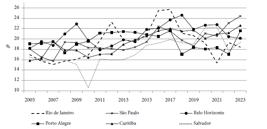
Distribution of municipal health resources according to selected capitals. Brazil, 2005 -2023.
Reform of the PHC healthcare model in Rio de Janeiro
Based on the theoretical framework and research instruments used to evaluate the services left as a legacy by Starfield8, these were adapted to the Brazilian reality (Supplementary Material 3, available at: https://doi.org/10.48331/scielodata.PNW6YL). The RCAPS in Rio de Janeiro was structured based on essential attributes: (i) access to and provision of first-contact services, (ii) the assumption of longitudinal responsibility by the patient and their family regardless of the absence or presence of disease, (iii) the guarantee of comprehensive care based on consideration of the physical, psychological, and social spheres of health within the limits of the health teams’ action, (iv) the coordination of the various actions and services necessary to resolve less frequent and more complex needs; along with “derived” attributes: (v) family guidance, (vi) community guidance through epidemiological knowledge of a given location, (vii) cultural competence, which refers to the relationship among health professionals with specific cultural characteristics.
A health system geared toward toward subspecialization threatens the goals of equity. The resources for highly technical, disease-oriented care compete with those required to provide basic services, especially for people who cannot afford them. Health services, as one of the direct determinants, can play a role in improving health, even in the face of notable inequities in the distribution of wealth, if under a strong Primary Care guidance8.
Access: Towards five million Rio de Janeiro residents with Family Health teams
The historical series with the evolution of the estimated coverage of citizens with Family Health teams over the last 15 years has been remarkable: Rio de Janeiro began with only 68 complete teams registered, with doctors (despite the SCNES of December/2008 indicating 163 teams, which was clearly incomplete), and then moved toward an accelerated growth of 1,356 teams in November/2024. To make the series comparable over time, we consider that, on average, a team is responsible for 3,450 registered individuals linked to primary care units (Municipal Health Centers, School Health Centers, and Family Clinics). It is important to remember that this was the parameter used by the Ministry of Health in 2008, which is where the term “potential population coverage” was coined, that is, the average mentioned above is considered in a homogeneous sense to define the number of people potentially covered by the teams. As a result, between 2008 and 2024, the city of Rio de Janeiro went from 234,600 people (3.5%) to 69.5% of the total number of residents in the city of Rio de Janeiro. It is projected that in 2025, with the increase in the number of teams, the city of Rio de Janeiro will reach more than five million residents with complete FHS teams (Graph 2) and around 25% of these with Oral Health teams (equipes de Saúde Bucal - eSB).
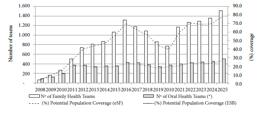
Evolution of the number of family health teams, oral health and potential population coverage. Municipality of Rio de Janeiro, 2008-2025 (*).
This expansion has been accompanied by an unprecedented increase in the number of outpatient procedures, reaching a growth of 1,179.4% between 2009 and 2024 (monthly average exceeded the initial 458,000, rising to 5.9 million procedures/exams). Furthermore, in October/2024, health teams in PHC reached a total of 22,411 professionals, with emphasis on 7,534 CHAs, 1,433 health surveillance agents (HSAs), 1,759 doctors, 1,534 nurses, 447 dentists, 1,755 nursing technicians, 608 oral health assistants/technicians, and 428 pharmacy teams, together with other higher education professionals (2,616) and miscellaneous professionals (4,297) (Supplementary Material 4, available at: https://doi.org/10.48331/scielodata.PNW6YL).
Pay for performance indicators: on access to and longitudinality of care
One of the ways the City Hall of Rio de Janeiro has found to measure and evaluate the performance of healthcare teams over time is through the use of performance indicators that have been progressively implemented since 2012 and are subject to a constant process of review and improvement. These indicators are associated with the PHC attributes mentioned above. Despite the warnings from authors who study this area that when there is motivation and incentives accepted as a salary supplement, with formal compliance with what was agreed upon, there is still a risk of opportunistic behavior24,25. Nevertheless, the administrative board chose to use them, with the initial mission of creating an organizational culture of recording and inducing good practices in the use of electronic medical records since mid-2010.
In this way, the professionals who make up the teams in each unit have extra financial incentives that allow them to earn a 14th salary, if well-defined goals are met (agreed as “variable parts 2 and 3” in the management contract). One of the most important indicators, which measures access and the longitudinality of care, refers to the percentage of consultations carried out by the family doctor. In Rio de Janeiro, the expected target is between 70% and 90%. In Lisbon, the reference for this same indicator ranges between 75% and 80%. This means that 100% of the doctor´s appointments of a SUS user in PHC are not expected to be done with the same family doctor, since there are periods of inter-doctor substitution in order to attend conferences and internal or external meetings, as well as vacation periods and even leaves of absence. The results found in the city of Rio de Janeiro indicate that, in 2024, the results of this indicator were always close to 80%, and therefore within the expected target (Graph 3).
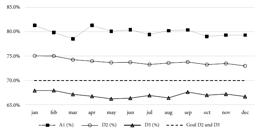
Regarding the monitoring of two of the main chronic conditions - diabetes and hypertension - the results proved to be different, with the target for both being at least 70%. In the first case, values above the target were found, that is, the proportion of registered people with diabetes with at least two appointments recorded in the last 12 months, at least one medical and one nursing, varied around 75% throughout 2024. The proportion of registered people with hypertension with at least two appointments recorded in the last 12 months (also at least one medical and one nursing appointment) fluctuated below 70%. However, the question can be raised about the lack of registration by the professionals of the teams or even the registration done in an inappropriate place in the medical record (Graph 3).
In times of Digital Health, a new indicator is being monitored with inputs into the electronic medical record: “the proportion of non-face-to-face scheduled appointments, whether by telephone, email, or electronic medical record web platform”. With the advent of the COVID-19 pandemic, between 2020-2022, new tools and technological solutions have been developed with incentives and regulations in Brazil, in such a way that certain types of appointments can be carried out in a non-face-to-face or remote mode. In the city of Rio de Janeiro, this indicator exceeded the target of 10% in 2024, remaining between 12% and 13% (data not tabulated).
Care coordination: What does the research say?
Regarding the attribute of care coordination, also since 2012, family and community doctors have been responsible in each unit for outpatient regulation functions for other levels of the system, scheduling appointments for other specialists and exams for diagnostic support online directly through SISREG, the Ministry of Health’s System, in the entire network, which counts on dozens of municipal, state, federal, and private service providers accredited with SUS. This means that a more experienced doctor from the primary care unit itself organizes his/her work process to include a period of regulation of the requests for appointments and exams from the unit itself, that is, from the colleagues who work in the unit.
Two surveys (2014 and 2024) were conducted with samples of users of public health services in the city of Rio de Janeiro to assess the extent to which PHC attributes have been developed, which help us understand this important aspect of health care13,26 (Supplementary Material 5, available at: https://doi.org/10.48331/scielodata.PNW6YL).
In these two surveys, the main estimated outcome was the PCATool-Brazil indicator or score - a score ranging from 0 to 10. In the instrument’s methodology, a score above 6.6 was considered satisfactory, that is, PHC services were adequately connected to their attributes. We observed that, for both child and adult users, a satisfactory index was reached in 2024, that is, we can state that PHC in Rio de Janeiro coordinated health care for the entire municipal network during the period evaluated in this study. Between 2014 and 2024, the PCATool-Brazil score that measures this attribute increased from 6.0 to 7.3 in children and from 6.6 to 7.2 in adults. Despite this, it was important to note that, with the enormous growth of PHC units, the medical resolution rate in PHC decreased, on average for the municipality, in both time periods. In 2014, 16.6% of those responsible for children and 28.3% of adults were unable to resolve their health problem at the unit on the day of the medical appointment. In 2024, these values increased to 22.5% (children) and 49.0% (adults). The city of Rio de Janeiro itself set a target of around 20%. In October 2023, in another survey, this time addressing workers in PHC units, there was a perception among 73.4% of those interviewed in Family Clinics and 69.6% in Municipal Health Centers that their units serve more than their service capacity27.
How to monitor the development of actions and procedures in PHC: service portfolioaq
Created in 2011 by the Rio de Janeiro Municipal Health Department28, the service portfolio sets out a minimum standard expected for the provision of services to be made available in all PHC units. Only in 2019 did the Brazilian Ministry of Health create a “national portfolio” for the entire country. According to Cunha et al.29, “by defining a transparent list of actions and services aimed at the most frequent health problems and conditions, we have the necessary ‘leverage’ to move the ‘world’ of comprehensiveness and bring it into the daily lives of people and PHC teams”.
In 2010, the city of Rio de Janeiro created a digital tool called “carteirômetro”, which has stopped being publicized by SMS-RJ since 2018, thus losing the ability to monitor, with transparency for the population of Rio de Janeiro, the development of actions and procedures carried out by FHS teams. Coincidentally, the attribute most poorly evaluated in the most recent external evaluation survey pointed precisely to “comprehensiveness - services available” and “comprehensiveness - services provided” as those with the greatest weakness for the population that uses the services of Family Clinics and Municipal Health Centers (PCATool-Brazil scores, below 6.0 for child users and below 5.0 for adult users)13.
Discussion
One path designated by the approved Annual Budget Law (LOA-2025) is to strengthen all levels of care by 2025, indicating a path for five million residents of Rio de Janeiro with FHS teams, strengthening the care model and expanding access to medium complexity, with the expansion of more “Super Health Centers”, the modern and technological polyclinics created in the city of Rio de Janeiro. But how can this assessment be carried out in a simple and contextualized manner, based on the experience of SUS users? A recent population-based household study pointed out the existence of a strong association between people who offer a high evaluation of services and higher indices among the PCATool-Brazil scores considering all of the Brazilian states30.
The expansion of the implementation of sample research panels to evaluate PHC services in Rio de Janeiro is an essential strategy for the continuous monitoring of the processes and results obtained by the FHS teams, which represent the central pillar of the RCAPS. This approach aims to provide consistent and updated data that can support the decisions of the municipal SUS management team, allowing adjustments and improvements in the services offered and provided. Major progress in this regard was achieved with the creation of the Center for Epidemiological Intelligence (CEI), which has stood out as an important tool for the analysis and integration of information related to public health in the city. However, there is still a significant gap in the integration of microdata from IBGE households and census surveys. This rift between the municipal management databases and the detailed information from the Institute limits the ability to optimize the understanding of the specific needs of each territory, hindering a more precise analysis of health conditions at the local level and the formulation of public policies that are more appropriate to the particularities of each territory. To overcome this challenge, a viable alternative would be to use the National Registry of Addresses for Statistical Purposes (Cadastro Nacional de Endereços para Fins Estatísticos - CNEFE) from the IBGE itself as a basis for the territorialization of health units. This tool can serve as a strategic starting point to improve the allocation and management of health services, enabling a more precise approach aligned with the specificities of each area of the city. In other words, the use of statistical intelligence, associated with the combination of data from different sources, can represent a significant innovation in the way health services are monitored and assessed, promoting more efficient and personalized management that more effectively meets the needs of the population of Rio de Janeiro.
The main challenge faced by healthcare management when investing in training processes is the need to remove professionals from their workplaces to participate in training and qualifications. This measure can create gaps in services and overload teams, which makes it necessary to use technological resources that allow for learning in a flexible manner, with low impact on daily activities. Advanced Distance Learning (DL) tools, with high interactivity and support from artificial intelligence, offer the possibility of personalizing teaching, adapting content to the needs of professionals and allowing individualized monitoring of their progress.
The implementation of DL tools with a high degree of interaction and artificial intelligence resources presents a significant opportunity to expand access to formal education courses currently offered by SMS-RJ. These innovative technologies can contribute decisively to the training process and continuing education of SUS professionals in Rio de Janeiro, ensuring that the training of the public health workforce in Rio de Janeiro is continuous and effective, without compromising the quality of care provided to the population. In 2025, the OTICS-Rio Station Network, in conjunction with RCAPS, will celebrate 15 years since its creation31. This network represents a fundamental milestone in strengthening public health and education policies in the city, playing a crucial role in integrating technology into the educational process of health professionals and workers. The continuity and advancement of this network are essential to ensure that the Rio de Janeiro SUS system remains aligned with the best training and qualification practices, in turn promoting more efficient management, with professionals who are better prepared to meet the demands of the population with safety and excellence. The use of distance learning, therefore, reaffirms itself as a strategic tool for the evolution of the health education model in Rio de Janeiro, keeping pace with technological transformations and the needs of the Rio de Janeiro SUS workforce.
Final considerations
The main challenges of the new healthcare model, implemented after the restructuring of the SMS-RJ organizational chart in January 2009, and which was subsequently improved, are directly linked to the need for a profound cultural transformation in the city’s public healthcare system, which required the adoption of a management model focused on inducing good practices based on results, with the introduction of new management tools and practices. The implementation of mechanisms to monitor accountability, combined with the use of indicators monitored in real time, represented a significant advance in the search for greater transparency and efficiency in the management of public resources. Budget decentralization, one of the main pillars of this model, brought with it expanded responsibility for managers of the city’s different planning areas. This movement required each healthcare unit to adapt to new ways of working, establishing and strengthening local teams prepared to deal with the specificities of the territories, without losing sight of the general guidelines of the municipal public health policy. This change also imposed upon local managers the responsibility of planning and executing actions more autonomously, with a focus on results and more dynamic and adaptive management.
However, the challenges are not limited to adapting to the new management tools. The cultural transformation required to internalize this new management approach required time, training, and above all, effective alignment among the various spheres of municipal management. The transition to a results-oriented model is not simple, and the need for coordination between the central, local, and regional levels required the reorganization of teams and the construction of a mindset focused on efficiency, continuous assessment, and the ability to respond quickly to the demands of the population. Thus, the progress achieved with the implementation of the new health management model in Rio de Janeiro was notable, but the path to its full consolidation remains challenging. Constant review and improvement of management practices are essential, as is the ongoing commitment to training and qualifying the professionals involved so as to ensure that the expected results are not only achieved, but also sustained over time.
This article presents the main references that underpinned the Primary Health Care Reform (RCAPS) in the city of Rio de Janeiro, recommending that new studies be conducted to assess its effective implementation, considering the strategic axes defined throughout the municipal management cycles of the last 15 years. The Family Health Strategy has consolidated itself as the main gateway to PHC services in the city, also attracting the middle class of Rio de Janeiro, who began to attend health units, along with the vaccination schedule offered by the Municipal Health Department. This experience demonstrated the viability of RCAPS in a large city with over six million inhabitants, and pointed out some limitations that need to be addressed: (i) the need to reorganize continuing education processes, with an emphasis on dialogue between primary care and hospital care, (ii) improving communication with the population that uses SUS, and (iii) insufficient tripartite funding, especially from the State Government. Finally, it would be ideal for the city to return to the levels of its own resources allocated to health seen in 2016, when the municipality allocated 25% of its own expenses to this area. The integration of Digital Health, as a strategic axis to improve communication, expand access and ensure greater resolution, is today consolidated as the greatest challenge for municipal management, representing the key to the evolution and modernization of public health services in the city of Rio de Janeiro. Overcoming these challenges will be decisive to guarantee the sustainability of the Rio de Janeiro SUS system and the quality of care for the population in the long term.
References
- 1 Cazelli CM. Avaliação da implementação do Programa de Saúde da Família no Município do Rio de Janeiro [dissertação]. Rio de Janeiro: Escola Nacional de Saúde Pública Sergio Arouca, Fundação Oswaldo Cruz; 2003.
-
2 Brasil. Ministério da Saúde (MS). Secretaria de Gestão Estratégica e Participativa. Departamento de Informática do SUS - DATASUS [Internet]. [acessado 2015 abr 20]. Disponível em: http://siops.datasus.gov.br/consleirespfiscal.php
» http://siops.datasus.gov.br/consleirespfiscal.php -
3 Brasil. Ministério da Saúde (MS). Secretaria de Atenção à Saúde. Departamento de Atenção Básica [Internet]. 2014 [acessado 2015 maio 20]. Disponível em: http://dab.saude.gov.br/portaldab/historico_cobertura_sf.php
» http://dab.saude.gov.br/portaldab/historico_cobertura_sf.php - 4 Soranz D, Pinto LF, Penna GO. Eixos e a Reforma dos Cuidados em Atenção Primária em Saúde (RCAPS) na cidade do Rio de Janeiro, Brasil. Cien Saude Colet 2016; 21(5):1327-1338.
- 5 Harzheim E, Hauser L, Pinto LF. Avaliação do grau de orientação para Atenção Primária em Saúde: a experiência dos usuários das Clínicas da Família e Centros Municipais de Saúde na cidade do Rio de Janeiro. Tabela A1. Relatório Final de Pesquisa PCATool Rio 2014. Rio Grande do Sul: Faculdade de Medicina, Universidade Federal do Rio Grande do Sul; 2015.
- 6 Prefeitura da Cidade do Rio de Janeiro. Plano Estratégico da Prefeitura da Cidade do Rio de Janeiro 2009-2012 - pós-2016. O Rio mais integrado e competitivo. Rio de Janeiro: Prefeitura da Cidade do Rio de Janeiro; 2010.
- 7 Rio de Janeiro. Secretaria Municipal de Saúde e Defesa Civil. Plano Municipal de Saúde 2009-2013. Rio de Janeiro: Secretaria Municipal de Saúde e Defesa Civil; 2009.
- 8 Starfield B. Atenção Primária: equilíbrio entre necessidades de saúde, serviços e tecnologia. Brasília: UNESCO, Ministério da Saúde; 2002.
- 9 Hartz ZMA, organizador. Avaliação em Saúde: dos modelos conceituais à prática na análise da implantação de programas. Rio de Janeiro: Fiocruz; 1997.
- 10 Rio de Janeiro. Secretaria Municipal de Saúde (SMS). Plano Municipal de Saúde 2014-2017. Rio de Janeiro: SMS; 2013.
- 11 Rio de Janeiro. Secretaria Municipal de Saúde (SMS). Plano Municipal de Saúde 2014-2017. Rio de Janeiro: SMS; 2018.
- 12 Harzheim E, organizador. Reforma da Atenção Primária à Saúde na cidade do Rio de Janeiro - avaliação dos três anos de Clínicas da Família. Pesquisa avaliativa sobre aspectos de implantação, estrutura, processo e resultados das Clínicas da Família na cidade do Rio de Janeiro. Porto Alegre: OPAS; 2013.
- 13 Harzheim E, coordenador. Avaliação do grau de orientação para a Atenção Primária à Saúde entre as unidades de saúde na cidade do Rio de Janeiro - 2024. Relatório Final da Pesquisa - PCATool Rio-2024. Porto Alegre: Faculdade de Medicina, Universidade Federal do Rio Grande do Sul; 2025.
- 14 Pisco L. Reforma da Atenção Primária em Portugal em duplo movimento: unidades assistenciais autónomas de saúde familiar e gestão em agrupamentos de Centros de Saúde. Cien Saude Colet 2011; 16(6):2841-2852.
- 15 Portugal. Presidência do Conselho de Ministros. Resolução do Conselho de Ministros nº 157/2005. Determina a criação de uma estrutura de missão para a reforma dos cuidados de saúde primários. Diário da República 2005; 12 out.
- 16 Engstrom EM, Motta JI, Venancio SA. A formação de profissionais na pós-graduação em saúde pública e atenção primária à saúde no município do Rio de Janeiro, Brasil. Cien Saude Colet 2016; 21(5):1461-1470.
- 17 Justino ALA, Oliver LL, Melo TP. Implantação do Programa de Residência em Medicina de Família e Comunidade da Secretaria Municipal de Saúde do Rio de Janeiro, Brasil. Cien Saude Colet 2016; 21(5):1471-1480.
- 18 Pinto LF, Soranz D. Doutorado Profissional em Atenção Primária em Saúde (DPAPS): o início de um legado para o SUS carioca. Cien Saude Colet 2024; 29(10):e13872024.
- 19 Patton C, Sawicki D. Basic methods of policy analysis and planning. New Jersey: Pearson Prentice Hall; 1993.
- 20 Campbell S, Reeves D, Kontopantelis E, Sibbald B, Roland M. Effects of Pay for Performance on the Quality of Primary Care in England. N Engl J Med 2009; 361:368-378.
- 21 Saltman RB, Rico A, Boerma WGW. Primary care in the driver's seat? Organizational reform in European primary care. Berkshire: Open University Press; 2006.
- 22 Brasil. Ministério da Saúde (MS). Portaria GM/MS nº 5.893, de 6 de dezembro de 2024. Estabelece recurso do Bloco de Manutenção das Ações e Serviços Públicos de Saúde - Grupo de Atenção Especializada, a ser incorporado ao Município do Rio de Janeiro no Estado do Rio de Janeiro. Diário Oficial da União 2024, 9 dez.
-
23 Portugal. Serviços Partilhados do Ministério da Saúde. Serviço Nacional de Saúde, Portugal [Internet]. 2024 [acessado 2024 nov 20]. Disponível em: https://www.spms.min-saude.pt/.
» https://www.spms.min-saude.pt - 24 Gérvas J, Ortun V, Palomo L, Ripoll MA. Incentivos en Atención Primaria: de la contención del gasto a la salud de la población. Rev Esp Salud Publica 2007; 81(6):589-596.
- 25 Poli Neto P, Faoro NT, Prado Junior JC, Pisco LAC. Remuneração variável na atenção primária à saúde: relato das experiências de Curitiba e Rio de Janeiro, no Brasil, e de Lisboa, em Portugal. Cien Saude Colet 2016; 21(5):1377-1388.
- 26 Harzheim E, Hauser L, Pinto LF. Avaliação do grau de orientação para Atenção Primária em Saúde: a experiência dos usuários das Clínicas da Família e Centros Municipais de Saúde na cidade do Rio de Janeiro. Relatório Final de Pesquisa PCATool Rio 2014. Rio Grande do Sul: Faculdade de Medicina, Universidade Federal do Rio Grande do Sul; 2015.
- 27 Rio de Janeiro. Secretaria Municipal de Saúde (SMS). V Pesquisa de Opinião com os Trabalhadores da Saúde da Prefeitura da Cidade do Rio de Janeiro. SMS-RJ e Riosaúde. Rio de Janeiro: SMS; 2023.
- 28 Rio de Janeiro. Secretaria Municipal de Saúde e Defesa Civil (SMSDC). Guia de Referência Rápida. Carteira de Serviços: Relação de serviços prestados na Atenção Primária à Saúde. Rio de Janeiro: SMSDC; 2011.
- 29 Cunha CRH, Harzheim E, Medeiros OL, D'Avila OP, Martins C, Wollmann L, Faller LA. Carteira de Serviços da Atenção Primária à Saúde: garantia de integralidade nas Equipes de Saúde da Família e Saúde Bucal no Brasil. Cien Saude Colet 2020; 25(4):1313-1326.
- 30 D'Avila OP, Perrone LR, Ribeiro MC, Pinto LF. O uso do Net Promoter Score para avaliação da Atenção Primária à Saúde: resultados de inquéritos de base populacional. Cien Saude Colet 2024; 29(11):1-10.
-
31 Prefeitura da Cidade do Rio de Janeiro. Secretaria Municipal de Saúde. Portal da Rede OTICS-RIO [Internet]. 2025 [acessado 2025 jan 5]. Disponível em: https://oticsrio.com.br/.
» https://oticsrio.com.br

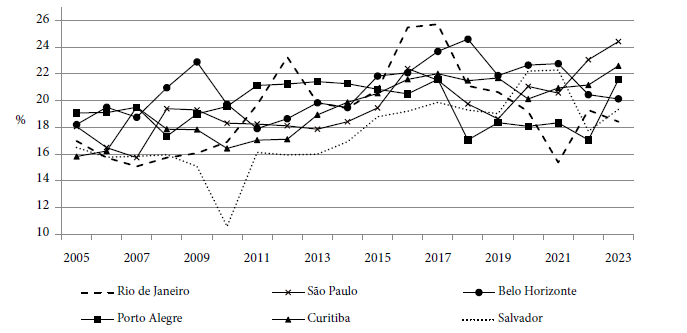 Source: SIOPS, Ministry of Health (available from: http://siops.datasus.gov.br/rel_subfuncao.php). For health data/own prescriptions, http://siops.datasus.gov.br/mctc_seleciona_ente.php [cited 2024 dez 10].
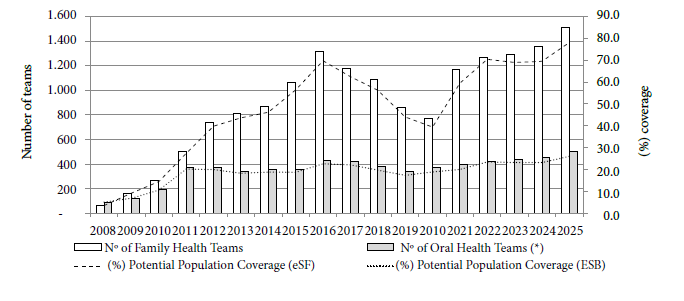 Note: Only family health teams were considered. EAB/EAP were not included. (*) Number of teams planned based on the LOAS (2025) presented to the Rio de Janeiro City Council by SMS-RJ. With this projection, it is estimated that in 2025, the mark of five million Rio residents with Family Health Teams will be surpassed, if we consider that on average an FHS is responsible for 3,450 people. Source: Authors, based on SCNES/Ministry of Health, eGestor APS and population projections and censuses - IBGE.
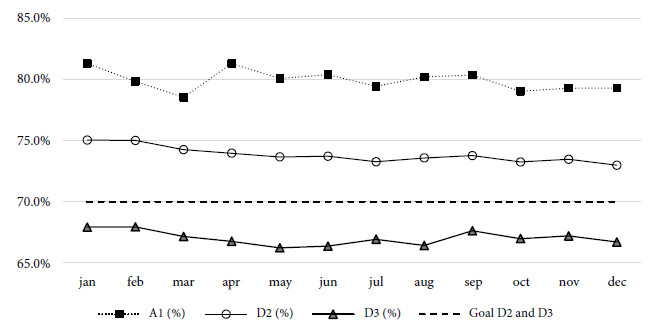 Note: Only FHS teams were considered, with a total of 1,359 teams (code 70) registered in the extraction of indicators from variable part 2 in December 2024. Basic Care (eAB) and Primary Care (eAP) teams were not included. Source: Authors, based on raw data provided by the electronic medical record with data aggregated by SMS-RJ.