 Level of physical activity prior to injury and its impact on functioning of people with spinal cord injury
ABSTRACT
The activity level of a person with spinal cord injury (SCI) can influence their functioning, independence and autonomy. This study aimed to evaluate the level of physical activity prior to SCI and its relationship with the individual’s functioning after hospital discharge. This is a quantitative, longitudinal, and analytical study with individuals diagnosed with traumatic SCI, with injury time ≤18 months, aged over 18 years old, hospitalized for rehabilitation. The following instruments were used: identification, sociodemographic profile and medical history questionnaire, international physical activity questionnaire (IPAQ-Short Form) and the spinal cord independence measure - self-reported version questionnaire (brSCIM-SR). Sample was composed of 35 subjects with average age of 41.9 years, mostly males, classified as complete SCI (AIS A grade). Individuals with SCI showed a significant improvement in functioning at discharge from the rehabilitation program. Most individuals were classified as active, when correlating the level of physical activity prior to injury with functional level at discharge. A moderate positive correlation was found between physical activity prior to the injury and the functional level after the injury, suggesting that an active life prior to the injury may favor better functioning in SCI.
Keywords:
Spinal Cord Injury; Physical Performance; Rehabilitation
RESUMO
O nível ativo da pessoa com lesão medular espinhal (LME) pode influenciar sua funcionalidade, independência e autonomia. O objetivo do estudo é avaliar o nível de atividade física pré-lesão e sua relação na funcionalidade da pessoa com LME após um período de internação. É um estudo analítico, longitudinal quantitativo, com amostra composta de indivíduos com diagnóstico de LME traumática, com tempo de lesão ≤18 meses, maiores de 18 anos, internados para reabilitação. Os instrumentos utilizados foram: questionário de identificação, perfil sociodemográfico e anamnese, questionário internacional de atividade física (IPAQ) - versão curta e o questionário spinal cord independence measure - self-reported version (brSCIM-SR). A amostra foi composta por 35 sujeitos com idade média de 41,9 anos, a maioria do sexo masculino, com nível de lesão torácica, classificados com AIS A. Houve melhora significativa da funcionalidade do indivíduo com LME na alta do programa de reabilitação, sendo que a maioria da amostra foi classificada como ativa. Ao correlacionar o nível de atividade física antes da lesão com o nível de funcionalidade na alta do sujeito, observou-se correlação positiva moderada, entre nível de atividade física prévio à lesão com o nível funcional após a lesão, sugerindo que uma vida ativa antes da lesão pode favorecer uma melhor funcionalidade na LME.
Descritores:
Traumatismos da Medula Espinal; Desempenho Físico; Reabilitação
RESUMEN
El nivel activo de la persona con lesión medular espinal (LME) puede influir en su funcionalidad, independencia y autonomía. El objetivo de este estudio es evaluar el nivel de actividad física previo a la lesión y su relación con la funcionalidad de la persona con LME después de un período de hospitalización. Se trata de un estudio longitudinal analítico, cuantitativo, con una muestra compuesta de individuos diagnosticados de LME traumática, con tiempo de lesión ≤18 meses, con más de 18 años de edad, hospitalizados para rehabilitación. Los instrumentos utilizados fueron cuestionario de identificación, perfil sociodemográfico y anamnesis, cuestionario internacional de actividad física (iPAQ) -versión corta- y cuestionario spinal cord independence measure - self-reported version (brSCIM-SR). La muestra estuvo conformada por 35 sujetos, con una edad media de 41,9 años, la mayoría del sexo masculino, con un nivel de lesión torácica, clasificados con AIS A. Hubo una mejora significativa en la funcionalidad del individuo con LME al alta del programa de rehabilitación, y la mayor parte de la muestra se clasificó como activa. Al correlacionar el nivel de actividad física antes de la lesión con el nivel de funcionalidad al alta del sujeto, se observó una correlación positiva moderada entre el nivel de actividad física previo de la lesión y el nivel funcional después de la lesión, lo que sugiere que una vida activa antes de la lesión puede favorecer una mejor funcionalidad en la LME.
Palabras clave:
Traumatismos de la Médula Espinal; Rendimiento Físico; Rehabilitación
INTRODUCTION
Spinal cord injury (SCI) is a condition that leads to disabling sequelae, affecting motor, sensory, autonomic, and psychoaffective domains. In turn, independence, participation, and reinsertion in activities of daily living (ADL), work, leisure, and social activities are directly impacted1-3.
In Brazil, traumas leading to SCI are underreported, yielding inaccurate data on incidence and prevalence4. The worldwide incidence of SCI is 10 cases per 100,000 people, with 700,000 annual cases. Also, SCI represents a major predictor of mortality, becoming a public health problem5.
Impaired functioning is the greatest impact on the life of SCI victims, with physical unfitness being the most impactful factor6,7. Subjects with SCI tend to be less active, becoming dependent on others and being more predisposed to develop diseases associated with immobility2, such as cardiovascular, cardiorespiratory, and metabolic complications8. The lack of physical fitness is closely linked to the inactivity of people with SCI, whose conditions stem from fatigue and muscle weakness, making a more active lifestyle and the practice of physical exercises strategies to make the person more participative in their ADLs, in society, as well as to improve quality of life9.
Literature indicates that staying active after SCI is essential for physical and functional performance and to reduce complications associated with immobility, such as dyslipidemias, altered blood sugar levels, vascular alterations, and musculoskeletal deformities7,10. Research on the impact of a more active life after SCI has increased in the scientific community. To the best of our knowledge, no studies have related the physical activity level prior to an SCI and functioning after injury. Therefore, this study aimed to evaluate the level of physical activity prior to an SCI and its relationship with the functioning of these individuals after hospitalization.
METHODOLOGY
Study design
This is an analytical, longitudinal and quantitative study carried out in the rehabilitation inpatient ward of a State Rehabilitation Center in the city of Goiânia, Goiás State, Brazil. The research complied with the recommendations of Resolution No 466/201211. All participants signed an informed consent form. Data collection was conducted after approval by the Research Ethics Committee.
Population
The following inclusion criteria were used: clinical diagnosis of SCI; both sexes; age ≥18 years; any level of injury; complete or incomplete traumatic injuries, and with time of injury ≤18 months. Subjects under tracheostomy that prevented verbal language, and those with neurological impairment that prevented the comprehension and response of the proposed questionnaires were excluded. Sample size was estimated using the G.Power ®, considering the methodology a posteriori, using the functional level variable (brSCIM-SR), with 94% beta power and 5% alpha power. Thus, 35 participants were necessary.
Instruments and collection procedures
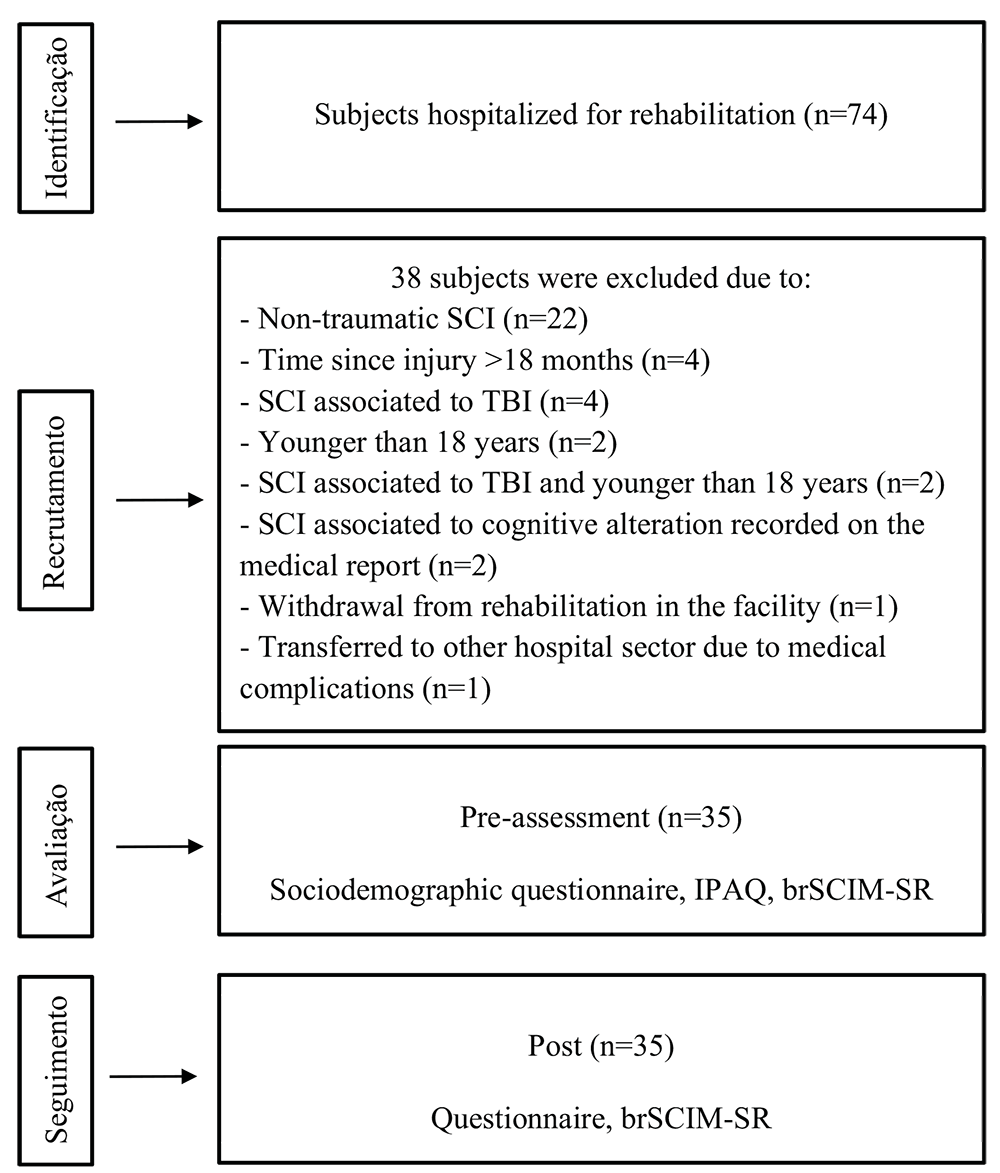
After signing the consent form, participants were interviewed in-person to collect data collection. A researcher applied the questionnaires at two moments, within the first 72 hours of hospitalization and 72 hours before hospital discharge. The following instruments were used: identification, sociodemographic profile and medical history questionnaire, international physical activity questionnaire - short form (IPAQ) and the spinal cord independence measure - self-reported version (brSCIM-SR) adapted to the Brazilian population (Figure 1).
Subjects eligibility flowchart. SCI: spinal cord injury; TBI: traumatic brain injury; IPAQ: International Physical Activity Questionnaire; brSCIM-SR: Brazilian Spinal Cord Independence Measure - Self-Reported Version.
Identification, sociodemographic profile, and medical history questionnaire
The identification, sociodemographic profile, and medical history questionnaire was developed by the researchers and consists of items on personal information (name, age, gender, marital status, education level) and data on the clinical picture (etiology, level of injury, and classification of the patient based on the American Spinal Injury Association Impairment Scale (AIS), time since the injury, length of hospital stay, body mass index (BMI), associated comorbidities, and what type of physical exercise, when performed. Clinical information the participant was unable to answer was searched in electronic medical records. Information on time and space was also collected with questions: “what is the name of the place where you are now?”, “what is the date of today?”, “what month are we?”, “what year are we?”, “what day of the week?”.
International Physical Activity Questionnaire (IPAQ)
To assess the level of physical activity in the week prior to spinal cord injury, the IPAQ-Short Form was used. This instrument classifies individuals as: very active, active, irregularly active (subclassified into A and B) and sedentary12.
Spinal cord independence measure - self-reported version (brSCIM-SR)
The assessment of the functional independence of people with SCI through brSCIM-SR is composed of 17 items that encompass important daily activities, distributed in three subsections: self-care, breathing and sphincter control, and mobility. The score varies according to each item depending on the level of difficulty, and can range from 0 to 100. Higher scores indicate better functioning13.
Statistical analysis
Data were tabulated in Excel spreadsheets, and the statistical analyses were carried out using the Minitab version 19 and Jamovi version 2.3. Data were subjected to normality test using the Shapiro-Wilk with graphical analysis and central trends. For paired comparison, the Wilcoxon and paired T-test. Spearman’s test was used to perform the correlation analysis. For all analyses, a 5% significance limit was considered.
RESULTS
A total of 74 subjects diagnosed with SCI were selected. Of these, 38 were excluded due to the study’s eligibility criteria. The sample consisted of 35 subjects with a mean age of 41.9±17.4 years, 28 (80%) male, mean BMI of 24.9±3.4kg/m2. Average length of hospitalization was 24.7 days. Table 1 shows the sample characterization, while Table 2 shows data regarding functioning before and after hospitalization.
Overall, most participants of our study were physically active before the injury: 48.6% active, 25.7% very active, 11.4% sedentary, 11.4% irregularly active A, and 2.9% irregularly active B.
We observed a significant improvement when comparing the functioning of the subject with SCI at admission and discharge from the rehabilitation program. Median brSCIM-SR at admission was 26 (11-52) and at discharge was 47 (12-61) (p=0.001). The correlation of functioning using the brSCIM-SR with clinical and sociodemographic aspects found a weak negative correlation with the brSCIM-SR score at the end of hospitalization for age (r=−0.49, p=0.002) and number of comorbidities (r=−0.34, p=0.041).
We observed a moderate positive correlation by correlating the level of physical activity prior to injury with the functional level after hospitalization for rehabilitation(r=0.33, p=0.04). There was an association between the IPAQ classification and the brSCIM-SR (R²=12.9%), that is, the brSCIM-SR explains 12.9% of the variation in the IPAQ classification (p=0.03).
DISCUSSION
Spinal cord injury is a condition that can directly influence the subject’s long-term functioning14. Among the research participants, a higher prevalence was observed in young/adults males, graded as A as per the AIS scale, and prevalence of thoracic injury, stemming from traumatic automotive accident, one month before the study. Our findings corroborates the literature regarding age, gender, and etiology. Notably, Rocha et al.14 found a longer average time since the injury (12.74 years) and Barbiellini Amidei et al.15 found a regarding injury level, in which cervical injury was more prevalent.
According to the IPAQ, most subjects were physically active prior to injury. Such outcome corroborates the findings by Wouda et al.16, who evaluated a similar population with same mean age using the IPAQ and observed they were physically active prior to the injury.
We identified a significant improvement in the functional level of our participants during the in-hospital rehabilitation, using the brSCIM-SR tool. By using the same scale, Dantas et al.17 and Richard-Denis et al.18 observed an improvement of the functioning of subjects with spinal cord injuries after rehabilitation in a specialized center. A study by Mahmoud, Qannam and Mortenson19 demonstrated the importance of early rehabilitation, aiming at increasing the functional level and adapting the subject to the new motor condition.
Our study found that the presence of comorbidities can directly influence the subject’s functioning, since-according to Gedde et al.20, Nightingale et al.8 and Silva et al.21-people with SCI may be prone to develop comorbidities due to sedentary lifestyle and immobility. Age is another aspect related to functional decline, as older people tend to have poorer functioning due to the senescent and senility aspects inherent to the aging process and the decrease in physical activity, as defined by Gonçalves22. Therefore, our study can explain the correlation found between younger people with SCI and better functional level.
A correlation was observed between physical activity level before the injury and functioning after hospitalization for rehabilitation of individuals with SCI. There are many studies in the literature advocating the importance of staying active after SCI23,24,10. However, there is scarce information on the relationship between the level of physical activity before injury and functioning after injury.
When studying physical activity level before the injury using the IPAQ, Wouda et al.16 showed that the participants of that study were active, but did not correlate this data with functioning after the injury, highlighting the novelty of our study. Staying active enhances neural plasticity, improving functions above the level of injury, favoring readaptation and an improved quality of life25. It also contributes to the restoration of impaired body functions and structures caused by the injury, reduces the limitations in ADLs and promotes the social participation of the subject26.
LIMITATIONS
The limitations of this study permeate a heterogeneous sample regarding the grade of SCI. Regarding IPAQ, there may be bias in the subjects not reliably remembering their routine in the last week prior to the injury. Finally, there are no specific instruments to assess the cognitive level of people with SCI. Despite these limitations, this study achieved a satisfactory sample size, enabling robust analyses and the novelty of the research.
CONCLUSION
Our results highlight physically active individual prior to the injury. Physical activity level prior to the injury was positively correlated with the functional level after the injury. The functional level of the subject with SCI significantly increased during intensive rehabilitation. Sociodemographic and clinical factors, such as age and comorbidities, can affect the functional level of the person with SCI.
DATA AVAILABILITY
The data underlying this study are available in the published article.
REFERENCES
-
1 Carvalhal SPSA. A intensidade do exercício prévio influencia na degeneração muscular em indivíduos submetidos à lesão medular? [dissertation]. Curitiba: Universidade Federal do Paraná; 2017 [cited 2026 Mar 10]. Available from: https://educapes.capes.gov.br/handle/1884/52651?mode=full
» https://educapes.capes.gov.br/handle/1884/52651?mode=full -
2 van der Westhuizen L, Mothabeng DJ, NKWENIKA TM. The relationship between physical fitness and community participation in people with spinal cord injury. South Afr J Physiother. 2017;73(1):e354. doi: 10.4102/sajp.v73i1.354
» https://doi.org/10.4102/sajp.v73i1.354 -
3 Brito LMO, Chein MBC, Marinho SC, Duarte TB. Epidemiological evaluation of victims of spinal cord injury. Rev Col Bras Cir. 2011;38(5):e304-9. doi: 10.1590/S0100-69912011000500004
» https://doi.org/10.1590/S0100-69912011000500004 -
4 Brasil. Ministério da Saúde. Secretaria de Atenção à Saúde. Departamento de Ações Programáticas Estratégicas e Departamento de Atenção Especializada. Diretrizes de Atenção à Pessoa com Lesão Medular [Internet]. Brasília, DF: Ministério da Saúde; 2013 [cited 2026 Mar 10]. Available from: https://bvsms.saude.gov.br/bvs/publicacoes/diretrizes_atencao_pessoa_lesao_medular.pdf
» https://bvsms.saude.gov.br/bvs/publicacoes/diretrizes_atencao_pessoa_lesao_medular.pdf -
5 Kumar R, Lim J, Mekary RA, Rattani A, Dewan MC, et al. Traumatic spinal injury: global epideliology and worldwide volume. World Neurosurg. 2018;113:e345-63. doi: 10.1016/j.wneu.2018.02.033
» https://doi.org/10.1016/j.wneu.2018.02.033 -
6 Chay W, Kirshblum S. Predicting outcomes after spinal cord injury. Phys Med Rehabil Clin N Am. 2020;31(3):331-43. doi: 10.1016/j.pmr.2020.03.003
» https://doi.org/10.1016/j.pmr.2020.03.003 -
7 Maher JL, Mcmillan DW, Nash M. Exercise and Health-Related Risks of physical deconditioning after spinal cord injury. Top Spinal Cord Inj Rehabil. 2017;23(3):175-87. doi: 10.1310/sci2303-175
» https://doi.org/10.1310/sci2303-175 -
8 Nightingale TE, Rouse PC, Walhin JP, Thompson D, Bilzon JLJ. Home-based exercise enhances health-related quality of life in persons with spinal cor injury: A randomized controlled trial. Arch Phys Med Rehabil. 2018;99(10):1998-2006. doi: 10.1016/j.apmr.2018.05.008
» https://doi.org/10.1016/j.apmr.2018.05.008 -
9 Baehr LA, Kaimal G, Hiremath SV, Trost Z, Finley M. Staying active after rehab: Physical activity perspectives with a spinal cord injury beyond functional hains. Plos One. 2022;17(3):e0265807. doi: 10.1371/journal.pone.0265807
» https://doi.org/10.1371/journal.pone.0265807 -
10 Ferri-Caruana A, Millán-González L, García-Massó X, Pérez-Nombela S, Pellicer-Chenoll M, et al. Motivation to physical exercise in manual wheelchair users with paraplegia. Top Spinal Cord Inj Rehabil. 2020;26(1):1-10. doi: 10.1310/sci2601-01
» https://doi.org/10.1310/sci2601-01 -
11 Brasil. Ministério da Saúde. Conselho Nacional de Saúde. Resolução nº 466, de 12 de dezembro de 2012 [Internet]. Brasília, DF: Ministério da Saúde; 2012 [cited 2026 Mar 10]. Available from: http://www.conselho.saude.gov.br/web_comissoes/conep/index.html
» http://www.conselho.saude.gov.br/web_comissoes/conep/index.html -
12 Matsudo S, Araújo T, Matsudo V, Andrade D, Andrade E, et al. Questionário Internacional de Atividade Física (IPAQ): Estudo de validade e reprodutibilidade no Brasil. Rev Bras Ativid Fís Saúde. 2001;6(2):5-18. doi: 10.12820/RBAFS.V.6N2P5-18
» https://doi.org/10.12820/RBAFS.V.6N2P5-18 -
13 Ilha J, Avila LCM, Santo CCE, Swarovski A. Tradução e adaptação transcultural da versão brasileira da Spinal Cord Independence Measure - Self - Reported Version (brSCIM-SR). Rev Bras Neurol. 2016;52(1):2-17. doi: 10.46979/rbn.v52i1.3197
» https://doi.org/10.46979/rbn.v52i1.3197 -
14 Rocha MA, Coura AS, França ISX, Feijão AR, Almeida IJS, et al. Funcionalidade familiar e estratégias de enfrentamento em pessoas com lesão medular. Acta Paul Enferm. 2021;34: eAPE000635. doi: 10.37689/acta-ape/2021AO000635
» https://doi.org/10.37689/acta-ape/2021AO000635 -
15 Barbiellini Amidei C, Salmaso L, Bellio S, Saia M. Epidemiology of traumatic spinal cord injury: a large population-based study. Spinal Cord. 2022;60(9):812-9. doi: 10.1038/s41393-022-00795-w
» https://doi.org/10.1038/s41393-022-00795-w -
16 Wouda MF, Lundgaard E, Becker F, Strøm V. Effects of moderate and high-intensity aerobic training program in ambulatory subjects with incomplete spinal cord injury - a randomized controlled trial. Spinal Cord. 2018;56(10):955-63. doi: 10.1038/s41393-018-0140-9
» https://doi.org/10.1038/s41393-018-0140-9 -
17 Dantas D, Amaro J, Silva P, Margalho P, Laíns J. Avaliação da recuperação funcional em lesionados medulares aplicando a Medida de Independência na Lesão Medular (SCIM) - Contributo para a validação da versão Portuguesa. RSPMFR. 2012;22(2):e20-27. doi: 10.25759/SPMFR.9
» https://doi.org/10.25759/SPMFR.9 -
18 Richard-Denis A, Chata R, Thompson C, Mac-Thione JM. Patterns and predictors of functional recovery from the subacute to the chronic phase following a traumatic spinal cord injury: a prospective study. Spinal Cord. 2020;58(1):43-52. doi: 10.1038/s41393-019-0341-x
» https://doi.org/10.1038/s41393-019-0341-x -
19 Mahmoud H, Qannam H, Mortenson B. Spinal Cord Injury rehabilitation in riyadh, saudi Arabia: Time to rehabilitation admission, length of stay and functional independence. Spinal Cord. 2017;55(5):509-14. doi: 10.1038/sc.2016.165
» https://doi.org/10.1038/sc.2016.165 -
20 Gedde MH, Lilleberg HS, Abmus J, Gilhus NE, Rekand T. Traumatic vs non-traumatic spinal cord injury: A comparison of primary rehabilitation outcomes and complications during hospitalization. J Spinal Cord Med. 2019;42(6):695-701. doi: 10.1080/10790268.2019.1598698
» https://doi.org/10.1080/10790268.2019.1598698 - 21 Silva LFM, Bandeira D, Freitas R, Santos VD, Dias CFC. A precaução de contato na prevenção e controle das infecções relacionadas à assistência à saúde. Rev Saúde AJES. 2021;7(13):e34-46.
-
22 Gonçalves ASA. Declínio funcional dos idosos e o envelhecimento ativo [dissertation]. Coimbra: Escola Superior de Enfermagem de Coimbra; 2022 [cited 2026 Mar 10]. Available from: https://pesquisa.bvsalud.org/portal/resource/pt/biblio-1425411
» https://pesquisa.bvsalud.org/portal/resource/pt/biblio-1425411 -
23 Kim DI, Taylor JA, Tan CO, Park H, Kim JY, et al. A pilot randomized controlled trial of 6-week combined exercise program on fasting insulin and fitness levels in individuals with spinal cord injury. Eur Spine J. 2019;25(5):1082-91. doi: 10.1016/j.metabol.2017.07.005
» https://doi.org/10.1016/j.metabol.2017.07.005 -
24 Ma JK, West CR, Ginis KAM. The effects of a patient and provider co-developed behavioral physical activity intervention on physical activity, phychosocial predictors, and fitness in individuals with Spinal Cord Injury: A randomized controlled trial. Sports Med. 2019;49(7):1117-31. doi: 10.1007/s40279-019-01118-5
» https://doi.org/10.1007/s40279-019-01118-5 -
25 Oliveira CQ, Refshauge K, Middleton J, Jong L, Davis G. Effects of Activity-based therapy interventions on mobility, Independence and quality of life for people with spinal cord injuries: a systematic review and meta-analysis. J Neurotrauma. 2017;34(9):1726-43. doi: 10.1089/neu.2016.4558
» https://doi.org/10.1089/neu.2016.4558 -
26 Stiens SA, Kirshblum SC, Groah SL, Mckinley WO, Gitter MS. Spinal cord injury medicine. Optimal participation in life after spinal cord injury: physical, phychosocial, and economic reintegration into the environment. Arch Phys Med Rehabil. 2002;82(3):S90-8. doi: 10.1053/apmr.2002.32156
» https://doi.org/10.1053/apmr.2002.32156
-
*
This study is part of the final project for the multiprofessional residency program in Functional Health and Rehabilitation by Jordana Batista da Silva Lima, conducted at the Goiás State Department of Health (2024), under the title “Level of physical activity prior to injury and its impact on the functionality of individuals with spinal cord injury.”
-
Financing source:
nothing to declare
-
Approved by the Ethics Committee CAAE No. 5.831.547/66234222.0.0000.0237.

 Source: Prepared by the author.