
 Socio-environmental problems in agricultural production areas: an analysis based on landscape perceptions
Abstract
The present research aims to report some socio-environmental problems, which can be noticed from the perceptions of the landscapes. These landscapes were visualized from the route taken to participate in classes in the Postgraduate Program in Geography at the Federal University of Jataí, observing the landscapes of eight municipalities in Mato Grosso (five) and Goiás (three). Based on these perceptions, it was possible to detect problems arising from agribusiness, such as: environmental degradation, social inequality and the presence of freight transport in urban areas. In this context, it is possible to conclude that the search for profit is something that is not limited, as small groups in society are favored to the detriment of the most vulnerable population.
Keywords:
agribusiness; socio-environmental problems; landscape
Resumo
A presente pesquisa tem como objetivo relatar alguns problemas socioambientais, os quais podem ser notados a partir das percepções das paisagens. Estas paisagens foram visualizadas a partir do trajeto percorrido para participar das aulas do Programa de Pós Graduação em Geografia da Universidade Federal de Jataí, sendo observadas as paisagens de oito municípios mato-grossenses (cinco) e goianos (três). Com base nessas percepções, foi possível detectar problemas provenientes do agronegócio, tais como: degradação ambiental, desigualdade social e presença de transporte de carga em áreas urbanas. Neste contexto o é possível concluir que a busca pelo lucro é algo que não há limitação, visto que há favorecimento a pequenos grupos da sociedade em detrimentos da população mais vulnerável.
Palavras-chave:
agronegócio; problemas socioambientais; paisagem
Resumen
La presente investigación tiene como objetivo reportar algunos problemas socioambientales, que pueden notarse a partir de las percepciones de los paisajes. Estos paisajes fueron visualizados a partir del recorrido realizado para participar de las clases del Programa de Postgrado en Geografía de la Universidad Federal de Jataí, observando los paisajes de ocho municipios de Mato Grosso (cinco) y Goiás (tres). A partir de estas percepciones fue posible detectar problemas derivados del agronegocio, tales como: degradación ambiental, desigualdad social y presencia del transporte de carga en las zonas urbanas. En este contexto, es posible concluir que la búsqueda de lucro es algo que no tiene limitación, ya que se favorece a pequeños grupos de la sociedad en detrimento de la población más vulnerable.
Palabras clave:
agronegocios; problemas socioambientales; paisaje
Introduction
In a revolutionary bias, from the ideals defended by Marx, resulted in several works that question the paths followed by society, mainly with the rise of capitalism, which accentuated social inequalities and favoritism of classes that make up a small part of the population to the detriment of the large population mass. (Engels; Marx, 1999).
These questions develop mainly due to the accentuation of social problems in all sectors, caused mainly after the industrial revolution. Therefore, authors who work with this bias have developed and are developing extremely important works that aim to promote a Geography that goes beyond academia, in other words, a Geography with social relevance that can make a difference especially for the majority of the population, which in Brazil and in much of the world is less favored, something essential in the agrarian sector (Marques, 2018).
Critical geographic thinking is present in practically all research sectors, such as: population, economy, politics, urban, as well as agrarian geography and others, so this trend was consolidated from the research of the Uspian school, the from important authors, such as Léa Goldenstein, Pasquale Petrone, Manoel Seabra, Antonio Carlos Robert de Moraes, Wanderley Messias, André Roberto Martin, Sandra Lencioni, Ana Fani A. Carlos, Amélia Luisa Damiani, Milton Santos and Ariovaldo U. de Oliveira , which guided several other authors to develop their research within the scope of Critical Geography, something that has increasingly consolidated over the years (Marques, 2018).
Within the scope of Agrarian Geography, research is based on some important authors, such as Ariovaldo de Oliveira, whose works highlight the promotion of a militant geography, which needs to be developed in order to improve the development of society, as well as bring to the population knowledge about the causalities of phenomena, so that it is possible to set goals seeking to achieve a fairer and more egalitarian social construction.
Ricardo Abramovay, also following the line of seeking academic production that contributes to society for social progress and the construction of an increasingly fair society, differs from Oliveira in some aspects, as in his works, vehemently, the The author emphasizes that it is very difficult to act against capitalism, due to the power exercised in society, but that it is always necessary to look for alternatives to alleviate problems, even if this is hard and slow work.
Marta Inês Medeiros Marques is also one of the main authors in understanding the social reality of Brazil, being an important theorist in contextualizing the consolidation of Critical Geography in the Agrarian sector.
Therefore, based on these important authors, it is possible to have support for the development of a Geography that can contribute to society, to social and egalitarian development, especially in the countryside, as this place is the “stage” of intense social inequality and accumulation. of capital.
This is the Geography we believe in, which we will try to contribute through the production of this article, being an article critical of the actions of public authorities in favor of large producers to the detriment of the most vulnerable population.
he objective of this research is to report some of the notable problems in municipalities that make up the reality we live in, given that the economies of the municipalities covered have their pillars in agribusiness. Therefore, we seek to emphasize the discrepancy between what is propagated to the population, a vision of progress, and the problems we face daily that could be resolved if the priority of those in power were not just the search for profit and capital accumulation.
Theoretical Reference
Geography is based on some main concepts to direct the path that this science has followed throughout its development. Based on these concepts, forms of analysis and definitions are created regarding the phenomena studied (Corrêa, 2004).
The concept of landscape is used both daily in our daily lives and in various studies and scientific areas (Corrêa, 2004).
Landscape, as a concept that summarizes the geographic object, must encompass environmental and aesthetic issues, including man and his actions, direct or indirect. To demonstrate the different approaches and development of the concept of landscape, below is a chronological synthesis of the different definitions and approaches to the concept (Holzer, 1999).
Alexander Von Humboldt made reference to the landscape, demonstrating his interest in the physiognomy and appearance of vegetation, the climate, its influence on beings and the general appearance of the landscape, which varies depending on the nature of the soil and its vegetation cover (Holzer, 1999).
German geographer and ethnographer, Friedrich Ratzel, argued contrary to Humboldt, as he emphasized anthropogenic issues when using the concept of landscape, showing that this concept is the result of the separation between man and his natural environment (Holzer, 1999).
Carl Sauer, American geographer and author of the book “The Morphology of Landscape” describes landscape as a complex organism, the result of the association of forms that can be analyzed. Consisting of natural elements available in a place, combined with human works resulting from the use that cultural group made of the land (Cavalcanti, 2014).
For Georges Bertrand, the concept of landscape is nothing more than a certain portion of space, the result of the dynamic, therefore unstable, combination of physical, biological and anthropic elements based on a dialectical interaction that makes the landscape an inseparable interaction between these elements and in constant and infinite evolution (Bertrand, 1971).
Aziz Nacib Ab’Saber understands the landscape as being the result of a relationship between past and current processes (Ab’Sàber, 2003).
We understand that the landscape did not come into existence after the birth of man, it was already present, but only when man perceives it does the defined concept emerge (Cavalcanti, 2014).
The landscape has acquired several meanings over time, going from the simple analysis of the physical components that make it up to the inclusion of man as an integral and modifying part of its reality (Cavalcanti, 2014).
Thus, as an object of interest in this study, the landscape can be understood as the product of interactions between elements of natural and human origin, in a given space. These landscape elements are organized dynamically over time and space (Christofoletti, 1999).
Therefore, from the perceptions of landscapes it is possible to observe various economic aspects and problems caused by favoritism to small groups in society.
In this sense, it appears that since 1500, economic activity in the countryside has been very present in Brazil and year after year it becomes increasingly stronger. Agribusiness has increasing production rates every year and results in the sector's prominence as the country's main economic activity (Vieira, 2019).
The ideas propagated to the population are only positive for the sector, developing in most individuals an idea of growth and progress, but something that is subject to questioning, given that the rates of hunger and unemployment are alarming, as well as the growth rates of the economy. are not proportional to the growth of agribusiness (Mitidiero Junior; Goldfarb, 2021).
Therefore, from these verifications it is possible to understand that the profit obtained from all this production is concentrated in the hands of a small part of the population and the environmental damage is considerable (Mitidiero Junior; Goldfarb, 2021).
However, the Brazilian countryside has interests that go beyond the economic situation, as there are traditional and historical populations that need the action of public policies to achieve their rights provided for in the Federal Constitution (Marques, 2002).
In Brazil there is significant complexity in the field, this is due to the different communities and social classes present and also the diversity of morphoclimatic domains and natural resources (Marques, 2002).
On the part of communities with historical characteristics, there are conflicts involving quilombolas and indigenous people, these conflicts are concentrated in the capitalist bias due to the attacks of agribusiness “barons”, miners and wood extractors, who try to expand the areas for exploitation being against the demarcation of indigenous and quilombola territories (Abramovay, 1992).
In Brazil there are two groups of people who are very important in aspects of rural conflicts: the quilombolas, which we highlight are groups that have been in the country since colonial Brazil and suffer from late and inadequate policies to abolish slavery; the original peoples of this Federation who have their populations reduced year after year. This importance is characterized by the need for public policies that address their desires with a sense of justice and based on the Federal Constitution (Abramovay, 1992).
Conflicts involving landless workers also have their bases in the Federal Constitution, which ensures that land must bring a return to the population through productivity and profitability. However, in Brazil there are problems with titling, the existence of unoccupied land and when there is any government regulation, the tendency is always to favor capitalists, with real agrarian reform becoming less and less unfeasible (Oliveira, 2016).
An example of this favoritism is the handing over of land titles to people who grabbed spaces and obtained titles from the Bolsonaro government for these places, which should belong to agrarian reform (Rohden, 2022).
Another preponderant factor is the growth of the agricultural frontier favoring large productions, to the detriment of family farming through public policies, resulting in family farming increasingly subject and subordinated to the interests of agribusiness (Oliveira, 2016).
If there are no fair public policies, family farming is increasingly part of the capitalist system, with less power of influence in the countryside and this class increasingly loses its essence, that is, when agribusiness does not extinguish the family farming location , the same outlines a mechanism for this class to contribute to its profits, either as a buyer of raw materials or as a middleman for products manufactured in family farming locations (Paulino, 2008).
Environmental issues also characterize serious problems, as there are no limits to agribusiness production, even if this has to increase deforestation rates or the use of pesticides, generating problems of contamination, pollution and contributions to climate change (Rohden, 2022).
Not only are conflicts and environmental degradation problems arising from agribusiness, as from the moment income is concentrated in the hands of small groups in society, the impact appears on the population, through social inequality, segregation and hand-holding. -inadequate workmanship (Mitidiero Junior; Goldfarb, 2021).
Materials and methods
Study área
The municipalities studied are located in the southeast of Mato Grosso and southwest of Goiás. The municipalities in Mato Grosso are: Juscimeira, Rondonópolis, Pedra Preta, Alto Garças and Alto Araguaia and the municipalities in Goiás are: Santa Rita do Araguaia, Mineiros and Jataí (IBGE, 2023).
The Municipality of Juscimeira is located at a latitude of -16° 02' 30” to the south and -54° 59' 45” in longitude to the west, with a distance of 156 km from the capital Cuiabá, its economy is based on trade, sugarcane cultivation -sugar production and cultivation of rice, corn, beans and others on small mini-farms, with tourism also showing a growth trend due to the presence of 22 thermal water wells, waterfalls and caves. Having counted in the last IBGE census (2023) a population of 11,480 people (Ferreira, 2022).
Rondonópolis, is located at -16° 15' 00” south and -59° 51' 51” west, 211 km away from the capital. Its economy stands out in the production of grains, such as soybeans, corn and cotton, as well as cash crops. subsistence. Another strong activity is significant livestock farming with a concentration on cattle. There is also a significant presence of industries, being the second largest industrial park in the state. Also highlighting commerce and ecotourism. It has a population of 244,897 people (Ferreira, 2022).
The municipality of Pedra Preta is located at a latitude of -16° 35’ 20” south and -54° 25’ 10” west longitude. The economy of this municipality is concentrated on the production of soybeans, corn and cotton and, in smaller quantities, rice, beans and others, as well as livestock farming growing every day, along with commerce. 234 km from the capital, it has a population of 18,066 people (Ferreira, 2022).
In Alto Garças, the location is -16° 43’ 10” south and -53 37’ 30” west, with an economy based on agribusiness with grain cultivation, livestock activity, as well as commerce. The distance to the capital is 357 km. Its population is 13,052 people (Ferreira, 2022).
Alto Araguaia, is located at -17° 11' 35” south and 53° 17' 20” west, its economy is based on commerce and agribusiness based on the development of crops such as soybeans, corn, rubber farming and subsistence agriculture, and also extensive livestock farming as a prominent activity in the region. 418 km from the capital Cuiabá, it has a population of 17,193 people (Ferreira, 2022).
In Goiás, the municipality of Santa Rita do Araguaia is located at Latitude: -17° 19' 48'' South and Longitude: -53° 12' 10'', its economy is based on trade in services, public administration, agriculture and industry, is 510 km away from the state capital, Goiânia, with a population of 5,927 people (IBGE, 2023).
The municipality of Mineiros is located at -17° 34′ 43″ South, -52° 32′ 33″ West. Its main sector of its economy is agriculture, it is 426 km away from the capital, and it has a population of 70,073 people (IBGE, 2023).
Finally, the municipality of Jataí is also covered in this research, which is located at -17° 52' 33'' South and Longitude: -51° 43' 17'' West. Its economy is based on agricultural production, with emphasis on the production of corn, soybeans and cattle. It is 320 km away from the capital Goiânia and has a population of 105,729 people (IBGE, 2023).
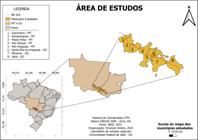
The specific location of the study area is on BR 364 and a common section of BRs 163/364 as highlighted in the figure below.
We emphasize that all the stretch from Rondonópolis onwards in the state of Mato Grosso, there is the concomitant stretch between highways BRs 163 and 364, while the stretch from Pedra Preta, towards the municipalities of Goiás, belongs to BR 364.
The stretch studied has a distance of 456 km, starting from the municipality of Juscimeira-MT to the municipality of Jataí-GO. On map 1, the path taken is highlighted in red, while in yellow there are markings of the municipalities that the path passes through.
The section studied corresponds to a structure that began its project, the Centro Oeste Development Program (PRODOESTE), from November 1971, which aimed to seek development for the states of Goiás and Mato Grosso (Pereira, 1974).
With the resources from the aforementioned program, drainage projects, highway construction, slaughterhouses and processing plants were financed, with the road modal being financed by the DNER (National Highway Department, with connections from Cuiabá-MT to Campo Grande - MS and Rondonópolis-MT to Goiânia-GO (Pereira, 1974).
Methodological procedures
Landscape is an important concept in Geographic science, being defined by Maximiliano (2004, p. 87) as resulting from the “dynamic relationship of physical, biological and anthropic elements. And that it is not just a natural fact, but includes human existence.” The author also indicates that the landscape is endowed with historicity, formulation and configurations based on time, through the combination of different elements.
Based on the Landscape analysis category, the insights obtained were analyzed qualitatively. With regard to the qualitative method, Zanella (2013) states that research is carried out with the aim of understanding the reality of the object of study, based on the observation of how individuals relate to the phenomena studied.
Most of the work in the field of Agrarian Geography is premised on the use of the concept of territory, however in this research we seek to highlight the possibility that any individual has of detecting problems arising from the capitalist system, in this case, in the agricultural sector, without it is necessary to collect quantitative data from official bodies.
The problems are so clear that it is possible that any individual, just by observing the landscape, within a journey of their daily lives, can perceive the contradictions and discrepancies of what is imposed by those who have greater capital power within society (Maximiliano, 2004).
Therefore, based on Maximiliano's (2004) statements, it was possible to verify some problems that could be identified and proven in the municipalities researched.
From the start of classes in the 2023/1 semester of the Postgraduate Program in Geography at the Federal University of Jataí, it was necessary to move from the starting point highlighted here, Juscimeira-MT, to the city of Jataí-GO, to fulfill subject credits.
Being a long journey and from the perspective of landscape observations it was possible to develop this work, therefore the choice of the mentioned municipalities was made because they are the access locations on the mentioned route.
When observing the landscapes and based on the configurations of the landscapes found, which make clear the very relevant presence of agribusiness in the region, we seek to highlight some of the problems that are found in these municipalities, problems that are accentuated by agribusiness and open space to discuss : as this is an activity that yields astronomical amounts of profits, the return to the population is neither coherent nor proportional (Souza, 2016).
Based on this context, when observing the landscapes, we see environmental degradation, social inequality and the presence of freight vehicles in urban centers, these being the three factors that we seek to highlight in this research, with these phenomena detailed in the results and discussion topics.
To highlight the growth of agricultural production in the municipalities studied, we chose to use the soybean production map from 2000 and 2022 to compare the progress of production in this sector. This map was chosen because it is one of the main productions in Brazil, which is educational to show the growth of this production in tons in the municipalities studied.
It is important to highlight that the problems arising from agribusiness are not only those listed in this research, since this is an activity that is increasingly growing in Brazil, being the main economic activity in the country, but the search for profit, accumulation and lack of adequate public policies, are contributing factors to the occurrence of problems such as hunger, environmental degradation, pollution, health problems, social inequality, lack of employment, housing and others (Mitidiero Junior; Goldfarb, 2021).
After listing the problems, it was possible to highlight them and relate them to agribusiness, which appears to be an activity in which there is no concern for social justice and environmental preservation.
Results and discussion
Ambiental degradation
In view of the above, the rates of environmental degradation in Brazil are growing every day, with no difference in the areas observed. The map below highlights the growth of production in the municipalities studied, which results in the problems highlighted here.
From Map 2 it is possible to verify that there is soybean production (the most produced crop in Mato Grosso) in all the municipalities studied and that this production is growing, encouraged by public policies and hegemony of this sector in Brazil and especially in the state of Mato Grosso.
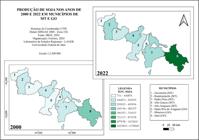
Table 1 below details the growth in production in each of the municipalities.
There is considerable growth in all the municipalities studied, with production growing by more than 100% in Alto Garças, Rondonópolis and Jataí, while in Alto Araguaia and Juscimeira the growth rate exceeded two hundred percent. Even though production is not doubling, the growth rates in Pedra Preta and Mineiros are also significant, with more than 80% and more than 30% respectively.
Something that draws attention is the production of Santa Rita do Araguaia, which even in gross numbers is the municipality with the least production, its rate has increased by more than 3000% in the last two decades, going from almost zero production to achieving considerable growth.
Based on this scenario, it is possible to verify that the result of this growth has generated wealth for small groups, not being growth that favors the population of these places, as we will highlight below.
For this growth to occur, increasingly larger areas are necessary; for this purpose, deforestation, fires and pollution are very present factors in these regions.
Technological advances, the lack of policies for environmental preservation and the search for profit result in intense processes of environmental degradation. In the region studied, it is possible to see an extremely degraded landscape, with exposed soil and high rates of deforestation, making it clear that the path taken over the last few decades is a priority for capital to the detriment of environmental preservation without the promotion of real sustainable development. (Moreira, 2010).
These problems can be seen in Mineiros and Jataí, as from their landscapes it is possible to see a marked expansion in the agricultural areas that reach the banks of the highways.
The municipalities of Mineiros-GO and Jataí-GO are part of a region dominated by agribusiness, due to this factor the composition of the landscape of these locations appears to be degraded, with no concern for environmental preservation, with something that draws a lot of attention is the occupation of areas by crops that reach practically within the shoulders of the roads.
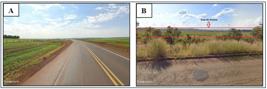
As highlighted by Oliveira (2016), the expansion of crop areas is constant, here are no limits to the growth of these areas, the banks of rivers, environmental protection areas, indigenous territories and others, nothing is respected, the figures below show a lack of attention to environmental laws. The following figure shows the advance of crops until very close to the BR 364 highway, something that can be characterized as inadequate expansion of crops.
In part “A” of image 1, the presence of crops very close to the track is recorded, in Jataí-GO. Figure 2 in part “B” demonstrates the cultivation of corn crops in its second horizon, with a small vegetation separating the crop from the track, with significantly degraded vegetation.
Regarding the punctuated context, Mitidiero Júnior (2013, p. 50), argues that:
Embora não se encontre leis e normas que autorizem ou proíbam explicitamente a agropecuária de beira de estrada, parece ser tácito que a ocupação dessas áreas não possa prescindir de contratos com os órgãos responsáveis, e é o que não acontece no desenrolar dessas atividades. Ainda, a prática da agropecuária nas faixas de domínio das rodovias pode trazer perigos tanto àqueles que a utilizam produtivamente como àqueles que utilizam a rodovia para deslocamento. A circulação de pessoas que produzem nessas áreas é sobremaneira perigosa, levando em consideração a velocidade de deslocamentos dos veículos. O pastoreio do gado nas áreas livres entre a faixa que separa o asfalto das propriedades rurais pode causar acidentes automobilísticos graves.
In the sense emphasized by the author, it is possible to verify one more problem, which is the risk of accidents. However, based on the presence of these large crops in the vicinity of highways, it is possible to detect environmental degradation across the landscape. Therefore, the need for more and more areas for agricultural production can be evidenced by the landscape highlighted in Image 1.
In this context, we can highlight that monoculture cultivation in Brazil already occupies a vast area, which appears to be limitless, occupying sectors such as indigenous or quilombola areas, river banks and proximity to highways (Spósito, 2010).
Through these questions, what is observed is the incessant search for capital accumulation, making it clear that there are no limits to the expansion of these cultivation areas and that if there are no energetic measures to regulate these activities, the result will be increasingly higher rates of deforestation, burning, use of pesticides and other perverse techniques to promote capital gains, since the exaggeration in the expansion of the area is clear, making it clear that atrocities and disrespect for laws are recurrent, even more so in more isolated locations (Spósito, 2010).
Social inequality
The starting municipality is Juscimeira-MT, which is a municipality that, in addition to tourism, has a large part of its economic base in agribusiness. The landscape in the municipality is increasingly degraded due to economic activities in the countryside.
Social inequality is present in Juscimeira, with a clear increase in the disparity in purchasing power, resulting in clear problems.
Later, we came across Rondonópolis-MT, a municipality that is one of the most important grain producers in the State of Mato Grosso, and also plays a prominent role in the industrial sector.
However, the observed landscape is one of pollution and devastation, since in the middle of the urban sector the presence of degraded, deforested soil is clear and when we enter the urban sector, smoke is easily visible, both from fires and from industries.
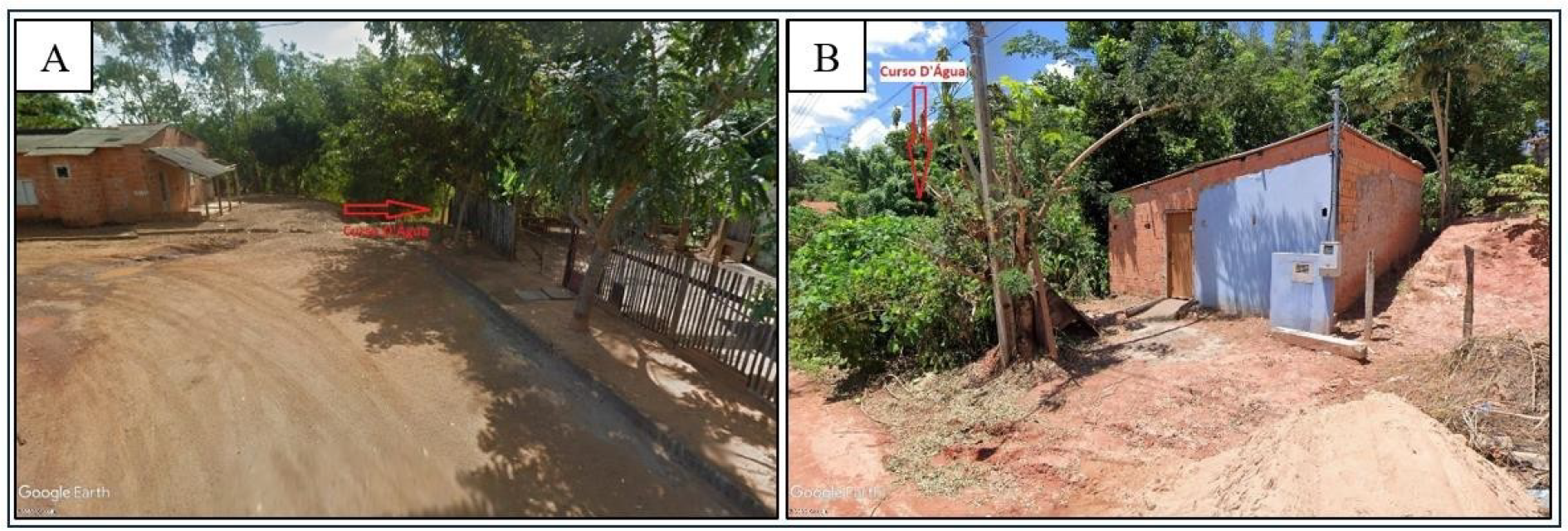
The urban sector is characterized by clear segregation, with structured neighborhoods and, on the other hand, residences in inappropriate locations and without adequate structure. The following figure shows, based on the perception of the landscapes, irregular housing in Juscimeira and Rondonópolis.
Part “A” of Image 2 indicates buildings in the municipality of Juscimeira-MT and part “B” shows a residence in the municipality of Rondonópolis. The red arrows indicate the presence of water courses in the vicinity of the residences, characterizing inadequate constructions and the presence of residences in inappropriate locations.
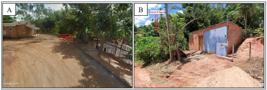
Something that draws attention is that the characteristics of the residences are similar, even though they are in municipalities with different agricultural production, but both with growth rates, which shows that regardless of the production rate, social inequality is present, both in small cities, when in medium-sized cities.
Agribusiness production rates grow every year, with these municipalities being part of this production, as their lands and structures are exploited so that the already consolidated agricultural sector grows more and more. In this sense, we observe an extremely relevant contrast, especially in the actions of public authorities in the face of social demands, where favor is given to the large producer while the most vulnerable population is ignored (Costa, 1988).
Brazil has a prominent production in the agricultural sector, but the profit obtained is in the hands of small groups, therefore, reports of people who go hungry and do not have appropriate housing in these cities and throughout Brazil are common (Moncau , 2021).
There are numerous locations with irregular housing, like those in image 2, even though they are in municipalities that are extremely promising in the agricultural sector.
The places where there is irregular housing are characterized by the absence of public power, these being the only places where some classes of society are able to have a permanent residence, this shows that even in locations where the proportion of growth rates of production in the agricultural sector It is such that income inequality is extreme (Moncau, 2021).
The urban area that belongs to the municipality of Pedra Preta, which has its economy also based on rural production, presents aspects of environmental degradation in the landscape. Pedra Preta is a municipality that contributes to the growth of Rondonópolis, since local production depends on the support of this neighboring city, that is, contributing to the economy of Rondonópolis, to the detriment of its own economy, due to the lack of structure that the city presents for production.
In the municipality of Pedra Preta, social problems are also similar, that is, concentration of income for some, while others suffer from the absence of public power to meet the basic needs of the population and individuals living inappropriately.
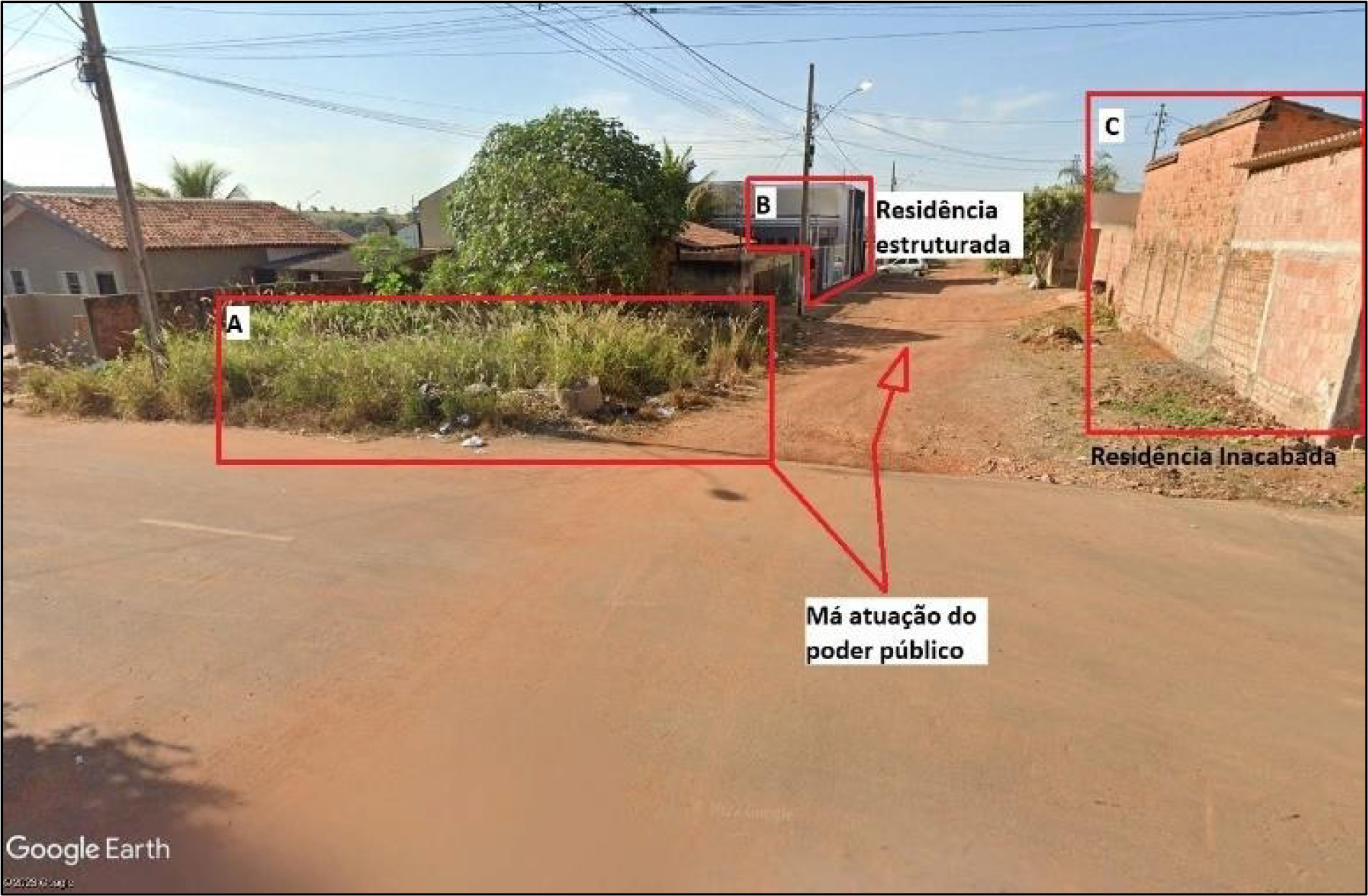
Image 3 shows the disparities between the actions of public authorities and the difference in income among the population.
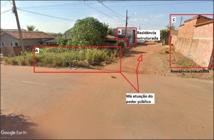
Part “A” of the figure shows the poor performance of the public authorities in offering structure to the population, with a lack of supervision, this being detected by the presence of waste discarded on public roads, land that even in urban areas is not well cared for. adequate, which can lead to disease transmitters and the proliferation of venomous animals, as well as a lack of asphalt paving and even in a paved area there is no construction of curbs and storm drains, characterizing the lack of infrastructure in the locality addressed (Carlos, 1994).
In parts “B” and “C”, we can highlight, even if succinctly, the presence of different housing structures, where in part “B” the structure has completed construction and presents good construction quality, however what is presented in figure “C” is a construction yet to be completed.
Our objective in these comparisons is not to highlight the different incomes of the owner of the residence in part “B” compared to that in part “C”, but rather to bring out a clear discrepancy in incomes, something very present in Brazilian cities, where even though they are localities There are very close differences in income and access to services that are more viable for some and less viable for others (Carlos, 1994).
In this sense, there needs to be questions about the economic sector, since even with agricultural production increasing every year, income inequality has been increasingly emphasized and the role of public authorities, which is strong in subsidies for large producers, does not act intensively to provide the population with basic services.
Presence of cargo vehicles in urban centers
The next two municipalities observed, Alto Garças and Alto Araguaia, also have a large part of their economies based on the agribusiness sector, which characterizes a landscape of deforestation, burning and pollution around these locations, however there is an aggravating factor in the urban sector of these two municipality that is the presence of BR 364, which passes through the center of these municipalities, generating intense traffic in these cities, traffic coming from large agribusiness productions, characterizing numerous problems for local society.
In the state of Goiás, the first urban sector verified is that of the city of Santa Rita do Araguaia, this city, like the others, has agribusiness as one of the pillars of its economy, like others already mentioned, it has the presence of the highway in its center , its landscape is polluted and environmental degradation is quite notable.
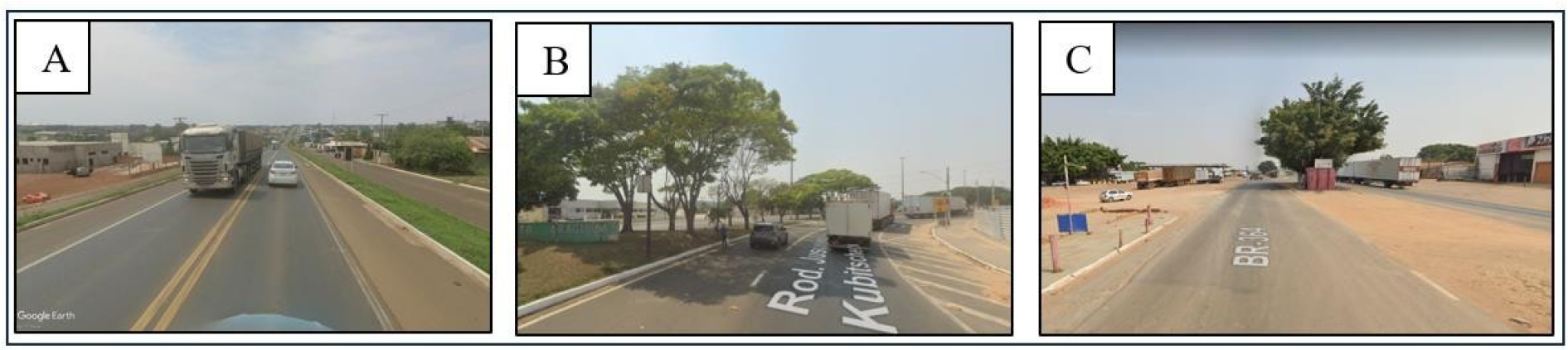
In the municipalities of Alto Garças - MT, Alto Araguaia - MT and Santa Rita do Araguaia - GO, in addition to the problems presented there is also the presence of highways in the urban sector of these cities, causing the presence of cargo vehicles, as discussed in image 3 a follow:

In image 3, the main roads in the municipalities of Alto Garças-MT (part “A”), Alto Araguaia-MT (part “B”) and Santa Rita do Araguaia - GO (part “C”) are shown, this route being , in the three municipalities, the BR 364 highway, which crosses the urban center of these municipalities, causing numerous problems, as highlighted in the following paragraphs. One of the problems refers to mobility, due to the reduction in speed when traveling on the road, this problem is a result of the number of freight vehicles together with passenger vehicles in the urban sector.
This mobility with reduced speed, as reported by Trinta (2001) and Brasileiro et al. (2014), reduces the flow of vehicles from the local population and vehicles from other locations that pass through urban centers with a highway, these problems being caused due to the lack of adequate signage and technical quality standards.
Road accessibility problems are also another verified situation, which is highlighted by Brasileiro et al. (2014), as this being a problem caused by poor planning, mainly by those responsible for the urban sector, causing damage to local transport, due to poor access locations to the road, as well as entry and exit locations with structures and inadequate signage.
There is also segregation of the population due to the inconvenience of the individual having to deal with all the problems that occur when coming into contact with the road. This segregation is characterized by the risk that the resident runs when accessing the road or having to cross it (DNER, 2001).
The presence of the road in the urban center also compromises safety, with the rates of these incidents increasing due to the greater number of motor vehicles on the road. The presence of the highway and the development of the commercial center of these municipalities located around this transport structure means that the number of people and vehicles is always considerable, which results in increasing numbers of traffic accidents (PIRES et al., 1997 ).
The aforementioned author also points out some that may occur in the long term, such as respiratory diseases and deterioration of architectural heritage and urban landscape (PIRES et al., 1997).
The problems listed here are just some of those that spread every day throughout Brazil.
Visiting these municipalities throughout the first half of 2023 was an opportunity to observe problems present in our reality.
We believe that for a perspective of improving living conditions and social justice, it involves understanding what is embedded in our reality, something that was aimed at in this article, the first step being to portray some of the problems present in our reality, the in order to have an overview of the reality in which we are inserted, so that we can later set goals to improve the lives of each individual who is part of the Brazilian population (Abramovay, 1992).
Final considerations
From the problems mentioned, it is possible to verify that agribusiness operations are focused only on profit and that this rule applies to all locations, regardless of the size of the cities. Based on this context, it is possible to conclude that socio-environmental problems can be easily detected from landscape analyses, since they have aspects of degradation with the removal of vegetation and favoring large crops and pastures, with the aggravating factor being that in At certain times of the year, they present with smoke and fog from fires.
Another factor that needs to be improved is cargo transport, since its presence in urban areas is quite common in Brazil. In this sense, there needs to be restructuring, as these problems, in addition to compromised mobility, pose a risk to the population of these locations, for This requires removing these roads from urban centers or restructuring transport to railways.
An important situation to be considered is environmental preservation, since the search for profit is increasingly accentuated without providing environmental preservation, bringing problems for current and future generations. In this sense, it is necessary to have new forms of sustainable development aiming at greater environmental preservation.
It is also concluded that public policies aimed at the most vulnerable population are not implemented satisfactorily, since in regions where profits are exorbitant there is no satisfactory return for the population in the form of basic services.
The majority of the population understands agribusiness as being something profitable, however, if they understand both rural and urban landscapes, they can detect problems that could be mitigated if social justice were more important than the accumulation policy and the population had a real size of public policies aimed at agribusiness.
Therefore, it is necessary to rethink the paths that Brazilian public policies for the agricultural sector are taking and what results will be achieved in the short, medium and long term, as what we have is a scenario that causes several problems and leaves the most vulnerable classes in the world marginalized. population, as well as environmental preservation.
References
- ABRAMOVAY, R. Paradigmas do capitalismo agrário em questão. São Paulo: Anpocs; Unicamp: Hucitec, 1992.
- AB’SÀBER, A. N. Domínios de natureza no Brasil: potencialidades paisagísticas. São Paulo: Ateliê Editorial, 2003.
- BERTRAND, G. Paisagem e geografia física global: um esboço metodológico. Revista IGEOG/USP, São Paulo: USP, n. 13, 1971. Caderno de ciências da terra.
- BRASILEIRO, L. A.; SCHIAPATI, R. S.; COMAR, L. C. A influência de rodovias na área urbana. Revista Nacional de Gerenciamento de Cidades, Tupã, SP, v. 02, n. 13, pp. 01-14, 2014.
- CORRÊA, R. L. (orgs.). Paisagem, Texto e Identidades. Rio de Janeiro EDUERJ, 2004.
- CARLOS, A. F. A. A Cidade. São Paulo: Contexto, USP, 1994.
- CAVALCANTI, L.C.S. Cartografia de paisagens: fundamentos. São Paulo: Oficina de Textos, 2014.
- COSTA, W. M. 1988, O Estado e as políticas territoriais no Brasil. São Paulo: Ed. Contexto.
- CHRISTOFOLETTI. A. Modelagem de Sistemas Ambientais. 1. Ed. São Paulo: Blucher, 1999.
- DNER. Projeto de Ampliação de Capacidade Rodoviária das Ligações com os Países do Mercosul - BR 101: Florianópolis (SC) - Osório (RS), Projeto Básico Ambiental. Brasília. Programa de Melhoria das Travessias Urbanas. Ministério dos Transportes. 2001. 50p.
- ENGELS, F.; MARX, K.. O manifesto comunista. 5.ed. São Paulo: Ed. Paz e Terra, 1999. P. 65.
- FERREIRA, J. C. V. Mato Grosso e seus municípios. Cuiabá-MT. Janina e Memórias Brasileiras. 4ª Edição. 2022.
- HOLZER, W. Paisagem, imaginário e identidade: alternativas para o estudo geográfico. IN: ROSENDAHL, Zeny e CORRÊA, Roberto Lobato (orgs.). Manifestação da Cultura no Espaço. Rio de Janeiro: EDUERJ, 1999.
-
IBGE. Cidades. 2023. Disponível em: https://cidades.ibge.gov.br/brasil/go/jatai/panorama Acesso em: 24/07/2023.
» https://cidades.ibge.gov.br/brasil/go/jatai/panorama -
IBGE. Cidades. 2023. Disponível em: https://cidades.ibge.gov.br/brasil/go/mineiros/panorama Acesso em: 24/07/2023.
» https://cidades.ibge.gov.br/brasil/go/mineiros/panorama -
IBGE. Cidades. 2023. Disponível em: https://cidades.ibge.gov.br/brasil/go/santa-rita-doaraguaia/panorama Acesso em: 24/07/2023.
» https://cidades.ibge.gov.br/brasil/go/santa-rita-doaraguaia/panorama - MARQUES, M. I. M. O conceito de espaço rural em questão. Terra Livre, n. 19, ano 18, p. 95112, 2002.
-
MARQUES, M. I. M. Geografia agrária crítica: um pouco de história. Geousp - Espaço e Tempo (Online), v. 22, n. 3, p. 504-514, dez. 2018. Doi: http://dx.doi.org/10.11606/issn.2179-0892.geousp.2018.153292
» http://dx.doi.org/10.11606/issn.2179-0892.geousp.2018.153292 - MAXIMIANO, L. A. Considerações sobre o conceito de paisagem. Editora UFPR. Curitiba- PR. 2014. Disponível em: file:///C:/Users/Jessica%20Barcelos/Downloads/3391-6605-1- PB.pdf. Acesso em: 24/07/2023.
-
MITIDIERO JÚNIOR, Marco Antonio; GOLDFARB, Yamila. Mudança climática, energia e meio ambiente: o agro não é tech, o agro não é pop e muito menos tudo. São Paulo - SP. Friedrich Ebert Stiftung. 2021. Disponível em: https://library.fes.de/pdffiles/bueros/brasilien/18319-20211027.pdf Acesso em 24/07/2023.
» https://library.fes.de/pdffiles/bueros/brasilien/18319-20211027.pdf - MITIDIERO JÚNIOR, M. A. Agricultura de beira de estrada ou agropecuária marginal ou, ainda, o campesinato espremido. Presidente Prudente-SP. Revista. Nº. 23. PP. 43-59. 2013.
-
MONCAU, G. O Agro não é pop: estudo aponta que a fome é resultado do agronegócio. Brasil de Fato. 2021. Disponível em: https://www.brasildefato.com.br/2021/10/20/o-agro-naoepop-estudo-aponta-que-a-fome-eresultado-do-agronegocio Acesso em: 24/07/2023.
» https://www.brasildefato.com.br/2021/10/20/o-agro-naoepop-estudo-aponta-que-a-fome-eresultado-do-agronegocio - MOREIRA, R. J. Críticas ambientalistas à Revolução Verde. Estudos Sociedade e Agricultura, Rio de Janeiro - RJ, PP. 39 - 52. 2010.
- OLIVEIRA, A. U. de. A mundialização da agricultura brasileira. São Paulo: Iãnde Editorial, 2016.
- PAULINO, E. T.; FABRINI, J. E. (org.). Campesinato e territórios em disputa. São Paulo: Expressão Popular, 2008.
- PAULINO, E. T.. Territórios em disputa e agricultura. In: FABRINI, PEREIRA, V. P. M. B. Desempenho do setor rodoviário; período 1967-1973. Rio de Janeiro. FGV. Revista de Administração Pública. 1974.
- PIRES, A. B.; VASCONCELLOS, E.A,; CAMARGO E SILVA, Ayrton. (Coord.) Transporte Humano: cidades com qualidade de vida. São Paulo: ANTP, 1997.
-
ROHDEN, J.. Feijão contaminado: alimento tem agrotóxico proibido ou fora do limite em teste do governo. Plural. Curitiba. 2022. Disponível em: https://www.plural.jor.br/noticias/vizinhanca/feijao-contaminado-alimento-temagrotoxicoproibido-ou-fora-do-limite-em-teste-do-governo/ Acesso em: 24/07/2023
» https://www.plural.jor.br/noticias/vizinhanca/feijao-contaminado-alimento-temagrotoxicoproibido-ou-fora-do-limite-em-teste-do-governo/ - SOUZA. R. Infraestruturas de logística e transporte em Mato Grosso: uma leitura geográfica. Dissertação de mestrado. Rondonópolis. UFMT. 2016.
- SPÓSITO, M. E. B.; WHITACKER, A. M. (Org) Cidade e campo: relações e contradições entre urbano e rural. 2. ed. São Paulo: Expressão Popular, 2010.
- TRINTA, Z. A. Contribuição ao Estudo das Travessias Urbanas de Pequeno e Médio Porte por Rodovias de Longo Curso. Dissertação (Mestrado em Engenharia de Transportes) Coordenação dos Programas de Pós - Graduação em Engenharia - COPPE. Rio de Janeiro/RJ. Universidade Federal do Rio de Janeiro. 2001. 229 p.
-
Vieira, J. E. R.; et al. Diagnóstico e desafios da Agricultura brasileira. Rio de Janeiro. IPEA. Disponível em: https://dea.ufc.br/wp-content/uploads/2019/11/diagnostico-e-desafios-daagricultura-brasileira.pdf Acesso em: 24/07/2023.
» https://dea.ufc.br/wp-content/uploads/2019/11/diagnostico-e-desafios-daagricultura-brasileira.pdf
-
Editor:
Altemar A. Rocha

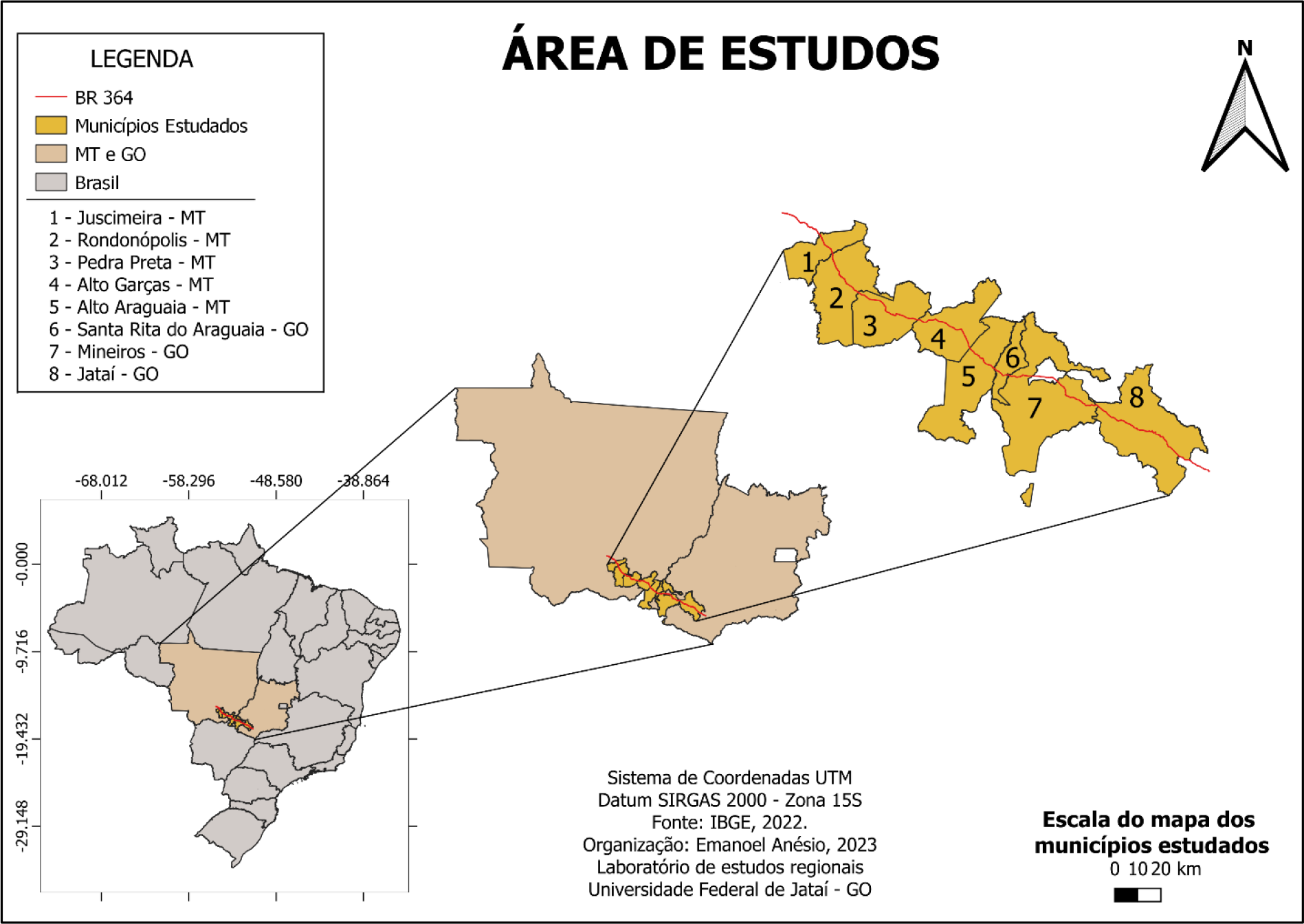 Source: IBGE, 2022 (Prepared by the author)
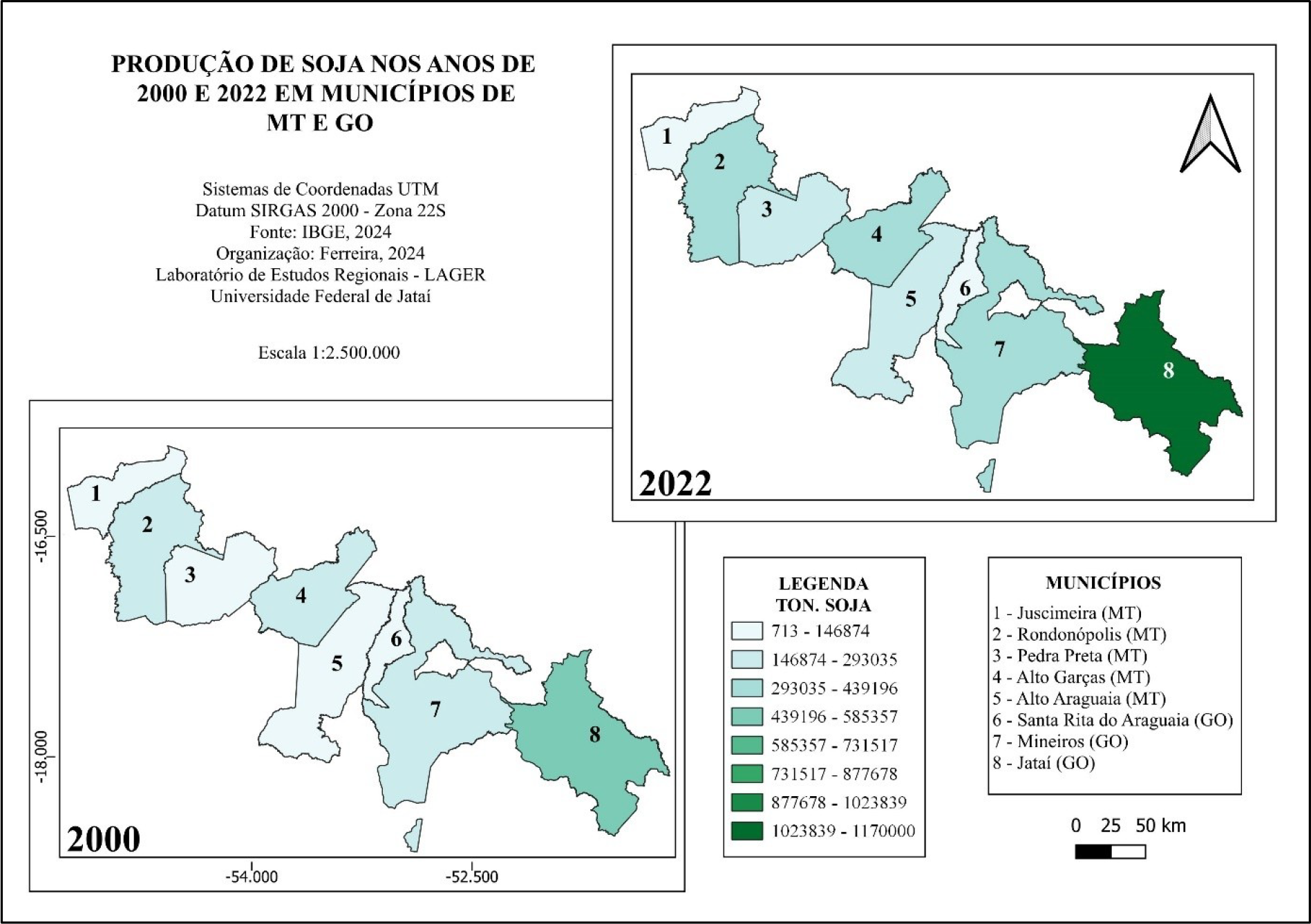 Source: IBGE, 2022 (Prepared by the author)
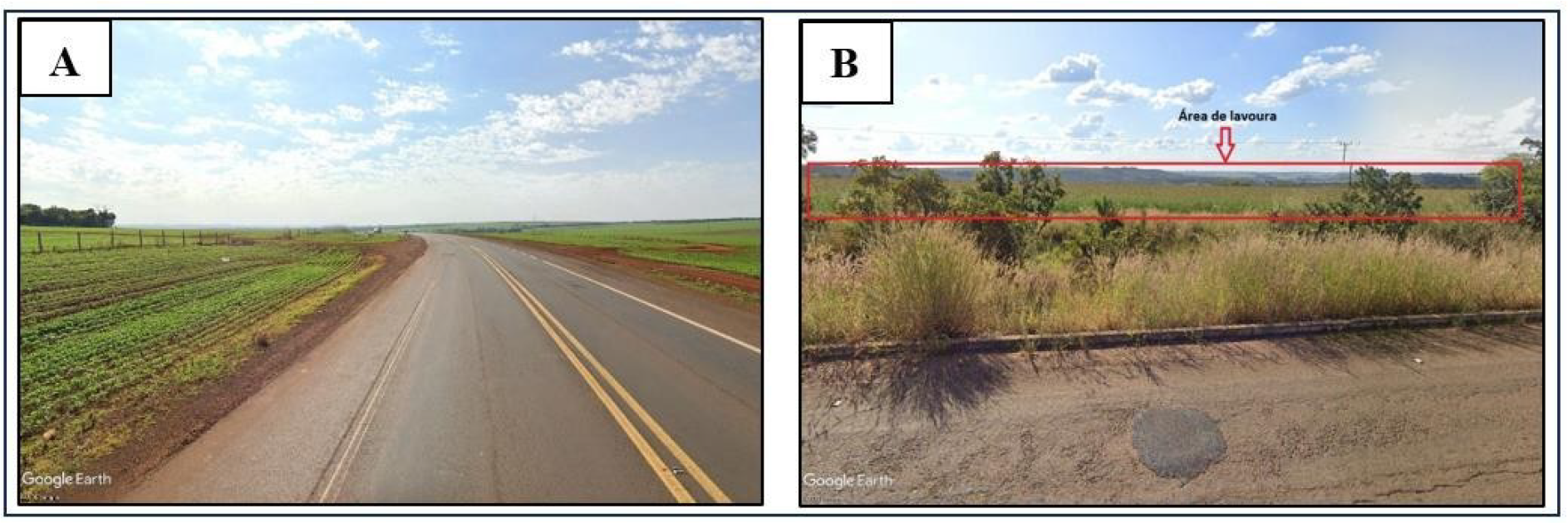 Source: Google Earth, 2023 (Elaborated by the author)
 Source: Google Earth, 2023 (Elaborated by the author)
 Source: Google Earth, 2023 (Elaborated by the author)
 Source: Google Earth, 2023 (Elaborated by the author)