 Rectal Sensory Testing in Anorectal Disorders: A Critical Review of Neurophysiological and Biomechanical Perspectives
Abstract
Introduction Rectal sensory dysfunction plays a central role in constipation, fecal incontinence, and functional defecatory disorders, yet its physiological basis and clinical interpretation remain not completely established. Advances in neuroanatomy and high-resolution anorectal manometry (HRAM) have reshaped current diagnostic paradigms, prompting reconsideration of the traditional threshold-based definition of rectal hyposensitivity.
Objective To provide the current mechanisms of rectal sensitivity measurements with critical analysis, and to show the emerging technological advances that can fill the existing gaps as well as the possibilities in the future.
Materials and Methods The present narrative review synthesizes emerging evidence on anorectal neurophysiology, HRAM-derived sensory thresholds, biomechanical contributors to rectal perception, and the role of novel technologies, such as translumbosacral magnetic stimulation and endoluminal functional lumen imaging probe (EndoFLIP) (technologies scheduled to arrive in Brazil this year), and the interaction of artificial intelligence (AI). Multicenter HRAM datasets evaluating the clinical significance of isolated abnormal thresholds were critically examined.
Results Rectal sensory thresholds reflect a complex interplay of afferent signaling, rectal wall biomechanics, and cortical processing. Multicenter analyses show that even a single elevated threshold may correlate with symptom severity, especially in women, although using a one-threshold definition. Distinguishing primary afferent dysfunction from biomechanical alterations is crucial, with pressure-volume analysis and emerging technologies offering complementary insights. Sensory biofeedback improves outcomes in true afferent hyposensitivity but is less effective when biomechanical factors predominate.
Conclusion Current evidence supports maintaining the London Classification definition of rectal hyposensitivity (≥ 2 abnormal thresholds), while recognizing that isolated abnormalities may indicate early dysfunction in selected patients. Integrating HRAM findings with biomechanical and neurophysiological metrics may refine diagnostic precision. Future developments may allow a single abnormal parameter to reliably define clinically meaningful rectal hyposensitivity.
Keywords
anorectal manometry; rectal sensory; defecatory disorder; fecal incontinence; constipation
Introduction
Anorectal sensory function represents a crucial domain within gastrointestinal neurophysiology that is not fully understood yet. Rectal sensory perception underpins key reflexes and conscious mechanisms responsible for continence, defecation, and rectal distensibility. Abnormal sensory processing, both hyposensitivity and hypersensitivity, can manifest as constipation, fecal incontinence, and/or paradoxical defecatory disorders, and is increasingly recognized as a determinant of symptom severity and therapeutic response. Despite its clinical relevance, the physiological basis and measurement of rectal sensation remain inconsistent across laboratories and poorly integrated with emerging neuroanatomical concepts.
Recent advances in functional neuroanatomy have reshaped the traditional view of anorectal innervation. As demonstrated by Yan et al. (2025),1 the anorectal region is supplied by a dense, overlapping network derived from the sympathetic, parasympathetic, and somatic nervous systems, which communicate extensively through the inferior hypogastric plexus and pudendal nerve pathways. These interconnected fibers support both afferent and efferent signaling, linking the rectum, anal sphincters, and pelvic floor with multiple spinal and supraspinal centers. This complexity helps explain why an isolated pudendal nerve injury may not generate sensory deficits and why neuropathic changes after obstetric trauma or pelvic surgery may manifest late as rectal sensory or accommodation dysfunction. Understanding this distributed architecture is essential for interpreting rectal sensory tests and for developing neurophysiological and neuromodulatory therapies.
In this context, high-resolution anorectal manometry (HRAM) offers the most accessible and standardized method for quantifying rectal sensory function. Through gradual balloon inflation, HRAM defines three cardinal thresholds that allow distinguishing normal sensory perception from rectal hyposensitivity. The London Classification (IAPWG, 2020)2 recommends that these thresholds be reported individually and that rectal hyposensitivity be diagnosed when two or more of these parameters exceed the upper limit of normality. However, recent multicenter studies question whether a single elevated threshold can already indicate clinically relevant sensory dysfunction, especially in women with functional defecation disorders.
Rectal sensory data, therefore, require integration between neurophysiological and biomechanical perspectives. Alterations in afferent signaling, rectal wall compliance, and cortical modulation can contribute to abnormal thresholds; however, only some represent primary afferent dysfunction.3 As emerging neurophysiological tools, such as translumbosacral anorectal magnetic stimulation, and cortical evoked potentials, map the gut-brain sensory axis with greater precision, it becomes essential to reassess how sensory parameters derived from HRAM truly reflect afferent impairment.4 The current review article will address emerging neuroanatomical concepts and their connections to the practical interpretation of sensory thresholds in the HRAM, technological advances in biomechanics, practical strategies and therapeutic implications, and future perspectives.
Materials and Methods
The present study was designed as a narrative, critical review of the current literature addressing rectal sensory function, its neurophysiological and biomechanical determinants, and the clinical interpretation of sensory thresholds obtained by high-resolution anorectal manometry (HRAM).
A structured, non-systematic literature search was conducted in PubMed/MEDLINE, Scopus, and Web of Science, focusing on articles published in English up to March 2025. The search strategy combined the following terms: rectal sensation, rectal hyposensitivity, high-resolution anorectal manometry, rectal compliance, defecatory disorders, fecal incontinence, constipation, London Classification, and anorectal neurophysiology. Reference lists of key articles were manually reviewed to identify additional relevant studies.
Priority was given to guidelines, consensus statements, multicenter cohort studies, and mechanistic investigations addressing rectal sensory testing, including the London Classification framework and its clinical validation. Particular attention was paid to studies evaluating the clinical relevance of isolated abnormal sensory thresholds and their association with symptom severity and therapeutic outcomes.
Emerging diagnostic technologies—such as translumbosacral anorectal magnetic stimulation, endoluminal functional luminal imaging probe (EndoFLIP), and artificial intelligence-assisted pressure-volume curve analysis—were reviewed descriptively, focusing on their conceptual contribution to refining the interpretation of rectal sensory dysfunction rather than on formal meta-analytic comparison.
Given the narrative nature of the current review, no quantitative synthesis or statistical pooling was performed. Instead, findings were critically appraised and integrated to propose a pragmatic, physiology-oriented framework for interpreting rectal sensory abnormalities in clinical practice.
Results
Interpretation of Rectal Sensory Tests
Given this complex neurophysiological background, HRAM-based sensory assessment becomes even more important and must extend beyond the simple identification of abnormal volumes. The main challenge is to distinguish true afferent dysfunction from variations related to rectal wall mechanics, methodological inconsistencies, or adaptive sensory modulation. Over the past decade, substantial heterogeneity in testing protocols, from balloon type and inflation speed to positioning and patient instructions, has contributed to a large variability in reported thresholds and the absence of universally accepted normative values.5 Thus, a critical reassessment of how sensory testing is performed and interpreted is essential to enhance diagnostic precision, reproducibility, and clinical applicability.6
In HRAM, gradual balloon insufflation is used to determine three main sensory thresholds: first constant sensation volume (FCSV), desire-to-defecate volume (DDV), and maximum tolerated volume (MTV). The London Classification, developed by the International Anorectal Physiology Working Group (IAPWG)2 defines rectal hyposensitivity (RH) when at least two of these thresholds exceed the upper limit of normality, emphasizing that all of them must be measured and reported individually (Fig. 1). This framework has strengthened diagnostic specificity and allowed comparisons between laboratories forming the basis of standardized sensory assessment.
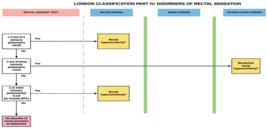
Part 4 of the IAPWG2: Disorders of rectal sensation. White boxes represent manometric findings or decision points; yellow boxes represent the resultant diagnosis; and pink boxes represent a negative/normal study. Abbreviation: ULN, upper limit of normal; b diagnosis of rectal hypo or hypersensitivity.
Discussion
Recent multicenter studies have rekindled interest in whether a single elevated threshold may have clinical and practical significance, particularly in women. In a database of 2,540 patients with functional defecatory disorders, women classified as having borderline rectal hyposensitivity, defined by only one of three altered thresholds, exhibited more severe constipation and higher prevalence of systemic comorbidities, such as diabetes mellitus and Parkinson's disease. Furthermore, the relationship between the number of abnormal thresholds and symptomatic burden followed a linear dose-response pattern, reinforcing the biological gradient of sensory dysfunction.7
Similarly, in a multicenter cohort of 2,876 patients with refractory constipation, a single abnormal threshold identified individuals with more pronounced symptoms and higher prevalence of functional evacuation patterns.8 Taken together, these findings suggest that isolated abnormalities should not be dismissed as random variability, at least in women with a compatible clinical phenotype, and considered as possible indicators of subclinical sensory impairment.
However, adopting a single threshold criterion for definitive diagnosis carries the risk of overdiagnosis and oversimplification of the underlying mechanisms. The concordance among the three sensory thresholds is only moderate, suggesting that each may capture distinct pathophysiological dimensions.9 Some patients present elevated sensitivity thresholds not due to afferent impairment, but due to biomechanical alterations such as reduced compliance or increased rectal wall stiffness.10 This distinction is clinically relevant because therapeutic strategies diverge: biofeedback aims at afferent adaptation, while biomechanical abnormalities demand interventions addressing rectal wall properties or pelvic floor coordination.11 Thus, accurate interpretation requires not only applying threshold-based definitions but contextualizing the findings within a comprehensive physiological framework.
Translumbosacral anorectal magnetic stimulation is an emerging neurophysiological modality capable of objectively assessing the integrity of anorectal sensory and motor pathways by noninvasive magnetic stimulation of the lumbosacral roots (L4–S3) and recording anal canal evoked potentials. This technique distinguishes primary afferent deficits from secondary alterations in rectal compliance, offering an important benchmark for refining the interpretation of rectal hyposensitivity beyond conventional HRAM. Although its preliminary results are promising in international centers, this technology is not yet available in Brazil, which limits its current incorporation into clinical practice, but reinforces its conceptual relevance in understanding the neurophysiological mechanisms of rectal sensory dysfunction.12
Biomechanics and Emerging Technologies
Measuring rectal compliance and distensibility has been an important point in the advancement of technologies for biomechanical assessment. Although the barostat has historically been considered the gold standard for measuring rectal compliance and distensibility, its use has declined due to cost, operational complexity, and reduced commercial availability of equipment. In Brazil, for example, the method is not clinically available, making it impossible to directly assess the mechanics of the rectal wall in motility centers.
In response to these limitations, alternatives have emerged that allow for the indirect inference of distensibility during HRAM itself, through the analysis of pressure-volume curves obtained during balloon inflation; although less precise than the barostat, these measurements provide useful estimates of the relationship between tone, accommodation, and elastic behavior of the rectal wall.
Furthermore, emerging technologies such as EndoFLIP, which is already used in the esophagus and experimentally adopted in anorectal physiology, allow for real-time assessment of luminal diameter, wall tension, and segmental distensibility through high-resolution impedance planimetry associated with an expandable balloon. EndoFLIP represents a significant advance by capturing dynamic biomechanical properties that high-resolution anorectal manometry does not detect, and may complement the interpretation of rectal hyposensitivity, especially in centers seeking to integrate neurosensory and mechanical parameters.13
An Integrated Practical Strategy
With the London protocol, we can use a practical strategy that can be initiated by applying its definition for rectal hyposensitivity (≥ 2 abnormal thresholds) and also explicitly classifying isolated abnormalities as "borderline" and interpreting them within clinical and technical context that, in addition to diagnostic excellence, will also be universal in study centers.
Borderline results justify confirmation under standardized conditions such as repeating the test with the same type of balloon, the same inflation increment, and the same lubrication; using normative values for each sex and technique used; and ensuring proper instructions and positioning for the patient. Whenever possible, rectal biomechanics should also be evaluated indirectly through HRAM pressure-volume curves during inflation.8
A profile compatible with primary afferent dysfunction, with high volumes and preserved compliance, supports referral for sensory rehabilitation through biofeedback.1,2 Whereas, patterns dominated by low compliance or defecatory incoordination point to pelvic floor biomechanical interventions, rather than labeling the patient as primarily hyposensitive.14
This integrated approach balances diagnostic accuracy and clinical pragmatism, aligning interpretation with the multifactorial nature of rectal sensory disorders worldwide.
Therapeutic Implications
From a therapeutic point of view, sensory biofeedback, particularly sensory adaptation training, has been shown to reduce perceptual volumes and improve bowel symptoms in patients with confirmed rectal hyposensitivity. Randomized and prospective trials show consistent gains in both sensory thresholds and clinical outcomes, reflecting afferent neuroplasticity and central reconditioning of rectal perception.15
However, the therapeutic response appears diminished when hyposensitivity arises from secondary biomechanical alterations, rather than primary afferent impairment.16 In borderline cases, current evidence does not yet support the claim that adopting a single parameter increases treatment response rates or prognostic accuracy, although isolated abnormalities may justify early screening for sensory rehabilitation in select patients, especially women with a compatible profile. It is therefore recommended to confirm these findings with a second dedicated examination, performing a complete assessment, and from there, directing patients to specific therapies with greater certainty.
Future research should integrate sensory measures derived from HRAM with new neurophysiological and biomechanical metrics such as cortical evoked potentials, translumbosacral magnetic stimulation, and artificial intelligence (AI)-assisted curve analysis, aiming to refine characterization of sensory dysfunction.17
With the expansion of the normative databases and the standardization and universalization of protocols, it is plausible that, in the future, a single abnormal parameter may be sufficient to define clinically significant rectal hyposensitivity, if it consistently correlates with symptoms and objective physiological impairment. Such a change would simplify diagnostic frameworks, enhance comparability between laboratories, and allow for earlier identification of patients at risk for bowel movement disorders related to rectal sensitivity.
In this evolving scenario, emphasis should shift from rigid and categorical definitions to the integration of robust databases with quantitatively and pathophysiologically grounded markers capable of predicting therapeutic response and long-term outcomes.
Conclusion
Rectal sensory testing by high-resolution anorectal manometry reflects the integrated function of afferent neural pathways, rectal wall biomechanics, and central sensory processing. Current evidence supports the continued use of the London Classification definition of rectal hyposensitivity, requiring the presence of at least two abnormal sensory thresholds to ensure diagnostic specificity and avoid overinterpretation of isolated findings.
Nonetheless, data from large multicenter cohorts indicate that a single abnormal sensory parameter may be associated with increased symptom burden in selected patient populations, particularly women with functional defecatory disorders. These isolated abnormalities should be interpreted as borderline findings, warranting careful clinical correlation and, when appropriate, confirmation under standardized testing conditions.
Future advances in anorectal physiology—incorporating objective neurophysiological assessments, refined biomechanical evaluation, and AI-assisted data analysis—may allow more precise phenotyping of rectal sensory dysfunction. With improved standardization and expansion of normative datasets, it is conceivable that a single abnormal parameter could eventually define clinically meaningful rectal hyposensitivity, provided it demonstrates consistent correlation with symptoms, objective physiological impairment, and therapeutic response.
Until such evidence is established, a comprehensive and integrated interpretation of rectal sensory data remains essential to guide diagnosis, avoid misclassification, and optimize individualized treatment strategies.
Data Availability
Data will be available upon request to the corresponding author.
References
-
1 Yan Y, Inal B, Kapavarapu P, Alber K, Rao SSC. Novel concepts on the functional neuroanatomy of the anorectum. Am J Gastroenterol 2024;120(07):1478–1487. Doi: 10.14309/ajg.0000000000002361
» https://doi.org/10.14309/ajg.0000000000002361 -
2 Carrington EV, Heinrich H, Knowles CH, et al; All members of the International Anorectal Physiology Working Group. The international anorectal physiology working group (IAPWG) recommendations: Standardized testing protocol and the London classification for disorders of anorectal function. Neurogastroenterol Motil 2020;32(01):e13679. Doi: 10.1111/nmo.13679
» https://doi.org/10.1111/nmo.13679 -
3 Rao SSC. Pathophysiology and management of constipation in neurologic disorders. J Clin Gastroenterol 2019;53(08):587-–596 https://doi.org/10.5056/jnm16060
» https://doi.org/10.5056/jnm16060 -
4 Mazor Y, Trieu RQ, Prott G, et al. Volumetric Rectal Perception Testing: Is It Clinically Relevant? Results From a Large Patient Cohort. Am J Gastroenterol 2021;116(12):2419–2429. Doi: 10.14309/ajg.0000000000001526
» https://doi.org/10.14309/ajg.0000000000001526 -
5 Bharucha AE, Basilisco G, Malcolm A, Lee TH, Hoy MB, Scott SM, Rao SSC. Review of the indications, methods, and clinical utility of anorectal manometry and the rectal balloon expulsion test. Neurogastroenterol Motil 2022 Sep;34(09):e14335. Doi: 10.1111/nmo.14335. Epub 2022 Feb 27. PMID: 35220645; PMCID: PMC9418387.
» https://doi.org/10.1111/nmo.14335 -
6 Brock C, Arendt-Nielsen L, Wilder-Smith O, Drewes AM. Sensory testing of the human gastrointestinal tract. World J Gastroenterol 2009 Jan 14;15(2):151–9. Doi: doi: 10.3748/wjg.15.151. PMID: 19132764; PMCID: PMC2653306.
» https://doi.org/10.3748/wjg.15.151 -
7 Seo J, Jung KW, Kim S, et al. Validation of the London Classification for Rectal Hyposensitivity in an Anorectal Manometry Database of 2540 Patients With Functional Defecatory Disorder. J Neurogastroenterol Motil 2025;31(02):276–284. Doi: 10.5056/jnm24019
» https://doi.org/10.5056/jnm24019 -
8 Vollebregt PF, Burgell RE, Hooper RL, Knowles CH, Scott SM. Clinical Impact of Rectal Hyposensitivity: A Cross-Sectional Study of 2,876 Patients With Refractory Functional Constipation. Am J Gastroenterol 2021;116(04):758–768. Doi: 10.14309/ajg.0000000000001039
» https://doi.org/10.14309/ajg.0000000000001039 -
9 Woo M, Pandey A, Li D, Buresi M, Nasser Y, Andrews CN. Constipated patients with functional defecatory disorder have secondary rectal hyposensitivity due to altered rectal biomechanics. J Gastroenterol Hepatol 2024;39(06):1082–1087. Doi: 10.1111/jgh.16517
» https://doi.org/10.1111/jgh.16517 -
10 Gladman MA, Dvorkin LS, Lunniss PJ, Williams NS, Scott SM. Rectal hyposensitivity: a disorder of the rectalwall or the afferent pathway? An assessment using the barostat. Am J Gastroenterol 2005;100(01):106–114. Doi: 10.1111/j.1572-0241.2005.40021.x
» https://doi.org/10.1111/j.1572-0241.2005.40021.x -
11 Jiang Y, Wang Y, Wang M, Lin L, Tang Y. Clinical significance and related factors of rectal hyposensitivity in patients with functional defecation disorder. Front Med (Lausanne) 2023;10:1119617. Doi: 10.3389/fmed.2023.111961
» https://doi.org/10.3389/fmed.2023.111961 -
12 Yan Y, Xiang X, Sharma A, Herekar A, Parr R, Rao S. 502 Translumbosacral Anorectal Magnetic Stimulation (TAMS): Novel Anorectal Neurophysiology Test, Normative Values, and Effects of Gender. Am J Gastroenterol 2019;114:S293. Doi: 10.14309/01.ajg.0000591540.67886.9f
» https://doi.org/10.14309/01.ajg.0000591540.67886.9f -
13 Desprez C, Leroi AM, Gourcerol G, Zifan A, Duflot T. Dynamic functional luminal imaging probe analysis of the anal sphincter opening function during straining in healthy volunteers. Am J Physiol Gastrointest Liver Physiol 2025;328(05):G513–G521. Doi: 10.1152/ajpgi.00369.2024
» https://doi.org/10.1152/ajpgi.00369.2024 -
14 Rao SSC, Coss-Adame E, Yan Y, Erdogan A, Valestin J, Ayyala DN. Sensory Adaptation Training or Escitalopramfor IBS With Constipation and Rectal Hypersensitivity: A Randomized Controlled Trial. Clin Transl Gastroenterol 2021 Jul 13;12(7):e00381. Doi: 10.14309/ctg.0000000000000381. PMID: 34254966; PMCID: PMC8280059.
» https://doi.org/10.14309/ctg.0000000000000381 -
15 Jiang Y, Wang Y, Wang M, Lin L, Tang Y. Clinical significance and related factors of rectal hyposensitivity in patients with functional defecation disorder. Front Med (Lausanne) 2023 Feb 21;10: 1119617. Doi: 10.3389/fmed.2023.1119617. PMID: 36895717;PMCID: PMC9988933.
» https://doi.org/10.3389/fmed.2023.1119617 -
16 Hite M, Curran T. Biofeedback for Pelvic Floor Disorders. Clin Colon Rectal Surg 2021 Jan;34(1):56–61. Doi: 10.1055/s-0040-1714287. Epub 2020 Sep 4. PMID: 33536850; PMCID: PMC7843943.
» https://doi.org/10.1055/s-0040-1714287 -
17 Cai S, Zu X, Ren X, XuM, Xia C, Tian H, Zhu HY, Li C, Zhang Y, Su M. Effects of Functional Magnetic Stimulation Combined with Pelvic Floor Muscle Training on Cerebral Hemodynamics and Brain Functional Connectivity in Women with Postpartum Pelvic Floor Dysfunction: A Randomized Controlled Trial. Int J Womens Health 2025 Nov 19;17:4631–4647. Doi: 10.2147/IJWH.S554211. PMID: 41287623; PMCID: PMC12640596.
» https://doi.org/10.2147/IJWH.S554211
Edited by
-
Editor-in-Chief:
Henrique Sarubbi Fillmann.