 Cystic Fibrosis: 15 Years of Experience in Newborn Screening in Uruguay
Abstract
Cystic fibrosis (CF) is a severe autosomal recessive genetic disorder caused by variants in the CFTR gene, affecting multiple organ systems, primarily the respiratory and digestive tracts. In Uruguay, a newborn screening (NBS) program for CF was established in 2010. This work presents a retrospective study of the results obtained since CF screening was incorporated to the program until March 2025. Data from IRT, PAP, sweat tests, and molecular analyses were evaluated.
Keywords:
Newborn screening; cystic fibrosis; Immunoreactive trypsinogen; CFTR
Introduction
Cystic fibrosis (CF) is a severe autosomal recessive genetic disease caused by variants in the CFTR gene (Cystic Fibrosis Transmembrane Conductance Regulator), many of them disrupt chloride transport, resulting in multisystemic condition affecting primarily the respiratory and digestive systems, sweat glands, and the male reproductive tract [1].
In Latin America, the incidence of CF varies, ranging from 1 in 1,600 to 1 in 14,000 [2]. Since early diagnosis leads to a better prognosis, neonatal screening has been adopted in many countries [3].
Over the years, various diagnostic strategies for neonatal screening of cystic fibrosis have been developed, although there is still no universal consensus. All programs started with Immunoreactive Trypsinogen (IRT) quantification, however, some programs rely on the IRT/IRT protocol, while others incorporate pancreatic-associated protein (PAP) and/or genetic studies. Despite these variations, the sweat test (ST) remains the gold standard for confirmatory diagnosis, as endorsed by international guidelines [4]. These strategies aim to improve sensitivity and specificity, while maintaining a favourable cost-benefit balance and enabling earlier diagnosis [5-7].
In Uruguay, authorities established CF screening as mandatory national program in 2009. In June 2010, the centralized Newborn Screening Laboratory initiated IRT testing using dried blood spots (DBS) from all newborns in the country.
To improve sensitivity and specificity, the screening strategy implemented in Uruguay combines the IRT/IRT and IRT/PAP algorithms [6].
This study presents a cross-sectional and retrospective analysis of the CF screening results obtained in Uruguay between June 2010 and March 2025.
Materials and Methods
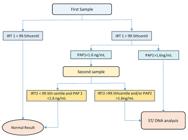
IRT levels were measured in dried DBS samples collected from all newborns throughout Uruguay. Specimens were obtained via heel-prick at approximately 40 hours of life and collected on Whatman® filter paper. Samples with IRT levels exceeding the established cutoff value (99.5th percentile) triggered a second-tier testing protocol, which included the determination of PAP (PAP1) and the request for a second DBS sample to repeat IRT (IRT2) and PAP (PAP2) analyses before 30 days born. The PAP cut-off value for both samples was set at 1.6 ng/mL. The IRT2 cut-off was defined as the 99.5th percentile for 15-day-old newborns. To account for delays in sample delivery to the laboratory - and the associated degradation of IRT - a separate 99.5th percentile threshold was applied for samples received beyond 15 days after collected. (Fig. 1) [7].
Throughout the study period, different analytical platforms were used for IRT quantification. From 2010 to 2015, the Coda system (Bio-Rad) was employed, followed by the AutoDELFIA platform (PerkinElmer) between 2015 and 2018. During 2018 and 2019, the Neoscreen 4 kit (Intercientífica) was utilized. The AutoDELFIA system was reintroduced from 2019 to 2024, and in 2025, the GSP platform (Revvity) was adopted. PAP were determined using the MucoPAP II kit (DYNABIO), following the manufacturer’s instructions.
If the screening algorithm yielded a positive result, patients were referred to the specialized clinical center for follow-up and evaluation. Confirmatory testing was then performed, which includes a ST and genetic analysis targeting the 50 most common CF-causing variants.
ST was performed according to CLSI guidelines, using pilocarpine iontophoresis on both forearms, and interpreted according to international diagnostic standards [8].
Genetic studies were performed using the CF-EU 2V1 kit (Elucigene), designed to detect the 50 most common CFTR variants associated with cystic fibrosis, and analyzed on an ABI PRISM 310 Genetic Analyzer. In cases where this panel yielded negative results, complete sequencing of the CFTR gene was performed by an external certified laboratory.
False negatives were defined as cases where a later diagnosis was made based on symptoms, despite the screening algorithm yielding normal results. False positives were defined as individuals referred for confirmatory testing (including ST and genetic analysis) and subsequently tested negative.
Results
During the study period, a total of 645,762 newborn first samples were tested for IRT1, representig nearly 99.5% of birth during this period. Approximately 1% (6,339 samples) produced elevated results, leading to PAP testing and a request for a second sample. Of these, 1,520 samples (24%) met the criteria for confirmatory testing, and 76 cases of CF were confirmed. Five cases were later identified as false negatives by the screening algorithm. Among those meeting the criteria for confirmatory testing, 305 (20%) were premature, and of these, only 3% were confirmed as CF. Considering these results, we estimate an incidence of 1 in 7,972 live births, which has remained consistent over the years.
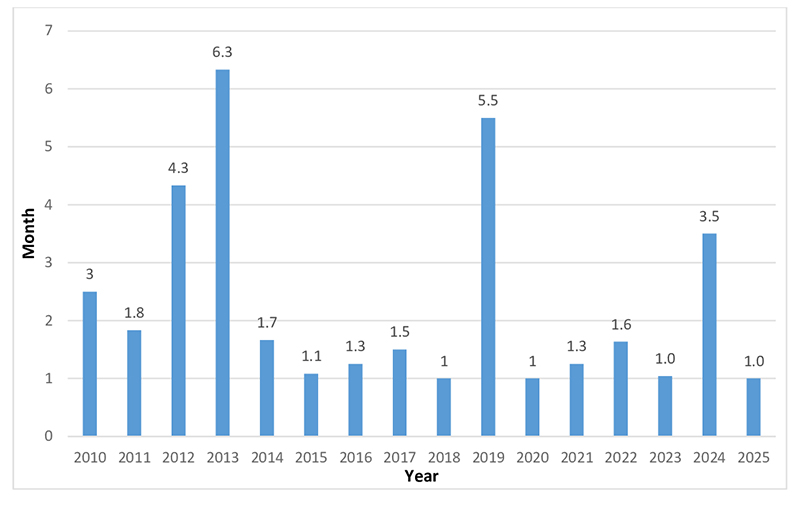
Of all the diagnosed cases, 52% were male, with an average age at diagnosis of 2 months, which has remained consistent throughout the entire program. In the years 2010, 2012, 2013, 2019, and 2024, there was an increase in the diagnostic response, raising the average, as shown in Fig. 2. This was due to some patients experiencing difficulties in attending for diagnosis before the two-month target.
Average diagnostic time per year, false negatives were excluded, and also the two cases that resulted in a normal sweat test, considered rare cases.
In the cohort of 81 patients under observation, 14 (17%) could not be fully diagnosed using the 50-variants panel, as only one was detected, necessitating complete sequencing. Consequently, our laboratory successfully identified 91% of the variants present in this population. The F508del was present in 79 alleles (49%), with 22 (27%) patients being homozygous. The second most frequent variant was R334W representing 7% of the alleles, and 14% of the patients. Non homozygous for R334W or other variant was found. In Table 1, the most relevant variants and their frequencies are presented.
Twelve (15%) of the diagnosed cases exhibited indeterminate ST results, with chloride levels ranging from 30 to 59 mmol/L, five of these carried the F508del. Additionally, two atypical cases were identified where ST results were within the normal range (0-29 mmol/L), nevertheless CFTR variants were detected (R334W/R117H and F508del/c.3361A>G). Notably, only one patient with an ST >100 mmol/L carried a single CFTR variant (F508del).
Throughout the study period, five false negatives were identified. The algorithm demonstrated a sensitivity of 92% (95% CI: 84.4-98.6%) and a specificity of 99.8% (95% CI: 99.5-100%). Consequently, the positive predictive value (PPV) was calculated at 5% (95% CI: 3.7-6.3%).
Discussion
Uruguay birth rate has significantly decreased in recent years. Fifteen years ago, it was around 50,000 births, while today it is approximately 35,000. Although the birth rate is low, the implementation of a newborn screening system is a great challenge if the goal is to reach the entire population with a prompt diagnostic response.
Over the years, the CF program implemented in Uruguay has proven to be an effective tool for early disease detection, achieving nearly 100% coverage of newborns. The estimated CF incidence during the study period is approximately 1 in 7,972 live births, aligning with expected ranges based on data reported for Latin American populations [2].
The program showed good performance considering the diagnostic time, with an average time of 2 months. Even during the pandemic years, the performance remained consistent, despite the challenges posed by limited access to healthcare services and delays in patient follow-ups. Several strategies have been implemented over these years to improve this indicator, including the evolution of analytical methods, improved follow-up of recalls for repeat samples, better scheduling of confirmatory tests, and the incorporation of technological tools to facilitate communication with patients.
Since CF began to be included in newborn screening programs around the world, numerous screening algorithms have been proposed, all of them starting with the determination of IRT. The use of a second sample for IRT measurement has been shown to improve sensibility and specificity [3].
Studies suggested PAP as a second-tier test, which was shown to improve both sensitivity and specificity [6,9]. Since then, many programs have included this test in combination with IRT. More recently, the use of genetic studies as a screening step has gained increasing importance. In 2010 when our programme started, an IRT/ IRT algorithm was initially proposed but soon PAP determination was introduced just to get better specificity. To date, genetic analysis has not been included in the screening algorithm due to considerations related to cost and technological availability. Instead, genetic testing serves as a confirmatory step following initial screening, ensuring accurate diagnosis while managing resource constraints effectively.
From the beginning, our objective has been to identify all CF cases in order to initiate early treatment and establish baseline incidence data for our population. The screening algorithm has proven effective, identifying all but five CF cases over 15 years. However, this success has come at a significant cost, not only economically but also in terms of human resources, time, and a high number of false positives, which, as is well known, generate anxiety in parents waiting a diagnosis [10].
The sensitivity of our algorithm is 92%, which is estimated to be within the range or even higher than that reported for other algorithms. Similarly, the positive predictive value (PPV) is below the optimal level, despite maintaining high specificity [11,12,13]. Our IRT1 and IRT2 cutoff points showed good results and were within those reported worldwide (99-99.5th percentile) [10-11]. A decrease in the percentile used could have reduced false negatives but would have greatly increased second sample requests and false positives, with a decrease in PPV.
Upon analyzing data from diagnosed patients, we found that two cases would have been missed using only the IRT1/IRT2 algorithm, as IRT2 levels were normal. Similarly, the PAP results would have led to overlooking one of these cases. In the same way, employing the IRT/PAP algorithm would have resulted in 21 diagnosed patients with an altered IRT1 being classified as negative due to normal PAP1 values. In these instances, while IRT2 remained elevated, PAP2 was only elevated in 10 cases. This analysis underscores that relying solely on either the IRT/IRT or IRT/PAP algorithm would have increased the number of false negatives. Therefore, combining both approaches proved more effective in our setting. Notably, PAP determination was particularly beneficial in cases where the second sample was collected after 30 days of life and in two meconium ileus cases presenting with normal IRT1 and IRT2 levels but altered PAP1 and PAP2 values.
While reports have demonstrated positive outcomes with the IRT/PAP algorithm [11,12,13,14] it is important to note that our program utilizes a photometric PAP kit. Studies suggest that the fluorometric PAP kit offers superior performance, though it carries a higher cost. Consequently, when using the IRT/IRT algorithm, it remains a viable and effective strategy in our context.
Considering an IRT1 high value ≥100 ng/mL as a very high threshold, we found that nearly 53% (43) of diagnosed cases met this criteria. This suggests that implementing a safety-net approach may be a strategy worth evaluating in the coming years.
Numerous studies have reported that F508del is the most common CFTR variant worldwide, accounting for approximately 50% of cases in Spanish and Italian populations [15].
Given Uruguay’s predominantly Mediterranean ancestry, the F508del was found in 49% of alleles in our study, a frequency consistent with expectations. Other variants detected at lower frequencies, such as R334W and N1303K (7% and 6%, respectively), appeared at slightly higher frequencies than previously reported in a 2002 Uruguayan study of 52 patients, which found these in approximately 2-3% of cases [16]. The G542X variant was observed in about 2% of alleles, which aligns with global data [17], but is lower than that previously reported by the Uruguayan group. The R1162X was found at the expected frequency (3%) [16]. Other rare variants, including the IVS8-5T and IVS8-7T polymorphisms, were identified in heterozygous form, always in combination with another known pathogenic variant. These combinations have been shown to likely contribute to the CF disease phenotype [12,13,15,17,18].
Conclusions
The results analyzed confirm that the current cystic fibrosis screening algorithm in Uruguay demonstrates robust diagnostic performance with a coverage of almost 100% and an optimal diagnosis time.
Nevertheless, the study conducted offers an opportunity to enhance both sensitivity and positive predictive value without compromising specificity, while also improving cost-effectiveness.
Acknowledgments
The authors would like to express their sincere gratitude to all the technical and administrative staff, as well as to everyone who has contributed in any way to the development and ongoing operation of the national newborn screening program. Their support and dedication throughout these 15 years have been essential to the implementation and continuity of cystic fibrosis screening in Uruguay.
References
- 1. García MC, Núñez D, Montenegro J. Actualización en fisiopatología, diagnóstico y tratamiento de la fibrosis quística. NPunto 2023 VI(60):89-115.
- 2. Silva LVR, Castaños C, Ruiz HH. Cystic fibrosis in Latin America-Improving the awareness. J Cyst Fibros 2016;15(6):791-793.
- 3. Farrell PM, Lai HJ, Li Z, et al. Evidence on improved outcomes with early diagnosis of cystic fibrosis through neonatal screening: Enough is enough! J Pediatr 2005;147:S30-S36.
- 4. CLSI. Newborn Screening for Cystic Fibrosis 2nd ed. Wayne, PA: Clinical and Laboratory Standards Institute; 2019.
- 5. Therrell BL, Padilla CD, et al. Current Status of Newborn Bloodspot Screening Worldwide 2024: A Comprehensive Review of Recent Activities (2020-2023). Int J Neonatal Screen 2024;10(2):38.
- 6. Sarles J, Berthézène P, Le Louarn C, et al. Combining immunoreactive trypsinogen and pancreatitis-associated protein assays, a method of newborn screening for cystic fibrosis that avoids DNA analysis. J Pediatr 2005;147(3)302-305.
- 7. Wilcken B, Wiley V. Newborn screening methods for cystic fibrosis. Paediatr Respir Rev 2003;4(4):272-277.
-
8. CLSI C34-ED4. Sweat Testing: Specimen Collection and Quantitative Chloride Analysis, 4th Edition. https://webstore.ansi.org/preview-pages/CLSI/preview_CLSI+C34-Ed4.pdf Accessed February 6, 2023
» https://webstore.ansi.org/preview-pages/CLSI/preview_CLSI+C34-Ed4.pdf - 9. Iovanna JL, Férec C, Sarles J, Dagorn JC. The pancreatitis-associated protein (PAP). A new candidate for neonatal screening of cystic fibrosis. CR Acad Sci III 1994;317(6):561-564.
- 10. Driscoll SJ, Heinz K, Goddard P, Desai M, Gilchrist FJ. Outcome data from 15 years of cystic fibrosis newborn screening in a large UK region. Arch Dis Child 2024;109(4):292-296.
- 11. Krulišová V, Balaščaková M, Skalická V, et al. Prospective and parallel assessments of cystic fibrosis newborn screening protocols in the Czech Republic: IRT/DNA/IRT versus IRT/PAP and IRT/PAP/DNA. Eur J Pediatr . 2012;171(8):1223-9.
- 12. Marcão A, Barreto C, Pereira L, et al. Cystic Fibrosis Newborn Screening in Portugal: PAP Value in Populations with Stringent Rules for Genetic Studies. Int J Neonatal Screen 2018;4(3):22.
- 13. Teper A, Smithuis F, Rodríguez V, et al. Comparison between two newborn screening strategies for cystic fibrosis in Argentina: IRT/IRT versus IRT/PAP. Pediatr Pulmonol 2021;56(1):113-119.
- 14. Sommerburg O, Stahl M, Hämmerling S, et al. Final results of the southwest German pilot study on cystic fibrosis newborn screening - Evaluation of an IRT/PAP protocol with IRT-dependent safety net. J Cyst Fibros 2022;21(3):422-433.
- 15. Lucotte G, Hazout S, De Braekeleer M. Complete map of cystic fibrosis mutation DF508 frequencies in Western Europe and correlation between mutation frequencies and incidence of disease. Hum Biol 1995;67(5):797-803.
- 16. Luzardo G, Aznarez I, Crispino B, et al. Cystic fibrosis in Uruguay. Genet Mol Res 2002;1(1):32-38.
-
17. Report of a joint meeting of WHO/ECFTN/ICF(M)A/EFCS. The molecular Genetics Epidemiology of cystic Fibrosis. https://iris.who.int/bitstream/handle/10665/68702/WHO_HGN_CF_WG_04.02.pdf?sequence=1&isAllowed=y Accessed July 8, 2025
» https://iris.who.int/bitstream/handle/10665/68702/WHO_HGN_CF_WG_04.02.pdf?sequence=1&isAllowed=y - 18. Bobadilla JL, M Macek Jr. , Fine JP, Farrell PM. Cystic fibrosis: A worldwide analysis of CFTR mutations--correlation with incidence data and application to screening. Hum Mutat 2002;19(6):575-606.
The dataset supporting the results of this study is not publicly available.