
 THROUGH AND BEYOND “CRIMINALS”: VIEWS ON BLACK MIGRANTS IN BRAZILIAN NEWS MEDIA
Abstract
This study examines how the Brazilian press constructs discursive representations of nationality, race, and gender concerning black migrants linked to offenses between 2008 and 2019. Drawing on Critical Discourse Analysis, Corpus Linguistics, and Multimodality Theory, it examines 373 texts and 547 images to identify recurrent narrative patterns. The findings show a persistent tendency to downplay xenophobic motivations in crimes against migrants, often portraying them as “space invaders” or “illegal traders” while silencing their perspectives. Visual representations commonly depict migrant women in private or domestic roles and men in public settings, contributing to their symbolic marginalization. The analysis reveals that Brazilian newspapers, to some extent, participate in the criminalization of black migrants, framing them ambiguously as both offenders and victims. Such portrayals reinforce racialized and gendered stereotypes and influence how the public interprets migrant presence, vulnerability, and agency within national debates on migration and security.
Keywords:
Crime; Migration; Critical Discourse Analysis; Corpus Linguistics; Multimodality Theory
Resumo
Este estudo examina como a mídia jornalística brasileira constrói representações discursivas de nacionalidade, raça e gênero de migrantes negros envolvidos em delitos entre 2008 e 2019. Com base na Análise Crítica do Discurso, na Linguística de Corpus e na Teoria da Multimodalidade, analisa 373 textos e 547 imagens para identificar padrões narrativos recorrentes. Os resultados revelam uma tendência persistente de minimizar motivações xenófobas em crimes contra migrantes, frequentemente retratados como “invasores de espaço” ou “comerciantes ilegais”, com pouca atenção às suas vozes. As imagens costumam apresentar mulheres migrantes em papéis privados e homens em esferas públicas, contribuindo para sua despotencialização simbólica. A análise mostra que os jornais brasileiros, em certa medida, participam da criminalização desses migrantes ao enquadrá-los de forma ambígua como perpetradores e vítimas. Tais representações reforçam estereótipos racializados e generificados, influenciando a percepção pública sobre a presença, a vulnerabilidade e a agência dessas populações.
Palavras-chave:
Crime; Migração; Análise Crítica do Discurso; Linguística de Corpus; Teoria da Multimodalidade
Resumen
Este estudio examina cómo la prensa brasileña construye representaciones discursivas de nacionalidad, raza y género de migrantes negros vinculados a delitos entre 2008 y 2019. Basado en el Análisis Crítico del Discurso, la Lingüística de Corpus y la Teoría de la Multimodalidad, examina 373 textos y 547 imágenes para identificar patrones narrativos destacados. Los resultados muestran una tendencia a minimizar motivaciones xenófobas en crímenes contra migrantes, quienes suelen ser presentados como “invasores del espacio” o “comerciantes ilegales”, con escasa consideración de sus voces. Las imágenes representan a las mujeres migrantes mayormente en roles privados y a los hombres en ámbitos públicos, lo que contribuye a su desposesión simbólica. El estudio evidencia que los periódicos brasileños, en cierta medida, participan en la criminalización de estos migrantes al situarlos de manera ambigua como perpetradores y víctimas, reforzando estereotipos racializados y de género que influyen en la percepción pública.
Palabras clave:
Crimen; Migración; Análisis Crítico del Discurso; Lingüística de Corpus; Teoría de la Multimodalidad
1 INTRODUCTION
The news about a young Congolese man, Moïse Kabagambe (24), coldly beaten to death by five assailants for simply demanding his back pay in a Rio de Janeiro beach stand, made front pages across the country and beyond this year (G1 Rio, 2022; Janone, 2022). Notwithstanding black activists, experts, and progressive leaders’ effort to point out that Kabagambe’s murder ultimately demonstrates Brazil’s cruel racism and xenophobia, part of mainstream media in Brazil still seems reluctant to admit such factors as underlying elements of this and similar crimes (see. Grellet, 2022; Jornal da Cultura, 2022). Denying racism is an ingrained component of Brazilian culture (see Guimarães, 1999), and subsuming anti-black-migrant crimes under the label of everyday-urban-violence or passion crimes also seems to be a recurrent practice by media outlets, as noted in the following subsections.
Differently from the episode above, though, previous studies have repeatedly pointed out how mainstream media outlets are inclined to depict migrants as offenders (Airgood, 2017; Lirola, 2014), and in the case of black migrants in the Global South, perhaps even more (Alfaro-Velcamp; Shaw, 2016). As for the specific case of Brazil, researchers have indicated that the country is not so different from the rest of the world, that is, despite OHCHR declaring that migration in itself is not a crime and that “criminalizing people based on their migration status can lead to several other human rights violations”, the Latin nation-state and its media outlets tend to continually view migrants as ‘illegals’ or ‘criminals’ (see. Araújo, 2020; Brandt; Wasserman, 2021). Moving from one place to another would, therefore, make them into offenders.
This perception extends to a wider array of crimes, emphasizing migrants’ supposed criminal nature. Brazilian media often depicts migrants as both criminals and victims of systemic violence, revealing a dual narrative. Accordingly, this study aims to examine the complex portrayal of Afro-migrants in Brazilian media, assessing their representation as both offenders and vulnerable victims. Brazilian newspapers depict black migrants in conflicting roles, sometimes as invaders and other times as helpless individuals needing aid, a duality reinforcing patronizing views (Davis, 1983).
This study centers on nationality, race, and gender, aiming to reveal how Brazilian media in the Global South constructs the identity of poor black migrants, often reflecting discourses seen in Western media. It analyzes the extent to which Afro-migrants are allowed a voice and how they are visually depicted regarding race, gender, and nationality. Key points of interest include portrayals of Afro-migrants as immigration offenders, public/private space invaders, and drug traffickers. Conversely, they are also viewed as victims of discrimination, labor abuse, and state neglect, highlighting their complex and often contradictory portrayal in Brazilian media. However, before delving into these discussions, the theoretical framework and corpus presentation will be introduced.
2 THEORETICAL-METHODOLOGICAL FRAMEWORK
The study applies Critical Discourse Analysis (CDA), specifically the Dialectical-Relational Approach (DRA), adapted for the Global South context. It incorporates Afro and Latin American philosophies (Freire, 2011; hooks, 1995; Mbembe, 2019) and concepts from Corpus Linguistics (CL) and Multimodality Theory. Representation, linking language to society and culture, emerges as a key theme, showing how language ‘names’ and positions entities in the social world. This naming reflects power, ideology, and hegemony, presenting relationships as either symmetric or asymmetric.
Representation is tied to pre-existing social structures, and meanings within texts are dynamically shaped by various syntactic processes (e.g., exclusion, categorization, stereotyping). Since language in sociocultural contexts produces and exchanges meanings, stable representations often form identities. These identities, dynamic and relational, embody collective perceptions of similarity and difference, highlighting imagined group boundaries.
Three identification types - syntagmatic, taxonomic, and paradigmatic (Eidson et al., 2017) - relate to categorizing individuals, such as ‘Haitian women’ or ‘Afro-Caribbean migrants.’ These categories adapt to hybrid identities, challenging the notion of homogeneous identity. Race, nationality, and gender, while socially constructed, maintain social significance and are influenced by historical and narrative elements.
The study uses CL tools to analyze frequencies, keywords, and noun phrases in media, examining the public perception of terms like ‘African’ and ‘immigrant.’ Concordance analysis reveals gender role patterns and the ideological framing in texts, with the corpus-based and corpus-driven approaches helping refine findings.
Multimodality Theory supports visual analysis, with SFL metafunctions applied to understand black migrants’ portrayal in media images. This study thus integrates CDA with multimodal analysis to uncover how visual and textual elements collaboratively shape public discourse on black migrants.
3 DATA GENERATION AND THE CONSTITUTION OF THE CORPUS
This study examines the media representation of black migrants in Brazil, using a balanced corpus of five prominent newspapers over specific timeframes. Two newspapers are national, reaching a broader audience, while three are regional, ensuring a mix of national and localized perspectives. Criteria for national newspaper selection include readership, longevity, and ownership, while regional ones focus on circulation and economic significance in states with high migrant populations.
The chosen newspapers are O Estado de São Paulo (EST), Folha de S. Paulo (FSP), O Tempo (OTP), Tribuna do Paraná (TPR), and Zero Hora (ZEH). EST, a conservative paper with a complex political past, is influential in São Paulo (Azevedo, 2025). FSP is more centrist, claiming neutrality yet controversially supportive of the 1964 military coup (Azevedo, 2025). OTP, a Minas Gerais outlet (Filgueiras, 2018), reflects owner Vittorio Medioli’s political stance, which is also right-wing (Carta Capital, 2022). TPR, a Paraná paper, and ZEH, based in a predominately white southern state, show close ties to regional elites (Ribeiro, 2024; Silva; Fernandes, 2023).
The research covers news from 2008-2019, a period marked by key events affecting migration, such as the 2008 economic crisis, intensified migration debates in 2015, and the rise of neo-fascist narratives in 2018-2019. Articles were filtered using keywords relevant to black migration, yielding 373 texts and 547 images, primarily involving crime-related topics for analysis.
4 RESULTS AND DISCUSSION
4.1 KEY TERMS AND CONCORDANCES: BLACK MIGRANTS’ RIGHT TO SELF-EXPRESSION
A primary analysis of the key terms of the sample points out that black migrants continue to be seen as outsiders/‘foreigners’ (forasteiros/‘estrangeiros’). Despite the constant use of nationality naming to present them in the news, most of such mentions emerge pluralized - i.e., ‘Haitians,’ ‘Bolivians,’ ‘Nigerians’ (‘haitianos,’ ‘bolivianos,’ ‘nigerianos’). Sometimes, aggregation is so pervasive that nationalities are replaced with a generic ‘Africans’ (‘africanos’) (cf. Hudson-Weems, 1993) as if this single word would be able to adequately distinguish a black person from a continent with more than fifty nations, 1.2 billion people, and more than two thousand different languages (see. Faria, 2021). Their collectivization in ‘groups’/‘fluxes’ (‘grupos’/‘fluxos’) or their reclassification into ‘majorities’/‘numbers’ (‘maioria’/‘números’) appears to contribute to further desensitization, denying their chance to be viewed as individuals with a name and culture, personal history and relationships, an opinion and understanding of the world and others (Asante, 2007; Freire, 2011; cf. hooks, 1981; Karenga, 1998). Key terms also confirm the duality abovementioned: if, on the one hand, black migrants are viewed as ‘illegals’ (‘ilegais’), ‘suspects’ (‘suspeitos’), and outlaw traders, they are likewise taken as ‘victims’ (‘vítimas’), targets, and wronged.
On the crime victims aspect, black migrants are constantly referred to as human ‘traffic’ subjects, victims of practices analogue to forced labor/near-‘enslavement’, targets of discrimination episodes, and economic exploitation by Bolivian/Peruvian coyotes, inter alia. On the criminal perpetrators front, they are often considered migration laws offenders, commercial regulations wrongdoers, land/space invaders (as poor black people usually are seen), drug traffickers (‘cocaine’/‘heroin’ or ‘cocaína’/‘heroína’), and forgers/fraudsters, among others. Considering that many cases involve labor law offenses presenting migrants as victims, there are a significant number of news pieces referring to the ‘work’/‘employment’/‘company’ (‘trabalho’/‘emprego’/‘empresa’) environment. Equally expected is the insistent mentioning of ‘laws’/‘decrees’ (‘decretos’/‘leis’), ‘police’ units/agents (‘unidades’/‘agentes de polícia’) or ‘operations’ (‘operações’), the ‘army’ (‘exército’), ‘justice’ (‘justiça’) departments, ‘safety’ (‘segurança’) entities, ‘prison’ (‘prisão’) facilities, ‘arrests’ (‘prisões’/‘detenções’), ‘investigation’ (‘investigação’) and law ‘enforcement’ (‘aplicação da lei’/‘cumprimento da lei’). If the offense under-reporting relates to migration laws, then there are more chances of black migrants being characterized as extremely deprived subjects, constantly missing or after something, like a ‘shelter’ (‘abrigo’), almost always needing someone else’s ‘help’ (‘ajuda’).
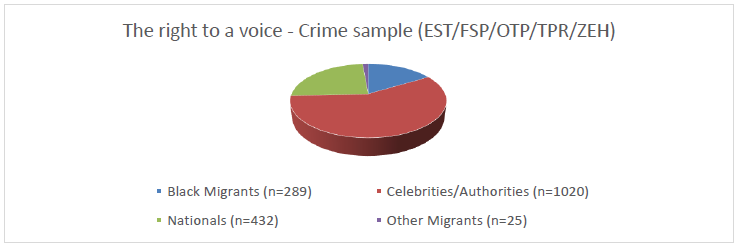
Black migrants’ opportunities to speak up about the crime topic are also much more reduced than other participants. Under this subject, their chances are below one-sixth of the turn-taking passages, as per analyzed concordances. Nationals and authorities, on the other hand, continue to hold most of the reported speech instances, with a higher frequency for the latter, as illustrated below:
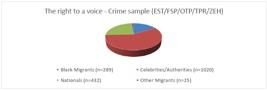
What one can initially realize is that as victims and charity-worthy subjects, migrants are given many more chances to voice their concerns and experiences, especially if they are seen as benefiting from nationals’ and officials’ generous initiatives. This would imply that turn-taking is more about showcasing authorities and nationals’ views, actions, and perceptions than expressing black migrants’ opinions and feelings, as suggested by the p-value of .004229, which is drawn from the statistic relations between different shareholders’ voices in the three samples mentioned above and secures a 99% level of confidence for such hypothesis. While formal verbs, such as ‘affirm,’ are four times more likely to be used to report authorities’ statements, informal ones, such as ‘tell,’ are five times more likely to be used to refer to black migrants’ speech. Here, perhaps more than ever before, the latter are responsible for the testimonies and raw accounts, while officials would manage the ‘valid’ version of the facts, the one that ‘counts.’
4.2 BLACK MIGRANTS STILL SEEN AS ILLEGALS
In Brazilian media, immigration laws heavily influence the portrayal of black migrants, often framing them as criminals merely for crossing borders. Mbembe’s (2019) idea of borders as “dead spaces of non-connection” aligns with this, as migrants face criminalization without harm or crime committed beyond seeking better lives. Unlike the prideful narratives around European immigration in regional southern Brazilian media (Paula, 2019; Reis; Vieira, 2019), black migrants are frequently deemed violators simply for crossing an “imaginary barrier.”
News outlets escalate black migrant criminalization from subtle to overt tones. For instance, conservative media like EST portrays borders as barely existent (“In Roraima, a border that in practice used to not exist,” EST, 23/08/2018). Even progressive FSP raises concerns about border safety (“Border control station has breaches,” FSP, 30/07/2012). Media also emphasize rising black migrant numbers (“Number of Senegalese at Acre border increases,” EST, 10/04/2013), likening Brazil’s diverse entry points to overwhelmed U.S.-Mexico borders, with migrants entering from multiple regions.
Once in Brazil, media often link black migrants to security and logistical issues (“Protests demand more safety in Pacaraima,” EST, 22/08/2018) and societal disruption, allegedly causing urban disorder (“Venezuelan prostitution advances with mass immigration in the north,” FSP, 29/04/2017). Public and urban disturbances are attributed to migrants, supposedly disrupting the national “social ecology”.
Media outlets’ inclination toward the legality approach seems to remain even in the presence of defense for compassionate humanitarianism. Accordingly, when state agents and entities announce the legalization of black migrants already in the country, newspapers appear to sound skeptical about it and often continue to refer to migrants as ‘foreigners’/strangers, abnormal/uncommon people under a nation’s socio-political conventions, or as ‘irregular/undocumented’ if the goal is to be more politically correct. In “Congress passes a law which will favor regularization of foreigners in the country” (06/12/2016, EST) and “Lula enacts a law that grants amnesty to irregular foreigners” (02/07/2009, EST), the subtle impression is that administrators and legislators are carelessly ‘forgiving’ thousands of plain outlaws. In this kind of text, such forgiveness does not just appear too much, for too many, but it would usually come unaccompanied by further thoughts on its [unforeseen] consequences. For some publications, even this act of ‘forgiving’ would mean ‘giving’ someone a free-pass for a serious offense, like a defendant who is about to be sentenced, a war criminal, or a political transgressor (see. Gardner, 2009). Clearly, such understanding contradicts the arguments many times presented in this work: being a migrant should not automatically turn someone into a criminal since migrating is part of being human, as much as breathing, eating, sleeping, and living with dignity (see. Boff, 1981; Mbembe, 2019).
Eventually, not only is state inefficiency pointed out as partially responsible for ‘uncontrolled’ black migration, but Brazil’s supposedly benevolence would be fostering criminal migration. In “Brazilian help encourages illegal migratory flux” (12/01/2013, OTP), a south-eastern regional newspaper suggests that by freely distributing humanitarian visas, Brazilian authorities would be incentivizing both coyotes and migrants. The former would criminally profit from desperate Haitians, for instance, and black migrants would be certain of being welcomed, being granted refuge and forgiveness for their migration-crime once they crossed the border of a crime-tolerant nation, as noted in “Economy and amnesty make foreigners choose Brazil” (23/11/2009, EST).
So, to face ‘illegals’ creativity, their ‘overwhelming’ numbers, and internal encouragement from Brazilian officials, news outlets also decide to focus on some more legalistic solutions, such as deportation and expulsion, not to mention ‘border control.’ Initially, regional publications contemplate these ways out just as possibilities, as noticed in “Africans who enter Brazil can be deported” (24/03/2008, TPR) and “Haitians who enter Brazil without a visa can be expelled” (17/02/2011, OTP).
However, at some point, they tend to support such views on black migrants more consistently. Hiding behind legalistic definitions or even jargon and attempting to maintain an image of political correctness, newspapers proceed to more openly highlight that the action of sending back many marginalized migrants to the same desperate place they managed to get out from is the formal and proper way of handling the situation (cf. Boff, 1981; Mbembe, 2019), as illustrated in “Illegal Haitians caught in MS stay in shelters and are notified to leave the country” (18/03/2010, FSP) and “Illegals will have 180 days to regularize” (04/06/2009, OTP).
4.3 INVADERS AND ILLEGAL TRADERS
Brazilian media often represent black migrants as invaders of public and private spaces, likening them to homeless individuals deemed criminal for occupying land, a parallel with stigmatized homeless movements (Almeida et al., 2019). For instance, in “Old factory and night club in Mooca turns into homeless invasion” (13/09/2018, FSP), there is an indication that Haitians and nationals would be desecrating and destroying a public patrimony, building houses inside a protected historical landmark. Disregarding a context of lack of adequate housing policy, as well as ignoring the background of people’s extreme deprivation and optionless living, some newspapers focus entirely on how precious pieces of real estate are being dilapidated by poor and improvident homeless people. Landmarks appear more valuable than human rights to a home and dignity (cf. Boff, 1981).
Migrants on luxurious streets, like Oscar Freire, face subtle devaluation, with reports prioritizing real estate over people’s need for housing (“Foreigners on Oscar Freire, homeless will have to leave the invaded building,” FSP, 17/07/2017). In evictions, media see the law as paramount, often without acknowledging migrants’ right to housing or societal failures (“Eviction puts an end to ‘The Republic of Haiti’ in downtown São Paulo,” FSP, 08/05/2013).
Migrants also appear as “illegal” traders, especially in street markets. It is necessary to clarify, however, that such depictions do not seem exclusively applied to black migrants, but they also include black nationals who, out of economic necessity, resort to street sales to generate survival income. Evidently, though, representations of black migrants may be inclined to be more connected to criminality than nationals, as suggested in “Bus with immigrants is intercepted by highway patrol” (10/07/2015, EST), in which nationals are also involved but whose participation is much less emphasized than the presence of Senegalese, Bolivians or Bangladeshis. In the abovementioned text and elsewhere-e.g., “Malls and sacoleiros transform Pari district into a ‘new March 25th’” (10/09/2017, FSP)-, black migrants and nationals are referred to as muambeiros (a very derogative term to designate someone, a bootlegger perhaps, who illegally buys and sells forgery items) or sacoleiros (another depreciative word to also name somebody who buys counterfeit/low-quality products and transports them unlawfully). Interestingly, the derogative Portuguese word muamba, which muambeiro derives from, is a loan term from a Bantu language spoken in Angola and has probably made its way into Brazil’s official language during the slave-trade period across the Atlantic. Unfortunately, though, the Kimbundu vocable (mu’hamba), which was born in one of the African cultures, has now been made into a tool to taint the discursive image of Afro or Afro-descending migrants.
4.4 DRUG, TRICKS, FRAUD, AND OTHER VIOLATIONS: BLACK MIGRANTS UNDER GLOOMIER LIGHTS
Drug trafficking is the most frequent crime linked to black migrants in Brazilian media. Headlines generalize them as a homogenous, criminal group (“Africans who swallowed drugs go to the penitentiary,” OTP, 22/05/2009). Africa itself is blamed for drug inflows, with migrants portrayed as drug mules (“Brazil is on the international drug trafficking involving Western Africa,” OTP, 26/02/2013).
Police statements dominate the narratives, casting black migrants as guilty before trial (“Police arrest Nigerian with 18kg of cocaine in SP eastern zone,” EST, 03/08/2010). Even when they demonstrate “creativity” in trafficking methods, migrants remain passive subjects to police action, reinforcing a negative image (“PF arrests Nigerians with cocaine in their stomachs and luggage,” TPR, 10/08/2015).
Migrants are also depicted as fraudsters, with crimes like extortion and money laundering often ascribed to Africans (“Squad of foreign loan sharks is arrested for scamming and extorting victims in Curitiba,” TPR, 06/03/2018).
Just as it happens with drug trafficking, under this trope, the collectivized noun “Africans” is recurrent and reinforces some publications’ portrayal of black migrants accused of a crime as, again, an amorphous/indistinctive crowd of dark-skinned [criminal] bodies. In examples such as “African gets arrested for black dollar scam” (16/06/2010, OTP) and “Squad of Africans sold ‘black dollar’” (28/10/2008, OTP), the presumption of innocence is taken further to the background of the report, while an over-emphasis on arrests, prison, and police testimonies is firmly placed at the foreground. Just for comparison effects, when a Canadian citizen, for instance-as in “Canadian is suspect of running scam against other foreigners” (21/11/2014, TPR) -is involved with an equally unlawful practice, many news articles titles are swift in naming him ‘accused,’ not explicitly criminal/prisoner/arrestee, as it is usually done with dark-skinned participants. To be fair, however, there are indeed a few occasions in which black migrants are referred to as ‘accused’ in the news pieces’ titles. Nevertheless, this only seems to be a pro-forma practice, considering that the same headlines almost always bring the idea of them as collectivized prisoners/detainees way before sentencing or hearing: “Africans accused of running the ‘black dollar scam’ get arrested in DF” (21/11/2008, OTP) and “Africans get detained for suspicion of confidence-trick in Araxá” (06/04/2015, OTP).
Another common crime imputed to black migrants is forgery, especially falsified documents. Since the number of cases, from a media perspective, tends to be higher than the frequency of publications, newspapers are inclined to congregate several events into one news piece, constantly calling attention to the quantification and to the role of black migrants in the counterfeiting process, as seen in “PF count 166 cases of fake passports in Serra” (24/11/2015, ZEH) and “PF in Caxias register 99 cases of immigrants with fake passport” (21/05/2015, ZEH). Instead of being collectivized as ‘Africans’ (taxonomic identification), as it happens in relation to drug trafficking reports, in this case, migrants are aggregated under their nationalities (syntagmatic identification). The implied perception is that migrants from this or that nation are more inclined to commit forgery crimes, as suggested in “Police arrest Angolan with fake documents in the Northern Zone of SP” (06/08/2012, EST) and “Federal Police arrest Haitian with fake documents in Cuiabá” (07/10/2014, FSP). Senegalese, Haitians, and Angolans are among the most mentioned nationalities, with the first and the second group representing by far the highest amount of document fraudsters. Other times, Afro-migrants’ nationality is used to label an entire criminal group itself, which further intensifies the impression that such alleged participants are inevitably connected to illegal activity, regardless of where they come from, who they are, and what they do for a living, as implied in “‘Haitians’ gang was expert at stealing cell phones” (30/01/15, TPR).
4.5 ABUSE, DISCRIMINATION, AND URBAN VIOLENCE: BETWEEN TARGETS AND AGENTS
Brazilian media depict black migrants as both victims and offenders, especially in articles on coyotes. Some news, like “Illegal immigrants enter the country through ‘coyotes’ network” (FSP, 27/05/2014), blend sympathy and blame for the migrants’ illegal entry, suggesting a complex view of migrants as criminals coerced by need.
On other rare occasions, however, the news article’s position seems so divided that it may leave more critical readers puzzled about what their ideological position at a certain point is. In “Accused of crimes, Venezuelans suffer aggression in Roraima: PF expels illegal immigrants” (20/08/2018, EST), EST’s piece comes up as a mix of meaning effects. In some passages, it seems to be sympathetic toward migrants’ conditions, as in “‘Coyotes’ take Haitians to the border with Acre via a clandestine route” (31/10/2013, EST), but in other excerpts, it ends up overtly portraying black migrants as offenders who might deserve to be deported anyway “Bus carrying immigrants is intercepted by the Highway Police” (10/07/2015, EST). Interestingly, unusual examples like this may give one a clue on how the impetus to maintain Brazil’s image as a welcoming/cordial nation (see. Holanda, 1983) - resorting to patronizing views on migrants as charity-worthy subjects to perform such cultural archetype - ends up colliding and mixing itself with both: (i) the implicitly violent/violated, reactionary/authoritarian, discriminatory/prejudicial people Brazilians often show themselves as (Schwarcz, 2019; Silva et al., 2020; see. Veloso, 2016); and (ii) the media desire to follow ‘blind’ legality, indifferent to human necessity and dignity, so common to media’s neo-conservative practices in the Western world (Atkinson; Sumnall, 2021; see. Chiumbu; Moyo, 2018).
Discrimination against black migrants appears in various forms but is downplayed by media keen to preserve Brazil’s hospitable image (“7 in 10 immigrants feel discriminated against in Brazil, says study,” EST, 13/11/2015). Discrimination reports often minimize xenophobic motives in severe cases, opting instead for narratives that portray Brazilians as generally tolerant (“Everybody got outraged, says a police officer who received Haitian victim of prejudice,” ZEH, 12/06/2015).
4.6 EXPLOITATION AND OMISSION: VICTIMHOOD CARRIES ON
Lastly, in this study’s list of crimes involving migrants, as either perpetrators or victims, one can mention two types of offense: one fundamentally requires a commissive attitude and the other omissive conduct. Starting with the commissive act, Brazilian publications focus a lot on labor crimes against black migrants. In many of the reports on such constitutional violations, newspapers make sure the nationality of offenders is explicitly contrasted with the origin of victims, as in “Venezuelan family is exploited in Brazil” (07/04/2018, EST). An attentive reader could interpret that the news piece has been written by somebody from abroad looking at Brazilian problems with labor laws since many passages of the text seem so concentrated on culturally and socially separating the crime agents from their targets. In the abovementioned case, such emphasis gets condescending, and black migrants tend to be represented as defenseless/helpless, incapable of standing up to their exploiters. The solution for the oppressed black family, the news outlet implies, seems to be charity. The media house then turns the news text into a persuasion case or a campaign to gather readers’ sympathy so they can donate to the family. Instead of demanding justice, deeply and critically analyzing the event within a larger picture of economic exploitation, or questioning Brazilian authorities as to why this still happens in the country, the news outlet prefers to resort to the same recipe the conservative/neoliberal elites from Brazil and elsewhere have got when facing brutal inequalities/capitalist cruel effects: ‘charity should do it for now’ (see. Hochman et al., 2018; Silva; Oliven, 2020). If Paulo Freire is right, charity should not suffice because such a notion is unfit to solve overt disparities and oppression: “[…] because I love people and I love the world I fight so that social justice gets implemented [way] before charity” (apud Magalhães, 2020, p. 01).
Ignoring Brazil’s long history of oppressive labor practices/crimes, media houses seek to treat every upcoming case as a completely new and different event, the first of its species, as illustrated in “Labor inspectors find Haitians doing degrading work for the first time in textile sector” (22/08/2014, FSP) and “Haitians and Bolivians in conditions analogous to slavery in SP: […] this has been the first time Haitians has been rescued from this situation in the city” (22/08/2014, OTP). There seems to be an element of crafted surprise that emerges from news texts, not necessarily shock/disgust. By rarely bringing up the memory of previous comparable experiences, news outlets appear to play with the appealing factors of novelty and curiousness while securing many more audience members’ interests. In fact, some articles tend to reinforce views on migrants as a mass of passive subjects, targets of misfortune and tragedy, charity and pity-worthy perhaps, especially in the face of labor crimes, as suggested in “Venezuelan indians [sic] spread across the north and authorities suspect of exploitation by Brazilians” (12/10/2017, FSP).
On the other hand, there are a few occasions in which a recent past of labor offenses is brought up for comparison, as in “Haitians are the ‘new Bolivians’ at precarious sewing workshops” (22/08/2014, FSP). Nevertheless, the background appears superficial, and the focus is swiftly redirected toward the unprecedented dimension of the situation, largely with the assistance of the expression “For the first time”. It is as if publications were showing readers that Brazil has no wide-ranging tradition of being oppressive toward migrant workers and national ones as well and that all protection laws emerge perhaps from intellectual elucubration or bureaucracy instead of decades-long campaigns and fights. In a sense, it is almost a media denial concerning such a history.
Since passiveness continues to be assigned to black migrants as a way of framing newsworthy episodes, again, public authorities are the ones becoming protagonists in many news pieces. Not surprisingly, the discursive image of law officers may often take them as rescuers, savers/interveners. The whole emphasis on task-forces and their agents may lead readers to refer to inspectors as ‘soldiers’ fighting in a crusade against labor crimes in a country presumedly ‘civilized,’ as noted in “Rescued from slavery work in MT” (01/03/2014, FSP) and “Task-force rescues Haitians from degrading work in MG” (19/11/2013, OTP).
As for black migrants’ agency, it is quite rare to be emphasized. When they are viewed as participants able to make decisions for themselves and report exploitative companies, e.g., still police officers and other law enforcement actors get highlighted as the ones protecting migrants from further suffering and pain, as seen in “Labor state-entities and police may investigate a Caxias company denounced by Haitian workers” (09/01/2018, ZEH). Following Brazilian media’s legalistic approach to migrants, the article above even includes full reference and content of laws/terms violated by the accused business. The ultimate goal of the text, though, does not seem to be human dignity, beyond and above the law, but its strict/circumscribed letters and perhaps no more than that.
The state is also represented as having its share of responsibility for black migrants’ suffered violations. Its punishable offenses can happen as commission or omission. Since the first has been discussed in relation to other actors, the latter should now be treated. In fact, omissive attitudes seem slightly more frequent when it comes to the imputation of criminal acts to the state, as in “MPT files a suit against Federal Government for lack of policies to shelter/welcome Haitians” (26/05/2015, EST). Surprisingly, implied accusations against the state’s omissive acts tend to come from the most conservative and/or neoliberal newspapers in the corpus, EST and FSP, for instance. At first sight, an organic commitment by news outlets to migrants’ rights seems to be carried out in full force. However, a close look might suggest that criticism against public entities is part of a tradition that the publication tends to follow (Araújo; Campos, 2021; see. Guilherme, 2018). By praising private initiatives, especially concerning charitable actions, and depreciating the state’s role in the economy and social life, EST, FSP, and other media outlets probably insist on the theory that as a failed/bureaucratic set of entities, the state is far from being an effective solution to collective challenges, as indicated in “Stopped at the border 77 days ago, Haitians sleep at a Peruvian plaza” (29/03/2012, FSP). It might be quite the opposite of that; the state’s absence and unstable forms of functioning, such as political parties’ disputes and PR campaigns, end up leaving migrants abandoned, unassisted, as noted in “Venezuelan teenager crossed the border and has been living in the streets for 3 months now” (05/12/2019, EST).
4.7 BLACK MIGRANTS IN PICTURES: GENDER ROLES UNDER CRIME AND VICTIMHOOD
In this corpus, nearly three-thirds of the images containing human beings represent black migrants, much higher than the results in other Global South corpora (see. Araújo, 2020). At the same time, nationals are twice as likely to appear alone here than in other corpora. Nonetheless, this does not automatically mean more empathetic depictions of black migrants (cf. Mawadza, 2012).
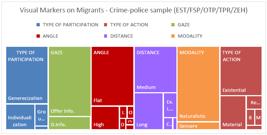
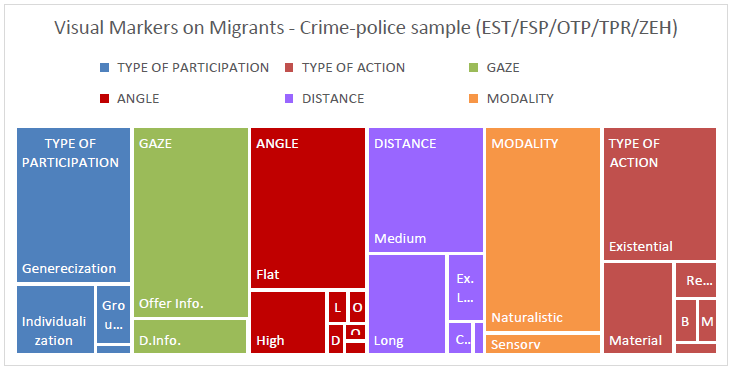
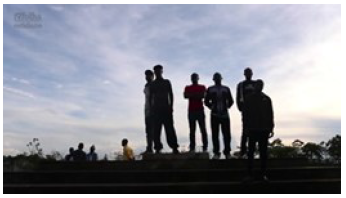
For the first time, genericization turns out to be the most common form of incorporating migrants into photojournalism related to crime. It sounds uncommon at first sight that in articles that are supposed to tell specific stories about individual migrants and their encounters with law enforcement, so many images end up representing them in groups and with rare references to their names, their origin/struggles, and expectations. More than sometimes aggregating black bodies in one frame, publications tend to re-utilize pictures from other news pieces, rooting them out of their context and reinserting them into a new communicative situation/moment (see. Blommaert, 2005). Deprived of their first background information and original framing, pictures go through a process of resignification precisely due to the new data that reshape them into the new media text. By doing so, newspapers are prone to create this void of naming, determination, and original narrative relating to the image. The photo ends up becoming an illustration, a generic unit that could be reused in dozens of other news texts. This could partially explain why the number of genericized visual representations is much higher under the crime topic than under other macro-frames - such as charity -, as noted in the chart below:
If pictures from the actual event reported have not been produced or could not be retrieved, then photo-recycling comes up as a solution to fill in the gap (see. Andrade, 2018; cf. Gras, 2019). The crucial issue, in this case, is that images are there to enhance meaning effects, aggregate other layers of meaning, and, more importantly, attract audience members, maybe obtain ‘likes,’ ‘shares,’ or ‘comments’ (see. Périco; Souza, 2018). In a sense, and considering neoliberal societies’ craze for [visual] commodification, black migrants are prone to become some sort of commodity in every new cultural-mediatic exchange they are added to; that is, in each new article, their image is re-utilized. By reusing the same set of images repeatedly, publications also reinforce, validate, or legitimize one-sided perceptions of black migrants, which indicate them as either criminals or poor victims (see. Smelter; Calvillo, 2020).
Once they made their way into photojournalism, migrants continued to be mostly portrayed through existential actions. This again reproduces views of them as more passive. On the other hand, under this crime-police theme, migrants get slightly more instances in which they are represented carrying out material actions more than under victimhood or charity macro-frames. Evidently, as criminals, they are expected to commit acts to break the law, a factor that could help explain why the higher frequency of material actions. Even so, much more than half of the pictures remain dedicated to depicting black migrants as victims of crime, not perpetrators.
The crime-police topic also seems to have an influence over camera angles. In comparison with other themes, in crime-police-related news pictures, while egalitarian/non-involving angles, such as flat ones, are much more numerous, the disempowering angles, such as high ones, are much less present, nearly twice less frequent. This could suggest that as ‘illegals’ or offense targets, black migrants have more chances of being placed in positions of less disempowerment. In this regard, two factors may play a role. On the one hand, as victims of violations, black migrants appear to entice more sensitivity and compassion, which national victims already get in a nation battling crime problems. In fact, part of this sympathy and mercy, besides being enhanced by the extreme vulnerability assigned to them by the media, might also be a transfer from the daily episodes already reported in news media concerning Brazilians. In this case, if a black migrant is a victim of ‘relatable’/comparable crimes to the ones endured by nationals, the probability of less disempowering angles in pictures seems to increase. On the other hand, and beyond coercion, a certain amount of power is necessary for ‘illegal’ black migrants to have the opportunity to carry out a crime, such as disobeying immigration laws. For that reason, images would have to place them in that position of some form of power for them to be able to disrespect regulations/norms and be taken as offenders.
An abundance of flat angles in symbiosis with other convenient visual markers (such as low frequency of sensory modality) provides media outlets with the necessary degree of proximity to crime scenes and dramatic episodes without necessarily empowering victims or fostering empathy, though. Truly sensitizing readers beyond patronizing views appears to be a rare practice. In fact, the lower proportion of less disempowering angles mentioned in the previous paragraph may actually suggest that condescending compassion/sympathy, when evoked, cannot or should not be equalled to empathy/involvement.
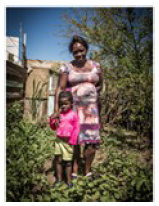
On the sensory modality aspect, however, a counterpoint could be made that the aestheticization of pictures depicting ‘illegals’ or crime victims would also be able to overdramatize reported events, exploiting people’s narratives/suffering and circumstances for the sake of a news spectacle. Indeed, this is a possibility. Nevertheless, as they emerge in news outlets of this corpus, the very few pictures that resort to a more aestheticizing approach may foment precisely the opposite of sensationalism: inspiration, awareness, understanding, and openness, as implied in the examples below:
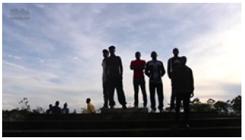
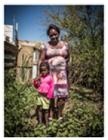
“Haitian Elisa Derisma, 43, and her daughter at home in Ocupação Progresso, Porto Alegre.”
Evidently, however, this paper does not argue that in such rarely sensitizing instances, newspapers practice mere and simple ‘goodwill out of their hearts.’ One should not forget that they are somehow producing, packaging, and sharing migrants’ narratives and experiences while still making a revenue out of that. Accordingly, it seems inevitable that in a neoliberal and highly competitive market of news and attention, migrants’ stories and feelings become, to a certain extent, commodified objects as well (Al-Rawi, 2020; see. Martin, 2019).
As for other actors in images, the most frequent form of participation is grouping, as pointed out in the following chart:
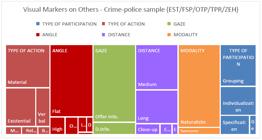
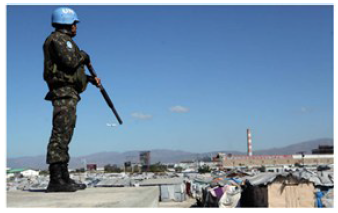
Unlike other macro-frames, under this macro-trope, pictures of groups of law enforcement agents are much more abundant. A few of these images appear to equally receive an aesthetic treatment (concerning angle, position, depth, or saturation) in such a way that suggests law officers as undaunted/imposing agents, peace/order keepers, protectors, almost inspirational heroes, as implied in the examples below:
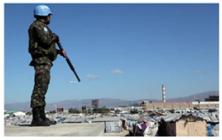
“Brazilian member of the UN peace forces in an aviation camp for refugees in Port-au-Prince; next Saturday will mark the third anniversary since the earthquake on January 12th, 2010, which left 300 thousand dead in the city”.
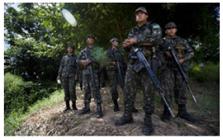
“River patrol at the entrance of the city located in the region of triple borders between Brazil, Bolivia, and Peru; the Brazilian Army carries out Agata Operation, which has as one of its goals to patrol the nearly 17 thousand km of cross-border territory”.
In any case, pictures with individualized and specified non-migrants continue to surpass the ones referring to black migrants in frequency, as pointed out in the previous chart. Additionally, images of these other participants tend to portray them mostly carrying out material and verbal actions. This may ultimately imply that agency or pro-activity is assigned to those participants way more frequently than to migrants. Those are the ones who more often get called by their name, have access to self-determination, and can make things happen.
Surprisingly, when referring to non-migrants, there seems to be slightly more distancing between camera positions and interlocutors than in pictures of migrants. There also seems to be an implied aura of respect or fear of law enforcement actors, which may end up influencing how far/close a particular shot can be taken. It could also be something more trivial, such as the impossibility of getting closer to a crime scene or the precaution by photojournalists not to get involved in the crossfire, for example. Nevertheless, the frequent occurrence of officers’ photos with long and extra-long shots, even when no conflict is in sight, might confirm suspicions brought from the other macro-frames. That is, the distancing and simultaneous empowering of officials can ultimately contribute to the desensitizing and dehumanizing of enforcement agents, making them appear impersonal/unbending arms of an abstract set of laws and institutions, which should probably be obeyed/feared/revered.
News pictures are also a realm for other kinds of imbalances to emerge, namely the ones referring to gender. While migrant women tend to be considered offenders and as offense targets half of the time for each role, migrant men are twice as likely to be seen as crime victims than lawbreakers. A possible explanation for this may lie in the fact that the number of images of migrant men far exceeds those of migrant women, whose pictures are present in no more than one-fifth of this corpus (only human figures considered). This simple reality makes room for a statistically more reliable conclusion regarding migrant men than concerning migrant women. Another possible motive is that the uncommon occurrence of women also crossing borders and becoming ‘illegals’ may emerge as a surprising event, a reason why newspapers might be inclined to proportionally report more on them as migration lawbreakers than men. Important to notice, though, that when it comes to violent crimes or offenses against property, then migrant men are the ones almost solely reported as perpetrators, with nearly zero instances referring to women.
As suggested before, Brazilian media’s impetus for an unreflective defense of legality seems to clash with its equal commitment to charitable or condescending views on black migrants, as pointed out in previous paragraphs. This dynamic is openly noticed in the high number of pictures portraying both migrant men and women as poverty or abuse victims, that is, as charity-worthy subjects.
Another striking finding is that in pictures, black migrant women tend to be seen as ‘cultural specimens’ much more often than men. This phenomenon appears to occur exclusively in relation to Indigenous migrant women, who at crossing borders seem to be exoticized by news outlets in pictures, quite often named deprived ‘Indians [sic] that spread out across’ the country, ‘occupy’ cities and ask for donations.
Other gender differences in visual language appear as a repetition of what has been noted elsewhere (see. Araújo, 2020). Migrant women continue to be frequently portrayed as mothers, while migrant men remain often represented as workers or spiritual leaders/worshippers.
Evidently, gender inequalities regarding black migrants are not absent from verbal representations either. In this sense, migrant women are twice more likely to be viewed as crime victims than perpetrators, quite different from the half-half noticed in visual language. Concerning migrant men, the results look much more balanced despite the slight numerical advantage of personal references to them as crime victims rather than offenders. At this point, the ingrained verbal perceptions of black women in general as already vulnerable, deprived, or poor might have an influence on depictions of them, reinforcing their constructed place as more fragile, compassion-worthy, or more helpless than men (Antunes de Jesus et al., 2019; Ribeiro et al., 2019; see. Santos, 2018). Meanwhile, migrant men are slightly more inclined to be associated with danger, risk-taking, intrepidity, and imprudence.
When it comes to gender roles related to the family core, migrant women continue to be portrayed in verbal language as wives and mothers. Although the number of identifiable passages pointing them out as workers or career individuals gets close to the frequency of references to them as mothers, they are still up to eight times more likely to be seen as mothers and wives than men are to be taken as fathers/husbands. Additionally, migrant men have up to three times more chances of being associated with professional settings than women.
There are two or three verbal instances, however, where black migrant men are not inclined to be somehow favored over black women when they are represented as ‘cultural specimens.’ In “Hell in the Promised Land” (31/08/2015, ZEH), a regional news outlet compares Haitians and Senegalese in a way that suggests cultural and biological categorization. The text appears to slightly exoticize their bodies and appearance, resorting to the black race as a monolithic/all-encompassing identity marker (see. Escudero, 2021). When confronted with divergence or diversity among ‘blacks,’ then the text seems to turn to an implicit stereotyping of their socio-religious behavior to justify the ‘unexpected incongruities’ between migrant ‘blacks.’ That is, the news report finds an objectifying way of understanding the fact that black migrants are as diverse and complex as any other human beings, some of whom, for being white, never have their divergences brought under the same purview of a unidimensional race:
Haitians are shorter and stronger. Senegalese are much taller and slimmer. Both are vain and like to dress well, especially Haitians, with famous brands and Messi, Neymar, Cristiano Ronaldo, and Michael Jordan shirts. The two countries have been colonized by France and, today, offer difficulties, misery, and unemployment to their people. Essentially, they are black. […] Religion is the pillar of this segregation [emphasis added].
5 CONCLUSION
Black migrants are inclined to be unfavorably represented within this corpus. Criminality tends to be more related to offenses against migration laws, but almost half of the analyzed instances portray black migrants as crime victims, not perpetrators. This is something relatively new, considering that nearly all previous studies have emphasized migrants in the role of criminals, not necessarily in the position of crime victims (see. Alfaro-Velcamp; Shaw, 2016; Balica; Marinescu, 2018; Crush; Williams, 2018).
Notwithstanding, the Brazilian press’ reports on crimes committed against migrants are more implicit and proportionally less frequent. That is, they could be confused with other ordinary cases of urban violence. This should not mean that race, gender, and nationality are not factors involved in crimes in Brazil or elsewhere - black migrant men are far more susceptible to murder than women (Gomes; Silva, 2017). It might be the opposite; this suggests that despite Brazilian outlets neglecting such factors (racism and xenophobia), these elements continue to be pivotal in violent acts that look like ‘usual’ passion crimes or repeated urban felonies.
Brazilian news media also resort to offenses not consistently found in previous research concerning the Global North, such as public/private space invaders and outlaw traders. The recipe of law-and-order regarding private property, perhaps much more than public ones, really seems to take its toll on these views on migrants as illegitimate occupiers, either in space or in commercial relations, or sometimes both.
In visual semiosis, either as victims or perpetrators, migrants under this frame of crime are more inclined to be seen in personalized scenes. After all, for a commission of or to be targeted by a felony, it is necessary to have an actor either as an active or passive part. Maybe that is why the emphasis on the individual under this macro-frame falls more often on migrants.
Understandably, types of action for migrants in Brazilian pictures tend to be often passive, considering that the Latin country’s media report slightly more on migrants as victims than offenders. These images also tend to distance migrants from readers and employ fewer instances of demanding-informational gaze and slightly fewer sensory modalities than expected. Altogether, these visual markers imply less engagement with the victimized migrants and the impactful scenes they are presented in, which appear in much fewer numbers and less explicitly visual detail.
Concerning gender roles, however, Brazilian images and verbal texts tend to favor migrant women a little bit more than what is shown in previous literature (cf. Mawadza, 2012). When related to crimes, it seems that migrant women’s work activities must be mentioned, so the frequency of roles related to profession, job, career, or employment increases. Nevertheless, the power still leans toward migrant men. Even though they represent nearly all victims of crime and perpetrators as well, their gender roles continue to be connected to the public arena, while migrant women tend to be restricted to the private environment, with exceptions, of course.
REFERENCES
-
AIRGOOD, B. Immigrant representation: a content analysis of media narratives of immigrants in U.K. and U.S. publications. 2017. Dissertação (Mestrado) - Michigan State University, East Lansing, 2017. DOI: http://doi.org/10.25335/wdms-xw14
» http://doi.org/10.25335/wdms-xw14 -
AL-RAWI, A. Networked emotional news on social media. Journalism Practice, v. 14, n. 9, p. 1125-1141, 2020. DOI: http://doi.org/10.1080/17512786.2019.1685902
» http://doi.org/10.1080/17512786.2019.1685902 -
ALFARO-VELCAMP, T.; SHAW, M. Please GO HOME and BUILD Africa: criminalising immigrants in South Africa. Journal of Southern African Studies, v. 42, n. 5, p. 983-998, 2016. DOI: http://doi.org/10.1080/03057070.2016.1211805
» http://doi.org/10.1080/03057070.2016.1211805 -
ALMEIDA, H. J. R.; VIEIRA, B. S.; SANTOS, J. L. O. dos. A criminalização midiática do movimento social de luta pela moradia digna. Revista de Direito da Cidade, v. 11, n. 4, p. 440-472, 2019. DOI: https://doi.org/10.12957/rdc.2019.39597
» https://doi.org/10.12957/rdc.2019.39597 -
ALVES ARAÚJO, G.; DA SILVA FREITAS, G. M. Migrantes na mídia latino-americana e africana: uma revisão de literatura por perspectivas menos eurocêntricas. Caderno de Letras, n. 42, p. 443-462, 2022. DOI: https://doi.org/10.15210/cdl.v0i42.21120
» https://doi.org/10.15210/cdl.v0i42.21120 -
ALVES ARAÚJO, G.; RODRIGUES SOUSA, E. A vitimidade como espaço de ambivalências: migrantes negros na imprensa brasileira. Todas as Letras - Revista de Língua e Literatura, v. 26, n. 3, 2025. DOI: https://doi.org/10.5935/1980-6914/eLETLL16625
» https://doi.org/10.5935/1980-6914/eLETLL16625 - ANDRADE, A. P. G. de. Telejornalismo apócrifo: a construção da notícia com imagens amadoras e de vigilância. Florianópolis: Insular, 2018.
- ANTUNES DE JESUS, C.; ABS DA CRUZ PRETO, L.; FERREIRA FERREIRA, B.; FERNANDES KOMKA VICENTE, M. Estereótipos de gênero e seus impactos na psique humana. Revista Científica Sophia, v. 1, n. 1, p. 70-87, 2019.
-
ARAÚJO, B. B.; CAMPOS, F. S. S. O neoliberalismo nos editoriais: o discurso de O Globo e O Estado de S. Paulo sobre a Previdência Social brasileira. Estudios sobre el Mensaje Periodístico, v. 27, n. 4, p. 1023-1034, 2021. DOI: http://doi.org/10.5209/esmp.72374
» http://doi.org/10.5209/esmp.72374 -
ARAÚJO, G. A. Black migrants in Brazilian and South African tabloids: representations on the Global South. Journal of Global Diaspora & Media, v. 1, n. 1, p. 35-53, 2020. DOI: http://doi.org/10.1386/gdm_00003_1
» http://doi.org/10.1386/gdm_00003_1 -
ARAÚJO, G. A.; FREITAS, G. M. da S. A review on discourse studies concerning migrants in media publications from Brazil and South Africa: towards more Afro-Latin perspectives. Index.comunicación, Madrid, v. 12, n. 1, p. 309-333, 2022. DOI: http://doi.org/10.33732/ixc/12/01Arevie
» http://doi.org/10.33732/ixc/12/01Arevie -
ARAÚJO, G. A.; FREITAS, G. M. da S. Afro-migrantes em jornais do Sul Global: “Criminosos”, “Samaritanos” e “Vítimas”. Fórum Linguístico, Florianópolis, v. 20, n. 3, p. 9139-9156, 2023. DOI: http://doi.org/10.5007/1984-8412.2023.e86563
» http://doi.org/10.5007/1984-8412.2023.e86563 - ASANTE, M. K. An Afrocentric manifesto: toward an African renaissance. [S.l.]: Polity Press, 2007.
-
ATKINSON, A. M.; SUMNALL, H. ‘Zombies’, ‘cannibals’, and ‘super humans’: a quantitative and qualitative analysis of UK news media reporting of the cathinone psychostimulants labelled ‘monkey dust’. Drugs: Education, Prevention and Policy, v. 28, n. 4, p. 299-315, 2021. DOI: http://doi.org/10.1080/09687637.2020.1799944
» http://doi.org/10.1080/09687637.2020.1799944 -
AZEVEDO, F. A. Jornais e política no Brasil (1985-2022). Más Poder Local, n. 61, p. 15-33, jul. 2025. DOI: http://doi.org/10.56151/maspoderlocal.282
» http://doi.org/10.56151/maspoderlocal.282 -
BALICA, E.; MARINESCU, V. (eds.). Migration and crime: realities and media representations. Cham: Palgrave Macmillan, 2018. DOI: http://doi.org/10.1007/978-3-319-95813-2
» http://doi.org/10.1007/978-3-319-95813-2 -
BLOMMAERT, J. Discourse: a critical introduction. Cambridge: Cambridge University Press, 2005. DOI: http://doi.org/10.1017/CBO9780511610295
» http://doi.org/10.1017/CBO9780511610295 - BOFF, L. O caminhar da Igreja com os oprimidos: do vale de lágrimas à Terra Prometida. Rio de Janeiro: Codecri, 1981.
- BRANDT, G. B.; WASSERMAN, M. O estereótipo como elemento discursivo: reflexões a partir da figura do imigrante no Brasil. Aedos, v. 12, n. 27, p. 72-94, 2021.
-
CARTA CAPITAL. Bolsonarista que defendeu a separação do Nordeste tem R$ 480 milhões em contratos com governo, diz jornal. Carta Capital, 11 nov. 2022. Disponível em: https://www.cartacapital.com.br/politica/bolsonarista-que-defendeu-a-separacao-do-nordeste-tem-r-480-milhoes-em-contratos-com-governo-diz-jornal/. Acesso em: 5 mar. 2026.
» https://www.cartacapital.com.br/politica/bolsonarista-que-defendeu-a-separacao-do-nordeste-tem-r-480-milhoes-em-contratos-com-governo-diz-jornal -
CHIUMBU, S. H.; MOYO, D. “South Africa belongs to all who live in it”: deconstructing media discourses of migrants during times of xenophobic attacks, from 2008 to 2017. Journal for Communication Sciences in Southern Africa, v. 37, n. 1, p. 136-152, 2018. DOI: http://doi.org/10.36615/jcsa.v37i1.1586
» http://doi.org/10.36615/jcsa.v37i1.1586 -
CRUSH, J.; WILLIAMS, V. Criminal tendencies: immigrants and illegality in South Africa. (Policy Brief 10). Cape Town: Southern African Migration Project, 2018. Disponível em:https://media.africaportal.org/documents/Criminal_Tendencies.pdf Acesso em: 5 mar. 2026.
» https://media.africaportal.org/documents/Criminal_Tendencies.pdf - DAVIS, A. Y. Women, race and class. New York: Vintage Books, 1983.
-
EIDSON, J. R. et al. From identification to framing and alignment: a new approach to the comparative analysis of collective identities. Current Anthropology, v. 58, n. 3, p. 340-359, 2017. DOI: http://doi.org/10.1086/691970
» http://doi.org/10.1086/691970 -
ESCUDERO, C. O “nós” e o “outro” no discurso midiático tradicional e comunitário sobre imigrantes: uma proposta de atualização a partir de Simmel e Park. Estudios sobre el Mensaje Periodístico, v. 27, n. 1, p. 85-93, 2021. DOI: http://doi.org/10.5209/esmp.71259
» http://doi.org/10.5209/esmp.71259 -
FARIA, C. África. InfoEscola, 1 jan. 2021. Disponível em: https://www.infoescola.com/geografia/africa/. Acesso em: 5 mar. 2026.
» https://www.infoescola.com/geografia/africa - FILGUEIRAS, Mirela Araújo. Como os jornais e as redes sociais atuaram na retomada do poder pela direita. Observatório da Imprensa, ed. 984, 24 abr. 2018.
- FREIRE, P. Pedagogia do oprimido. 62. ed. Rio de Janeiro: Paz e Terra, 2011.
-
G1 RIO. Moïse Kabagambe: o que se sabe sobre a morte do congolês no Rio. G1, Rio de Janeiro, 31 jan. 2022. Disponível em: https://g1.globo.com/rj/rio-de-janeiro/noticia/2022/01/31/moise-kabamgabe-o-que-se-sabe-sobre-a-morte-do-congoles-no-rio.ghtml Acesso em: 5 mar. 2026.
» https://g1.globo.com/rj/rio-de-janeiro/noticia/2022/01/31/moise-kabamgabe-o-que-se-sabe-sobre-a-morte-do-congoles-no-rio.ghtml - GARDNER, B. A. (ed.). Black’s law dictionary. 9. ed. St. Paul: West, 2009.
-
GOMES, F. B.; SILVA, J. M. Necropolíticas espaciais e juventude masculina: a relação entre a violência homicida e a vitimização de jovens negros pobres do sexo masculino. GEOUSP - Espaço e Tempo (Online), v. 21, n. 3, p. 703-717, 2017. DOI: http://doi.org/10.11606/issn.2179-0892.geousp.2017.127748 Acesso em: 5 mar. 2026.
» http://doi.org/10.11606/issn.2179-0892.geousp.2017.127748 -
GRAS, I. Recycled images as layers of meaning in picture books. Interfaces, n. 41, p. 45-63, 2019. DOI: http://doi.org/10.4000/interfaces.646
» http://doi.org/10.4000/interfaces.646 -
GRELLET, F. Congolês cobra dívida de trabalho e é espancado até a morte. Terra, 21 jan. 2022. Disponível em: https://www.terra.com.br/noticias/brasil/cidades/congoles-cobra-divida-de-trabalho-e-e-espacando-ate-a-morte,9e9dcb48a5b7aec720e7ff2693612bffvba892hs.html Acesso em: 5 mar. 2026.
» https://www.terra.com.br/noticias/brasil/cidades/congoles-cobra-divida-de-trabalho-e-e-espacando-ate-a-morte,9e9dcb48a5b7aec720e7ff2693612bffvba892hs.html - GUILHERME, C. A. De volta ao passado: a proposta neoliberal do Estadão no pós-golpe. Revista Espaço Acadêmico, n. 208, p. 66-74, 2018.
- GUIMARÃES, A. S. A. Racismo e anti-racismo no Brasil. São Paulo: Ed. 34, 1999.
- HOCHMAN, G.; TEIXEIRA, L. A.; PIMENTA, T. S. História da saúde no Brasil. São Paulo: Hucitec, 2018.
- HOLANDA, S. B. de. Raízes do Brasil. Rio de Janeiro: José Olympio, 1983.
- HOOKS, bell. Ain’t I a woman: black women and feminism. Boston: South End Press, 1981.
- HOOKS, bell. Killing rage: ending racism. New York: Henry Holt & Co., 1995.
- HUDSON-WEEMS, C. Africana womanism: reclaiming ourselves. Troy: Bedford, 1993.
-
JANONE, L. Imprensa internacional repercute morte de congolês no RJ. CNN Brasil, 2 fev. 2022. Disponível em: https://www.cnnbrasil.com.br/nacional/imprensa-internacional-repercute-morte-de-congoles-no-rj/. Acesso em: 5 mar. 2026.
» https://www.cnnbrasil.com.br/nacional/imprensa-internacional-repercute-morte-de-congoles-no-rj -
JORNAL DA CULTURA. Jovem imigrante é morto na grande SP por dívida de R$ 100. Jornal da Cultura, 10 fev. 2022. Disponível em: https://cultura.uol.com.br/noticias/46384_jovem-imigrante-e-morto-na-grande-sp-por-divida-de-r-100.html Acesso em: 5 mar. 2026.
» https://cultura.uol.com.br/noticias/46384_jovem-imigrante-e-morto-na-grande-sp-por-divida-de-r-100.html - KARENGA, M. Kwanzaa: a celebration of family, community and culture. [S.l.]: USP, 1998.
-
LIROLA, M. M. Approaching the representation of Sub-Saharan immigrants in a sample from the Spanish press. Critical Discourse Studies, v. 11, n. 4, p. 482-499, 2014. DOI: http://doi.org/10.1080/17405904.2014.915382
» http://doi.org/10.1080/17405904.2014.915382 -
MAGALHÃES, A. (dir.). Especial Paulo Freire 1 - O intelectual amoroso (37). In: Reportagens especiais - Rádio Câmara [áudio]. Brasília: Rádio Nacional, 28 maio 2020. Disponível em: https://www.camara.leg.br/radio/programas/285321-especial-paulo-freire-1-o-intelectual-amoroso-0730/. Acesso em: 5 mar. 2026.
» https://www.camara.leg.br/radio/programas/285321-especial-paulo-freire-1-o-intelectual-amoroso-0730 -
MARTIN, F. In the suicide forest: how social media news sharing is affecting news journalism. In: MARTIN, F.; DWYER, T. (eds.). Sharing news online: commentary cultures and social media news ecologies. Cham: Springer International Publishing, 2019. p. 1-19. DOI: http://doi.org/10.1007/978-3-030-17906-9_1
» http://doi.org/10.1007/978-3-030-17906-9_1 - MAWADZA, A. The Zimbabwean threat: media representations of immigrants in the South African media. 2012. Tese (Doutorado) - University of the Western Cape, [S.l.], 2012.
-
MBEMBE, A. Necropolitics. Durham: Duke University Press, 2019. DOI: http://doi.org/10.2307/j.ctv1131298.1
» http://doi.org/10.2307/j.ctv1131298.1 -
PAULA, G. S. de. Nas fronteiras da alteridade: a representação do espaço do migrante na narrativa jornalística de Zero Hora (2014-2015). 2019. Dissertação (Mestrado em Comunicação) - Universidade Federal do Rio Grande do Sul, Porto Alegre, 2019. Disponível em: https://1library.org/document/zx996xwz-fronteiras-alteridade-representacao-espaco-imigrante-narrativa-jornalistica-hora.html Acesso em: 5 mar. 2026.
» https://1library.org/document/zx996xwz-fronteiras-alteridade-representacao-espaco-imigrante-narrativa-jornalistica-hora.html -
PÉRICO, G. I.; SOUZA, S. T. de. O algoritmo do Facebook e a distribuição de notícias online na era da pós-verdade: um estudo do jornal Folha de S. Paulo. In: 41º Congresso Brasileiro de Ciências da Comunicação. Anais [...]. Joinville: Intercom, 2018. p. 1-14. Disponível em: https://portalintercom.org.br/anais/nacional2018/resumos/R13-0910-1.pdf Acesso em: 5 mar. 2026.
» https://portalintercom.org.br/anais/nacional2018/resumos/R13-0910-1.pdf -
REIS, A. G.; VIEIRA, M. S. “Os novos imigrantes”: construções discursivas sobre haitianos e senegaleses em um jornal do Sul do Brasil. Ciências Sociais Unisinos, v. 55, n. 3, p. 387-396, 2019. DOI: http://doi.org/10.4013/csu.2019.55.3.08
» http://doi.org/10.4013/csu.2019.55.3.08 - RIBEIRO, B. C. P. et al. Discutindo esterótipos de gênero: análise das representações de novas masculinidades em campanhas publicitárias. Caderno Profissional de Marketing UNIMEP, v. 7, n. 1, p. 1-16, 2019.
-
RIBEIRO, Alexsandro Teixeira. A Gazeta do Povo: um jornal sob gerações dos Cunha Pereira. Revista NEP - Núcleo de Estudos Paranaenses da UFPR, v. 10, n. 1, p. 110-143, 2024. DOI: http://doi.org/10.5380/nep.v10i1.95763
» http://doi.org/10.5380/nep.v10i1.95763 -
SANTOS, G. M. dos. Construindo crenças: metáforas de uma feminilidade. 2018. Trabalho de Conclusão de Curso (Graduação em Letras) - Universidade de Brasília, Brasília, 2018. Disponível em: https://bdm.unb.br/handle/10483/22598 Acesso em: 5 mar. 2026.
» https://bdm.unb.br/handle/10483/22598 - SCHWARCZ, L. M. Sobre o autoritarismo brasileiro. São Paulo: Companhia das Letras, 2019.
- SILVA, A. F. da et al. Cordial, mas nem tanto: a banalização do discurso de ódio no Brasil. In: Inteligência artificial: a nova fronteira da ciência brasileira. Brasília: [s.n.], 2020. v. 2, p. 443-447.
-
SILVA, C. F. da; FERNANDES, E. G. Imagem e contestação: regimes emocionais no enquadramento midiático a eventos de protesto. Opinião Pública, v. 29, n. 1, p. 69-101, 2023. DOI: http://doi.org/10.1590/1807-0191202329169
» http://doi.org/10.1590/1807-0191202329169 -
SILVA, P. K.; OLIVEN, R. G. Filantrocapitalismo versus filantropia para a justiça social: um debate norte-americano sobre como lidar com a pobreza. Mana, v. 26, n. 1, p. 1-34, 2020. DOI: http://doi.org/10.1590/1678-49442020v26n1a204
» http://doi.org/10.1590/1678-49442020v26n1a204 -
SMELTER, T. J.; CALVILLO, D. P. Pictures and repeated exposure increase perceived accuracy of news headlines. Applied Cognitive Psychology, v. 34, n. 5, p. 1061-1071, 2020. DOI: http://doi.org/10.1002/acp.3684
» http://doi.org/10.1002/acp.3684 - VELOSO, G. N. de P. O preconceito de um país multicultural: o “jeitinho” de discriminar do brasileiro. Revista da Faculdade de Direito Santo Agostinho, v. 6, n. 1, p. 49-57, 2016.
Os conjuntos de dados estarão disponíveis mediante solicitação ao(s) autor(es).

 Source: Crime-police corpus - prepared by the authors.
 Source: Crime-police corpus - prepared by the authors.
 Source: News piece: Video shows saga of Haitians trafficked to Brazil" (30/05/2014. FSP).
 Source: News piece: From earthquake to occupation: female Haitian lives in irregular and contaminated area (08/03/2018, FSP)
 Source: Crime-police corpus - prepared by the authors.
 Source: News Piece: From earthquake to occupation: female Haitian lives in irregular and contaminated area (08/03/2018, FSP).
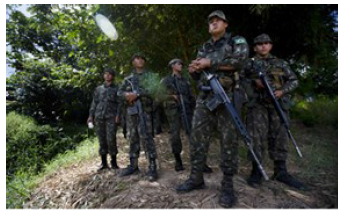 Source: News Piece: Border post in the jungle closes at 8 p.m. (02/06/2013, FSP)