Synthesis and Evaluation of Mechanical Properties of Nano TiO2 Reinforced Aluminium Metal Matrix Nano Composites (MMNCs)
Abstract
In the present investigation, aluminium Metal Matrix Composites (MMCs) were synthesized by reinforcing nano TiO2 particles at varying weight percentages (0.5 ,1.5,2.5 and 3.5 wt%) into an AA6061 molten aluminium matrix using the stir casting method. The synthesized composites were characterized using optical microscopic analysis, Scanning Electron Microscopy (SEM) and X- ray diffraction (XRD). The hardness and tensile properties of the composites were evaluated. The analysis of mechanical properties revealed that the T6 composite containing 0.5 wt% nano TiO2 particles had a maximum hardness of 79.6 BHN compared to other T6 samples and as well as ac-cast samples. Ultimate tensile strength and yield strength of T6 composite containing 0.5 wt% TiO2 was found to be (180 MPa and 135 MPa) higher than other T6 composites and as cast samples. Fractography of Al MMC containing 0.5 wt% nano TiO2 particles revealed ductile -brittle fracture mode in the T6 condition.
Keywords:
Al MMC; Nano TiO2 particles; Weight percentage (wt%); Heterogenous nucleation sites; Grain refinement; Wettability; Fractography
1. Introduction
Aluminium Metal Matrix Composites (MMCs) have been widely used in automotive, construction and aerospace applications due to its properties such as; high strength to weight ratio,wear resistance and corrosion resistance1-6. Ceramic nano particulate reinforcements are considered as a favorable option for aluminium to impart high strength to weight ratio compared to microsized ceramic particulate reinforcements7. Nagaral et al.8 reported that Al MMCs reinforced with nano B4C particulates, exhibited notable improvements in mechanical properties. Similar results were reported by Nagaral et al.9 in the study of mechanical properties of Al MMCs reinforced with nano ZrO2 particulates. There are different ways where Metal Matrix Nano Composites (MMNCs) can be synthesized such as; stir casting, powder metallurgy, squeeze casting, etc. Among them, stir casting is well recognized for its cost-effectiveness and simplicity. Stir casting process mostly worked in the manufacture of MMCs10 and as well as MMNCs as it produces composites with uniform reinforcement distribution11.
Nano composites are materials that integrate nano particles into a matrix of standard materials and alloys. The addition of nano particles result in a significant enhancement of performance, which may include strength, durability in addition to electrical and thermal conductivity. The efficiency of nano particles is such that the extent of added material generally represents merely 0.5 to 15% by weight. Higher surface area of the nano particles increases interface surface area of the matrix and particles. The material properties of the MMNCs are significantly superior to those of the traditional Metal Matrix Composites.
According to several studies11, MMNCs are a combination of a metal matrix and dispersed nano ceramic particles or a metal phase. SiC, Boron, Al2O3, TiO2, SiN, B4C, B4N are widely used ceramic reinforcements. MMNCs are used in space shuttles, airplanes, electronic media, bicycles, automobiles, mechanical and wear applications. Compared with aluminium MMCs reinforced with microscopic ceramic particulates, Al composites reinforced with nano particulates exhibited significant improvements in physical and mechanical properties such as strength, modulus of elasticity, fatigue strength and resistance to wear loss12-15.
In the present investigation AA6061 Alloy reinforced with varying weight percentages ( wt%) of TiO2 nano ceramic particles were synthesised by using stir casting route in contrast to several investigations carried out with micro ceramic reinforcements as observed in the studies on the wear behaviour of Al MMCs reinforced with ZrO2 and graphite reinforcements, carried out by Sampath Kumar et al.16. The synthesized composites were characterized and tested to study the effect of wt% of TiO2 particles in influencing the mechanical properties of Al MMCs. Several investigations indicated that particle weight percentage and particles size influenced the microhardness of Al MMCs reinforced with ceramic reinforcements.
2. Materials and Methods
AA6061 alloy was used as the base metal in the present work. TiO2 nano particles having average particle size of 30nm was used as the reinforcement at varying wt% in this study. The chemical composition of the as-cast base alloy and composites obtained using Optical Emission Spectroscope (OES) is showed in Table 1.
OES analysis revealed that Ti wt% increased with increasing wt% of TiO2 ceramic particulates , confirming that TiO2 particulates have got mixed in the Al alloy.
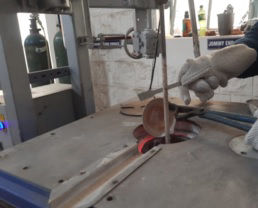
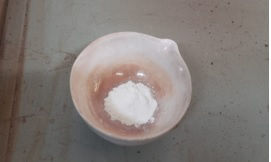
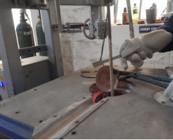
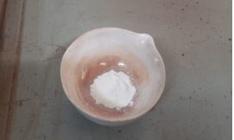
Stir casting setup used for Al MMNCs synthesis is showed in Figure 1. The aluminium base alloy was placed in a crucible and heated in the furnace to melt the aluminium. The molten aluminium was maintained at a constant temperature of 850°C for pouring. The nano TiO2 particles (Figure 2) preheated at 4000 C for 1 hour,were gradually added to the molten aluminium and the mixture was stirred using a stirring rod at a constant speed of 500 rpm for 15 minutes to achieve initial dispersion. A small amount of magnesium (Mg) was introduced into the molten composite material to improve wettability.
To further enhance the dispersion and prevent agglomeration of nano TiO2 particles, ultrasonification was done at 20 kHz for 3 minutes. Ultrasonication was followed by coveral flux addition in the molten composite to prevent oxidation of Al MMNCs and for removal of impurities. The molten composite material was then carefully poured in to mould preheated at 2000C. The samples were then allowed to cool and solidify at room temperature.
The synthesized composites were subjected to T6 treatment. In the T6 treatment, composites were solutionized at 530°C for 1 hour in order to homogenise the solid solution, followed by quenching in water. Solutionized composites were artificially aged at 185°C for 6 hours followed by air cooling. This process enables the precipitation of the alloying elements and improves the wettability of TiO2 particles with the matrix leading to an increase in the strength and hardness of the material.
3. Results and Discussions
3.1. Microstructure
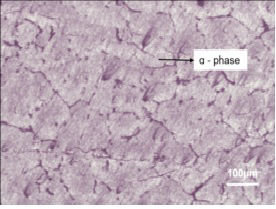
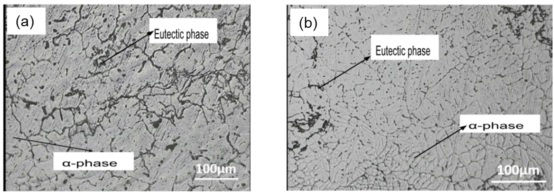
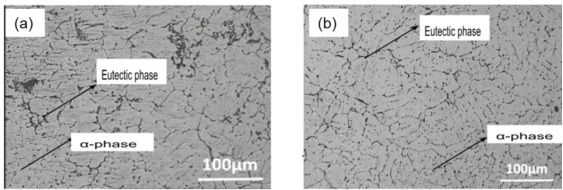
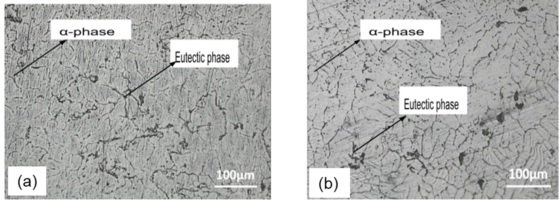
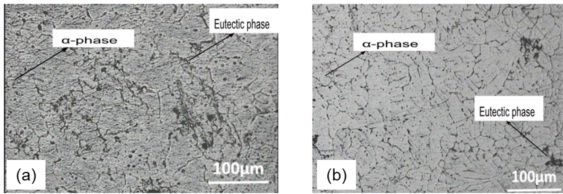
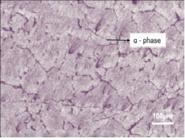
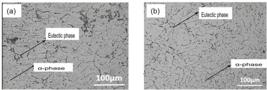
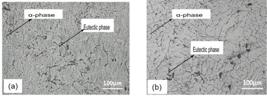
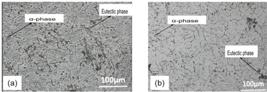
Microstructure of base alloy exhibited α - Al phase and eutectic network as showed in Figure 3. Microstructure of the as-cast composites and T6 composites (Figures 4, 5, 6 and 7) showed α-Al phase and eutectics network with grains found to be finer than as-cast composites.
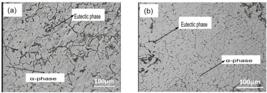
Microstructure of Al MMNCs reinforced with 0.5wt%TiO2 (a) as cast condition (b) heat treated condition.
Microstructure of Al MMNCs reinforced with 1.5wt%TiO2 (a) as cast condition (b) heat treated condition.
Microstructure of Al MMNCs reinforced with 2.5wt%TiO2 (a) as cast condition (b) heat treated condition.
Microstructure of Al MMNCs reinforced with 3.5wt%TiO2 (a) as cast condition (b) heat treated condition.
Grain size of composites found to decrease with increasing wt% of TiO2 particles due to increase in number of heterogenous nucleation sites in the as-cast and T6 composites. In heat treated condition grains were found to be comparitively finer and equiaxed than as-cast composites. This is possibly due to overcoming segregations imparted by the addition of TiO2 particles in the as-cast composites by T6 treament which also enhanced wettability of TiO2 particles with the matrix.
3.2. XRD analysis
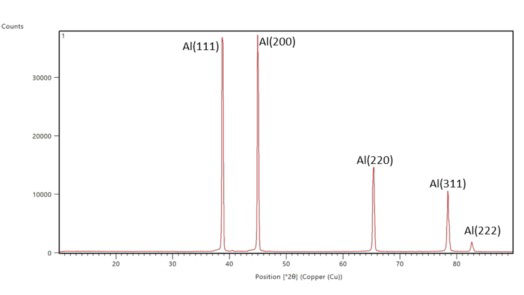
Results of the XRD analysis of the base alloy and composites containing 0.5wt% TiO2 particles are shown in Figures 8 and 9 respectively. Presence of TiO2 peak at 2θ value of 41.2° for MMC reinforced with 0.5wt% TiO2 in the obatined XRD pattern (Figure 9) confirmed the successful incorporation of TiO2 in the composites.
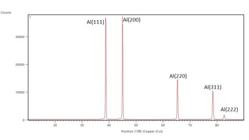
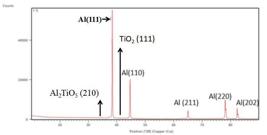
Base alloy and 0.5 wt% TiO2 nano particles containing composite exhibited Al peaks at 2θ values of 38.61°, 44.5°, 65.3°, 78.2° and 82.3° as showed in Figures 8 and 9. Further, Al2TiO5 peak was also observed in 0.5 wt% TiO2 nano particles containing composite at 2θ value of 34.5°.
3.3. Hardness
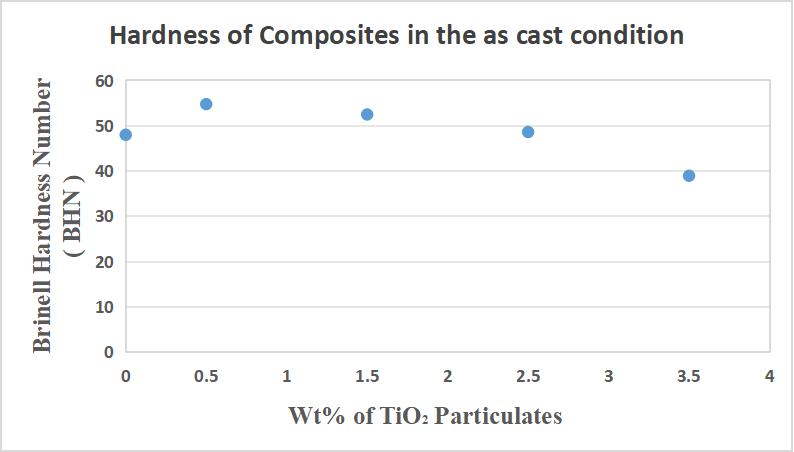
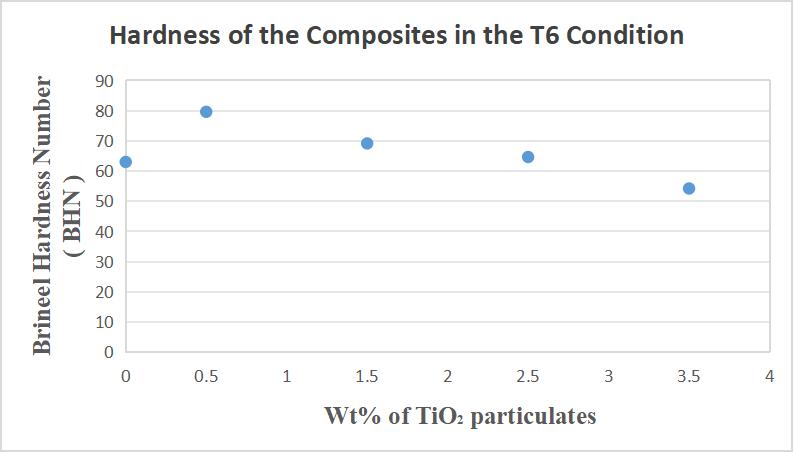
The hardness test was conducted in accordance with ASTM E 10 standard using a brinell hardness tester with a ball indenter of 10mm diameter and a load of 500 kgf. Table 2 shows the hardness values of base alloy and composites in the as-cast condition. In the as cast condition, Al MMNC reinforced with 0.5wt% TiO2 had showed highest hardness than other composites (Figure 10). Hardness of 0.5 wt% TiO2 nanoparticles reinforced composite was found to be 54.77 BHN. Table 3 shows the hardness value of base alloy and composites in T6 condition. The hardness values found to be higher in the T6 samples compared to respective as-cast samples. This can be attributed to grain refinement in the T6 samples which impedes dislocation, leading to increase in hardness since impedement to dislocation increases force to cause deformation (indentation). 0.5 wt% TiO2 reinforced Al MMNC showed higher hardness (79.6 BHN) than other composites in the T6 condition (Figure 11). Hardness of composites found to decrease with TiO2 wt% due to non-uniform wettability of reinforcement particles with the matrix.
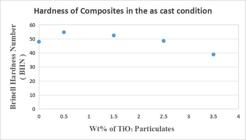
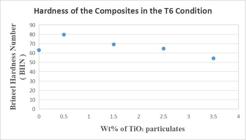
Studies in nanoparticles reinforced Al MMNCs, reported that hardness and tensile strength increased significantly compared to base alloy17, as well as to micro ceramic particles reinforced Al composites18 due to uniform dispersion of nano-particles , orowan strengthening and grain refinement19-21.
3.4. Tensile studies
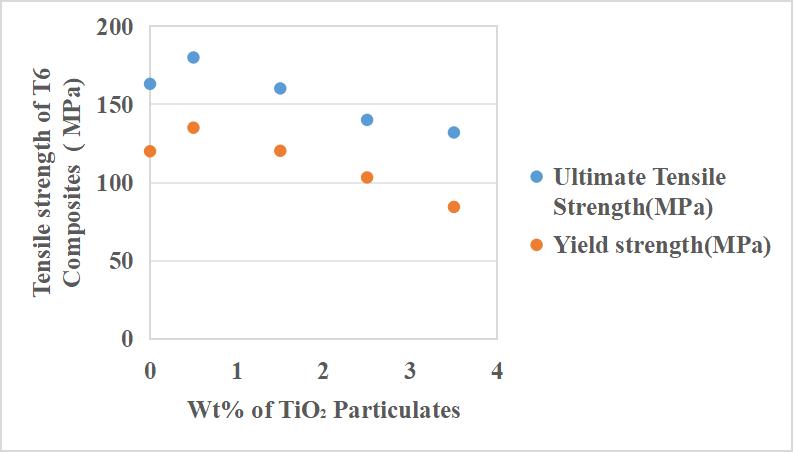
The Al MMNC reinforced with 0.5wt%TiO2 showed higher tensile properties compared to 1.5wt%, 2.5wt% & 3.5wt% TiO2 reinforced composites (Table 4 and Figure 12). Fractured surface analysis of the T6-treated Al MMNC reinforced with 0.5 wt.% nano TiO2 revealed a combination of fine dimples and localized cleavage facets, indicating a mixed mode of ductile–brittle fracture. The presence of uniformly distributed fine dimples can be associated with micro-void nucleation, growth, and coalescence around the well-bonded TiO2 nanoparticles, suggesting effective load transfer from the aluminium matrix to the reinforcement. The strong interfacial bonding and uniform dispersion of nano TiO2 particles restricted localized plastic deformation and delayed crack initiation, thereby contributing to enhanced tensile strength. Strong interfacial bonding and uniform dispersion of nano particles were also reported in some studies as main factors for the enhancement of tensile strength1,5,14,17,20 due to imepedement of dislocations.
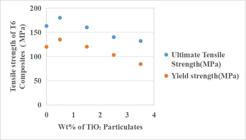
In contrast, composites containing higher weight percentages of TiO2 exhibited comparatively flatter fracture surfaces with increased cleavage features and reduced dimple density. This behavior can be attributed to particle agglomeration and non-uniform wettability at higher reinforcement levels, which act as stress concentration sites and promote premature crack initiation. The reduced plastic deformation capability and easier crack propagation in these regions lead to a predominantly brittle fracture mechanism, resulting in a decline in tensile properties.
T6 composite containing 0.5 wt% TiO2 particles exhibited an ultimate tensile strength of 180 MPa which is 10% greater than T6 base alloy. Yield strength of 0.5 wt% TiO2 containing composite (135 MPa) was found to be 12% higher than yield strength of T6 base alloy. These results are comparable to Al MMCs reinforced with hybrid reinforcements4,6,12,18.
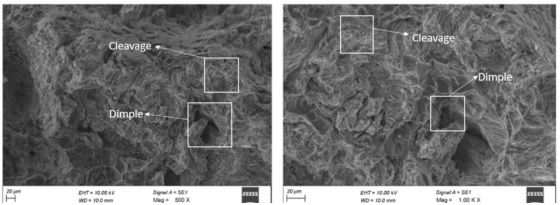
Fractography analysis of 0.5wt% TiO2 reinforced Al MMNC in the T6 condition showed the presence of cleavage and dimple features confirming mixed mode of fracture (both ductile and brittle fracture) in the composites as showed in the Figure 13. Mixed mode fracture occurred due to simultaneous ductile deformation of the aluminium matrix and brittle fracture associated with stress concentration around stiff nano-TiO2 particles and their interfaces. This also indiacted that with increasing wt% of TiO2 particles composites would have undergone brittle fracture.

4. Conclusion
-
OES analysis showed that samples reinforced with varying wt% of TiO2 nano particles exhibited higher amounts of Ti than the base alloy.
-
XRD analysis confirmed the presence of TiO2 at 2θ value of 42.2° in the 0.5 wt% TiO2 reinforced composite.
-
Microstructure of the as-cast and T6 samples showed α-Al phase and eutectic network. Microstructure of the T6 composites showed relatively fine and equiaxed grain structure. Al MMC containing 0.5wt% TiO2 particled had undergone higher grain refinement due to strong wettability of TiO2 particles at the heterogenous nucleation sites in the matrix.
-
In the as-cast condition and T6 condition, the hardness value of composite containing 0.5wt% TiO2 particles (54.77 BHN and 79.61 BHN) was found to be higher than the other composites and as well as base alloy.
-
Composite containing 0.5wt% TiO2 particles showed higher ultimate tensile strength (180 MPa) and yield strength (135 MPa) compared to base alloy and other compoistes in the T6 condition.
-
Higher hardness and tensile properties of 0.5 wt% TiO2 particles containing composite can be attributed to effective impedement of dislocation in the matrix by reinforcements which had strong wettability with the matrix.
-
Fractography of 0.5wt% TiO2 reinforced composite showed mixed mode of fracture and indiacted brittle fracture in other composites.
-
Data Availability
The entire dataset supporting the results of this study was published in the article itself
5. References
-
1 Arora R, Kumar S, Singh G, Pandey OP. Influence of particle size and temperature on the wear properties of rutile-reinforced aluminum metal matrix composite. J Compos Mater. 2015;49(7):843-52. https://doi.org/10.1177/0021998314526079
» https://doi.org/10.1177/0021998314526079 -
2 Ahmad N, Verma M, Nagaral M, Kachhap S. Microstructural characteristics and wear properties of Si3N4/ZrO2 reinforced Al7055 alloy T6 heat treated metal matrix composites. Interactions (Cham). 2024;245(1):310. https://doi.org/10.1007/s10751-024-02138-y
» https://doi.org/10.1007/s10751-024-02138-y -
3 Casati R, Vedani M. Metal matrix reinforced by nano-particles: a review. Metals (Basel). 2014;4(1):65-80. https://doi.org/10.3390/met4010065
» https://doi.org/10.3390/met4010065 -
4 Chen Z, Wang T. Development of TiB2 reinforced aluminum foundry alloy based in situ composites – Part II: enhancing the practical aluminum foundry alloys using the improved Al–5 wt%TiB2 master composite upon dilution. Mater Sci Eng A. 2014;605:22-32. https://doi.org/10.1016/j.msea.2014.02.088
» https://doi.org/10.1016/j.msea.2014.02.088 -
5 Hu H, Onyebueke L, Abatan A. Characterizing and modeling mechanical properties of nanocomposites-review and evaluation. J Miner Mater Charact Eng. 2010;9(4):275-319. https://doi.org/10.4236/jmmce.2010.94022
» https://doi.org/10.4236/jmmce.2010.94022 - 6 Krishnaraj S, Elatharasan G. Experimental and numerical investigation of Al 6061 alloys reinforced with SiC-TiO2 Int J Mech Prod Eng. 2016;4(11):50-6.
-
7 Al-Jaafari MAA. Study the effects of titanium dioxide nanoparticles reinforcement on the mechanical properties of Aluminum Alloys composite. IOP Conf Ser: Mater Sci Eng. 2021;1105(1):012062. https://doi.org/10.1088/1757-899X/1105/1/012062
» https://doi.org/10.1088/1757-899X/1105/1/012062 -
8 Nagaral M, Kalgudi S, Auradi V, Kori SA. Mechanical characterization of ceramic nano B4C-Al2618 alloy composites synthesized by semi-solid state processing. Trans Indian Ceram Soc. 2018;77(3):146-9. https://doi.org/10.1080/0371750X.2018.1506363
» https://doi.org/10.1080/0371750X.2018.1506363 -
9 Nagaral M, Hiremath V, Auradi V, Kori SA. Influence of two-stage stir casting process on mechanical characterization and wear behavior of AA2014-ZrO2 nano-composites. Trans Indian Inst Met. 2018;71(11):2845-50. https://doi.org/10.1007/s12666-018-1441-6
» https://doi.org/10.1007/s12666-018-1441-6 - 10 Ahmad N, Verma M, Nagaral M, Kacchhap S. Evaluation of mechanical strength of stir-casted AA7025 aluminium metal matrix composites reinforced with titanium carbide (TiC) particles using Taguchi optimization technique. Mater Today Proc. 2022;62:1420-6.
- 11 Padmavathi KR, Ramakrishnan R. Tribological properties of micro and nano SiC reinforced aluminium metal matrix composites. Int J Chemtech Res. 2017;10(6):367-72.
-
12 Pandiarajan R, Maran P, Marimuthu S, Ganesh KC. Mechanical and tribological behavior of the metal matrix composite AA6061/ZrO2/C. J Mech Sci Technol. 2017;31(10):4711-7. https://doi.org/10.1007/s12206-017-0917-3
» https://doi.org/10.1007/s12206-017-0917-3 -
13 Raghu S, Nanjundaswamy HM, Jayasheel I, Harti B, Manjunatha M, Sreenivasa Sujana N. Effect of various sizes of TiO2 nano-particulate composites on mechanical and tribological properties synthesized by bottom pouring stir casting method. Res Sq. 2022. In press. https://doi.org/10.21203/rs.3.rs-2111074/v1
» https://doi.org/10.21203/rs.3.rs-2111074/v1 - 14 Reddy BS. Advances in nanocomposites: synthesis, characterization and industrial applications. London: InTech; 2011.
-
15 Sahandi P, Khodabakhshi F, Simchi A, Kokabi AH. Fatigue fracture of friction-stir processed Al-Al3Ti-MgO hybrid nanocomposites. Int J Fatigue. 2016;87:266-78. https://doi.org/10.1016/j.ijfatigue.2016.02.007
» https://doi.org/10.1016/j.ijfatigue.2016.02.007 -
16 Sampath Kumar R, Chittappa HC, Nagaral M. Influence of graphite and ZrO2 particle additions on the mechanical and wear behaviour of Al7075 aluminium alloy composites. J Bio Tribocorros. 2025;11(3):92. https://doi.org/10.1007/s40735-025-01015-7
» https://doi.org/10.1007/s40735-025-01015-7 - 17 Sharifi Tabar M, Sarani A, Khorshahian S, Shafiee Afarani M. Fabrication of 5052 Al/Al2O3 nano ceramic particle reinforced composite via friction stir processing route. Mater Des. 2011;32:4164-72.
-
18 Venkatesan S, Xavior MA. Tensile behavior of aluminum alloy (AA7050) metal matrix composite reinforced with graphene fabricated by stir and squeeze cast processes. Sci Technol Mater. 2018;30(2):74-85. https://doi.org/10.1016/j.stmat.2018.02.005
» https://doi.org/10.1016/j.stmat.2018.02.005 -
19 Xavier XR, Jaisingh SJ. Synthesis and characterization of AA7050-TiO2 reinforced aluminum matrix composite. J Mech Sci Technol. 2021;35(11):4917-24. https://doi.org/10.1007/s12206-021-1010-5
» https://doi.org/10.1007/s12206-021-1010-5 -
20 Zhan GD, Kuntz J, Wan J, Garay J, Mukherjee AK. Alumina-based nanocomposites consolidated by spark plasma sintering. Scr Mater. 2002;47(11):737-41. https://doi.org/10.1016/S1359-6462(02)00191-4
» https://doi.org/10.1016/S1359-6462(02)00191-4 -
21 Zhang Z, Chen DL. Contribution of orowan strengthening effect in particulate-reinforced metal matrix nanocomposites. Mater Sci Eng A. 2008;483-484:148-52. https://doi.org/10.1016/j.msea.2006.10.184
» https://doi.org/10.1016/j.msea.2006.10.184
Edited by
-
Associate Editor:
Aloisio Klein.
-
Editor-in-Chief:
Luiz Antonio Pessan.
The entire dataset supporting the results of this study was published in the article itself