Sexual reproductive cycle and gametogenesis in sea anemones (Cnidaria: Anthozoa): a scope review
ABSTRACT
Sea anemones have a wide range of reproductive modes, which may contribute to their broad distribution. Understanding reproductive traits and patterns, such as seasonality, is important to elucidate the evolutionary processes that shaped the current distribution of this group. However, data on the reproductive cycles and gametogenesis of sea anemones remain fragmented. In this scope review, we compile existing knowledge, highlight topics requiring further investigation, identify patterns in the available data, and discuss potential methodological limitations in previous studies. We used the same search terms across three indexed scientific databases (Scopus, Web of Science, and ScienceDirect) and Google Scholar. The obtained articles were filtered for replicates and relevance to the topic (i.e., studies that included a description of the gametogenic process, with or without temporal sampling). To find articles not captured in the initial search, we conducted a forward and backward citation tracking. A total of 65 articles were included. According to our findings, research on gametogenesis and reproductive cycles of sea anemones began in 1964 and peaked in the late 1980s and early 1990s. Studies have investigated the reproductive cycles/gametogenesis of 43 sea anemone species across 14 families, with Actiniidae being the most studied. Most articles were conducted in temperate regions, analyzed oocytes and spermatic cysts together, employed microanatomical methods, did not use a classification system for spermatic cysts, and did not measure abiotic variables (e.g., salinity or temperature). The reproductive peak seems to be more closely associated with geographic location than with phylogenetic traits. Our findings provide an overview of the current state of research on sexual reproduction and gametogenesis studies in Actiniaria. We hope this review will serve as a guide for future studies to address gaps and improve existing methodological approaches in this field.
Keywords:
Actiniaria; Reproductive pattern; Oocyte; Spermatic cyst; Seasonality
INTRODUCTION
Reproduction within the order Actiniaria is diverse and varies across families, genera, and species. Even among individuals of the same species, reproductive modes can differ due to environmental factors (Bocharova and Kozevich, 2011; Chia, 1976). The ability to reproduce both sexually and asexually, depending on a combination of genetic and abiotic triggers, may be one of the greatest advantages of Actiniaria and could explain the wide distribution of sea anemones in most marine environments, including Antarctic ice and the deep sea (Daly et al., 2013; Melo et al. 2020).
Describing the modes and patterns of reproduction in Actiniaria is crucial to determine the evolutionary history of the group. Such information is valuable for taxonomical and evolutionary studies (Pante et al., 2015). Although investigated by different researchers using different methodologies, current knowledge on reproductive cycles and gametogenesis of sea anemones remains fragmented, incomplete, and not easily accessible. As a result, it is difficult to obtain a comprehensive picture of which research questions remain unanswered, which have been exhaustively studied, and what the next steps should be to advance this field.
Scoping reviews are among the available tools for identifying such gaps. Their advantages include: summarizing the current state of the art within a field, defining key terms or topics, identifying knowledge gaps, and proposing new areas for exploration (Peters et al., 2015; Tricco et al., 2018).
In this study, we present a scoping review on the reproductive cycle and gametogenesis in Actiniaria, aiming to summarize the existing body of knowledge, highlight topics that require further investigation, identify patterns in published data, and revisit the methods used so far.
METHODS
DATA GATHERING
We initially conducted a literature search in January 2023, with no temporal restrictions, on three scientific databases: Web of Science, Scopus, and ScienceDirect. In November 2024, we expanded our research by using Google Scholar to capture additional articles not indexed by traditional databases. The search terms used on all platforms were: (“actiniaria” OR “sea anemone”) AND (spermatogenesis OR “reproductive cycle” OR “sexual reproduction” OR oogenesis OR “reproductive biology” OR gametogenesis). The use of special characters such as the asterisk (*) was adapted according to advanced search parameters of each platform. Search settings were set to include original papers, reviews, and book chapters only. We exported the metadata from each database search to Zotero (free access at https://www.zotero.org), where we removed duplicates and screened abstracts. For our analysis, we only used studies that included periodic sampling and/or described the gametogenic process to some extent, either from a structural or temporal perspective. Articles lacking species identification, even if they described the gametogenic cycle, were not included.
After abstract screening, selected articles were downloaded and thoroughly read. We extracted the following information from each article: study year, sampling location and periodicity, type of gamete studied, species, largest oocyte recorded (µm), use of microanatomical technique, presence of hermaphrodites, peak male maturity, peak female maturity, environmental variables influencing gametogenesis, and use of temperature and/or salinity data (Table S1). Data were obtained from explicit statements in the text or inferred from plots.
We then conducted a forward reference search using Google Scholar to identify articles citing each paper, as well as a backward reference search by checking the reference lists of the previously obtained papers to find additional studies. Those meeting our inclusion criteria and available online were added to our analysis.
It is important to note that the initial database search was conducted using English-language search terms only, which may have excluded relevant studies published exclusively in other languages. However, during the complementary search on Google Scholar - which is less restrictive in language indexing - we allowed retrieval of results in all available languages. This broader search did not yield significantly different results from those obtained in the primary databases, suggesting that the use of English terms captured the majority of relevant literature. While a multilingual search might potentially expand the dataset, we consider the current compilation representative of the existing body of knowledge, especially given the predominance of English in scientific publishing. Nonetheless, future reviews could benefit from incorporating multilingual search strategies, particularly when seeking broader geographic and cultural coverage.
Taxonomic papers were excluded because most do not address seasonality and are mostly based on one or a few non-continuous sampling events (see the Discussion section for an explanation on the importance of temporal sampling).
ChatGPT Plus was used to make edits and improve the writing consistency of the English version of the manuscript.
DATA ANALYSIS
In our analyses, we focused on six main topics: temporal (year of publication), taxonomical (which species were studied) and spatial (where species are from) data distribution, methodological approaches, reproductive cycle (period of gamete release), and inclusion of environmental factors. Information extracted from each paper is available in Table S1.
Three main variables were used to build graphs and tables: ‘diversity,’ representing the number of unique species found across studies; ‘records,’ the total number of times a species was studied (some species appeared in multiple studies); and ‘studies,’ the total number of articles included in this review.
We performed data manipulation, evaluation, and cleaning using the Pandas Python package on Google Colab. Plots were made using the GGPLOT2 R package (Wickham, 2016) (see Supplementary Material for data spreadsheets and graph codes).
RESULTS
SEARCH EFFORT
A total of 693 articles were obtained from Web of Science, Scopus, and ScienceDirect, and another 4,820 from Google Scholar. Of those obtained from the three primary databases, 93 duplicates were removed. After abstract screening, we excluded 552 articles that did not meet our predefined criteria (studies including temporal sampling and/or describing the gametogenic process in either in a structural or temporal context). The screening and filtering process applied to the results from Google Scholar followed the same criteria and resulted in the inclusion of only five additional articles, resulting in a total of 53 eligible articles. After the forward and backward reference searches, we included another 12 articles, resulting in a total of 65 studies for analysis (Figure S1; Table S2).
TEMPORAL DISTRIBUTION OF THE DATA
The first study to conduct a temporal and/or structural analysis of gametogenesis in sea anemones was published by Ford in 1964, and the most recent study was published in 2023 by Yunpeng et al. The early 1980s marked a peak in research activity, with up to four articles published in a single year (Figure S2). However, the number of papers published decreased, reaching a plateau of no more than two articles per year since 1990.
TAXONOMICAL DISTRIBUTION
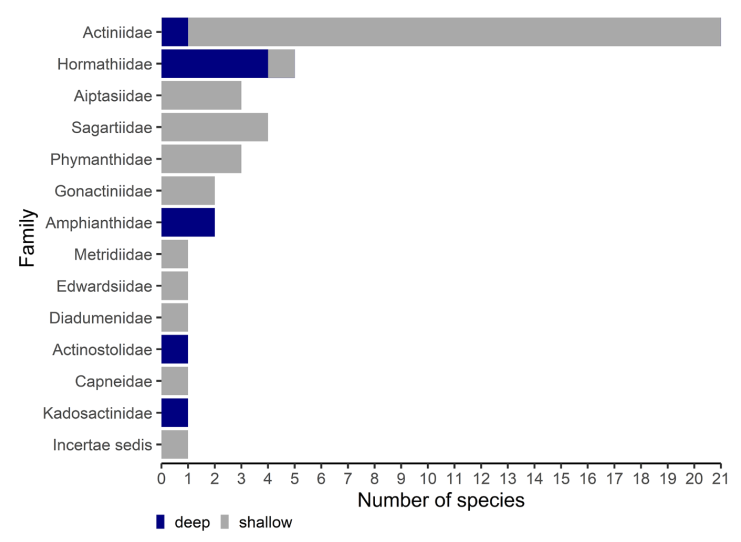
The gametogenic cycle has been documented for 13 out of the 60 recognized Actiniaria families (Rodriguez et al., 2023) (Figure 1), covering two of the three suborders: Enthemonae, with studies on 12 families, and Anenthemonae, with studies on a single family, Edwardsiidae. Most Enthemonae families belong to the Metridioidea superfamily.
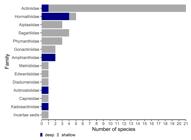
Number of species studied per family. Colors represent species from shallow or deep environment.
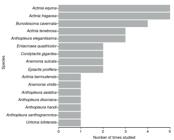
Regarding species diversity, 21 of the 47 species included in this review belong to the Actiniidae family (Actinioidea superfamily), making it the most extensively studied family. This represents a fourfold increase compared to the second most studied family, Hormathiidae (Metridioidea superfamily), with only five species investigated. Within Actiniidae, research has primarily focused on eight genera, with over half of studies concentrating on Actinia and Anthopleura. Notably, two species, Actinia equina and Actinia fragacea, dominate the data, each contributing five records and collectively accounting for 30% of all gametogenesis research on Actiniidae (Figure 2). Across all families, 19 species have been investigated multiple times.
METHODOLOGICAL APPROACHES
Most studies (n=57) employed microanatomical techniques to detail gametogenic tissues, and for most species analyzed, both gametes were examined (n=55). When only one gamete type was included, spermatic cysts were less studied (n=9) than oocytes (n=19) (Table 1).
Only 19 studies employed a qualitative classification system to determine the maturity stages of spermatic cysts (Table 1). Among these, the most used classifications were those proposed by Carter and Miles (1989), Jennison (1979), Scott and Harrison (2009), and Wedi and Dunn (1983), each mentioned twice.
Sampling was conducted monthly in 37 out of the 51 field studies. For the remaining studies (n=14), sampling periodicity varied from weekly to annual, or lacked a consistent pattern (Table 1). Finally, only 20 studies recorded abiotic data such as temperature and salinity.
GEOGRAPHICAL DISTRIBUTION
Regarding countries where specimens were sampled, most studies took place in the United States of America (n=21), followed by the United Kingdom (n=10), Australia (n=5), Japan, Israel, and Taiwan (n=3 each); Sweden, Germany, France, Canada, and China (n=2 each), and Malaysia, the Netherlands, New Zealand, Italy, Argentina, Spain, Singapore, Morocco, Ireland, and Russia (n=1 each).
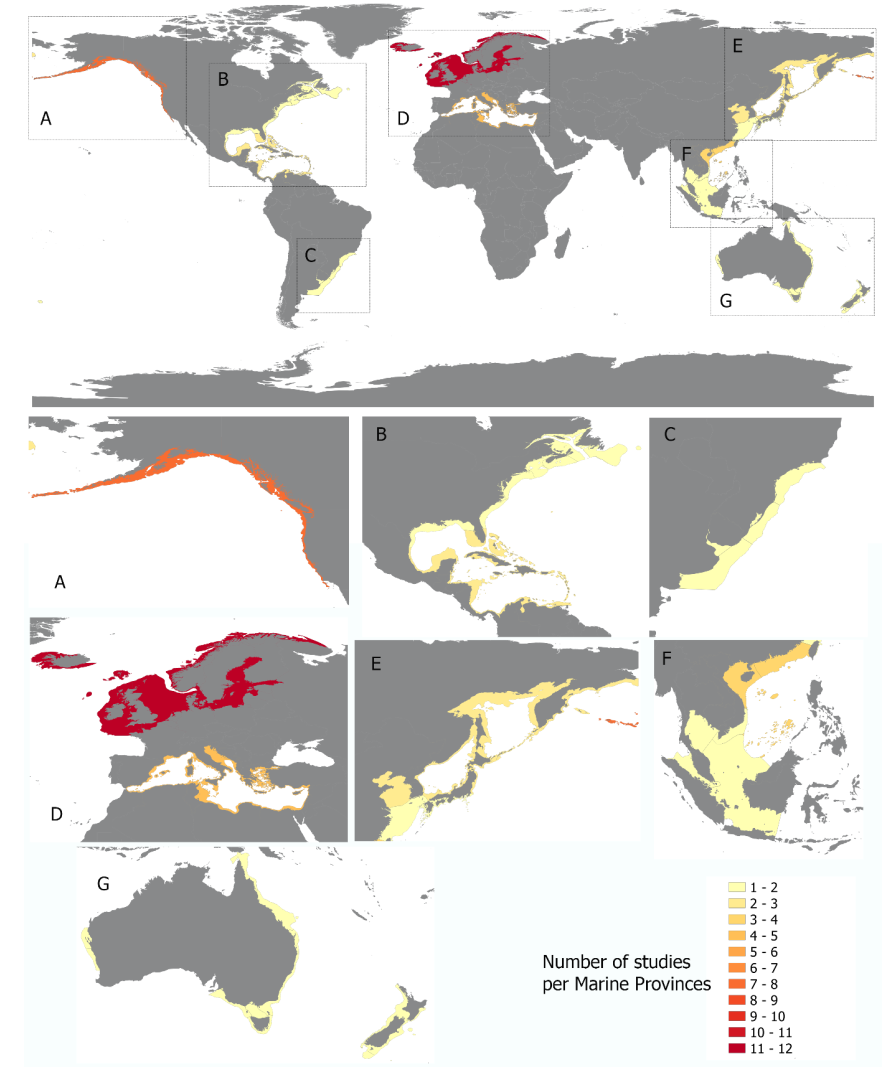
A total of 51 papers reported periodic field sampling, (i.e., collecting specimens over a defined period). Using the Marine Ecoregions classification by Spalding et al. (2007), sampling efforts covered eight of the 12 realms and 19 of the 62 provinces. Many studies (19) were conducted in the Temperate Northern Atlantic realm, which comprises the United Kingdom coast, the Baltic Sea, the Mediterranean, and the East and Southeast Coasts of the United States of America. The most studied province within this realm was the Northern European Sea, with 10 studies.
Of the 51 studies that included field sampling, 38 were conducted in Temperate Realms. Only 11 studies were conducted in tropical regions - six in the Tropical Northwestern Atlantic and five in the Central Indo-Pacific Realm. Seven studies sampled deep-sea specimens (deeper than 200m) and were considered a separate category, since the deep ocean was not included in the classification by Spalding et al. (2007). Therefore, the map in Figure 3, which illustrates the spatial distribution of data, includes shallow-water species only. Data on deep-water species are illustrated in Figure 1 and mentioned in the Discussion section.
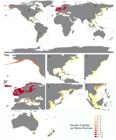
Number of studies published per Marine Province (sensu Spalding et al. 2007). The image only illustrates data from shallow water species. Provinces illustrated are: A - Cold Temperate Northeast Pacific; B - Cold Temperate Northwest Atlantic, Warm Temperate Northwest Atlantic, Tropical Northwest Atlantic; C - Warm Temperate Southwestern Atlantic; D - Northern European Seas, Mediterranean Sea; E - Cold Temperate Northwest Pacific, Warm Temperature Northwest Pacific; F - South China Sea, Sunda Shelf; G - Northeast Australian Shelf, West Central Australian Shelf, East Central Australian Shelf, Southeast Australian Shelf, Southern New Zealand.
REPRODUCTIVE CYCLE AND ENVIRONMENTAL FACTORS
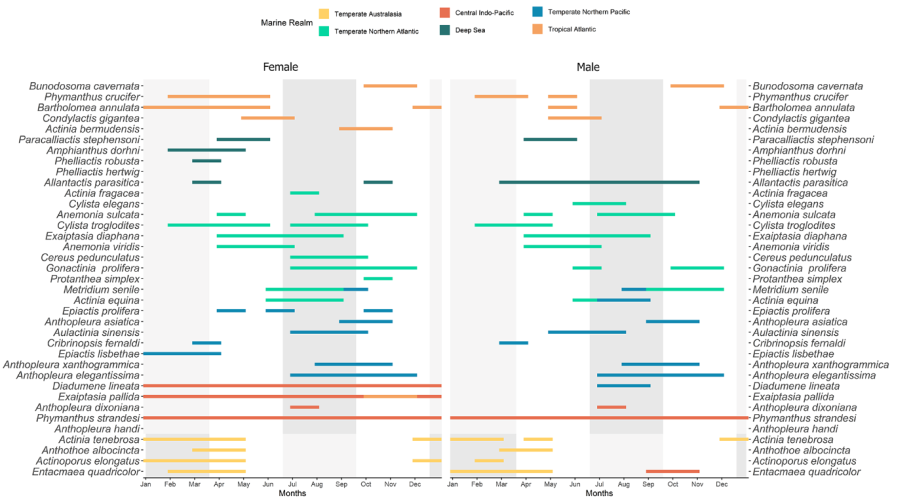
The amount of data available differs between males and females, as some studies reported data for one sex only. For females, peak reproductive periods are documented for 38 species, while for males, data exist for 27 species (Figure 4). Among all studied species, nine were investigated by multiple research groups on different occasions, resulting in either complementary, overlapping, or divergent findings (Table S3). For at least 19 species, except for the four that reproduce year-round, peak maturity seems related to temperature increase (e.g., Anemonia viridis, Cylista troglodytes) (Figure 4). In some cases, such as Entacmaea quadricolor, peak maturity follows temperature rises but varies temporally with latitude (Figure 4; yellow lines represent Temperate Australasia in the Southern Hemisphere; the red line represents the Central Indo-Pacific in the Northern Hemisphere) (Bi et al., 2015; Scott and Harrison, 2009).
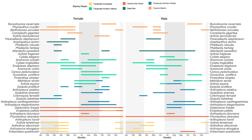
Peak reproductive maturity of sea anemones grouped by Marine Realm. Left - Female individuals. Right - Male individuals. Horizontal bars indicate the period in which individuals of the corresponding species are at their peak maturity (e.i. period when most reproductive structures are at their maximum development stage, and which is immediately followed by a period with none or only a few mature gametes or mature individuals in the population). Gray vertical rectangles on the background represent periods of winter (lighter gray) and summer (darker gray). Last four species were sampled on the Sothern Hemisphere, hence why grey bars are in the opposite color order. Species with more than one color have data from more than one population of from different Marine Realm.
The temporal pattern of reproductive peaks found in males is similar to that observed in females (Figure 4). However, three female species (Diadumene lineata, Exaiptasia pallida, and Phymanthus strandesi) presented mature oocytes year-round (Chen et al., 2008; Dunn, 1982; Fukui, 1995; Lin et al., 2001), a pattern seen in only one male species (Phymanthus strandesi; in Lin et al., 2001). Thus, continuous reproduction seems to be common among females of the Central Indo-Pacific realm (Figure 4).
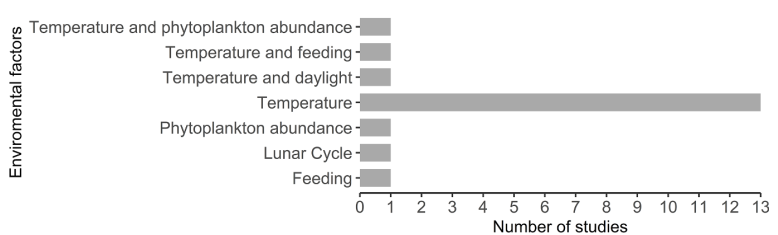
Only a few articles (n=19) explicitly mention factors influencing gametogenesis in sea anemones. Temperature alone was listed as the main driver in 13 of these studies. In some cases, temperature was considered relevant in combination with other factors such as daylight, diet, and phytoplankton abundance (Figure 5). Only Chen et al. (2008) mentioned a factor other than temperature and diet influencing peak maturity, namely the lunar cycle.
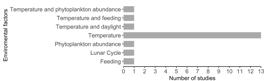
Main environmental factors mentioned by authors as directly influencing the beginning of the gametogenic cycle.
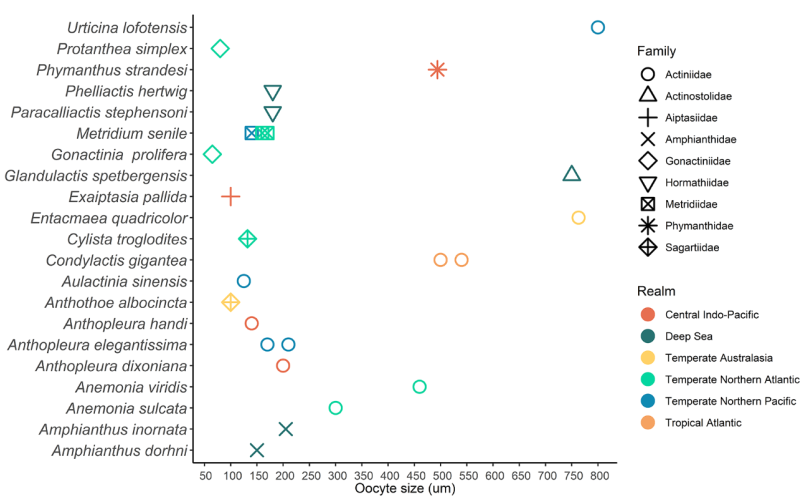
The size of the largest oocytes measured (see the Discussion section) varied between families, genera, and marine realms, with no clear pattern observed (Figure 6). The smallest mature oocyte was recorded in Gonactinia prolifera, measuring 65µm (Chia et al., 1989). The largest mature oocyte belonged to a specimen of Urticina lofotensis, with 800µm, as reported by Wedi and Dunn (1983). The maximum mature oocyte size found for Metridium senile was consistent across studies (170µm [Loseva, 1970]; 140µm [Bucklin, 1982]; and 160µm [Lombardi and Lesser, 2010]). A similar pattern of comparable maximum mature oocyte sizes was seen in Condylactis gigantea and Anthopleura elegantissima. However, for both species, individuals were sampled from the same marine realm, unlike the studies on M. senile.
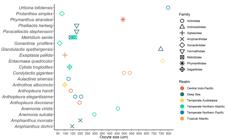
Size of largest oocyte found in different species. Only oocyte measures from histological slides were considered. Families are defined by shape and Marine Realms defined by color.
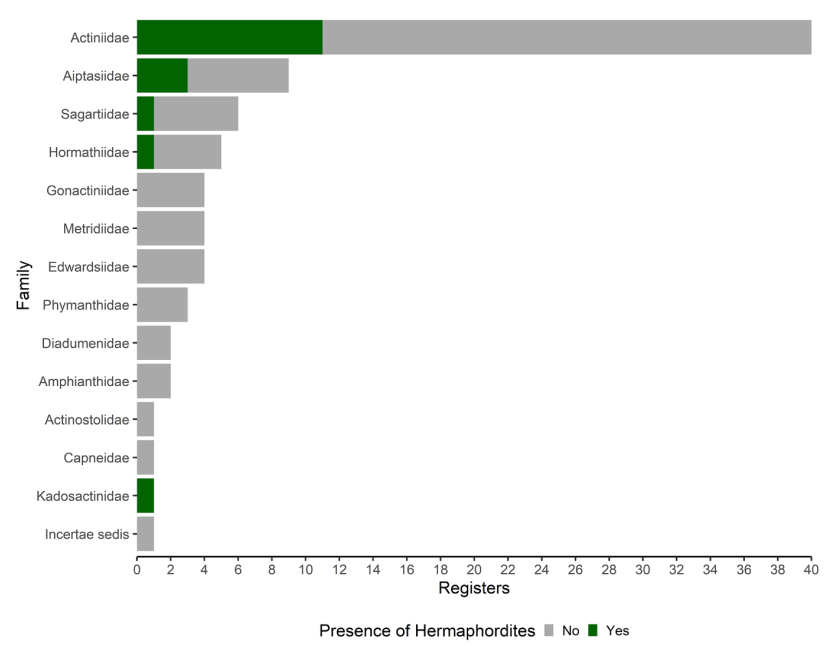
Among the 65 papers reviewed, 17 explicitly recorded the presence of hermaphrodites. These records comprise five families: Actiniidae (with most records), Aiptasiidae, Hormathiidae, Kadosactinidae, and Sagartiidae. Kadosactis commensalis, the only member of Kadosactinidae studied, was reported as presenting hermaphroditic individuals (Figure 7). For some species, such as Actinia equina and Anthopleura elegantissima, the presence of hermaphrodites was reported only in some studies.

DISCUSSION
The primary goal of this study was to investigate the temporal distribution of scientific knowledge on the gametogenic cycle and sexual reproduction of Actiniaria, and to determine whether there is an upward or downward trend in the volume of publications on this topic over time. The results suggest a declining number of publications on temporal and structural studies of gametogenesis in Actiniaria (Figure S2). From the earliest study found in this review - Ford (1964), on the reproduction of Anthopleura elegantissima - the number of studies increased over time, peaking in the early 1980s. This was followed by a five-year gap between 1985 and 1990, and a modest resurgence between 1990 and 1995. Most research during this period was led by four authors: Alan Larckman, who studied the ultrastructure of reproductive cells, and Brian Jennison, Fu-Shiang Chia, and Daphne Fautin Dunn, who focused on ecological aspects.
However, interest in the subject has been stable over the past three decades, with no more than two studies published per year since the 1990s. The lower number of studies may be linked to several factors, including the required sampling effort, the time needed to study the reproductive/gametogenic cycle, and the techniques traditionally employed. Most species studied exhibit an annual reproductive cycle (i.e., one reproductive event per year), with a few exceptions (see Chen et al., 2008). Consequently, robust gametogenesis studies that capture reproductive peaks require consistent sampling over extended periods. The most common and replicated method involves monthly samplings throughout 12 months (e.g., Wedi and Dunn, 1983; Scott and Harrison, 2009), which results in slow, time-consuming data collection and may be a disadvantage in the current fast-paced scientific environment.
Another potential factor is the lack of major advances in the techniques used in these studies. Histology remains the most accurate method for determining when reproductive structures reach peak maturity. This was shown in a recent study by Yong et al. (2021), who employed the same experimental design and histological techniques as the first studies in the field (e.g., Chia and Rostron, 1970). Some alternative approaches attempted to identify peak reproductive periods by measuring glycogen levels (Hummel and Bogaards, 1991) and glycine concentrations (Kasschau and McCommas, 1982). However, these methods did not take root in Actiniaria research. Despite being low-cost, reproductive studies with long sampling periods are time-consuming. Furthermore, because they are often straightforward and descriptive, they are usually not published in high-impact journals, even though their data are the foundation for connectivity and conservation studies (Pante et al., 2015). To modernize this field and generate more robust results, future research could employ modern approaches, such as molecular data.
METHODOLOGICAL APPROACHES
Among the articles obtained in this scoping review, 51 included some type of fieldwork. Studies differed in terms of methods, especially in temporal sampling distribution, which ranged from monthly sampling over a certain period (e.g., Shawn, 1989; Utrilla et al., 2019), to annual (Ayre, 1984), or a combination of weekly and monthly sampling (Chen et al., 2008). Such variation complicates direct comparison between studies and may result in some reproductive temporal patterns being overlooked - especially when sampling lasted less than a year. The minimum ideal sampling period to accurately identify annual reproductive patterns is 12 months. However, such sampling effort may not be feasible for all species, especially those inhabiting deep-sea and polar environments, which are only accessible during a few months each year (e.g., Rodríguez et al., 2013).
The lack of continuous sampling limits the inclusion of reproductive data from taxonomic studies. For male reproductive structures, which rely on discrete qualitative classification (as discussed below), taxonomic studies could potentially be informative. However, that is not the case for female reproductive structures, which are classified based on continuous quantitative data. Sampling a female specimen at a single point during its reproductive cycle does not enable determination of what developmental stage the gametes are at or the maximum oocyte size, which is the only reliable way to compare oocyte sizes across species and identify when reproductive peaks occur. While including data from taxonomic papers could add some insights, it is unlikely to substantially increase the number of species studied or expand the geographic coverage. Therefore, we do not anticipate that incorporating such data would meaningfully challenge the overarching patterns observed in this study.
Most studies (57 out of 65) employed microanatomical techniques, such as histology, to describe reproductive cycle features. Histological techniques provide the necessary resolution to describe oocyte and spermatic cyst maturation (e.g., Sheridan et al., 2015), which is important when analyzing gamete development phases. Although there have been attempts to use histochemical techniques to describe the reproductive cycle, these efforts did not lead to new attempts. Ideally, combining multiple approaches, such as molecular data (e.g., Reuven et al., 2021), could yield more accurate data regarding the onset and conclusion of the reproductive cycle. This would be especially effective when fieldwork is paired with laboratory tests, which have proved useful in testing triggers for sexual reproduction (Fritzenwanker and Technau, 2002; Grawunder et al., 2015).
Gametogenesis monitoring in Actiniaria relies heavily on microanatomical techniques and varies distinctly between male and female reproductive structures. In the latter, oocytes are typically analyzed by grouping them into size classes based on diameter, providing a relatively standardized and quantitative approach. In contrast, male gamete development is assessed by analyzing spermatic cysts - clusters of synchronously maturing sperm cells enclosed within membranes along the mesenteries. These cysts are qualitatively classified according to the dominant cell type present, such as spermatogonia, spermatocytes, or mature spermatozoa. Several classification systems have been proposed to describe the maturation stages of spermatic cysts. For example, Jennison (1979) outlined a three-stage system, while Scott and Harrison (2009) expanded it to four stages, offering greater resolution based on the relative abundance of differentiated cells. However, no universally accepted framework exists, and many authors develop or adapt their own systems, resulting in inconsistencies across the literature (e.g., Bucklin, 1982; Wedi and Dunn, 1983). This lack of consensus hampers cross-study comparisons and can obscure broader reproductive patterns. Although proposing a unified classification is beyond the scope of this review, we emphasize the need for a standardized and widely adopted approach - ideally with clear definitions and visual references - to improve methodological consistency and facilitate comparative analyses across species and regions.
Lastly, employing standardized data collection and analysis procedures would facilitate comparisons between studies conducted at different locations, on different species, and across different periods. To initiate discussions on this topic, we propose that sampling be conducted monthly for at least 12 months whenever feasible; that microanatomical techniques be employed; that oocytes are measured using histology; that spermatic cysts be classified based on an established system (e.g., Scott and Harrison, 2009); and that environmental variables - especially temperature - are measured during sampling, as this was often overlooked in the studies reviewed (Table 1).
TAXONOMIC DISTRIBUTION
The 65 studies gathered in this scoping review covered 47 sea anemone species, representing about 4% of the known Actiniaria diversity based on the valid species count by Rodríguez et al. (2023). Most species studied belong to the Actiniidae family, which was represented in 40 instances (some articles include multiple species). This may be because it is the largest family within Actiniaria and its members are mostly found in shallow waters (Fautin, 2016)genus, and species groups of extant members of orders Actiniaria and Corallimorpharia [cnidarian subclass Hexacorallia (Zoantharia. Easy identification in the field and easy sampling can be key when choosing a study organism and favor the study of shallow-water species over deep-water ones. In fact, only nine out of 47 species are deep-water inhabitants, while the majority (n=39) occur in shallow waters.
Within Actiniidae, the most studied genus was Actinia Linnaeus, 1767, with 14 studies. Despite being a diverse genus, with 63 valid species (Rodriguez et al., 2023), the studies gathered here were limited to four species: Actinia equina (Linnaeus, 1758), Actinia fragacea Tugwell, 1856, Actinia tenebrosa Farquhar, 1898, and Actinia bermudensis (McMurrich, 1889). Moreover, 10 of the 14 studies focused solely on A. equina and A. fragacea. This may reflect the lack of Actiniaria specialists in locations where other Actinia species occur, as well as the easy identification, collection, and high abundance of A. equina and A. fragacea in their distribution areas (Stephenson, 1935). Both species are ubiquitous sea anemones in the most studied marine province, the Northern European Seas (Figure 3). Many studies on these species focused only on microanatomical analyses of reproductive cells (e.g., Carter and Thorp, 1979; Larkman, 1981, 1984).
Of the nine deep-sea species studied, half belong to the Hormathiidae Carlgren family, 1932: Allantactis parasitica Danielssen, 1890; Phelliactis hertwigii Simon, 1892; Phelliactis robusta Carlgren, 1928; and Paracalliactis stephensoni Carlgren, 1928. Although the number of studied species may seem low, it is relevant considering that sampling and identifying deep-water species requires technical expertise and financial resources. Still, additional studies on the reproductive biology of deep-sea species are needed. Current findings on gametogenesis and reproductive cycles within Actiniaria are based on shallow-water groups, which limits our overall perspective and may exclude relevant aspects necessary to comprehend the evolutionary history of species found below 200-m depth, especially in terms of which environmental factors can trigger the onset of gametogenesis.
Regarding species diversity, substantial gaps remain in our knowledge of the sexual reproductive cycle and gametogenesis across many Actiniaria groups. This is the case of the Anenthemonae suborder, which has only been studied through the species Nematostella vectensisStephenson, 1935, from the Edwardsiidae family - one of the three families comprising the suborder (Rodriguez et al. 2014). Efforts to cover a greater diversity would help elucidate whether a general reproductive pattern exists within Actiniaria, and what are the singularities of each group within the order.
In Actiniaria, the sexual system (sensus Leonard, 2013) includes dioecy (e.g., Phymanthus crucifer in Jennison, 1981), protogynous sequential hermaphrodites (e.g., Gonactinia prolifera in Dunn, 1975; Anthopleura handi in Dunn, 1982), protandrous sequential hermaphrodites (e.g., Kadosactis commensalis in Bronsdon et al., 1993), and trioecy (e.g., Exaiptasia diaphana in Armoza-Zvuloni et al., 2014). There are also cases in which a species is primarily considered dioecious but presents occasional hermaphroditic individuals (e.g., Anthopleura elegantissima in Jennison, 1979; Paracalliactis stephensoni in van Praët et al., 1990), suggesting a possible intrinsic sexual plasticity within the order. Of the 14 Actiniaria families studied so far (considering T. errans as belonging to a separate family), only five have records of hermaphrodites (Figure 7). The occurrence of hermaphrodites within Actiniaria remains poorly understood, with limited records available for the order (Bocharova and Kozevich, 2011).
Dissecting individuals for mesentery count is a necessary step for species description in Actiniaria. As a consequence, reproductive structures are often observed and described in taxonomic studies. Therefore, a review focused specifically on the presence of hermaphrodites - based on an in-depth research on taxonomic literature - could reveal how this trait is distributed within the order and shed light on the evolution of sexual systems in Actiniaria.
GEOGRAPHICAL DISTRIBUTION
Based on the spatial distribution of the studies gathered, most of the existing scientific knowledge on the subject is concentrated in temperate zones, especially in the Northern Hemisphere (Figure 4). This pattern may reflect, among other things, the greater diversity of sea anemone species in temperate zones (Fautin et al., 2013) then, using the Chao2 statistic, inferred the completeness of that inventory. We found the greatest species richness of sea anemones at 30-40° N and S, with lower numbers at tropical latitudes and the fewest species in polar areas. The Chao2 statistic allowed us to infer that the richness pattern we found is not due to particularly poor knowledge of tropical sea anemones. No 10° band of latitude has less than 60% of the theoretical number of species known, but for only about half of them could we reject the null hypothesis (P=0.05. However, it could also be a bias related to the number of Actiniaria specialists in each area, which has been historically higher in countries from the Northern Hemisphere.
From a biogeographical perspective, we considered two spatial divisions proposed by Spalding et al. (2007): Marine Realms (very large regions with high endemism levels, driven by factors such as water temperature, historical and broad-scale isolation, and the proximity of the benthos) and Marine Provinces (large regions with some endemism and distinct biota, resulting from abiotic features such as isolation, currents, upwellings, nutrient supply, and salinity; subdivisions of Marine Realms). Studies on the reproductive cycle and/or gametogenesis in Actiniaria have been conducted in six of the 12 proposed Marine Realms. However, when looking at Marine Provinces, the gap is much larger: of the 62 proposed provinces, only 16 have been covered by the studies gathered here. Considering that environmental factors influence the sexual reproductive cycle of Actiniaria (Fritzenwanker and Technau, 2002; Grawunder et al., 2015; Reuven et al., 2021), and that different provinces have unique environmental features, further research is needed in a broader range of provinces, especially in tropical and polar regions, where environmental characteristics differ considerably from those in the most-studied temperate zones.
The lack of studies in the Southern Hemisphere was one of the main findings regarding the spatial distribution of research. Only eight studies have been conducted in marine environments of this region, with most (n=6) being in Australia. This underrepresentation of the Global South is not exclusive to reproductive studies (Bryan-Brown et al., 2017); however, it remains an obstacle that must be overcome to strengthen research on Actiniaria. We highlight the need for studies in the east and west coasts of Africa and South America, which could generate data enabling broader biogeographical comparisons and the identification of general patterns in Actiniaria reproduction.
REPRODUCTIVE CYCLE AND FACTORS INFLUENCING REPRODUCTION
Of the 39 species for which the reproductive peak was described, no clear pattern was found when species were grouped by family. However, when data were grouped by Marine Realms, a seasonal pattern emerged, linked to temperature variations. Temperature - either alone or in synergy with other variables - was the most frequently cited factor in studies associating sexual reproduction with environmental drivers (Figure 5). These data support the hypothesis proposed by Orton (1920), which suggests that temperature is the main factor driving reproduction in marine invertebrates. This notion was also supported by various laboratory studies that tested which environmental factors could trigger the onset of the reproductive cycle in Actiniaria (Fritzenwanker and Technau, 2002; Grawunder et al., 2015; Reuven et al., 2021).
The relationship between reproduction and temperature is clear for some species. For Entacmaea quadricolor, reproduction was investigated in two different locations: Australia (Scott and Harrison, 2009), where summer lasts from December to March, and the coast of Hong Kong (Bi et al., 2015), where summer lasts from June to September. In both studies, authors found that the species reproduces from the end of summer to the beginning of fall, as shown in Figure 4. This supports the idea that temperature is the main triggering factor. However, these results should be interpreted with caution, as records for Hong Kong included only male specimens, and some studies suggest that E. quadricolor could be a species complex (Titus et al., 2019).
Studies on Actinia equina and Metridium senile also suggest that environmental factors are key on sea anemone reproduction. For both species, separate studies were conducted by different authors in different locations (coasts of the Atlantic and Pacific oceans) at similar latitudes, with results suggesting similar annual reproductive seasons on both sides (see Figure 6 and Table S3). However, as with other sea anemones, these species may represent species complexes (Glon et al., 2021; Pereira et al., 2021), which could lead to alternative interpretations beyond the scope of this review.
Although most species exhibited patterns consistent with Orton (1920, p. 531) - that species in tropical regions reproduce continuously due to minimal temperature variation - species from the Tropical Atlantic exhibited a discontinuous reproductive period (Figure 4). These results indicate that, in tropical regions, other environmental variables may influence or even override temperature as the main environmental trigger for reproduction. Since this is one of the least studied regions, the deviation from Orton’s hypothesis may reflect low sampling efforts; therefore, more studies are needed to assess how important temperature is for reproduction in species from the Tropical Atlantic realm.
In contrast, four out of the six species from the tropical Central-Indo Pacific region exhibited continuous reproduction (Phymanthus strandesi, Anthopleura handi, Diadumene lineata, and Exaiptasia pallida [A. pulchella in Chen et al., 2008]), which supports Orton’s hypothesis. However, only P. strandesi has records of both female and male individuals. For D. lineata and E. pallida, only female specimens were found. Since both species are considered invasive in many parts of the world (e.g., Grajales and Rodríguez, 2014; Podbielski et al., 2016) and can reproduce asexually, the lack of males could reflect sampling limited to a single population or part of it, or a potential high rate of asexual reproduction. Furthermore, as discussed in Chen et al. (2008), the high rates of gamete production by Exaiptasia pallida in Taiwan may reflect favorable local environmental conditions. As aforementioned, such continuous reproduction in tropical regions contrasts with studies from the Tropical Atlantic, which revealed an annual reproductive cycle (Jennison, 1983). Therefore, this may be more of a local effect than a latitudinal one.
The size of oocytes, which is a key parameter in reproductive studies, does not appear to be strongly influenced by geographic location. For example, the largest oocyte size reported for Metridium senile, Condylactis gigantea, and Anthopleura elegantissima show little variance across regions (Table S3; Figure 6). This may be a result of a combination of environmental influences and intrinsic factors, such as individual body size (Sebens, 1981). Similarly, from a phylogenetic perspective, oocyte size shows little variation within the same Family (e.g., Sargartiidae, Amphianthidae, Gonactiniidae) (Figure 6). The exception is in Actiniidae, which presents a high size variability between species.
Along with environmental and phylogenetic factors, reproductive strategy also seems to be crucial in influencing oocyte and egg size. According to Chia (1976), sea anemone species that have oviparous-pelagic-lecithotrophic development tend to produce larger eggs than those with planktotrophic development. This is possibly due to the greater yolk investment required to sustain larvae that do not feed. This relationship between development mode and egg size has also been demonstrated for Medusozoa. A comparative study on Medusozoa showed that egg size is influenced by reproductive strategy and environmental factors like temperature and depth, with larger eggs being commonly associated to lecithotrophic development (García-Rodríguez et al., 2023). These results indicate shared evolutionary trade-offs between egg size, fecundity, and larval ecology, which may also be the case in Actiniaria, despite the differences in life history and reproductive anatomy from Medusozoa. Yet, broader comparative studies are needed to confirm such putative patterns in Anthozoa, as current data on sea anemones are still limited and fragmented.
CONCLUSION
This scope review provides an overview of the current knowledge on gametogenesis and reproductive cycles of sea anemones (Actiniaria), highlighting the progress made to date, as well as the existing gaps. Af-ter peaking in the 1980s, research interest on the topic has since plateaued, likely because long-term repro-ductive studies are demanding, and due to the limited use of more modern methodologies. Much of what is known today stems from histological investigations conducted mainly in temperate regions of the Northern Hemisphere, leaving substantial gaps in our understanding of tropical and Southern Hemisphere species. Based on available data, reproductive traits appear to be shaped less by phylogenetic lineage and more by environmental factors, particularly temperature, which may act as a primary driver of seasonal reproductive peaks. Oocyte size varies little across taxa and locations. However, exceptions in certain lineages suggest a degree of plasticity that warrants further investigation. Differences in developmental modes (e.g., lecithotrophy versus planktotrophy) suggest evolutionary trade-offs also seen in other cnidarian groups. However, broader comparative studies are needed to confirm these patterns within Anthozoa. At the same time, progress in the field is still limited by a lack of methodological standardization and inconsistent report-ing of key abiotic variables, which hampers efforts to synthesize patterns across studies. This study consoli-dates a scattered body of work and draws attention to the need for renewed research efforts, particularly those that employ modern tools and address underrepresented regions, to improve our understanding of reproductive diversity and its ecological and evolutionary drivers in Actiniaria.
ACKNOWLEDGMENTS
The authors would like to acknowledge all valuable comments from Msc. Jessica Borba, Dr. Stephanie Bush, Dr. Ralf Cordeiro, Dr. Sérgio Stampar and the anonymous reviewers.
REFERENCES
-
Armoza-Zvuloni, R., Kramarsky-Winter, E., Loya, Y., Schlesinger, A. & Rosenfeld, H. 2014. Trioecy, a Unique Breeding Strategy in the Sea Anemone Aiptasia diaphana and Its Association with Sex Steroids. Biology of Reproduction, 90(6). DOI: https://doi.org/10.1095/biolreprod.113.114116
» https://doi.org/10.1095/biolreprod.113.114116 -
Ayre, D. 1984. Effects of environment and population density on the sea anemone Actinia tenebrosa. Marine and Freshwater Research, 35(6), 735. DOI: https://doi.org/10.1071/MF9840735
» https://doi.org/10.1071/MF9840735 -
Bi, Y., Zhang, B., Zhang, Z. & Qiu, J. 2015. Seasonal gametogenesis of host sea anemone (Entacmaea quadricolor) inhabiting Hong Kong waters. Journal of Ocean University of China, 14(1), 143-148. DOI: https://doi.org/10.1007/s11802-015-2349-y
» https://doi.org/10.1007/s11802-015-2349-y -
Bocharova, E. S. & Kozevich, I. A. 2011. Modes of reproduction in sea anemones (Cnidaria, Anthozoa). Biology Bulletin, 38(9), 849-860. DOI: https://doi.org/10.1134/S1062359011090020
» https://doi.org/10.1134/S1062359011090020 -
Bronsdon, S. K., Tyler, P. A., Rice, A. L. & Gage, J. D. 1993. Reproductive biology of two epizoic anemones from the deep north-eastern Atlantic Ocean. Journal of the Marine Biological Association of the United Kingdom, 73(3), 531-542. DOI: https://doi.org/10.1017/S0025315400033087
» https://doi.org/10.1017/S0025315400033087 -
Bryan-Brown, D., Brown, C., Hughes, J. & Connolly, R. 2017. Patterns and trends in marine population connectivity research. Marine Ecology Progress Series, 585, 243-256. DOI: https://doi.org/10.3354/meps12418
» https://doi.org/10.3354/meps12418 -
Bucklin, A. 1982. The annual cycle of sexual reproduction in the sea anemone Metridium senile. Canadian Journal of Zoology, 60(12), 3241-3248. DOI: https://doi.org/10.1139/z82-412
» https://doi.org/10.1139/z82-412 -
Carter, M. A. & Miles, J. 1989. Gametogenic cycles and reproduction in the beadlet sea anemone Actinia equina (Cnidaria: Anthozoa). Biological Journal of the Linnean Society, 36(1-2), 129-155. DOI: https://doi.org/10.1111/j.1095-8312.1989.tb00487.x
» https://doi.org/10.1111/j.1095-8312.1989.tb00487.x -
Carter, M. A. & Thorp, C. H. 1979. The reproduction of Actinia equina L. var. mesembryanthemum. Journal of the Marine Biological Association of the United Kingdom, 59(4), 989-1001. DOI: https://doi.org/10.1017/S0025315400036985
» https://doi.org/10.1017/S0025315400036985 -
Chen, C., Chang, H.-Y. & Soong, K. 2012. No Tradeoff between Sexual and Asexual Investments in the Sea Anemone Aiptasia pulchella (Anthozoa: Actiniaria). Zoological Studies. Available from: Available from: https://www.scopus.com/inward/record.uri?eid=2-s2.0-84878539521&partnerID=40&md5=f4e74a9cc778ea151cb1f9048a831293 Access date: 2025 May 23.
» https://www.scopus.com/inward/record.uri?eid=2-s2.0-84878539521&partnerID=40&md5=f4e74a9cc778ea151cb1f9048a831293 - Chen, C., Soong, K. & Chen, C. A. 2008. The Smallest Oocytes among Broadcast-Spawning Actiniarians and a Unique Lunar Reproductive Cycle in a Unisexual Population of the Sea Anemone, Aiptasia pulchella (Anthozoa: Actiniaria). Zoological Studies, 10.
-
Chia, F. S. 1976. Sea Anemone Reproduction: Patterns and Adaptive Radiations. In: Mackie, G. O. (Ed.). Coelenterate Ecology and Behavior (pp. 261-270). Boston: Springer US. DOI: https://doi.org/10.1007/978-1-4757-9724-4_28
» https://doi.org/10.1007/978-1-4757-9724-4_28 -
Chia, F. S. & Rostron, M. A. 1970. Some Aspects of the Reproductive Biology of Actinia Equina [Cnidaria: Anthozoa]. Journal of the Marine Biological Association of the United Kingdom, 50(1), 253-264. DOI: https://doi.org/10.1017/S0025315400000758
» https://doi.org/10.1017/S0025315400000758 - Chia, F. S., Lutzen, J., & Svane, I. 1989. Sexual reproduction and larval morphology of the primitive anthozoan Gonactinia prolifera M. Sars. Journal of experimental marine biology and ecology, 127(1), 13-24.
-
Daly, M., Rack, F. & Zook, R. 2013. Edwardsiella andrillae, a New Species of Sea Anemone from Antarctic Ice. PLoS ONE, 8(12), e83476. DOI: https://doi.org/10.1371/journal.pone.0083476
» https://doi.org/10.1371/journal.pone.0083476 -
Dunn, D. F. 1975. Reproduction of the externally brooding sea anemone Epiactis prolifera verrill, 1869. The Biological Bulletin, 148(2), 199-218. DOI: https://doi.org/10.2307/1540543
» https://doi.org/10.2307/1540543 -
Dunn, D. F. 1982. Sexual Reproduction of Two Intertidal Sea Anemones (Coelenterata: Actiniaria) in Malaysia. Biotropica, 14(4), 262. DOI: https://doi.org/10.2307/2388084
» https://doi.org/10.2307/2388084 -
Fautin, D. G. 2016. Catalog to families, genera, and species of orders Actiniaria and Corallimorpharia (Cnidaria: Anthozoa). Zootaxa, 4145(1), 1-449. DOI: https://doi.org/10.11646/zootaxa.4145.1.1
» https://doi.org/10.11646/zootaxa.4145.1.1 -
Fautin, D. G., Malarky, L. & Soberón, J. 2013. Latitudinal Diversity of Sea Anemones (Cnidaria: Actiniaria). The Biological Bulletin, 224(2), 89-98. DOI: https://doi.org/10.1086/BBLv224n2p89
» https://doi.org/10.1086/BBLv224n2p89 - Ford, C. E. 1964. Reproduction in the Aggregating Sea Anemone, Anthopleura elegantissima. Pacific Science, 18, 138-145.
-
Fritzenwanker, J. H. & Technau, U. 2002. Induction of gametogenesis in the basal cnidarian Nematostella vectensis (Anthozoa). Development Genes and Evolution, 212(2), 99-103. DOI: https://doi.org/10.1007/s00427-002-0214-7
» https://doi.org/10.1007/s00427-002-0214-7 -
Fukui, Y. 1995. Seasonal changes in testicular structure of the sea anemone Haliplanella lineata (Coelenterata: Actiniaria). Invertebrate Reproduction & Development, 27(3), 197-204. DOI: https://doi.org/10.1080/07924259.1995.9672449
» https://doi.org/10.1080/07924259.1995.9672449 -
García-Rodríguez, F. J., Collins, A. G., Zamora-Téllez, A. M., & Morandini, A. C. 2023. Reproductive and environmental traits explain the variation in egg size among Medusozoa (Cnidaria). Proceedings of the Royal Society B: Biological Sciences, 290(2000), 20230543. DOI: https://doi.org/10.1098/rspb.2023.0543
» https://doi.org/10.1098/rspb.2023.0543 -
Glon, H., Quattrini, A., Rodríguez, E., Titus, B. M. & Daly, M. 2021. Comparison of sequence-capture and ddRAD approaches in resolving species and populations in hexacorallian anthozoans. Molecular Phylogenetics and Evolution, 163, 107233. DOI: https://doi.org/10.1016/j.ympev.2021.107233
» https://doi.org/10.1016/j.ympev.2021.107233 -
Grajales, A. & Rodríguez, E. 2014. Morphological revision of the genus Aiptasia and the family Aiptasiidae (Cnidaria, Actiniaria, Metridioidea). Zootaxa, 3826(1), 55. DOI: https://doi.org/10.11646/zootaxa.3826.1.2
» https://doi.org/10.11646/zootaxa.3826.1.2 -
Grawunder, D., Hambleton, E. A., Bucher, M., Wolfowicz, I., Bechtoldt, N. & Guse, A. 2015. Induction of Gametogenesis in the Cnidarian Endosymbiosis Model Aiptasia sp. Scientific Reports, 5(1), 15677. DOI: https://doi.org/10.1038/srep15677
» https://doi.org/10.1038/srep15677 -
Hummel, H. & Bogaards, R. H. 1991. The Reproduction of the Anemone Sagartia troglodytes (PRICE): No Influence of Tidal Manipulation. Marine Ecology, 12(1), 35-40. DOI: https://doi.org/10.1111/j.1439-0485.1991.tb00081.x
» https://doi.org/10.1111/j.1439-0485.1991.tb00081.x -
Jennison, B. L. 1979. Gametogenesis and reproductive cycles in the sea anemone Anthopleura elegantissima (Brandt, 1835). Canadian Journal of Zoology, 57(2), 403-411. DOI: https://doi.org/10.1139/z79-047
» https://doi.org/10.1139/z79-047 -
Jennison, B. L. 1981. Reproduction in three species of sea anemones from Key West, Florida. Canadian Journal of Zoology, 59(9), 1708-1719. DOI: https://doi.org/10.1139/z81-235
» https://doi.org/10.1139/z81-235 - Jennison, B. L. 1983. Reproductive biology of three species of sea anemones from the central Atlantic Coast of Florida. Florida Scientist, 179-186.
-
Kasschau, M. R. & McCommas, S. A. 1982. Glycine concentration as a biochemical indicator of sex and maturation in the sea anemone Bunodosoma cavernata. Comparative Biochemistry and Physiology Part A: Physiology, 72(3), 595-597. DOI: https://doi.org/10.1016/0300-9629(82)90129-3
» https://doi.org/10.1016/0300-9629(82)90129-3 -
Larkman, A. U. 1981. An ultrastructural investigation of the early stages of oocyte differentiation in Actinia fragacea (Cnidaria; Anthozoa). International Journal of Invertebrate Reproduction, 4(3), 147-167. DOI: https://doi.org/10.1080/01651269.1981.10553425
» https://doi.org/10.1080/01651269.1981.10553425 -
Larkman, A. U. 1984. An ultrastructural study of the establishement of the testicular cysts during spermatogenesis in the sea anemone Actinia fragacea (Cnidaria: Anthozoa). Gamete Research, 9(3), 303-327. DOI: https://doi.org/10.1002/mrd.1120090307
» https://doi.org/10.1002/mrd.1120090307 -
Leonard, J. L. 2013. Williams’ Paradox and the Role of Phenotypic Plasticity in Sexual Systems. Integrative and Comparative Biology, 53(4), 671-688. DOI: https://doi.org/10.1093/icb/ict088
» https://doi.org/10.1093/icb/ict088 - Lin, M., Chen, C. & Fang, L. 2001. Distribution and sexual reproduction of a seagrass-bed-inhabiting actiniarian, Phymanthus strandesi (Cnidaria : Anthozoa : Actiniaria : Phymanthidae), at Hsiao-Liuchiu Island, Taiwan. Zoological Studies, 40(3), 254-261.
-
Lombardi, M. R. & Lesser, M. P. 2010. The annual gametogenic cycle of the sea anemone Metridium senile from the Gulf of Maine. Journal of experimental marine biology and ecology, 390(1), 58-64. DOI: https://doi.org/10.1016/j.jembe.2010.04.004
» https://doi.org/10.1016/j.jembe.2010.04.004 - Loseva, L. M. 1970. Observations on Oogenesis in Sea Anemones: 1. Oogenesis in Bunodactis stella (Verr.). Vestn. Leningr. Gos. Univ., 21, 4860.
- Melo, Y. A., Targino, A. K. & Gomes, P. B. 2020. New records of family Hormathiidae (Cnidaria: Actiniaria) from Brazilian coast with description of Paraphelliactis labiata n. sp. Zootaxa, 4766(4), 4766.
-
Orton, J. H. 1920. Sea-Temperature, Breeding and Distribution in Marine Animals. Journal of the Marine Biological Association of the United Kingdom, 12(2), 339-366. DOI: https://doi.org/10.1017/S0025315400000102
» https://doi.org/10.1017/S0025315400000102 -
Pante, E., Puillandre, N., Viricel, A., Arnaud-Haond, S., Aurelle, D., Castelin, M., Chenuil, A., Destombe, C., Forcioli, D., Valero, M., Viard, F. & Samadi, S. 2015. Species are hypotheses: avoid connectivity assessments based on pillars of sand. Molecular Ecology, 24(3), 525-544. DOI: https://doi.org/10.1111/mec.13048
» https://doi.org/10.1111/mec.13048 -
Pereira, A. M., Cadeireiro, E., Ocaña, O., Vukić, J., Šanda, R., Mirimin, L. & Robalo, J. I. 2021. Molecular and morphological validation of the species of the genus Actinia (Actiniaria: Actiniidae) along the Atlantic Iberian Peninsula. Regional Studies in Marine Science, 42, 101648. DOI: https://doi.org/10.1016/j.rsma.2021.101648
» https://doi.org/10.1016/j.rsma.2021.101648 -
Peters, M. D. J., Godfrey, C. M., Khalil, H., McInerney, P., Parker, D. & Soares, C. B. 2015. Guidance for conducting systematic scoping reviews. International Journal of Evidence-Based Healthcare, 13(3), 141-146. DOI: https://doi.org/10.1097/XEB.0000000000000050
» https://doi.org/10.1097/XEB.0000000000000050 -
Podbielski, I., Bock, C., Lenz, M. & Melzner, F. 2016. Using the critical salinity (S crit) concept to predict invasion potential of the anemone Diadumene lineata in the Baltic Sea. Marine Biology, 163(11), 227. DOI: https://doi.org/10.1007/s00227-016-2989-5
» https://doi.org/10.1007/s00227-016-2989-5 -
Reuven, S., Rinsky, M., Brekhman, V., Malik, A., Levy, O. & Lotan, T. 2021. Cellular pathways during spawning induction in the starlet sea anemone Nematostella vectensis. Scientific Reports, 11(1). DOI: https://doi.org/10.1038/s41598-021-95033-3
» https://doi.org/10.1038/s41598-021-95033-3 -
Rodríguez, E., Orejas, C., López-González, P. J. & Gili, J. M. 2013. Reproduction in the externally brooding sea anemone Epiactis georgiana in the Antarctic Peninsula and the Weddell Sea. Marine Biology, 160(1), 67-80. DOI: https://doi.org/10.1007/s00227-012-2063-x
» https://doi.org/10.1007/s00227-012-2063-x - Rodríguez, E., Barbeitos, M. S., Brugler, M. R., Crowley, L. M., Grajales, A., Gusmão, L., Haussermann, V., Reft, A. & Daly, M. 2014. Hidden among sea anemones: the first comprehensive phylogenetic reconstruction of the order Actiniaria (Cnidaria, Anthozoa, Hexacorallia) reveals a novel group of hexacorals. PloS one, 9(5), e96998.
-
Rodríguez, E., Fautin, D. & Daly, M. 2023. World List of Actiniaria. Available from: Available from: https://www.marinespecies.org/actiniaria doi: 10.14284/568. Access date: 2023 Jan. 20.
» https://doi.org/10.14284/568» https://www.marinespecies.org/actiniaria -
Scott, A. & Harrison, P. L. 2009. Gametogenic and reproductive cycles of the sea anemone, Entacmaea quadricolor. Marine Biology, 156(8), 1659-1671. DOI: https://doi.org/10.1007/s00227-009-1201-6
» https://doi.org/10.1007/s00227-009-1201-6 - Sebens, K. P. 1981. The allometry of feeding, energetics, and body size in three sea anemone species. The Biological Bulletin, 161(1), 152-171.
- Shaw, P. W. 1989. Seasonal patterns and possible long-term effectiveness of sexual reproduction in three species of sagartiid sea anemones. In: Ryland, J. S. & Tyler, P. A. (Ed.). Reproduction, genetics and distributions of marine organisms (pp. 189-199). Fredensborg: Olsen & Olsen.
-
Sheridan, N. E., Fautin, D. G. & Garrett, M. J. 2015. Gametogenesis and reproductive periodicity of the “biologically vulnerable” giant Caribbean sea anemone, Condylactis gigantea, in Florida. Invertebrate Biology, 134(2), 116-128. DOI: https://doi.org/10.1111/ivb.12084
» https://doi.org/10.1111/ivb.12084 -
Spalding, M. D., Fox, H. E., Allen, G. R., Davidson, N., Ferdaña, Z. A., Finlayson, M., Halpern, B. S., Jorge, M. A., Lombana, A., Lourie, S. A., Martin, K. D., McManus, E., Molnar, J., Recchia, C. A. & Robertson, J. 2007. Marine Ecoregions of the World: A Bioregionalization of Coastal and Shelf Areas. BioScience, 57(7), 573-583. DOI: https://doi.org/10.1641/B570707
» https://doi.org/10.1641/B570707 - Stephenson, T. A. 1935. The British sea anemones, Vol. 2. London: The Ray Society.
-
Titus, B. M., Blischak, P. D. & Daly, M. 2019. Genomic signatures of sympatric speciation with historical and contemporary gene flow in a tropical anthozoan (Hexacorallia: Actiniaria). Molecular Ecology, 28(15), 3572-3586. DOI: https://doi.org/10.1111/mec.15157
» https://doi.org/10.1111/mec.15157 -
Tricco, A. C., Lillie, E., Zarin, W., O’Brien, K. K., Colquhoun, H., Levac, D., Moher, D., Peters, M. D. J., Horsley, T., Weeks, L., Hempel, S., Akl, E. A., Chang, C., McGowan, J., Stewart, L., Hartling, L., Aldcroft, A., Wilson, M. G., Garritty, C., Lewin, S., Godfrey, C. M., MacDonald, M. T., Langlois, E. V., Soares-Weiser, K., Moriarty, J., Clifford, T., Tunçalp, Ö. & Straus, S. E. 2018. PRISMA Extension for Scoping Reviews (PRISMA-ScR): Checklist and Explanation. Annals of Internal Medicine, 169(7), 467-473. DOI: https://doi.org/10.7326/M18-0850
» https://doi.org/10.7326/M18-0850 - Utrilla, O., Castro-Claros, J. D., Urra, J., Navas, F. D. & Salas, C. 2019. Reproduction of the anthozoan Anemonia sulcata (Pennant, 1777) in southern Spain: from asexual reproduction to putative maternal care. Marine Biology, 166, 1-14.
-
Van Praët, M., Rice, A. L. & Thurston, M. H. 1990. Reproduction in two deep-sea anemones (Actiniaria); Phelliactis hertwigi and P. robusta. Progress in Oceanography, 24(1-4), 207-222. DOI: https://doi.org/10.1016/0079-6611(90)90031-V
» https://doi.org/10.1016/0079-6611(90)90031-V -
Wedi, S. E. & Dunn, D. F. 1983. Gametogenesis and reproductive periodicity of the subtidal sea anemone urticina lofotensis (coelenterata: actiniaria) in California. The Biological Bulletin, 165(2), 458-472. DOI: https://doi.org/10.2307/1541212
» https://doi.org/10.2307/1541212 - Wickham, H. 2016. ggplot2: Elegant Graphics for Data Analysis. New York: Springer-Verlag.
-
Yong, C. L. X., Yap, N. W. L., Tan, K. S. & Huang, D. 2021. Reproduction in the tropical frilly sea anemone Phymanthus pinnulatus (Cnidaria, Actiniaria). Invertebrate Biology, 140(2). DOI: https://doi.org/10.1111/ivb.12313
» https://doi.org/10.1111/ivb.12313 - Yunpeng, L., Zhicheng, W., Long, Z, Wei, Z, Mengda, D., Yi, S., & Zhifeng, Z. 2023. Development of gonads with annual cycle in Anlactinia sinensis. Journal of Tropical Oceanography, 42(6), 120-126.
-
DATA AVAILABILITY STATEMENT:
The supplementary tables and images, and datasets generated and analyzed during the current study can be found in R.A.B GitHub repository - https://github.com/rafawithR/Gamtoreview.
-
FUNDING:
This study was supported by a PhD scholarship granted to R.A.B. by the Coordenação de Aperfeiçoamento de Pessoal de Nível Superior (CAPES), Brazil - Finance Code 001.
-
SUPPLEMENTARY MATERIALS:
Codes and spreadsheets used for data analysis and plotting can be found here: https://github.com/rafawithR/Gamtoreview.
The supplementary tables and images, and datasets generated and analyzed during the current study can be found in R.A.B GitHub repository - https://github.com/rafawithR/Gamtoreview.