Length-weight relationships and relative condition factor of some commercially important fishes and invertebrates in the southwestern sea of Vietnam
ABSTRACT
Length-weight relationships (LWRs) and relative condition factor (Kn) of some commercially-important fish and invertebrate species including Atule mate (Cuvier, 1833), Dendrophysa russelii (Cuvier, 1829); Encrasicholina heteroloba (Rüppell, 1837); Euthynnus affinis (Cantor, 1849); Mulloidichthys vanicolensis (Valenciennes, 1831); Nemipterus mesoprion (Bleeker, 1853); Pennahia anea (Bloch, 1793); Rastrelliger brachysoma (Bleeker, 1851); Sardinella gibbosa (Bleeker, 1849); Saurida elongata (Temminck & Schlegel, 1846); Saurida undosquamis (Richardson, 1848); Scolopsis taenioptera (Cuvier, 1830); Upeneus tragula (Richardson, 1846); Sepiella inermis (Van Hasselt, 1835); Parapenaeopsis maxillipedo (Alcock, 1905); Portunus pelagicus (Linnaeus, 1758) were determined using 12,727 specimens collected from two fisheries independent surveys and monthly port sampling between November 2022 to October 2023. The slope (b) values of the LWRs ranged from 2,613 for S. inermis to 3,528 for R. brachysoma. Eleven species exhibited positive allometric growth, three had negative allometric growth and two had isometric growth.
Keywords:
Length-weight relationships; Isometric growth; Condition factor; Fishes; Invertebrates
INTRODUCTION
The Southwestern Sea (SWS) of Vietnam, as part of the Gulf of Thailand, is a flat shallow-water seabed, characterized by tropical climate with two distinct monsoon seasons: the rainy season (RS; April-September) and the dry season (DS; October-March). It encompasses two ecological production units (VI and VII) in the Sea of Vietnam (Bell et al., 2021), featuring high biological diversity and productivity, with most species of fish and invertebrates exhibiting rapid growth rates and short lifespans (Pham and Nguyen, 1997). Fisheries in SWS are small-scale, with a large number of fishing vessels and diverse fishing gears (e.g., purse seine, handline, gillnet, ringnet, etc.). Fisheries management in SWS faces considerable challenges in establishing management measures, since the quality of available data is often inadequate for determining the stock status of most species. In data-deficient contexts, adaptive fisheries management approaches that utilize indicators synthesized from both fisheries-dependent and independent surveys represent a practical solution (Raakjær et al., 2007).
Length-weight relationships (LWRs) data are essential not only for stock assessment (Duarte et al., 1998; Jennings et al., 2001; King, 2007) but also for taxonomic and morphological studies (Frota et al., 2004; Froese, 2006; Le Cren, 1951; Paraskevi and Konstantinos, 2012). In the context of biomass estimation, the LWR equation is a pivotal factor used to convert length of species to weight (King, 2007). The relative condition factor (Kn) reflects the health status and growth performance of species by comparing the observed body weight to the expected weight derived from the population’s length-weight ratio (Le Cren, 1951). LWRs and Kn are species-specific and can exhibit stochastic variability due to sex, longevity, and seasonal or inter-annual influences (Compaire and Soriguer, 2020; Le Cren, 1951; Mazumder et al., 2016).
In this study, the LWRs and Kn were estimated for some commercially important fish and invertebrate species from the SWS of Vietnam, with the objective of enhancing stock assessment and advancing our understanding of their biology.
METHODS
DATA COLLECTION
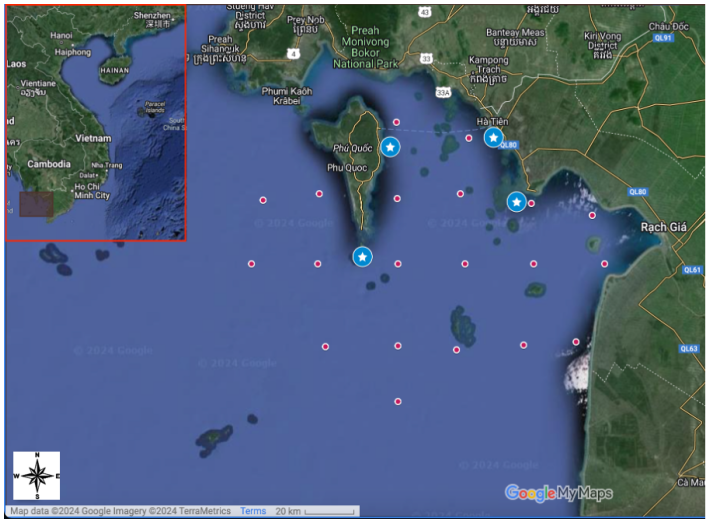
Fish and invertebrate specimens were collected during fisheries independent surveys (FIS) and port sampling (PS) in 2022 and 2023. The FIS was carried out by a commercial fishing boat, KG60012TS, a wooden-hulled vessel with an overall length of 13.6 m, equipped with a 230-horsepower engine. The bottom trawl net used for data sampling had a 16-m headrope, an 18-m footrope, and an 18-mm cod-end stretched mesh. The sampling strategy was a systematic design, with 20 sampling stations (Figure 1). Two trawl surveys were carried out in November 2022 and June 2023, representing the dry season (DS) and the rainy season (RS), respectively. Sampling was conducted in accordance with the methodology described by Sparre and Venema (1998). The trawl was towed at 2.3-2.5 knots during the surveys for 45-60 minutes. Fishes and invertebrates trawled onboard were sorted, identified and frozen then sent to the laboratory of the Research Institute for Marine Fisheries for biological analysis.
Port sampling (PS) sites (stars) and trawl sampling stations (red dots) of the fisheries independent surveys (FIS) in the SWS of Vietnam.
The PS was conducted monthly during the periods from November 2022 to October 2023 at landing sites along the coast of Kien Luong, Ha Tien districts, and Phu Quoc Island of Kien Giang province, Vietnam. Samples of 16 fish and invertebrate species were randomly taken from the catches of trawl nets, gillnets, purse seines, and collapsible traps when the fishing boat disembarked for catch unloading.
Individual length measurements of fish and invertebrates were conducted using calipers and measured to the nearest millimeter. We measured the total length (TL) for species with no forked tail, fork length (FL) for species with a forked tail, carapace width (CW) for crabs, mantle length (ML) for squids, and body length (BL) for shrimp. The body weight (g) of individual fish and invertebrates was measured on land using a digital scale with an accuracy of 0.01 g.
A total of 12,727 specimens of 12 fish and four invertebrate species belonging to 11 families were collected for biological analysis (Table 1), including Atule mate, Dendrophysa russelii, Encrasicholina heteroloba, Euthynnus affinis, Mulloidichthys vanicolensis, Nemipterus mesoprion, Pennahia anea, Rastrelliger brachysoma, Sardinella gibbosa, Saurida elongata, Saurida undosquamis, Scolopsis taenioptera, Upeneus tragula, Sepiella inermis, Parapenaeopsis maxillipedo, and Portunus pelagicus. There were 9,819 specimens sampled monthly by PS and additional 2,911 individuals of A. mate, D. russelii, S. undosquamis, and S. inermis were collected at sea during FIS. The sample size ranged from 75 individuals for N. mesoprion to 1,433 for S. undosquamis.
Number of specimens collected during the periods from Nov. 2022 to Oct. 2023. FIS: fisheries independent survey; PS: port sampling; N: sample size; FL: fork length; TL: total length; ML: mantle length; BL: body length; CW: carapace width.
DATA ANALYSIS
LWRs of fish and invertebrates were estimated by transforming the power equation W=aL b to the linear regression log(W)=log(a)+b*log(L), in which W is the weight in grams and L is the length in cm, a is the intercept and b is the slope (Le Cren, 1951). Based on the estimated b, the growth of a fish or invertebrate species (growth type: GT) is considered negative allometric (b<3), isometric (b=3), or positive allometric (b>3) (Beyer, 1987). The 95% confidence interval (CI) and standard error (SE) of LWR coefficients were also estimated to determine if the hypothetical value of isometry is within these estimated limits.
Relative condition factor (Kn) was calculated using the Le Cren (1951) formula: Kn=W/(a×L b ). A higher Kn generally indicates that an individual has a higher weight relative to its length than the average for the species.
LWRs and Kn of fish and invertebrates were analyzed using combined-sex data to provide general information on growth patterns of species. Additionally, separate analyses by sex and maturity stage were conducted to assess potential differences in growth across life history stages.
All data were analyzed and plotted using R Studio (R Core Team, 2021), following the guidelines of Ogle (2016).
RESULTS
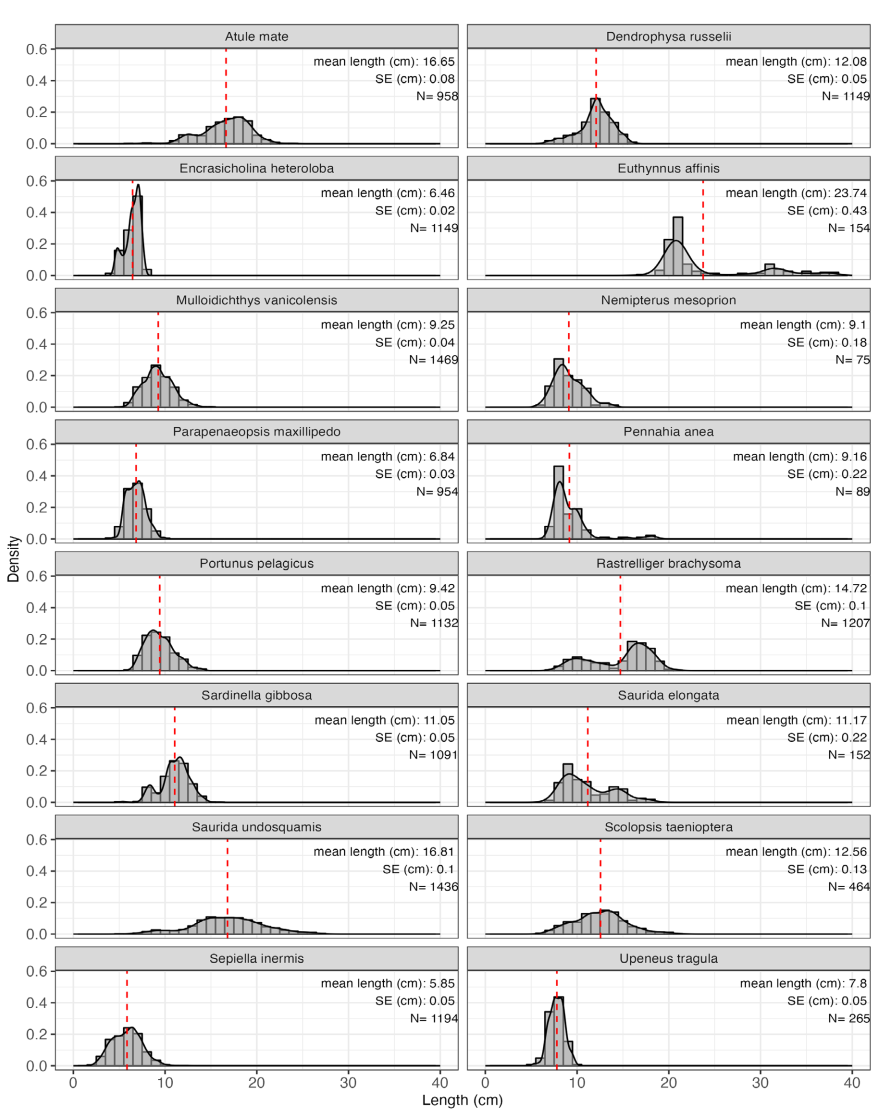
The length frequency distributions of fish and invertebrates are given in Figure 2. Several species demonstrated bimodal distributions representing multiple cohorts, including A. mate, E. affinis, P. anea, R. brachysoma, S, elongata, and S. undosquamis. Conversely E. heteroloba, P. maxillipedo, and U. tragula followed a more restricted unimodal distribution, potentially indicating that the sampling/fishing is concentrated on a single cohort.
Length frequency distribution of 16 commercially important species in the SWS of Vietnam. The vertical red dash lines denote the mean length of the species.
Parameters of the LWR equation, growth type and Kn of fish and invertebrate species in the SWS of Vietnam are presented in Table 2. Among the studied species, b values ranged from 2,613 (S. inermis) to 3,528 (R. brachysoma). All estimated LWRs showed a significant correlation with the coefficient of determination (r2) ranging from 0.91 to 0.99 (p<0.05). Student’s t-test and analysis of the b value indicated that 11 species had positive allometric growth (b>3); three presented negative allometric growth values (b<3), including S. taenioptera, S. inermis, P. maxillipedo and two species had isometric growth, consisting of N. mesoprion and P. anea.
Parameters of the LWR equation, Kn and growth type (GT) for fish and invertebrate species in the SWS of Vietnam. N: sample size; a: intercept; b: slope; r2: coefficient of determination, SE (b) standard error of the b value; CI (b): 95% confident interval of the b value, A+: positive allometric growth; A-: negative allometric growth; I: Isometric growth.
Table 2 presents the Kn values observed for the species studied. Three fish species had Kn values below 1.0 (E. heteroloba; S. undosquamis; S. elongata), and ten species with the mean Kn fluctuated between 1.223 to 1.791. Relatively high Kn were observed in two invertebrate species including S. inermis and P. pelagicus reflecting particularly robust physiological condition in these taxa.
DISCUSSION
The LWRs differed among species and depended on life history traits. The Kn reflects the health status and growth performance of species in relation to the physical and biological changes in environmental factors (Le Cren, 1951). Food availability is considered the main factor influencing the growth of species (Jobling, 1994). The Kn of each population varies yearly or seasonally (Jennings et al., 2001) and also depends on the life span of the species.
In this study, the b values of fish differed but aligned with the expected range as indicated by Froese (2006), between 2.5-3.5. In invertebrate species, b values vary across taxonomic groups. Cephalopods such as squids and cuttlefish, as well as shrimps, typically exhibit b<3, indicating negative allometric growth (Jahan and Mahmud, 2025; Mohale et al., 2024; Siddique et al., 2016). In contrast, crabs often show b>3, reflecting positive allometric growth (Hamid et al., 2018; Rohmayani et al., 2018). In this study, the cuttlefish Sepiella inermis exhibited a b value of 2.613, consistent with negative allometry. This value is higher than the estimate reported by Siddique et al. (2016) of 1.979, and comparable to that found by Jahan and Mahmud (2025). Önsoy and Salman (2022) reported that the b values of Sepiida range between 2.36-2.82.
Our findings on Kn are well-aligned with previous studies, showing values similar to those of fishes, which are typically in the 1.0-2.0 range (Dinh et al., 2022a, 2022b, 2022c; Ragheb, 2023; Tran et al., 2021). Kn values are relatively high in crabs (Hamid et al., 2018; Rohmayani et al., 2018) and cephalopods (Önsoy and Salman, 2022). Rohmayani et al. (2018) reported that the Kn of the blue swimming crab Portunus pelagicus from the Java Sea, Indonesia, ranged between 4.22 and 11.7. Önsoy and Salman (2022) indicated that the mean Kn of Sepiida order is 12.51±2.61, varying from 3.02 to 31.31.
Sexually dimorphic and variable ontogenetic growth patterns were observed for the species. During the juvenile stage, A. mate, D. russelii, E. affinis, S. taenioptera, and U. tragula had a higher b value than those in the adult stages, indicating that weight growth was faster during the juvenile stage. This suggests that juveniles were accruing weight across length intervals at a higher rate compared to the adult stages. On the contrary, M. vanicolensis, N. mesoprion, P. anea, R. brachysoma, S. gibbosa, S. elongata, and S. undosquamis showed slower weight growth in the juvenile stage but faster growth in the adult phase.
LWRs of marine species in Vietnam are poorly described. Recently, LWRs have been determined for Trypauchen vagina, Periophthalmus variablilis, Periophthalmus chrysospilos, and Ellochelon vaigiensis in the Mekong delta of Vietnam (Dinh, 2016; Dinh et al., 2022a; 2022b; 2022c; 2022d). Tran et al. (2021) studied the LWRs of the mudskipper (Periophthalmus modestus) in the Red River Delta of Vietnam. Nguyen (2024) reported the LWRs of 16 marine fish species in the Sea of Vietnam, analyzed from data sampled from three different eco-regions: the Gulf of Tonkin, the Central and the Southeast areas (Nguyen, 2024). In this study, none of these species had previously reported parameters of LWRs in the Sea of Vietnam. Thus, these results represent a valuable contribution to regional fisheries science, particularly for stock assessment applications. LWRs are fundamental tools for converting length data into biomass estimates, especially when weight measurements are unavailable. The established LWRs, therefore, enhance the quality of biological information accessible to fisheries managers, supporting the formulation of species-specific and ecosystem-based management strategies.
CONCLUSION
This study provided the first data on the LWRs and Kn of 12 fish and four invertebrate species in the SWS of Vietnam, with positive allometric growth observed in 11 species, negative allometric growth in three species, and isometric growth in two species. The Kn values of most studied species ranged from 1.0 to 2.0, except for crab Portunus pelagicus and cuttlefish Sepiella inermis. The coefficient of determination for LWRs of the combined sexes among species showed a significant correlation (r2>0.9). These results can provide the necessary information for stock assessment in Vietnam, particularly for species with limited or no prior LWR information.
ACKNOWLEDGMENTS
We would like to thank Dr. James Bell from the Centre for Environment, Fisheries and Aquaculture Science (Cefas, UK) for his helpful and valuable comments on the first draft of this work. Thanks also to colleagues and crews who participated in the fisheries independent surveys at sea and port samplings. We also thank the two reviewers for their useful comments on this study.
REFERENCES
-
Bell, J. B., Nguyễn, N. V., Việt, H. V., Nguyễn, M. H., Bùi, H. T., Trâng, T. V., McIlwaine, P., Kenny, A. & Nguyễn, B. K. 2021. Identifying marine ecological production units in Vietnam. ICES Journal of Marine Science, 78(4), 1241-1252. DOI: https://doi.org/10.1093/icesjms/fsab047
» https://doi.org/10.1093/icesjms/fsab047 - Beyer, J. E. 1987. On length-weight relationships Part I computing the mean weight of the fish in given length class. Fishbyte, 5, 11-13.
-
Compaire, J. C. & Soriguer, M. C. 2020. Length-weight relationships of seven fish species from tidepools of an intertidal rocky shore in the Gulf of Cadiz, Spain (NE Atlantic). Journal of Applied Ichthyology, 36, 852-854. DOI: https://doi.org/10.1111/jai.14087
» https://doi.org/10.1111/jai.14087 - Dinh, Q. M. 2016. Growth pattern and body condition of Trypauchen vagina in the Mekong Delta, Vietnam. Journal of Animal and Plant Sciences, 26(2), 523-531.
-
Dinh, Q. M., Nguyen, T. H. D., Nguyen, T. T. K., Tran, G. V. & Truong, N. T. 2022a. Spatiotemporal variations in length-weight relationship, growth pattern and condition factor of Periophthalmus variabilis Eggert, 1935 in Vietnamese Mekong Delta. PeerJ, 10, e12798. DOI: https://doi.org/10.7717/peerj.12798
» https://doi.org/10.7717/peerj.12798 -
Dinh, Q. M., Nguyen, T. H. D., Nguyen-Ngoc, L. & Nguyen, T. T. K. 2022b. Temporal variation in length-weight relationship, growth and condition factor of Acentrogobius viridipunctatus in the Mekong Delta, Viet Nam. Regional Studies in Marine Science, 55, 102545. DOI: https://doi.org/10.1016/j.rsma.2022.102545
» https://doi.org/10.1016/j.rsma.2022.102545 -
Dinh, Q. M., Nguyen, T. H. D., Truong, N. T., Tran, L. T. & Nguyen, T. T. K. 2022c. Morphometrics, growth pattern and condition factor of Periophthalmus chrysospilos Bleeker, 1853 (Gobiiformes: Oxudercidae) living in the Mekong Delta. Egyptian Journal of Aquatic Research, 48, 157-161. DOI: https://doi.org/10.1016/j.ejar.2021.10.009
» https://doi.org/10.1016/j.ejar.2021.10.009 -
Dinh, Q. M., Truong, N. T., Duc Nguyen, T. H., Huyen Tran, L. T., Kieu Nguyen, T. T. & Phan, L. H. 2022d. Variations in length-weight relationship, growth and body condition of the commercial mullet Ellochelon vaigiensis in the Vietnamese Mekong Delta. Heliyon, 8(11), e11789. DOI: https://doi.org/10.1016/j.heliyon.2022.e11789
» https://doi.org/10.1016/j.heliyon.2022.e11789 - Duarte, L. O., Garcia, C. B., Sandoval, N., von Schiller, D., Melo, G. & Navajas, P. 1998. Length-weight relationships of demersal fishes from the Gulf of Salamanca, Colombia. Naga, 21(3), 30-32.
-
Froese, R. 2006. Cube law, condition factor and weight-length relationships: history, meta-analysis and recommendations. Journal of Applied Ichthyology, 22, 241-253. DOI: https://doi.org/10.1111/j.1439-0426.2006.00805.x
» https://doi.org/10.1111/j.1439-0426.2006.00805.x - Frota, L., Costa, P. & Braga, A. 2004. Length-weight relationships of marine fishes from the central Brazilian coast. Naga, 27(1-2), 20-26.
-
Hamid, A., Batu, D. T. F. L., Riani, E. & Wardiatno, Y. 2018. Carapace width-weight relationships and condition factor of blue swimming crab, Portunus pelagicus Linnaeus, 1758 (Crustacea: Decapoda) in Lasongko Bay, Southeast Sulawesi, Indonesia. Advances in Environmental Biology, 12(11), 14-21. DOI: https://doi.org/10.22587/AEB.2018.12.11.2
» https://doi.org/10.22587/AEB.2018.12.11.2 -
Jahan, R. & Mahmud, N. 2025. Length-weight relationship, condition factors and reproductive biology of the spineless cuttlefish Sepiella inermis (Ferussac & d’Orbigny, 1848) in the southeastern regions of the Bay of Bengal, Bangladesh. Heliyon, 11(3), e42338. DOI: https://doi.org/10.1016/j.heliyon.2025.e42338
» https://doi.org/10.1016/j.heliyon.2025.e42338 - Jennings, S., Kaiser, M. & Reynolds, J. D. 2001. Marine Fisheries Ecology. Hoboken, Wiley-Blackwell.
- Jobling, M. 1994. Fish Bioenergetics. Dordrecht, Springer Netherlands.
-
King, M. 2007. Stock Assessment. In: King, M. Fisheries biology, assessment and management (pp. 239-272). Hoboken: John Wiley & Sons, Ltd. DOI: https://doi.org/10.1002/9781118688038.ch5
» https://doi.org/10.1002/9781118688038.ch5 -
Le Cren, E. D. 1951. The length-weight relationship and seasonal cycle in gonad weight and condition in the perch (Perca fluviatilis). The Journal of Animal Ecology, 20(2), 201-219. DOI: https://doi.org/10.2307/1540
» https://doi.org/10.2307/1540 -
Mazumder, S. K., Das, S. K., Bakar, Y. & Ghaffar, M. A. 2016. Effects of temperature and diet on length-weight relationship and condition factor of the juvenile Malabar blood snapper (Lutjanus malabaricus Bloch & Schneider, 1801). Journal of Zhejiang University-SCIENCE B, 17, 580-590. DOI: https://doi.org/10.1631/jzus.B1500251
» https://doi.org/10.1631/jzus.B1500251 -
Mohale, H. P., Jawahar, P., Jayakumar, N., Oli, G. O., Ravikumar, T., Bhosle, R. V., Ananda, S. P., Kadam, R. V. & Sonwal, M. C. 2024. Length-weight relationship and condition factors of seven penaeus shrimp species along the Southeast Coast of Tamil Nadu (Southern India). Indian Journal of Animal Research, 58(8), 1383-1392. DOI: https://doi.org/10.18805/IJAR.B-5218
» https://doi.org/10.18805/IJAR.B-5218 -
Nguyen, K. Q. 2024. Length-weight and length-length relationships of 16 marine fish species in Vietnam. Ocean and Coastal Research, 72. DOI: https://doi.org/10.1590/2675-2824072.23052
» https://doi.org/10.1590/2675-2824072.23052 - Ogle, D. H. 2016. Introductory fisheries analyses with R. Boca Raton, Chapman and Hall/CRC.
-
Önsoy, B. & Salman, A. 2022. Length weight relationships of coleoid cephalopods from the eastern Mediterranean. Scientific Reports, 12(12256). DOI: https://doi.org/10.1038/s41598-022-16611-7
» https://doi.org/10.1038/s41598-022-16611-7 - Paraskevi, K. K. & Konstantinos, I. S. 2012. Morphometrics and allometry in fishes. In: Wahl, C. (Ed.) Morphometrics (pp. 65-86). Rijeka: IntechOpen.
- Pham, T. & Nguyen, L. 1997. Overiew of the coastal fisheries of Vietnam. status and management of tropical coastal fisheries in Asia, 1997. ICLARM Conference Proceeding 96-106.
-
R CORE TEAM. 2021. R: a language and environment for statistical computing. Vienna, Austria: R Foundation for Statistical Computing. Available from: Available from: https://www.R-project.org/ Access date: 2025 Jul. 7.
» https://www.R-project.org/ -
Raakjær, J., Manh Son, D., Stæhr, K.-J., Hovgård, H., Dieu Thuy, N. T., Ellegaard, K., Riget, F., Van Thi, D. & Giang Hai, P. 2007. Adaptive fisheries management in Vietnam: the use of indicators and the introduction of a multi-disciplinary Marine Fisheries Specialist Team to support implementation. Marine Policy, 31(2), 143-152. DOI: https://doi.org/10.1016/j.marpol.2006.05.013
» https://doi.org/10.1016/j.marpol.2006.05.013 -
Ragheb, E. 2023. Length-weight relationship and well-being factors of 33 fish species caught by gillnets from the Egyptian Mediterranean waters off Alexandria. Egyptian Journal of Aquatic Research, 49(3), 361-367. DOI: https://doi.org/10.1016/j.ejar.2023.01.001
» https://doi.org/10.1016/j.ejar.2023.01.001 -
Rohmayani, V., Pahlevi, M. R., Irawan, B. & Soegianto, A. 2018. Length-Weight relationship, sex ratio and condition factor of blue swimming crab (Portunus pelagicus Linnaeus, 1758) from Java Sea Indonesia. AIP Conference Proceedings, 2002(1). DOI: https://doi.org/10.1063/1.5050167
» https://doi.org/10.1063/1.5050167 -
Siddique, M. A. M., Khan, S. K., Habib, A., Bhuiyan, K. A. & Aftabuddin, S. 2016. Size frequency and length-weight relationships of three semi-tropical cephalopods, Indian squid Photololigo duvaucelii, needle cuttlefish Sepia aculeata, and spineless cuttlefish Sepiella inermis from the coastal waters of Bangladesh, Bay of Bengal. Zoology and Ecology, 26(3), 176-180. DOI: https://doi.org/10.1080/21658005.2016.1190523
» https://doi.org/10.1080/21658005.2016.1190523 - Sparre, P. & Venema, S. C. 1998. Introduction to tropical fish stock assessment. Roma, Food and Agriculture Organization of the United Nations.
-
Tran, H. D., Nguyen, H. H. & Ha, L. M. 2021. Length-weight relationship and condition factor of the mudskipper (Periophthalmus modestus) in the Red River Delta. Regional Studies in Marine Science, 46, 101903. DOI: https://doi.org/10.1016/j.rsma.2021.101903
» https://doi.org/10.1016/j.rsma.2021.101903
-
DATA AVAILABILITY STATEMENT:
All data are available from the corresponding author upon reasonable request.
-
FUNDING:
This study received financial support from the People’s Committee of Kien Giang Province under contract No. 06/2022/HD-CCTSKG-VHS.
-
SUPPLEMENTARY MATERIALS:
Supplementary material for this article is available via hyperlinks to the Zenodo service.
All data are available from the corresponding author upon reasonable request.