 Karyotype analysis and physical mapping of the 5S and 45S rDNA genes in Hymenocallis howardii (Amaryllidaceae) by FISH
Abstract
Hymenocallis howardii Bauml is a bulbous species belonging to the monocotyledonous family Amaryllidaceae and is distributed in southwestern Mexico. Chromosome numbers reported for the genus Hymenocallis vary widely, ranging from 2n = 24 and 2n = 110. The aim of this study was to determine the chromosome number and to conduct karyotype analysis and physical mapping of 45S and 5S ribosomal DNA (rDNA) in H. howardii. These analyses were performed in root meristematic cells using DAPI staining and fluorescence in situ hybridization (FISH). The number of chromosomes found for this species was 96. The 45S rDNA signals were detected at two loci located in the telomeric regions of the short chromosome arms, while six loci of 5S rDNA were observed in telomeric and subtelomeric positions, also on the short arms. The karyotype formula was 64m + 30sm + 2st, and the karyotype symmetry/asymmetry indices (TF% = 40.43, AsK% = 59.56, Syi% = 67.88) indicated a slightly asymmetric karyotype, characterized by a gradual decrease in chromosome length from 10.46 µm to 3.36 µm, with a predominance of metacentric and submetacentric chromosomes. The presence of only two 45S rDNA sites in H. howardii suggests that it is a paleopolyploid species.
Keywords:
fluorescent in situ hybridization; idiogram; ornamental plant bulbous; ribosomal DNA
Resumo
Hymenocallis howardii Bauml é uma espécie bulbosa da família das monocotiledoneas Amaryllidaceae distribuida no sudoeste do México. O género Hymenocallis apresenta diferentes números de cromossomos, que variam entre 24 e 110. O objetivo do trabalho foi determinar o número cromossômico e realizar a análise do cariótipo e o mapeamento físico do DNA ribossomal (rDNA) 45S e 5S em H. howardii. A análise do cariótipo e o mapeamento físico do DNA ribossômico foram realizados em células meristemáticas da raiz de H. howardii por coloração com DAPI e hibridização in situ por fluorescência (FISH). O número de cromossomos encontrados para esta espécie foi 96. Os sinais do rDNA 45S foram localizados em dois loci na posição telomérica dos braços curtos dos cromossomas e seis loci para os sinais do rDNA 5S em posições teloméricas e subteloméricas também nos braços curtos dos cromossomos. A fórmula cariotípica observada foi de 64m + 30sm + 2 st, índice de simetria/assimetria cariotípica foi de TF% = 40,43, AsK% = 59,56 e Syi% = 67,88, indicando um cariótipo ligeiramente assimétrico, que mostra uma diminuição gradual do comprimento dos cromossomas de 10,46 µm a 3,36 µm, com predominância de cromossomos metacêntricos e submetacêntricos. A localização de apenas dois sinais de rDNA 45S nos cromossomos de H. howardii sugere que se trata de uma espécie paleopoliplóide.
Palavras-chave:
DNA ribossômico; hibridação in situ fluorescente; idiograma; planta ornamental bulbosa
Introduction
Hymenocallis Salisb. (Greek for “beautiful membrane”), is a genus of monocotyledonous, herbaceous, perennial and bulbous plants with white flowers and some of them fragrant, was recognized as a distinct genus under family Amaryllidaceae since 1812, commonly known as “Spider lily” (Chawla et al., 2022). The genus comprises around 70 species distributed in the southeastern and central United States of America, Caribbean islands, Mexico, Central America and northeastern South America, predominantly in Mesoamerica. In Mexico, the highest number of species of the genus is found (32), many of them endemic (Tapia-Campos et al., 2012). Hymenocallis howardii Bauml, and endemic species distributed in the South-West of Mexico is a small plant of glaucous foliage, which blooms from mid-June through mid-July is highly appreciated as an ornamental.
The chromosome number of the genus is highly variable, with valuesranging from 2n = 24 to 2n = 110, however the most common values are 2n = 46 and 2n = 40 (Flory, 1976). The extremely variable chromosome number, even within plants of the same species (for example H. littorae reported by Tanee et al. (2018) and Afroz et al., (2024), suggests that polyploidy and aneuploidy have contributed significantly to the evolution of chromosomes in the genus Hymenocallis (Jee and Vijayavalli, 1999), many authors have reported aneuploid accessions which exhibit a deviation from chromosome numbers 2n = 40 or 2n = 46 probably as a result of centric fission, a process in the evolution dynamics in this genus (Flory, 1976).
Fluorescence in situ hybridization (FISH) with ribosomal DNA probes is widely used for chromosome identification and for investigating genome organization and evolutionary patterns in numerous plant species. It enables the detection of chromosome rearrangements - including translocations, inversions, and deletions - and provides important insights for evolutionary and phylogenetic studies (Jiang, 2019). There are published works using FISH techniques in plants of the Amaryllidaceae family (Ahmad et al., 2020; Costa et al., 2020; Zeng et al., 2020; Báez et al., 2020a; Báez et al., 2020b; Nascimento et al., 2022; Jamja et al., 2024; Quan et al., 2024; Pustahija et al., 2024; Ahmad et al., 2025) of which only the work reported by Tanee et al. (2018) is on a species of the Hymenocallis genus, so it is necessary to increase the studies in this genus, in order to improve our understanding regarding the evolution in this group of plants. Among the several species of the genus, Hymenocallis howardii stands out as an ornamental plant. An important step in a breeding program is the collection of cytogenetic information, and the objective of the present study was the determination of the karyotype and the physical mapping of the 5S and 45S ribosomal DNA genes in H. howardii plants.
Material and Methods
Plant material and chromosome preparation
Root tips obtained from bulbs of Hymenocallis howardii plants belonging to an in vivo collection of the Centro de Investigación y Asistencia en Tecnología y Diseño del Estado de Jalisco, (CIATEJ, A.C.) were used; the specimens of H. howardii were collected in a population in the Tequila volcano, located in the municipality of Tequila Jalisco. The work was carried out on ten specimens; the bulbs were placed in a container containing a mix of Peat Moss:vermiculite (7:3). Chromosome slides preparation was performed according to the method reported by Rodríguez-Domínguez et al. (2017). In brief, the root tips were placed in a freshly prepared saturated solution of alpha-bromonaphthalene (0.1%) for 48 h at 4 °C and fixed in a methanol:acetic acid (3:1) solution for 24 h at 4 ° C. Afterwards, they were washed with milli-Q water and incubated in an enzyme mixture containing each 0.2% (w/v) pectolyase Y23, 0.2% (w/v) RS cellulase and 0.2% (w/v) cytohelicase in 10 mM citrate buffer (pH 4.5) at 37 °C for 3 h. Later, a cell suspension was obtained by vortexing, followed by washing with distilled water, centrifuging at 6,150 X g during 45 s, washed with methanol, then, centrifuged at 7,440 X g during 30 s. The cell pellet was resuspended in 100 µl methanol. Finally, in a fume hood, the slides were covered with a layer of pure acetic acid and 10 µl of cell suspension were added to each slide inclined at an angle of 45 degrees, and two drops of pure acetic acid were added; the slides were exposed (facing down) to vapor from a water bath at 55 °C for 5 s, and a drop of pure acetic acid was added and allowed to air dry.
Ribosomal DNA probes and labeling
Two different clones were utilized as probe, clones pTa71 and pTa794 which contains the EcoRI fragment of 45S and 5S ribosomal DNA from wheat respectively (Zang et al., 2022; Osman et al., 2022). Isolation of wheat ribosomal DNA was performed using the kit High Pure Plasmid Isolation Kit (Roche®) and labeled with Tetramethylrhodamine-5-dUTP by nick translation according to the manufacturer’s instructions (Roche Diagnostics GmbH).
Fluorescent in situ hybridization
Slides with metaphase chromosomes were incubated overnight at 37 °C in a humid chamber, the next day, each slide was treated with 200 μl RNase A (100 μg mL-1) in 2x saline sodium citrate (SSC) for 1 h at 37 °C and washed three times for 5 min each in 2x SSC, incubated in 0.01 M HCl for 2 min. Afterwards, 200 μl Pepsin (5 μg mL-1) were added and incubated for 10 min at 37 °C and rinsed in mQ water for 2 min and in 2x SSC for 5 min each. Then, the slides were incubated in paraformaldehyde solution (4%) for 10 min at room temperature (RT), washed three times in 2x SSC for 5 min each and dehydrated in an increasing ethanol series (70%, 90%, and absolute ethanol) for 3 min each and air-dried. For hybridization, to each slide was added 40 μl mix, containing 20x SSC, 50% formamide, 10% sodium dextran sulphate, 10% SDS and 25-50 ng 5S probe. The DNA was denatured by heating the hybridization mixture at 70 °C for 10 min and then placed on ice for at least 10 min. Slides were denatured at 80 °C for 10 min on a hot plate and then incubated overnight in a pre-warmed humid chamber at 37 °C. Slides were washed at 37 °C in 2× SSC for 15 minutes, 0.1× SSC at 42 °C for 30 minutes, and 2× SSC at RT for 10 min. Chromosomes were counterstained with 1 μg mL-1 DAPI (4′,6-diamidino-2-phenylindole) and a drop of VECTASHIELD® Antifade Mounting Media (Vector Laboratories, Inc., Newark, CA, USA) was added for its examination under a Leica DMRA2 microscope (Leica Microsystems, Wetzlar, Germany) equipped with epi-fluorescent illumination, filter sets of DAPI and Cy3. Images were captured by an Evolution QEi monochrome digital camera (Media Cybernetics, Inc., Rockville, USA) and processed with Image-Pro Plus software. The DAPI images were sharpened with a 7 x 7 High Gauss spatial filter. DAPI and Tetramethylrhodamine fluorescence were pseudo-colored with their respective dye tint for the FISH analyses. In order to carry out a new hybridization using another probe (45S) on the slides containing the cells of interest, washes were carried out that consisted of cleaning the excess immersion oil from the slide with a solvent composed of ethanol and acetone; then the slides were incubated at 37 °C for 10 minutes to reduce the viscosity of the glycerol (Vectashield); the coverslip was then carefully removed and the slides were washed three times in detection buffer, the first wash was for 5 minutes and the second and third washes for 30 minutes each; consequently, two washes were carried out in 2x SSC for 5 minutes at room temperature; finally, the slides were dehydrated with three washes of 3 minutes each in 70%, 90%, and 100% ethanol, and were allowed to air dry. Afterwards, they were used again for a new hybridization with the steps previously described and the resulting signals of the 45S probe were pseudo-colored in green to contrast from those of the previous 5S probes.
Karyotype analysis
A minimum of ten cells with well-spread metaphase chromosomes were used for karyotype analysis. Chromosome measurements were made using the freeware software DRAWID v0.26 (Kirov et al., 2017). Total chromosome length (L+S), long arm (L), and short arm (S) were reported as mean ± Standard deviation (SD) and range, whereas the arm ratio (L/S) was presented as mean ± SD (Table 1). The arm ratio was used to classify the chromosomes as recognized by Levan et al. (1964), chromosomes were arranged in order of decreasing length and in base to centromere position. Three different methods of evaluating karyotype asymmetry were used: TF%, AsK%, and Syi (Peruzzi and Eroğlu, 2013).
Results
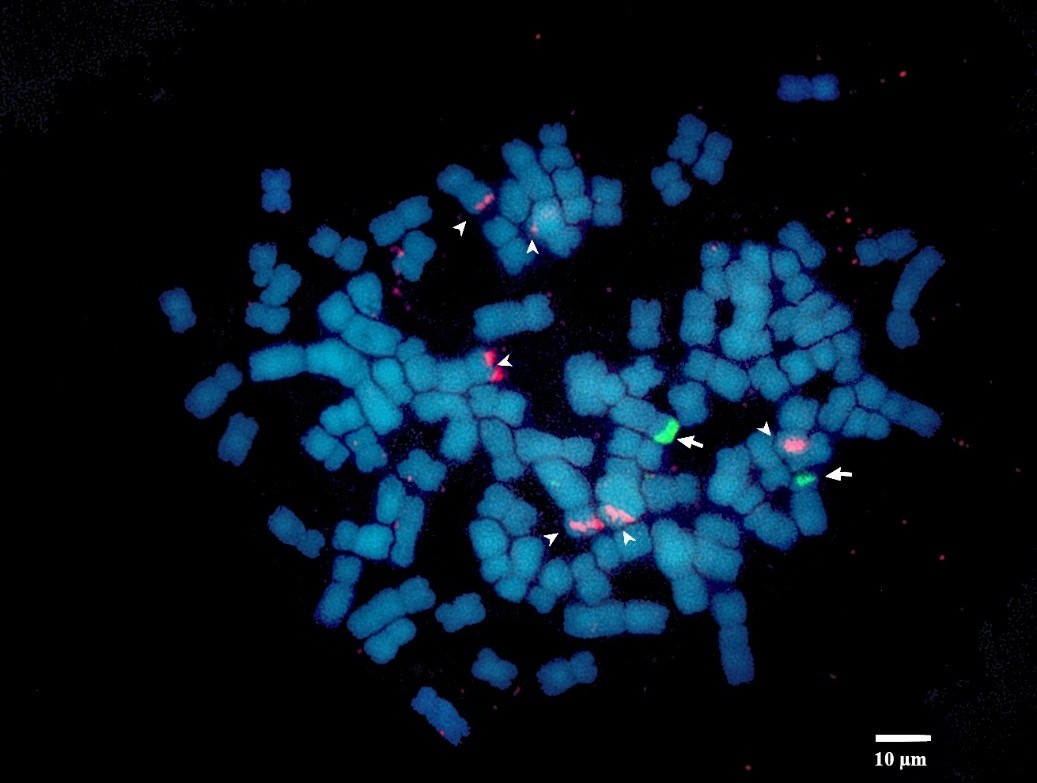
Hymenocallis howardii showed a chromosome number 2n = 96 which coincides with that previously reported by Rodríguez-Domínguez et al. (2017). Its Karyotype presented two 45S hybridization sites in the telomeric position and six for 5S also in the telomeric and subtelomeric positions (Fig. 1). For the hybridization experiments in this species, only Tetra-methylrhodamine-5-dUTP was used to label both ribosomal DNA probes (45S and 5S), washing the slides between one hybridization and the next; In order to more easily differentiate the results, the 5S hybridization sites were pseudo-colored in red while the 45S hybridization sites were pseudo-colored in green using the Image Pro Plus 6.1 software (Media Cybernetics) (Fig. 1). The signals obtained with FISH are shown in the idiogram proposed in Fig. 2, where it is possible to observe the positions of the 45S and 5S probes. The karyotypic formula is 64m + 30sm + 2st and the karyotype symmetry/asymmetry index is TF % = 40.43, AsK % = 59.56, and Syi % = 67.88. Karyotype showed a gradual decrease in chromosome length from 10.46 µm to 3.36 µm predominating metacentric and submetacentric chromosomes. (Table 1).
Fluorescent in situ hybridization of the 5S genes (red signals, arroweads) and 45S rDNA (green signals, arrows) in Hymenocallis howardii. Chromosomes were counterstained with DAPI.
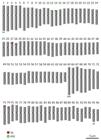
Idiogram of Hymenocallis howardii showing the 5S and 45S rDNA loci (m = metacentric, sm = submetacentric, st = subtelocentric).
Discussion
According to this study, the previously reported chromosome number 2n = 96 for this species is confirmed (Rodríguez-Domínguez et al., 2017). The chromosome number for the genus Hymenocallis presents a wide range of somatic numbers, H. quitoensis has a chromosome number 2n = 24, which is the lowest reported for the genus (Snoad, 1952), while the highest numbers reported are 2n = 104-110 for H. pedunculata (Flory, 1976). The basic chromosome number reported for most species of the genus Hymenocallis is x = 22 and 23 (Meerow et al., 2020) however, most researchers agree that these values are of secondary origin, in this sense, Raina and Khoshoo (1971) suggested three basic numbers for the genus: x = 10, 11, and 12. Many aneuploid accessions that have been reported present a derivation of these values, possibly giving rise to the different current basic numbers reported for the genus. Based on this, in our study we can infer that H. howardii is a tetraploid species with a basic number x = 24; This agrees with other investigations in which multiple chromosome numbers of said basic number are reported, for example, for H. sonorensis (Flory, 1976), H. rotate and H. godfreyi (Smith and Darst, 1994), among others, for which a chromosome number of 2n = 48 is reported.
Based on the chromosome classification using the methodology of Levan et al. (1964), the identification of individual chromosomes can be facilitated as long as a high Asymmetry Index is present. In the case of H. howardii, the values obtained TF% = 40.43, AsK% = 59.56, Syi% = 67.88 indicate a slightly asymmetric karyotype, so many chromosomes resemble each other. All this, added to the fact that it is possibly a polyploid species, makes it difficult to identify individual chromosomes using conventional staining techniques.
All ribosomal DNA signals were detected in the terminal regions of the short arms of the chromosomes; in the case of the 5S probe, it occurred on six chromosomes while the 45S probe occurred on two chromosomes. This lower number of signals in this probe could be explained because 45S rDNA loci are generally more prone to rapid homogenization, silencing, and loss of loci, especially in polyploids (Kotseruba et al., 2010). Similarly, differences in the size of the 45S signals were also detected, which may be due to the existence of different copy numbers of the rDNA genes in each chromosome; this agrees with Tanee et al., (2018) who found different sizes in the 45S signals in H. littoralis on homologous chromosomes. In our study, all the rDNA signals (45S and 5S) were located in eight chromosomes distributed in pairs of similar chromosomes (Fig. 2), however, as it is a possible tetraploid species, these signals should appear in groups of four similar chromosomes, this coincides with the study by Tanee et al., (2018) who found only a 5S rDNA signal in a chromosome of pair number 2 in H. littoralis, being absent in the homologous chromosome in all the plants analyzed. The latter suggest that the increase of ploidy in the species is ancient, probably paleopolyploid, because only two 45S rDNA loci were found, if the polyploidization event would be recent, at least four loci with the 45S rDNA should have been present, as is the case of Sprekelia formosissima, a close related Amaryllidaceae (Rodríguez-Domínguez et al., 2020).
Conclusions
The chromosome number of Hymenocallis howardii was confirmed and the ploidy level was inferred, which is 2n = 4x = 96. The position of rDNA signal were investigated through in situ hybridization, the 45S rDNA signals were localized in two loci in telomeric position of short arms of chromosome seven and its homologue, and six loci for the 5S rDNA signals in telomeric and subtelomeric positions also in short arms of chromosomes 10, 14, 37. The results obtained in this work suggest that H. howardii might be a paleopolyploid, the chromosome number confirms that it is a tetraploid, but the presence of only two 45S rDNA signals suggest that two of these loci, which were expected to be present in at least four chromosomes (being a tetraploid) were lost in the evolutionary process of H. howardii. The chromosome number and the individual chromosome identification through in situ hybridization provide knowledge that is necessary in order to begin a breeding program in this ornamental specie, also in the Hymenocallis genera and in within the Amaryllidaceae family.
Acknowledgments
The authors are grateful to “Laboratorio Nacional PlanTECC”, whose funding made this work possible.
Data availability statement
All the research data is contained in the manuscript.
References
-
AFROZ, S.; BEGUM, K.N.; SAHA, S.; HASSAN, M.A.; RAHMAN, M.O. Taxonomy, karyomorphology and pollen viability of Hymenocallis littoralis (Jacq.) Salisb. (Amaryllidaceae). Bangladesh Journal of Plant Taxonomy, v.31, n.2, p.265-273, 2024. https://doi.org/10.3329/bjpt.v31i2.78752
» https://doi.org/10.3329/bjpt.v31i2.78752 -
AHMAD, R.; LI, G.; NAWAZ, M.K.; HASSAN, MU.; SAEED, S.; IBRAR, D.; HESLOP-HARRISON, J.S.P.; YANG, Z.; KHAN, N. Association of Sub-Telomeric Satellite DNA with 45S rDNA in Cultivated Onion (Allium cepa) with Denaturing and Non-Denaturing (ND-) FISH. International Journal of Agriculture & Biology, v.24, n.6, p.1457‒1463, 2020. https://doi.org/10.17957/ijab/15.1583
» https://doi.org/10.17957/ijab/15.1583 -
AHMAD, R.; TOMASZEWSKA, P.; SHAH, M.K.N.; KHAN, N.; IBRAR, D.; AKHTAR, N.; HESLOP-HARRISON, J.S.P. Allium chromosome evolution and DNA sequence localization. Molecular Biology Reports, v.52, n.1, p.84, 2025. https://doi.org/10.1007/s11033-024-10184-6
» https://doi.org/10.1007/s11033-024-10184-6 -
BÁEZ, M.; SOUZA, G.; GUERRA, M. Genome size and cytomolecular diversification in two species of the South African endemic genus Tulbaghia L. (Allioideae, Amaryllidaceae). South African Journal of Botany, v.130, p.407-413, 2020a. https://doi.org/10.1016/j.sajb.2020.01.024
» https://doi.org/10.1016/j.sajb.2020.01.024 -
BÁEZ, M.; SOUZA, G.; GUERRA, M. Does the chromosomal position of 35S rDNA sites influence their transcription? A survey on Nothoscordum species (Amaryllidaceae). Genetics and Molecular Biology, v.43, n.1, e20180194, 2020b. https://doi.org/10.1590/1678-4685-gmb-2018-0194
» https://doi.org/10.1590/1678-4685-gmb-2018-0194 -
CHAWLA, S.L.; MOMIN, K.C.; PAWAR, R.D.; KUMARI, K.; PATIL, S. Traditional bulbous plants. In: DATTA, S.K.; GUPTA, Y.C. (eds.). Floriculture and Ornamental Plants. Singapore: Springer Nature Singapore, 2022. p.263-305. https://doi.org/10.1007/978-981-15-3518-5
» https://doi.org/10.1007/978-981-15-3518-5 -
COSTA, L.; JIMENEZ, H.; CARVALHO, R.; CARVALHO-SOBRINHO, J.; ESCOBAR, I.; SOUZA, G. Divide to conquer: evolutionary history of Allioideae tribes (Amaryllidaceae) is linked to distinct trends of karyotype evolution. Frontiers in Plant Science, v.11, p.320, 2020. https://doi.org/10.3389/fpls.2020.00320
» https://doi.org/10.3389/fpls.2020.00320 - FLORY, W.S. Distribution, chromosome numbers and types of various species and taxa of Hymenocallis Nucleus v.19, p.204-227, 1976.
-
JAMJA, T.; AKHTAR, S.F.; BORA, S.; TABING, R., BORUAH, P.; SAATU, M.; UIKE, A.R.; RAO, E.G. Molecular and cytogenetic techniques (FISH and GISH) for rapid hybrid confirmation to hasten the breeding pace of ornamental geophytes. Journal of Applied and Natural Science, v.16, n.2, p.768-776, 2024. https://doi.org/10.31018/jans.v16i2.5544
» https://doi.org/10.31018/jans.v16i2.5544 -
JEE, G.; VIJAYAVALLI, B. Karyomorphology of eight taxa of Hymenocallis from South India. Caryologia, v.52, n.1-2, p.59-64, 1999. https://doi.org/10.1080/00087114.1998.10589154
» https://doi.org/10.1080/00087114.1998.10589154 -
JIANG, J. Fluorescence in situ hybridization in plants: recent developments and future applications. Chromosome Research, v.27, p.153-165, 2019. https://doi.org/10.1007/s10577-019-09607-z
» https://doi.org/10.1007/s10577-019-09607-z -
KIROV, I.; KHRUSTALEVA, L.; VAN LAERE, K.; SOLOVIEV, A.; MEEUS, S.; ROMANOV, D.; FESENKO, I. DRAWID: user-friendly java software for chromosome measurements and idiogram drawing. Comparative Cytogenetics, v.11, n.4, p.747-757, 2017. https://doi.org/10.3897/compcytogen.v11i4.20830
» https://doi.org/10.3897/compcytogen.v11i4.20830 -
KOTSERUBA, V.; PISTRICK, K.; BLATTNER, F.R.; KUMKE, K.; WEISS, O.; RUTTEN, T.; FUCHS, J.; ENDO, T.; NASUDA, S.; GHUKASYAN, A.; HOUBEN, A. The evolution of the hexaploidy grass Zingeria kochii (Mez) Tzvel. (2n=12) was accompanied by complex hybridization and uniparental loss of ribosomal DNA. Molecular Phylogenetics and Evolution, v.56, n.1, p.146-155, 2010. https://doi.org/10.1016/j.ympev.2010.01.003
» https://doi.org/10.1016/j.ympev.2010.01.003 -
LEVAN, A.; FREDGA, K.; SANDBERG, A.A. Nomenclature for centromeric position on chromosomes. Hereditas, v.52, n.2, p.201-220, 1964. https://doi.org/10.1111/j.1601-5223.1964.tb01953.x
» https://doi.org/10.1111/j.1601-5223.1964.tb01953.x -
MEEROW, A.W.; GARDNER, E.M.; NAKAMURA, K. Phylogenomics of the Andean tetraploid clade of the American Amaryllidaceae (Subfamily Amaryllidoideae): unlocking a polyploid generic radiation abetted by continental geodynamics. Frontiers in Plant Science, v.11, n.582422, 2020. https://doi.org/10.3389/fpls.2020.582422
» https://doi.org/10.3389/fpls.2020.582422 -
NASCIMENTO, T.; GONGALVES, S.R.; BÁEZ, M.; SEIJO, G.; GUERRA, M. Molecular cytogenetics reveals an uncommon structural and numerical chromosomal heteromorphism in Zephyranthes brachyandra (Amaryllidaceae). Boletín de la Sociedad Argentina de Botánica, v.57, n.1, p.39-49, 2022. https://doi.org/10.31055/1851.2372.v57.n1.34304
» https://doi.org/10.31055/1851.2372.v57.n1.34304 -
OSMAN, K.; FRANKLIN, F.C.H.; SANCHEZ-MORAN, E. Cytogenetic techniques for analyzing meiosis in hexaploid bread wheat. In: LAMBING, C. (eds). Plant Gametogenesis. Methods in Molecular Biology. Humana, New York, NY, 2022. p.71-84. https://doi.org/10.1007/978-1-0716-2253-7_6
» https://doi.org/10.1007/978-1-0716-2253-7_6 -
PERUZZI, L.; EROĞLU, H.E. Karyotype asymmetry: again, how to measure and what to measure? Comparative cytogenetics, v.7, n.1, p.1-9, 2013. https://doi.org/10.3897/compcytogen.v7i1.4431
» https://doi.org/10.3897/compcytogen.v7i1.4431 -
PUSTAHIJA, F.; BAŠIĆ, N.; SILJAK-YAKOVLEV, S. Karyotype Variability in Wild Narcissus poeticus L. Populations from different environmental conditions in the Dinaric Alps. Plants, v.13, n.2, p.208, 2024. https://doi.org/10.3390/plants13020208
» https://doi.org/10.3390/plants13020208 -
QUAN, M.; JIANG, X.; XIAO, L.; LI, J.; LIANG, J.; LIU, G. Reciprocal natural hybridization between Lycoris aurea and Lycoris radiata (Amaryllidaceae) identified by morphological, karyotypic and chloroplast genomic data. BMC Plant Biology, v.24, v.1, p.14, 2024. https://doi.org/10.1186/s12870-023-04681-2
» https://doi.org/10.1186/s12870-023-04681-2 - RAINA, S.N.; KHOSHOO, T.N. Cytogenetics of the tropical bulbous ornamentals. V. Chromosomal variation and evolution in Hymenocallis La Cellule, v.68, n.3, p.239-259, 1971.
-
RODRÍGUEZ-DOMÍNGUEZ, J.M.; RÍOS-LARA, L.L.; TAPIA-CAMPOS, E.; BARBA-GONZALEZ, R. An improved technique for obtaining well-spread metaphases from plants with numerous large chromosomes. Biotechnic & Histochemistry, v.92, n.3, p.159-166, 2017. https://doi.org/10.1080/10520295.2017.1288927
» https://doi.org/10.1080/10520295.2017.1288927 -
RODRÍGUEZ-DOMÍNGUEZ, J.M.; TAPIA-CAMPOS, E.; BARBA-GONZALEZ, R. Physical mapping of 45S and 5S rDNA in two Sprekelia formosissima cytotypes (Amaryllidaceae) through Fluorescent In Situ Hybridization (FISH). Caryologia, v.73, n.3, p.121-126, 2020. https://doi.org/10.13128/caryologia-578
» https://doi.org/10.13128/caryologia-578 -
SMITH, G.L.; DARST, M. A new species of Hymenocallis (Amaryllidaceae) in the Florida Panhandle. Novon, v.4, n.4, p.396-399, 1994. https://doi.org/10.2307/3391452
» https://doi.org/10.2307/3391452 - SNOAD, B. Chromosome counts of species and varieties of garden plants. Annual Report of the John Innes Horticultural Institute v.42, p.47-50, 1952.
-
TANEE, T.; SUDMOON, R.; SIRIPIYASING, P.; SUWANNAKUD, K.S.; MONKHEANG, P.; CHAVEERACH, A. New Karyotype Information of Hymenocallis littoralis, Amaryllidaceae. Cytologia, v.83, n.4, p.437-440, 2018. https://doi.org/10.1508/cytologia.83.437
» https://doi.org/10.1508/cytologia.83.437 - TAPIA-CAMPOS, E.; RODRIGUEZ-DOMINGUEZ, J.M.; REVUELTA-ARREOLA, M.M.; VAN TUYL, J.M.; BARBA-GONZALEZ, R. Mexican geophytes II: the genera Hymenocallis, Sprekelia, and Zephyranthes Floriculture and Ornamental Biotechnology, v.6, n.1, p.129-139, 2012.
-
ZENG, J.; SUN, Y.; WAN, L.; ZHONG, J.; YU, S.; ZOU, N.; CAI, J.; ZHOU, S. Analyzing Narcissus genome compositions based on rDNA loci on chromosomes and crossing-compatibility of 16 cultivars. Scientia Horticulturae, v.267, n.109359, 2020. https://doi.org/10.1016/j.scienta.2020.109359
» https://doi.org/10.1016/j.scienta.2020.109359
Edited by
-
Editor:
Maurecilne Lemes da Silva Carvalho (Universidade do Estado de Mato Grosso, Brasil)