 Modulation of senescence in Alstroemeria: effects of LED Light and preservative solutions on postharvest performance
Abstract
The inherently short postharvest longevity of Alstroemeria spp. floral stems represents a significant challenge for the floriculture sector, particularly due to rapid leaf yellowing, tepal abscission, and consequent loss of visual quality. This study aimed to evaluate the effects of different LED light spectra and preservative solutions on the postharvest performance of Alstroemeria cv. Pompeii floral stems. The experiment was conducted using a factorial design consisting of five light spectra (red, blue, white, 2 red:1 blue, and 2 blue:1 red) combined with nine preservative solutions, including pulsing treatments with silver thiosulfate or gibberellin associated with holding solutions containing gibberellin, melatonin, or benzyladenine, in addition to a distilled water control. The evaluated parameters included vase life, water relations, chlorophyll content, and petal color. The results demonstrated that pulsing with silver thiosulfate combined with gibberellin was the most effective treatment for preserving postharvest quality, significantly extending vase life and delaying senescence. Gibberellin pulsing also showed satisfactory performance by extending vase life and delaying leaf yellowing, therefore representing a viable and non-toxic alternative. Furthermore, exposure to red LED light improved water balance, maintained petal color stability, and reduced chlorophyll degradation.
Keywords:
Alstroemeria spp.; efficient LED lighting; flower senescence; sustainable floriculture; vase life.
Resumo
A curta longevidade pós-colheita inerente às hastes florais de Alstroemeria spp. representa um desafio significativo para o setor da floricultura, particularmente devido ao rápido amarelecimento foliar, à abscisão das tépalas e à consequente perda da qualidade visual. Este estudo teve como objetivo avaliar os efeitos de diferentes espectros de luz LED e soluções conservantes sobre o desempenho pós-colheita de hastes florais de Alstroemeria cv. Pompeii. O experimento foi conduzido em delineamento fatorial composto por cinco espectros de luz (vermelho, azul, branco, 2 vermelho:1 azul e 2 azul:1 vermelho) combinados com nove soluções conservantes, incluindo tratamentos de pulsing com tiossulfato de prata ou giberelina associados a soluções de manutenção contendo giberelina, melatonina ou benziladenina, além de um controle com água destilada. Os parâmetros avaliados incluíram longevidade de vaso, relações hídricas, teor de clorofila e coloração das pétalas. Os resultados demonstraram que o pulsing com tiossulfato de prata combinado com giberelina foi o tratamento mais eficaz para a preservação da qualidade pós-colheita, promovendo aumento significativo da longevidade de vaso e retardando a senescência. O pulsing com giberelina também apresentou desempenho satisfatório ao prolongar a longevidade de vaso e retardar o amarelecimento foliar, representando, portanto, uma alternativa viável e não tóxica. Além disso, a exposição à luz LED vermelho melhorou o balanço hídrico, manteve a estabilidade da coloração das pétalas e reduziu a degradação da clorofila.
Palavras-chave:
Alstroemeria spp.; iluminação LED eficiente; floricultura sustentável; longevidade; senescência floral.
Introduction
One of the main challenges in the commercial production of Alstroemeria (Alstroemeria spp.) is postharvest preservation, as vase life is severely limited by premature leaf yellowing and tepal abscission (Ponce et al., 2024; Sadeghi et al., 2024; Gama et al., 2025). Leaf yellowing is largely associated with ethylene biosynthesis and signaling, to which Alstroemeria exhibits high sensitivity (Hadapad et al., 2024). These physiological responses accelerate senescence and rapidly compromise the ornamental and commercial value of the floral stems.
Several studies have sought to identify effective preservative solutions for senescence regulation. Pulsing, applied prior to placing floral stems in preservative solutions, is a widely used technique for extending postharvest longevity. The duration of pulsing treatments may vary according to the compound and plant species, ranging from a few seconds to several hours (Sharma and Thakur, 2020). In Alstroemeria, pulsing with 606.64 mg L-1 silver thiosulfate has been shown to effectively increase the postharvest longevity of floral stems maintained both at room temperature (Oliveira et al., 2024) and under refrigerated conditions (Ponce et al., 2024).
The effectiveness of silver thiosulfate (STS) is primarily attributed to the action of silver ions (Ag+), which competitively bind to ethylene receptor sites, thereby inhibiting ethylene perception and subsequent senescence responses (Costa et al., 2021). Nevertheless, silver thiosulfate presents important limitations for commercial application, as it is an unstable liquid formulation that must be used immediately after preparation. In addition, growing environmental concerns associated with the disposal of STS solutions containing Ag+ (Liu et al., 2018) further highlight the need to identify alternative pulsing agents that are both effective and aligned with principles of sustainability.
Gibberellin is among the preservative solutions recommended for extending the postharvest life of cut flowers, acting as an ethylene antagonist through the modulation of abscisic acid (ABA) signaling and contributing to delayed senescence and membrane maintenance (Costa et al., 2021; Amin et al., 2022). Similarly, benzyladenine has been reported to inhibit lipid peroxidation and preserve membrane integrity, delaying senescence in plant tissues (Zhang et al., 2023), in addition to being effective in extending the vase life of Alstroemeria cv. Akemi floral stems (Gama et al., 2025). Melatonin has also emerged as a promising bioactive compound for postharvest preservation, being associated with reduced chlorophyll degradation, delayed leaf senescence, and enhanced antioxidant activity (Mazrou et al., 2022; Yan et al., 2023).
Storage conditions play a crucial role in determining postharvest longevity. Cold storage is widely recommended because it activates endogenous defense mechanisms, minimizes postharvest damage (Vendonk et al., 2022; Mattos et al., 2023), and significantly extends vase life (Mohammadi et al., 2023; Paiva et al., 2024). In addition to temperature control, postharvest lighting has emerged as a promising non-chemical and non-thermal preservation strategy, attracting increasing attention in postharvest research as a sustainable alternative to conventional treatments (Perera et al., 2022).
The application of LED lighting during the postharvest phase has demonstrated positive effects on the vase life of cut flowers by delaying senescence and reducing leaf yellowing in species such as rose, anthurium, carnation, and, more recently, Alstroemeria (Aalifar et al., 2020; Evelyn et al., 2020; Ha et al., 2020; Pintos et al., 2023). The growing use of LEDs in horticulture is associated with their ability to provide specific wavelengths in a controlled manner, combined with high energy efficiency and low heat emission (Aliniaeifard et al., 2020; Song et al., 2020). Among the visible spectra, red and blue wavelengths play important roles in regulating physiological processes related to water relations, gas exchange, and the maintenance of postharvest physiological activity (Perera et al., 2022).
Despite the promising effects of LED lighting on the postharvest preservation of Alstroemeria, studies remain limited regarding the isolated effects of different light spectra and their interaction with preservative solutions. To date, available studies have evaluated only white light and combined red-blue spectra in this species (Pintos et al., 2023). In addition, plant responses to LED lighting vary according to species and cultivar, highlighting the need for further studies aimed at optimizing light-based postharvest strategies for Alstroemeria (Song et al., 2020).
In this context, the present study was designed to address critical gaps in the postharvest management of Alstroemeria, particularly regarding the use of sustainable alternatives to silver thiosulfate (STS) as pulsing treatments and the effects of distinct LED light spectra on postharvest physiology. In addition, the potential interaction between light quality and preservative solutions was investigated in order to improve floral longevity, leaf preservation, and the overall postharvest quality of Alstroemeria cv. Pompeii floral stems.
Accordingly, the objective of this study was to evaluate the effects of different LED light spectra and preservative solutions, with or without pulsing using plant growth regulators, on the postharvest quality of flowers and leaves of Alstroemeria cv. Pompeii. By integrating light quality management with chemical and hormonal strategies, this study aimed to contribute to the development of more efficient and sustainable postharvest technologies for floral stems.
Materials and Methods
Inflorescences of Alstroemeria cv. Pompeii were obtained from a commercial production site and harvested early in the morning at the floral bud stage, characterized by closed buds marking the onset of floral development. Immediately after harvest, the stems were placed in water to maintain hydration and randomly divided into three groups: 1) stems subjected to pulsing in a 34.64 mg L-1 gibberellin (GA3) solution; 2) stems subjected to pulsing in a 606.64 mg L-1 silver thiosulfate (STS) solution, following the methodology proposed by Ponce et al. (2024); and 3) stems maintained in pure water. The basal portion of all stems was immersed for one hour in their respective pulsing treatments.
Following the pulsing treatments, all stems were transferred to boxes with their bases immersed in pure water and transported vertically to the laboratory located 255 km away. Transport lasted approximately 3 h and was carried out under air-conditioned conditions, with temperature maintained at approximately 18 ± 2 °C. Upon arrival, the stems were selected and standardized to a length of 0.4 m, measured from the base to the uppermost point of the inflorescence. Basal leaves were removed to prevent contact with the preservative solutions.
The stems were placed in transparent plastic containers sealed at the top, with a capacity of 0.7 L, each containing 0.5 L of the respective treatment solution. The containers were randomly distributed according to the pulsing treatment. During the experimental period, the solutions were neither replenished nor replaced. The stems remained throughout the experimental period in a climate-controlled room at 18 ± 2 °C and 67% ± 3% relative humidity under continuous lighting according to the specific light treatments applied.
The experiment was conducted in a completely randomized design in a 5 × 9 factorial scheme, consisting of five LED light spectra and nine preservative treatments. The experimental unit consisted of one container with three floral stems, with three replicates per treatment. After pulsing, the stems were assigned to their respective holding solutions, resulting in nine preservative treatments composed of combinations between pulsing treatments and holding solutions, in addition to a control treatment maintained only in water. Treatments originating from STS pulsing generated four preservative combinations, whereas GA3 pulsing generated four additional combinations, with water being used exclusively in the control treatment.
The preservative solutions included: pulsing with STS plus distilled water; pulsing with STS combined with 200 mg L-1 benzyladenine (6-BA); pulsing with STS plus 34.64 mg L-1 gibberellin (GA3); pulsing with STS plus 23.23 mg L-1melatonin; pulsing with GA3 plus distilled water; pulsing with GA3 combined with 200 mg L-1 benzyladenine; pulsing with GA3 plus 34.64 mg L-1 gibberellin; pulsing with GA3 plus 23.23 mg L-1 melatonin; and a control treatment in which stems were maintained only in water.
The stems were exposed to five LED light spectra using commercial LED lamps from the same manufacturer (XLS Lighting): white light (WL, XLS 9W White, 6500 K, 380-760 nm), blue light (BL, XLS 10W Blue, 460-470 nm), red light (RL, XLS 11W Red, 620-660 nm), and two combinations in the proportions of 2 red to 1 blue (2RL:1BL) and 2 blue to 1 red (2BL:1RL). All LED lamps were installed under identical spatial arrangements and positioned at the same distance from the floral stems, providing continuous and uniform illumination throughout the experimental period. Light intensity was measured at the level of the floral stems and expressed as photosynthetic photon flux density (PPFD), with average values of 2.65 μmol m-2 s-1 for WL, 0.64 μmol m-2 s-1 for BL, 2.10 μmol m-2 s-1 for RL, 2.26 μmol m-2 s-1 for 2RL:1BL, and 1.78 μmol m-2 s-1 for 2BL:1RL. Although all treatments were conducted under the same environmental and installation conditions, slight differences in PPFD values were observed among treatments due to intrinsic differences in power and spectral emission characteristics of each lamp model.
To evaluate the postharvest longevity of Alstroemeria, the following aspects were considered: color, turgidity, and leaf yellowing, scored on a scale from 1 to 5, where 5 represented the highest quality and 3 indicated the loss of commercial value (Table 1). Evaluations were conducted every three days by three trained evaluators, who scored the stems individually and blindly to avoid any bias. All stems received the maximum score (5) on the first day, and assessments were discontinued when all evaluators assigned a score of 3 to the flowers, following the scoring criteria proposed by Ponce et al. (2024). Longevity was recorded in days, counting the elapsed time until the stems reached a score of 3, which was established as the commercial value threshold according to the visual quality scale.
Chlorophyll content was determined using the ClorofiLOG CFL 1030 sensor (Falker Automação Agrícola, Brazil). Readings were taken every four days in a non-destructive manner on the middle portion of the same leaf on each stem to ensure uniformity. One reading was performed per leaf, considering one leaf per stem in each replicate. Chlorophyll loss was estimated as a percentage based on the difference between the initial and final content recorded throughout the experimental period.
Petal color was evaluated once a week using a portable colorimeter CR-400 (Konica Minolta), recording the parameters L* (lightness), a* (red-green variation), and b* (yellow-blue variation), with the aim of monitoring color changes throughout the postharvest period. Measurements were always taken on the inner surface of the same flower on each stem.
The total color variation (ΔE*) was calculated based on the difference between the initial and final values of the CIELAB parameters L*, a*, and b*, using the following equation (Melgosa, 2000):
where:
ΔE* represents the total color difference (dimensionless);
Lf, af, and bf are the values of lightness and chromatic coordinates at the end of the evaluation;
Li, ai, and bi correspond to the initial values at the beginning of the evaluation.
The fresh weight of the stems was determined by individually weighing all stems using a digital scale. The variation in fresh weight (VFW) was calculated using the following equation (Sales et al., 2021):
Where:
Mi = initial fresh weight (g)
Mf = final fresh weight (g)
t = time (days)
The transpiration rate of the preservative solution was calculated based on the volume of solution absorbed and the variation in the fresh weight of the stems over the evaluation period (Sales et al., 2021):
Where:
T = transpiration rate (mL/stem/day)
Vc = volume of solution consumed (mL)
Mi = initial fresh weight (g)
Mf = final fresh weight (g)
t = time (days)
The absorption rate was calculated by measuring the difference between the final solution volume (recorded on the last day) and the initial volume (recorded on the first day), divided by the number of elapsed days (Sales et al., 2021):
Where:
Ta = absorption rate (mL/stem/day)
Vf = final solution volume (mL)
Vi = initial solution volume (mL)
t = time (days)
The data were subjected to analysis of variance, and when significant differences were detected, the Scott-Knott test at a 5% probability level was applied using the Sisvar software (Ferreira, 2019).
Results
Durability of floral stems
Floral stems exposed to red light exhibited the greatest postharvest longevity compared with all other light spectra, regardless of the preservative solution applied (Fig. 1).
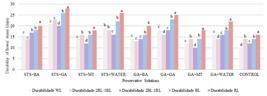
Durability of floral stems (days) of Alstroemeria cv. Pompeii under different LED spectra and preservative solutions. Means followed by the same letter do not differ significantly according to the Scott-Knott test at 5% probability
This effect was consistently observed, as stems maintained under red light preserved a satisfactory visual appearance for a long period, showing minimal signs of wilting, darkening, or premature petal abscission. In contrast, treatments combining blue and red LEDs, particularly the 2BL:1RL ratio, as well as white light resulted in inferior performance, characterized by reduced vase life and a higher incidence of senescence-related symptoms including wilting and petal abscission.
Regarding the preservative solutions, the strongest postharvest responses were observed in floral stems subjected to pulsing with silver thiosulfate (STS) followed by holding in a gibberellic acid (GA-3) solution. This treatment extended vase life up to 10 days relative to the water control and remained consistently effective across all tested light spectra. The pronounced effect of STS is likely associated with its capacity to inhibit ethylene perception, thereby suppressing ethylene-mediated senescence processes and maintaining tissue integrity.
Pulsing with gibberellin also significantly improved postharvest performance, extending vase life by up to 8 days compared with the control. Although slightly less effective than STS, the combination of gibberellin pulsing with GA-3 holding solution represents a promising and more sustainable alternative, as it avoids the environmental and handling concerns associated with silver-based compounds while effectively delaying senescence-related symptoms.
In contrast, melatonin showed limited efficacy as a preservative solution. Its application resulted in a maximum extension of vase life of only two days, even when combined with STS pulsing. When associated with gibberellin pulsing, melatonin exhibited accelerated senescence, characterized by early flower abscission and rapid loss of visual quality, suggesting that, under conditions tested, melatonin does not play a sufficient role in delaying postharvest senescence in Alstroemeria.
Leaf chlorophyll content
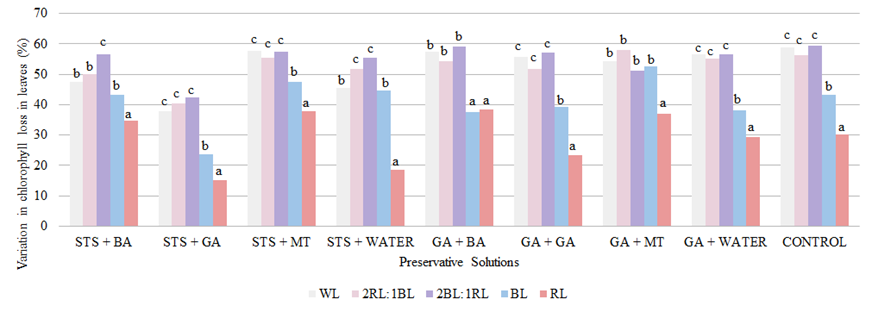
Red light was the most effective treatment for preserving the leaf greenness, maintaining the highest chlorophyll content throughout the experimental period (Fig. 2).

Variation in chlorophyll loss in leaves (%) of Alstroemeria cv. Pompeii under different LED spectra and preservative solutions. Means followed by the same letter do not differ significantly according to the Scott-Knott test at 5% probability
This positive effect was consistently observed across most treatments (solutions), particularly those combined with plant growth regulators. In contrast, leaves exposed to white light or the combined blue-red spectrum (2BL:1RL) exhibited significantly lower chlorophyll levels. Under these conditions, pronounced pigment degradation was evident from the early days of evaluation, indicating that these light spectra were less effective in inhibiting leaf senescence processes.
Pulsing with STS followed by maintenance in a GA3-containing solution was the most effective treatment for chlorophyll preservation, regardless of the light spectra applied. Under this treatment leaves retained a deep green coloration and exhibited significantly lower pigment degradation compared to the other treatments. Solutions based exclusively on GA-3, in which both the pulsing and holding phases involved gibberellin (GA3 + GA3), also performed well, although their effectiveness was slightly lower than that of the STS + GA3treatment.
Treatments containing benzyladenine, particularly the GA3 + BA combination, moderately reduced chlorophyll degradation relative to the control, but were less effective than gibberellin-based treatments. In contrast, stems maintained in melatonin solution and in the control treatment exhibited the highest chlorophyll loss, with leaves showing pronounced yellowing and marked pigment degradation. These negative effects were further accentuated under white light and combined blue-red spectrum (2BL:1RL), indicating a limited capacity of these conditions to suppress leaf senescence.
Total petal color difference
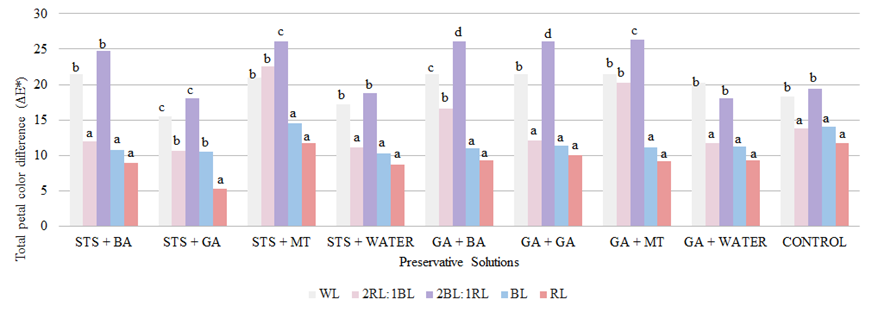
The most effective preservation of petal coloration was observed in floral stems maintained under red light, which exhibited the lowest ΔE* values, indicating minimal deviation from the original petal color throughout the postharvest period (Fig. 3).

Total petal color difference (ΔE*) of Alstroemeria cv. Pompeii under different LED spectra and preservative solutions. Means followed by the same letter do not differ significantly according to the Scott-Knott test at 5% probability
Blue light also promoted satisfactory color retention, although to a lesser extent than red light. In contrast, the combination of blue-red spectrum at a 2BL:1RL ratio resulted in the highest ΔE* values, reflecting pronounced petal color degradation. A similar trend was observed under white light, though with slightly lower ΔE* values than those recorded for the 2BL:1RL treatment.
The STS + GA3 treatment consistently resulted in the lowest ΔE* values across all tested light spectra, demonstrating high effectiveness in preserving petal coloration, particularly when combined with red light. Solutions containing only GA3, used both during pulsing and maintenance phases (GA3+ GA3), as well as its combination with BA, also contributed to relatively low ΔE* values, although these effects were less pronounced than those achieved with STS + GA3 treatment.
Water Relations
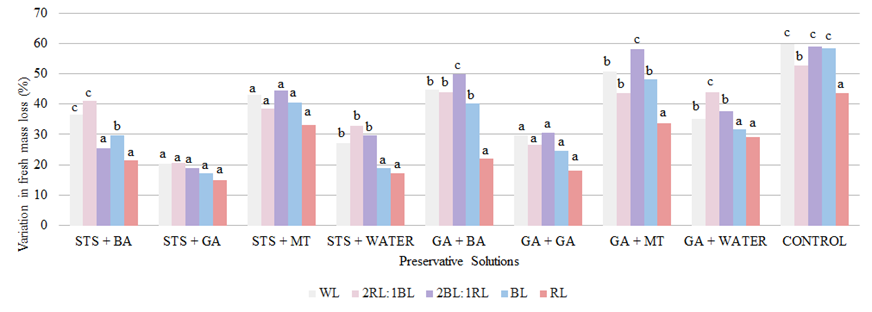
The maintenance of floral stems under red light resulted in lower fresh weight loss (Fig. 4), reduced transpiration rates (Fig. 5), and a more stable and balanced water uptake (Fig. 6) throughout the storage period. Blue light also promoted favorable water relations, although its effects were consistently slightly inferior to those observed under red light.

Variation in fresh mass loss (%) of Alstroemeria cv. Pompeii under different LED spectra and preservative solutions. Means followed by the same letter do not differ significantly according to the Scott-Knott test at 5% probability
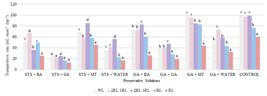
Transpiration rate (mL stem-1 day-1) of Alstroemeria cv. Pompeii under different LED spectra and preservative solutions. Means followed by the same letter do not differ significantly according to the Scott-Knott test at 5% probability

Absorption rate (mL stem-1 day-1) of Alstroemeria cv. Pompeii under different LED spectra and preservative solutions. Means followed by the same letter do not differ significantly according to the Scott-Knott test at 5% probability
In contrast, stems maintained under white light and the 2BL:1RL blue-red light combination exhibited the poorest performance with respect to water relations. These treatments were characterized by pronounced fresh weight loss, elevated transpiration rates, and an imbalance between water uptake and retention, indicating a failure to maintain cellular hydration despite water absorption. Such responses indicate a severe disruption of water homeostasis, commonly associated with compromised membrane integrity and reduced cellular functionality. These physiological impairments were visually evident, as stems displayed pronounced wilting and a significant decline in aesthetic quality over the evaluation period.
The pulsing treatment with STS followed by maintenance in a GA3 solution was consistently superior across all evaluated parameters. Stems subjected to this protocol showed minimal fresh weight loss, moderate transpiration rates, and well-regulated water uptake, resulting in improved turgor maintenance and superior visual quality throughout storage. Similarly, pulsing with GA3 followed by maintenance in GA3 promoted favorable water relations, yielding responses comparable to those observed under the STS + GA3 treatment, indicating an effective regulation of water balance and tissue hydration.
In contrast, the inclusion of melatonin in the preservative solution, irrespective of the pulsing treatment applied, resulted in the most detrimental outcomes for water relations. This treatment led to severe fresh weight loss (Fig. 4), along with the highest transpiration rates and ineffective maintenance of tissue hydration despite high water uptake. A similar pattern was observed in the control treatment, which also showed a rapid decline in hydration capacity, leading to early wilting and substantial deterioration in both visual appeal and structural integrity of the stems.
Discussion
The lamps used in the experiment differed in both power outputs and spectral compositions, enabling an accurate assessment of the effects of light quality on the postharvest preservation of Alstroemeria cv. Pompeii floral stems. Light intensity varied among treatments, ranging from 0.64 μmol m-2 s-1 under blue light to 2.65 μmol m-2 s-1 under white light, while red light exhibited an intermediate intensity of 2.1 μmol m-2 s-1, despite the use of an equal number of lamps across all treatments. Although differences in irradiance may have partially contributed to the observed responses, the superior performance under red light compared with white light, despite its lower PPFD, suggests a substantial contribution of spectral quality to the postharvest responses of Alstroemeria stems.
Traits such as the maintenance of green leaf coloration and extended vase life are critical determinants of postharvest quality in Alstroemeria. Within this context, the light environments evaluated in this study, especially red light, were effective not only in delaying senescence but also in enhancing key visual and physiological attributes of the floral stems. These findings underscore the potential of specific light spectra as a strategic tool to optimize postharvest longevity and quality in floral stems.
The superior performance of red light in extending the vase life of Alstroemeria floral stems appears to result from a complementary interaction between light-mediated signalling pathways and the physiological mechanisms governing water relations and oxidative balance. Red light perception by phytochromes is known to modulate hormonal signalling, particularly gibberellins and ethylene sensitivity, while also influencing stomatal behavior and membrane stability. These regulatory effects contribute to improved cellular homeostasis, delaying senescence-related processes and preserving tissue integrity over time (Bartucca et al., 2020).
In the present study, stems exposed to red light exhibited more efficient water uptake coupled with controlled transpiration, resulting in sustained turgor pressure and improved hydration status. Consequently, the preservation of pigments and cellular structures under red light supports the observed extension of vase life and overall postharvest quality.
The controlled hydration dynamic allowed floral tissues to reach their maximum developmental potential while maintaining structural stability and longevity. In contrast, stems maintained under white light displayed less coordinated water uptake and higher transpiration rates, leading to reduced turgor maintenance, limited flower expansion, and accelerated senescence.
Collectively, these findings highlight the important role of red light in the postharvest physiological responses by integrating light perception, hormonal regulation, water balance, and oxidative stress control.
Red light was also significantly more effective in maintaining chlorophyll content, a crucial factor for the visual and commercial quality of Alstroemeria stems. This effect is directly related to the activation of phytochromes by red light, which in turn represses the activity of transcriptional regulators involved in chlorophyll degradation and ethylene biosynthesis (Song et al., 2020). The inhibition of these senescence-associated pathways under red light explains the reduced pigment breakdown and the consequent delay in leaf yellowing.
Similarly, the lowest ΔE* values recorded under red light confirm its effectiveness in preserving petal coloration. This effect can be attributed not only to the protection of pigments such as anthocyanins and carotenoids but also to the mitigation of oxidative stress, which often triggers pigment degradation reactions (Hosseini et al., 2025).
Although less effective than red light, blue light also contributed positively to petal color preservation. This response may be explained by the fact that blue light, like ultraviolet light, directly influences the biosynthesis of anthocyanins, pigments responsible for reddish, purplish, and bluish tones in petals. Exposure of flowers to this light spectrum stimulates the expression of genes related to the flavonoid pathway, especially those associated with anthocyanin production, thereby promoting not only color preservation but, in some cases, even color enhancement (Horibe, 2020).
Regarding the water relations of the stems, those maintained under red light exhibited lower fresh weight loss, reduced transpiration rates, and more stable water uptake. This indicates that stems exposed to red light were better able to maintain turgor and, consequently, preserve their aesthetic and commercial quality for a longer period. Blue light also showed beneficial effects, although to a lesser extent, supporting its role in sustaining physiological mechanisms associated with water balance.
The interaction between LED spectra and preservative solutions suggests that both factors contributed in a complementary manner to the postharvest preservation of Alstroemeria stems. Treatments involving STS + GA3 exhibited superior performance particularly under red light, indicating a possible additive effect between hormonal regulation and light-mediated physiological responses. Similarly, treatments based on GA3 also showed favorable responses under red light, especially regarding vase life, chlorophyll preservation, and water balance. Although no clear synergistic interaction was statistically demonstrated, the combined application of red light and preservative solutions based on STS or GA3 resulted in the best overall postharvest performance.
In contrast, stems maintained under white light and the 2BL:1RL spectrum exhibited reduced preservation efficiency, characterized by shorter vase life, accelerated chlorophyll degradation, severe wilting, and premature petal abscission. These results suggest that such light conditions were less effective in suppressing senescence-related processes and maintaining tissue hydration throughout storage.
This lower efficiency may be directly related to the lack of spectral specificity of white light. Similarly, although the 2BL:1RL treatment combined blue and red wavelengths, the proportion used appears insufficient to effectively trigger the physiological processes typically associated with these wavelengths when used independently. As a result, both spectra were the least effective in preserving postharvest quality, as evidenced by intensified senescence, pigment degradation, and accelerated loss of turgor.
Regarding preservative solutions, the treatment involving STS pulsing followed by a GA3-containing maintenance solution proved to be the most effective in preserving the postharvest quality of Alstroemeria cv. Pompeii stems, confirming previous findings for this species (Ponce et al., 2024). However, despite its high efficacy, the use of STS has been increasingly questioned due to its high toxicity and associated environmental risks, primarily related to silver residue accumulation in plant tissues and the environment (Liu et al., 2018). In contrast, the use of GA3, either during pulsing or in the maintenance solution, showed highly satisfactory results, promoting hydration preservation, delaying senescence, maintaining visual quality, and reducing leaf yellowing, in addition to protecting pigment content. These results support the proposal that replacing STS with gibberellin for the pulsing stage represents a highly promising, effective, and environmentally safe alternative, since GA3 is a non-toxic, biodegradable compound that does not leave harmful residues (Guo et al., 2025).
The underperformance of melatonin was contrary to expectations, considering that this compound is widely recognized for enhancing antioxidant enzyme activity and delaying senescence in various plant species (Yan et al., 2023). This result suggests a limited physiological response of Alstroemeria to melatonin application under the experimental conditions used. The effectiveness of this product appears to be strongly dependent on factors such as species, applied concentration, and interaction with other plant hormones. In the case of Alstroemeria, its isolated application was likely insufficient to efficiently provide a satisfactory postharvest preservation of the flowers.
Most experiments are typically conducted under white light or in uncontrolled environmental conditions, overlooking the significant influence that different light spectra may have on flower physiology. In this context, the use of LED lighting with specific wavelengths such as red light emerges as an innovative and highly promising strategy, capable of triggering beneficial physiological responses through the selective activation of photoreceptors associated with water regulation, pigment maintenance, and senescence delay (Horibe, 2020).
The results consistently demonstrate that light spectrum plays an important role in postharvest preservation. Although differences in light intensity were observed among treatments, the superior responses obtained under red light suggest that spectral quality substantially contributed to the observed physiological effects. The effectiveness of red light in delaying chlorophyll degradation, preserving floral pigments, maintaining water balance, and extending stem longevity shows that spectrum control in the postharvest environment is a viable, efficient, and sustainable tool for prolonging the shelf life of Alstroemeria cv. Pompeii.
This approach represents a significant advancement over conventional practices, offering a non-chemical, easy-to-implement, and environmentally safe alternative that can be applied not only at the retail level but also during transport, storage, and display stages. Furthermore, the adoption of this technology reduces reliance on chemical inputs, addressing the growing demand for more sustainable, efficient, and environmentally responsible production chains, in line with both national and international market standards.
Conclusions
The postharvest quality of Alstroemeria cv. Pompeii floral stems was significantly improved by exposure to red or blue LED light, which enhanced hydration maintenance, preserved petal coloration, and delayed leaf yellowing, demonstrating their effectiveness as alternatives to conventional white light. Among the preservative solutions, gibberellin (GA3) pulsing provides substantial improvements in stem longevity, chlorophyll retention, and water balance, achieving performance comparable to that of silver thiosulfate (STS). Given its residue-free nature and lower environmental risk, the combined use of specific LED spectra, particularly red light, and GA3 pulsing represents a safe and sustainable strategy for postharvest management of Alstroemeria cv. Pompeii. However, the successful commercial implementation of this technology will depend on the adequate standardization of LED distance and PPFD conditions to minimize irradiance variability and ensure consistent postharvest responses.
Acknowledgments
The authors would like to thank the Reijers Group for providing the Alstroemeria flower stems used in this research, the Coordination for the Improvement of Higher Education Personnel (CAPES) for the scholarship that made this project possible, to National Council for Scientific and Technological Development (CNPq) for the grant provided, and the Federal University of Lavras (UFLA) for the technical support, physical and laboratory structure made available for the development of the work.
References
-
AALIFAR, M.; ALINIAEIFARD, S.; ARAB, M.; ZARE, M.; DIANATI, S.; SEREK, M.; WOLTERING, E.; LI, T. Blue light improves vase life of carnation cut flowers through its effect on the antioxidant defense system. Frontiers in Plant Science, v.11, 511, 2020. https://doi.org/10.3389/fpls.2020.00511
» https://doi.org/https://doi.org/10.3389/fpls.2020.00511 -
ALINIAEIFARD, S.; FALAHI, Z.; DIANATI, S.; LI, T.; WOLTERING, E. Postharvest spectral light composition affects chilling injury in anthurium cut flowers. Frontiers in Plant Science , v.11, 846, 2020. https://doi.org/10.3389/fpls.2020.00846
» https://doi.org/https://doi.org/10.3389/fpls.2020.00846 -
AMIN, M.; NADERI, R.; SEDAGHATHOOR, S.; KALATEHJARI, S. Pre and post-harvest effect of gibberellic acid and salicylic acid on cut branches of Asparagus umbellatus Ornamental Horticulture, v.28, p.323-331, 2022. https://doi.org/10.1590/2447-536X.v28i3.2467
» https://doi.org/https://doi.org/10.1590/2447-536X.v28i3.2467 -
BARTUCCA, M.; GUIDUCCI, M.; FALCINELLI, B.; DEL BUONO, D.; BENINCASA, P. Blue:Red LED light proportion affects vegetative parameters, pigment content, and oxidative status of einkorn (Triticum monococcum L. ssp. monococcum) wheatgrass. Journal of Agriculture and Food Chemistry, v.68, n.33, p.8757-8763, 2020. https://doi.org/10.1021/acs.jafc.0c03851
» https://doi.org/https://doi.org/10.1021/acs.jafc.0c03851 -
COSTA, L.; ARAUJO, F.; RIBEIRO, W.; SANTOS, M.; FINGER, F. Postharvest physiology of cut flowers. Ornamental Horticulture , v.27, n.3, p.374-385, 2021. https://doi.org/10.1590/2447-536X.v27i3.2372
» https://doi.org/https://doi.org/10.1590/2447-536X.v27i3.2372 -
EVELYN, S.; FARRELL, A.; ELIBOX, W.; ABREU, K.; UMAHARAN, P. The impact of light on vase life in Anthurium andraeanum Hort. cut flowers. Postharvest Biology and Technology, v.159, 110984, 2020. https://doi.org/10.1016/j.postharvbio.2019.110984
» https://doi.org/https://doi.org/10.1016/j.postharvbio.2019.110984 -
FERREIRA, D. Sisvar: a computer analysis system to fixed effects split plot type designs. Brazilian Journal of Biometrics, v.37, n.4, p.529-535, 2019. https://doi.org/10.28951/rbb.v37i4.450
» https://doi.org/https://doi.org/10.28951/rbb.v37i4.450 -
GAMA, A.; PAIVA, P.; BRITO, O.; COSTA, A.; SILVA, D.; PAIVA, R. Role of preservative solutions on physiological mechanisms for delaying leaf yellowing in Alstroemeria flowers. Ciencia e Agrotecnologia, v.49, e023024, 2025. https://doi.org/10.1590/1413-7054202549023024
» https://doi.org/https://doi.org/10.1590/1413-7054202549023024 -
GUO, M.; PAN, R.; GAI, W.; YANG, J.; LIANG, M. Melatonin and gibberellin synergistically enhance postharvest quality and extend shelf life of peach. Journal of Food Composition Analysis, v.142, 107460, 2025. https://doi.org/10.1016/j.jfca.2025.107460
» https://doi.org/https://doi.org/10.1016/j.jfca.2025.107460 -
HA, S.; IN, B.; LIM, J. LED light improves postharvest quality and longevity of cut rose flowers ‘Lovely Lydia’. Acta Horticulturae, n.1291, p.261-268, 2020. https://doi.org/10.17660/ActaHortic.2020.1291.31
» https://doi.org/https://doi.org/10.17660/ActaHortic.2020.1291.31 -
HADAPAD, P.S.; NAIK, B.H.; CHANDRASHEKAR, S.Y.; KANTHARAJ Y.; KUMAR, P.H. Effect of vase chemicals at different concentration on longevity of Alstroemeria cut flower. International Journal of Advanced Biochemistry Research, v.8, n.10, p.1421-1426, 2024. https://doi.org/10.33545/26174693.2024.v8.i10Sq.2736
» https://doi.org/https://doi.org/10.33545/26174693.2024.v8.i10Sq.2736 -
HORIBE, T. Use of light stimuli as a postharvest technology for cut flowers. Frontiers in Plant Science , v.11, 573490, 2020. https://doi.org/10.3389/fpls.2020.573490
» https://doi.org/https://doi.org/10.3389/fpls.2020.573490 -
HOSSEINI, N.; JABBARZADEH, Z.; AMIRI, J. Eco-friendly extension of postharvest longevity in Alstroemeria cut flowers using melatonin and putrescine treatments. Heliyon 11(3), e42343, 2025. https://doi.org/10.1016/j.heliyon.2025.e42343
» https://doi.org/https://doi.org/10.1016/j.heliyon.2025.e42343 -
LIU, J.; ZHANG, Z.; LI, H.; LIN, X.; LIN, S.; JOYCE, D.; HE, S. Alleviation of effects of exogenous ethylene on cut ‘Master’ carnation flowers with nano-silver and silver thiosulfate. Postharvest Biology and Technology , v.143, p.86-91, 2018. https://doi.org/10.1016/j.postharvbio.2018.04.017
» https://doi.org/https://doi.org/10.1016/j.postharvbio.2018.04.017 -
MATTOS, D.G; PAIVA, P.D.O.; SILVA, D.P.C.; REIS, M.V.; NETO, A.R.C.; PAIVA, R. Precooling and cold storage effects on antioxidant system in calla lily postharvest. Ciencia e Agrotecnologia , v.47, e018022, 2023. https://doi.org/10.1590/1413-7054202347018022
» https://doi.org/https://doi.org/10.1590/1413-7054202347018022 -
MAZROU, R.M.; HASSAN, S.; YANG, M.; HASSAN, F. Melatonin preserves the postharvest quality of cut roses through enhancing the antioxidant system. Plants, v.11, n.20, p.2713, 2022. https://doi.org/10.3390/plants11202713
» https://doi.org/https://doi.org/10.3390/plants11202713 -
MELGOSA, M. Testing CIELAB based color difference formulas. Color Research & Application, v. 25, n.1, p.49-55, 2000. https://doi.org/10.1002/(SICI)1520-6378(200002)25:1<49::AID-COL7>3.0.CO;2-4
» https://doi.org/https://doi.org/10.1002/(SICI)1520-6378(200002)25:1<49::AID-COL7>3.0.CO;2-4 -
MOHAMMADI, M.; EGHLIMA, G.; RANJBAR, M. Ascorbic acid reduces chilling injury in anthurium cut flowers during cold storage by increasing salicylic acid biosynthesis. Postharvest Biology and Technology , v.201, 112359, 2023. https://doi.org/10.1016/j.postharvbio.2023.112359
» https://doi.org/https://doi.org/10.1016/j.postharvbio.2023.112359 -
OLIVEIRA, C.P.; PAIVA, P.D.O.; NETO, A.R.C.; NASCIMENTO, S.S.; PONCE, M.M.; SILVA, D.P.C.; REIS, M.V. Control of leaf yellowing and postharvest longevity of Alstroemeria in different preservative solutions. Ornamental Horticulture , v.30, e242753, 2024. https://doi.org/10.1590/2447-536X.v30.e242753
» https://doi.org/https://doi.org/10.1590/2447-536X.v30.e242753 -
PAIVA, P.D.O.; BERUTO, M.I.; PAIVA, R.; VERDONK, J.C. Editorial: Quality of ornamental crops: effect of genotype, preharvest, and improved production chains on quality attributes of ornamental crops, volume II. Frontiers in Plant Science , v.15, 1449585, 2024. https://doi.org/10.3389/fpls.2024.1449585
» https://doi.org/https://doi.org/10.3389/fpls.2024.1449585 -
PERERA, W.; NAVARATNE, S.; WICKRAMASINGHE, I. Impact of spectral composition of light from light-emitting diodes (LEDs) on postharvest quality of vegetables: A review. Postharvest Biology and Technology , v.191, 111955, 2022. https://doi.org/10.1016/j.postharvbio.2022.111955
» https://doi.org/https://doi.org/10.1016/j.postharvbio.2022.111955 -
PINTOS, F.; NICO, A.; RODONI, L.; CIEZA, R., HASPERUÉ, J. Postharvest illumination of Alstroemeria: Effect of light quality on flower metabolism and shelf life. Postharvest Biology and Technology , v.201, 112346, 2023. https://doi.org/10.1016/j.postharvbio.2023.112346
» https://doi.org/https://doi.org/10.1016/j.postharvbio.2023.112346 -
PONCE, M.M.; SILVA, C.M.; PAIVA, P.D.O.; SILVA, D.P.C. Leaf yellowing control and physiological responses of Alstroemeria under postharvest solutions with growth regulators and silver thiosulfate. Journal of Plant Growth Regulators, p.1-13, 2024. https://doi.org/10.1007/s00344-024-11603-5
» https://doi.org/https://doi.org/10.1007/s00344-024-11603-5 -
SADEGHI, S.; JABBARZADEH, Z. The effect of pre- and post-harvest sodium nitroprusside treatments on the physiological changes of cut Alstroemeria aurea ‘Orange Queen’ during vase life. BMC Plant Biology, v.24, n.1, p.678, 2024. https://doi.org/10.1186/s12870-024-05393-x
» https://doi.org/https://doi.org/10.1186/s12870-024-05393-x -
SALES, T.S.; PAIVA, P.D.O.; MANFREDINI, G.M.; NASCIMENTO, A.M.P.; REIS, M.V. Water relations in cut calla lily flowers maintained under different postharvest solutions. Ornamental Horticulture , v.27, p.126-136, 2021. https://doi.org/10.1590/2447-536X.v27i2.2235
» https://doi.org/https://doi.org/10.1590/2447-536X.v27i2.2235 -
SHARMA, P.; THAKUR, N. Effect of pulsing and storage methods for extending vase life of cut flowers. International Journal of Chemical. Studies, v.8, n.6, p.1320-1328, 2020. https://doi.org/10.22271/chemi.2020.v8.i6s.10943
» https://doi.org/https://doi.org/10.22271/chemi.2020.v8.i6s.10943 -
SONG, Y.; QIU, K.; GAO, J.; KUAI, B. Molecular and physiological analyses of the effects of red and blue LED light irradiation on postharvest senescence of pak choi. Postharvest Biology and Technology , v.164, 111155, 2020. https://doi.org/10.1016/j.postharvbio.2020.111155
» https://doi.org/https://doi.org/10.1016/j.postharvbio.2020.111155 -
YAN, D.; WANG, J.; LU, Z.; LIU, R.; HONG, Y.; SU, B.; WANG, Y.; PENG, Z.; YU, C.; GAO, Y.; LIU, Z.; XU, Z.; DUAN, L.; LI, R. Melatonin-mediated enhancement of photosynthetic capacity and photoprotection improves salt tolerance in wheat. Plants , v.12, n.23, 3984, 2023. https://doi.org/10.3390/plants12233984
» https://doi.org/https://doi.org/10.3390/plants12233984 -
VERDONK, J.C.; FERRANTE, A.; BERUTO, M.I.; BATT, P.; PAIVA, R.; SCHOUTEN, R.E.; PAIVA, P.D.O. Editorial: Quality of ornamental crops: effect of genotype, preharvest, and improved production chains on quality attributes of ornamental crops. Frontiers in Plant Science , v.13, 918864, 2022. https://doi.org/10.3389/fpls.2022.918864
» https://doi.org/https://doi.org/10.3389/fpls.2022.918864 -
ZHANG, L.; SHI, X.; HOU, H.; LIN, Q.; ZHU, S.; WANG, G. 6-Benzyladenine treatment maintains storage quality of Chinese flowering cabbage by inhibiting chlorophyll degradation and enhancing antioxidant capacity. Plants , v.12, n.2, 334, 2023. https://doi.org/10.3390/plants12020334
» https://doi.org/https://doi.org/10.3390/plants12020334
All the research data is contained in the manuscript.