A new genus and species of the ghost-shrimp family Callianideidae from the Caribbean coast of Panama (Decapoda: Axiidea)
Abstract
A peculiar new species of ghost-shrimp from Bocas del Toro Archipelago on the Caribbean coast of Panama is assigned to the genus Trichocallia gen. nov. in the family Callianideidae. The holotype and presently the only known specimen of Trichocallia delicatula sp. nov. was collected with a suction pump on a silty-muddy bottom under a network of decomposing and partly overgrown mangrove roots. The new genus appears to be most closely related to Callianidea H. Milne Edwards, 1837, with two species in the Indo-West Pacific, and Paracallianidea Sakai, 1992, with two species, one in the western Atlantic and one in the eastern Pacific.
Keywords
Malacostraca; Decapod crustacean; New taxon; Caribbean Sea; West Atlantic; Marine biodiversity
INTRODUCTION
The small ghost shrimp family Callianideidae presently includes six genera: (1) Callianidea H. Milne Edwards, 1837, with the type species C. typa H. Milne Edwards, 1837 [recent synonym: C. ryukyu Sakai, 2011; for older synonymy see Sakai (2011)], and C. madagascariensis Sakai, 2011 [= Callianidea sp. of Poore (1997)], both from the Indo-West Pacific; (2) Paracallianidea Sakai, 1992, with two species, the type species P. laevicauda (Gill, 1859) in the western Atlantic, and P. occidentalis (Schmitt, 1939) in the eastern Pacific; (3) the monotypic Mictaxius Kensley & Heard, 1991, with M. thalassicola Kensley & Heard, 1991 from the western Atlantic; (4) Heardaxius Sakai, 2011, with the type species H. salvati (Ngoc-Ho, 2005) and H. rogerbamberi Poore, 2015, both from the Indo-West Pacific; (5) Thomassinia de Saint-Laurent, 1979, with four species, the type species T. gebioides de Saint-Laurent, 1979, T. aimsae Poore, 1997, T. moorea Poore, 1997 and T. sachikoae (Sakai, 2017) [= Garyia sachikoae Sakai, 2017], all from the Indo-West Pacific; and (6) Crosniera Kensley & Heard, 1991, with the type species C. minima (Rathbun, 1901) and C. wennerae Heard & King, 2007 in the western Atlantic, and C. corindon Poore, 1997, C. panie Poore, 1997 and C. dayrati Ngoc-Ho, 2005 in the Indo-West Pacific (de Saint-Laurent, 1979; Kensley & Heard, 1991; Sakai, 1992, 2011, 2017; Poore, 1997, 2015; Ngoc-Ho, 2005; Poore & Collins, 2015). In addition, an eastern Pacific taxon described as Callianidea mariamartae Hernáez & Vargas, 2013 from Costa Rica (Hernáez & Vargas, 2013) appears to be a junior synonym of P. occidentalis (Poore, 2015). Two species originally described under the generic name Callianidea were later transferred to Michelea Kensley & Heard, 1991 (now in Micheleidae), which includes two species in the western Atlantic and several more in the Indo-West Pacific (Kensley & Heard, 1991; Poore & Collins, 2015).
In 2015, during sampling of decapod crustaceans (with focus on infaunal alpheid shrimps) in Bocas del Toro, Panama, the author collected a peculiar specimen with all diagnostic characters of the family Callianideidae (sensu Poore, 2015), using a metallic suction (yabby) pump in very shallow water (less than 1 m). In 2024, this specimen was examined and compared with material of Callianidea (C. typa) and Paracallianidea (P. laevicauda, P. occidentalis). Material of Heardaxius (H. rogerbamberi) and Mictaxius (M. thalassicola) was also briefly examined, as well as diagnoses and illustrations of the remaining two callianidean genera Thomassinia and Crosniera (de Saint-Laurent, 1979; Poore, 1997, 2015). The author concluded that the specimen from Bocas del Toro represents a hitherto undescribed lineage of the Callianideidae, presumably closely related to Callianidea and Paracallianidea. In the present study, a new callianideid genus is proposed for the below described new species from Bocas del Toro.
MATERIAL AND METHODS
The holotype of the new species is deposited in the collection of Museu de Zoologia, Universidade de São Paulo, São Paulo, Brazil (MZUSP). Comparative material (see below) is deposited in MZUSP, Muséum National d’Histoire Naturelle, Paris, France (MNHN), and Florida Museum of Natural History, University of Florida, Gainesville, FL, USA (FLMNH UF). Carapace length (cl, in mm) was measured from the tip of the rostral projection to the posterior margin of the carapace.
Comparative material: [1] Callianidea typa H. Milne Edwards, 1837: 2 males (cl 12.7 mm, 11.9 mm), 1 ovigerous female (cl 9.3 mm), MZUSP 33154, 33156, 33155, respectively, Oman, near Muscat, Darsayt, 23°38′04.2″N/58°32′51.8″E, shallow subtidal flat with large rocks, depth: 1 m, in fine sand deep under large boulders, hand/dip net, leg. A. Anker, 24.08.2010. [2] Paracallianidea laevicauda (Gill, 1859): 1 male (cl 10.4 mm), MZUSP 28341, Brazil, Pernambuco, Projeto Algas, sta. 17A, other details and collector unknown, 07.05.1986. [3] Paracallianidea occidentalis (Schmitt, 1939): 1 female (cl 8.4 mm), MNHN-IU-2019-3219, Panama, Pacific coast, Taboga Island, depth: less than 1.5 m at low tide, deep in fine sand under large boulder, leg. A. Anker, 17.07.2008 (photographic voucher AA-18-019). [4] Heardaxius rogerbamberi Poore, 2015: holotype, ovigerous hermaphrodite (cl 4.2 mm), MNHN-IU-2013-7093, Papua New Guinea, Madang Lagoon, Rempi, PAPUA NIUGINI sta. PR81, 05°01.6′S/145°47.9′E, depth: 2-15 m, subtidal sandflat with some seagrass, rocks and corals, under large rocks in sand (hand net) and in burrows (suction pump), leg. A. Anker et al, 22.11.2012 (photographic voucher MNHN-IU-2013-7093). [5] Mictaxius thalassicola Kensley & Heard, 1991: 1 female (cl 6.2 mm), FLMNH UF 31992, Saint Martin, Le Galion, bay side, 18°04′40.8″N 63°00′54.0″W, seagrass lagoon, depth: less than 2 m, suction pump, leg. A. Anker & J.-P. Maréchal, 14.04.2012 (photographic voucher BSTM-0511).
Taxonomy
Family Callianideidae H. Milne Edwards, 1837 Genus Trichocallia gen. nov.
Diagnosis: Gonochoristic. Rostrum triangular. Linea thalassinica distinct in anterior fourth of carapace. Seventh thoracic sternite with narrow anterior part between coxae of fourth pereiopods. First pleomere with domed anterior part. Eyestalks flattened, contiguous, truncate anteriorly; cornea dorsal, normally pigmented. Antennal scaphocerite small, articulating. Third maxilliped exopod overreaching distal margin of ischium, with minutely toothed crista dentata. First pereiopods (chelipeds) dissimilar, minor cheliped slender, cylindriform. Third pereiopod propodus distinctly longer than broad, with distoventral spiniform seta and dense rows of setae on ventrolateral surface. Fourth pereiopod propodus with distoventral spiniform seta and dense rows of setae on ventrolateral surface. Fifth pereiopod not distinctly sub-chelate, pollex with small distal protuberance and dense row of setae on distolateral surface. Setal rows on anterolateral surface of carapace and third to fifth pleomeres. Male first pleopod with two articles, distal article without appendix interna. Male second pleopod with small digitiform appendix interna, apparently without appendix masculina (but see below). Rami of second to fifth pleopods with tubular, hair-like, mostly branching and segmented marginal filaments. Uropodal endopod without transverse row of short spiniform setae; exopod ovate, without dorsal plate.
Type species:Trichocallia delicatulasp. nov. (Figs. 1 2 3 4 5), by monotypy and present designation.
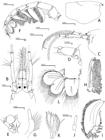
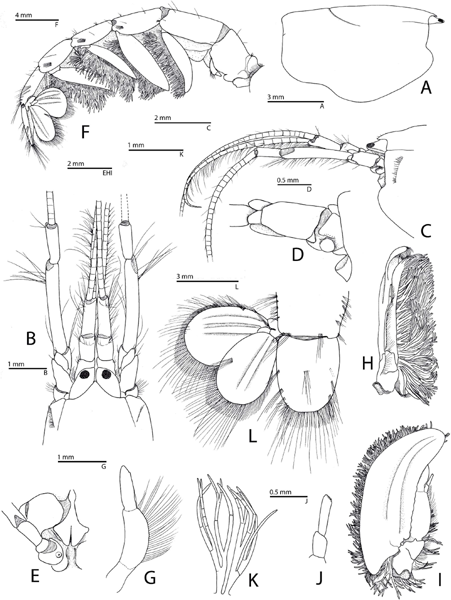
Trichocallia delicatulagen. et sp. nov., holotype, male (cl 8.3 mm) from Bocas del Toro, Panama (MZUSP 34100): (A) carapace, lateral (setae omitted); (B) frontal region, dorsal; (C) same, lateral; (D) base of antennal peduncle, lateral; (E) sternum between coxae of fourth pereiopods and base of right fifth pereiopod, ventral; (F) pleon and tail fan, ventrolateral; (G) left first pleopod, mesial; (H) left second pereiopod, mesial; (I) same, anterior (lateral); (J) same, detail of appendix interna, anterior (lateral); (K) same, two branching gill filaments, mesial; (L) telson and left uropod, dorsal.
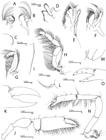
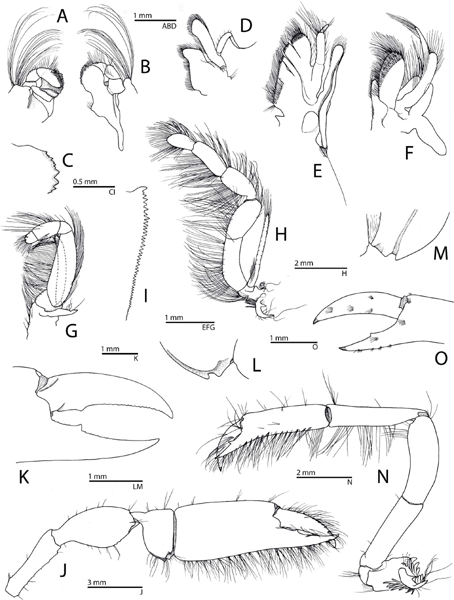
Trichocallia delicatulagen. et sp. nov., holotype, male (cl 8.3 mm) from Bocas del Toro, Panama (MZUSP 34100): (A) mandible and adjacent setose lobe, mesial; (B) same, lateral; (C) same, detail of distal margin of incisor process, lateral; (D) maxillule, lateral; (E) maxilla, lateral; (F) first maxilliped, lateral; (G) second maxilliped, lateral; (H) third maxilliped, lateral; (I) same, detail of crista dentata, mesial; (J) major (right) cheliped, lateral; (K) same, chela fingers (setae omitted); L, M, same, detail of ventral margin of carpus, lateral and mesial, respectively; (N) minor (left) cheliped, lateral; (O) same, chela fingers (position of main setal tufts indicated).
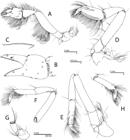
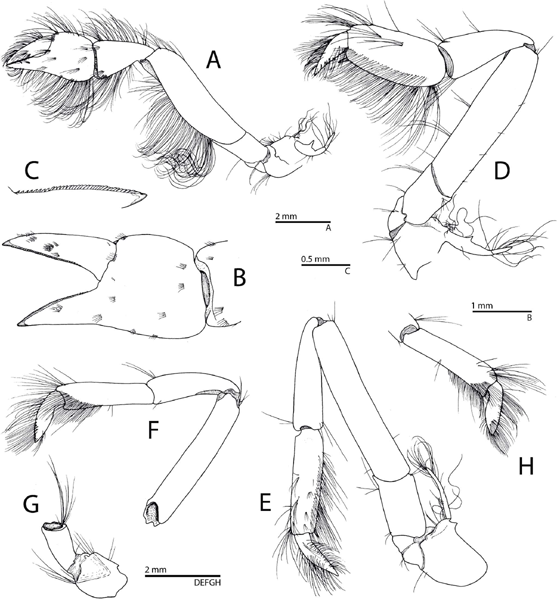
Trichocallia delicatulagen. et sp. nov., holotype, male (cl 8.3 mm) from Bocas del Toro, Panama (MZUSP 34100): (A) second pereiopod, lateral; (B) same, chela (position of main setal rows indicated); (C) same, detail cutting edge of pollex, mesial; (D) third pereiopod, lateral; (E) fourth pereiopod, lateral; (F) fifth pereiopod, lateral; (G) same, basal articles, lateral; (H) same, propodus and dactylus, mesial.
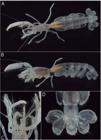
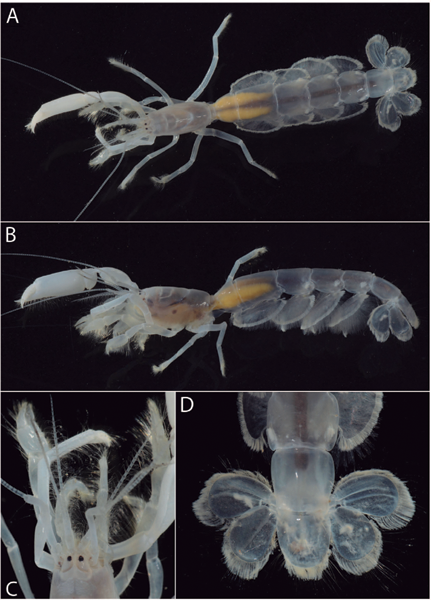
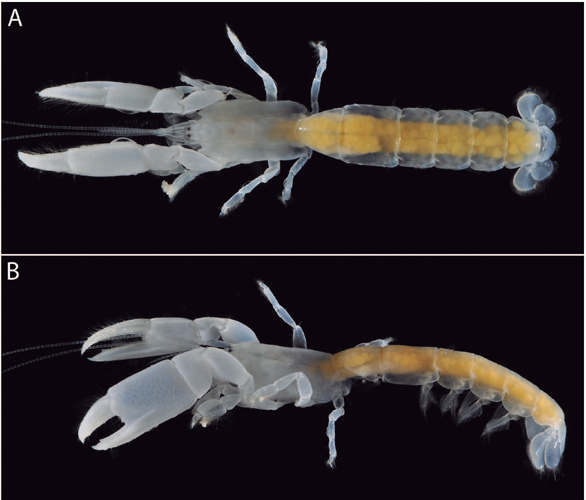
Trichocallia delicatulagen. et sp. nov., holotype, male (cl 8.3 mm) from Bocas del Toro, Panama (MZUSP 34100): (A) habitus alive, dorsal; (B) same, lateral; (C) frontal region and anterior appendages, dorsal; (D) posterior pleon and tail fan, dorsal. Photographs by the author.
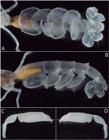
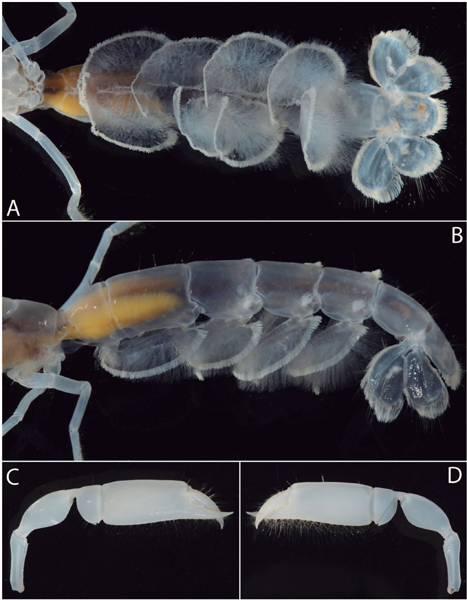
Trichocallia delicatulagen. et sp. nov., holotype, male (cl 8.3 mm) from Bocas del Toro, Panama (MZUSP 34100): (A) pleon and tail fan, ventral; (B) same, lateral; C, D, major (right) cheliped, lateral and mesial, respectively. Photographs by the author.
Distribution: Western Atlantic.
Etymology: The generic name is a combination of tricho (from Greek trichos, for hair, referring to hair-like filaments on the pleopods) and callia (first six letters of the family name, Callianideidae, being also a Greek word for beautiful); gender feminine.
Remarks: The above diagnosis of Trichocallia gen. nov. closely adheres to that of Callianidea provided by Poore (2015), except for the following details: (1) the rostrum is rather well developed and triangular, not “obsolete” or “barely developed”, as in Callianidea; (2) the linea thalassinica is present in the first quarter or so of the carapace, not absent as in Callianidea; (3) the eyes are normally pigmented, black, not poorly pigmented, as in Callianidea; (4) the propodus of the third pereiopod is noticeably more elongate, 2.4 times as long as wide, not “about as long as broad” as in Callianidea; and (5) the fifth pereiopod is not distinctly subchelate, with the distal margin of the propodus only slightly bulging (cf. Figs. 1 2 3 4 5; Sakai, 1992; Poore, 1997, 2015).
The two genera also seem to differ in the pattern of setal rows on the pleon (cf. Figs. 1F, 5B, 6B), although the accounts of C. typa in Kensley & Heard (1991), Sakai (1992) and Poore (1997), as well as the diagnosis in Poore (2015) provide somewhat contradictory information on this matter. According to Kensley & Heard’s (1991: fig. 2A) diagram of Callianidea (+ Paracallianidea), setal rows are present on all pleomeres: one oblique row on the first pleomere, one transverse row on each second to fifth pleomere, and three oblique rows on the sixth pleomere. In Trichocallia gen. nov., the oblique row on the first pleomere and the transverse row on the second pleomere are lacking (Figs. 1F, 5B). Another important difference between the type species of Trichocallia gen. nov. and C. typa lies in the much higher number of teeth in the cristata dentata of the third maxilliped ischium (> 40 vs. 19-26 in C. typa; cf. Fig. 2I; Sakai, 1992: fig. 4G; Poore, 1997: fig. 3I). On the other hand, no significant differences between Trichocallia gen. nov. and Callianidea and were detected in the remaining mouthparts (cf. Fig. 2A-G; Sakai, 1992: fig. 4A-E; Poore, 1997: fig. 3C-H).
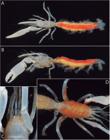
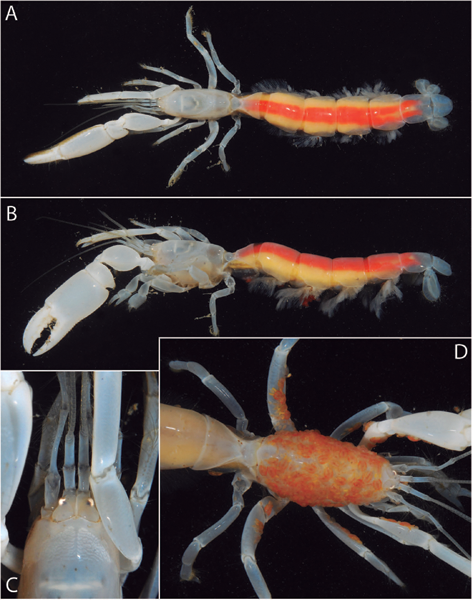
Callianidea typaH. Milne Edwards, 1837, ovigerous female (cl 9.3 mm) [A-C] and male (cl 11.9 mm) [D] from Darsayt, Oman (MZUSP 33155, 33156); (A) habitus alive, dorsal; (B) same, lateral; (C) frontal region and anterior appendages, dorsal; D. anterior part of body covered by symbiotic copepods (possibly Clausidium persiaensisSepahvand, Rastegar-Pouyani, Kihara & Momtazi, 2017). Photographs by the author.
Although the numerous, tubular, hair-like, mostly branching and segmented filaments on the rami of the second to fifth pleopods (Fig. 5A, B) are an important diagnostic character of Trichocallia gen. nov., they may also be present, albeit in less extreme form, in Callianidea. For instance, Poore (1997: fig. 1A, F) illustrated similarly tubular and branching filaments on the pleopods of a male specimen of C. typa from Djibouti. Sakai’s (1992: fig. 5F, H) illustrations of the Okinawa material of C. typa show only some filaments as narrowly tubular (hair-like), whereas others are relatively thick, especially at their base. A combination of narrowly tubular and thicker filaments can also be seen in the herein examined specimens from Oman (both types visible in Fig. 6B). In addition, it must be noted that in C. madagascariensis, the pleopodal filaments are simple and not branching as in C. typa (Poore, 1997, 2015).
Sakai (1992) separated Paracallianidea from Callianidea based on “the differences in pleopods 1-2, the appendix interna of the male pleopod 2, the pleopodal respiratory filaments, the linea thalassinica, and the spinulation of maxilliped 3”. In fact, Paracallianidea can be separated from Callianidea based on two characters, both involving the first and second pleopods of males (Poore, 2015). The tubular pleopodal filaments of the two known species of Paracallianidea, viz. P. laevicauda and P. occidentalis, are not branching (Kensley & Heard, 1991: fig. 4I); however, this is also the case of C. madagascariensis (Poore, 1997, 2015). The presence of a short linea thalassinica in Paracallianidea (vs. its absence in Callianidea) was considered as “trivial” by Poore (2015), whereas the presence of a small ventral tooth on the third maxilliped merus is shared by P. laevicauda, P. occidentalis and, again, C. madagascariensis (Poore, 1997, 2015). Kensley & Heard (1991) did not see the necessity for placing P. laevicauda (reported under Callianidea) in a separate genus, an opinion also shared by Poore (1997). Nevertheless, Poore (2015) and Poore & Ahyong (2023) recognised Paracallianidea, including it in their key to the genera of the Callianideidae. Trichocallia gen. nov. can be separated from Paracallianidea by (1) the more numerous, complexly branching pleopodal filaments vs. less numerous and not branching in Paracallianidea; (2) the dorsally situated cornea, which is in lateral position in Paracallianidea; (3) the third maxilliped merus ventrally unarmed vs. armed with a subdistal tooth in Paracallianidea; (4) the much weaker major chela, also with each finger armed with only one small tooth vs. with two teeth on each finger in Paracallianidea; (5) the minor chela with strongly unequal fingers vs. with fingers equal in length in Paracallianidea; (6) the simple male first pleopod, without discernible appendix interna vs. with appendix interna in the form of mesial row of hooks on a subtriangular second article in Paracallianidea; and (7) the male second pleopod with appendices interna and masculina fused or the latter perhaps absent (see below) vs. separated in Paracallianidea (cf. Fig. Kensley & Heard, 1991: figs. 3, 4). In addition, as already mentioned above, in the type species of Trichocallia gen. nov., the crista dentata of the third maxilliped ischium is composed of more than 40 minute teeth. Neither Schmitt (1939) nor Kensley & Heard (1991) provided a description of the crista dentata in P. occidentalis and P. laevicauda, respectively. However, in Callianidea mariamartae, which was considered as a possible synonym of P. occidentalis (Poore, 2015), the crista dentata is armed with about 17 teeth (Hernáez & Vargas, 2013: fig. thus adding another differentiating character to the distinction between the new genus and Paracallianidea (and Callianidea, see above).
The holotype of the type species of Trichocallia gen. nov. was determined by the author as male, due to the absence of demarcated gonopore areas on the mesial surface of the third pereiopod coxae and the presence of a gonopore on the fifth pereiopod coxae. Upon the author’s request, Dr. Marcos Tavares (MZUSP) kindly reexamined the holotype and confirmed that it is indeed a male, thus excluding the possibility of it being an intersex (hermaphroditic) individual. The first male pleopod is biarticulate and does not have an appendix interna, although its position appears to be indicated by a minute subdistal tooth or lobe (Fig. 1G), similar to that illustrated for some specimens of C. typa (Dworschak, 2014: fig. 1d, e). In Callianidea, at least in the material identified as C. typa and C. ryukyu (synonym of C. typa), there seem to be some variation in the development of the male first pleopod (Dworschak, 2014: fig. 1a-e, g-k). However, in all males of C. typa, the pleopod seems to consist of only one article, not counting a very short ring-like base (see also Sakai, 1992: fig. 5e; Poore, 1997: fig. 1C, D; Sakai, 2011: fig. 40C). The illustrations of Poore (1997: fig. 1D) and Sakai (2011: fig. 40C) show a small but distinct appendix interna, apparently articulating with the rest of the pleopod, a configuration not observed by Dworschak (2014). In addition, in the diagnosis of Callianidea, Poore (2015) stated: “Male pleopod 1 present, appendix interna thumb-like, slightly projecting”, whereas a few lines below contradicting himself, noting that according to Dworschak (2014), the “appendix interna ranges from absent through a small lobe to a digitiform thumb”. Therefore, the present author uses only the biarticulate condition of the male first pleopod in the distinction between Trichocallia gen. nov. and Callianidea and Paracallianidea.
The second male pleopod of the type species of Trichocallia gen. nov. has a rod-shape structure composed of two articles; the distal article has small uncini on apex, indicating that it is an appendix interna. In the diagnosis of Callianidea, Poore (2015) stated “Pleopod 2 of male without appendix masculina, with small digitiform appendix interna”; however, in the comparison between Paracallianidea and Callianidea, the same author mentioned “appendices interna and masculina separated [in Paracallianidea], not fused [in Callianidea]”. Thus, it remains unclear whether in both Callianidea and Trichocallia gen. nov., the appendix masculina is lacking or fused with the appendix interna. Adding more to the confusion, Sakai (2011: fig. 40D) illustrated a male second pleopod with appendices interna and masculina in a male specimen of C. typa from Indonesia, contradicting his earlier observations:“Pleopods of male (Fig. 5F) lacking both appendix masculina and appendices internae” (Sakai, 1992). Dworschak (2014: 232), in his account of C. typa, stated that male second pleopods bear“a small process near the base of the endopod mesially, which could be interpreted as appendix interna (Fig. 1f), but no appendix masculina”. A molecular analysis of all recently collected material identified as C. typa, from various Indo-West Pacific localities, combined with careful observations of the male first and second pleopods (e.g., Dworschak, 2014: 232, for specimens from Christmas Island, Japan and the Philippines; Poore, 2015: 232, fig. 4c, for a specimen from Djibouti), will hopefully resolve some of these issues.
The remaining four callianideid genera, viz. Crosniera, Heardaxius, Mictaxius and Thomassinia (all formerly assigned to Thomassiniidae), present more numerous differences with Trichocallia gen. nov. and seem to be more distantly related to the new genus. For instance, all members of these genera have equal or subequal chelipeds and their relatively narrow pleopods are lacking respiratory filaments (Mictaxius thalassicola shown in Fig. 8).
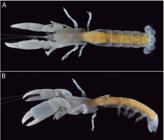
Mictaxius thalassicolaKensley & Heard, 1991, female (cl 6.2 mm) from Saint Martin (FLMNH UF 31992): (A) habitus alive, dorsal; (B) same, lateral. Photographs by the author.
The author initially considered two other possibilities for the generic assignment of the below described species. The placement of the new species in Callianidea would probably require a synonymisation of Paracallianidea (kept as a valid genus by Poore, 2015 and Poore & Ahyong, 2023), resulting in a nearly pantropical genus defined mainly by the variously developed (branching or non-branching, segmented or non-segmented) respiratory filaments on the second to fifth pleopods. On the other hand, its placement in Paraallianidea would require an extensive generic emendation of that genus, for instance, adding features, such as (1) linea thalassinica extending from 0.1 to 0.25 length of the carapace; (2) respiratory filaments of the second to fifth pleopods branching or non-branching; (3) male first pleopod with one or two articles, with or without modified appendix interna; and (4) male second pleopod with or without distinct appendix masculina. Therefore, the author opted for the establishment of a new genus, a hypothesis to be tested in future phylogenetic analyses.
Trichocallia delicatula sp. nov. (Figs. 1 2 3 4 5)
Type material: Holotype: male (cl 8.3 mm, dissected), MZUSP 34100, Panama, Caribbean coast, Bocas del Coro, Isla Colon, near Punta Caracol, 9°22′38.7″N 82°18′01.7″W depth: 0.5-1 m, possibly in burrow in silty-muddy sediment, under decomposing mangrove roots, suction pump, leg. A. Anker, 27.04.2015.
Description: Body glabrous, feebly calcified; carapace and pleon dorsally and sometimes dorsolaterally with numerous, more or less elongate, erect setae. Carapace with rostrum broadly triangular, reaching mid-length of eyestalks; linea thalassinica short, running from small incision on anterolateral margin posterior to eyes to about 0.25 carapace length; anterolateral surface with row of 19-20 setae; anterolateral margin just above broadly rounded pterygostomial angle somewhat uneven; cervical groove feebly demarcated posterior to carapace midlength (Figs. 1A-C, 4C). Seventh thoracic sternite with narrow anterior extension, between enlarged coxae of fourth pereiopods (Fig. 1E).
Pleon elongate, almost three times as long as carapace (Fig. 4A, B). First pleomere slightly shorter than second pleomere, tergite with somewhat domed anterior portion, pleuron rounded ventrally, somewhat protruding posteriorly; second pleomere without setal rows; third to sixth pleomeres of approximately same length, flattened dorsally; third pleomere with small setal row on proximoventral surface near junction with second pleomere, and larger transverse setal row more posteriorly, on ventrolateral surface; fourth and fifth pleomere each with one transverse setal row on ventrolateral surface; sixth pleomere with numerous tufts of long setae dorsally and laterally and some rows of elongate setae laterally (Figs. 1F, L, 4A, B, 5B). Telson 1.25 times as long as wide; lateral margins broadly convex; posterior margin evenly convex (Figs. 1L, 4D).
Eyestalks flattened, contiguous, truncate anteriorly; distomesial angle blunt; cornea moderately pigmented, dorsal (Fig. 1B, C). Antennular peduncle moderately elongate, with first article exceeding eyestalk; second article about 1.5 times as long as wide; third article 1.7 times length of second article, setose ventrally, reaching to about half-length of fourth article of antennal peduncle (Fig. 1B, C). Antennal peduncle with robust second article (= basicerite) and small, scale-like scaphocerite; fifth article 0.4 times as long as fourth article (Fig. 1B-D).
Mandible with three-articulated palp, distal article with dense field of short setae; incisor process distally with 11 teeth of various sizes, including two much larger teeth; sclerite adjacent to mandible with row of elongate setae (Fig. 2A-C). Maxillule with two-articulated palp, last article with long curved seta (Fig. 2D). Maxilla with three-articulated palp, first articulation faint, distal article very slender; scaphognathite with long seta on posterior margin (Fig. 2E). First maxilliped with two-articulated palp, second article narrow; exopod with lobe extending to 0.6 of exopod length; epipod bilobed (Fig. 2F). Second maxilliped with elongate epipod; exopod extending to distal margin of ischiomerus; dactylus about 0.4 length of propodus (Fig. 2G). Third maxilliped pediform; epipod elongate, curved, with proximal tooth and some lamellae; exopod reaching well beyond distal margin of ischium; ischium with crista dentata composed of more than 40 distally increasing teeth, distal-most tooth prominent; merus 0.8 length of ischium; carpus, propodus and dactylus unarmed, about as long as basis, ischium and merus combined (Fig. 2H, I).
First pereiopods (= chelipeds) very unequal in size and asymmetrical in shape (Figs. 2J-O; 4A, B; 5C, D). Major cheliped moderately large relative to body size (Fig. 4A); ischium slightly widening distally, with five low spaced teeth on ventral margin and one low proximal tooth on dorsal margin; merus ovate with moderately convex dorsal margin and strongly convex ventral margin, almost 1.8 times as long as greatest width, ventral margin slightly crenulated distally; carpus with short handle-like proximal portion and subrectangular main portion, latter about twice as wide as long, ventral margin with two blunt teeth, mesial margin with shallow oblique sulcus originating between teeth on ventral margin and extending dorsally almost entire width of carpus; propodus palm subrectangular, about twice as long as wide, smooth, with almost straight margins; propodus pollex (= fixed finger) about as long as greatest width of palm, cutting edge with one triangular tooth at about 0.3 of pollex length and some minor crenulation; dactylus subequal to pollex, cutting edge with one subtriangular low tooth at about 0.3 of dactylar length and weak crenulation (Fig. 2J-M). Minor cheliped slender, much weaker than major cheliped (Fig. 4A); ischium not widening distally, with straight margins; merus as long as ischium, somewhat curved, with broadly convex dorsal margin, concave proximoventral margin and strongly convex distoventral margin, about 2.8 times as long as greatest width; carpus elongate, slender, gently widening distally, almost four times as long as greatest width, 1.3 times as long as merus, ventral margin unarmed; propodus palm elongate-subrectangular, about 3.5 times as long as wide, smooth, with almost straight margins; propodus pollex about half as long as palm, cutting edge with one triangular tooth at about mid-length; dactylus much longer than pollex, with strongly descending tip, cutting edge unarmed (Fig. 2N, O).
Second pereiopod with ischium short, subquadrate, ending in small blunt distoventral projection; merus 3.5 times as greatest width, ventral margin broadly convex, with row of very long curved setae, dorsal margin almost straight; carpus cup-shaped; chela somewhat swollen relative to carpus; propodus palm slightly wider than long, with convex dorsal margin; fingers (= propodus pollex and dactylus) slightly gaping when closed, subequal in length, cutting edges with row of mostly closely adjacent, minute denticles (Fig. 3A-C). Third pereiopod with ischium subquadrate; merus about 3.5 times as long as greatest width, ventral margin straight, dorsal margin slightly convex distally; carpus about half-length of merus, distally widening; propodus sub-rectangular-ovate, 2.4 times as long as greatest width, with dense row of long fine setae on ventrolateral surface and stout spiniform seta on distoventral margin; dactylus about 0.4 length of propodus, strongly tapering distally (Fig. 3D). Fourth pereiopod structurally similar to third but slenderer and with different proportions of articles; ischium more rectangular; merus five times as long as wide, with straight margins; carpus 0.6 length of merus; propodus as long as carpus, with stout spiniform seta on distoventral margin; dactylus almost 0.6 length of propodus (Fig. 3E). Fifth pereiopod slenderest of walking legs; coxa with small setiferous protuberance and gonopore; merus about 5.2 times as long as wide, subcylindrical; carpus 0.6 length of merus; propodus as long as carpus, not distinctly subchelate, with short blunt distoventral projection, distolateral surface with dense rows of setae; dactylus with strong concavity on proximoventral margin, gently tapering distally, almost 0.6 length of propodus (Fig. 3F-H; see also Fig. 1E).
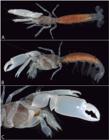
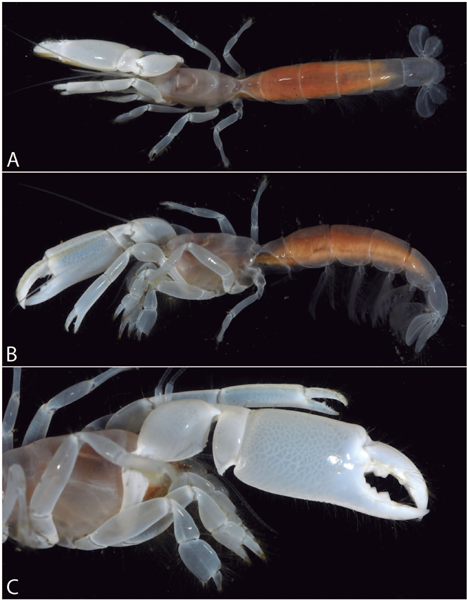
Paracallianidea occidentalis (Schmitt, 1939), female (cl 8.4 mm) from Taboga Island, Panama (MNHN-IU-2019-3219): (A) habitus alive, dorsal; (B) same, lateral; (C) cephalothorax and pereiopods, lateral. Photographs by the author.
First pleopod composed of two articles; distal article with minute tooth on subdistal mesial margin (Fig. 1G). Second to fifth pleopods conspicuously expanded, very large relative to pleon size, and with hyperdeveloped respiratory filaments, latter tubular, hair-like, mostly complexly branching and segmented (Figs. 1F, H, I, K, 4A, B, 5A, B). Second pleopod with exopod and endopod subequal; appendix interna and appendix masculina apparently fused (or at least latter not individualised or perhaps lacking), forming small, digitiform process, latter subdivided into two parts, distal part with minute uncini on apex (Fig. 1H-J); remaining pleopods each with similar digitiform appendix interna. Uropod not reaching beyond telson; exopod and endopod broadly ovate, latter somewhat smaller, dorsal surface and margins unarmed; exopod with two low longitudinal ridges; endopod with single longitudinal ridge (Figs. 1L, 4D).
Colour in life: Body translucent whitish, with slight pinkish tinge on carapace and pale-yellow inner organs visible by translucence; most appendages also translucent whitish, except for opaque, ivory-white chelipeds (Figs. 4, 5).
Etymology: The new species’ name refers to its fragile and rather delicate appearance (delicatula, feminine of delicatulus, Latin word for “rather delicate”), especially compared to the more robust species in the related genera Callianidea and Paracallianidea; used as an adjective.
Distribution: Presently known only from the type locality in Bocas del Toro, Caribbean coast of Panama.
Ecology: The holotype was collected in 0.5-1 m deep water, on silty-muddy bottom covered by a matrix of decomposing and partly overgrown mangrove roots, however, at some distance from living mangrove trees.
Remarks:Trichocallia delicatulasp. nov. is the fourth species of the family Callianideidae recorded from the western Atlantic, the other three being Paracallianidea laevicauda, ranging from the Caribbean Sea to Suriname and northeastern Brazil (Pernambuco); Mictaxius thalassicola, ranging throughout the Caribbean Sea (e.g., Panama, Mexico, French Antilles); and Crosniera minima from the Gulf of Mexico and northern Caribbean Sea (Holthuis, 1959; Kensley & Heard, 1991; present study; A. Anker, pers. obs.). For remarks on intergeneric relationships, see above.
-
FUNDING INFORMATION:
Field work in Panama (see below) was supported by a grant from the Gordon and Betty Moore Foundation (GBMF5603) and STRI.
ACKNOWLEDGMENTS:
The holotype was collected during a short survey of decapod crustaceans in Bocas del Toro, Panama, co-organised by Dr. Matthieu Leray (Smithsonian Tropical Research Institute – STRI). The author is grateful to the staff of the STRI research station in Bocas del Toro for logistical support. Research permit No. SE/AO-3-18 was provided by the Ministry of the Environment of the Republic of Panama (MiAMBIENTE). Special thanks go to Dr. Marcos Tavares (MZUSP), who provided instrumental help in the final stage of this study, reexamining several important characters on the holotype.
REFERENCES
- Dworschak, P.C. 2014. The Axiidea (Crustacea, Decapoda) of Cocos (Keeling) and Christmas Islands, with description of a new species of Eucalliax Manning & Felder, 1991. Raffles Bulletin of Zoology, Suppl. 30: 230-245.
- Gill, T. 1859. Descriptions of a new species of Callianidea Ed. Proceedings ofthe Academy of Natural Sciences of Philadelphia, 11: 167-168.
-
Heard, R.W. & King, R.A. 2007. Crosniera wennerae, a new species of thalas-sinidean (Crustacea: Decapoda: Thomassiniidae) from the South Atlantic Bight. Zootaxa, 1644(1): 41-49. https://doi.org/10.11646/zootaxa.1644.1.2
» https://doi.org/10.11646/zootaxa.1644.1.2 -
Hernáez, P. & Vargas, R. 2013. A new species of Callianidea H. Milne Edwards, 1837 (Decapoda, Axiidea, Callianideidae) from the Pacific coast of Central America, with key to the genus. Zootaxa, 3681(2): 147-154. https://doi.org/10.11646/zootaxa.3681.2.3
» https://doi.org/10.11646/zootaxa.3681.2.3 -
Holthuis, L.B. 1959. The Crustacea Decapoda of Suriname (Dutch Guiana). Zoologische Verhandelingen, Leiden, 44(1): 1-296. Available: https://repository.naturalis.nl/pub/317569/ZV1959044001.pdf
» https://repository.naturalis.nl/pub/317569/ZV1959044001.pdf - Kensley, B. & Heard, R.W. 1991. An examination of the shrimp family Callianideidae (Crustacea: Decapoda: Thalassinidea). Proceedings of the BiologicalSociety of Washington, 104(3): 493-537.
- Milne Edwards, H. 1837. Histoire naturelle des crustacés, comprenant l’anatomie, la physiologie et la classification de ces animaux. Paris, Libraire Encyclopédique de Roret. 532p.
-
Ngoc-Ho, N. 2005. Thalassinidea (Crustacea, Decapoda) from French Polynesia. Zoosystema, 27(1): 47-83. Available: https://sciencepress.mnhn.fr/sites/default/files/articles/pdf/z2005n1a4.pdf
» https://sciencepress.mnhn.fr/sites/default/files/articles/pdf/z2005n1a4.pdf -
Poore, G.C.B. 1997. A review of the thalassinidean families Callianideidae Kossmann, Micheleidae Sakai, and Thomassiniidae de Saint Laurent (Crustacea: Decapoda) with descriptions of fifteen new species. Zoosystema, 19(2-3): 345-420. https://doi.org/10.5962/p.296164
» https://doi.org/10.5962/p.296164 -
Poore, G.C.B. 2015. Rediagnosis of Callianideidae and its genera (Crustacea: Decapoda: Axiidea), and description of a new species of Heardaxius Sakai, 2011. Zootaxa, 3995(1): 229-240. https://doi.org/10.11646/zootaxa.3995.1.19
» https://doi.org/10.11646/zootaxa.3995.1.19 -
Poore, G.C.B. & Ahyong, S.T. 2023. Marine decapod Crustacea. A guide to families and genera of the world. CSIRO Publishing/CRC Press, 916pp. https://doi.org/10.1071/9781486311798
» https://doi.org/10.1071/9781486311798 -
Poore, G.C.B. & Collins, D.J. 2015. Micheleidae (Crustacea: Decapoda: Axiidea): new family, generic and species synonymies, three new Australian species, and new records. Memoirs of Museum Victoria, 73: 95-105. https://doi.org/10.24199/j.mmv.2015.73.08
» https://doi.org/10.24199/j.mmv.2015.73.08 -
Rathbun, M.J. 1901. The Brachyura and Macrura of Porto Rico. Bulletin of the United States Fisheries Commission, 2: 1-137. Available: https://repository.si.edu/handle/10088/35311
» https://repository.si.edu/handle/10088/35311 - de Saint-Laurent, M. 1979. Sur la classification et la phylogénie des Thalassinides: definitions de la superfamille des Axioidea, de la sous-famille des Thomassiniinae et de deux genres nouveaux (Crustacea Decapoda). Comptes Rendus Hebdomadaires de Séances de lAcadémie des Sciences, Série D, Sciences Naturelles, Paris, 288(18): 1395-1397
- Sakai, K. 1992. The families Callianideidae and Thalassinidae, with the description of two new subfamilies, one new genus and two new species (Decapoda, Thalassinidea). Naturalists, Publications of Tokushima Biological Laboratory, Shikoku University, 4: 1-33
-
Sakai, K. 2011. Axioidea of the world and a reconsideration of the Callianassoidea (Decapoda, Thalassinidea, Callianassida). Crustaceana Monographs, 13: 1-616. https://doi.org/10.1163/9789047424185 002
» https://doi.org/10.1163/9789047424185 002 -
Sakai, K. 2017. A second report on material from Dr. Mortensen’s collection of Thalassinidea and Callianassidea (Decapoda) in the Zoological Museum, Copenhagen. Crustaceana, 90(7-10): 1117-1144. https://doi.org/10.1163/15685403-00003583
» https://doi.org/10.1163/15685403-00003583 -
Schmitt, W.L. 1939. Decapod and other Crustacea collected on the Presidential Cruise of 1938 (with introduction and station data). Smithsonian Miscellaneous Contributions, 98: 1-29. https://doi.org/10.5962/bhl.part.4784
» https://doi.org/10.5962/bhl.part.4784 -
Sepahvand, V.; Rastegar-Pouyani, N.; Kihara, T.C. & Momtazi, F. 2017. A new species of Clausidium Kossmann, 1874 (Crustacea, Copepoda, Cyclopoida, Clausidiidae) associated with ghost shrimps from Iran. Nauplius, 25: 1-16, e2017018. https://doi.org/10.1590/2358-2936e2017018
» https://doi.org/10.1590/2358-2936e2017018
Edited by
-
Edited by:
Marcos Domingos Siqueira Tavares