 Accountability and Civil Society Organizations: An Integrity Maturity Self-Assessment
ABSTRACT
Objective: this study analyzed integrity within civil society organizations (CSOs) and sought to propose and apply an integrity maturity self-assessment tool tailored to the nature and context of CSOs. Grounded in the concept of accountability, this study details integrity and its operationalization across different perspectives and programs.
Methods: through a qualitative approach, data were collected via interviews, observations, documents, and articles. The study followed four stages: selecting integrity programs for CSOs; expert validation of the theoretical-methodological matrix; developing the self-assessment tool; and its subsequent application and analysis within an organization.
Results: findings indicate that integrity is demonstrated when organizational practices align with principles, values, and objectives while fulfilling legal obligations and maintaining ethical stakeholder relations. The application of the matrix allowed for refinements and a critical analysis of the tool.
Conclusion: the tool encompasses the accountability triad: objective responsibility, subjective responsibility, and responsiveness. Its potential lies in its self-assessment nature, anchored in subjective responsibility, which serves as a basis for problem prevention and resolution, ultimately fostering objective responsibility and responsiveness.
Keywords:
accountability; integrity; civil society organizations
RESUMO
Objetivo: analisou-se a integridade em organizações da sociedade civil (OSCs), buscando propor e aplicar uma ferramenta de autoavaliação de maturidade da integridade adaptada à natureza e ao contexto de OSCs. Pauta-se na accountability e detalha o conceito de integridade e sua operacionalização em diferentes perspectivas e programas.
Método: a abordagem é qualitativa, sendo a coleta de dados pautada em entrevistas, observações, documentos e artigos. O estudo foi realizado em quatro etapas: seleção de programas de integridade para OSCs; validação da matriz teórico-metodológica por especialistas; elaboração de ferramenta de autoavaliação; aplicação da ferramenta de autoavaliação da maturidade da integridade em uma organização e análises decorrentes.
Resultados: observou-se que a integridade pode ser demonstrada quando as práticas organizacionais estão alinhadas com princípios, valores e objetivos, ao mesmo tempo em que atendem às obrigações legais e mantêm relações éticas com seus públicos. A aplicação da matriz de autoavaliação de maturidade da integridade permitiu adaptações e uma análise crítica da ferramenta.
Conclusão: a ferramenta contempla aspectos do tripé da accountability - responsabilidade objetiva, subjetiva e responsividade. A potencialidade da ferramenta está no fato de ela ser um instrumento de autoavaliação, ancorado na responsabilidade subjetiva, que serve de base para a prevenção e a solução de problemas, favorecendo a responsabilidade objetiva e a responsividade.
Palavras-chave:
accountability; integridade; organizações da sociedade civil
INTRODUCTION
Accountability and integrity are central to civil society organizations (CSOs) as they seek to promote well-being, foster social change, and remain accountable and responsive to their stakeholders - including donors, beneficiaries, partners, and society at large. This article is grounded in the concept of accountability, understood as a set of “social relations and institutional mechanisms that make powerful actors or agents responsive to their public” (Schommer & Guerzovich, 2025, p. 1). Accountability encompasses the responsibility and obligation of agents in governments, corporations, and CSOs to render accounts, provide information and justification for their actions, and be subject to consequences, sanctions, or rewards based on their acts or omissions (Campos, 1990; Hernandez & Cuadros, 2014).
This understanding incorporates the notions of objective and subjective responsibility (Campos, 1990; Heidemann, 2009; Pinho & Sacramento, 2009; Rodrigues & Menezes, 2024). Objective responsibility refers to the duty of an individual or organization toward another party, with potential consequences for compliance or noncompliance (Campos, 1990; Heidemann, 2009; Pinho & Sacramento, 2009). Subjective responsibility, in turn, concerns the ethical dimension embedded in decision-making processes, particularly in the exercise of authority within organizations or institutional roles (Campos, 1990; Heidemann, 2009; Pinho & Sacramento, 2009). Objective responsibility typically aligns with a formal, normative conception of accountability, whereas subjective responsibility corresponds to a relational approach that emphasizes values, social norms, power asymmetries, expectations, and learning processes that shape interactions among actors within specific institutional contexts (Schommer & Guerzovich, 2025).
As demands for accountability and integrity intensify - expressed in norms and values that guide actions and relationships - CSOs may serve as catalysts for change, contributing to building a more just and responsible society (Hernández et al., 2021; Ordem dos Advogados do Brasil [OAB], 2018). In the Brazilian context, the Regulatory Framework for Civil Society Organizations (Marco Regulatório das Organizações da Sociedade Civil - MROSC), Law 13,019/2014 (Lei nº 13.019, 2014), establishes legal and procedural parameters to strengthen transparency, accountability, and integrity in CSOs. It defines conditions and guidelines for ethical and responsible organizational conduct (Grupo de Institutos, Fundações e Empresas [GIFE], 2021; OAB, 2018). Particularly when collaborating with governmental entities, CSOs are expected to uphold integrity, ethical standards, and transparency in internal and external processes (GIFE, 2021; OAB, 2018; Rodrigues & Menezes, 2024).
This research on CSOs’ integrity introduces and applies an integrity maturity self-assessment tool tailored to these organizations in the capital of the Brazilian state of Santa Catarina, Florianópolis, and neighboring cities (a region known as Greater Florianópolis). The specific objectives are: (1) to characterize the concept of integrity according to different national and international approaches; (2) to map the principles and analytical dimensions that constitute the concept of integrity in CSOs; (3) to identify, in consultation with experts, key factors associated with organizational integrity in CSOs; and (4) to develop and pilot-test an integrity maturity self-assessment tool (Rodrigues & Menezes, 2024).
Integrity maturity is defined here as levels (initial, basic, intermediate, managed, and optimized) of direct, reliable relationships among CSOs’ internal and external stakeholders, grounded in values and actions. These relationships are evident in collaborative decision-making, implementation, and monitoring processes, as well as in the transparency and quality of publicly disclosed information about organizational processes and results (Angélico, 2015; De Bona, 2022; Hernández et al., 2021; Koppell, 2005; Vieira & Barreto, 2019). Integrity programs and assessment instruments typically encompass top management commitment, risk management practices, codes of conduct (internal and external), an organizational culture of integrity, institutional policies and internal controls, due diligence procedures, whistleblowing or integrity reporting channels, and communication and monitoring mechanisms (GIFE, 2021; OAB, 2018; Legal Ethics Compliance [LEC], 2018; United States Sentencing Commission [USSC], 2015; Vieira & Barreto, 2019; Rodrigues & Menezes, 2024).
This article is structured into five sections, including this introduction, which states the research objectives and theoretical foundations. The second section describes the empirical context under investigation. The third section presents the diagnostic analysis of the problem and/or opportunity identified. The fourth section develops the analytical discussion and proposes innovation and intervention measures. The fifth section highlights the final considerations.
EMPIRICAL CONTEXT INVESTIGATED
Integrity is a topic that requires continuous learning to embed ethics in public administration, corporations, and CSOs. It has been discussed across various organizational settings, particularly regarding a set of principles and instruments applicable to CSOs. Interactions between CSOs and public administration must meet specific requirements (OAB, 2018).
Under Law 13,019/2014 (Lei nº 13.019, 2014), the Regulatory Framework for Civil Society Organizations (MROSC) sets out requirements and guidelines to promote ethical and responsible conduct among organizations. The MROSC emphasizes transparency in CSO management, requiring the disclosure of financial, budgetary, and operational information in a manner accessible to the public. This transparency, also expected of public administration (Angélico, 2015; Zuccolotto & Teixeira, 2019), strengthens accountability and helps prevent improper or fraudulent practices. Furthermore, the MROSC establishes criteria for the use of public resources by CSOs, requiring internal control mechanisms and formal reporting on their allocation (Lei nº 13.019, 2014). Private donors, such as philanthropic foundations, also require integrity commitments from CSOs (GIFE, 2021).
For CSOs establishing contracts with the public sector, documentation of internal and external integrity, auditing, and conduct practices and procedures is required to prevent behaviors that may conflict with the principles of public administration or the organization’s mission (OAB, 2018). Therefore, integrity tends to strengthen partnerships between CSOs and the public sector, helping ensure that such collaborations are conducted in an ethical, transparent, and mutually beneficial manner for the parties involved and for society at large.
For CSOs, regardless of the requirements imposed by public or private partners and donors, adopting integrity guidelines and criteria may enhance their legitimacy, performance, and sustainability (Organização para a Cooperação e Desenvolvimento Econômico [OCDE], 2017), within the contexts and causes in which they operate. CSOs may implement integrity mechanisms to improve the quality of their actions and relationships, thereby increasing credibility, efficiency, governance, and risk prevention and mitigation.
The CSO studied in this research, Instituto Comunitário Grande Florianópolis (ICOM), is a nonprofit organization founded in 2005. It seeks to foster an environment that protects the rights of all citizens and values people’s capacities (ICOM, 2022). ICOM recognizes itself as a community foundation, an organization oriented toward community philanthropy, valuing local resources and capacities and seeking to build a broad donor base (ICOM, 2022). ICOM recognizes itself as a community foundation, an organization oriented toward community philanthropy, valuing local resources and capacities and seeking to build a broad donor base (Carman, 2001; Global Fund for Community Foundations [GFCF], 2025; Graddy & Morgan, 2006; Grønbjerg, 2006; ICOM, 2022; Reis et al., 2023; Wu, 2021). Community foundations “are often described as organizations with the flexibility to respond rapidly to issues of public interest that arise within the territories where they operate” (ICOM, 2022, p. 6). ICOM’s activities are structured around three pillars (ICOM, 2022), inspired by community foundation models:
-
(a) Community knowledge and coordination, involving the identification of local advances and challenges to influence public policies, support organized civil society, and guide philanthropic grants;
-
(b) Strengthening organized civil society, enhancing the autonomy and capability to co-produce public goods and services, as well as advocating for rights;
-
(c) Promoting philanthropy so that individuals and companies become aware of, engage with, and donate to causes of public interest within the territory.
The organization’s governance structure comprises 35 members, who collectively constitute (ICOM, 2022): the General Assembly, the highest deliberative body. From among these 35 members, 27 serve on the Deliberative Board, which is responsible for strategic direction and planning, ensuring alignment between the organization’s mission and its managerial practices. The Board of Directors is likewise composed of five members drawn from the General Assembly, who provide operational oversight to the executive team and collaborate in the design and implementation of plans and actions. In addition, three members of the assembly serve on the fiscal committee, which oversees financial management and ensures fiscal compliance.
Between 2005 and 2022, ICOM supported approximately 2,834 CSOs through training programs, advisory services, workshops, and financial support, investing approximately BRL 14 million in the community through grants to other organizations and its own programs (ICOM, 2022), These initiatives aimed to improve quality of life, reduce social inequalities, and foster trust between individuals and institutions. ICOM’s activities are funded by private donations from individuals and national and international organizations, as well as by government contracts. The organization’s purposes, principles, and some of its methods are systematized and publicly available. Its financial statements, audit reports, and annual activity reports are published each year. However, until 2023, the organization lacked regular, formal mechanisms to define and assess its integrity levels. In 2023, it developed a code of integrity and revised its internal bylaws, initiating the development of an integrity policy. Within the scope of ICOM’s actions and its relationships with public and private partners, as well as with its board and executive team, the need emerged for internal stakeholders to conduct an integrity self-assessment.
The development of a method for analyzing organizational integrity may serve as a reference for other CSOs with which ICOM interacts, particularly in the Greater Florianópolis region. It may also be of interest to organizations and researchers in other contexts, as well as to public- and private-sector managers collaborating with CSOs.
DIAGNOSIS OF THE PROBLEM AND/OR OPPORTUNITY
A possible starting point for analyzing the theme of integrity in the context of CSOs is the concept of accountability and its relationship to the features of democracy (Campos, 1990). Drawing on Mosher (1968), seminal work Campos (1990) notes that accountability encompasses objective responsibility, i.e., the obligation of someone to answer to another for something, and subjective responsibility, i.e., the internalization of values and motivations by the person responding. Accountability is also linked to obligation, with the possibility of consequences for the person responsible for an action, which may take the form of reward or punishment (Campos, 1990). Thus, whoever bears responsibility for something or someone must justify themselves and is accountable for the performance and results of their actions or omissions.
Accountability is defined by the quality of the relationships between the parties (Campos, 1990). For example, the way in which rulers render accounts to citizens and the extent to which citizens can demand accountability and position themselves in relation to it depend on the quality of the relationship between them. This indicates that accountability involves not only formal aspects but also relational ones (Pagani, 2022). Information and power asymmetries also influence accountability (Moncrieffe, 2011). Those who hold power, for example, citizens in a given locality, CSO members, or donors, do not always wish to impose sanctions on their agents. Rather, they expect them to find solutions to relevant challenges, explain their actions or difficulties, and, if necessary, redefine agreements to preserve and renew trust in the relationship.
Denhardt and Denhardt (2003) emphasize trust by defining accountability as the quality or state of being trustworthy or responsible. Koppell (2005) identifies five dimensions of accountability: transparency, liability, controllability, responsibility, and responsiveness. For each dimension, the author proposes a key question, as presented in Table 1.
These dimensions reflect the complexity of accountability and the need to mobilize diverse bodies of knowledge to understand it (Denhardt & Denhardt, 2003). Numerous authors have expanded the debate on accountability (Medeiros et al., 2013), addressing its vertical and horizontal aspects (O’Donnell, 1998), its democratic dimension (Abrucio & Loureiro, 2004), its relational dimension (Guerzovich & Aston, 2023; Moncrieffe, 2011; Pagani, 2022; Schommer & Hernandez Quiñonez, 2024) and its relationship with models of public administration (Denhardt & Denhardt, 2003; Rocha, 2011). Accountability encompasses electoral controls, the establishment of intertemporal state rules, the monitoring of officeholders through institutional controls (Abrucio & Loureiro, 2004; Menezes et al., 2025; O’Donnell, 1998) and the quality of relationships and learning processes developed in practice within situated systems and contexts (Pagani, 2022; Schommer & Guerzovich, 2025).
According to Hernandez and Cuadros (2014), vertical accountability includes elections - classic mechanisms for demanding accountability in democracies - as well as forms of citizen and CSO oversight during government terms. Horizontal accountability refers to state agencies with legal authority and the capacity to undertake actions ranging from routine oversight to legal sanctions, including impeachment. There are also cross-cutting forms of accountability, referring to cases in which the direct exercise of citizen oversight has been institutionalized or in which citizens participate in institutional oversight bodies. Additionally, social accountability is a non-electoral form of vertical accountability that encompasses initiatives, practices, and oversight mechanisms driven by citizens, CSOs, or the media to demand accountability and evaluate the performance of politicians, public servants, and private companies that use public resources. For Guerzovich and Aston (2023), social accountability is a means of improving the quality of goods and services and making providers more responsive to citizens’ needs.
According to Hernandez and Cuadros (2014), accountability refers to the responsibility and obligation of government officials, public employees, private companies, and civil society organizations that manage public resources or deliver public services to inform and justify their actions, conduct, and results. It also entails being subject to sanctions or rewards in cases where laws and public duties are breached or performance is deemed inadequate; reporting, in this framework, may occur voluntarily. The authors argue that accountability presupposes the presence of local, national, and international social and state actors capable of demanding explanations, exercising oversight and checks and balances, evaluating performance, and enforcing sanctions. Furthermore, they maintain that accountability is closely linked to well-being and socioeconomic development, insofar as the inability to demand accountability constitutes both a manifestation of poverty and a mechanism that perpetuates it (Hernandez & Cuadros, 2014).
Integrity has been the subject of extensive debate. In companies, it is associated with combating corruption and reducing fraud. The Brazilian National Institute of Information Technology (ITI) identifies three elements that sustain integrity: prevention, detection, and correction (ITI, 2019). These elements require direct managerial involvement, communication, transparency, training, effective whistleblowing channels, investigative procedures, and continuous policies that promote good practices. Integrity may be understood as the condition of public and private organizations and agencies that comply with their governance principles and norms and seek to maintain an organizational culture characterized by high ethical values and standards of conduct (OCDE, 2017; Vieira & Barreto, 2019).
The Third Sector Law Commission of the Brazilian Bar Association (Ordem dos Advogados do Brasil - Distrito Federal [OAB-DF]) defines integrity as the quality of being whole, complete, and impartial. This concept is recognized as a virtue grounded in rectitude and fairness.
Applied to individuals, integrity describes those who conduct themselves ethically, correctly, and transparently, are committed to honesty and consistency in all actions and behaviors, and maintain upright conduct even when they could derive personal advantage (OAB, 2018, p. 17).
Denhardt and Denhardt (2003) emphasize that public servants and citizens, as part of the nation, must demonstrate integrity and honesty by sharing values and participating in democratic processes. In CSOs, integrity entails fostering an environment in which employees, volunteers, and partners are encouraged to respect and act in accordance with ethical standards defined by the organization and the context in which it operates.
In 2017, the Organisation for Economic Co-operation and Development (OECD) published a guide to good practices for the ethical and transparent management of CSOs, emphasizing the importance of integrity in building donor trust and ensuring organizational sustainability. Integrity is a foundational principle of political, economic, and social structures, contributing to individual and collective well-being and to sustainable development (OCDE, 2017).
In the legal context, integrity serves as a safeguard against fraud and errors. The Anti-Corruption Law in Brazil (Lei no 12.846, 2013), applies to all types of organizations and, under Article 7, VIII, provides for “the existence of internal integrity and auditing mechanisms and procedures, incentives for reporting irregularities, and the effective enforcement of codes of ethics and conduct within legal entities” (Lei no 12.846, 2013).
De Bona (2022) notes that integrity can be examined from multiple dimensions: institutional, administrative-functional, political, economic, socio-environmental, cultural, organizational, ethical, and transversal. This research focuses on organizational integrity and proposes a self-assessment tool for organizational maturity. This perspective moves beyond a purely normative dimension, emphasizing the organization’s mission and the ways in which its values are expressed in practice. Assessing integrity requires examining mechanisms, guidelines, internal procedures, and actions related to ethical values. These elements should aim to prevent, detect, and correct deviations, fraud, irregularities, and acts harmful to public authorities and the organization itself (De Bona, 2022).
Integrity programs apply to organizations of any type, regardless of their area of activity, size, or sector, provided their principles are adapted to the organization’s nature and context. This study is based on three integrity programs. Table 2 summarizes their shared and distinctive characteristics.
The first framework, developed in the United States and set out in the guidelines manual of the (USSC, 2015). outlines the structure of a corporate compliance program comprising measures that organizations may adopt to “demonstrate the effectiveness of the integrity program and potentially obtain a reduction in culpability in the evaluation of corporate integrity programs” (Vieira & Barreto, 2019, p. 109). Although the term compliance is sometimes used interchangeably with integrity, it more precisely refers to adherence to applicable laws, regulations, and standards. In this sense, compliance constitutes a specific dimension of governance that contributes to the broader framework of integrity in public management (Carvalho, 2017).
The second framework draws on Brazilian integrity programs and the guidelines set forth in Decree 8,420/2015, which regulates the Anti-Corruption Law 12,846/2013 and establishes criteria for evaluating an effective corporate integrity program (Lei no 12.846, 2013). The OAB (2018), guide is another document addressing corruption prevention under the Anti-Corruption Law. OAB (2018) provides practical guidance for implementing compliance programs (here used interchangeably with integrity) within CSOs. For CSOs with government contracts, adherence to an integrity program is desirable because it defines internal procedures to prevent, detect, and address fraud or other illicit acts against the public administration that could jeopardize the organization’s sustainability (OAB, 2018).
The third framework was developed by GIFE in 2018 as an integrity program to establish internal procedures that promote ethical conduct, prevent irregularities, and address everyday operational challenges. The document emphasizes the integrity policy, which includes practical measures on ethical standards of behavior, expected conduct for members aligned with each organization’s areas of activity, responsible management of public and private resources, and appropriate measures and sanctions in the event of violations of established conduct (GIFE, 2021).
Support from top management and manuals or codes of conduct are common across the three frameworks. These components demonstrate the importance of leadership in guiding organizational actions, assuming responsibility for subordinates’ conduct, and fostering an ethical, integrity-oriented environment. They also highlight the need for formal documents that explicitly articulate values, norms, and expected standards of conduct.
Furthermore, it is desirable that all members of an organization understand how to interact with and respond to internal and external stakeholders in alignment with the organization’s mission, nature, and guiding principles. Monitoring and communication mechanisms are central to all programs and policies, as they enable assessment of how the organization has evolved in relation to conduct affecting integrity and whether such conduct remains aligned with its mission and values. These mechanisms also support the communication of results, both internally and externally, to the various audiences with whom the organization interacts, as well as clarify the tools used to manage and monitor internal and external actions.
In the context of CSOs, integrity maturity refers to the levels - initial, basic, intermediate, managed, and optimized - of direct and reliable relationships among internal and external stakeholders. These relationships are grounded in the values and objective actions of various internal and external actors (Brito et al., 2022; Lei nº 13.019, 2014). These levels may be reflected in decision-making, implementation, and monitoring processes conducted in a shared and collaborative manner, as well as in the transparency and quality of publicly disclosed information concerning results and stakeholder expectations (De Bona, 2022; Koppell, 2005; Vieira & Barreto, 2019).
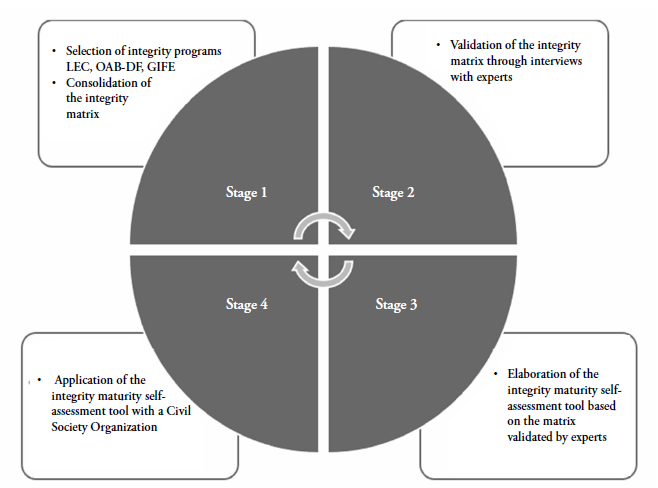
The proposal developed in this study was grounded in a qualitative research approach (Flick, 2012). With regard to research techniques, a bibliographic review was conducted, encompassing the collection and analysis of published materials, including peer-reviewed articles, books, technical manuals, theses, and dissertations. The study also incorporated descriptive and applied research procedures (Gil, 2018). The stages of the research process are presented in Figure 1:
Stage 1 of the study was conducted through documentary research, including a survey of publications on established and widely disseminated integrity programs (GIFE, 2021; LEC, 2018; OAB, 2018; USSC, 2015), The latter two were examined based on Vieira and Barreto (2019) work. The selection and analysis of integrity action lines were guided by a model structured around concepts, dimensions, and indicators (Quivy & Campenhoudt, 1998). Table 3 presents the study’s theoretical-methodological matrix, outlining the construction of concepts, dimensions, categories, and axes (indicators) addressed in the research.
The consolidation of the theoretical matrix was based on the dimensions of the accountability concept (Koppell, 2005) and on the adaptation of the axes observed across different integrity programs. The integrity category was identified within the accountability dimensions, and the components (axes) were then listed. Some integrity axes are directly related to accountability dimensions; others are indirectly related. For example, risk management, due diligence, and monitoring are directly linked to the dimensions of controllability and responsibility and also support liability and responsiveness (Koppell, 2005). Furthermore, within each axis, indicators are assigned to demonstrate the maturity of each listed component (Quivy & Campenhoudt, 1998).
Stage 2 of the study involved three semi-structured interviews with field experts. The selection of experts was based on appointment and access opportunities, which is appropriate when it is difficult to gather all participants for group analysis (Tribunal de Contas da União, 2018). Interviews were conducted with a person from the Integrity and Compliance Office of the Comptroller General of the State of Santa Catarina (CGE) (Interview 1); with an expert in open government and accountability from the State University of Santa Catarina (Interview 2); and with a member of the Comptroller General of the municipality of Florianópolis (Interview 3). The interviews were conducted between September 26, 2023, and October 24, 2023, and were recorded and transcribed. The data were analyzed qualitatively to identify best practices and proposals for improving the integrity matrix for CSOs.
In Stage 3, the interviewed experts elaborated on and validated the integrity matrix. Following the experts’ suggestions, the integrity maturity self-assessment tool was developed and then returned to the same experts for validation.
In Stage 4, the integrity maturity self-assessment tool was piloted with a CSO. ICOM was chosen because of its background in fostering community development in the state of Santa Catarina since 2005 and its recognition by other CSOs. Furthermore, the lead researcher of the study completed a two-year internship at the institution, gaining insight into various internal routines and accountability systems. Another author also participates in the organization. Both participated in a working group that, in 2023, discussed and implemented actions related to integrity in the organization. The research presented here took place in parallel with this working group, and some of its elements were considered.
The integrity maturity self-assessment tool was sent to ICOM on October 25, 2023, completed by the administrative-financial management, and returned two days later. The analysis drew on the content of the integrity framework validated by experts, interviews, and observations, and compared it with the concepts and theories mobilized in this article.
ANALYSIS OF THE PROBLEM AND PROPOSALS FOR INTERVENTION AND RECOMMENDATIONS
Based on studies, models, and manuals on integrity programs, it was observed that CSOs exhibit a weakness in self-assessing their integrity maturity. In public and private organizations, this practice is not insignificant. Thus, this study proposed a tool to be applied to CSOs. The theoretical and normative starting point was the selection of the three integrity program manuals analyzed. The choice was based on the availability of materials, the credibility of the issuing organizations, and their references, including the guidelines of the Brazilian Anti-Corruption Law (Lei no 12.846, 2013), which addresses the issue of integrity.
After analyzing the concepts in manuals and programs, it was possible to identify axes and concepts relevant to developing a self-assessment tool. Such an assessment enables the measurement of an organization’s internal and external practices and actions that reflect its commitment to integrity and reveal its integrity maturity level. Table 4 presents the consolidated results in matrix format:
The following axes were consolidated: board support; code of conduct (internal and external); organizational culture of integrity; institutional policies and internal control; risk management; due diligence; integrity and communication channel; and monitoring (GIFE, 2021; LEC, 2018; OAB, 2018; USSC, 2015; Vieira & Barreto, 2019). Based on interviews with experts and national and international maturity models, a maturity scale for integrity was proposed. The proposed scale comprises the following levels (Brito et al., 2022; Departamento Nacional de Infraestrutura de Transportes, 2023):
-
Initial (1 to 1.9): The procedure is not structured; it does not apply to the organization’s profile; there is a lack of structure and resources (financial, human, and technological); or it may be in an initial phase and under discussion within the organization;
-
Basic (2 to 2.9): The organization implements the procedure at a basic level of implementation and structuring; basic development of the activity’s management structures is observed;
-
Intermediate (3 to 3.9): The organization successfully implements the procedure and understands its processes; it possesses the necessary judgment capacity; the internal team operates with an intermediate level of autonomy relative to the board of directors, allowing some independence in the execution of its duties, although under the strategic guidance of top management;
-
Managed (4 to 4.9): The organization implements the procedure, which is already incorporated into the organizational culture and disseminated internally; team management is guided by principles of governance, institutional development, and organizational sustainability; preventive measures, performance evaluation practices, and process improvement mechanisms are adopted;
-
Optimized (5): The organization adopts a systematic approach to analyzing its internal and external processes; it is innovation-oriented; its processes are continuously monitored, evaluated, and improved in alignment with institutional strategic planning; it maintains an engaged team committed to organizational improvement and effectiveness.
Based on the axes and indicators presented (Table 4 ), the maturity levels described in Table 5 (Apêndice), were incorporated, resulting in an outline of the self-assessment tool for the integrity of CSOs in the Greater Florianópolis region.
The tool encompasses the self-assessment process, examining the elements that compose the integrity axes and their corresponding indicators. The analysis identifies these elements and evaluates each indicator’s maturity level. The objective is to provide a holistic understanding of organizational integrity, revealing not only the presence of the elements but also the degree to which they are embedded in accountability practices.
By defining each indicator and its maturity level, the tool aims to position the organization on a clear, comprehensible integrity scale. It not only indicates the presence or absence of integrity practices but also offers insights into opportunities for improvement and the organization’s position within the integrity maturity spectrum. Thus, the self-assessment process does not merely highlight compliance; it also assesses the organization’s standing against integrity and accountability standards established by external norms and parameters, as reflected in models applied by other organizations. The indicators and results of the self-assessment may support reflection by the organization and its stakeholders and may incorporate additional aspects more closely aligned with the organization’s nature and the relationships it establishes within its context and with its stakeholders.
Application of the integrity tool: An evaluation of ICOM’s experience
The tool may be useful for measuring and evaluating the organization’s actions to strengthen integrity and identify opportunities to improve its internal and external performance. When applying the tool to ICOM, the ‘board support’ axis reached the maximum maturity level of 5.00 (optimized). This result indicates that the organization is oriented toward comprehensive oversight of its processes, with full support from the board of directors. The board is engaged and committed, and organizational processes are continuously measured, controlled, and improved.
Regarding the second axis, ‘risk management,’ a score of 4.50 (managed) was obtained, indicating that the organization is aware of its structure and the risks it assumes. The organization has implemented preventive actions to mitigate potential adverse events and has mapped and identified, in advance, possible risks of fraud and misappropriation. Although ICOM demonstrates attention to these risks and adopts preventive measures, it remains necessary to define a more systematic periodicity and methodology for risk analysis. In addition, further development of an organizational culture oriented toward integrity and continuous monitoring across all organizational areas is required.
Regarding Axis 3, ‘code of conduct (internal and external),’ the organization scored 4.60 (managed), indicating that it defines and seeks to uphold conduct in accordance with established, collectively discussed parameters and is committed to the professional development of its members. In 2023, the organization developed its code of integrity through a working group and discussions with staff, management, and board members. The document was approved by the General Assembly in December 2023 (ICOM, 2023), and now serves as the foundation for the integrity policy currently under development. ICOM’s mission and institutional documents demonstrate concern for injustice, inclusion, non-discrimination, and human rights. The organization’s actions aim to create mechanisms and projects that promote quality relationships with the various actors in its field of activity.
A score of 4.25 (managed) was obtained for Axis 4, ‘organizational culture of integrity.’ This result reflects an organizational culture and operational approach grounded in integrity, both internally and in relationships with third parties. The organization invests in the professional and personal development of its team. Subject to resource availability, staff members are supported in attending events, professional training, and work-related travel. The organization also considers improvements to its management model, addressing not only professional development but also employee well-being. In this context, expanding benefits related to remuneration and quality of life is identified as an opportunity for improvement, as these factors influence individual and collective performance, workplace relationships, and the organization’s interactions with partners and communities.
Particular attention should be given to the indicator measuring selection criteria and diversity in hiring processes for project teams. Although the organization actively seeks professionals aligned with its institutional mission, challenges persist in promoting diversity within its technical and governing bodies, particularly regarding gender and race. Recognizing this gap, the organization has engaged in discussions on representativeness, equity, and the promotion of a more inclusive and plural environment, aligned with organizational diversity guidelines and consistent with its mission in community development (Diaz & Shaw, 2002; Guo & Musso, 2007; Wu, 2021).
Regarding Axis 5, ‘institutional policies and internal control,’ the self-assessment scored 5.00 (optimized), reflecting an engaged board and a technical team knowledgeable about institutional policies. Organizational processes are properly controlled and continuously improved in response to emerging needs. Financial processes and routines are clearly defined and supported by a financial management system that provides online access, ensures accuracy, reduces errors, and generates analytical reports. Accountability procedures are well structured, with qualified professionals responsible for their execution. The organization maintains a qualified and active fiscal committee and undergoes independent external audits. A defined, adhered-to annual calendar that includes fiscal committee, accounting, and auditing activities optimizes workflow and reduces the risk of errors and omissions.
Regarding Axis 6, ‘due diligence,’ ICOM scored 4.00 (managed), indicating that structured procedures are in place, though further development is needed to reach the highest maturity level. The organization evaluates and analyzes service providers and prospective contractors; however, this process is not yet formalized or systematically applied across all projects. One proposed improvement is to establish a structured information assessment flow to support more informed and secure decision-making for future contracting. Additionally, ICOM has updated its contracts to comply with the General Data Protection Law (LGPD) (ICOM, 2022, 2023). Overall, the organization demonstrates a proactive stance in implementing verification and security procedures and seeks to remain aligned with relevant trends and regulatory demands, given the types of projects it undertakes and the legitimacy it seeks among public and private partners and donors.
For Axis 7, ‘integrity and communication channel,’ ICOM reported a score of 4.00 (managed), indicating structured, implemented procedures that still require further improvement. The organization aims to expand and refine the dissemination of its activities to its audiences. The most developed indicators within this axis concern the preparation of activity and project reports, which are made available on multiple platforms to meet the expectations of investors and supporters. The organization also uses various communication channels to publicize its work, foster engagement with external stakeholders, and create new project opportunities (ICOM, 2022).
During the pilot application, the absence of a formal system for individuals associated with the organization to report concerns or seek guidance on internal conduct and procedures was identified. Similarly, the lack of a designated individual or group to receive and address integrity-related issues was observed. The proposed intervention was to create a dedicated unit or committee responsible for integrity matters and to establish a reporting channel (physical or online) for individuals to submit concerns or inquiries, thereby strengthening internal relationships and enhancing the quality of organizational processes and outcomes. In the code of integrity approved in December 2023, such a channel was formally established and publicized (ICOM, 2023).
Axis 8, ‘monitoring,’ scored 4.25 (managed), indicating that monitoring activities are effectively conducted, though not all available resources are fully employed. The organization maintains mechanisms to monitor deliverables and oversee team performance, facilitating systematic follow-up on project implementation. Team members regularly report progress and emerging challenges, enabling timely interventions to ensure commitments to partners are met. Through in-person and online meetings, as well as structured, documented discussions, ICOM monitors goals and results. Nevertheless, further advancement is recommended toward a comprehensive, continuous project evaluation model that encompasses leadership, management, and technical staff and assesses projects throughout their entire lifecycle.
The consolidation of the axes indicates that the organization achieved an overall integrity maturity score of 4.60. This result suggests adherence to its institutional mission and the implementation of procedures grounded in a robust integrity framework. The presence of preventive measures indicates that integrity is embedded in the organizational culture, although further refinement and dissemination remain possible.
Through this self-assessment tool, the organization may incorporate integrity as a managerial instrument rooted in its organizational culture. These advances extend beyond the formalization of an integrity program, reflecting internalized norms, practices, and behaviors cultivated throughout the organization’s 20-year trajectory, with the engagement of employees, founders, directors, and other board members.
The integrity maturity self-assessment tool aims to capture organizational values and how integrity is operationalized in daily practice. However, translating values into concrete actions is not always straightforward. Ethical orientation and the pursuit of integrity are continuous processes of reflection, commitment, and learning across all organizational activities and accountability dimensions (Campos, 1990; Heidemann, 2009; Koppell, 2005). Moreover, the tool may incorporate additional indicators tailored to each organization’s specific nature and strategic objectives, particularly in expanding legitimacy and social impact in areas such as community development and public policy (Carman, 2001; Graddy & Morgan, 2006).
The application of the tool demonstrates that CSOs may conduct integrity self-assessments periodically, preferably at the conclusion of each organizational planning and evaluation cycle. The identified aspects for improvement may then be incorporated into planning for the subsequent cycle. The application process should ensure broad organizational representation, including individuals from administrative and financial, operational, and communications areas, among others. It is also advisable to include representatives of major projects implemented during the period, as well as representatives of beneficiary communities and partner organizations (Rodrigues & Menezes, 2024).
Finally, the organization may further structure and systematize its mechanisms for assessing responsiveness, that is, its capacity to meet stakeholders’ expectations and those of society as a whole, through integrity perception surveys and impact assessments aligned with its operational context and relational dynamics (Graddy & Morgan, 2006; Koppell, 2005; Pagani, 2022).
FINAL CONSIDERATIONS
The debate on accountability and integrity has deepened and expanded in recent decades, driven by societal demands and by norms and control systems that promote transparency and accountability across public and private organizations and agents. This study analyzed integrity in CSOs and proposed a self-assessment tool to measure integrity maturity, drawing on the experience of Instituto Comunitário Grande Florianópolis (ICOM). The study characterized the concept of integrity across national and international approaches. Furthermore, it mapped and analyzed the axes and indicators that constitute integrity within CSOs, thereby supporting the development of the proposed tool.
The analysis is grounded in the concept of integrity maturity, understood as encompassing different levels of relationships based on shared values and the objectivity of actions undertaken by agents within CSOs. These levels are reflected in shared and collaborative decision-making, implementation, and monitoring processes, as well as in the transparency and quality of information disclosed regarding results and the expectations of society and stakeholders with whom the organization interacts (De Bona, 2022; Koppell, 2005; Schommer & Guerzovich, 2025; Vieira & Barreto, 2019). Through the examination of integrity manuals and consultation with specialists, it was possible to consolidate the maturity axes considered necessary for measuring organizational integrity (GIFE, 2021; LEC, 2018; OAB, 2018; Rodrigues & Menezes, 2024; USSC, 2015; Vieira & Barreto, 2019).
The application of the integrity maturity self-assessment tool with ICOM enabled both the evaluation of the tool and its refinement, particularly regarding recommendations for its implementation in CSOs. The tool addresses one dimension of the broader integrity-and-accountability assessment framework for CSOs. This framework may be grounded in three elements of accountability: objective responsibility, understood as answering to external actors through compliance with norms, laws, and instruments such as audits; subjective responsibility, (understood as answering to oneself through self-assessment mechanisms, as exemplified by the proposed integrity maturity tool); and responsiveness, (understood as evaluating the organization’s response to societal expectations through integrity perception surveys and impact analyses, according to its operational context and relational dynamics)(Abrucio & Loureiro, 2004; De Bona, 2022; Campos, 1990; Heidemann, 2009; Koppell, 2005; OCDE, 2017; Rodrigues & Menezes, 2024; Schommer & Guerzovich, 2025; Vieira & Barreto, 2019).
Just as the culture of integrity is a social phenomenon, integrity policies and anti-corruption efforts also evolve within dynamic social contexts. As such, they are subject to continuous transformation. The tool initially conceived may - and should - evolve through the refinement, consolidation, and adjustment of concepts, axes, and indicators, according to empirical application and contextual demands.
The main contribution of the tool lies in its nature as a self-assessment instrument. Existing evaluation instruments are generally oriented toward objective responsibility, emphasizing external accountability mechanisms and independent audits. By contrast, the tool proposed in this study is grounded in the notion of subjective responsibility, whereby the organization generates solutions and critically reviews its own operational mechanisms. It represents a form of internal accountability exercised by the organization upon itself, beyond the obligation to render accounts to external actors (Campos, 1990; Heidemann, 2009; Mosher, 1968). Answering oneself - by critically assessing whether actions are coherent with institutional policies and intended purposes - is as important as responding to external stakeholders (Rodrigues & Menezes, 2024).
Although the self-assessment tool captures the organization’s perceived level of integrity maturity, the individuals responsible for completing it may not always have all the relevant information and resources needed to evaluate each item with full precision (De Bona, 2022). Therefore, in future studies and applications, data collection should involve multiple organizational actors, including board members, executive leadership, managers, financial and program coordinators, and other stakeholders closely engaged with the organization, to capture diverse perceptions along the matrix axes.
Regarding future research, the following question arises: how do internal representatives of CSOs perceive the integrity maturity self-assessment matrix? Comparative studies are recommended to examine the application of the tool across different CSOs, involving both internal and external stakeholders. Such studies should ideally be conducted in similar territorial contexts and among organizations with comparable objectives and fields of activity. It is also recommended to analyze the tool’s longitudinal effects, determining whether evaluation results contribute to improvements in integrity maturity over the medium and long term. Furthermore, each organization may adapt the tool to its specific nature, operational context, and relational environment, promoting its continuous refinement over time.
REFERENCES
- Abrucio, F. L., & Loureiro, M. R. (2004). Finanças públicas, democracia e accountability. In P. R. Arvate, & C. Biderman. Economia do Setor Público no Brasil. Elsevier; Campus.
- Angélico, F. (2015). Lei de acesso à informação. Estúdio Editores.
-
Brito, E. M., Arzabe, J., Rosário, P. C., & Arêde, C. C. G. (2022). Modelo de maturidade: Um avanço na gestão correcional. Cadernos Técnicos da CGU. https://repositorio.cgu.gov.br/xmlui/handle/1/96168
» https://repositorio.cgu.gov.br/xmlui/handle/1/96168 -
Campos, A. M. (1990). Accountability: Quando poderemos traduzi-la para o português? Revista de Administração Pública 24(2), 30-50. https://periodicos.fgv.br/rap/article/view/9049
» https://periodicos.fgv.br/rap/article/view/9049 -
Carman, J. G. (2001). Community foundations: A growing resource for community development. Nonprofit Management and Leadership 12(1), 7-24. https://doi.org/10.1002/nml.12102
» https://doi.org/10.1002/nml.12102 -
Carvalho, A. A. Neto (2017). Controle interno essencial à governança e à compliance. Apresentação: I Fórum Nacional de Controle. Tribunal de Contas da União, TCU. https://portal.tcu.gov.br/data/files/32/F5/D1/79/4F77F5103B29BAE51A2818A8/Controle%20Interno%20essencial%20%C3%A0%20Governan%C3%A7a%20e%20ao%20Compliance-Ant%C3%B4nio%20Alves%20de%20Carvalho-TCU-Semec.pdf
» https://portal.tcu.gov.br/data/files/32/F5/D1/79/4F77F5103B29BAE51A2818A8/Controle%20Interno%20essencial%20%C3%A0%20Governan%C3%A7a%20e%20ao%20Compliance-Ant%C3%B4nio%20Alves%20de%20Carvalho-TCU-Semec.pdf -
De Bona, R. S. (2022). Políticas de integridade pública e anticorrupção: Uma proposta de sistematização dos principais elementos e componentes inter-relacionados. Liceu 12(1), 29-54. https://liceu.fecap.br/LICEU_ON-LINE/article/view/1876
» https://liceu.fecap.br/LICEU_ON-LINE/article/view/1876 - Denhardt, J. V., & Denhardt, R. B. (2003). The New Public Service: Serving, not steering. M. E. Sharpe.
-
Decreto no 8.420, de 18 de março de 2015. (2015). Regulamenta a Lei nº 12.846, de 1º de agosto de 2013, que dispõe sobre a responsabilização administrativa de pessoas jurídicas pela prática de atos contra a administração pública, nacional ou estrangeira e dá outras providências.. Presidência da República. https://www.planalto.gov.br/ccivil_03/_ato2015-2018/2015/decreto/D8420.htm
» https://www.planalto.gov.br/ccivil_03/_ato2015-2018/2015/decreto/D8420.htm -
Departamento Nacional de Infraestrutura de Transportes. (2023). Mapa de maturidade de integridade. Ministério dos Transportes. https://www.gov.br/dnit/pt-br/assuntos/integridade/coordenacao-geral-de-integridade/programa-corrupcao-e-fraude-na-mira-do-dnit/mapa-de-maturidade-de-integridade
» https://www.gov.br/dnit/pt-br/assuntos/integridade/coordenacao-geral-de-integridade/programa-corrupcao-e-fraude-na-mira-do-dnit/mapa-de-maturidade-de-integridade - Diaz, W. A., & Shaw, A. (2002). Community foundations and progressive grantmaking public charities. In L. C. Burbridge, W. A. Diaz, T. Odendahl, & A. Shaw (Eds.), The meaning and impact of board and staff diversity in the philanthropic field: Findings from a national study. Joint Affinity Groups.
- Flick, U. (2012). Introdução à metodologia de pesquisa: Um guia para iniciantes. Penso.
- Gil, A. C. (2018). Como elaborar projetos de pesquisa (6a. ed.). Atlas.
-
Global Fund for Community Foundations. (2025). Institutional website. https://globalfundcommunityfoundations.org/
» https://globalfundcommunityfoundations.org/ -
Graddy, E. A., & Morgan, D. L. (2006). Community foundations, organizational strategy, and public policy. Nonprofit and Voluntary Sector Quarterly 35(4), 605-630. https://doi.org/10.1177/0899764006289769
» https://doi.org/10.1177/0899764006289769 - Grønbjerg, K. (2006). Foundation legitimacy at the community level in the United States. In: K. Prewitt, Ed. The legitimacy of philanthropic foundations: United States and European perspectives (pp. 150-174). Sage Foundation.
-
Grupo de Institutos, Fundações e Empresas. (2021). Política de Integridade do GIFE. GIFE. https://gife.org.br/wp/media/2021/11/GIFE_Politica-Integridade-ID-228617.pdf
» https://gife.org.br/wp/media/2021/11/GIFE_Politica-Integridade-ID-228617.pdf -
Guerzovich, F., & Aston, T. (2023). Social accountability 3.0: engaging citizens to increase systemic responsiveness. Politeia, Udesc Esag and act4delivery.https://drive.google.com/file/d/1zPu1ISQsSpy_AYMe9EC4IL_ujoJmw-51/view
» https://drive.google.com/file/d/1zPu1ISQsSpy_AYMe9EC4IL_ujoJmw-51/view -
Guo, C., & Musso, J. A. (2007). Representation in nonprofit and voluntary organizations: a conceptual framework. Nonprofit and Voluntary Sector Quarterly, 36(2), 308-326. https://doi.org/10.1177/0899764006289764
» https://doi.org/10.1177/0899764006289764 - Heidemann, F. G. (2009). Ética de responsabilidade: Sensibilidade e correspondência a promessas e expectativas contratadas. In F. G. Heidemann, & J. F. Salm, (Org.). Políticas públicas e desenvolvimento: Bases epistemológicas e modelos de análise (pp. 301-309). UnB.
- Hernandez Q., A., & Cuadros D., D. (2014). Iniciativas de transparencia y accountability en America latina: Naturaliza, tipología e incidencia en la democracia y el desarrollo. In D. Pinheiro, D. Melo, & J. Costa. (Org.). Democracia: Desafios, oportunidades e tendências (pp. 226-270). Imaginar o Brasil.
-
Hernández, Q., A., Schommer, P. C. & Cuadros De Vílchez, D. (2021). Incidence of social accountability in local governance: The Case of the Network for Fair, Democratic and Sustainable Cities and Territories in Latin America. Voluntas 32, 650-662. https://doi.org/10.1007/s11266-020-00295-6
» https://doi.org/10.1007/s11266-020-00295-6 -
Instituto Comunitário Grande Florianópolis. (2022). Relatório de Atividades. ICOM. https://www.icomfloripa.org.br/wp-content/uploads/2023/02/ICOM-Relatorio-2022-3.pdf
» https://www.icomfloripa.org.br/wp-content/uploads/2023/02/ICOM-Relatorio-2022-3.pdf -
Instituto Comunitário Grande Florianópolis. (2023). Documentos institucionais. Código de Integridade 2023. ICOM. https://www.icomfloripa.org.br/documentos-institucionais/
» https://www.icomfloripa.org.br/documentos-institucionais/ -
Instituto Nacional de Tecnologia da Informação. (2019). Programa de Integridade e Compliance do ITI. ITI. https://www.gov.br/iti/pt-br/acesso-a-informacao/institucional/Programa_de_Integridade_e_Compliance___Assinado_1.pdf
» https://www.gov.br/iti/pt-br/acesso-a-informacao/institucional/Programa_de_Integridade_e_Compliance___Assinado_1.pdf -
Koppell, J. G. S. (2005). Pathologies of accountability: ICANN and the Challenge of “Multiple Accountabilities Disorder”. Public Administration Review 65(1), 94-108 http://www.jstor.org/stable/3542585
» http://www.jstor.org/stable/3542585 -
Legal Ethics Compliance. (2018). Os pilares do programa de compliance: Uma breve discussão. https://conteudo.lec.com.br/ebook-pilares-do-programa-de-compliance
» https://conteudo.lec.com.br/ebook-pilares-do-programa-de-compliance -
Lei nº 12.846, de 1º de agosto de 2013. (2013). Dispõe sobre a responsabilização administrativa e civil de pessoas jurídicas pela prática de atos contra a administração pública, nacional ou estrangeira, e dá outras providências. Diário Oficial da União, 2 ago. 2013. https://www.planalto.gov.br/ccivil_03/_ato2011-2014/2013/lei/l12846.htm
» https://www.planalto.gov.br/ccivil_03/_ato2011-2014/2013/lei/l12846.htm -
Lei nº 13.019, de 31 de julho de 2014. (2014). Estabelece o regime jurídico das parcerias entre a administração pública e as organizações da sociedade civil. Diário Oficial da União, 1º ago. 2014. https://www.planalto.gov.br/ccivil_03/_ato2011-2014/2014/lei/l13019.htm
» https://www.planalto.gov.br/ccivil_03/_ato2011-2014/2014/lei/l13019.htm -
Medeiros, A. K., Crantschaninov, T. I., & Silva, F. C. (2013). Estudos sobre accountability no Brasil: Meta-análise de periódicos brasileiros das áreas de administração, administração pública, ciência política e ciências sociais. Revista de Administração Pública, 47(3), 745-775. https://doi.org/10.1590/S0034-76122013000300010
» https://doi.org/10.1590/S0034-76122013000300010 -
Menezes, E. C. O., Rocha, A. C., Schommer, P. C., Debetir, E., & Raupp, F. M. (2025). Controle institucional e articulação para a accountability e coprodução do controle: Evidências desde o Paraná e Santa Catarina. Revista Brasileira de Planejamento e Desenvolvimento, 14(1), 166-190. https://doi.org/10.3895/rbpd.v14n1.17946
» https://doi.org/10.3895/rbpd.v14n1.17946 - Moncrieffe, J. (2011). Relational accountability: complexities of structural injustice, Bloomsbury Academic & Professional. Zed Books.
- Mosher, F. C. (1968). Democracy and the public service. Oxford University Press.
-
O’Donnell, G. (1998). Accountability horizontal e novas poliarquias. Lua Nova: Revista De Cultura E Política, (44), 27-54. https://doi.org/10.1590/S0102-64451998000200003
» https://doi.org/10.1590/S0102-64451998000200003 - Organização para a Cooperação e Desenvolvimento Econômico. (2017). Integridade Pública: Recomendação do Conselho da OCDE sobre Integridade Pública. OCDE.
-
Ordem dos Advogados do Brasil. (2018). Cartilha de Direito Digital. OAB. https://www.oabdf.org.br/wp-content/uploads/2018/12/Cartilha.pdf
» https://www.oabdf.org.br/wp-content/uploads/2018/12/Cartilha.pdf - Pagani, C. (2022). Aprendizagem em accountability na administração pública: uma perspectiva baseada nas práticas de controle sociopolítico em Santa Catarina. (tese de doutorado). Universidade do Estado de Santa Catarina, Brasil.
-
Pinho, J. A. G., & Sacramento, A. R. S. (2009). Accountability: Já podemos traduzi-la para o português? Revista de Administração Pública, 43(6), 1343-1368. https://periodicos.fgv.br/rap/article/view/6898
» https://periodicos.fgv.br/rap/article/view/6898 - Quivy, R., & Campenhoudt, L. V. (1998). A pergunta de partida. Manual de investigação em ciências sociais. (2. ed.). Gradiva.
- Reis, C., Schommer, P. C., & Narzetti, W. C. (2023). Moeda social, tecnologias e desenvolvimento: o Banco Comunitário ICOM na pandemia In Pesquisa sobre o uso das tecnologias de informação e comunicação nas organizações sem fins lucrativos brasileiras: TIC Organizações Sem Fins Lucrativos 2022. (v.1, pp. 109-117). Comitê Gestor da Internet no Brasil.
-
Rocha, A. C. (2011). Accountability na administração pública: Modelos teóricos e abordagens. Contabilidade, Gestão e Governança 14(2), 82-97. https://revistacgg.org/index.php/contabil/article/view/314
» https://revistacgg.org/index.php/contabil/article/view/314 - Rodrigues, L. D., & Menezes, E. C. O. (2024). Accountability e Organizações da Sociedade Civil: Proposta de autoavaliação de maturidade da integridade. 12º Congresso Internacional de Governo, Administração e Políticas Públicas. Madri, Spain.
-
Schommer, P. C., & Hernandez Quiñonez, A. (2024). Accountability, equidade em serviços públicos e governo aberto no Brasil e na Colômbia. Revista de Administração Pública, 58(5), e2024-0008. https://doi.org/10.1590/0034-761220240008
» https://doi.org/10.1590/0034-761220240008 -
Schommer, P. C., & Guerzovich, F. (2025). Accountability: From definitions to systemic practice. In List, R.A., Anheier, H.K., & Toepler, S. (Eds.). International Encyclopedia of Civil Society. Springer, Cham. https://doi.org/10.1007/978-3-319-99675-2_9707-1
» https://doi.org/10.1007/978-3-319-99675-2_9707-1 -
Tribunal de Contas da União. (2018). Referencial básico de gestão de riscos. Tribunal de Contas da União, TCU. Secretaria Geral de Controle Externo (Segecex). https://portal.tcu.gov.br/publicacoes-institucionais/cartilha-manual-ou-tutorial/referencial-basico-de-gestao-de-riscos
» https://portal.tcu.gov.br/publicacoes-institucionais/cartilha-manual-ou-tutorial/referencial-basico-de-gestao-de-riscos -
United States Sentencing Commission. (2015). Effective compliance and ethics program. §8B2.1. (Chap. 8). USSC. http://www.ussc.gov/guidelines-manual/2015/2015-individual-chapters-andguidelines-html
» http://www.ussc.gov/guidelines-manual/2015/2015-individual-chapters-andguidelines-html -
Vieira, J. B., & Barreto, R. T. S. (2019). Governança, gestão de riscos e integridade: O papel da alta administração pública federal. Escola Nacional de Administração Pública (ENAP). https://repositorio.enap.gov.br/bitstream/1/4281/1/5_Livro_Governan%C3%A7a%20Gest%C3%A3o%20de%20Riscos%20e%20Integridade.pdf
» https://repositorio.enap.gov.br/bitstream/1/4281/1/5_Livro_Governan%C3%A7a%20Gest%C3%A3o%20de%20Riscos%20e%20Integridade.pdf -
Wu, V. S. (2021). The geography and disparities of community philanthropy: A community assessment model of needs, resources, and ecological environment. Voluntas, 32, 351-371. https://doi.org/10.1007/s11266-019-00180-x
» https://doi.org/10.1007/s11266-019-00180-x -
Zuccolotto, R., & Teixeira, M. A. C. (2019). Transparência: Aspectos conceituais e avanços no contexto brasileiro. Coleção Governo e Políticas Públicas. Enap. https://repositorio.enap.gov.br/bitstream/1/4161/4/Transparencia.pdf
» https://repositorio.enap.gov.br/bitstream/1/4161/4/Transparencia.pdf
-
Funding
The authors thank the Fundação de Amparo à Pesquisa e Inovação do Estado de Santa Catarina and the Universidade do Estado de Santa Catarina for the support provided in conducting this research (Document nr. 2025TR001464).
-
Plagiarism Check
RAC maintains the practice of submitting all documents approved for publication to the plagiarism check, using specific tools, e.g.: iThenticate.
-
Peer Review Method
This content was evaluated using the double-blind peer review process. The disclosure of the reviewers’ information on the first page, as well as the Peer Review Report, is made only after concluding the evaluation process, and with the voluntary consent of the respective reviewers and authors.
-
Data Availability
The authors claim that all data used in the research have been made publicly available through the Harvard Dataverse platform and can be accessed at:Dorigon Rodrigues, Laís; de Oliveira Menezes, Elaine Cristina; Schommer, Paula Chies, 2026, "Replication Data for: Accountability and Civil Society Organizations: An Integrity Maturity Self-Assessment published by Revista de Administração Contemporânea", Harvard Dataverse, V1. https://doi.org/10.7910/DVN/PNVO2HRAC encourages data sharing but, in compliance with ethical principles, it does not demand the disclosure of any means of identifying research subjects, preserving the privacy of research subjects. The practice of open data is to enable the reproducibility of results, and to ensure the unrestricted transparency of the results of the published research, without requiring the identity of research subjects.
-
Cite as:
Rodrigues, L. D., Menezes, E. C. O., & Schommer, P. C. (2026). Accountability and civil society organizations: An integrity maturity self-assessment. Revista de Administração Contemporânea, 30(2), e250244. https://doi.org/10.1590/1982-7849rac2026250244.en
-
JEL Code:
L31.
-
Peer Review Report:
The Peer Review Report is available at this external URL

Edited by
-
Editor-in-chief:
Paula Chimenti (Universidade Federal do Rio de Janeiro, COPPEAD, Brazil) https://orcid.org/0000-0002-6492-4072
-
Associate Editor:
Gustavo da Silva Motta (Universidade Federal Fluminense, Brazil) https://orcid.org/0000-0003-1393-143X
The authors claim that all data used in the research have been made publicly available through the Harvard Dataverse platform and can be accessed at:
Dorigon Rodrigues, Laís; de Oliveira Menezes, Elaine Cristina; Schommer, Paula Chies, 2026, "Replication Data for: Accountability and Civil Society Organizations: An Integrity Maturity Self-Assessment published by Revista de Administração Contemporânea", Harvard Dataverse, V1. https://doi.org/10.7910/DVN/PNVO2H
RAC encourages data sharing but, in compliance with ethical principles, it does not demand the disclosure of any means of identifying research subjects, preserving the privacy of research subjects. The practice of open data is to enable the reproducibility of results, and to ensure the unrestricted transparency of the results of the published research, without requiring the identity of research subjects.

 Source: Elaborated by the authors.