 THE THIRD MISSION OF UNIVERSITIES TOWARDS KNOWLEDGE TRANSFER, INNOVATION, ENTREPRENEURSHIP, AND SUSTAINABLE DEVELOPMENT: A SYSTEMATIC LITERATURE REVIEW
ABSTRACT
The concept of the third mission of universities emphasizes the importance of universities actively collaborating with industry and society to promote knowledge transfer, innovation, and regional development. This article presents a systematic literature review conducted in the Scopus database, analyzing 67 papers to trace the evolution of research on this topic. Using tools such as VOSviewer and Bibliometrix for data visualization, a growing interest in areas such as the triple helix, technology transfer, and entrepreneurial universities was identified, while new areas of focus, including information management and the knowledge economy, are emerging. The methodology employed combines PRISMA method standards, bibliometric analysis, and systematic review. The results underscore the need to integrate the third mission into university strategies globally to advance sustainable development.
Keywords:
Third mission of universities; triple helix; entrepreneurial university; knowledge transfer; sustainable development
RESUMEN
El concepto de la tercera misión universitaria subraya la importancia de que las universidades colaboren activamente con la industria y la sociedad para fomentar la transferencia de conocimiento, la innovación y el desarrollo regional. Este artículo presenta una revisión sistemática de la literatura en la base de datos Scopus, analizando 67 documentos para mapear la evolución de la investigación sobre este tema. Utilizando herramientas como VOSviewer y Bibliometrix para la visualización de datos, se identificó un creciente interés en áreas como la triple hélice, la transferencia tecnológica y la universidad emprendedora, mientras que nuevas áreas de atención, como la gestión de la información y la economía del conocimiento, están emergiendo. La metodología empleada combina los estándares del método PRISMA, el análisis bibliométrico y la revisión sistemática. Los resultados destacan la necesidad de integrar la tercera misión en las estrategias universitarias a nivel global para promover el desarrollo sostenible.
Palabras clave:
tercera misión universitaria; triple hélice; universidad emprendedora; transferencia de conocimiento; desarrollo sostenible
RESUMO
O conceito da Terceira Missão Universitária destaca a importância de as universidades colaborem ativamente com a indústria e a sociedade para fomentar a transferência de conhecimento, a inovação e o desenvolvimento regional. Este artigo apresenta uma revisão sistemática da literatura na base de dados Scopus, analisando 67 documentos para mapear a evolução da investigação sobre esse tema. Utilizando ferramentas como VOSviewer e Bibliometrix para a visualização de dados, foi identificado um crescente interesse em áreas como a Tríplice Hélice, a transferência tecnológica e a universidade empreendedora, enquanto novas áreas de atenção, como a gestão da informação e a economia do conhecimento, estão emergindo. A metodologia empregada combina os padrões do método PRISMA, a análise bibliométrica e a revisão sistemática. Os resultados destacam a necessidade de integrar a Terceira Missão nas estratégias universitárias em nível global para promover o desenvolvimento sustentável.
Palavras-chaves:
terceira missão universitária; hélice tríplice; universidade empreendedora; transferência de conhecimento; desenvolvimento sustentável
INTRODUCTION
The concept of the third mission of universities (TM) highlights the importance of collaboration between universities, industry, and society to facilitate knowledge transfer, strengthen entrepreneurship, foster innovation, and promote the sustainable development of countries, extending beyond their primary academic missions of teaching and research (Touriñán, 2020). To offer a clear and structured perspective on its configuration and significance in the current context of higher education, as reflected in the scientific literature (Popescu & Mandru, 2020), this article presents a systematic review to analyze the constituent elements and potential benefits of structuring TM.
A fundamental issue is apparent in this area, as there is no unified, clear, and concise conceptualization of the components of the third mission of universities, making it difficult for universities, especially in Latin America, to evaluate and effectively appropriate them (Kudryashova et al., 2020). Therefore, this article aims to analyze the academic literature to address the questions of how the third mission of universities can be conceptualized and what categories compose it for effective appropriation.
This research is relevant as it seeks to address the issue of the theoretical framework, which lacks an explanation of the components that can help higher education institutions understand and enhance the implementation of the third mission of universities (Bueno, 2007) by concentrating on the areas that make up its structure. Therefore, this study contributes to the existing body of knowledge by providing analytical tools that can help develop more effective practices for its understanding and implementation, with an emphasis on sustainable development.
Methodologically, this study is based on a systematic and bibliometric review of the literature, supported by aspects of the PRISMA methodology (Moher et al., 2009), which seeks to identify and analyze the elements of the third mission of universities. To this end, the SCOPUS academic database was used to select studies that directly address the concept, the elements that comprise it, and its application in different higher education institutions. The review process included the synthesis of results, the assessment of the relevance and quality of the selected studies, as well as the identification of emerging trends in the conceptualization and application of the third mission of universities.
As for its structure, the article is initially developed with a systematic literature review, including the research procedure. The following sections present the discussion, focusing on concepts, areas of application, and the interaction between the key components identified. It concludes with final recommendations and outlines future lines of research.
LITERATURE REVIEW
The third mission of universities (TM) is one of the key concepts in the redefinition of the role of higher education institutions in the 21st century (Touriñán, 2020) and refers to the expanded role universities have taken beyond teaching and research to impact society. Although there is no generally agreed-upon model of indicators for its application that determines all the activities that define it within a university (Ortiz-Reyes et al., 2007), it is recognized, according to Kudryashova et al. (2020), that it originated in the context of changes in higher education and society.
Forliano et al. (2021) indicate that the third mission of universities began to take shape in the 1980s and 1990s when universities started seeking new funding sources in response to reductions in public funding. According to Cuesta-Delgado et al. (2024), initially, this concept was linked to the commercialization of knowledge, such as the creation of spin-offs and patent registration, with the aim of universities becoming engines of economic growth. However, other authors, such as Compagnucci et al. (2021), argue that universities have always had a role beyond teaching and research, involving a broader contribution to society that cannot be confined solely to economic terms. These activities include social responsibility, cultural development, and contributions to the community, which are not necessarily directly related to the generation of economic benefits.
Etzkowitz and Leydesdorff (2000) have contributed significantly to the conceptualization and study of the third mission of universities by introducing the concept of the triple helix, arguing that university, business, and government should work closely together to foster the creation of new knowledge and innovations. Chang (2010) expands this perspective by referring to the third mission as the triple helix, highlighting the importance of this interaction in generating innovations that contribute to socio-economic advancement, where innovation is presented as an essential resource (Luengo & Obeso, 2013).
Most authors agree that it is a global phenomenon that has evolved over time, with research by Rybnicek and Königsgruber (2019), Leal et al. (2021), Murphy and Dyrenfurth (2019), among others, highlighting that the implementation of the third mission of universities varies widely between different universities and contexts and includes various component elements.
One of the key components of the third mission of universities (TM) is the transfer of knowledge (Touriñán, 2020). This process encompasses the mobilization of both scientific knowledge, skills, and experience (knowledge transfer) and technical innovations and tools (technology transfer) from universities to society and industry. Valbuena and Sánchez (2024) point out that generating value for the community recognizes educational advances and the need for technology to produce, distribute, and protect knowledge. Therefore, knowledge transfer is fundamental for empowering diverse actors and promoting social innovation, while technology transfer acts as a catalyst for economic growth, enabling academic discoveries to be converted into socially beneficial ventures, products, services, and processes (Rothaermel et al., 2007). In this way, universities operate as key actors facilitating the development of innovation ecosystems, i.e., collaborative networks with businesses, governments, and other organizations dedicated to fostering regional and social development.
Another important dimension of the third mission of universities is social engagement and community development, which implies that universities have a social responsibility both to their communities and in partnership with them. Brauner et al. (2020) indicate that higher education institutions play an important role in addressing social and economic problems in a regional context and that the necessary element to promote TM is social engagement, which consists of a committed team, project management, agility, partnerships, multidisciplinarity, communication strategy and support, and reputation. Through initiatives such as community service projects, continuing education programs, and participation in policy-making, universities can positively influence society (Benneworth et al., 2015). Social engagement enables universities to act as change agents and promote inclusive and sustainable development.
Sustainable development is also a component of the third mission of universities in the literature, for which universities should research and develop, in terms of innovation, programs that help combat global problems such as poverty, climate change, and inequality (Mulder et al., 2012). Through education, applied research, and business relations, universities can lead initiatives that have a significant impact on achieving the United Nations Sustainable Development Goals (SDGs). By addressing sustainability issues in their classes, teachers and students are not only responding to a growing societal demand but also preparing themselves to face the challenges of tomorrow.
In addition, another key component of the third mission of universities frequently discussed by authors is social innovation and the promotion of entrepreneurship. Social innovation refers to developing novel solutions to social issues that improve the quality of life and strengthen social cohesion (Moulaert et al., 2005). In this regard, universities can play a vital role in incubating ideas and projects that generate not only economic but also social and environmental benefits. Meanwhile, the promotion of entrepreneurship within universities contributes to the creation of new businesses and job opportunities, which are essential for economic development and poverty reduction.
METHODOLOGY
The methodological approach integrates both bibliometric analysis and a systematic review of the academic literature, incorporating aspects of the PRISMA methodology to examine the concept and elements of the third mission of universities (TM). The bibliometric analysis was conducted using the Scopus database, applying specific terms to capture relevant studies on the third mission and its connections with concepts such as the triple helix (Eck & Waltman, 2010). This approach allowed for mapping predominant trends and conceptual connections in the field, providing a quantitative basis for selecting relevant studies. The systematic review followed certain PRISMA standards (Rincón, 2024), including a checklist and flowchart to ensure a rigorous and transparent review process (Moher et al., 2009).
The formulation of the consultation was meticulous and effective in obtaining relevant articles for the bibliometric and systematic analysis, excluding only one document because it pertained to a different object of study. Each keyword used in the search was the result of a review of studies on the third mission of universities.
Table 1 PRISMA: Elements considered in the study| SECTION/TOPIC | PRISMA 2020 Item | Description of the PRISMA 2020 checklist element |
|---|---|---|
| Title | 1 | The study analyzes and evaluates the third mission and its constituent elements. |
| Summary | 2 | A structured summary that includes objectives, main findings, and conclusions. |
| Objectives | 4 | To examine and map the elements of the third mission, assessing their main application areas and interactions in the university context. |
| Eligibility guidelines | 5 | Inclusion of studies that analyze the third mission, published between 2009 and 2024. Exclusion of studies not directly related to the central theme, with a specific exclusion of the document published in 1968. |
| Sources of information | 6 | Search for documents in Scopus using specific terms related to the third mission and related fields, such as the triple helix and quadruple helix models, as well as the elements and determinants that compose it. |
| Search strategy | 7 | Scopus: (TITLE-ABS-KEY (“universi* third mission” OR “third mission” OR “The Third Mission”) AND TITLE-ABS-KEY (“triple helix” OR “fourth mission” OR “Quadruple Helix” OR “educational administration” OR “management of education”) OR TITLE-ABS- KEY (indicators OR determinants OR elements AND “ranking methodology”)) AND ( EXCLUDE (Pubyear, 1968)) |
| Risk of BIAS | 11 |
Application of methodological filters to limit bias: Only peer-reviewed articles and publications in English were considered with direct relevance to the study topic, excluding only one paper because it was not situated in the subject area or fell outside the chosen timeframe. The search was carried out using the following Boolean criteria: (TITLE-ABS-KEY (“universi* third mission” OR “third mission” OR “The Third Mission”) AND TITLE-ABS-KEY (“triple helix” OR “fourth mission” OR “Quadruple Helix” OR “educational administration” OR “management of education”) OR TITLE-ABS- KEY (indicators OR determinants OR elements AND “ranking methodology”)) AND (EXCLUDE (Pubyear, 1968)) Tools used: Scopus and VOSviewer Bibliometrix for analytics. |
| Selection of studies | 8 | Rigorous selection based on thematic relevance and compliance with the established inclusion/exclusion criteria. Only the document from 1968 was deliberately excluded from the analysis, as it did not fall within the study field or timeframe. |
| Synthesis of results | 20a | Detailed analysis and mapping of the interactions and structures of the third mission of universities, using conceptual maps and qualitative analysis. |
| Certainty of evidence | 22 | As a literature review on this research topic, effects are not taken into account. The study focuses on the interpretation of existing data without generating new empirical data. |
| Discussion | 23b | Identification of limitations in the existing literature and suggestions for future research to further investigate the implementation and effects of the third mission of universities. |
The included studies were selected based on their thematic relevance and potential contribution to understanding the third mission of universities. Priority was given to papers that provided significant insights into the areas and elements of TM application, focusing on articles that offered a detailed and contextualized analysis.
Through this process, multiple studies were evaluated, resulting in the inclusion of those that met all eligibility criteria and contributed to a holistic understanding of the topic (Cochrane, 2019). Each selected study underwent an in-depth analysis, with key elements identified and synthesized to highlight how they contribute to university strategies and operations aimed at impacting society. This systematic and structured approach minimized bias and maximized the relevance and applicability of the findings.
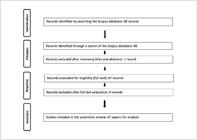
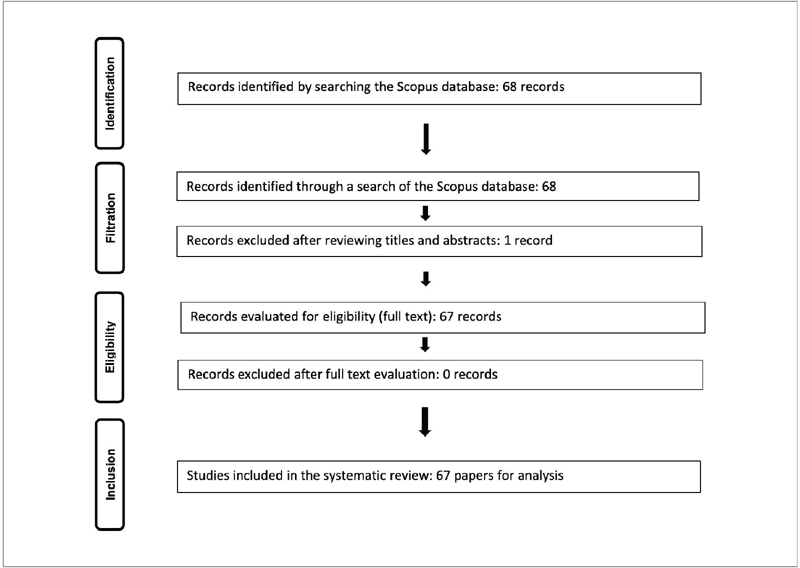
As shown in Figure 1, the final papers were obtained through a methodical and rigorous review process at each phase of examining the studies on the third mission of universities recorded in Scopus.
Graphs generated through Scopus, Bibliometrix, and VOSviewer were used to illustrate the dynamics between the various components identified, thus facilitating the visualization of how these components interact within the university ecosystem (Aria & Cuccurullo, 2017). These graphics contribute to a better understanding of the strategies that universities can adopt to improve their impact on society, guiding future academic policies and practices.
RESULTS
Bibliometric analysis
Through bibliometric analysis, we aim to map the development of the concept of the third mission of universities (TM), which has emerged as a key concept in contemporary academia. This analysis focuses on the interaction between universities, government, industry, and society, identifying the main trends, actors, and global collaborations that have shaped its evolution to better understand its progression through research.
A SCOPUS search was conducted as of August 30, 2024, initially yielding 68 records; however, one record from 1968 was excluded as it pertained to a different field of study. The bibliographic analysis focused on the period between 2009 and 2024, resulting in a total of 67 selected documents. Of these, 73% are academic articles, underscoring scientific journals as the primary means of dissemination in the field of the third mission of universities. The remaining 27% of the documents are distributed among conference papers, book chapters, books, and other formats, providing critical perspectives and complementary data demonstrating the diversity of formats used in knowledge dissemination.
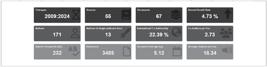
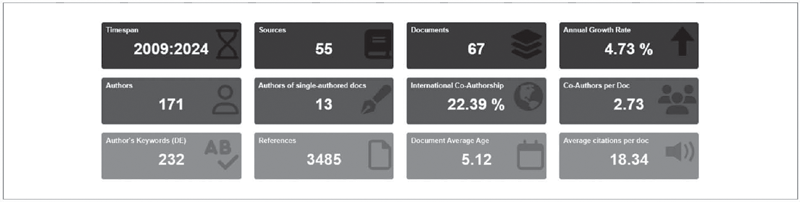
Figure 2 presents a detailed quantitative analysis of the bibliometrics related to scientific production on TM over the past 15 years. The study encompasses 67 papers published across 55 different sources, reflecting a notable diversity in dissemination channels and a strong trend toward collaboration, with contributions from 171 authors and an average of 2.7 co-authors per paper. Additionally, 22.39% of the papers feature international co-authorship, underscoring the global dimension of the subject. The academic impact of these studies is significant, with an average of 18.34 citations per paper and a total of 3,485 references, highlighting the strength and scope of the research. The average age of the papers is 5.12 years, indicating that while the research is relatively recent compared to other topics, it is relevant and driving current academic debates.
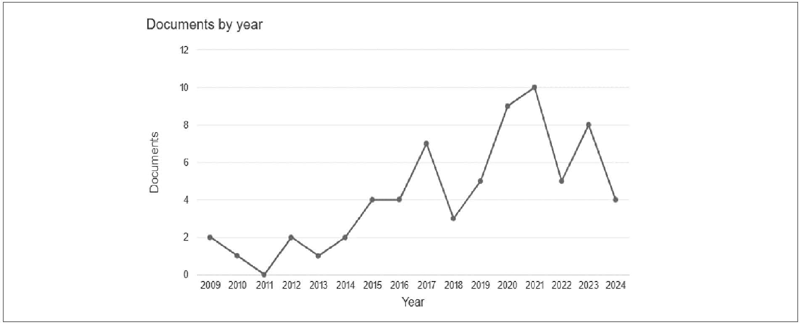
When analyzing scientific production over the study years, Figure 3 highlights the most significant SCOPUS trends in academic production related to TM. Firstly, there is a clear growth in the number of publications over time, especially from 2015 onwards, reaching a peak in 2021, which reaffirms the interest and importance of this topic.
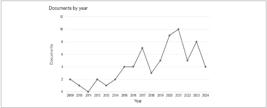
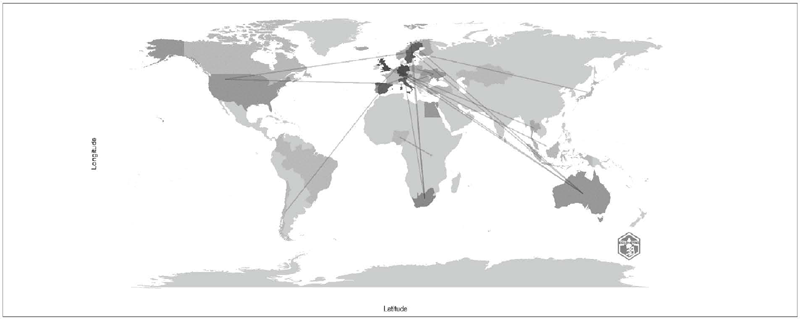
Figure 4 illustrates patterns that reflect inequality in global scientific production, mapping the collaboration between countries in TM research. It shows that most collaborations are concentrated in Europe and Oceania, with countries such as the United States, France, and Australia playing key roles in generating knowledge on this topic (Trencher et al., 2014). The international collaborative networks established by these regions have positioned them as leaders in third mission research. The connectivity between these countries indicates a high level of academic and scientific integration, fostering knowledge exchange that drives innovation and the application of the third mission of universities in diverse contexts.

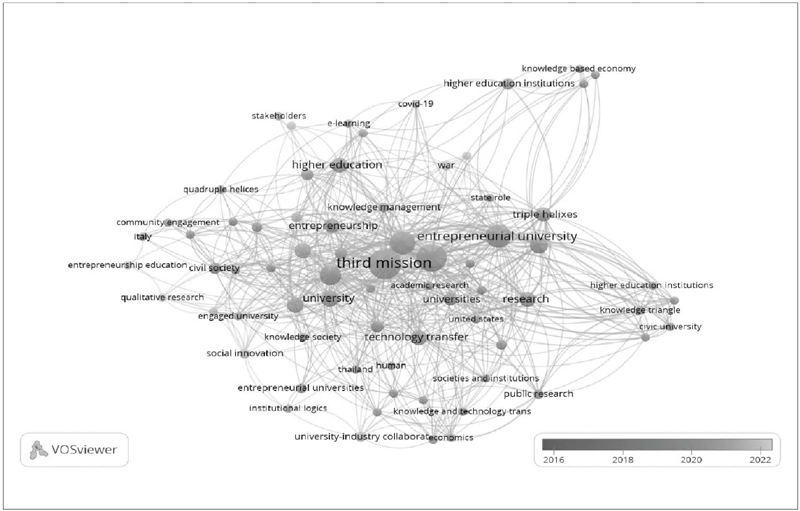
Figure 5 illustrates the relationship of keywords over time, highlighting the evolution of TM research. The networks generated by VOSviewer reveal patterns in the progress of this field. Terms such as “third mission,” “triple helix,” “innovation,” “entrepreneurial university,” and “technology transfer” occupy central and prominent positions on the map, underscoring their ongoing relevance. This pattern of connections suggests that the literature has shifted to explore how universities can foster innovation and knowledge transfer as two fundamental aspects of TM.
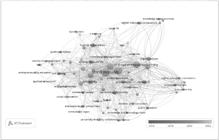
Figure 5 also reveals that in terms of frequency and temporal relevance, keywords like “innovation” and “entrepreneurial university” have gained prominence in recent years, as shown in the map. These terms reflect a growing interest in universities’ ability to play active roles in economic and social development by promoting entrepreneurship and innovation. Conversely, concepts such as “triple helix” indicate that their study remains ongoing and relevant in the literature, serving as a fundamental theoretical framework for analyzing collaboration among the various actors in the innovation ecosystem.
The progression of study themes over time also indicates emerging trends in the literature. The presence of keywords like “sustainable development goals” and “COVID-19” reflects how contemporary issues are being addressed in the literature. These terms demonstrate universities’ support for the global sustainability agenda and their response to global phenomena, such as crises, positioning TM as a framework for adaptive challenges within institutions.
Systematic analysis
This section presents the most comprehensive analysis of the existing literature on the third mission of universities (TM). Table 2 provides a selection of the most cited articles in Scopus on this topic, highlighting their fundamental role in the conceptualization, application, and identification of its key elements.
As shown in Table 2, the work of Rosli and Rossi (2016) stands out, demonstrating through a literature review how TM is linked to policy coordination and funding, with Rybnicek and Königsgruber (2019) highlighting the collaboration between university and industry. Murphy and Dyrenfurth (2012) emphasize the role of universities in job creation and economic development. Similarly, Leal et al. (2021) and Aversano et al. (2022) illustrate the implementation of the Sustainable Development Goals within universities and the integration of corporate social responsibility.
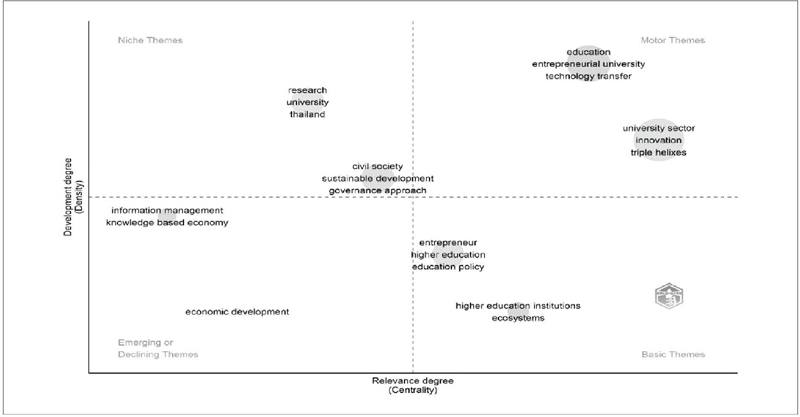
Figure 6 presents a thematic map that provides a detailed overview of key themes in research on the third mission of universities, illustrating their grouping and relationship to the elements of study according to relevance and level of development. The top right quadrant displays “driving themes” such as education, entrepreneurial university, technology transfer, innovation, and the triple helix model, which have high centrality and development, indicating their vital role in implementing TM. This involves universities working closely with industry and government to drive economic and social development. Another important aspect to note is the upper left quadrant, characterized by “niche topics,” where specialized and dense subjects such as research and universities are found. Meanwhile, the lower right quadrant presents “core themes” such as entrepreneurship, higher education, and ecosystems, indicating that these are broad, foundational themes of the third mission of universities.
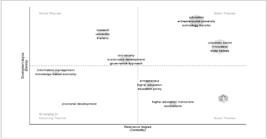
Finally, the lower right quadrant identifies “emerging themes” such as knowledge-based economics, information management, and economic development. Although these elements are less prominent and central, they are gaining importance over time as academic domains that are beginning to be explored.
Adoption and benefits of the third mission in higher education institutions
The adoption of the third mission of universities (TM) aligns with global trends towards a more socially engaged higher education, focusing on elements and categories found in the literature, such as innovation, entrepreneurship, and social engagement.
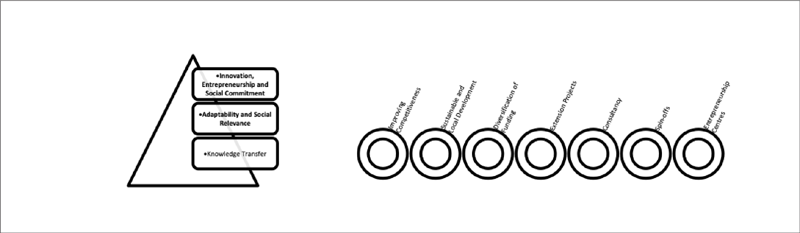
The present study suggests that higher education institutions (HEIs), particularly Latin American universities, which are underrepresented in high-impact research on this topic, adopt TM by considering three essential components (see Figure 7):

-
Innovation, entrepreneurship, and social commitment: This section emphasizes the importance of developing projects that contribute to the economic, cultural, and social development of the community.
-
Adaptability and Social Relevance: This will enable HEIs to adopt a model that adapts to social and economic changes, offering a comparison of programs more aligned with labor market needs and focused on addressing challenges and providing solutions to the Sustainable Development Goals (SDGs).
-
Knowledge Transfer: Promotes the creation and application of academic knowledge in society, generating social and economic impact.
As key aspects of adopting the third mission in institutions, there are components that can serve as differentiators. Firstly, they focus on enhancing competitiveness, distinguishing an HEI from other educational institutions and attracting students interested in practical experience and entrepreneurship. Secondly, they emphasize sustainable and local development, creating value from academic knowledge. Finally, they encourage diversification of funding, enabling access to new capital through collaboration with the business sector and government.
Figure 7 also shows that TM is crucial for institutions in accessing additional resources beyond traditional tuition fees. This access enables the development and promotion of outreach projects, consultancy services, spin-offs, entrepreneurship centers, incubators, and other initiatives.
In order for this to be included within the university strategy, it is recommended that TM align with its own incentives, such as: in the evaluation and promotion of professors, the activities of outreach programs should be recognized and valued at the same level as research and teaching; allocating funds and resources specifically designated to support programs, projects, and initiatives for community participation and knowledge transfer; establishing awards, distinctions, and recognitions to highlight best practices and initiatives in TM, led by professors, students, graduates, community, business, and government; and promoting collaboration in social impact projects through agreements, partnerships, and networks that facilitate interaction with external actors (such as corporations, government, and NGOs). To encourage greater transfer of technology and knowledge to society, it is necessary to adapt and make intellectual property policies more flexible and also to encourage the involvement of students with credits in voluntary service-learning and social assistance programs, as well as in internships or business practice with social care as part of their comprehensive training.
To conclude, it is argued, given the studies analyzed in different contexts, that implementing the third mission of universities represents a holistic strategy that not only addresses contemporary educational challenges but also promotes an active role for the institution in social innovation and economic development. This strengthens the traditional role of Latin American HEIs in teaching and research and also promotes their financial sustainability through the diversification of income sources.
DISCUSSION
This systematic and bibliometric analysis of the third mission of universities (TM) identifies elements of the structure that make up the object of study, both consolidated and developing within this field of research. The notable increase in the number of articles published, especially since 2015, highlights the interaction between university, industry, government, and society, as well as the mapping of scientific production over 15 years, from 2009 to 2024. The peak of Scopus publications occurred in 2021, indicating the consolidation of the topic on the international academic agenda. Latin America remains one of the least represented regions in this field, representing an opportunity to strengthen TM research in this region and foster stronger links for its appropriation.
The systematic review highlights the influence of key articles that have shaped the understanding and application of the third university mission. The thematic map analysis in Figure 6 provides a deeper understanding of how themes are organized within research on the third mission of higher education. Innovation, the entrepreneurial university, technology transfer, and education are the key “driving themes” for understanding the framework in which universities play an essential role in economic and social progress as they interact with industry and government. Context-specific research emphasizes specialized areas that, despite their relevance, have a narrower application. In contrast, “core themes” such as entrepreneurship and higher education institution ecosystems, while still requiring further exploration, provide the foundation for more expansive research areas, continued investigation, and a broader focus on less developed areas that may significantly impact TM’s future evolution. Finally, emerging or declining themes, such as information management, the knowledge-based economy, and economic development, present opportunities for future research and underscore the importance of focusing on underdeveloped areas that could have a notable impact on the field moving forward.
In conclusion, this research significantly impacts both the theory and practice of TM by identifying and analyzing consolidated and emerging trends, providing a framework for understanding how universities can continue to adapt and evolve in their role as drivers of economic and social development. Figure 7 shows a possible route for universities to adopt the third mission, highlighting essential components within the TM concept identified in this study, such as innovation, social engagement, knowledge transfer, and entrepreneurship. Universities can fulfill their traditional mission of teaching and research while contributing significantly to societal development through initiatives like creating spin-offs and strengthening social capital. These components are essential in generating differentiating elements that set them apart from other institutions. The importance of promoting greater international inclusion and cooperation in research on the third mission is also emphasized, underscoring the limited participation of regions such as Latin America. This broader inclusion would not only enrich the field of study with new perspectives but also allow universities in these regions to engage more actively in the global development agenda, contributing more effectively to the social and economic well- being of their local contexts.
CONCLUSIONS
This study provides an assessment of the current state and emerging trends in research on the third university mission (TM), highlighting its evolution and relevance in the contemporary academic context. Through a detailed bibliometric analysis, a sustained increase in TM-related scientific production has been observed, particularly since 2015, indicating a growing interest in the interaction between universities, government, industry, and society. This growth has been accompanied by a notable concentration of international collaborations in regions such as Europe and Oceania, while the low representation of Latin America in this field underscores the need for greater inclusion and participation from this region in global research. The systematic review shows that concepts such as the triple helix, technology transfer, the entrepreneurial university, and social engagement continue to be fundamental pillars in the literature, underscoring their crucial role in promoting economic and social development.
The thematic analysis identifies both established areas and emerging themes that merit attention in future research. While innovation and higher education are widely researched topics, the study reveals the emergence of new approaches, such as information management, the knowledge-based economy, and economic development. These themes, although currently less developed, have significant potential to impact the evolution of TM in the coming years. These findings suggest that the third mission remains a dynamic field, continuously adapting to new social, technological, and economic demands.
Higher education institutions (HEIs) can offer programs focused on social outreach to fulfill the third university mission. In this context, they can integrate sustainability and social responsibility into their curricula, conducting research in areas such as the circular economy, green mobility, and renewable energy—fostering community engagement and promoting research aimed at addressing the indicators outlined in the Sustainable Development Goals (SDGs). Finally, HEIs can play an active role in fostering entrepreneurship, which is essential for economic growth and job creation. Furthermore, they must have the ability to generate revenue outside academia, but it is crucial that they establish a knowledge transfer office where projects are shared among industry, government, community, and university.
It is therefore recommended that universities, particularly those in Latin America, intensify their efforts to engage more actively in the study and application of TM based on these findings; work on impact and improvement projects related to the SDGs in their countries; and develop innovative products in collaboration with industry and government to address social and commercial issues and promote entrepreneurship. It is essential that governments support these initiatives, aligning funding and incentives with the objectives of the third mission, so that universities can maximize their social and economic impact.
This study has certain limitations, which in turn present opportunities for future research. Firstly, it includes studies with a geographical bias, and it would be important to analyze and contribute to the development of research in this field in Latin America. Additionally, future work should further explore the emerging areas identified, such as information management and the knowledge-based economy in university management. Finally, empirical studies evaluating the impact of TM in different regional and social contexts of universities are needed to provide a deeper and more nuanced understanding of its implementation.
-
Evaluated through double-anonymized peer review.
References
-
Aria, M., & Cuccurullo, C. (2017). Bibliometrix: An R-tool for comprehensive science mapping analysis. Journal of Informetrics, 11(4), 959-975. https://doi.org/10.1016/j.joi.2017.08.007
» https://doi.org/10.1016/j.joi.2017.08.007 -
Aversano, N., Nicolò, G., Sannino, G., & Tartaglia, P. (2022). Corporate social responsibility, stakeholder engagement, and universities. Administrative Sciences, 12(3), 79. https://doi.org/10.3390/admsci12030079
» https://doi.org/10.3390/admsci12030079 -
Benneworth, P., Boer, H. de, & Jongbloed, B. (2015). Between good intentions and urgent stakeholder pressures: Institutionalizing the universities’ third mission in the Swedish context. European Journal of Higher Education, 5(3), 280-296. https://doi.org/10.1080/21568235.2015.1044549
» https://doi.org/10.1080/21568235.2015.1044549 -
Brauner, D., Reichert, F., Janissek-Muniz, R., Zen, A., Menezes, D., Closs, L., Carraro, W., Ruppenthal, C., Muller, F., Lubaszewski, M., & Rhoden, M. (2020). An engaged university: Rescuing SMEs during the Covid-19 crisis. RAE-Revista de Administração de Empresas, 60(6), 437-450. https://doi.org/10.1590/s0034-759020200607
» https://doi.org/10.1590/s0034-759020200607 -
Bueno, E. (2007). La Tercera Misión de la Universidad: El reto de la transferencia del conocimiento. Revista Madrid,41, 2. https://dialnet.unirioja.es/servlet/articulo?codigo=2313692&info=resumen&idioma=SPA
» https://dialnet.unirioja.es/servlet/articulo?codigo=2313692&info=resumen&idioma=SPA -
Chang, H. (2010). El modelo de la triple hélice como un medio para la vinculación entre la universidad y empresa. Revista Nacional de Administración, 1(1), 85-94. https://doi.org/10.22458/rna.v1i1.286
» https://doi.org/10.22458/rna.v1i1.286 -
Cochrane. (2019). Cochrane handbook for systematic reviews of interventions (Higgins, J. Thomas, J. Chandler, M. Cumpston, T. Li, M. Page, & V. Welch, Eds.). Wiley Blackwell. https://doi.org/10.1002/9781119536604
» https://doi.org/10.1002/9781119536604 -
Compagnucci, L., & Spigarelli, F. (2020). The Third Mission of the university: A systematic literature review on potentials and constraints. Technological Forecasting and Social Change, 161, 120284. https://doi.org/10.1016/j.techfore.2020.120284
» https://doi.org/10.1016/j.techfore.2020.120284 -
Compagnucci, L., Spigarelli, F., Coelho, J., & Duarte, C. (2021). Living labs and user engagement for innovation and sustainability. Journal of Cleaner Production, 289, 125721. https://doi.org/10.1016/j.jclepro.2020.125721
» https://doi.org/10.1016/j.jclepro.2020.125721 -
Cuesta-Delgado, D., Barberá-Tomás, D., & Marques, P. (2024). A text-mining analysis of Latin America Universities’ mission statements from a ‘Third Mission’ perspective. Studies in Higher Education, 1-19. https://doi.org/10.1080/03075079.2024.2377371
» https://doi.org/10.1080/03075079.2024.2377371 -
Eck, N. van, & Waltman, L. (2010). Software survey: VOSviewer, a computer program for bibliometric mapping. Scientometrics, 84(2), 523-538. https://doi.org/10.1007/s11192-009-0146-3
» https://doi.org/10.1007/s11192-009-0146-3 -
Etzkowitz, H., & Leydesdorff, L. (2000). The dynamics of innovation: from National Systems and “Mode 2” to a Triple Helix of university–industry–government relations. Research Policy, 29(2), 109- 123. https://doi.org/10.1016/S0048-7333(99)00055-4
» https://doi.org/10.1016/S0048-7333(99)00055-4 -
Forliano, C., Bernardi, P. De, & Yahiaoui, D. (2021). Entrepreneurial universities: A bibliometric analysis within the business and management domains. Technological Forecasting and Social Change, 165, 120522. https://doi.org/10.1016/j.techfore.2020.120522
» https://doi.org/10.1016/j.techfore.2020.120522 -
Kudryashova, E., Sorokin, S., & Bugaenko, O. (2020). University-industry interaction as an element of the university’s «third mission». Vysshee Obrazovanie v Rossii, 29(5), 9-21. https://doi.org/10.31992/0869-3617-2020-29-5-9-21
» https://doi.org/10.31992/0869-3617-2020-29-5-9-21 -
Leal, W., Frankenberger, F., Salvia, A., Azeiteiro, U., Alves, F., Castro, P., Will, M., Platje, J., Lovren, V., Brandli, L., Mifsud, M., & Ávila, L. (2021). A framework for the implementation of the sustainable development goals in university programmes. Journal of Cleaner Production, 299, 126915. https://doi.org/10.1016/j.jclepro.2021.126915
» https://doi.org/10.1016/j.jclepro.2021.126915 -
Loiotile, A. D., Nicolò, F. De, Agrimi, A., Bellantuono, L., Rocca, M. La, Monaco, A., Pantaleo, E., Tangaro, S., Amoroso, N., & Bellotti, R. (2022). Best practices in knowledge transfer: Insights from top universities. Sustainability (Switzerland), 14(22), 15427. https://doi.org/10.3390/su142215427
» https://doi.org/10.3390/su142215427 -
Luengo, M., & Obeso, M. (2013). The triple helix effect on innovation performance. RAE-Revista de Administração de Empresas, 53, 388-399. https://periodicos.fgv.br/rae/article/view/30027
» https://periodicos.fgv.br/rae/article/view/30027 -
Moher, D., Liberati, A., Tetzlaff, J., & Altman, D. (2009). Preferred reporting items for systematic reviews and meta-analyses: The PRISMA statement. PLoS Medicine, 6(7), e1000097. https://doi.org/10.1371/journal.pmed.1000097
» https://doi.org/10.1371/journal.pmed.1000097 -
Moulaert, F., Martinelli, F., Swyngedouw, E., & Gonzalez, S. (2005). Towards alternative model(s) of local innovation. Urban Studies, 42(11), 1969-1990. https://doi.org/10.1080/00420980500279893
» https://doi.org/10.1080/00420980500279893 -
Mulder, K., Segalàs, J., & Ferrer-Balas, D. (2012). How to educate engineers for/in sustainable development. International Journal of Sustainability in Higher Education, 13(3), 211-218. https://doi.org/10.1108/14676371211242535
» https://doi.org/10.1108/14676371211242535 -
Murphy, M., & Dyrenfurth, M. (2019). The expanding business of the entrepreneurial university: Job creation. In: Christensen, S.H., Delahousse, B., Didier, C., Meganck, M., Murphy, M. (eds) The Engineering-Business Nexus. Philosophy of Engineering and Technology, 32. Springer, Cham. https://doi.org/10.1007/978-3-319-99636-3_11
» https://doi.org/10.1007/978-3-319-99636-3_11 - Murphy, M., & Dyrenfurth, M. J. (2012). The role of the university in creating jobs: Job creation as a function of engineering and. In Proceedings of the ASEE Annual Conference and Exposition
-
Ortiz-Reyes, M., Williams-Tejeda, D., Delgado, M., Lopez, J., & Negron, N. (2017). La tercera misión de las universidades. Cuaderno de Investigación en la Educación, 32, 30-50. https://revistas.upr.edu/index.php/educacion/article/view/13922/11618
» https://revistas.upr.edu/index.php/educacion/article/view/13922/11618 -
Popescu, M., & Mandru, L. (2020, noviembre 5). A new generic model for the management system of University’s Third Mission” Case study in Romania https://www.researchgate.net/publication/348447663_A_New_Generic_Model_for_The_Management_System_of_University%27s_Third_Mission_Case_Study_in_Romania
» https://www.researchgate.net/publication/348447663_A_New_Generic_Model_for_The_Management_System_of_University%27s_Third_Mission_Case_Study_in_Romania -
Rincón, M. (2024). Capacidades dinámicas y su abordaje en las universidades: Una revisión sistemática de la literatura. Revista Venezolana de Gerencia, 29(Especial 11), 15-36. https://doi.org/10.52080/rvgluz.29.e11.1
» https://doi.org/10.52080/rvgluz.29.e11.1 -
Rosli, A., & Rossi, F. (2016). Third-mission policy goals and incentives from performance-based funding: Are they aligned? Research Evaluation, 25(4), 427-441. https://doi.org/10.1093/reseval/rvw012
» https://doi.org/10.1093/reseval/rvw012 -
Rothaermel, F., Agung, S., & Jiang, L. (2007). University entrepreneurship: A taxonomy of the literature. Industrial and Corporate Change, 16(4), 691-791. https://doi.org/10.1093/icc/dtm023
» https://doi.org/10.1093/icc/dtm023 -
Rybnicek, R., & Königsgruber, R. (2019). What makes industry–university collaboration succeed? A systematic review of the literature. Journal of Business Economics, 89(2), 221-250. https://doi.org/10.1007/s11573-018-0916-6
» https://doi.org/10.1007/s11573-018-0916-6 -
Touriñán, J. (2020). La ‘tercera misión’ de la universidad, transferencia de conocimiento y sociedades del conocimiento: Una aproximación desde la pedagogía. Contextos Educativos – Revista de Educación, 26, 41-81. https://doi.org/10.18172/con.4446
» https://doi.org/10.18172/con.4446 -
Trencher, G., Yarime, M., McCormick, K., Doll, C., & Kraines, S. (2014). Beyond the third mission: Exploring the emerging university function of co-creation for sustainability. Science and Public Policy, 41(2), 151-179. https://doi.org/10.1093/scipol/sct044
» https://doi.org/10.1093/scipol/sct044 -
Valbuena, S., & Sánchez, R. (2024). Gestión del conocimiento, capital intelectual y educación: Análisis bibliométrico 1999-2023. Revista Universidad y Empresa, 26(47), 1-36. https://doi.org/10.12804/revistas.urosario.edu.co/empresa/a.13674
» https://doi.org/10.12804/revistas.urosario.edu.co/empresa/a.13674
Edited by
-
Guest Editors:
Charles Kirschbaum, Daniel Paulino Teixeira Lopes, Gregory Pogue, Kadígia Faccin, and Ricardo Reolon

 Source: Adapted from
  Source: Based on metadata from the Scopus platform using Bibliometrix software
 Source: Based on metadata from the Scopus platform
 Source: Based on metadata from the Scopus platform using Bibliometrix software
 Source: Based on metadata from the Scopus platform using VOSviewer software
 Source: Based on metadata from the Scopus platform using Bibliometrix software