 INDUSTRY, UNIVERSITY, AND INNOVATION: UNDERSTANDING THE RELATIONSHIP BETWEEN COLLABORATION CHANNELS AND FIRM INNOVATION CAPABILITIES IN BRAZIL
ABSTRACT
This study analyzes the influence of different university-industry (U-I) collaboration channels through which firms enhance their innovation capabilities. A survey was conducted with 176 Brazilian manufacturing firms. The results indicate that while U-I collaboration channels are important for building firm innovation capabilities, not all channels are equally effective. Collaboration channels based on knowledge transfer are the most beneficial for firms in terms of their impact on innovation capabilities, particularly in the dimensions of management, transaction, and development capabilities, compared to those based on innovation networks. This means that knowledge transfer through technology licensing, training, HR recruitment, and publications and reports, improve the firms’ internal process and innovation capabilities. This article contributes to the understanding of universities’ impact on firms beyond short-term measures, such as financial and innovation performance, by providing a holistic perspective. Finally, it is important to emphasize that this study sheds light on the specific dynamics of the interaction between two key societal actors-universities and industrial firms-in the generation and application of scientific and technological knowledge. It contributes to the broader discourse on Sustainable Development Goal 9 - Industry, Innovation, and Infrastructure, particularly within the context of an emerging economy.
Keywords:
university-industry collaboration; firm innovation capability; firm innovation performance; manufacturing firms; collaboration channels.
RESUMO
O objetivo deste estudo é analisar a influência de diferentes canais de colaboração universidade-empresa (U-E) por meio dos quais as empresas aprimoram suas capacidades de inovação. Uma pesquisa foi conduzida com 176 empresas brasileiras de manufatura. Os resultados indicam que, embora os canais de colaboração U-E sejam importantes para a construção de capacidades de inovação das empresas, nem todos são igualmente eficazes. Os canais de colaboração baseados na transferência de conhecimento são os mais benéficos para as empresas em termos de seu impacto nas capacidades de inovação, particularmente nas dimensões de gestão, transação e desenvolvimento, em comparação com aqueles baseados em redes de inovação. Isso significa que a transferência de conhecimento por meio de tecnologias licenciadas, treinamento, recrutamento de RH e publicações e relatórios permite que as empresas melhorem seus processos internos e, por sua vez, sua capacidade de inovação. Por fim, é importante destacar que este estudo esclarece as dinâmicas específicas da interação entre dois atores sociais fundamentais - universidades e empresas industriais - na geração e aplicação de conhecimento científico e tecnológico. Ao fazer isso, contribui para o debate mais amplo sobre o Objetivo de Desenvolvimento Sustentável 9 - Indústria, Inovação e Infraestrutura, particularmente no contexto de uma economia emergente.
Palavras-chave:
colaboração universidade-empresa; capacidade de inovação empresarial; desempenho de inovação empresarial; empresas de manufatura; canais de colaboração.
RESUMEN
El objetivo de este estudio es analizar la influencia de los diferentes canales de colaboración universidad-empresa (U-I) a través de los cuales las empresas mejoran sus capacidades de innovación. Se realizó una encuesta con 176 empresas manufactureras brasileñas. Los resultados indican que, si bien los canales de colaboración U-I son importantes para desarrollar capacidades de innovación en las empresas, no todos los canales son igualmente efectivos. Los canales de colaboración basados en la transferencia de conocimiento son los más beneficiosos para las empresas en términos de su impacto en las capacidades de innovación, particularmente en las dimensiones de gestión, transacciones y capacidades de desarrollo, en comparación con los basados en redes de innovación. Esto significa que la transferencia de conocimiento a través de licencias de tecnología, capacitación, contratación de recursos humanos y publicaciones e informes permite a las empresas mejorar sus procesos internos y, a su vez, sus capacidades de innovación. Este artículo contribuye a la comprensión del impacto de las universidades en las empresas más allá de las medidas de corto plazo, como el desempeño financiero y de innovación, al proporcionar una perspectiva holística. Finalmente, es importante subrayar que este estudio arroja luz sobre las dinámicas específicas de la interacción entre dos actores sociales clave -las universidades y las empresas industriales- en la generación y aplicación de conocimiento científico y tecnológico. Al hacerlo, contribuye al discurso más amplio sobre el Objetivo de Desarrollo Sostenible 9 - Industria, Innovación e Infraestructura, particularmente en el contexto de una economía emergente.
Palabras clave
colaboración universidad-industria; capacidad de innovación de las empresas; desempeño de innovación de las empresas; empresas manufactureras; canales de colaboración.
INTRODUCTION
The role of universities in generating knowledge and innovation is a topic that is gaining increasing attention from academics and policymakers. Establishing a relationship between university activities and the social and economic returns to society is essential to expanding the possibilities of applying knowledge and generating solutions to societal problems. One form of the relationship between the university and society is the university-industry (U-I) interaction. Through this interaction, it is possible to understand how the university engages with companies to generate innovations and potentially increase their competitiveness.
There are many avenues that universities can pursue to become entrepreneurial and transfer their knowledge and technology to firms (Etzkowitz, 2003; Guerrero & Urbano, 2012). U-I collaboration provides firms with access to valuable resources that are useful for innovation activities, such as human resources, university infrastructure, and technology licensing (Bishop et al., 2011). Consequently, most academic literature posits that U-I collaboration allows firms to increase their performance (Apa et al., 2021; Robin & Schubert, 2013).
However, the empirical literature on the benefits of U-I collaboration has important gaps. The first gap concerns understanding which collaboration channels are the most beneficial for firms’ innovativeness. To date, the few studies exploring distinct types of U-I collaboration have revealed that they have different impacts on firms’ innovation activities and performance (Jones & Zubielqui, 2017; Puffal et al., 2021).
The second gap is the lack of a holistic approach when measuring the outcomes of U-I collaboration for firms. For instance, it is known that the potential benefits of U-I collaboration extend far beyond an increase in firm performance, allowing for the development of firms’ R&D and learning capabilities (Ahrweiler et al., 2011; Fuentes & Dutrénit, 2012). However, previous studies have evaluated the impact of U-I collaboration either on firm performance (Fitjar & Rodriguez-Posé, 2013) or on non-performance benefits, without combining them in the same study (Bishop et al., 2011; Fuentes & Dutrénit, 2012). Thus, focusing on only one type of U-I collaboration outcome for firms implies a lack of a holistic view of the benefits obtained by the firms.
Innovation capability is one of the most important capabilities for firms (Guan & Ma, 2003; Hogan et al., 2011; Saunila, 2020; Zawislak et al., 2012). It allows a firm to achieve superior performance (Reichert et al., 2016; Zawislak et al., 2012) and sustain that performance in the long term (Saunila & Ukko, 2012).
Previous empirical studies have shown that access to a university’s knowledge and resources enhances a firm’s ability to build its capabilities (Ahrweiler et al., 2011; Fuentes & Dutrénit, 2012). However, few studies have examined the impact of universities on firms’ innovation capabilities.
Hence, we posit the following research question: What is the influence of different U-I collaboration channels on the innovation capabilities and performance of manufacturing firms? To answer this question, an exploratory theoretical-empirical research study was conducted. Hypotheses were constructed based on a literature review and tested using a primary database collected through a survey conducted in 2021 with 176 Brazilian manufacturing firms that engaged in collaboration with universities. The data was analyzed using the structural equation modeling technique.
The theoretical contribution of this article is twofold. First, it offers a holistic examination of the range of potential benefits firms obtain from collaboration with universities by incorporating innovation capability into the model and demonstrating how different types of U-I collaboration have varying impacts on firms’ innovation capability and performance. We highlight that U-I collaboration influences four key dimensions of innovation capability: management, transactions, development, and operations, with particular emphasis on the first three, as they play a central role in shaping firms’ long-term competitiveness. Moreover, our findings indicate that knowledge transfer channels have a stronger impact on enhancing these capabilities compared to innovation networks, reinforcing the strategic relevance of structured knowledge exchange in fostering industrial firms’ innovation capabilities in Brazil.
Second, the study contributes to the strategic understanding of collaboration mechanisms by providing insights into the options firms have in terms of collaboration channels to build their innovation capabilities. By distinguishing the relative influence of knowledge transfer and innovation networks, our analysis offers a refined perspective on how firms can optimize their engagement with universities to achieve innovation outcomes. Hence, we do not state that all types of U-I collaboration should be pursued at all costs.
INNOVATION CAPABILITY AND U-I COLLABORATION
This section is divided into 2 subsections. First, a general introduction to innovation capabilities and university-industry (U-I) collaboration is presented. Then, hypotheses are constructed.
Overview of firms’ innovation capabilities and U-I collaboration
From an innovation performance perspective, innovation capability is one of the most important for firms, as it allows them to achieve superior innovation performance (Reichert et al., 2016; Zawislak et al., 2012) and sustain that performance in the long term (Guan & Ma, 2003; Hogan et al., 2011; Saunila, 2020; Saunila & Ukko, 2012; Zawislak et al., 2012). Innovation capability can be defined as “the ability to continuously transform knowledge and ideas into new products, processes, and systems for the benefit of the firm and its stakeholders” (Lawson & Samson, 2001).
Firms seek to engage in U-I collaboration for different reasons, such as sourcing state-of-the-art scientific and technological knowledge, using physical facilities, and enhancing innovativeness (Bonaccorsi & Piccaluga, 1994). In turn, the possession of specific types of resources and access to knowledge sources serves as an input for building innovation capability (Castela et al., 2018; Guan & Ma, 2003). Previous empirical investigations have shown that external relations are important tools to enhance firm innovation performance (Fitjar & Rodríguez-Pose, 2013; Mikhailov et al., 2020).
There are different perceptions of what a firm’s capabilities are. Leonard-Barton (1992) argued that a firm’s core capabilities are embedded in employees’ knowledge and in the firm’s internal systems, such as technical and organizational ones. Additionally, values and norms are also part of a firm’s core capabilities (Leonard-Barton, 1992). It is important to add that universities are excellent human-resource providers. Therefore, they can act as catalysts for firms’ core capabilities in human resource aspects (Jones & Zubielqui, 2017).
Helfat (1997) argued that innovation capability is dependent on a firm’s R&D activities. Conducting R&D in collaboration with a university or outsourcing R&D to a university provides an opportunity not only to develop new products or processes but also to lower investment costs. However, conducting R&D activities requires advanced knowledge and state-of-the-art knowledge from universities may act as a catalyst for enhancing the knowledge stock needed (D’Este & Patel, 2007; Etzkowitz & Zhou, 2017).
Various empirical studies have been conducted to measure the benefits of U-I collaboration for firms. They identified six types of benefits: financial performance improvement, product innovation, process innovation, technological performance, increased learning capabilities, and firm longevity (Alpkan & Gemici, 2023;; Fuentes & Dutrénit, 2012; Min et al., 2019; Puffal et al., 2021).
Most studies focus on measuring the effects of collaboration on financial, technological, and innovation performance, often overlooking other important measures (Min et al., 2019). Moreover, there is no consensus on which types of collaboration are most beneficial for firms. For instance, Puffal et al. (2021) posit that U-I collaboration based on the exploration of university knowledge enhances the product and process innovativeness of Brazilian firms. Mikhailov et al. (2020) found similar results, suggesting that firms should engage in knowledge-intensive collaboration.
Apa et al. (2021) demonstrated that formal and informal collaboration between universities and industry positively influenced the innovation performance of small and medium-sized enterprises in Italy. However, informal collaboration between universities and industry may not have the same effect on innovation for companies in Ghana (Abdulai et al., 2020) and Italian SMEs (Garcia-Perez-de-Lema et al., 2017). Fuentes and Dutrénit’s (2012) research revealed that training-based U-I collaboration generally does not impact innovation in Mexican admanufacturing firms, whereas human resource-based collaboration does.
In their study, Puffal et al. (2021) found that knowledge transfer collaborations are more beneficial for process innovation, while collaborations utilizing university infrastructure are more beneficial for product innovation. Mikhailov et al. (2020) suggest that the presence of research-oriented or development-oriented collaborations is necessary for firms to achieve high innovativeness, but not other types of U-I collaboration.
Liboreiro et al. (2022) demonstrated that university laboratory spin-offs are important for U-I collaboration but typically do not result in the creation of innovative products. Additionally, prior quantitative studies have indicated that intellectual property generated by universities in collaborative research laboratories may not lead to the development or success of new products (Zawislak & Dalmarco, 2011).
U-I collaborations can be classified in various ways (e.g., D’Este & Patel, 2007; Póvoa & Rapini, 2010). Building on the idea that U-I collaborations enable firms to access diverse resources, we categorize them based on the channels firms use in their innovation activities. Drawing from existing classifications, we propose a typology of U-I collaborations based on these channels. Table 1 outlines two types of U-I collaboration. The first one, called ‘knowledge transfer,’ involves utilizing channels such as training, HR recruitment, technology licensing, and reading publications and reports. The second type, called ‘innovation networks,’ focuses on collaboration channels such as consulting, outsourced R&D, joint R&D, accessing university networks, HR exchange, and spinoffs.
Constructing hypotheses
In emerging economies, where structural constraints and weaker R&D capability limit firms’ ability to innovate independently, universities act as essential sources of specialized knowledge and skilled human capital (D’Este & Patel, 2007; Vega-Jurado et al., 2017). Knowledge transfer mechanisms, such as technology licensing, training, and HR recruitment, allow firms to absorb external knowledge and enhance efficiency and innovativeness of their internal routines (Bishop et al., 2011; Puffal et al., 2021).
By integrating university knowledge, firms can strengthen their problem-solving, R&D, and production processes, helping them progress toward more advanced innovation activities (Apa et al., 2021; Fitjar & Rodríguez-Posé, 2013). HR recruitment also plays a key role in bridging the skills gap and fostering continuous learning within firms (Jones & Zubielqui, 2017).
These collaborative engagements help the firms to leverage university expertise to gradually enhance their innovation capabilities and, even partially bridge the innovation gap with firms in developed economies, which are known for having high innovation capabilities (Fuentes & Dutrénit, 2012; Puffal et al., 2021). Hence, we propose the following hypothesis:
-
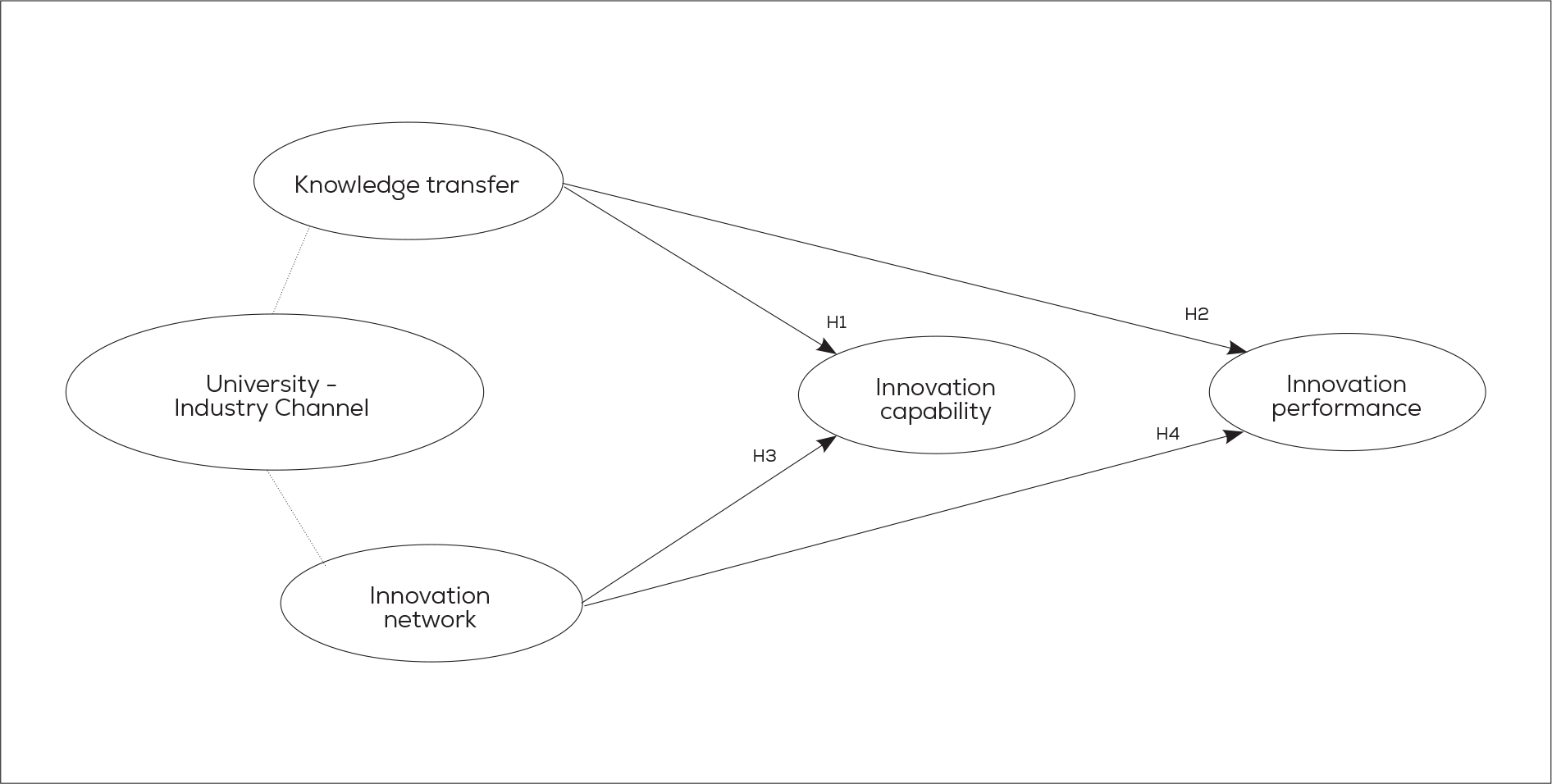
H1: The use of knowledge transfer collaboration channels has a positive effect on the innovation capability of firms engaged in U-I collaboration.
Previous research has demonstrated that knowledge transfer mechanisms -such as training, recruitment, and technology licensing- may serve as critical pathways for firms to internalize external knowledge and convert it into innovation outcomes through new or significantly improved processes and products (D’Este & Patel, 2007; Vega-Jurado et al., 2017). By engaging in these collaborative channels, firms gain structured access to codified and tacit knowledge generated in universities, which in turn strengthens their capabilities and enhances their innovation performance. This effect is particularly relevant when firms utilize formalized knowledge transfer mechanisms, as they provide a structured way to incorporate scientific and technological knowledge into innovation activities (Bishop et al., 2011). The literature highlights that firms benefiting from knowledge transfer collaborations may experience long-term innovation improvements, as they embed the acquired expertise, allowing for a more systemic integration of new knowledge into their innovation activities (Puffal et al., 2021). Moreover, knowledge transfer collaborations play a fundamental role in enabling firms to upgrade their innovation-related routines, particularly when using human resource recruitment and training programs (Jones & Zubielqui, 2017). These factors contribute to enhancing firm innovation performance, particularly in emerging economies, where firms tend to lack high-level internal routines that allow them to present superior innovation performance (Fischer et al., 2019).
-
H2: The use of knowledge transfer collaboration channels has a positive effect on the innovation performance of firms engaged in U-I collaboration.
Theoretical perspectives on innovation suggest that firms benefit from external collaborations by developing more advanced and efficient internal routines (Chesbrough, 2006). Innovation networks enable firms to access university-based expertise through consulting, joint R&D, and participation in collaborative research networks. This collaborative setting fosters the co-creation of knowledge and allows firms to enhance their exploratory and exploitative learning capabilities, which are crucial for the development of sustained capabilities (Bishop et al., 2011; Póvoa & Rapini, 2010). Innovation networks serve as dynamic platforms for firms to experiment with new technologies, co-develop solutions with academic researchers, and gain exposure to state-of-the-art infrastructure, all of which directly impact their ability to innovate (D’Este & Patel, 2007). Studies have shown that firms engaging in such collaborative networks demonstrate higher levels of technological sophistication due to their access to interdisciplinary expertise and advanced problem-solving frameworks (Mikhailov et al., 2020). In this context, the firm’s ability to establish and maintain research-oriented and development-oriented collaborations becomes a key determinant of its innovation potential, further reinforcing the role of innovation networks in shaping long-term competitive advantage (Mikhailov & Puffal, 2023). Hence, we propose hypothesis 3.
-
H3: The use of innovation networks and collaboration channels has a positive effect on the innovation capability of firms engaged in U-I collaboration.
Empirical studies suggest that firms engaging in research-oriented university collaborations benefit not only in terms of capability development but also in direct innovation performance improvements (Mikhailov & Puffal, 2023; Puffal et al., 2021). Innovation networks facilitate a firm’s access to cutting-edge research, specialized infrastructure, and interdisciplinary expertise, which are essential drivers of product and process innovation (D’Este & Patel, 2007). Moreover, firms that actively participate in innovation partnerships tend to develop more radical innovations compared to those that rely solely on internal R&D (Min et al.,, 2019). Therefore, by leveraging university partnerships within innovation networks, firms are better positioned to enhance their innovation performance and introduce market-relevant innovations. Hence, we propose hypothesis 4.
-
H4: The use of innovation networks and collaboration channels has a positive effect on the innovation performance of firms engaged in U-I collaboration.
Figure 1 presents the conceptual model examined empirically in this study.
The Influence of U-I Collaboration Channels on Firms’ Innovation Capabilities and Firms’ Innovation Performance
U-I COLLABORATION AND INNOVATION IN BRAZIL
The development of science, technology, and innovation in Brazil occurred differently than in Europe and North America (Rapini et al., 2015). The establishment of universities in Brazil was delayed compared to many other Latin American countries (Suzigan, 2011). The first Brazilian universities, founded in the 20th century, primarily focused on undergraduate teaching due to the limited demand for skilled workers from industry (Rapini et al., 2015).
The institutionalization of science in Brazil began in the mid-1950s. During this period, science and technology policies followed a ‘supply logic,’ creating knowledge based on internal priorities with minimal industry involvement. This approach was based on the “Linear Model,” which assumed that knowledge would naturally flow to the productive sector (Rapini et al., 2015). Entrepreneurial universities began to emerge only in the 21st century.
Until the late 2000s, traditional teaching and research institutions operated with limited interaction, leading to a restricted positive feedback loop between science and technology (Dalmarco et al., 2019; Suzigan & Albuquerque, 2008). The immaturity of the Brazilian National Innovation System (NIS) also highlights the prevalence of low levels of private investment in R&D (Albuquerque, 1996; Albuquerque et al., 2015), and the structural feature of higher public spending on R&D over private investment (Schneegans et al., 2021).
The most common characteristics of innovations generated by Brazilian firms are those of low-tech intensity and generally of a process type (reflecting a competitiveness based more on costs than on product differentiation, for example) (Fischer et al., 2019). This characteristic affects firms´ ability to absorb relevant external knowledge. Knowledge from suppliers and competitors is considered more important than other external sources of knowledge (Caliari et al., 2021). This suggests the adoption of strategies termed by the authors as “passive-dependent” for process innovation and “active-imitative” for product innovation by Brazilian firms.
Numerous studies have examined the university-industry (U-I) interaction in Brazil and the influence of activities carried out by universities on generating innovation in companies. Some studies highligh weakness in Brazil’s National Innovation System (NIS) regarding its ability to systematically and continuously foster interaction among its actors. On the other hand, a notable increase in the number of interactions between firms and universities over time and across different fields of knowledge has been found. The study by Suzigan (2011) stands out in this regard for revealing significant historical and current characteristics of the U-I interaction in Brazil.
In the same vein, it is noteworthy that more recent studies indicate that U-I collaboration in Brazil has been strengthening (Fischer et al., 2019; Santiago & Lauriano, 2023). Since the 2000s, universities have increasingly engaged with industry, leading to a rise in the number of companies involved in such collaborations. The percentage of innovative Brazilian companies interacting with universities grew from 1.96% in 2003 to 7.20% in 2014 (Fischer et al., 2019). Moreover, a recent study by Figueiredo et al. (2021) identified the significance of non-R&D interactions with universities in developing low-level technological capabilities.
METHOD AND MEASURES
We conducted a specially designed survey targeting managers of manufacturing firms that interacted with universities and research institutes. The survey used a structured questionnaire that measured: (1) University-industry (U-I) collaboration, (2) firms’ innovation capabilities, and (3) firms’ innovation performance.
Data
The list of manufacturing firms was obtained from the CNPq Directory of Research Groups Census (DGP-CNPq) 2016, which was the most recent national census (Conselho Nacional de Desenvolvimento Científico e Tecnológico, 2021). This database contains data on all research groups formally registered in Brazil and has been organized by the Brazilian National Council for Scientific and Technological Development (CNPq). The questionnaire used to form the database was completed by leaders of scientific research groups and contained a wide range of information on the composition of research groups, location, scientific and technological productions, and relationships with other stakeholders. By checking the sectoral activity classification code (CNAE) of the research groups’ partners, 1,026 manufacturing firms that collaborated with universities were identified.
Constructs and variables
The validity and reliability of the data collection instrument are crucial parts of the survey method (Churchill, 1979). All questions and constructs of the structured questionnaire applied were based on validated measurement instruments (Alves et al., 2017; Reichert et al., 2016).
Dependent variables
The dependent variables were divided into two groups (Table 2 and Table 3). The first group included first-order dependent variables based on the innovation capabilities model of Zawislak et al. (2012), namely, development capability (DC), operations capability (OC), management capability (MC), and transaction capability (TC), which were previously applied through validated measurement instruments.
It is crucial to highlight that development capability refers to a firm´s ability to understand the current state of technological advancements and, when necessary, adapt these technologies to enhance or modify its operational capability and any other capabilities aimed at achieving greater technical and economic efficiency. Operational capability, in turn, refers to the firm’s ability to execute its production capability through routines that integrate knowledge, skills, and technical systems at a specific point in time (Zawislak et al., 2012).
Management capability involves the ability to convert the results of technological development into organized operations and transactional agreements. Finally, transaction capability encompasses the firm’s capability to minimize market negotiation and logistics costs, effectively improving its transaction costs. Together, these capabilities form a company’s innovation capability (Reichert et al., 2016; Zawislak et al., 2012).
It is important to emphasize that the model developed by Zawislak et al. (2012) has been applied to develop innovation capabilities measurement scales specifically to Brazilian manufacturing companies by Alves et al. (2017) and Reichert et al. (2016). Additionally, the measurement instrument was specifically developed for surveys applied to manufacturing companies, which is the case of the sample used in the present research. This makes the aforementioned model very suitable for current research.
The second group included a second-order dependent variable, an innovation performance measurement validated by Engelman et al. (2017), composed of one factor (composite reliability = 0.85, average variance extracted = 0.80). The factor was composed of three Likert-scale variables that evaluated: (1) firm market share growth in comparison to competitors in the last 3 years, (2) firm revenue from new products in comparison to competitors in the last 3 years, and (3) the number of new products and processes introduced in the last 3 years in comparison to competitors.
Independent variables
The independent variables were composed of two categories of U-I collaboration channels used to support collaborative firms’ innovation activities. The interviewees were asked to rate, on a scale from 1 to 5, the importance of 10 different U-I collaboration channels for conducting the firm’s innovation activities, using a five-point scale ranging from “not important” to “very important.” The firm’s managers were asked: “How important are the following collaboration channels with universities for conducting innovative activities in your company, with 1 being ‘not important’ and 5 being ‘very important’?” Table 4 shows the mean values for the use of specific collaboration channels for innovation activities.
Likewise, factor analysis was performed with the variables representing different interaction channels (11). The Kaiser-Meyer-Olkin (KMO) measure of sampling adequacy was 0.825, and Bartlett’s Test of Sphericity was statistically significant (p < 0.001), suggesting the suitability of the study data for dimension reduction through factor analysis. The total variance explained by the two factors was 51.34%. The results suggested the presence of two categories of U-I collaboration channels: knowledge transfer (4 items with composite reliability = 0.86 and average variance extracted = 0.92) and innovation networks (6 items with composite reliability = 0.84 and average variance extracted = 0.83). The factor loadings are presented in Table 5. Thus, all required indices of validity and reliability parameters of the construct and individual factors met the thresholds suggested by scholars.
Factor Analysis of U-I Collaboration Channels Used by the Firm to Conduct Innovation Activities
Control variables
The following control variables were used: firm size, calculated by applying log10 to the number of employees; age, calculated by applying log10 to the number of years since the company’s foundation; firm technological intensity, coded as low (1), medium-low (2), medium-high (3), and high (4); impact of the COVID-19 pandemic on firm R&D investment (5-point Likert scale); and presence of cooperation with university research groups after the start of the COVID-19 pandemic (dummy variable). It is important to add that the variables were chosen because they may impact the firms’ innovation performance and even some capabilities, as seen in previous studies (Apa et al., 2020; Bishop et al., 2011). We also considered the impact of COVID-19 on R&D investment, as this is an important factor in accurately assessing a company’s level of R&D activity, which may have changed significantly since the onset of the pandemic.
Data collection
A specialized team of researchers contacted 1,026 firms between September and November of 2021. A total of 176 responses were obtained, resulting in a response rate of 17.2%. This response rate is close to previous innovation and U-I collaboration non-mandatory surveys (i.e., Reichert et al., 2016; Robin & Schubert, 2013). Reichert et al. (2016) and Puffal et al. (2021) recommend interviewing companies’ top managers, who tend to have a holistic view of the firm, to obtain knowledge of firms’ capabilities and collaborations. Thus, interviews were conducted with firms’ CEOs and top managers.
Data analysis
The preliminary analysis included the evaluation of outliers (z-values and Mahalanobis distance for innovation capability variables), resulting in the exclusion of 8 observations (below the 5% threshold). The final sample included 168 firms. The data were analyzed using partial least squares structural equation modeling (PLS-SEM) with IBM AMOS software.
The sample was composed of innovative companies, the majority of which stated they conduct continuous R&D activities (92.9%) and have a formal R&D department (79.2%). Additionally, 33.4% of companies reported creating new products or processes in the last three years that are new to the country. Hence, these companies are important users of resources provided by Brazilian universities. Hence, it is important to stress that the analyzed companies may be quite significant to the Brazilian innovation system.
The sectoral distribution of the firms surveyed is shown in Table 7.
The sample included firms from different sectors, including machinery and equipment (22.8%), food and beverage (10.8%), chemicals (8.0%), and pharmaceuticals (7.4%).
RESULTS AND DISCUSSION
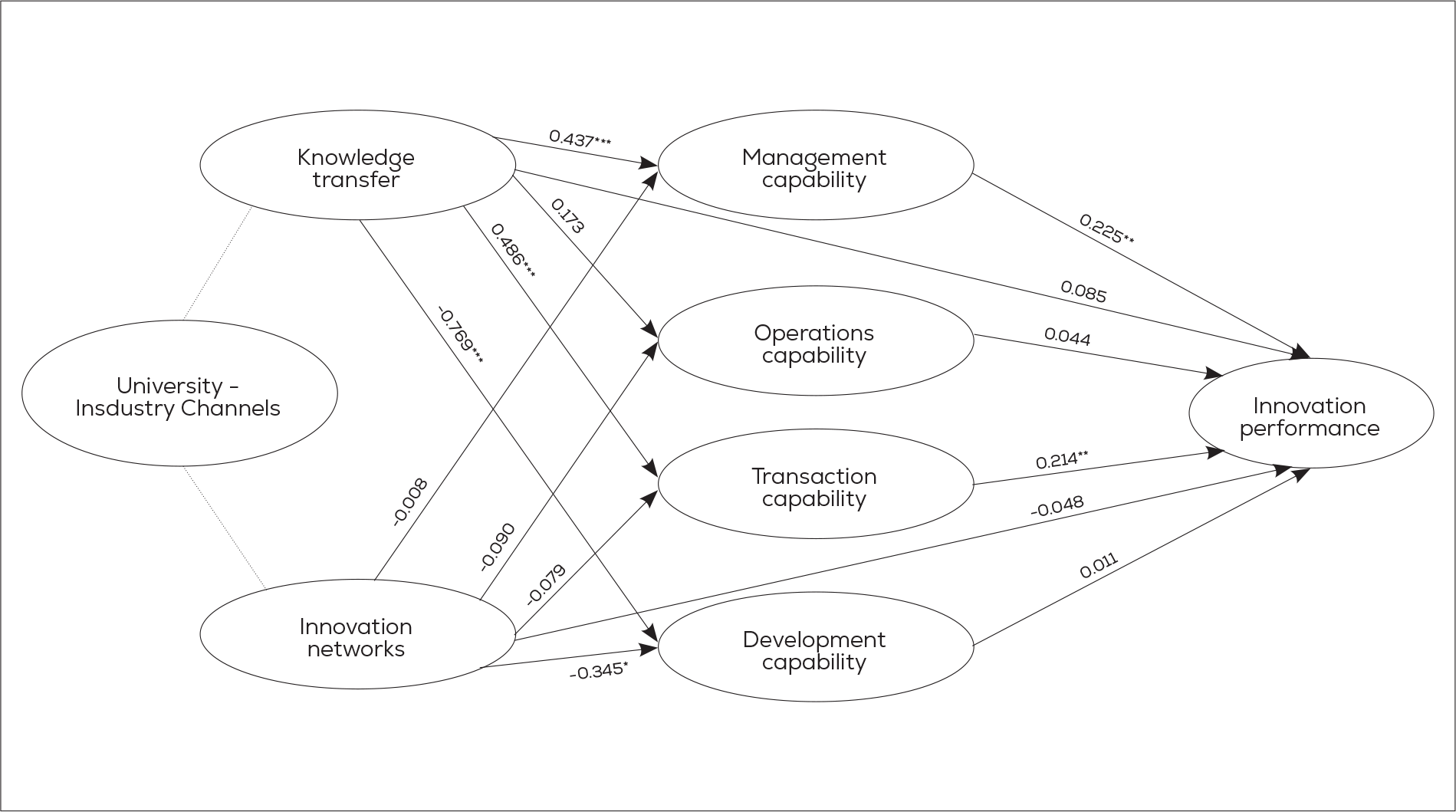
This section presents the main results and discussion. First, the model fit indicators are shown (Table 8). Then, the results of the model are presented (Figure 2 and Table 9).
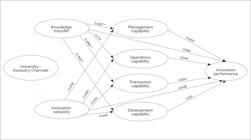
U-I Collaboration Channels, Firms’ Innovation Capabilities, and Firms’ Innovation Performance
As shown in Figure 2 and Table 9, university-industry (U-I) collaboration channels based on knowledge transfer positively impact all capabilities except operations capability, supporting Hypothesis 1. The positive impact of the factor ‘knowledge transfer’ is expected, as it allows the company to access the resources required for product and process development (Puffal et al., 2021).
The factor innovation networks did not present a positive effect on any of the four capabilities. Hence, the results of the SEM did not provide support for Hypothesis 3. It is important to note that the sample was composed exclusively of firms that collaborated with universities. Therefore, the SEM results suggest that knowledge transfer is more beneficial for collaborative firms than innovation networks.
To explain these results, it is important to examine the specific channels that compose the factors of knowledge transfer and innovation networks. For instance, a possible reason for the superior benefits of the factor knowledge transfer compared to innovation networks is that the transfer of valuable new knowledge through technology licensing, training, HR recruitment, and publications and reports allows for more structured knowledge flows from the university to the firm, thereby enabling the firm to improve its internal processes and, in turn, its innovation capabilities. These findings are aligned with previous studies that emphasize the strategic value of formalized knowledge exchanges (Bishop et al., 2011; Puffal et al., 2021).
Participation in innovation networks may not lead to a structured knowledge flow from universities to firms. This is particularly true for channels such as outsourced R&D and participation in networks involving universities. Garcia et al. (2017) and Wu et al. (2015) found that outsourced R&D may not be as beneficial for firms’ innovation as other types of U-I collaborations. It is worth noting that the innovation networks factor includes channels such as spinoffs, and, as highlighted by previous studies, it is not uncommon in Brazil for spinoffs or joint R&D labs to fail to generate tangible benefits for firms (Liboreiro et al., 2022).
Overall, based on the analysis of the results, it is possible to conclude that U-I collaboration channels based on knowledge transfer are preferable to channels based on innovation networks. From this, it can be hypothesized that knowledge absorption and its application to the commercial needs of the analyzed companies are better in the case of knowledge transfer-based collaboration than in innovation network-based collaboration.
Hypotheses 2 and 4 were not supported, as significant effects of collaboration channels on firms’ innovation performance were not identified. Therefore, despite knowledge transfer being more beneficial for firms in terms of increasing innovation capability, the same cannot be said for firms’ innovation performance. The absence of significant results for Hypotheses 2 and 4 - concerning innovation performance - suggests that while specific U-I collaboration improves internal capabilities, it may not immediately translate into measurable performance gains. It is also possible that performance improvements require the maturation of capabilities, subsequent cycles of learning, and complementary investments, which may not be fully captured in cross-sectional analyses. Thus, our study extends the works of Fuentes and Dutrénit (2012) and Vega-Jurado et al. (2017), who noted the long-term and indirect nature of capability building in U-I collaborations.
These findings also suggest that focusing solely on short-term performance metrics may underestimate the transformative potential of U-I collaborations. In this regard, our results contribute to the theoretical literature by demonstrating that the benefits of U-I interaction are channel-specific and context-dependent, and that capability development could be considered a core outcome in its own right-not merely a pathway to performance.
Our findings extend these discussions by demonstrating the channel-specific dynamics of U-I collaboration and reinforcing that not all forms of collaboration yield equivalent benefits. This study advances the literature by highlighting that knowledge transfer channels play a central role in capability enhancement in Brazil, which is an emerging country. It builds on the typologies and findings of Puffal et al. (2021) and Mikhailov et al. (2020), refining the understanding of how university resources contribute to firm-level capability formation.
The study contributes to the literature by expanding and integrating the insights from prior research. We extend Puffal et al. (2021) and Mikhailov et al. (2020) by categorizing U-I collaborations into higher-order constructs and testing their differentiated impact on multiple capability dimensions. We also expand Bishop et al. (2011) and Fuentes and Dutrénit (2012) by analyzing not only access to resources but also their transformation into innovation capabilities-particularly in an emerging economy context where firms face structural constraints. This nuanced understanding of U-I collaboration mechanisms helps refine theory on how firms learn from universities and which conditions enable such learning to translate into organizational innovation capacity.
CONCLUDING REMARKS
The results found in the study contribute to advancing our understanding of the relationship between U-I collaboration and its impact on innovation capacity and firm performance.The results suggest that not all university-industry (U-I) collaboration channels are equally important for building firms’ innovation capability. In particular, the findings indicate that U-I knowledge transfer is more beneficial for firms’ innovation capabilities than U-I innovation networks. In contrast, in terms of firms’ innovation performance, it was not possible to determine which factor-knowledge transfer or innovation networks-is more beneficial.
Thus, the innovative capability of firms investigated is more impacted by the interaction carried out with the university through the elements relating to human resources, technology licensing, and publications. This result is in line with the characteristics of the innovative efforts that Brazilian firms generally make. In general, Brazilian firms find it more difficult to make continuous efforts in terms of R&D and other elements that make up the innovation network channel.
In addition, it is important to highlight that: 1) interaction with the university generates positive effects when considering knowledge transfer, as seen, but it also needs to be combined with other efforts or aspects to reap the benefits arising from the innovation network; and 2) the result suggests that the impact of collaboration with universities on the firm’s innovative capacity depends on various factors and therefore cannot be understood as linear, certain, or positive.
In terms of the theoretical contribution of this article, we highlight: 1) it extends the understanding of the benefits firms obtain from U-I collaboration by incorporating the innovation capability perspective into the empirical model and by distinguishing the impacts of different collaboration types. We explain the effect of U-I collaboration not only on firm performance in the given moment but also on the development of innovative-related capabilities, particularly development, management, and transactions capabilities, that sustain long-term innovativeness, allowing the firm to sustain superior performance; and 2) it contributes to the strategic understanding of collaboration mechanisms by providing insights into the options firms have in terms of collaboration channels to build their innovation capabilities. Thus, we contribute to the research on U-I collaborations, especially on the topic of the outcomes of these collaborations for the actors.
Finally, considering that relationships with the industry through scientific research groups are regarded as an entrepreneurial university practice, the paper expands the understanding of the potential impacts of entrepreneurial practices of universities in emerging countries. We hope the results will be useful for policymakers by providing them with reliable data to formulate public policies for innovation and offering insights into the types of U-I collaboration that are most beneficial for enhancing firms’ innovation capabilities. It is suggested that when the goal of public policy or a private company manager’s action is to develop or strengthen the innovative capability of firms, emphasis should be placed on promoting U-I interactions, with a particular focus on knowledge transfer channels. Furthermore, when the goal is to encourage U-I interaction, it is important to consider that interactions centered on knowledge transfer are likely to generate greater impacts in terms of outcomes for the firm’s innovative capability. Therefore, we suggest that our study, by advancing knowledge on innovation in emerging countries, indirectly contributes to SDG 9 - industry, innovation, and infrastructure, particularly on the innovation dimension in emerging countries.
This research presents certain limitations. First, as U-I collaboration is a complex concept with many different typologies (Schaeffer et al., 2017), it cannot be assured that the applied typology did not affect the study’s results (Apa et al., 2021). The same can be said about innovation capability constructs, as there are different understandings of what constitutes innovation capability (Castela et al., 2018; Guan & Ma, 2003; Zawislak et al., 2012).
Second, not all U-I collaborations that occurred in Brazil are covered by the DGP-CNPq 2016 database (Mikhailov et al., 2022). Since U-I collaboration can be either formal or informal, most U-I collaboration databases have this same limitation (Apa et al., 2021; Arant et al., 2019). Third, it is important to consider the environmental context, which differs between emerging and developed economies. Hence, the article’s results should not be generalized to other economies. Finally, we point out that the results are largely based on the single cross-sectional survey, which could also be considered a limitation.
For future research, we suggest further investigation into the impact of U-I collaboration channels on firms’ innovation capabilities and performance. The results showed that not all types of collaboration channels are equally beneficial for firms, so it is important to explore the reasons for this in depth. Did this occur because different collaboration types impact a different mix of firms’ internal routines? Including geographical and locational factors within an empirical model would provide an interesting opportunity to deepen the investigation. Also, we suggest taking a deeper look into the duration of the collaboration. Do longer collaborations affect benefits obtained by the firms in a more positive way than shorter ones? Is there a U-shaped moderation effect of collaboration duration on the size of benefits?
Finally, we suggest conducting a cross-country investigation to deepen the understanding of the role of environmental factors in the impacts of U-I collaboration on firms’ benefits. We hope that this study will pave the way for new empirical investigations into the benefits of U-I collaboration.
-
The Peer Review Report is available at this link
-
Evaluated through a double-anonymized peer review.
-
FUNDING
Coordenação de Aperfeiçoamento do Nível Superior (CAPES) - code 001.Fundação de Amparo à Pesquisa do Estado do Rio Grande do Sul (FAPERGS) - project number 23/2551-0001870-5.
REFERENCES
-
Abdulai, A. F., Murphy, L., & Thomas, B. (2020). University knowledge transfer and innovation performance in firms: The Ghanaian experience. International Journal of Innovation Management, 24(3), 2050023. https://doi.org/10.1142/S1363919620500231
» https://doi.org/10.1142/S1363919620500231 -
Ahrweiler, P., Pyka, A., & Gilbert, N. (2011). A new model for university-industry links in knowledge-based economies. Journal of Product Innovation Management, 28(2), 218-235. https://doi.org/10.1111/j.1540-5885.2010.00793.x
» https://doi.org/10.1111/j.1540-5885.2010.00793.x - Albuquerque, Eduardo, Suzigan, Wilson, Kruss, Glenda, & Lee, Keun. (Eds.). (2015). Developing national systems of innovation: University_Industry interactions in the global south. Edward Elgar Publishing.
-
Albuquerque, E. M. (1996). Sistema nacional de inovação no Brasil: Uma análise introdutória a partir de dados disponíveis sobre a ciência e a tecnologia. Revista de Economia Política, 16(3), 56-72. https://doi.org/10.1590/0101-31571996-0891
» https://doi.org/10.1590/0101-31571996-0891 -
Alpkan, L., & Gemici, E. (2023). The relation between high-performance work systems and product innovativeness: The mediating role of technological capabilities and the moderating role of university-industry collaboration. Journal of Engineering and Technology Management, 67, 101735. https://doi.org/10.1016/j.jengtecman.2023.101735
» https://doi.org/10.1016/j.jengtecman.2023.101735 -
Alves, A. C., Barbieux, D., Reichert, F. M., Tello-Gamarra, J., & Zawislak, P. A. (2017). Innovation and dynamic capabilities of the firm: Defining an assessment model. RAE-Revista de Administração de Empresas, 57(3), 232-244. https://doi.org/10.1590/S0034-759020170304
» https://doi.org/10.1590/S0034-759020170304 -
Apa, R., Marchi, V. De, Grandinetti, R., & Sedita, S. R. (2021). University-SME collaboration and innovation performance: The role of informal relationships and absorptive capacity. The Journal of Technology Transfer, 46, 961-988. https://doi.org/10.1007/s10961-020-09802-9
» https://doi.org/10.1007/s10961-020-09802-9 -
Arant, W., Fornahl, D., Grashof, N., Hesse, K., & Söllner, C. (2019). University-industry collaborations: The key to radical innovations? Review of Regional Research, 39(2), 119-141. https://doi.org/10.1007/s10037-019-00133-3
» https://doi.org/10.1007/s10037-019-00133-3 -
Bishop, K., D’Este, P., & Neely, A. (2011). Gaining from relations with universities: Multiple methods for nurturing absorptive capacity. Research Policy, 40(1), 30-40. https://doi.org/10.1016/j.respol.2010.09.009
» https://doi.org/10.1016/j.respol.2010.09.009 -
Bonaccorsi, A., & Piccaluga, A. (1994). A theoretical framework for the evaluation of university-industry relationships. R&D Management, 24(3), 229-247. https://doi.org/10.1111/j.1467-9310.1994.tb00876.x
» https://doi.org/10.1111/j.1467-9310.1994.tb00876.x -
Caliari, T., Mendes, P. S., Rapini, M., & Tolentino, C. (2021). Technological cumulativeness and innovation in Brazilian manufacturing industry: Evidences from Brazilian innovation surveys 2008, 2011, and 2014. Journal of the Knowledge Economy, 12, 876-898. https://doi.org/10.1007/s13132-020-00645-1
» https://doi.org/10.1007/s13132-020-00645-1 -
Castela, B. M., Ferreira, F. A., Ferreira, J. J., & Marques, C. S. (2018). Assessing the innovation capability of small-and medium-sized enterprises using a non-parametric and integrative approach. Management Decision, 56(6), 1365-1383. https://doi.org/10.1108/MD-02-2017-0156
» https://doi.org/10.1108/MD-02-2017-0156 -
Churchill, G. A., Jr. (1979). A paradigm for developing better measures of marketing constructs. Journal of Marketing Research, 16(1), 64-73. https://doi.org/10.1177/002224377901600110
» https://doi.org/10.1177/002224377901600110 -
Conselho Nacional de Desenvolvimento Científico e Tecnológico. (2021). “Base de dados do Censo do Diretório de Grupos de Pesquisa no Brasil: Como os dados são obtidos” http://lattes.cnpq.br/web/dgp/como-os-dados-sao-obtidos
» http://lattes.cnpq.br/web/dgp/como-os-dados-sao-obtidos - Chesbrough, H. (2006). Open innovation: a new paradigm for understanding industrial innovation. Open innovation: Researching a new paradigm, 400, 0-19.
-
Cohen, W. M., & Levinthal, D. A. (1990). Absorptive capacity: A new perspective on learning and innovation. Administrative Science Quarterly, 35(1), 128-152. https://doi.org/10.2307/2393553
» https://doi.org/10.2307/2393553 -
Colombo, M. G., & Delmastro, M. (2002). How effective are technology incubators? Evidence from Italy. Research Policy, 31(7), 1103-1122. https://doi.org/10.1016/S0048-7333(01)00178-0
» https://doi.org/10.1016/S0048-7333(01)00178-0 -
Cunha, N. C. V., & Madalena Fracasso, E. (1999). University-enterprise interaction in biotechnology in the south of Brazil. Journal of Knowledge Management, 3(1), 66-74. https://doi.org/10.1108/13673279910259411
» https://doi.org/10.1108/13673279910259411 -
Dalmarco, G., Hulsink, W., & Zawislak, P. A. (2019). New perspectives on university-industry relations: An analysis of the knowledge flow within two sectors and two countries. Technology Analysis & Strategic Management, 31(11), 1314-1326. https://doi.org/10.1080/09537325.2019.1612868
» https://doi.org/10.1080/09537325.2019.1612868 -
D’Este, P., & Patel, P. (2007). University-industry linkages in the UK: What are the factors underlying the variety of interactions with industry? Research Policy, 36(9), 1295-1313. https://doi.org/10.1016/j.respol.2007.05.002
» https://doi.org/10.1016/j.respol.2007.05.002 -
Engelman, R. M., Fracasso, E. M., Schmidt, S., & Zen, A. C. (2017). Intellectual capital, absorptive capacity and product innovation. Management Decision, 55(3), 474-490. https://doi.org/10.1108/MD-05-2016-0315
» https://doi.org/10.1108/MD-05-2016-0315 -
Etzkowitz, H. (2003). Innovation in innovation: The triple helix of university-industry-government relations. Social Science Information, 42(3), 293-337. https://doi.org/10.1177/05390184030423002
» https://doi.org/10.1177/05390184030423002 - Etzkowitz, H., & Zhou, C. (2017). The triple helix: University-industry-government innovation and entrepreneurship Routledge.
-
Figueiredo, P. N., Cabral, B. P., & Silva, F. Q. (2021). Intricacies of firm-level innovation performance: An empirical analysis of latecomer process industries. Technovation, 105, 102302. https://doi.org/10.1016/j.technovation.2021.102302
» https://doi.org/10.1016/j.technovation.2021.102302 -
Fischer, B. B., Schaeffer, P. R., & Vonortas, N. S. (2019). Evolution of university-industry collaboration in Brazil from a technology upgrading perspective. Technological Forecasting and Social Change, 145, 330-340. https://doi.org/10.1016/j.techfore.2018.05.001
» https://doi.org/10.1016/j.techfore.2018.05.001 -
Fitjar, R. D., & Rodríguez-Pose, A. (2013). Firm collaboration and modes of innovation in Norway. Research Policy, 42(1), 128-138. https://doi.org/10.1016/j.respol.2012.05.009
» https://doi.org/10.1016/j.respol.2012.05.009 -
Fuentes, C. De, & Dutrénit, G. (2012). Best channels of academia-industry interaction for long-term benefit. Research Policy, 41(9), 1666-1682. https://doi.org/10.1016/j.respol.2012.03.026
» https://doi.org/10.1016/j.respol.2012.03.026 -
Garcia-Perez-de-Lema, D., Madrid-Guijarro, A., & Martin, D. P. (2017). Influence of university-firm governance on SMEs innovation and performance levels. Technological Forecasting and Social Change, 123, 250-261. https://doi.org/10.1016/j.techfore.2016.04.003
» https://doi.org/10.1016/j.techfore.2016.04.003 -
Guan, J., & Ma, N. (2003). Innovative capability and export performance of Chinese firms. Technovation, 23(9), 737-747. https://doi.org/10.1016/S0166-4972(02)00013-5
» https://doi.org/10.1016/S0166-4972(02)00013-5 -
Helfat, C. E. (1997). Know-how and asset complementarity and dynamic capability accumulation: The case of R&D. Strategic Management Journal, 18(5), 339-360. https://sms.onlinelibrary.wiley.com/doi/10.1002/(SICI)1097-0266(199705)18:5%3C339::AID-SMJ883%3E3.0.CO;2-7
» https://sms.onlinelibrary.wiley.com/doi/10.1002/(SICI)1097-0266(199705)18:5%3C339::AID-SMJ883%3E3.0.CO;2-7 -
Hogan, S. J., Soutar, G. N., McColl-Kennedy, J. R., & Sweeney, J. C. (2011). Reconceptualizing professional service firm innovation capability: Scale development. Industrial Marketing Management, 40(8), 1264-1273. https://doi.org/10.1016/j.indmarman.2011.10.002
» https://doi.org/10.1016/j.indmarman.2011.10.002 -
Jones, J., & Zubielqui, G. C. de. (2017). Doing well by doing good: A study of university-industry interactions, innovativeness and firm performance in sustainability-oriented Australian SMEs. Technological Forecasting and Social Change, 123, 262-270. https://doi.org/10.1016/j.techfore.2016.07.036
» https://doi.org/10.1016/j.techfore.2016.07.036 -
Lawson, B., & Samson, D. (2001). Developing innovation capability in organisations: a dynamic capabilities approach. International Journal of Innovation Management, 5(03), 377-400. https://doi.org/10.1142/S1363919601000427
» https://doi.org/10.1142/S1363919601000427 -
Leonard-Barton, D. (1992). Core capabilities and core rigidities: A paradox in managing new product development. Strategic Management Journal, 13(S1), 111-125. https://doi.org/10.1002/smj.4250131009
» https://doi.org/10.1002/smj.4250131009 -
Liboreiro, K. R., Corradi, A. A., & Rapini, M. S. (2022). The role of the university research laboratory in technology transfer to firms in Brazil: Two case studies in biotechnology. Industry and Higher Education, 36(4), 398-414. https://doi.org/10.1177/09504222221105366
» https://doi.org/10.1177/09504222221105366 -
Mikhailov, A., & Puffal, D. P. (2023). University-industry Collaboration and Innovation in Low-tech Industries: the Case of Brazil. Triple Helix, 10(3), 291-320. http://dx.doi.org/10.4067/S0718-27242020000300006
» http://dx.doi.org/10.4067/S0718-27242020000300006 -
Mikhailov, A., Puffal, D., & Santini, M. (2020). University-Industry relations and industrial innovation: Evidence from Brazil. Journal of Technology Management & Innovation, 15(3), 6-16. https://doi.org/10.1163/21971927-bja10042
» https://doi.org/10.1163/21971927-bja10042 - Mikhailov, A., Ruffoni, J., Morales, G. L., Glaser, I. F., Puffal, D.P (2022). Características da hélice universidade-empresa no Brasil: Interações entre grupos de pesquisa das universidades e empresas industriais. In M. G. Amaral, A. A. C. Mineiro, & A. F. Faria, Interação universidade-empresa-governo-sociedade no Brasil (pp. 159-185). Editora CRV.
-
Min, J. W., Vonortas, N. S., & Kim, Y. (2019). Commercialization of transferred public technologies. Technological Forecasting and Social Change, 138, 10-20. https://doi.org/10.1016/j.techfore.2018.10.003
» https://doi.org/10.1016/j.techfore.2018.10.003 -
Meyer-Krahmer, F., & Schmoch, U. (1998). Science-based technologies: university-industry interactions in four fields. Research Policy, 27(8), 835-851. https://doi.org/10.1016/S0048-7333(98)00094-8
» https://doi.org/10.1016/S0048-7333(98)00094-8 -
Póvoa, L. M. C., & Rapini, M. S. (2010). Technology transfer from universities and public research institutes to firms in Brazil: What is transferred and how the transfer is carried out. Science and Public Policy, 37(2), 147-159. https://doi.org/10.3152/030234210X496619
» https://doi.org/10.3152/030234210X496619 -
Puffal, D. P., Ruffoni, J., & Spricigo, G. (2021). Empirical evidence for Brazilian firms in terms of university-industry interaction, public funding, and innovation outcome. International Journal of Innovation Management, 25(4), 2150040. https://doi.org/10.1142/S1363919621500407
» https://doi.org/10.1142/S1363919621500407 -
Rapini, M. S., Chiarini, T., & Bittencourt, P. F. (2015). University-Firm interactions in Brazil: Beyond human resources and training missions. Industry and Higher Education, 29(2), 111-127. https://doi.org/10.5367/ihe.2015.0245
» https://doi.org/10.5367/ihe.2015.0245 -
Reichert, F. M., Zawislak, P. A., & Arundel, A. (2016). Exploring innovation success recipes in low-technology firms using fuzzy-set QCA. Journal of Business Research, 69(11), 5437-5441. https://doi.org/10.1016/j.jbusres.2016.04.151
» https://doi.org/10.1016/j.jbusres.2016.04.151 -
Robin, S., & Schubert, T. (2013). Cooperation with public research institutions and success in innovation: Evidence from France and Germany. Research Policy, 42(1), 149-166. https://doi.org/10.1016/j.respol.2012.06.002
» https://doi.org/10.1016/j.respol.2012.06.002 -
Santiago, C. V. S., & Lauriano, N. G. (2023). A reflection on the evolution of the Brazilian National Innovation System in twenty years. International Journal of Scientific Management and Tourism, 9(5), 2865-2885. https://doi.org/10.55905/ijsmtv9n5-015
» https://doi.org/10.55905/ijsmtv9n5-015 -
Saunila, M. (2020). Innovation capability in SMEs: A systematic review of the literature. Journal of Innovation & Knowledge, 5(4), 260-265. https://doi.org/10.1016/j.jik.2019.11.002
» https://doi.org/10.1016/j.jik.2019.11.002 -
Saunila, M., & Ukko, J. (2012). A conceptual framework for the measurement of innovation capability and its effects. Baltic Journal of Management, 7(4), 355-375. https://doi.org/10.1108/17465261211272139
» https://doi.org/10.1108/17465261211272139 -
Schaeffer, P. R., Dullius, A. C., Rodrigues, R. M., & Zawislak, P. A. (2017). Searching to bridge the gaps: A new typology of university-industry interaction. Academia Revista Latinoamericana de Administración, 30(4), 459-473. https://doi.org/10.1108/ARLA-05-2016-0148
» https://doi.org/10.1108/ARLA-05-2016-0148 -
Schartinger, D., Rammer, C., Fischer, M. M., & Fröhlich, J. (2002). Knowledge interactions between universities and industry in Austria: sectoral patterns and determinants. Research policy, 31(3), 303-328. https://doi.org/10.1016/S0048-7333(01)00111-1
» https://doi.org/10.1016/S0048-7333(01)00111-1 -
Schneegans, S., Lewis, J. & Straza, T. (2021). Relatório de Ciências da UNESCO: A corrida contra o tempo por um desenvolvimento mais inteligente - Resumo executivo. Paris: UNESCO. https://unesdoc.unesco.org/ark:/48223/pf0000377250_por
» https://unesdoc.unesco.org/ark:/48223/pf0000377250_por -
Schultz, C., Gretsch, O., & Kock, A. (2021). The influence of shared R&D-project innovativeness perceptions on university-industry collaboration performance. The Journal of Technology Transfer, 46(4), 1144-1172. https://doi.org/10.1007/s10961-020-09818-1
» https://doi.org/10.1007/s10961-020-09818-1 -
Suzigan, W. (2011). The underestimated role of universities for the Brazilian system of innovation. Brazilian Journal of Political Economy, 31, 03-30. https://doi.org/10.1590/S0101-31572011000100001
» https://doi.org/10.1590/S0101-31572011000100001 - Suzigan, W., & Albuquerque, E. (2008). Interactions between firms and universities in Brazil: A historical perspective. Annals of Globelics, 22-26.
-
Vega-Jurado, J., Kask, S., & Manjarrés-Henriquez, L. (2017). University industry links and product innovation: Cooperate or contract? Journal of Technology Management & Innovation, 12(3), 1-8. http://dx.doi.org/10.4067/S0718-27242017000300001
» http://dx.doi.org/10.4067/S0718-27242017000300001 -
Wu, Y., Welch, E. W., & Huang, W. L. (2015). Commercialization of university inventions: Individual and institutional factors affecting licensing of university patents. Technovation, 36, 12-25. https://doi.org/10.1016/j.technovation.2014.09.004
» https://doi.org/10.1016/j.technovation.2014.09.004 -
Zawislak, P. A., Alves, A. C., Tello-Gamarra, J., Barbieux, D., & Reichert, F. M. (2012). Innovation capability: From technology development to transaction capability. Journal of Technology Management & Innovation, 7(2), 14-27. http://dx.doi.org/10.4067/S0718-27242012000200002
» http://dx.doi.org/10.4067/S0718-27242012000200002 -
Zawislak, P. A., & Dalmarco, G. (2011). The silent run: New issues and outcomes for university-industry relations in Brazil. Journal of Technology Management & Innovation, 6(2), 66-82. http://dx.doi.org/10.4067/S0718-27242011000200005
» http://dx.doi.org/10.4067/S0718-27242011000200005
Edited by
-
Evaluated through a double-anonymized peer review. Guest Editors: Charles Kirschbaum, Daniel Paulino Teixeira Lopes, Gregory Pogue, Kadígia Faccin e Ricardo Reolon