 EFFECT OF COMMON INSTITUTIONAL OWNERSHIP ON TUNNELING: EMPIRICAL EVIDENCE FROM CHINA
ABSTRACT
This study examines the role of common institutional ownership (CIO) in reducing the tunneling behavior of controlling shareholders in Chinese listed companies. We empirically examined the influence of CIO on tunneling using a multiple regression model. The results show that CIO restrains tunneling, and the impact intensifies with an increase in CIO and a higher shareholding ratio. This effect is more pronounced in firms with poor information environments, low external supervision, non-state ownership, and a high degree of separation between ownership and control. We find that common institutional investors alleviate tunneling by using information advantage and engaging in shareholder activism. These results offer new evidence of the effect of common institutional investors on controlling shareholders’ behavior.
Keywords:
common institutional ownership; tunneling; information advantage; shareholder activism; China
RESUMO
Este estudo examina o papel da propriedade institucional comum (PIC) na redução do comportamento de tunneling dos acionistas controladores em empresas chinesas listadas em bolsa. Utilizando um modelo de regressão múltipla, a influência da PIC no comportamento de tunneling é examinada empiricamente. Os resultados mostram que a PIC restringe esse comportamento, sendo que esse impacto se intensifica com o aumento da PIC e com um índice de participação acionária mais alto. O efeito é mais acentuado em empresas com ambientes informacionais deficientes, baixa supervisão externa, de propriedade privada e cum um alto grau de separação entre propriedade e controle. Descobrimos que os investidores institucionais comuns amenizam o comportamento de tunneling usando a vantagem informacional e participando do ativismo de acionistas. Esses resultados oferecem novas evidências sobre o efeito dos investidores institucionais comuns no comportamento dos acionistas controladores.
Palavras-chave:
propriedade institucional comum; tunneling; vantagem informacional; ativismo de acionistas; China.
RESUMEN
Este estudio examina el papel de la propiedad institucional común (PIC) en la reducción del comportamiento de tunneling de los accionistas controladores en las empresas chinas que cotizan en bolsa. Utilizando un modelo de regresión múltiple, se examina empíricamente la influencia de la PIC en el tunneling. Los resultados muestran que la PIC reduce el tunneling, y que el impacto se intensifica con el aumento de la PIC y del porcentaje de participación accionaria. Este efecto es más pronunciado en empresas con entornos de información deficientes, escasa supervisión externa, propiedad no estatal y un alto grado de separación entre propiedad y control. Encontramos que los inversores institucionales comunes alivian el tunneling utilizando la ventaja de la información y participando en el activismo accionarial. Estos resultados ofrecen nuevas pruebas sobre el efecto de los inversores institucionales comunes en el comportamiento de los accionistas de control.
Palabras clave
propiedad institucional común; tunneling; ventaja informativa; activismo de los accionistas; China.
INTRODUCTION
Although China’s stock market continues to be dominated by individual investors, the comprehensive and deepening reform of the capital market has led to a year-on-year increase in the proportion of institutional investors (Wen et al., 2020). Specifically, the mergers and acquisitions of investment institutions and the development of industry exchange-traded funds in China have led to the merger of several institutional investors with separate holdings in different companies. This has increased institutional investors’ holdings in multiple firms in the same industry (Du et al., 2021). This study focuses on common institutional investors (CIIs). According to the Securities Law of the People’s Republic of China, institutional investors consist of mutual funds, qualified foreign institutional investors, securities dealers, insurance companies, social insurance institutions, trust companies, finance companies, and banks. Following He and Huang (2017), we define CIIs as investors holding more than 5% of the shares of two or more firms in the same industry. We use the term “common institutional ownership (CIO)” to refer to the existence, number, and shareholding ratio of CIIs. CIO, also referred to as institutional cross-ownership (Brooks et al., 2018; He et al., 2019) but also affects the outcomes of mergers and acquisitions (M&As, exerts a significant impact on a firm’s operation and governance (Du et al., 2021; Park et al., 2019; Pawliczek & Skinner, 2018). Relative to small shareholders, CIIs have a higher shareholding ratio, richer investing experience, and more comprehensive information to monitor corporate behavior (Kang et al., 2018; Li et al., 2021). Thus, CIO may act as a powerful interested party and significantly influence controlling shareholders’ behavior.
The separation of ownership and control gives rise to the principal-agent problem. Research on the principal-agent problem using data from developed countries is mainly based on the assumption of a decentralized shareholding structure, focusing on the agency problem between shareholders and managers. As the agent, managers may harm the interests of shareholders based on different motives. Compared with the decentralized shareholding structure in developed countries, most companies in China have retained a centralized shareholding structure since they were restructured and listed on the stock exchange, and the voting rights and other resources that come with a controlling stake have enhanced the ability of large shareholders to expropriate the interests of small and medium-sized shareholders. As a result, in China, the agency problem is mainly concentrated between majority shareholders and minority shareholders, which manifests in the appropriation of company assets by majority shareholders for the benefit of the parent company or their private interests to the detriment of minority shareholders. This phenomenon is known as “tunneling” (Johnson et al., 2000). Corporate governance theory holds that effective supervision of majority shareholders is very important to reduce the infringement of the interests of minority shareholders by their tunneling behavior.
Minority shareholders have limited shares and only engage in fragmented decision-making (Chen et al., 2009). This makes it difficult to inhibit the tunneling behavior of majority shareholders and highlights the need for a powerful interested party, such as a CII. Specifically, in Chinese listed companies, although the high concentration of shareholding enhances a firm’s decision-making efficiency, majority shareholders’ greater voice makes it difficult for minority shareholders to impose effective constraints against the former’s tunneling behavior (Jiang et al., 2015; Zhang et al., 2017). As an agency problem, tunneling undermines the interests of minority shareholders. However, the continuous development of China’s capital market has led to laws that protect the rights and interests of minority shareholders (Chen et al., 2020). On March 1, 2020, China implemented the New Securities Law to curb market violations, enhance investor protection, and create a fairer investment environment for minority shareholders. These measures to curb tunneling behavior and the impact of tunneling have attracted wide attention.
In this context, this study investigates whether and how CIO influences tunneling behavior. Specifically, we reveal a negative relationship between CIO and tunneling. The results show that the entry, increase in number, and shareholding ratio of CIIs have a significantly negative relationship with tunneling. To alleviate endogeneity issues, we conduct a series of robustness checks and find consistent results. Subsequently, we study the mechanisms through which CIO influences tunneling. In this regard, we explore how the effect of CIO differs across firms. We find that CIIs alleviate tunneling by using information advantage and engaging in shareholder activism. We also perform heterogeneity tests. The results show that the effect of CIO is more pronounced in firms with poor information environments, low external supervision, non-state ownership, and a high degree of separation between ownership and control.
This study makes three important contributions to the literature. First, by studying the relationship between CIO and tunneling, we discuss the impact of CIO on corporate governance (Brooks et al., 2018; Du et al., 2021; Fu & Qin, 2021; Gao et al., 2019; He & Huang, 2017; He et al., 2019; Kostovetsky & Manconi, 2020; Park et al., 2019; Pawliczek & Skinner, 2018; Ramalingegowda et al., 2021)but also affects the outcomes of mergers and acquisitions (M&As. In this regard, most studies on CIIs use US data, while a small number of studies on Chinese CIIs focus on corporate governance (Du et al., 2021). To the best of our knowledge, there is no study on the impact of CIIs on controlling shareholders’ behavior, and this study attempts to fill this gap. Second, this study enriches the literature on the determinants of tunneling (Boateng & Huang, 2017; Chen et al., 2009; Chen et al., 2020; Cheung et al., 2009; Gao et al., 2021; Jiang et al., 2015; Johnson et al., 2000; Li et al., 2021; Zhang et al., 2014; Zhang et al., 2017). Specifically, it showcases CIO-a previously overlooked factor-as an important explanatory factor for tunneling. Third, this study provides policy implications. Contrary to previous research that found CIO may generate monopoly power (Azar et al., 2018), we find the positive role of CIO in alleviating tunneling. As the proportion of institutional investors in China’s stock market is still relatively low, policies that promote the development of institutional investors are encouraged.
The remainder of this paper is structured as follows. In Section 2, the related literature is reviewed and the hypotheses are developed. Section 3 discusses the sample selection, variable measurement, empirical models, and descriptive statistics of all variables. Section 4 presents the empirical evidence, including the baseline results, underlying mechanism analysis, further analysis, endogeneity tests, and robustness checks. Section 5 presents the conclusion.
LITERATURE REVIEW AND HYPOTHESES DEVELOPMENT
Tunneling is mainly caused by the concentration of ownership (Jiang et al., 2015; Johnson et al., 2000; Li et al., 2021; Zhang et al., 2014). On the one hand, the presence and increase in the holding ratio of controlling shareholders can increase monitoring and management effectiveness, thereby alleviating agency conflict in the traditional sense (Boateng & Huang, 2017; Chan et al., 2016). On the other hand, the controlling shareholders can assign personnel to the management to strengthen the alignment of their interests with those of the management, thereby facilitating collusion (Jiang et al., 2015; Johnson et al., 2000; Zhang et al., 2014). Johnson et al. (2000) referred to this collusion as tunneling.
Previous research has shown that majority shareholders have economic incentives to expropriate minority shareholders in the absence of effective supervision (Jiang et al., 2015; Johnson et al., 2000). Tunneling is facilitated by information and power differences between majority and minority shareholders (Baek et al., 2006; Cheung et al., 2009; Gao & Kling, 2008; Li et al., 2021; Ye et al., 2015). Extant research has found that corporate governance can effectively curb tunneling (Du, 2014; Gao et al., 2021; Gao & Kling, 2008; Ye et al., 2015). In addition, firms can effectively restrain tunneling behavior by imposing equity constraints on shareholding, such as having multiple large shareholders, a high shareholder-equity ratio, or strong institutional investors (Boateng & Huang, 2017; Jiang et al., 2015; Li et al., 2021; Zhang et al., 2017). Since executives are usually appointed by the controlling shareholders, companies face difficulties in imposing strong constraints on tunneling in the absence of governance mechanisms. Hence, they rely on external supervision (Boateng & Huang, 2017; Gao et al., 2021; Ye et al., 2015). As an external investor with a large shareholding and strong industry influence, a CII can restrain the opportunistic behavior of the management and controlling shareholders and thereby alleviate the principal-agent problem (Du et al., 2021; Fu & Qin, 2021; Ramalingegowda et al., 2021). Recently, CIO has gained academic attention as a special ownership structure. Some studies have emphasized the effect of CII on anti-competition and related outcomes. CII decreases product market competition and encourages cooperation among firms (Azar et al., 2018; He & Huang, 2017), facilitates innovation diffusion (Gao et al., 2019; Kostovetsky & Manconi, 2020), and increases the probability of a merger (Brooks et al., 2018) but also affects the outcomes of mergers and acquisitions (M&As. Some studies pertain to the impact of CIO on corporate governance. By efficiently increasing monitoring, encouraging cooperation, and internalizing negative externalities, CIO enhances management disclosure incentives, improves the information environment (Park et al., 2019; Pawliczek & Skinner, 2018), increases firms’ philanthropy (Fu & Qin 2021), and decreases earnings management (Du et al., 2021; Ramalingegowda et al., 2021).
Some studies have shown that institutional investors can suppress tunneling in the following ways (Jiang et al., 2015; Zhang et al., 2017). First, relative to individual investors, CIIs have information advantages, which can reduce information asymmetry and inhibit tunneling. Thus, a firm can reduce agency costs between majority and minority shareholders by reducing information asymmetry and strengthening external minority shareholders. However, the concealment of transactions and the cover-ups of executives make it difficult to detect tunneling behavior (Chan et al., 2016; Jiang et al., 2015) we investigate the relationship between tax avoidance (proxied by effective tax rates. Particularly, the external minority shareholders find it difficult to determine whether the managers are engaged in tunneling or critical business operations. Several managers (appointed by the controlling shareholders) may camouflage tunneling practices, for example, by decreasing the quality of information disclosure (Luo et al., 2011; Zhang et al., 2014). However, CIIs can accurately monitor tunneling by procuring information from multiple holding companies in the same industry. This can be attributed to CIIs’ strong industry analysis capabilities as a result of their extensive shareholdings in multiple firms in the same industry-shareholding ratio-and the number of holding companies (He et al., 2019; Kang et al., 2018; Park et al., 2019). CIIs also gain a greater information advantage by investing in the same industry rather than multiple industries (Kang et al., 2018).
Second, tunneling may lead to declining firm performance and investor returns (Zhang et al., 2017). CIIs can curb tunneling, given their ability to proactively communicate with the management (Ramalingegowda et al., 2021). In other words, CIIs can pressurize the management or actively participate in the firm’s operations to restrain the controlling shareholders when they engage in tunneling. Jalil and Rahman (2010) showed that mere CII ownership may not engender positive results. They must be involved in shareholder activism to be effective as external monitors. Relative to individual investors, institutional investors can reduce the cost of activism and alleviate the free-rider problem of minority investors to a certain extent (Norli et al., 2015). He et al. (2019) found that CIO increases the possibility of voting against the management by internalizing governance externalities. As shareholders with more than 5% of the shares, Chinese CIIs can raise their proposals to the board of directors at general meetings. In other words, the formal mechanism of CIO allows CIIs to participate in firms’ decision-making and question inappropriate decisions. CIIs have high monitoring motivation, low-cost shareholder activism, and a formal mechanism. Influential and noncontrolling CIIs can directly deny proposals by engaging in shareholder activism, such as transactions inducing tunneling-related costs. Based on this discussion, we propose the following hypotheses:
-
H1: CIO has a negative relationship with tunneling.
-
H2: CIIs’ information advantage and shareholder activism restrain tunneling.
SAMPLE, VARIABLES, AND EMPIRICAL APPROACH
Sample selection
We collected data on listed firms from the China Stock Market and Accounting Research (CSMAR) database. CSMAR provides comprehensive data on China’s stock market, listed firms’ financial reports, and corporate governance of listed firms. We selected the sample using the following criteria from previous literature (Du, 2014; Jiang et al., 2015). First, we eliminated insolvent firms (whose liabilities exceed assets). Second, we excluded firms with institutional shareholding ratios greater than 100%, as these could be conside red abnormal values. Third, we removed firms with missing financial data. This elimination yielded a sample comprising 2,338 companies and 17,435 firm-year observations from 2007 to 2020. We winsorized all continuous variables at the 1% level to avoid the impact of extreme values.
Variable measurement
Dependent variable: Tunneling
Controlling shareholders employ the following tunneling methods: direct illegal occupation, guarantees, related-party transactions, mergers and acquisitions, and excessive dividends (Chen et al., 2009; Cheung et al., 2009; Jiang et al., 2015). Some majority shareholders occupy the funds of listed companies through daily related-party transactions, which are more concealed than a direct illegal occupation. Related-party transactions refer to business transactions between a listed company and its largest shareholder, parent company, actual controller, or another company controlled by the largest shareholder (Jian & Wong, 2010). Undoubtedly, related-party transactions with fair prices can reduce transaction costs and improve production efficiency. However, related-party transactions can be used to expropriate minority shareholders, given the difficulties in identifying related parties, measuring fair pricing for minority investors, and deciphering transaction forms (Cheung et al., 2009; Jian & Wong, 2010). We employed related-party transactions to measure tunneling. We used the following two indicators of related-party transactions of majority shareholders. The first indicator was the sum of all related-party transactions. The second indicator excluded the following categories: cooperation projects, license agreements, research and development results, key management personnel compensation, and noise transactions. When performing the regression, we used the natural logarithm of the sum of all the above related-party transactions plus 1.
Independent variable: Common institutional ownership
Following extant literature (He et al., 2019; Kostovetsky & Manconi, 2020; Park et al., 2019), we employed three methods to measure CIO. CIO1 was a dummy variable that takes the value of 1 if the firm has CIIs. CIO2 was the number of CIIs. CIO3 was the sum of the shareholding ratio of the CIIs. The estimation steps were as follows. First, we obtained the shareholding details of institutional investors from the CSMAR; the dataset included firm code, industry code, and institutional investor ID, name, and shareholding ratio each quarter. Second, we removed observations with a shareholding ratio of less than 5%. Third, if the investor ID belonged to an investor owning shares of two or more companies within the same industry on a quarterly date, we treated the investor as a CII. Fourth, we calculated the number of CIIs of each listed company at the quarterly level and summed up their shareholding ratio. Fifth, if a company had no CII for any quarter of a year, we denoted CIO1 for the year as 0; otherwise, CIO1 was equal to 1. By adding the number of CIIs for the four quarters of the year, we obtained CIO2. CIO3 was defined as the average shareholdings of CIIs over the four quarters of the year.
Control variables
We included several factors that can affect tunneling. First, we controlled for firm-specific characteristics, including size, leverage, turnover, and return on assets (ROA) (Chen et al., 2020; Li et al., 2021; Zhang et al., 2017). We used the natural logarithm of market value as firm size (Size) as companies of different sizes differ in tunneling (Gao & Kling, 2008). Gao and Kling (2008) showed that highly leveraged firms experience higher tunneling. Hence, we used the debt-to-equity ratio to measure leverage. Turnover is the difference between the annual average values of monthly turnover rates of the enterprise in the t-1 and t-2 years. Turnover is a measurement of liquidity related to tunneling through informed trading (Zhang et al., 2017). We also considered ROA as a performance indicator; ROA is closely related to managerial behavior and tunneling (Zhang et al., 2017).
Second, we controlled for ownership structure. The property rights of firms (SOE) significantly influence tunneling (Liu et al., 2016). The shareholding ratio of the controlling shareholder (ContrProp) is the power base and motivation for tunneling. The higher the shareholding ratio, the greater the impact on the firm and the more convenient the conditions for tunneling (Chen et al., 2020). As an external investor, the higher the shareholding ratio of institutional investors (InsProp), the greater the motivation and power to supervise tunneling (Zhang et al., 2017). When the management’s shareholding ratio is high, tunneling harms the interests of the management. Hence, we controlled the proportion of the management’s holding (MngmProp) (Jiang et al., 2015; Li et al., 2021).
The board of directors also plays a crucial role in corporate governance and monitoring tunneling behavior. Hence, we controlled the characteristics of the board of directors by including the size of the board (Bsize), the ratio of independent directors in the board (Indratio), and CEO duality, the practice that the same person holds the position of chairman and general manager at the same time (Dposition). A large board, a high ratio of independent directors, and separation between the chairman and general manager increase corporate governance and effectiveness in monitoring tunneling behavior (Boateng & Huang, 2017).
Empirical models
To investigate the impact of CIO on tunneling, we estimated the following model:
where tunneling is measured using the natural logarithm of related-party transactions at the end of the year; CIO is measured by CIO1, CIO2, and CIO3; CONTROLS includes all the aforementioned control variables. λi and λt represent the firm and year fixed effects, respectively. ɛi,t is the error term. β1 measures the influence of CIO on tunneling and tests H1. We expect β1 to be negative.
Descriptive statistics
Table 1 presents the descriptive statistics. The mean values of Tunneling1 and Tunneling2 are 18.643 and 18.469, respectively, with Tunneling1 ranging from 13.2 to 23.037. This indicates significant differences in tunneling across different firms. The mean value of CIO1 is 0.205. On average, 20.5% of the companies have CIIs. The maximum value of CIO2 is 16, indicating that one listed firm has up to 16 CIIs. The mean value of SOE is 0.205, showing that 20.5% of the firms are SOEs. The ownership structure of companies varies greatly. The minimum, mean, and maximum values of ContrProp are 11.34, 35.84, and 69.84, respectively, suggesting that controlling shareholders typically hold more power relative to other shareholders. Some firms have high management holdings, with the maximum value being 64.677). However, on average, it may be difficult to impose constraints on the majority shareholders (mean is 4.904). Additionally, there are a minimum and maximum of 5 and 14 board members, respectively. About 20% of the firms have the same person holding the position of chairman and general manager at the same time (mean 0.2). The values of the other control variables are within reasonable ranges.
EMPIRICAL EVIDENCE
Common institutional ownership and tunneling
Table 2 presents the regression results of Eq. (1). CIO is measured by CIO1 (Columns 1 and 4), CIO2 (Columns 2 and 5), and CIO3 (Columns 3 and 6). Tunneling is measured by Tunneling1 (Columns 1-3) and Tunneling2 (Columns 4-6). In all columns, the coefficients on CIO are significantly negative. The result is consistent for CIO1, CIO2, CIO3, Tunneling1, and Tunneling2. The existence of CIIs restrains tunneling; specifically, an increase in the number and shareholding ratio of CIIs in a firm effectively inhibits tunneling. Table 2 also shows that while an increase in the shareholding ratio of controlling shareholders increases tunneling, an increase in the shareholding ratio of institutional investors and management curbs tunneling. Our baseline results verify H1.
Robustness checks and endogeneity
Alternative measure of common institutional ownership
We define CIIs as investors holding more than 5% equity in two or more firms in the same industry. To test the robustness of this definition, we used other CIO measures. First, in China, the top ten shareholders of listed companies experience more risk exposure and have a greater influence on the firm. Thus, we defined the top ten shareholders of two or more listed companies in the same industry as CIIs. The CIO1_T dummy variable is equal to 1 if the CIIs are among the top ten shareholders; CIO2_T denotes the number of CIIs in the companies. Second, the company law in China stipulates that shareholders with more than 3% of the company’s shares may submit an interim proposal to the board of directors for consideration at the general meeting 10 days before the meeting. It is reasonable to conclude that shareholders with more than 3% of the company’s shares exercise a certain influence on the company’s decisions. We changed the criteria from 5% to 3% and recalculated CIO1_3%, CIO2_3%, and CIO3_3%. We re-estimated all the models; the results are presented in Table 3. Panel A shows that CIO is negatively related to tunneling. The coefficients of CIO1_T and CIO2_T are larger than the coefficients in Table 2. Since investors among the top ten shareholders have greater influence, we believe the results are reasonable. The results of Panel B show that although the estimated coefficients when CIO is measured at 3% are smaller than that when it is measured at 5%, CIO measured at 3% continues to exert a significantly inhibiting effect on tunneling. Overall, these results indicate that our findings are robust to alternative proxies of CIO.
Instrumental variable
Our main analysis identified that CIO decreases tunneling. However, this relationship may suffer from reversed causality. Firms engaged in less tunneling may be more attractive to investors, which may increase CIO. We alleviated the potential endogeneity issue by using the industry average shareholding ratio of CIIs as an instrumental variable. Enterprises in the same industry have similar industrial policies and technological conditions. Hence, there is a correlation between the average shareholding ratio of CIIs in the industry and an individual enterprise. At the same time, the industry average does not directly influence tunneling, and hence, it satisfies the exogenous assumption. We applied the two-stage least-squares regression; the results of the second step are reported in Panel A of Table 4. Consistent with previous results, the coefficients of CIO2 and CIO3 are significantly negative, implying that CIO decreases tunneling. Kleibergen-Paap rk LM statistic indicates that there are no underidentifying restrictions, and Cragg-Donald Wald F statistic indicates that there are no weak instrument restrictions. This test verifies the robustness of the negative relationship between CIO and tunneling, after mitigating the endogeneity issue.
Propensity score matching and ordinary least square
The reverse causality and sample selection bias may also lead to a negative CIO coefficient. Sample selection bias may occur if CIIs select investment targets according to firm characteristics. Therefore, we used propensity score matching (PSM) to control for sample selection bias and alleviate the endogeneity problem caused by selection bias. We divided the sample into firms with and without CIO (CIO1 as the treatment variable). We employed the logit model to compute the propensity score. We also used the control variables in Eq. (1) as matching variables (Size, Leverage, Turnover, ROA, SOE, ContrProp, InsProp, MngmProp, Indratio, Bsize, and Dposition). We used the nearest neighbor matching to find firms with similar characteristics in the control group; subsequently, we re-estimated our model using the matched sample. Panel B of Table 4 shows that the coefficients of CIO2 and CIO3 are significantly negative, supporting our conclusion that CIO alleviates tunneling.
Propensity score matching and difference-in-differences
We used the staggered DID method to further explore the robustness of our conclusion. Specifically, we used the method to estimate the difference in tunneling in the absence and presence of CII, that is, CIO1 changing from 0 to 1. The estimation model is as follows:
We defined the sample without CII as the control group and set Treat_in as 0. During the sample period, firms with CIO1 changing from 0 to 1 were considered the treatment group; we set Treat_in as 1. Period equal to 1 if the year falls after CIIs’ entry into the treatment group and 0 otherwise. Other variables were defined in the same way as those in Eq (1). In this estimation, we eliminated firms with CII. To avoid selection bias, we also conducted the test based on the sample from PSM (the same as that in Section 4.2.3). The results in Columns (1) and (2) of Panel C present the coefficients of Treat_inPeriod, which are negative. The entry of CII significantly reduces tunneling. We also showed the impact of CIIs’ withdrawal from certain firms through a similar analysis. While the definition of the control group is the same, we set the treatment group as firms with CIO1 changing from 1 to 0 during the sample period. Period equal to 1 if the year falls after the withdrawal of CII, and 0 otherwise. Columns (3) and (4) of Panel C show the results wherein the coefficients of Treat_outPeriod are significantly positive. Tunneling increases after CIIs’ exit from firms, which further validates our findings.
Exogenous shock of the Anti-monopoly Law
To examine the change in the impact of CIO on tunneling after the implementation of the Anti-monopoly Law, we introduced an anti-monopoly law implementation dummy variable Post. It takes the value of 1 if the year is in 2009 and afterward, and 0 otherwise. The interaction between this variable and the CIO variable is included in the regression. The estimation model is as follows:
The regression results are shown in Panel D of Table 4. The coefficients of the interaction term of CIO and Post are significantly negative in all regressions regardless of which CIO measure is used. The results indicate that the Anti-monopoly Law has a certain degree of deterrent effect on the collusion motivation of CIO, and after the implementation of the Anti-monopoly Law, the collusion effect of CIO is weakened, and tunneling behavior is alleviated.
Placebo tests
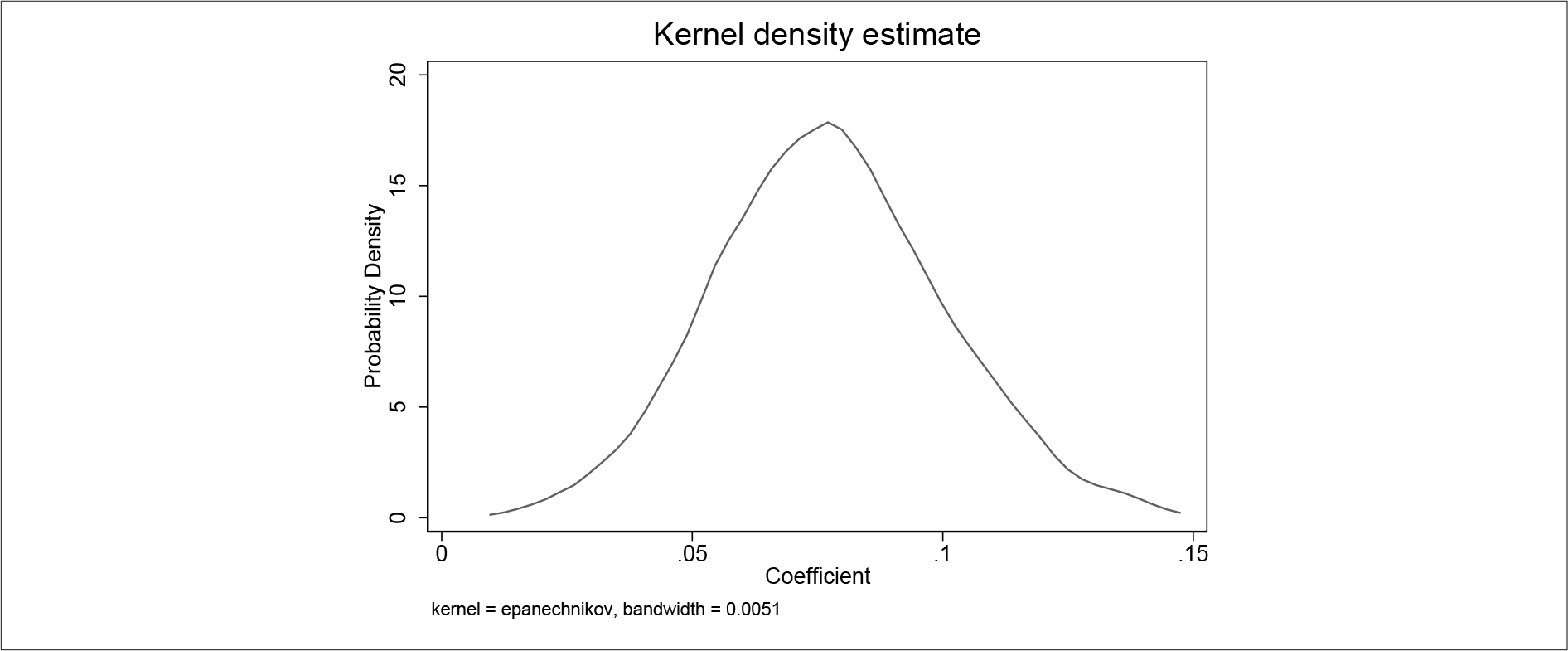
We also conducted a placebo test to exclude the influence of unobservable random disturbances on tunneling. We set a falsified variable of CIO1 using a simulation method of randomly assigning values to the firms in the treatment group. The process was repeated 1,000 times to ensure that the placebo test could effectively identify causality. Figure 1 (Tunneling1 is the explained variable) and Figure 2 (Tunneling2 is the explained variable) show the probability density distribution diagrams of the estimated coefficients of the falsified CIO1 variables. Accordingly, in both diagrams, the estimated values of the randomly generated CIO1 variables are far from the estimates in the baseline regression. Thus, the result verifies that no unobservable random disturbances affect the causal conclusion; the CIO1 variables randomly generated have no impact on the tunneling of firms. Therefore, the negative and significant impact of CIO on tunneling behavior is not affected by unobservable random disturbances.
Possible mechanisms
We attempted to exploit possible mechanisms driving the impact of CIO on tunneling. To this end, we studied how the relationship between CIO and tunneling differs across firms. First, tunneling is not lowered by investors holding firms’ equity in other industries. However, CIIs owning equity in a larger number of firms in the same industry have a greater advantage of collecting and analyzing information and thus exert a more significant effect on tunneling. Hence, information advantage is one of the mechanisms through which CIO reduces tunneling. Second, the shareholder activism of CIIs has increased the proportion of non-controlling shareholders’ voting in general meetings. By voting and submitting proposals in general meetings, CIIs can challenge unreasonable corporate decisions, such as related-party transactions (tunneling).
Information advantage
Equity ownership in multiple companies in the same industry provides institutional investors with information advantages, which is crucial for supervising tunneling behavior. Therefore, first, we compared whether the impact of equity ownership in multiple companies in the same industry was consistent with equity ownership in multiple companies in all industries (Kang et al., 2018). We defined CII as an investor (CIO1_F) owning 5% equity in two or more listed companies (not restricted by industry); we also calculated the number of CIIs (CIO2_F) and the shareholding ratio (CIO3_F). Subsequently, we re-estimated Eq. (1). The results in Table 5 show that the coefficients of CIO1_F, CIO2_F, and CIO3_F are negative but not significant. The results indicate that only CIIs in the same industry can gain information advantages and restrain tunneling.
Second, the information advantage of CII may be related to their industry power. The larger the number of CIIs’ holding equity in firms in the same industry, the more capable and motivated they are to collect relevant information about the firms. This may lead to a greater information advantage (Du et al., 2021; Park et al., 2019). Following Du et al. (2021), we constructed CIIs’ industry power indicator (Power) and add PowerCIO2(CIO3) to Eq. (1). The estimation model is as follows:
We calculated Power in the following manner. We added the number of all firms held by all CIIs in the same industry on a quarterly basis. Subsequently, we calculated the annual average, added one to it, and then took the natural logarithm. Table 6 shows that the coefficients of PowerCIO2(CIO3) are significantly negative. The higher the power of CII, the stronger its inhibiting effect on tunneling. The results reveal that the ownership of a large number of firms in the same industry strengthens CIIs’ information advantage and, in turn, equips them to restrain tunneling effectively.
Shareholder activism
Shareholder activism manifests through shareholders’ voting at general meetings, proposals, change management, and participation at important meetings (Li et al., 2018; Norli et al., 2015). Following Li et al. (2018), we used the voting rate of non-controlling shareholders at general meetings as a proxy for shareholder activism. The general meeting of shareholders is the highest decision-making body of a firm; it is also an important platform through which shareholders influence the firm (Jong et al., 2006). Specifically, non-controlling shareholders can directly express their demands and influence corporate decision-making by voting at the general meeting and submitting proposals (Li et al., 2018). Therefore, the voting rate of non-controlling shareholders at general meetings effectively reflects their activism. We used MSP, MSP_Annual, and MSP_Extra to measure the activism of non-controlling shareholders to participate in corporate decision-making. MSP denotes the proportion of voting by non-controlling shareholders at general meetings. MSP_Annual and MSP_Extra denote the proportion of voting by non-controlling shareholders at annual and extraordinary general meetings, respectively. We changed the dependent variable in Eq. (1) to MSP and estimated the effect of CIO on MSP. The estimation model is as follows:
Table 7 shows that although the coefficient of CIO1 in Column (7) is not significant, the other coefficients of CIO1, CIO2, and CIO3 are significantly positive. CIO significantly improves the activism of non-controlling shareholders to participate in general meetings, both annual and extraordinary. Therefore, meetings enable CIIs to engage in shareholder activism, thereby impacting company operations and restraining tunneling behavior.
Further analysis
This section discusses firms with different information environments, tunneling constraints, and controlling shareholders’ characteristics.
Information environment
We explored whether CIIs play the same role in firms with different information environments. Firms engaged in high-quality information disclosure may have better information environments and internal governance, lower supervision costs of minority shareholders, and a focus on tunneling. Hence, we expected CIIs to have a negligible effect on tunneling in firms with a better information environment. The Kim and Verrecchia (KV) value reflects the actual effect of information disclosure of listed firms, including mandatory and voluntary information disclosures (Kim & Verrecchia, 2001). The higher the KV, the lower the quality of information disclosure. Based on whether the quality of information disclosure exceeds the average value, we split the sample into highand low-information-disclosure-quality firms. Panels A and B of Table 8 show that CIO significantly restrains tunneling only in firms with low information disclosure quality. The results indicate that CIO can play a greater role in firms with a poor information environment, consistent with our prediction.
Constraints on tunneling
Previous studies found that external governance effectively restrains tunneling behavior (Jiang et al., 2015; Zhang et al., 2014). We found that CIO effectively restrains tunneling by shareholder activism. Using network attention and excess on-the-job consumption as measures of external governance, we discussed the effects of CIO on tunneling under different tunneling constraints.
Network attention. Based on whether the total number of news items in which the firm appears is higher than the industry-adjusted mean value, we split the sample into highand low-network-attention groups. When a firm belongs to a high-network-attention group, the firm’s external environment plays a key role. Such an external environment allows for the effective supervision of internal enterprise behavior. Therefore, we predicted that CIO may have less effect on tunneling in the high-network-attention group. Table 9 shows that CIO only decreases the tunneling of firms in the low-network-attention group.
Excess on-the-job consumption. We used the excess on-the-job consumption of executives to proxy non-monetary private income, measured by the difference between the actual and optimal on-the-job consumption of executives (Luo et al., 2011). We split the sample into highand low-excess on-the-job consumption groups, according to whether the excess on-the-job consumption exceeds the average. When a firm belongs to a low-excess on-the-job consumption group, it implies strict external monitoring of the firm and tunneling practices. CIO may have less impact on tunneling of firms with low-excess on-the-job consumption. The results in Panels A and B show that CIO strongly influences tunneling of firms in the high-excess on-the-job consumption group. In sum, as a complement to informal external governance mechanisms, CIO significantly impacts corporate governance in poor external governance environments. Table 10 presents the results.
Different types of controlling shareholders
SOEs and non-SOEs. When examining the impact of institutional investors on corporate governance, previous studies have distinguished the sub-samples of SOEs and non-SOEs, especially when using Chinese data (Du, 2014; Liu et al., 2016). Liu et al. (2016) showed that the restraining effect of independent directors’ attendance on tunneling is more pronounced in non-SOEs. Thus, we split the sample into SOEs and non-SOEs to distinguish the effect of CIO on tunneling in different firms. Table 11 shows that CIO significantly influences tunneling in non-SOEs and has no impact on SOEs’ tunneling. On the one hand, owing to the particularity of the SOEs, CIIs have less influence on firms’ managers. On the other hand, owing to the absence of owners in SOEs, tunneling often occurs for political reasons, and it is difficult for CIIs to exert influence.
Separation of ownership and control. The separation of ownership and control is the root cause of tunneling (Gao et al., 2021; Zhang et al., 2014). Separation incentivizes controlling shareholders to engage in self-dealing transactions and thereby sacrifice the interests of minority shareholders (Jiang et al., 2015; Johnson et al., 2000). Gao et al. (2021) found that analysts’ restraining effect on tunneling is more salient in highly separated firms. To distinguish the effect of CIO on tunneling in different separation scenarios, we split the sample into highly separated and relatively unseparated firms according to whether the value of the separation ratio exceeds the mean value. The separation ratio is calculated using the ownership ratio/control ratio of the actual controller. Table 12 presents the results. Panel A shows that CIO significantly reduces tunneling in highly separated firms. However, Panel B shows that the coefficients of CIO are not statistically significant in less separated firms. Controlling shareholders in highly separated firms have a stronger motivation for tunneling, and CIO has a more salient impact on these firms.
CONCLUSION
We found a negative relationship between CIO and tunneling. The entry of CIIs reduces tunneling. The larger the number of investors and the higher the shareholding ratio, the greater the inhibitory effect of CIO on tunneling. We re-estimated CIO and showed that our findings are robust to the alternative proxy of CIO. The results of instrumental variables (IV), PSM, and PSM-DID show that the negative relationship remains significant after controlling for endogeneity. The mechanism analysis also provides evidence consistent with the findings that CIO mitigates tunneling through information advantage and shareholder activism. Additionally, the negative relationship between CIO and tunneling is more pronounced among firms with poor information environment, low external supervision, non-state ownership, and a high degree of separation.
These findings have the following three policy implications. First, listed companies should actively introduce CIIs to improve corporate governance, as CIIs’ management experience, information resources, and motivation equip them to execute external governance functions. The government should also protect the legitimate rights and interests of CIIs to ensure they can effectively supervise management behaviors. Second, listed companies should motivate minority shareholders to participate in corporate governance by protecting their basic rights. For companies with serious agency problems, the government can appropriately set the minimum voting ratio of minority shareholders. Third, contrary to previous research that found CIO may generate monopoly power (Azar et al., 2018), this research did not find that CIIs collude with management or majority shareholders. However, the government should strengthen the management to prevent such occurrences. As the proportion of institutional investors in the Chinese stock market is still relatively low, policies that promote the development of institutional investors are encouraged.
We conclude by outlining related questions that are beyond the scope of this study. First, due to data availability, we did not differentiate between fair-priced transactions from those with tunneling purposes. Second, despite the positive findings in this study, it should be noted that our results did not specify the influence of CIO on tunneling by institutional investor types. Third, CIO plays multifaceted roles in corporate governance. Although we exploited two possible mechanisms of how CIO alleviates tunneling, other potential mechanisms, such as “voice mechanism” and “exit mechanism” remain under researched. These issues warrant future research.
NOTE
-
Balance test after PSM is reported in an online Appendix at https://kdocs.cn/l/cdWdIuy8zs3B.
-
Evaluated through a double-anonymized peer review
-
The reviewers did not authorize disclosure of their identity and peer review report.
REFERENCES
-
Azar, J., Schmalz, M. C., & Tecu, I. (2018). Anticompetitive effects of common ownership. Journal of Finance, 73(4), 1513-1565. https://doi.org/10.1111/jofi.12698
» https://doi.org/10.1111/jofi.12698 -
Baek, J.-S., Kang, J.-K., & Lee, I. (2006). Business groups and tunneling: Evidence from private securities offerings by Korean chaebols. Journal of Finance, 61(5), 2415-2449. https://doi.org/10.1111/j.1540-6261.2006.01062.x
» https://doi.org/10.1111/j.1540-6261.2006.01062.x -
Boateng, A., & Huang, W. (2017). Multiple large shareholders, excess leverage and tunneling: Evidence from an emerging market. Corporate Governance: An International Review, 25(1), 58-74. https://doi.org/10.1111/corg.12184
» https://doi.org/10.1111/corg.12184 -
Brooks, C., Chen, Z., & Zeng, Y. (2018). Institutional cross-ownership and corporate strategy: The case of mergers and acquisitions. Journal of Corporate Finance, 48, 187-216. https://doi.org/10.1016/j.jcorpfin.2017.11.003
» https://doi.org/10.1016/j.jcorpfin.2017.11.003 -
Chan, K. H., Mo, P. L. L., & Tang, T. (2016). Tax avoidance and tunneling: Empirical analysis from an agency perspective. Journal of International Accounting Research, 15(3), 49-66. https://doi.org/10.2308/jiar-51345
» https://doi.org/10.2308/jiar-51345 -
Chen, D., Jian, M., & Xu, M. (2009). Dividends for tunneling in a regulated economy: The case of China. Pacific-Basin Finance Journal, 17(2), 209-223. https://doi.org/10.1016/j.pacfin.2008.05.002
» https://doi.org/10.1016/j.pacfin.2008.05.002 -
Chen, S., Han, X., & Jebran, K. (2020). Social trust environment and tunneling. Journal of Contemporary Accounting and Economics, 16(3), 100212. https://doi.org/10.1016/j.jcae.2020.100212
» https://doi.org/10.1016/j.jcae.2020.100212 -
Cheung, Y.-L., Jing, L., Lu, T., Rau, P. R., & Stouraitis, A. (2009). Tunneling and propping up: An analysis of related party transactions by Chinese listed companies. Pacific-Basin Finance Journal, 17(3), 372-393. https://doi.org/10.1016/j.pacfin.2008.10.001
» https://doi.org/10.1016/j.pacfin.2008.10.001 -
Du, X. (2014). Does religion mitigate tunneling? Evidence from Chinese Buddhism. Journal of Business Ethics, 125(2), 299-327. https://doi.org/10.1007/s10551-013-1917-6
» https://doi.org/10.1007/s10551-013-1917-6 -
Du, Y., Sun, F., & Deng, X. (2021). Common institutional ownership and corporate earnings management. China Industrial Economics, 6, 155-173. https://doi.org/10.19581/j.cnki.ciejournal.2021.06.010
» https://doi.org/10.19581/j.cnki.ciejournal.2021.06.010 -
Fu, Y., & Qin, Z. (2021). Institutional cross-ownership and corporate philanthropy. Finance Research Letters, 43, 101996. https://doi.org/10.1016/j.frl.2021.101996
» https://doi.org/10.1016/j.frl.2021.101996 -
Gao, K., Shen, H., Gao, X., & Chan, K. C. (2019). The power of sharing: Evidence from institutional investor cross-ownership and corporate innovation. International Review of Economics and Finance, 63, 284-296. https://doi.org/10.1016/j.iref.2019.01.008
» https://doi.org/10.1016/j.iref.2019.01.008 -
Gao, K., Shen, Y., & Chan, K. C. (2021). Does analyst following restrain tunneling? Evidence from brokerage closures and mergers. Finance Research Letters, 41, 101849. https://doi.org/10.1016/j.frl.2020.101849
» https://doi.org/10.1016/j.frl.2020.101849 -
Gao, L., & Kling, G. (2008). Corporate governance and tunneling: Empirical evidence from China. Pacific-Basin Finance Journal, 16(5), 591-605. https://doi.org/10.1016/j.pacfin.2007.09.001
» https://doi.org/10.1016/j.pacfin.2007.09.001 -
He, J., & Huang, J. (2017). Product market competition in a world of cross-ownership: Evidence from institutional blockholdings. Review of Financial Studies, 30(8), 2674-2718. https://doi.org/10.1093/rfs/hhx028
» https://doi.org/10.1093/rfs/hhx028 -
He, J., Huang, J., & Zhao, S. (2019). Internalizing governance externalities: The role of institutional cross-ownership. Journal of Financial Economics, 134(2), 400-418. https://doi.org/10.1016/j.jfineco.2018.07.019
» https://doi.org/10.1016/j.jfineco.2018.07.019 -
Jalil, A. A., & Rahman, R. A. (2010). Institutional investors and earnings management: Malaysian evidence. Journal of Financial Reporting and Accounting, 8(2), 110-127. https://doi.org/10.1108/19852511011088370
» https://doi.org/10.1108/19852511011088370 -
Jian, M., & Wong, T. J. (2010). Propping through related party transactions. Review of Accounting Studies, 15(1), 70-105. https://doi.org/10.1007/s11142-008-9081-4
» https://doi.org/10.1007/s11142-008-9081-4 -
Jiang, G., Rao, P., & Yue, H. (2015). Tunneling through non-operational fund occupancy: An investigation based on officially identified activities. Journal of Corporate Finance, 32, 295-311. https://doi.org/10.1016/j.jcorpfin.2014.10.011
» https://doi.org/10.1016/j.jcorpfin.2014.10.011 -
Johnson, S., Porta, R. La, Lopez-de-Silanes, F., & Shleifer, A. (2000). Tunneling. American Economic Review, 90(2), 22-27. https://doi.org/10.1257/aer.90.2.22
» https://doi.org/10.1257/aer.90.2.22 -
Jong, A. de, Mertens, G., & Roosenboom, P. (2006). Shareholders’ voting at general meetings: Evidence from the Netherlands. Journal of Management and Governance, 10(4), 353-380. https://doi.org/10.1007/s10997-006-9006-1
» https://doi.org/10.1007/s10997-006-9006-1 -
Kang, J.-K., Luo, J., & Na, H. S. (2018). Are institutional investors with multiple blockholdings effective monitors? Journal of Financial Economics, 128(3), 576-602. https://doi.org/10.1016/j.jfineco.2018.03.005
» https://doi.org/10.1016/j.jfineco.2018.03.005 -
Kim, O., & Verrecchia, R. E. (2001). The relation among disclosure, returns, and trading volume information. Accounting Review, 76(4), 633-654. https://doi.org/10.2308/accr.2001.76.4.633
» https://doi.org/10.2308/accr.2001.76.4.633 -
Kostovetsky, L., & Manconi, A. (2020). Common institutional ownership and diffusion of innovation (SSRN Scholarly Paper ID n. 2896372). Social Science Research Network. https://doi.org/10.2139/ssrn.2896372
» https://doi.org/10.2139/ssrn.2896372 -
Li, J., Wang, L., Zhou, Z.-Q., & Zhang, Y. (2021). Monitoring or tunneling? Information interaction among large shareholders and the crash risk of the stock price. Pacific-Basin Finance Journal, 65, 101469. https://doi.org/10.1016/j.pacfin.2020.101469
» https://doi.org/10.1016/j.pacfin.2020.101469 -
Li, S., Zhai, S., & Gu, P. (2018). The noncontrolling shareholders’ activism and corporate technological innovation. China Industrial Economics, 7, 155-173. https://doi.org/10.19581/j.cnki.ciejournal.2018.07.007
» https://doi.org/10.19581/j.cnki.ciejournal.2018.07.007 -
Liu, H., Wang, H., & Wu, L. (2016). Removing vacant chairs: Does independent directors’ attendance at board meetings matter? Journal of Business Ethics, 133(2), 375-393. https://doi.org/10.1007/s10551-014-2402-6
» https://doi.org/10.1007/s10551-014-2402-6 -
Luo, W., Zhang, Y., & Zhu, N. (2011). Bank ownership and executive perquisites: New evidence from an emerging market. Journal of Corporate Finance, 17(2), 352-370. https://doi.org/10.1016/j.jcorpfin.2010.09.010
» https://doi.org/10.1016/j.jcorpfin.2010.09.010 -
Norli, Ø., Ostergaard, C., & Schindele, I. (2015). Liquidity and shareholder activism. Review of Financial Studies, 28(2), 486-520. https://doi.org/10.1093/rfs/hhu070
» https://doi.org/10.1093/rfs/hhu070 -
Park, J., Sani, J., Shroff, N., & White, H. (2019). Disclosure incentives when competing firms have common ownership. Journal of Accounting and Economics, 67(2-3), 387-415. https://doi.org/10.1016/j.jacceco.2019.02.001
» https://doi.org/10.1016/j.jacceco.2019.02.001 -
Pawliczek, A., & Skinner, A. N. (2018). Common ownership and voluntary disclosure. SSRN Electronic Journal, 1-56. https://doi.org/10.2139/ssrn.3002075
» https://doi.org/10.2139/ssrn.3002075 -
Ramalingegowda, S., Utke, S., & Yu, Y. (2021). Common institutional ownership and earnings management. Contemporary Accounting Research, 38(1), 208-241. https://doi.org/10.1111/1911-3846.12628
» https://doi.org/10.1111/1911-3846.12628 -
Wen, F., Xu, L., Chen, B., Xia, X., & Li, J. (2020). Heterogeneous institutional investors, short selling and stock price crash risk: Evidence from China. Emerging Markets Finance and Trade, 56(12), 2812-2825. https://doi.org/10.1080/1540496X.2018.1522588
» https://doi.org/10.1080/1540496X.2018.1522588 -
Ye, Y., Huang, L., & Li, M. (2015). Negative media coverage, law environment and tunneling of controlling shareholder: Evidence from Chinese listed companies. China Finance Review International, 5(1), 3-18. https://doi.org/10.1108/CFRI-12-2013-0135
» https://doi.org/10.1108/CFRI-12-2013-0135 -
Zhang, M., Gao, S., Guan, X., & Jiang, F. (2014). Controlling shareholder-manager collusion and tunneling: Evidence from China. Corporate Governance: An International Review, 22(6), 440-459. https://doi.org/10.1111/corg.12081
» https://doi.org/10.1111/corg.12081 -
Zhang, X., Yang, X., Strange, R., & Zhang, Q. (2017). Informed trading by foreign institutional investors as a constraint on tunneling: Evidence from China. Corporate Governance: An International Review, 25(4), 222-235. https://doi.org/10.1111/corg.12206
» https://doi.org/10.1111/corg.12206
Edited by
-
Associate Editor:
Carlos Maquieira

 Note: This figure shows the result of a placebo test to exclude the influence of unobservable random disturbances on tunneling. We set a falsified variable of CIO1 using a simulation method of randomly assigning values to the firms in the treatment group. The process is repeated 1,000 times to ensure that the placebo test can effectively identify causality.