 Antecedents and consequences of individual absorptive capacity in times of crisis
Abstract
Purpose: This article examines the relationship between individuals’ characteristics (motivation and cognition), individual absorptive capacity, and individual innovative performance in times of crisis.
Originality/value: The study contributes to emerging academic thinking on the micro-foundations of dynamic capabilities, self-determination theory as an antecedent factor, and individual innovative performance as a consequence factor of individual absorptive capacity. Regarding practical contributions, managers and entrepreneurs should invest in training in times of crisis, aiming to develop individual practices and skills to promote organizations’ innovative capacity.
Design/methodology/approach: Data were collected through a questionnaire (survey). There were 320 respondents. Confirmatory Factor Analy-sis was applied to validate the constructs’ items using PLS-SEM to test the hypotheses using the Smart-PLS2.0 software.
Findings: The results demonstrated that the dissociative cognitive style was the most significant predictor of individual absorptive capacity in times of crisis. It was also found that the level of extrinsic motivation had no effect when analyzed concerning the level of individual absorptive capacity in times of crisis. Finally, the findings showed a positive relationship between individual absorptive capacity and individual innovative performance. However, the times of crisis variable did not exert a moderating effect on this relationship.
Keywords:
motivation; cognition; individual absorptive capacity; individual innovative performance; times of crisis
Resumo
Objetivo: Examinar a relação entre as características dos indivíduos (motivação e cognição), a capacidade absortiva individual e o desempenho inovador individual em tempos de crise.
Originalidade/valor: O estudo contribui para o pensamento acadêmico emergente dos microfundamentos das capacidades dinâmicas, da teoria da autodeterminação como antecedente e do desempenho inovador individual como consequência da capacidade absortiva individual. Sobre as contribuições práticas, gestores e empreendedores devem investir em capacitação em tempos de crise, visando o desenvolvimento de práticas e habilidades individuais, a fim de promover capacidade inovativa das organizações.
Design/metodologia/abordagem: Os dados foram coletados por meio de um questionário (survey). O número de respondentes foi de 320 e sobre essa totalidade foram aplicadas uma Análise Fatorial Confirmatória para validar os itens dos construtos e o PLS-SEM para teste das hipóteses com auxílio do software Smart-PLS2.0.
Resultados: Apurou-se que o preditor mais significativo da capacidade absortiva individual em tempos de crise foi o estilo cognitivo dissociativo. Constatou-se ainda que o nível da motivação extrínseca não teve efeito quando analisado em relação ao nível da capacidade absortiva individual em tempos de crise. Por fim, os achados mostraram uma relação positiva de consequência da capacidade absortiva individual ao desempenho inovador individual, no entanto, a variável tempos de crise não exerceu um efeito moderador em tal relação.
Palavras-chave:
motivação; cognição; capacidade absortiva individual; desempenho inovador individual; tempos de crise
INTRODUCTION
In 2019, the Sars-CoV-2 virus, recognized as COVID-19, triggered a global health crisis (Bavel et al., 2020). In three months, the infection spread, gene-rating more than 118,000 cases and 4,291 deaths in 114 countries, which led the World Health Organization (WHO) to declare a global pandemic. In 2022, the pandemic reached more than 33.5 million confirmed cases and 676 thousand deaths (CONASS, 2022). This context not only led to challenges in coping with the disease but also impacted how people work and relate to each other, which allows us to define it as a crisis time, thus conceiving it as one of the variables of this article.
Among other challenges in this crisis, it is possible to mention the boost of digital transformation (Nurhas et al., 2022) and supply chain changes (Raj et al., 2022). Thus, while efforts to develop pharmacological interventions to overcome COVID-19 were employed, researchers of public and private organizations also endeavored to provide valuable knowledge regarding the reorganization of society, promoting technological advances and readjusting production systems (Bartik et al., 2020; Bavel et al., 2020; Martins & Freire, 2023). In this sense, knowledge was the primary input to face the aforementioned challenges, which must flow between individuals and organizations to contribute to practical and innovative solutions (Yildiz et al., 2024; Snehvrat et al., 2022). The ability to continuously renew, develop, and transfer assets based on knowledge was, and still is, a central goal of public and private organizations in dealing with crises.
Martins and Freire (2023) point out that during the COVID-19 pandemic, at least a quarter of Brazilian startups were negatively impacted. The authors argue that startups’ Absorptive Capacity (AC) can determine their capacity for innovation and survival, including during crises such as the COVID-19 pandemic. Malvestiti et al. (2021) describe how AC is related to the capacity for social innovation and is, in turn, oriented towards sustaina-bility and organizational sustainability.
CA stands out as the competence to support constant learning and innovation in organizations (Pedrosa et al., 2022; Van Wijk et al., 2008), being considered a dynamic capability at the organizational level and concerning the identification and acquisition of external knowledge as well as its integration with internal knowledge via transformation and exploration (Zahra & George, 2002; Lichtenthaler & Lichtenthaler, 2009). In this line, studies such as those by Lichtenthaler (2011) and Martins and Freire (2023) exami-ned the AC phenomenon at the organizational and interorganizational levels. However, there is a growing demand for studies on AC at the individual level (Lowik et al., 2017), as individuals represent the primary agents of knowledge creation and innovation (Bogers et al., 2017; West & Bogers, 2017; Yildiz et al., 2024), which also means that individuals are responsible for changes both in periods of normality and in times of crisis.
INDIVIDUAL AC: CURRENT STATE OF DISCUSSIONS AND RESEARCH APPROACH
In this article, we start from the premise that the search for solutions to everyday problems and the creation of knowledge aimed at generating innovations to deal with moments of crisis is part of the interaction and disposition of individuals (Yildiz et al., 2024). Thus, creating and converting knowledge depends on the recursive transition between its tacit and explicit forms, depending on interactional processes mediated by mechanisms made availa-ble by the organization (Chiu et al., 2023). It is worth mentioning that tacit knowledge is not easily codified, making it difficult to convert and share. On the other hand, explicit knowledge is codified and generally easily shareable.
Yildiz et al. (2024) and Snehvrat et al. (2022) point to the need for studies that address individual AC, arguing that individuals play a fundamental role in absorbing new knowledge. Despite this lack, research has explored individual AC to understand how organizations undertake open innovation (Lowik et al., 2017). Santos et al. (2020a) evaluated individual AC and entrepreneurial intention in successors of rural properties in cooperative systems. Tian and Soo (2018) observed that organizational commitment to learning, employees’ intrinsic motivation, and creativity and performance positively impact individual AC results.
Therefore, starting from the understanding that individual AC is an element and a resource for organizational AC (Agostineto et al., 2022), it is also necessary to understand how essential factors to the individual, such as cognition and motivation, affect AC. In this sense, Jiménez-Castillo and Sánchez-Pérez (2013) and Chiu et al. (2023) demonstrated how individual AC was influenced by motivation, cognition, and the diversity of external networks. Individual AC was also shown to enhance favorable results regarding task performance (Park et al., 2007), knowledge creation, and innovation (Tortoriello, 2015; Ter Wal et al., 2017; Enkel et al., 2017). Accordingly, based on the Self-Determination Theory (Ryan & Deci, 2000), it is necessary to examine the different types of motivation (intrinsic and extrinsic) and cognition (associative and dissociative) of the organization’s employees, these antecedents being distinct from AC individuals.
Another relevant aspect to point out in this article is that, until now, there have been opportunities for research into capabilities, individual behaviors, and innovation during times of crisis similar to the COVID-19 pandemic. Some studies found a significantly negative relationship in this sense (Golparvar et al., 2012; Wang et al., 2020), while others found a non-significant relationship (Abbas & Raja, 2015; Bani-Melhem et al., 2018; Teng et al., 2021). It is also worth mentioning that this type of context has become increasingly recurrent, given the problems of environmental crises and wars.
Therefore, the link between individual characteristics, knowledge absorption, and innovative performance in times of crisis deserves to be the subject of further studies. Consequently, when we assume that crises affect individuals’ cognitive and motivational aspects due to the ambiguities and uncertainties inherent to such moments. We also assume that this situation affects individual AC and is associated with the absorption and creation of knowledge at the organizational level. Thus, by understanding how situations of uncertainty and crisis arise from the COVID-19 pandemic, it is possible to infer that the individual’s AC must be driven by the intrinsic interest in learning and personal development for the absorption and creation of knowledge and innovation in the organization (Tian & Soo, 2018).
On the other hand, by stimulating individual action through clear and observable results, extrinsic motivation can undermine certain aspects of AC (Chiu et al., 2023). Hence, distinguishing between different types of motivation is essential to further refinement of individual AC and its ante-cedents. As motivational and cognitive factors can influence individual AC, it is possible to assume that the ability to innovate by generating new products, services, or processes will also be impacted (West & Bogers, 2017), especially in crisis contexts. Therefore, when analyzing individual AC, individual innovative performance is adopted here as its consequence (Lowik et al., 2017). This article examines the relationship between individuals’ characteristics (motivation and cognition), individual absorptive capacity, and individual innovative performance.
The development of this work enabled progress on two fronts. Firstly, there is a debate about the relationship between individual AC and times of crisis in the environment. Second, it was observed how two antecedents of individual AC - motivation and cognition - are affected in times of crisis. Through the methodological trajectory we employed, it was possible to empirically examine the different types of motivation and cognition, as well as how they were used to develop individual AC and improve the innovative performance of people who worked in RD&I (Research, Development, and Innovation) during the COVID-19 pandemic.
In addition to the antecedents of individual AC, its results were also examined, that is, its impact on the innovative performance of individuals who worked on RD&I activities in critical periods such as the COVID-19 pandemic. Such performance represents an important source of organizational innovation and competitive advantage in crisis contexts in general (Gong et al., 2013). Finally, the moderating role of crisis times was evalua-ted in the relationship between individual AC and individual innovative performance during the COVID-19 pandemic.
THEORETICAL BACKGROUND AND HYPOTHESES
This article examined individuals’ cognitive and motivational factors and capabilities from a knowledge management perspective focused on AC at the individual level (Cohen & Levinthal, 1990; Lichtenthaler, 2011; Lowik et al., 2017). In this sense, it is necessary to remember that we start from the premise that individual-level factors represent a critical antecedent of the capabilities to generate solutions and innovate at the organizational level (Regnér & Zander, 2014; Tian & Soo, 2018; Martins & Freire, 2023), in the same way that an organization’s AC depends on that organization’s knowledge absorption capabilities (Lane et al., 2006; Tian & Soo, 2018).
In other words, individual AC forms the basis of organizational AC and can be leveraged both by individual characteristics and by the motivation and cognition of individuals in the activity of knowledge absorption, as well as the transformation and exploitation of this knowledge (Lowik et al., 2017; Santos et al., 2020b). Likewise, organizations must promote actions that facilitate the use of organizational mechanisms, assist in the socialization of knowledge (Zahra & George, 2002; Todorova & Durisin, 2007), or even in the transference of knowledge (Jansen et al., 2005) to contribute to the promotion of individual AC.
It is worth highlighting that AC is mainly treated as a collective phenome-non and studied at the level of teams (Nemanich et al., 2010), alliances between organizational actors (Lane & Lubatkin, 1998; Newey & Verreynne, 2011; Enkel & Heil, 2014), industrial districts and, more commonly, the organizational level (Jansen et al., 2005; Lane et al., 2006; Volberda et al., 2010). In this context, several scholars argue about the need for more empiri-cal studies on individual AC (Lane et al., 2006; Yildiz et al., 2024), and in response to these calls, recent research has begun to advance the understanding of AC in individual level (Jiménez-Castillo & Sánchez Pérez, 2013; Ter Wal et al., 2017; Snehvrat et al., 2022). Accordingly, some studies sought to examine the link between individual AC and elements such as cognition and the impacts of this conjunction on individual learning (Martinkenaite & Breunig, 2016; Yao & Chang, 2017; Yildiz et al., 2019), while others proposed to verify whether social interaction affects individual AC (Tortoriello, 2015).
In this sense, it is necessary to understand how the context also interferes with personal characteristics such as cognition, motivation, and individual AC. Thus, based on the premise that crises such as COVID-19 have become recurrent, there is a lack of studies that assess the extent to which individual characteristics-such as motivation and cognition-influence the ability to absorb knowledge to improve solution creation.
Regarding individuals’ motivational factors, although extrinsic motivation is an important generator of engagement about behaviors that result in the search for knowledge, intrinsic motivation also promotes positive results in individual AC (Chiu et al., 2023). Considering the Self-Determination Theory approach, we can infer that intrinsic motivation has a more significant influence than extrinsic motivation. In this way, intrinsic motivation has a greater capacity to influence the employee’s results concerning their creativity, knowledge sharing, and performance in the innovation activity (Zhang & Bartol, 2010; Agostineto et al., 2022).
Self-determination theory was adopted to differentiate intrinsic and extrinsic motivation (Gagné & Deci, 2005), with these two dimensions of motivation also being examined as predictors of the development of individual AC (Chiu et al., 2023). Thus, we can infer that intrinsically motivated people work with more pleasure, embarking on a task because they find it enjoyable despite the absence of expectations of immediate extrinsic rewards (Williams & Deci, 1996; Ryan & Deci, 2000). Previous studies show that intrinsically motivated individuals have a natural basis for learning and professional development (Vansteenkiste et al., 2004; Vansteenkiste et al., 2006).
Regarding times of crisis, due to the high degree of ambiguity and uncertainty, learning processes may not produce adequate results. This situation can lead the individual to exert minimal effort to solve problems and achieve results (Reinholt et al., 2011; Santos et al., 2020a). Consequently, some of the knowledge acquired and assimilated may not be recovered or may even become useless, depriving the individual of recognition or motivation for their efforts to identify and assimilate new knowledge (Chiu et al., 2023). This implies that individuals need to be motivated to learn to explore new ideas and assimilate external knowledge, even if the results of such efforts are not immediate or visible (Rigolizzo & Amabile, 2015; Lowik et al., 2016). Other research, such as Reinholt et al. (2011), also shows that intrinsic and autonomous motivation leads to higher effort, perseverance, and persistence. In a resume, it is important to sustain the desire of individuals to obtain the necessary skills to absorb new knowledge in situations of ambiguity and uncertainty.
In contrast to intrinsic motivation, extrinsic motivation is salient when the activity leads to material rewards and explicit recognition (Gagné & Deci, 2005). Thus, extrinsically motivated professionals are more likely to respond to pressure from external regulations and/or self-imposed pressure (Deci & Ryan, 1985). When an individual has strong extrinsic motivation, he regulates his efforts in response to external mandates and incentives (Reinholt et al., 2011).
Considering the uncertainties and risks associated with absorbing new knowledge, extrinsic motivation may cause individuals to reduce effort in their tasks in times of crisis (Rigolizzo & Amabile, 2015; Deci & Ryan, 1985). This reasoning suggests that different forms of motivation play different roles in developing individual AC in a critical context (Tian & Soo, 2018). Therefore, intrinsically motivated professionals would be more inclined to develop skills necessary for highly ambiguous and uncertain tasks regarding knowledge absorption in scenarios such as the COVID-19 pandemic, as studied by Martins and Freire (2023). Otherwise, extrinsic motivation would induce individuals to refrain from seeking new ideas due to a less permanent and intense stimulus related to external rewards. Based on this context, the following hypotheses were formulated:
-
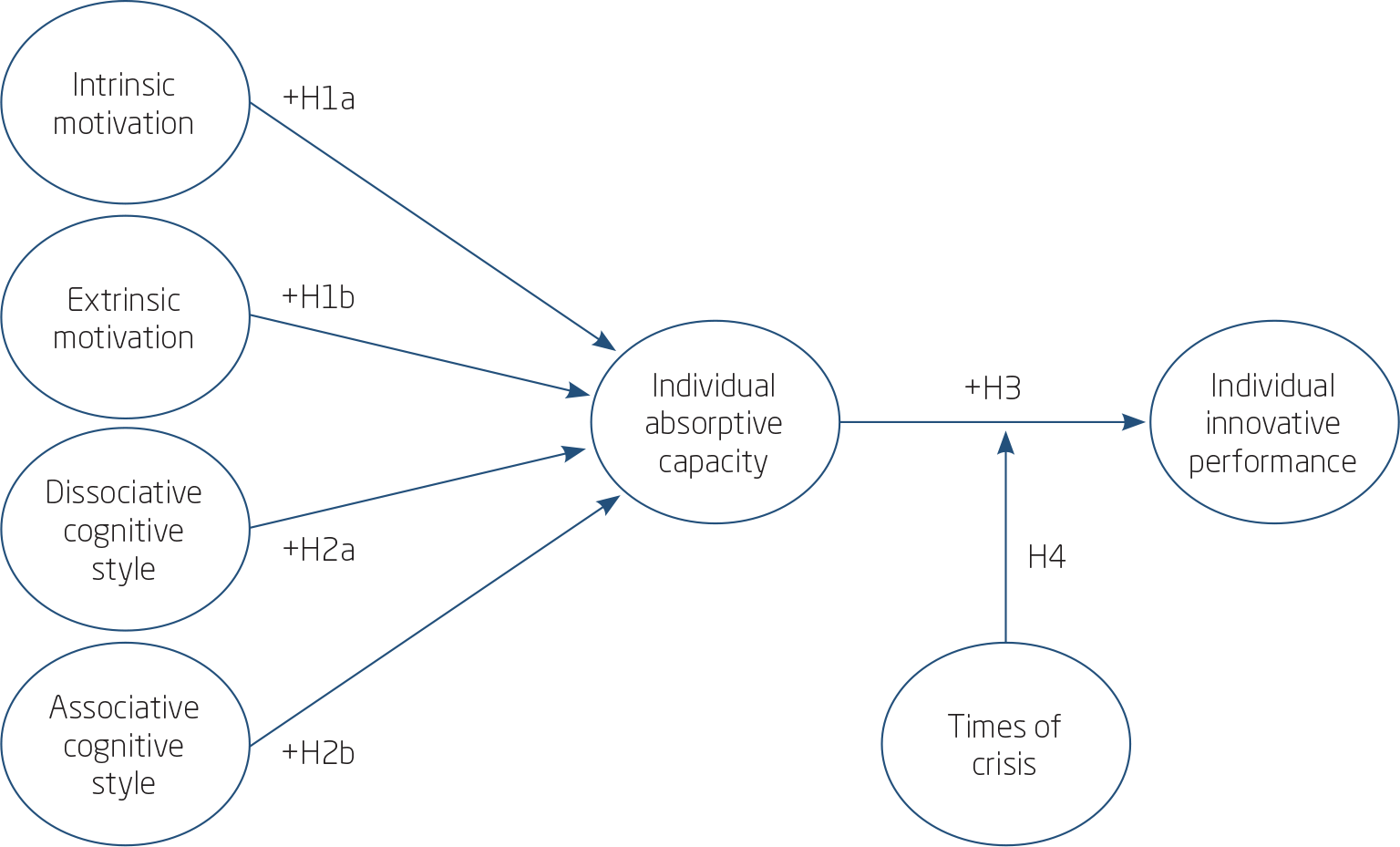
H1a. The higher the level of intrinsic motivation, the higher the individual absorptive capacity in times of crisis.
-
H1b. The higher the level of extrinsic motivation, the higher the level of individual absorptive capacity in times of crisis.
Despite the relevance of motivational factors, individuals’ cognitive abilities interfere with learning, problem-solving, and creativity (Cohen & Levinthal, 1990; Lane et al., 2006; Todorova & Durisin, 2007). Individual cognition is how individuals process information and make decisions (Fiske & Taylor, 2013). It is still opportune to test the relationship between individual cognition and individual AC, especially in times of crisis.
Koestler (1964) differentiated cognitive styles between dissociative and associative to explain individual information processing and decision-making differences. Dissociation is a decision-making style in which individuals use imagination and intuition to seek solutions outside of disciplinary boundaries, discovering unreadily apparent connections. Payne et al. (1990) indicate dissociation involves unlearning and changing the “rules of the game.” Otherwise, individuals with an associative style tend to rely on rational thinking, emphasizing verbal reasoning and articulating expressions of ideas (Jabri, 1991). They pay attention to aspects of a problem for which conventional solutions are at hand and attempt to adhere to existing rules and methodologies within disciplinary boundaries (Payne et al., 1990).
Unlike other cognitive style dimensions, dissociation and association cognitive styles are not antagonistic but are independent subscales (Payne et al., 1990). It is argued that individuals have both styles but may prefer one depending on the task.
The literature on AC talks about how the creation of knowledge involves combining existing knowledge with the generation of new knowledge and ideas. This creative process is more facilitated by the dissociative cognitive style in times of crisis (Todorova & Durisin, 2007; Zahra & George, 2002). Furthermore, the dissociative style encourages the absorption of external knowledge since individuals endowed with this cognitive style tend to seek differences and unknown solutions in situations of uncertainty and ambiguity. Thus, it is expected that the dissociative cognitive style has a positive relationship with individual AC in times of crisis (Lowik et al., 2017), as it is necessary to incorporate new work methods, which require openness to change and unlearning. Thus, the following hypotheses were formulated:
-
H2a. The higher the level of dissociative cognitive style, the higher the level of individual absorptive capacity in times of crisis.
-
H2b. The higher the level of associative cognitive style, the higher the level of individual absorptive capacity in times of crisis.
As motivational and cognitive factors can influence individual AC, we can assume that the ability to innovate will also be impacted by them (West & Bogers, 2017). Thus, individual innovative performance is understood as a consequence of individual AC. According to Lowik et al. (2017), individual innovative performance is related to idea generation and exploration. Thus, generating ideas requires individuals to be creative in decision-making (Lane et al., 2006), doing it to anticipate unexpected problems and solve them (West & Farr, 1990). These new ideas result from recognition, assimilation, and transformation activities (Agostineto et al., 2022). Additionally, exploring ideas results from implementing ideas generated by these individuals or others (Zahra & George, 2002).
According to Schweisfurth and Raasch (2018), employees’ innovative performance will be positively related to their ability to identify needs and promote solutions. Recognition of user needs related to their experiences and problems when using a product or new applications is crucial for innovation. Therefore, assessing external knowledge and needs is crucial for selecting economically important directions for innovation (Martinkenaite & Breunig, 2016; Yao & Chang, 2017). Consequently, professionals with high need AC can frame external need knowledge within existing cognitive schemas (assimilation) or can construct new knowledge structures to accommodate it (transformation) (Todorova & Durisin, 2007; Yildiz et al., 2019), enabling its application in organizational innovation.
To effectively use external knowledge for innovation, individuals must draw on external resources and evaluate the value of the knowledge to be absorbed (Dahlander et al., 2016). Professionals with high solution AC can identify and evaluate external solution knowledge earlier and more accurately than individuals who do not have this capacity. Thus, they are more likely to absorb valuable knowledge for innovation, which makes them capable of assimilating knowledge from the external solution and exploiting it for innovation.
Therefore, individual AC is expected to have a positive relationship with individual innovative performance in critical scenarios, such as the COVID-19 pandemic. Furthermore, times of crisis are expected to moderate the relationship between individual AC and individual innovative performance. Thus, the following hypotheses are formulated:
-
H3. The higher the level of individual absorptive capacity, the higher the level of individual innovative performance in times of crisis.
-
H4. Time of crisis moderates the relationship between individual absorptive capacity and individual innovative performance.
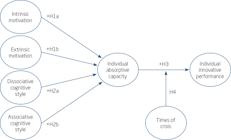
Figure 1 presents the conceptual model of this research and the legend of the constructs.
MATERIALS AND METHODS
This research is quantitative, following a hypothetical-deductive orientation, and uses a survey. To test the hypotheses, a research instrument based on validated scales was constructed and made available by QuestionPro from December 2019 to March 2022. Invitations to participate in the research were sent via email, LinkedIn, and WhatsApp, along with a link to access the questionnaire.
The survey respondents’ profiles include individuals who worked on RD&I activities during the COVID-19 pandemic. The reason for the choice was that such individuals should continually deal with the absorption of internal and external knowledge to make decisions that potentially result in innovations. The qualification of this research subject allowed access to the phenomenon studied here. In this way, it was tested to determine what measure of individual innovative performance is influenced by individual AC, which in turn is affected by motivational and cognitive factors in times of crisis.
The sampling obtained was for convenience, and based on the selected profile, we sought, through invitation, to obtain a sample suitable for the variables tested. The GPower software was used to calculate the sample size, as Faul et al. (2007) and Ringle et al. (2014) recommended. A power test of 95% (0.95) was adopted, with GPower indicating the need to collect at least 92 valid responses. This number was tripled following sampling practices in research of this type, considering that the model includes a moderation test. Thus, the recommendation for the final sample resulted in 276 respondents as a minimum sample. After applying the questionnaires, 478 responses were obtained, of which 148 were disregarded due to incomplete responses. Finally, 330 valid responses were obtained and passed through the analysis process.
To construct the research instrument, the scales initially developed in English underwent the back-translation process to guarantee cross-cultural equivalence. Furthermore, they underwent adaptation to consider the crisis factors, which were directly associated with the period of the COVID-19 pandemic. The complete questionnaire was validated by six experts in AC and innovation who are fluent in English and are professors and researchers in the administration who work in stricto sensu postgraduate programs. Therefore, to achieve greater refinement of the research instrument and avoid problems, as well as to correct any deficiencies and check the time taken to respond to the questionnaire, a pre-test was carried out with 20 respondents, who attested to their understanding of the questions, validating the instrument (Hair Jr. et al., 2009).
It is worth explaining that the face and content validation procedures seek to preserve the scales’ main characteristics in measuring the constructs involved (Malhotra, 2007). Thus, the questionnaire sought the respondent’s perception of the phenomenon investigated based on a 7-point Likert scale, ranging from 1 (totally disagree) to 7 (totally agree). All question blocks were randomized, and the ordering of the scale items was changed-this action aimed to mitigate response bias that can harm self-administered questionnaires.
The research questionnaire consisted of 43 items referring to the constructs studied, and five variables were used to characterize the sample properly. The scale used for the intrinsic motivation variable was that of Gagné et al. (2010). This scale showed good reliability and validity in the study by Yildiz et al. (2019). The scale by Gagné et al. (2010) was also used for the extrinsic motivation variable, which showed good reliability and validity in the study by Yildiz et al. (2019).
The cognitive style variable was evaluated as a decision-making heuristic, and for this purpose, Jabri’s (1991) differentiation between association and dissociation was used. It is worth explaining that Jabri’s (1991) scale is based on Koestler’s (1964) research on creativity, which is also cited in the article by Zahra and George (2002) and Todorova and Durisin (2007). This scale showed good reliability and validity in the study by Lowik et al. (2017).
The Lowik et al. (2016) scale was used for the individual AC variable, a second-order construct consisting of individual activities of recognition, assimilation, transformation, and application of new external knowledge. This scale achieved good reliability and validity in Lowik et al. (2017) and Agostineto et al. (2022) studies.
Individual innovator performance was measured using the Lowik et al. (2017) scale. This scale showed good reliability and validity in Ng and Feldman (2010) and Agostineto et al. (2022) studies. Finally, the Billings et al. (1980) scale was considered adaptively for the moderating variable times of crisis. The indicators on this scale seek to assess the threat of loss of value, the uncertainty about the individual’s decision-making actions depending on the probability of this loss occurring or not, as well as measuring the time pressure to make decisions. It is worth noting that this scale showed good reliability and validity in the study by Santos et al. (2020b). Table 1 presents all tested constructs and their respective scales.
After data collection, outliers and observations that presented different response patterns from those of the others were analyzed. The pairwise correlations of the variables were analyzed to verify the data’s linearity, as a significant correlation coefficient at the 5% level indicates linearity. Furthermore, the Bartlett test was performed to verify linearity in each construct. In the descriptive analysis of quantitative variables, measures of central tendency, position, and dispersion were used.
Initially, this research adopted a Confirmatory Factor Analysis (CFA) based on the proposition of hypotheses constructed from construct theories (Hair Jr. et al., 2016). Thus, to evaluate the relationships between the constructs used, a Structural Equation Model (SEM) was carried out using the PLS approach with the support of the SmartPLS2 software. The SEM process is divided into two parts: the measurement model and the structural model. To verify the validity of the measurement model, convergent validity, reliability, and discriminant validity were evaluated (Hair Jr. et al., 2016).
To verify convergent validity, the Average Variance Extracted (AVE) criterion was used (Fornell & Larcker, 1981), and the construct reaches validity when this indicator is more significant than 0.50 (Henseler et al., 2009). To measure reliability, Cronbach’s Alpha (CA) and Composite Reliability (CC) (Chin, 1998) were used, which must be greater than 0.70 to indicate the reliability of the construct (Tenenhaus et al., 2005), and in exploratory research values above 0.60 are also accepted (Hair Jr. et al., 2009). Discriminant validity is guaranteed when the AVE of a construct is greater than the shared variance of that construct with the others (Fornell & Larcker, 1981). To verify the dimensionality of the constructs, the Parallel Lines criterion was used (Hoyle & Duvall, 2004), which returns the number of dimensions of the construct.
The Bootstrap method was used to calculate confidence intervals for the weights of the measurement model and the coefficients of the structural model. This procedure provides information about the variability of the estimated parameters, which is important for validating the results. The Bootstrap method is widely used to make inferences when the probability distribution of the variable of interest is unknown.
To evaluate the quality of the adjustments, R2 and GoF were used (Tenenhaus et al., 2005). R2 represents a scale from 0% to 100%, demonstrating how much the independent constructs explain the dependent ones, and, in general, values lower than 25% represent weak explanatory capacity, values between 25% and 50% indicate moderate explanatory capacity and values above 50% demonstrate substantial explanatory capacity (Hair Jr. et al., 2009). The GoF is a geometric mean of the AVEs of the constructs and the R2 of the model and varies from 0% to 100%. The GoF in PLS cannot discriminate between valid and invalid models, in addition to not applying to models with formative constructs (Henseler et al., 2009), allowing only a synthesis of the AVEs and R2 of the model in a single statistic, which may be helpful for future comparisons of adherence of different samples to the model.
RESULTS
Regarding outliers, no values were found outside the scale range of their respective variable, not revealing the type of outlier related to the error in data tabulation. Thus, two observations were found that were considered univariable outliers: observations that were standardized and outside the range of 4.00. About multivariate outliers, nine (0.02%) observations were identified, as they had a significance of the Mahalanobis D2 measure below 0.001. As it is believed that the observations are valid cases of the population and that, if they were eliminated, they could limit the generality of the multivariate analysis, despite possibly improving its results (Hair Jr. et al., 2009), it was decided not to exclude none of the cases.
Regarding linearity, 759 out of 903 significant relationships were observed at the 5% level, which represents approximately 84.05% of possible correlations, according to the Pearson correlation matrix. Furthermore, using the Bartlett test, p-values lower than 0.05 were observed in all constructs, identifying significant linearity within the constructs (Hair Jr. et al., 2009).
Table 2 presents the sample constituted in this research. 61.21% of individuals are male, 44.74% have completed higher education, and 69.67% have held their current position for less than five years. Individuals in the organization have held their current position for less than five years, representing 80.48%, and 78.08% are allocated to large companies.
In the measurement model analysis, based on CFA indicators, the constructs’ convergent validity, discriminant validity, and reliability were verified. Only one item presented a factor loading lower than 0.50, namely Q43 (“I am doing this job for the salary”) of the extrinsic motivation variable. Therefore, this item was removed from the analysis because it did not contribute significantly to forming the latent variable, and it undermines the scope of the basic assumptions that constitute the validity and quality of the indicator representing the concept of interests. Furthermore, analyzing the final model, all remaining items presented a factorial load greater than 0.50.
Table 2 presents the analyses carried out on the measurement model’s constructs. Thus, all constructs’ CA indices were satisfactory, with the lowest being 0.74 for extrinsic motivation. For CC, the numbers were more significant than 0.60. Convergent validation was adequate for all constructs, as AVEs were more significant than 0.50. Furthermore, the discriminant validity analysis was satisfactory in all constructs since the maximum shared variance (MCV) of each one was lower than the respective AVE.
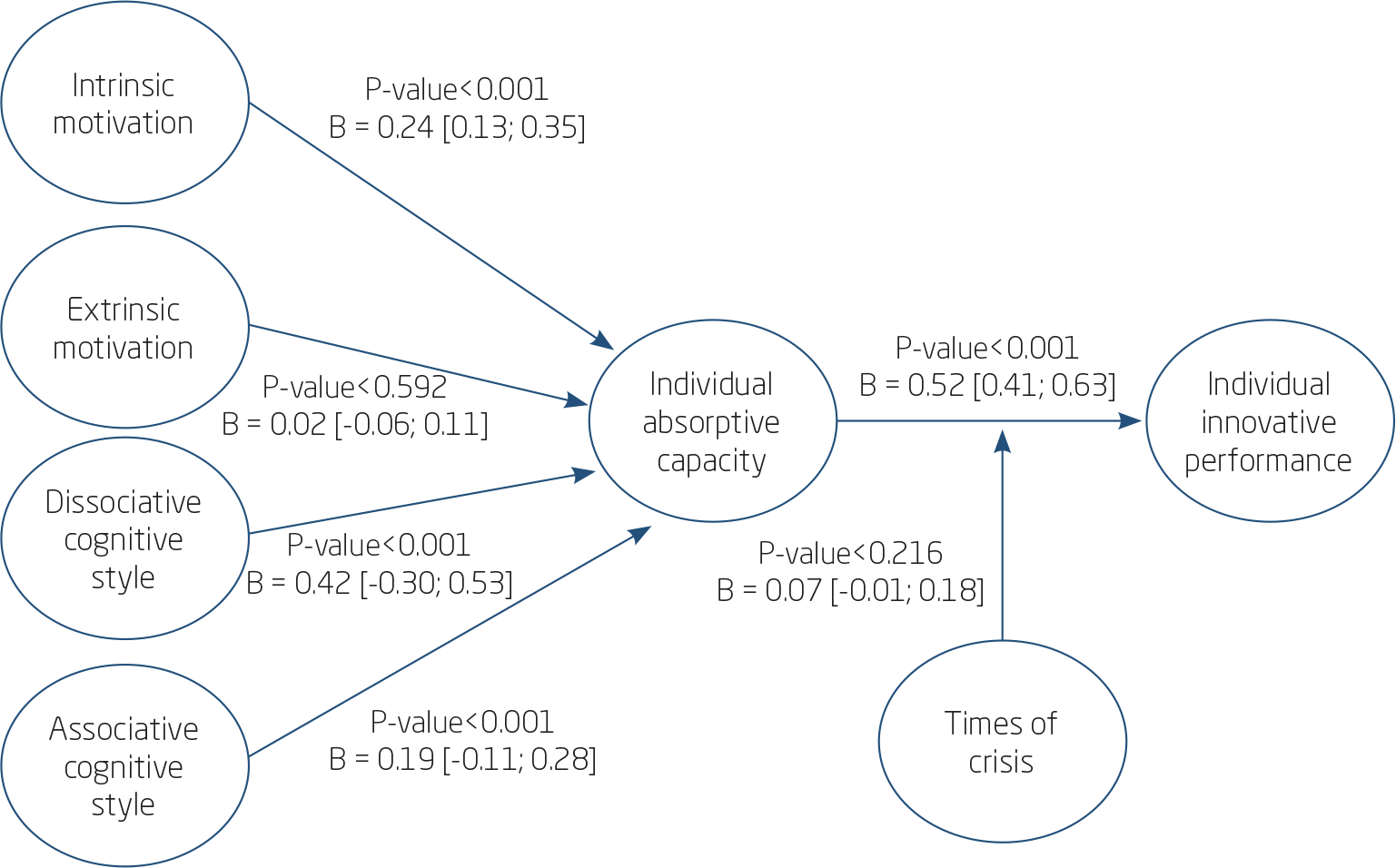
After examining the measurement model, we analyzed the structural model and tested the relationships between the model’s variables proposed in Figure 1. In this sense, the tests were carried out based on the path coefficient and analysis of the IC (Interval of Trust), applying bootstrapping analysis with 5,000 subsamples. Figure 2 presents the results obtained.
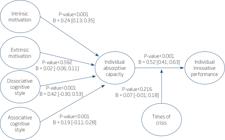
Table 4 presents the structural model with the respective analyses and hypothesis tests. It highlights the occurrence of a significant (p < 0.001) and positive (β = 0.24 [0.13; 0.35]) influence of intrinsic motivation on individual AC, so the more significant the intrinsic motivation, the greater it tends to be the individual CA in times of crisis. Therefore, H1a was accepted. The relationship was insignificant for extrinsic motivation on individual AC (p < 0.592). Therefore, H1b was not supported. The level of extrinsic motivation had no effect when analyzed concerning the level of individual AC in times of crisis.
Still, on the tests presented in Table 4, there was a significant (p < 0.001) and positive (β = 0.42 [0.30; 0.53]) influence of the dissociative cognitive style on individual AC; therefore, the greater the dissociative cognitive style, the greater the individual AC tends to be. Therefore, H2a was accepted. Regarding the associative cognitive style on individual absorptive capacity, a significant (p < 0.001) and positive (β = 0.19 [0.11; 0.28]) influence is also noted, meaning that the greater the style associative cognitive, the greater the individual AC tends to be. Therefore, H2b was accepted.
The analysis of the relationship between individual AC and individual innovative performance reveals a significant (p < 0.001) and positive (β = 0.52 [0.41; 0.63]) influence of one on the other and, thus, how much the more significant individual AC, the greater the individual innovative performance tends to be. Therefore, H3 was accepted. Next, the moderating effect of times of crisis on the relationship between individual AC and individual innovative performance was tested. However, this relationship was neither significant (p < 0.216) nor valid since it includes the zero value in the CI (β = 0.07 [-0.01; 0.18]). Therefore, H4 was not accepted.
DISCUSSION
The findings demonstrated a positive quality of anticipation of intrinsic motivation, dissociative cognitive style, and associative cognitive style concerning individual AC in times of crisis. Specifically, the dissociative cognitive style was the most significant predictor of individual AC in times of crisis. It was also found that the level of extrinsic motivation had no valid effect when analyzed about the level of individual AC in times of crisis. This situation can be explained by the Self-Determination Theory (Ryan & Deci, 2000) as extrinsically motivated people have a strong expectation for immediate rewards and/or concrete results, while intrinsic motivation associates the fulfillment of tasks with the individual’s well-being.
Tian and Soo (2018) noted that professionals’ commitment drives individual AC. In this sense, we can infer that intrinsic motivation generates greater commitment in crises, positively influencing individual AC. Therefore, intrinsic motivation is a better impetus for individual action when tasks require creativity and involve a large amount of risk and uncertainty, as described in the context of the COVID-19 pandemic, described in the first pages of this text. Furthermore, absorbing new knowledge requires creativity and cognitive flexibility (Agostineto et al., 2022), often associated with intrinsic rather than extrinsic motivation (Ryan & Deci, 2000). From this perspective, our findings align with the central principles of the Self-Determination Theory described by Chiu et al. (2023). However, they demonstrate a different relationship when extrinsic motivational factors are analyzed, especially in times of crisis.
The reason for considering the dissociative cognitive style as the most significant predictor of individual AC in times of crisis in the present study can be attributed to the assumptions of AC itself, according to which new knowledge must combine with existing knowledge to generate new ideas and solutions (Zahra & George, 2002; Enkel & Heil, 2014; West & Bogers, 2017). This creative process is enhanced by a dissociative cognitive style in times of crisis (Todorova & Durisin, 2007; Zahra & George, 2002). This situation has already been indirectly pointed out by Martins and Freire (2023) when the authors point out the AC of startups as a survival factor during the COVID-19 pandemic. Furthermore, it is known that individuals with dissociative cognition seek differences and unknown solutions in situa-tions of uncertainty (Gagné & Deci, 2005) and, consequently, the dissociative cognitive style is enhanced in periods such as the COVID-19 pandemic, as new working methods need to be incorporated quickly, which requires openness to changes and unlearning (Reinholt et al., 2011).
Finally, the findings showed a positive relationship between the consequences of individual AC and individual innovative performance. However, it was seen that the crisis context did not exert a moderating effect on this relationship. The impact of crises on individuals’ behavior can be explained by feelings of fear, anxiety, sadness, and uncertainty, together with symptoms of post-traumatic stress and depression (Cincera et al., 2012). These symptoms are cumulative behavioral consequences that can alter innovative performance in the medium and long term (Roper & Turner, 2020; Scudellari, 2020). Therefore, this moderation, shown here as invalid, needs to be more appropriately studied due to complex individual behavior in times of crisis.
It is worth noting that such findings expand the literature on AC micro foundations (Volberda et al., 2010; Jiménez-Castillo & Sánchez Pérez, 2013; Dahlander et al., 2016; Ter Wal et al., 2017), which often does not consider the different forms of motivation, as well as the different cognitive styles and their possible effects on individual action and behavior (Wang et al., 2015). Therefore, understanding the distinction between intrinsic and extrinsic motivation and dissociative and associative cognitive styles is rele-vant to identifying the right incentives to stimulate development at the individual level and the gains in competence at the collective and organizational levels, especially in times of crisis, the focus of this study.
CONCLUSIONS
This article contributes to the emerging debates on the micro-foundations of dynamic capabilities related to individual AC, especially characteri-zing advances regarding the role of motivational and cognitive factors as an antecedent of individual AC in times of crisis. Furthermore, the article also contributes to understanding individual AC as a factor that influences individual innovative performance in times of crisis, covering situations of high uncertainty and ambiguity.
Another important result was the finding that, in critical periods, ins-titutional and structural support related to extrinsic factors is insufficient to guarantee innovation capacity. Therefore, policymakers, managers, and entrepreneurs must invest in training and qualification programs addressing the development of behavioral, innovative, and knowledge absorption practices and skills, especially valuing job satisfaction behaviors and intrinsic motivations.
Regarding the limitations of this research, the data collection was restricted to Brazil, and the use of cross-sectional data to analyze a complex crisis context stands out-an environment that would be better suited to longitudinal studies. The lack of measurement of the effect of the individual’s organizational position on individual AC and innovative performance also represented a limitation. Indeed, this limitation represents a relevant opportunity for future research.
Still, in relation to future work, it is understood that longitudinal and process studies can expand and deepen the concept of individual AC and its antecedents and results. In the same sense, expanding data collection to other cultures would enable more comprehensive results. Finally, the exploration of complex interrelationships between individual and organizational level factors would also be opportunities for future studies, such as, for example, an investigation into the impacts of people management practices and incentive policies as a stimulus for company growth from individual AC and individual innovative performance from company employees.
-
RAM does not have permission from the authors or evaluators to publish this article’s review.
-
RAM does not have information about open data regarding this manuscript.
REFERENCES
-
Abbas, M., & Raja, U. (2015). Impact of psychological capital on innovative performance and job stress. Canadian Journal of Administrative Sciences/Revue Canadienne des Sciences de l’Administration, 32(2), 128-138. https://doi.org/10.1002/cjas.1314
» https://doi.org/10.1002/cjas.1314 -
Agostineto, R. C., Soares, T. C., Mazon, G., & Soares, S. V. (2022). Influence of intellectual capital and individual absorptive capacity on innovation performance. Revista de Administração da UFSM, 15, 270-289. https://doi.org/10.5902/1983465968613
» https://doi.org/10.5902/1983465968613 -
Bani-Melhem, S., Zeffane, R., & Albaity, M. (2018). Determinants of employees’ innovative behavior, (3), 1601-1620. https://doi.org/10.1108/IJCHM-02-2017-0079
» https://doi.org/10.1108/IJCHM-02-2017-0079 -
Bartik, A. W., Cullen, Z. B., Glaeser, E. L., Luca, M., & Stanton, C. T. (2020). What jobs are being done at home during the COVID-19 crisis? Evidence from firm-level surveys. National Bureau of Economic Research, w27422. https://doi.org/10.3386/w27422
» https://doi.org/10.3386/w27422 -
Bavel, J. J. V., Baicker, K., Boggio, P. S., Capraro, V., Cichocka, A., Cikara, M., ... & Willer, R. (2020). Using social and behavioural science to support COVID-19 pandemic response. Nature Human Behaviour, 4(5), 460-471. https://doi.org/10.1038/s41562-020-0884-z
» https://doi.org/10.1038/s41562-020-0884-z -
Billings, R. S., Milburn, T. W., & Schaalman, M. L. (1980). A model of crisis perception: A theoretical and empirical analysis. Administrative Science Quarterly, 25(2), 300-316. https://doi.org/10.2307/2392456
» https://doi.org/10.2307/2392456 -
Bogers, M., Zobel, A. K., Afuah, A., Almirall, E., Brunswicker, S., Dahlander, L., Frederiksen, L., Gawer, A., Gruber, M., Haefliger, S., Hagedoorn, J., Hilgers, D., Laursen, K., Magnusson, M. G., Majchrzak, A., McCarthy, I. P., Moeslein, K. M., Nambisan, S., Piller, F. T., Radziwon, A., Rossi-Lamastra, C., Sims, J., Ter Wal, A. L. J. (2017). The open innovation research landscape: Established perspectives and emerging themes across different levels of analysis. Industry and Innovation, 24(1), 8-40. https://doi.org/10.1080/13662716.2016.1240068
» https://doi.org/10.1080/13662716.2016.1240068 - Chin, W. W. (1998). The partial least squares approach to structural equation modeling. Modern Methods for Business Research, 295(2), 295-336.
-
Chiu, M. L., Cheng, T. S., & Lin, C. N. (2023). Driving open innovation capability through new knowledge diffusion of integrating intrinsic and extrinsic motivations in organizations: Moderator of individual absorptive capacity. Journal of the Knowledge Economy, 15, 3685-3717. https://doi.org/10.1007/s13132-023-01315-8
» https://doi.org/10.1007/s13132-023-01315-8 -
Cincera, M., Cozza, C., Tübke, A., & Voigt, P. (2012). Doing R&D or not (in a crisis), that is the question. European Planning Studies, 20(9), 1525-1547. https://doi.org/10.1080/09654313.2012.709064
» https://doi.org/10.1080/09654313.2012.709064 -
Cohen, W. M., & Levinthal, D. A. (1990). Absorptive capacity: A new perspective on learning and innovation. Administrative Science Quarterly, 35(1), 128-152. https://doi.org/10.2307/2393553
» https://doi.org/10.2307/2393553 -
CONASS. (2022). Painel nacional: COVID-19. Conselho Nacional de Secretários da Saúde https://www.conass.org.br/painelconasscovid19/
» https://www.conass.org.br/painelconasscovid19/ -
Dahlander, L., O’Mahony, S., & Gann, D. M. (2016). One foot in, one foot out: How does individuals’ external search breadth affect innovation outcomes? Strategic Management Journal, 37(2), 280-302. https://doi.org/10.1002/smj.2342
» https://doi.org/10.1002/smj.2342 - Deci, E. L., Ryan, R. M. (1985). Intrinsic motivation and self-determination in human behavior Plenum Press.
-
Enkel, E., & Heil, S. (2014). Preparing for distant collaboration: Ante-cedents to potential absorptive capacity in cross-industry innovation. Technovation, 34(4), 242-260. https://doi.org/10.1016/j.technovation.2014.01.010
» https://doi.org/10.1016/j.technovation.2014.01.010 -
Enkel, E., Heil, S., Hengstler, M., & Wirth, H. (2017). Exploratory and exploitative innovation: To what extent do the dimensions of individual-level absorptive capacity contribute? Technovation, 60, 29-38. https://doi.org/10.1016/j.technovation.2016.08.002
» https://doi.org/10.1016/j.technovation.2016.08.002 -
Faul, F., Erdfelder, E., Lang, A. G., & Buchner, A. (2007). G* Power 3: A flexi-ble statistical power analysis program for the social, behavioral, and biomedical sciences. Behavior research methods, 39(2), 175-191. https://doi.org/10.3758/BF03193146
» https://doi.org/10.3758/BF03193146 - Fiske, S. T., & Taylor, S. E. (2013). Social cognition: From brains to culture Sage.
-
Fornell, C., & Larcker, D. F. (1981). Evaluating structural equation models with unobservable variables and measurement error. Journal of Marketing Research, 18(1), 39-50. https://doi.org/10.1177/002224378101800104
» https://doi.org/10.1177/002224378101800104 -
Gagné, M., & Deci, E. L. (2005). Self-determination theory and work motivation. Journal of Organizational Behavior, 26(4), 331-362. https://doi.org/10.1002/job.322
» https://doi.org/10.1002/job.322 -
Gagné, M., Forest, J., Gilbert, M. H., Aubé, C., Morin, E., & Malorni, A. (2010). The motivation at work scale: Validation evidence in two languages. Educational and Psychological Measurement, 70(4), 628-646. https://doi.org/10.1177/0013164409355698
» https://doi.org/10.1177/0013164409355698 -
Golparvar, M., Kamkar, M., & Javadian, Z. (2012). Moderating effects of job stress in emotional exhaustion and feeling of energy relationships with positive and negative behaviors: Job stress multiple functions approach. International Journal of Psychological Studies, 4(4). http://dx.doi.org/10.5539/ijps.v4n4p99
» http://dx.doi.org/10.5539/ijps.v4n4p99 -
Gong, S. X., Ye, H. Q., & Zeng, Y. Y. (2013). Impacts of the recent financial crisis on ship financing in Hong Kong: a research note. Maritime Policy & Management, 40(1), 1-9. https://doi.org/10.1080/03088839.2012.745202
» https://doi.org/10.1080/03088839.2012.745202 - Hair, J. F., Jr., Black, W. C., Babin, B. J., Anderson, R. E., & Tatham, R. L. (2009). Análise multivariada de dados Bookman.
- Hair, J. F., Jr., Hult, G. T. M., Ringle, C., & Sarstedt, M. (2016). A primer on partial least squares structural equation modeling (PLS-SEM) (2nd ed.). Sage.
- Henseler, J., Ringle, C. M., & Sinkovics, R. R. (2009). The use of partial least squares path modeling in international marketing: New challenges to international marketing Emerald Group.
- Hoyle, R. H., & Duvall, J. L. (2004). Determining the number of factors in exploratory and confirmatory factor analysis. Handbook of Quantitative Methodology for the Social Sciences, 301-315.
-
Jabri, M. M. (1991). The development of conceptually independent subscales in the measurement of modes of problem solving. Educational and Psychological Measurement, 51(4), 975-983. https://doi.org/10.1177/001316449105100417
» https://doi.org/10.1177/001316449105100417 -
Jansen, J. J., Van Den Bosch, F. A., & Volberda, H. W. (2005). Managing potential and realized absorptive capacity: How do organizational ante-cedents matter? Academy of Management Journal, 48(6), 999-1015. https://doi.org/10.5465/amj.2005.19573106
» https://doi.org/10.5465/amj.2005.19573106 -
Jiménez-Castillo, D., & Sánchez-Pérez, M. (2013). Nurturing employee market knowledge absorptive capacity through unified internal communication and integrated information technology. Information & Management, 50(2/3), 76-86. https://doi.org/10.1016/j.im.2013.01.001
» https://doi.org/10.1016/j.im.2013.01.001 - Koestler, A. (1964). The act of creation Hutchinson & Co.
-
Lane, P. J., & Lubatkin, M. (1998). Relative absorptive capacity and interorganizational learning. Strategic Management Journal, 19(5), 461-477. https://doi.org/10.1002/(SICI)1097-0266(199805)19:5%3C461::AID-SMJ953%3E3.0.CO;2-L
» https://doi.org/10.1002/(SICI)1097-0266(199805)19:5%3C461::AID-SMJ953%3E3.0.CO;2-L -
Lane, P. J., Koka, B. R., & Pathak, S. (2006). The reification of absorptive capacity: A critical review and rejuvenation of the construct. Academy of Management Review, 31(4), 833-863. https://doi.org/10.5465/amr.2006.22527456
» https://doi.org/10.5465/amr.2006.22527456 -
Lichtenthaler, U. (2011). Open innovation: Past research, current debates, and future directions. Academy of Management Perspectives, 25(1), 75-93. https://doi.org/10.5465/amp.25.1.75
» https://doi.org/10.5465/amp.25.1.75 -
Lichtenthaler, U., & Lichtenthaler, E. (2009). A capability-based framework for open innovation: Complementing absorptive capacity. Journal of Mana-gement Studies, 46(8), 1315-1338. https://doi.org/10.1111/j.1467-6486.2009.00854.x
» https://doi.org/10.1111/j.1467-6486.2009.00854.x -
Lowik, S., Kraaijenbrink, J., & Groen, A. (2016). The team absorptive capacity triad: A configurational study of individual, enabling, and motivating factors. Journal of Knowledge Management, 20(5). https://doi.org/10.1108/JKM-11-2015-0433
» https://doi.org/10.1108/JKM-11-2015-0433 -
Lowik, S., Kraaijenbrink, J., & Groen, A. J. (2017). Antecedents and effects of individual absorptive capacity: A micro-foundational perspective on open innovation. Journal of Knowledge Management, 21(6), 1319-1341. https://doi.org/10.1108/JKM-09-2016-0410
» https://doi.org/10.1108/JKM-09-2016-0410 - Malhotra, N. K. (2007). Marketing research: An applied orientation (5th ed.). Prentice-Hall of India.
-
Malvestiti, R., Esteves, D. B. L., & Dandolini, G. A. (2021). A capacidade absortiva como feedback na sustentabilidade das organizações. Revista de Administração Mackenzie, 22(1), 1-29. https://doi.org/10.1590/1678-6971/eRAMR210073
» https://doi.org/10.1590/1678-6971/eRAMR210073 -
Martinkenaite, I., & Breunig, K. J. (2016). The emergence of absorptive capacity through micro-macro level interactions. Journal of Business Research, 69(2), 700-708. https://doi.org/10.1016/j.jbusres.2015.08.020
» https://doi.org/10.1016/j.jbusres.2015.08.020 -
Martins, G. J. T., & Freire, P. S. (2023). Capacidade absortiva em startups: Alavancando as vantagens competitivas das Edtechs durante a pandemia da Covid-19. Revista de Administração Mackenzie, 24(4), 1-26. https://doi.org/10.1590/1678-6971/eRAMR230257.pt
» https://doi.org/10.1590/1678-6971/eRAMR230257.pt -
Nemanich, L. A., Keller, R. T., Vera, D., & Chin, W. W. (2010). Absorptive capacity in R&D project teams: A conceptualization and empirical test. IEEE Transactions on Engineering Management, 57(4), 674-688. https://doi.org/10.1109/TEM.2009.2037736
» https://doi.org/10.1109/TEM.2009.2037736 -
Newey, L., & Verreynne, M. L. (2011). Multilevel absorptive capacity and interorganizational new product development: A process study. Journal of Management & Organization, 17(1), 39-55. https://doi.org/10.5172/jmo.2011.17.1.39
» https://doi.org/10.5172/jmo.2011.17.1.39 -
Ng, T. W., & Feldman, D. C. (2010). The relationships of age with job attitudes: A meta-analysis. Personnel Psychology, 63(3), 677-718. https://doi.org/10.1111/j.1744-6570.2010.01184.x
» https://doi.org/10.1111/j.1744-6570.2010.01184.x -
Nurhas, I., Aditya, B. R., Jacob, D. W., & Pawlowski, J. M. (2022). Understanding the challenges of rapid digital transformation: The case of COVID-19 pandemic in higher education. Behaviour & Information Tech-nology, 41(13), 2924-2940. https://doi.org/10.1080/0144929X.2021.1962977
» https://doi.org/10.1080/0144929X.2021.1962977 -
Park, J. H., Suh, H. J., & Yang, H. D. (2007). Perceived absorptive capacity of individual users in performance of Enterprise Resource Planning (ERP) usage: The case for Korean firms. Information & Management, 44(3), 300-312. https://doi.org/10.1016/j.im.2007.02.001
» https://doi.org/10.1016/j.im.2007.02.001 -
Payne, R. L., Lane, D., & Jabri, M. (1990). A two-dimensional person-environment fit analysis of the performance, effort and satisfaction of research scientists. British Journal of Management, 1(1), 45-57. https://doi.org/10.1111/j.1467-8551.1990.tb00155.x
» https://doi.org/10.1111/j.1467-8551.1990.tb00155.x -
Pedrosa, N., Montoni, L., Martens, C. D. P., Silva, L. F. D., & Cunha, J. C. D. (2022). Absorptive capacity in information technology projects: A multiple case study in the telecommunication industry. International Journal of Project Organisation and Management, 14(1), 36-64. https://doi.org/10.1504/IJPOM.2022.121549
» https://doi.org/10.1504/IJPOM.2022.121549 -
Raj, A., Mukherjee, A. A., de Sousa Jabbour, A. B. L., & Srivastava, S. K. (2022). Supply chain management during and post-COVID-19 pandemic: Mitigation strategies and practical lessons learned. Journal of Business Research, 142, 1125-1139. https://doi.org/10.1016/j.jbusres.2022.01.037
» https://doi.org/10.1016/j.jbusres.2022.01.037 -
Regnér, P., & Zander, U. (2014). International strategy and knowledge creation: The advantage of foreignness and liability of concentration. British Journal of Management, 25(3), 551-569. https://doi.org/10.1111/1467-8551.12054
» https://doi.org/10.1111/1467-8551.12054 -
Reinholt, M. I. A., Pedersen, T., & Foss, N. J. (2011). Why a central network position isn’t enough: The role of motivation and ability for knowledge sharing in employee networks. Academy of Management Journal, 54(6), 1277-1297. https://doi.org/10.5465/amj.2009.0007
» https://doi.org/10.5465/amj.2009.0007 - Rigolizzo, M., & Amabile, T. (2015). Entrepreneurial creativity: The role of learning processes and work environment supports. The Oxford Handbook of Creativity, Innovation and Entrepreneurship, 61-78.
-
Ringle, C. M., Da Silva, D., & de Souza Bido, D. (2014). Modelagem de equações estruturais com utilização do SmartPLS. Revista Brasileira de Marketing, 13(2), 56-73. https://doi.org/10.5585/remark.v13i2.2717
» https://doi.org/10.5585/remark.v13i2.2717 -
Roper, S., & Turner, J. (2020). R&D and innovation after COVID-19: What can we expect? A review of prior research and data trends after the great financial crisis. International Small Business Journal, 38(6), 504-514. https://doi.org/10.1177/0266242620947946
» https://doi.org/10.1177/0266242620947946 -
Ryan, R. M., & Deci, E. L. (2000). Intrinsic and extrinsic motivations: Classic definitions and new directions. Contemporary Educational Psychology, 25(1), 54-67. https://doi.org/10.1006/ceps.1999.1020
» https://doi.org/10.1006/ceps.1999.1020 -
Santos, C. C., Teston, S. F., Zawadzki, P., Lizote, S. A., & Machado, H. P. V. (2020a). Individual absorptive capacity and entrepreneurial intention in successors of rural properties. Revista de Administração Mackenzie, 21(3), 1-29. https://doi.org/10.1590/1678-6971/eRAMR200045
» https://doi.org/10.1590/1678-6971/eRAMR200045 -
Santos, L. L., Borini, F. M., Miranda Oliveira, M., Rossetto, D. E., & Bernardes, R. C. (2020b). Bricolage as capability for frugal innovation in emerging markets in times of crisis. European Journal of Innovation Management. 25(2), 413-432. https://doi.org/10.1108/EJIM-06-2020-0225
» https://doi.org/10.1108/EJIM-06-2020-0225 -
Schweisfurth, T. G., & Raasch, C. (2018). Absorptive capacity for need knowledge: Antecedents and effects for employee innovativeness. Research Policy, 47(4), 687-699. https://doi.org/10.1016/j.respol.2018.01.017
» https://doi.org/10.1016/j.respol.2018.01.017 -
Scudellari, M. (2020). The pandemic’s future. Nature, 584(7819), 22-25. https://doi.org/10.1038/d41586-020-02278-5
» https://doi.org/10.1038/d41586-020-02278-5 -
Snehvrat, S., Chaudhary, S., & Majhi, S. G. (2022). Ambidexterity and absorptive capacity in boundary-spanning managers: Role of paradox mindset and learning goal orientation. Management Decision, 60(12), 3209-3231. https://doi.org/10.1108/MD-03-2021-0328
» https://doi.org/10.1108/MD-03-2021-0328 -
Tenenhaus, M., Vinzi, V. E., Chatelin, Y. M., & Lauro, C. (2005). PLS path modeling. Computational Statistics & Data Analysis, 48(1), 159-205. https://doi.org/10.1016/j.csda.2004.03.005
» https://doi.org/10.1016/j.csda.2004.03.005 -
Teng, X., Chang, B. G., & Wu, K. S. (2021). The role of financial flexibility on enterprise sustainable development during the COVID-19 crisis-a consideration of tangible assets. Sustainability, 13(3), 1245. https://doi.org/10.3390/su13031245
» https://doi.org/10.3390/su13031245 -
Ter Wal, A. L., Criscuolo, P., & Salter, A. (2017). Making a marriage of materials: The role of gatekeepers and shepherds in the absorption of external knowledge and innovation performance. Research Policy, 46(5), 1039-1054. https://doi.org/10.1016/j.respol.2017.03.003
» https://doi.org/10.1016/j.respol.2017.03.003 -
Tian, A. W., & Soo, C. (2018). Enriching individual absorptive capacity. Personnel Review, 47(5), 1116-1132. https://doi.org/10.1108/PR-04-2017-0110
» https://doi.org/10.1108/PR-04-2017-0110 -
Todorova, G., & Durisin, B. (2007). Absorptive capacity: Valuing a reconceptualization. Academy of Management Review, 32(3), 774-786. https://doi.org/10.5465/amr.2007.25275513
» https://doi.org/10.5465/amr.2007.25275513 -
Tortoriello, M. (2015). The social underpinnings of absorptive capacity: The moderating effects of structural holes on innovation generation based on external knowledge. Strategic Management Journal, 36(4), 586-597. https://doi.org/10.1002/smj.2228
» https://doi.org/10.1002/smj.2228 -
Van Wijk, R., Jansen, J. J., & Lyles, M. A. (2008). Interand intra-organizational knowledge transfer: a meta-analytic review and assessment of its antecedents and consequences. Journal of Management Studies, 45(4), 830-853. https://doi.org/10.1111/j.1467-6486.2008.00771.x
» https://doi.org/10.1111/j.1467-6486.2008.00771.x -
Vansteenkiste, M., Simons, J., Lens, W., Sheldon, K. M., & Deci, E. L. (2004). Motivating learning, performance, and persistence: The synergistic effects of intrinsic goal contents and autonomy-supportive contexts. Journal of Personality and Social Psychology, 87(2), 246-260. https://psycnet.apa.org/doi/10.1037/0022-3514.87.2.246
» https://psycnet.apa.org/doi/10.1037/0022-3514.87.2.246 -
Vansteenkiste, M., Lens, W., & Deci, E. L. (2006). Intrinsic versus extrinsic goal contents in self-determination theory: Another look at the quality of academic motivation. Educational psychologist, 41(1), 19-31. https://doi.org/10.1207/s15326985ep4101_4
» https://doi.org/10.1207/s15326985ep4101_4 -
Volberda, H. W., Foss, N. J., & Lyles, M. A. (2010). Perspective-Absorbing the concept of absorptive capacity: How to realize its potential in the organization field. Organization Science, 21(4), 931-951. https://doi.org/10.1287/orsc.1090.0503
» https://doi.org/10.1287/orsc.1090.0503 -
Wang, H., Li, T., Gauthier, S., Yu, E., Tang, Y., Barbarino, P., & Yu, X. (2020). Coronavirus epidemic and geriatric mental healthcare in China: How a coordinated response by professional organizations helped older adults during an unprecedented crisis. International Psychogeriatrics, 32(10), 1117-1120. https://doi.org/10.1017/S1041610220000551
» https://doi.org/10.1017/S1041610220000551 -
Wang, W., Feng, Y., & Liu, L. (2015). The effect of organizational levers and the mediating role of individual absorptive capacity in information system innovation. 2015 48th Hawaii International Conference on System Sciences, 3780-3789. IEEE. https://doi.org/10.1109/HICSS.2015.454
» https://doi.org/10.1109/HICSS.2015.454 -
West, J., & Bogers, M. (2017). Open innovation: Current status and research opportunities. Innovation, 19(1), 43-50. https://doi.org/10.1080/14479338.2016.1258995
» https://doi.org/10.1080/14479338.2016.1258995 - West, M.A., & Farr, J.L. (1990). Innovation and creativity at work: Psychological and organizational strategies John Wiley.
-
Williams, G. C., & Deci, E. L. (1996). Internalization of biopsychosocial values by medical students: A test of self-determination theory. Journal of Personality and Social Psychology, 70(4), 767-779. https://psycnet.apa.org/doi/10.1037/0022-3514.70.4.767
» https://psycnet.apa.org/doi/10.1037/0022-3514.70.4.767 -
Yao, F. K., & Chang, S. (2017). Do individual employees’ learning goal orientation and civic virtue matter? A micro-foundations perspective on firm absorptive capacity. Strategic Management Journal, 38(10), 2041-2060. https://doi.org/10.1002/smj.2636
» https://doi.org/10.1002/smj.2636 -
Yildiz, A. (2018). Pre-service teachers’ views regarding the effect of learning scientists’ biographies on students’ motivation. European Journal of Education Studies, 5(2). https://doi.org/10.5281/zenodo.1421189
» https://doi.org/10.5281/zenodo.1421189 -
Yildiz, H. E., Murtic, A., Morgulis-Yakushev, S., & Klofsten, M. (2024). Individual-level absorptive capacity: Unveiling the interplay between dispositions and work context. Technovation, 131, 102965. https://doi.org/10.1016/j.technovation.2024.102965
» https://doi.org/10.1016/j.technovation.2024.102965 -
Yildiz, H. E., Murtic, A., Zander, U., & Richtnér, A. (2019). What fosters individual-level absorptive capacity in MNCs? An extended motivation-ability-opportunity framework. Management International Review, 59(1), 93-129. https://doi.org/10.1007/s11575-018-0367-x
» https://doi.org/10.1007/s11575-018-0367-x -
Zahra, S. A., & George, G. (2002). Absorptive capacity: A review, reconceptualization, and extension. The Academy of Management Review, 27(2), 185. https://doi.org/10.2307/4134351
» https://doi.org/10.2307/4134351 -
Zhang, X., & Bartol, K. M. (2010). Linking empowering leadership and employee creativity: The influence of psychological empowerment, intrinsic motivation, and creative process engagement. Academy of Management Journal, 53(1), 107-128. https://doi.org/10.5465/amj.2010.48037118
» https://doi.org/10.5465/amj.2010.48037118
Edited by
-
EDITORIAL BOARD
Editor-in-chiefAlmir Martins Vieira
-
Associated editor
Gustavo Moraes
-
Technical support
Gabriel Henrique Carille
-
EDITORIAL PRODUCTION
Publishing coordinationAndreia Cominetti
-
Editorial intern
Bruna Silva de Angelis
-
Copy editor
Irina Migliari (Bardo Editorial)
-
Layout designer
Emap
-
Graphic designer
Emap
RAM does not have information about open data regarding this manuscript.

 Note. GoF = 47.84%.